Brazil’s electric vehicle market is expanding rapidly, with significant growth projected for EV and charging infrastructure. This surge increases the demand for advanced Elektrikli araç şarj çözümleri from providers like TPSON.
| Metrik | 2024 Market Value | 2025 Market Value | 2029 Market Value |
|---|---|---|---|
| EV & Charging Infrastructure | US$1,805.9 million | US$2,327.7 million | US$5,332.8 million |
A reliable portable EV şarj cihazı is essential for EV drivers navigating the country. The right EV charger must offer dual-voltage (127V/220V) compatibility for Brazil’s grid. It requires INMETRO certification for guaranteed safety. Excellent weather resistance (IP65+) and adjustable charging current are also critical features for a reliable EV portable charger. Elektrikli araç şarj cihazı üreticileri are developing taşınabilir elektrikli araç şarj cihazları to meet these needs.
Understanding Brazil’s Unique Power Grid
An EV driver’s success in Brazil depends on understanding the country’s electrical landscape. The national power grid presents unique challenges that demand a specifically designed taşınabilir şarj cihazı. A driver must consider voltage, frequency, and phase to ensure safe and effective charging anywhere they travel.
The Dual-Voltage System
Brazil does not have a single, nationwide voltage standard. Instead, it operates a dual-voltage system that varies by region, city, and even building. This reality makes electrical compatibility a top priority for EV owners.
Navigating 127V and 220V Regions
Most Brazilian states use 127V as the primary residential voltage. An EV driver will encounter this standard frequently. However, 220V is common in some northern states and is often found in newer hotels or commercial buildings. This patchwork system means travelers can encounter either voltage on a single trip, making a versatile charging solution essential for their electric vehicles.
Why Single-Voltage Chargers Are Risky
Using a single-voltage charger in Brazil is a significant gamble. A device designed only for 127V can be permanently damaged or create a fire hazard when plugged into a 220V outlet. Conversely, a 220V-only charger will fail to operate or perform at a drastically reduced rate on a 127V circuit, leaving an EV driver stranded.
Güvenlik Uyarısı: Never assume the voltage of an unfamiliar outlet. A dual-voltage portable charger automatically adapts, removing the risk of equipment damage and ensuring a reliable charging session.
Frequency and Phase Standards
Beyond voltage, a charger must align with Brazil’s frequency and phase standards. These technical specifications are non-negotiable for the proper function of sensitive electronics like an EV charger.
The Importance of 60Hz Compatibility
The standard electrical frequency across Brazil is 60 Hertz (Hz). With very few exceptions, all power outlets deliver alternating current at this frequency. Any portable EV charger used in the country must be designed to operate at 60 Hz. Using a device rated for 50 Hz can lead to overheating, inefficient charging, and long-term damage to the unit.
Single-Phase Power in Homes
Residential power in Brazil is typically delivered via a single-phase connection. This setup provides the two standard voltages available to households:
- Single-phase 127V
- Single-phase 220V
Portable chargers are designed to use these common residential outlets, unlike a high-power public charging station. Technologically advanced providers like TPSON engineer their portable EV charging solutions to work flawlessly with the single-phase power found in homes, ensuring that drivers of electric vehicles can plug in confidently. This makes finding a charging station less of a concern for daily needs.
Core Electrical Compatibility for a Reliable Portable EV Charger

Selecting the right equipment requires a deeper look into its technical specifications. A charger’s ability to adapt to Brazil’s electrical environment is the foundation of its reliability. Key features like voltage adaptability, correct frequency operation, and proper connectors determine whether a charging session is successful and safe.
Voltage and Frequency Adaptability
A truly reliable ev portable charger must intelligently handle the variations in Brazil’s power grid. This adaptability is not a luxury; it is a fundamental requirement for any EV driver traveling across the country.
Automatic vs. Manual Voltage Switching
Portable chargers manage dual-voltage requirements in one of two ways: automatically or manually.
- Automatic Switching: A charger with this feature detects the incoming voltage (127V or 220V) and adjusts its internal settings instantly. This seamless process eliminates user error and provides the safest, most convenient charging experience. Advanced providers like TPSON engineer their products with this smart technology.
- Manual Switching: This older method requires the user to physically flip a switch on the charger to match the outlet’s voltage. Forgetting to set the switch correctly can lead to equipment damage or a complete failure to charge.
Uzman İpucu: Always choose a charger with automatic voltage switching. It removes the guesswork and protects both the charger and the EV from potential electrical damage, making it an essential feature for worry-free travel.
Verifying 60Hz Operation
Compatibility with Brazil’s 60Hz frequency is non-negotiable. An EV owner can verify this by checking the specification label on the charger’s casing or its technical data sheet. The label will clearly state the input frequency range, which must include 60Hz. Operating a device designed for 50Hz on the Brazilian grid can cause it to overheat, reduce charging efficiency, and shorten its lifespan.
Essential Plug and Connector Types
The physical connections at both ends of the cable are just as important as the electronics inside. A charger must have the correct plug for the wall outlet and the right connector for the vehicle. This ensures full compatibility and safe power delivery.
Brazil’s NBR 14136 Wall Plug
The standard wall outlet in Brazil follows the NBR 14136 specification. A compliant portable charger must be equipped with this three-pin plug to connect to residential power sources safely. The third pin provides a critical ground connection (2P+E, or two poles plus earth), which is vital for protecting against electrical faults.
| Şartname | Detail |
|---|---|
| Fiş Tipi | BRA 3 PIN |
| İletkenler | 2P+E |
| Plug Approval | NBR 14136 |
| Temperature Rating | 70°C |
| Voltage Rating | 250V |
Using adapters can introduce points of failure and may not provide a secure ground connection, compromising safety. A dedicated NBR 14136 plug is the only professional solution.
Vehicle Connectors: Type 1 vs. Type 2
The connector that plugs into the EV is determined by the vehicle’s manufacturer and model. The two primary ev charging standards for AC charging are Type 1 and Type 2.
- Type 1 (J1772): This connector is common on older EV models and some vehicles imported from North America.
- Type 2 (Mennekes): This is the modern standard for most new vehicles sold in Brazil, Europe, and Asia. It is more versatile and can support higher charging power.
Most new electric vehicles in Brazil use the Type 2 connector, which is also the standard at a public AC charging station. An EV driver must purchase a reliable portable ev charger with the connector that matches their specific car. Checking the vehicle’s charging port before buying a charger is a crucial step.
Critical Safety Mechanisms and Certifications
Electrical compatibility is only one part of the equation. A reliable portable charger must also incorporate robust safety mechanisms and hold the proper certifications. These elements provide the ultimate assurance that every charging session protects the user, the vehicle, and the electrical infrastructure.
The Importance of INMETRO Certification
In Brazil, the most important mark of safety and quality for electrical products is the INMETRO certification. This is a mandatory requirement, not an optional feature.
What INMETRO Guarantees
INMETRO (National Institute of Metrology, Quality, and Technology) is Brazil’s official body for setting technical standards and conformity assessment. An INMETRO-certified portable EV charger has undergone rigorous testing to ensure it meets local safety and performance requirements. This certification guarantees:
- Elektrik Güvenliği: The product is safe to use with Brazil’s 127V/220V grid.
- Material Quality: The plastics, cables, and internal components are durable and fire-resistant.
- Accurate Performance: The charger delivers the advertised power output reliably.
Not: Purchasing a charger without INMETRO certification exposes an EV owner to significant risks, including electrical shock, fire hazards, and damage to their vehicle. It may also void the vehicle’s warranty.
How to Verify Certification
An EV driver can easily verify a product’s compliance. Authentic INMETRO-certified products must display the official INMETRO mark directly on the product’s label or packaging. This seal is a clear indicator that the device is legally approved for sale and use in Brazil, providing essential peace of mind.
International Safety Standards
Beyond local requirements, leading manufacturers often seek international certifications. These marks demonstrate a commitment to global quality and safety benchmarks, offering an additional layer of trust.
Understanding CE, UL, and TÜV Marks
Several internationally recognized marks indicate high-quality manufacturing and adherence to stringent safety protocols.
- CE (Conformité Européenne): This mark signifies that a product meets the European Union’s health, safety, and environmental protection standards.
- UL (Underwriters Laboratories): A UL listing means the product has been tested by a globally respected third-party organization to meet specific safety and sustainability standards.
- TÜV (Technischer Überwachungsverein): This German certification is renowned worldwide for its rigorous testing of product safety, quality, and durability.
Why These Add an Extra Layer of Trust
While INMETRO is essential for Brazil, these international marks show that a product was designed for a global market. Technologically advanced providers like TPSON often secure these certifications for their products. This proves the charger meets multiple demanding ev charging standards, not just the minimum local requirement. It reflects a higher level of engineering and quality control.
Built-in Protective Safety Mechanisms
A modern portable charger is equipped with multiple active safety features. These systems constantly monitor the charging process to prevent accidents before they happen.
Aşırı Akım ve Aşırı Gerilim Koruması
The electrical grid can be unpredictable. Overcurrent and overvoltage protection shields the charger and the EV from potentially damaging power fluctuations.
- Aşırı Akım Koruması: This system prevents the charger from drawing more electrical current than the circuit can safely handle. It monitors the flow and will automatically shut off if it detects an overload, protecting the EV’s battery and the building’s wiring.
- Overvoltage Protection: This feature acts as a shield against sudden voltage spikes, often caused by grid faults or lightning. It diverts or absorbs the excess voltage before it can harm the sensitive electronics in the vehicle and charger.
This dual protection is fundamental for preserving the long-term health of an EV’s battery and onboard systems.
Ground Fault and Leakage Detection
This is one of the most critical personal safety features. Ground fault protection constantly monitors the electrical circuit for any current leakage. If a fault occurs due to a damaged cable or moisture, current can “leak” to the ground, creating a severe shock hazard. The system detects this leakage instantly and cuts power, preventing injury. This protection is vital for ensuring user safety in all conditions.
Thermal Monitoring and Overheating Prevention
Charging an EV generates heat. A well-designed portable charger manages this with an integrated thermal monitoring system.
- Continuous Sensing: Internal sensors are placed at critical points, like the wall plug and the control box.
- Temperature Monitoring: These sensors constantly measure the temperature during a charging session.
- Automatic Adjustment: If the temperature exceeds a safe threshold (e.g., 85°C), the system automatically reduces the charging current or temporarily stops the session to allow the components to cool.
This intelligent thermal management prevents damage to the plug, outlet, and cable, ensuring safe and reliable operation even during long charging cycles in Brazil’s hot climate.
Assessing Power Output and Charging Speed
An EV driver must understand the relationship between power, amperage, and time to manage their charging expectations effectively. The power output of a portable charger directly determines its charging speed, but several factors can influence the final result.
Understanding Power in Kilowatts (kW)
Power is the rate at which energy is delivered to the EV’s battery. This rate is measured in kilowatts (kW). A higher kW value translates to a faster flow of energy and, consequently, a quicker charging session.
How kW Affects Charging Time
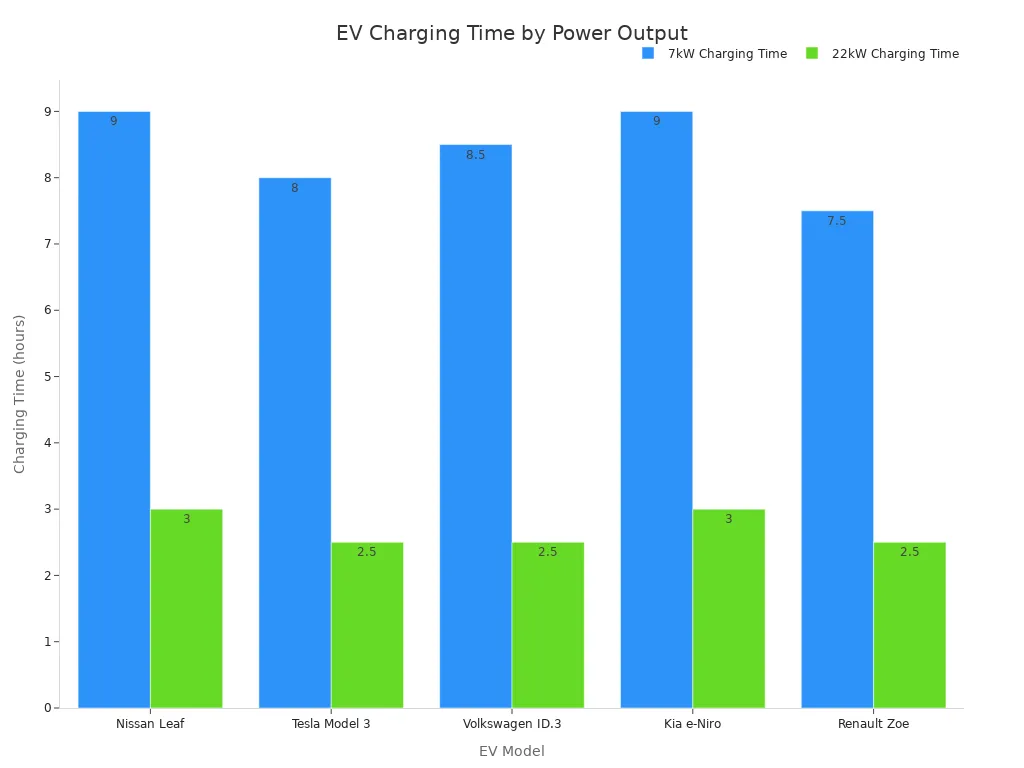
Bu power output of a charger is the single most significant factor influencing charging speed. Think of it like filling a container with water: a wider pipe (higher kW) fills the container much faster than a narrow one. A portable charger typically offers a power output between 2 kW and 7 kW, suitable for overnight charging. In contrast, a public DC fast charging station can deliver 50 kW to 350 kW for rapid top-ups. A higher power output significantly reduces the time needed to replenish the battery.
Matching Power to Your EV’s Onboard Charger
Every EV has an onboard charger that converts AC power from the wall outlet to DC power for the battery. This component has a maximum AC charging rate. For example, if a portable charger can deliver 7 kW but the EV’s onboard system is limited to 3.6 kW, the vehicle will only charge at 3.6 kW. The charging speed is always limited by the slowest component in the chain, which is often the vehicle itself.
The Benefit of Adjustable Amperage
A key feature of a high-quality portable charger is adjustable amperage. This allows the user to manually set the electrical current (measured in amps) that the charger draws from the wall socket, providing both safety and flexibility.
Safely Charging on Older Wiring
Many buildings in Brazil may have older wiring not designed for the sustained high load of EV charging. Drawing too much current can cause outlets to overheat, posing a serious fire risk.
With an adjustable amperage charger, a user can select a lower setting, such as 8A or 10A. This simple adjustment protects the building’s electrical system from overload, ensuring a safe charging session even when the wiring quality is unknown.
Maximizing Speed on Modern Circuits
When connected to a modern, properly rated circuit, an EV driver can select the charger’s maximum amperage (e.g., 16A or 32A). This maximizes the power output and delivers the fastest possible charging speed. This flexibility ensures that drivers of electric vehicles can optimize their charging for any situation, balancing safety with speed.
Calculating Real-World Charging Times
While theoretical calculations are helpful, real-world charging times depend on voltage and environmental conditions.
Estimates for 127V vs. 220V
Voltage has a direct impact on power output and charging speed. A charger operating on a 220V outlet will deliver more than double the power compared to the same charger on a 127V outlet.
- On a 127V Outlet (at 16A): Power is approximately 2.0 kW.
- On a 220V Outlet (at 16A): Power is approximately 3.5 kW.
This means an EV will charge significantly faster when a 220V source is available, making it the preferred option whenever possible.
Factors That Impact Charging Efficiency
Several external factors can affect charging efficiency. The most significant is ambient temperature. Lithium-ion batteries in electric vehicles perform best in a moderate temperature range of 20–25°C. In colder weather, the chemical reactions inside the battery slow down, increasing internal resistance. The EV’s battery management system will automatically reduce the charging speed to protect the battery, resulting in longer charging times.
Evaluating Durability in Real-World Environments

A portable EV charger’s reliability extends beyond its electrical specifications. Its physical construction must withstand the rigors of daily use and diverse environmental conditions. The durability in real-world environments is a critical factor that separates a high-quality device from one that will fail prematurely. An EV owner should carefully assess a charger’s weather resistance, material quality, and operating temperature range.
Weather Resistance and IP Ratings
Brazil’s climate includes intense sun, heavy tropical downpours, and high humidity. A portable charger needs excellent weather resistance to operate safely in these conditions. This is measured by the Ingress Protection (IP) rating.
Decoding IP65, IP66, and IP67
The IP rating consists of two numbers. The first digit indicates protection against solids like dust, and the second indicates protection against liquids like water. For an EV charger, a higher number means better protection.
| IP Derecesi | Dust Protection | Water Protection |
|---|---|---|
| IP65 | Completely protected against dust ingress. | Protected against low-pressure water jets from any direction. |
| IP66 | Completely protected against dust ingress. | Protected against powerful water jets from any direction. |
| IP67 | Completely protected against dust ingress. | Protected against temporary immersion in water (up to 1 meter for 30 minutes). |
Why High Ratings Matter in Brazil’s Climate
A high IP rating is not a luxury; it is a necessity for safety and longevity. An IP65 rating is the minimum standard an EV driver should consider, offering protection against rain and dust. For those in regions with frequent, intense storms or who might use the charger in exposed locations, an IP66 or IP67 rating provides superior defense. This ensures that moisture and debris cannot compromise the internal electronics, preventing short circuits and ensuring reliable operation for all types of electric vehicles.
Material and Build Quality
The durability of a portable EV charger also depends on the materials used in its construction. High-quality components ensure the device can handle physical stress and environmental exposure over many years.
UV-Resistant Casing for Sun Exposure
Prolonged exposure to intense sunlight can degrade and weaken standard plastics, making them brittle. Leading manufacturers use advanced materials for their casings.
For example, some high-end chargers use advanced polycarbonate compounds specifically engineered to be UV-resistant. This ensures the casing maintains its physical and visual integrity, preventing cracks and protecting the internal components from the elements.
Reinforced, Tangle-Resistant Cables
The charging cable endures constant coiling, uncoiling, and occasional impacts. A quality cable should be thick and reinforced to resist abrasion and being crushed. A tangle-resistant design also adds significant user convenience, making the daily task of charging vehicles much simpler.
Operating Temperature Range
An EV charger must function reliably across a wide spectrum of temperatures. This is especially important in a country with diverse climates like Brazil.
Performance in High Heat
Brazil’s northern and central-western regions can experience extreme heat. A charger must be able to dissipate its own operational heat while exposed to high ambient temperatures. Top-tier products are certified to operate safely in temperatures up to +50°C or even +60°C, preventing overheating and ensuring consistent performance.
Functionality in Cooler Regions
While less common, Brazil’s southern states can have cool winters. A wide operating temperature range, often down to -30°C, indicates robust engineering. This broad tolerance shows the charger is built with high-quality components that perform reliably in any condition, providing confidence to the EV owner.
Selecting a User-Friendly and Reliable EV Portable Charger
Beyond electrical safety and durability, a charger’s day-to-day usability is paramount. A reliable portable ev charger should offer an intuitive experience, practical design, and smart features that simplify the charging process. These elements transform a functional tool into an indispensable part of EV ownership.
The User Interface
The user interface provides critical information about the charging session. Clear communication from the device ensures an EV driver can monitor progress and diagnose issues at a glance. Most chargers use either an LCD screen or LED indicators.
Reading an LCD Screen
An LCD screen offers the most detailed real-time data. A high-quality portable charger with a clear screen can display key metrics like current voltage, selected amperage, power delivery in kW, and total energy consumed. This level of detail empowers users to understand exactly how their EV is charging.
Understanding LED Indicators
LED indicators offer a simpler, more immediate status update. While less detailed than an LCD, they provide essential plug-and-play functionality. Different colors or blinking patterns signify states like “Power On,” “Charging,” “Charging Complete,” or “Fault Detected.”
| Ekran Tipi | Information Provided | Common Use Case |
|---|---|---|
| LCD Screen | Detailed data: Voltage, current, power, energy delivered, temperature. | For users who want comprehensive real-time feedback. |
| LED Indicators | Basic status: Power, charging, complete, fault. | For users who prefer a quick, at-a-glance status check. |
Practical Design Features
The physical design of a charger directly impacts its convenience and ease of use. Thoughtful features make handling and storing the device much more manageable.
Optimal Cable Length (5-7 Meters)
A cable length between 5 and 7 meters offers the best balance of reach and manageability. This length is sufficient to connect to an outlet even if the EV is not parked directly beside it. Shorter cables can be restrictive, while longer ones become heavy and difficult to store.
Portability, Weight, and Storage
A reliable ev portable charger must be easy to transport. Look for a compact and lightweight design that does not sacrifice durability. Many advanced charging solutions, like those from TPSON, come with a dedicated carrying case. This protects the charger and keeps the cable neatly organized in the vehicle’s trunk.
Akıllı Özellikler ve Bağlanabilirlik
Modern chargers for electric vehicles increasingly incorporate smart technology. These features enhance control, reduce costs, and improve the overall charging experience.
Uygulama Entegrasyonu ve Uzaktan İzleme
Many advanced chargers connect to a smartphone app via Wi-Fi or Bluetooth. This connectivity allows an EV owner to monitor their charging session remotely. They can check the current status, view energy consumption metrics, and receive notifications when charging is complete.
Scheduled Charging Capabilities
Scheduled charging is a powerful smart feature with significant benefits. It allows users to program the charger to begin a session at a specific time, often during off-peak hours when electricity rates are lower. This charging capability offers several advantages:
- Maliyet Tasarrufu: Charging during off-peak hours can reduce electricity bills.
- Şebeke Kararlılığı: It helps balance energy demand by avoiding peak consumption periods.
- Convenience: The EV is automatically charged and ready to go when needed.
This intelligent management transforms the charger from a simple power cord into a smart home energy device, optimizing both cost and convenience for all types of vehicles.
Post-Purchase: Warranty and Support
An EV owner’s relationship with a charger manufacturer extends far beyond the initial purchase. Reliable after-sales support and a comprehensive warranty are crucial for long-term confidence and peace of mind. These post-purchase services ensure that any potential issues are resolved quickly and efficiently.
Evaluating Manufacturer Warranty
A strong warranty is a manufacturer’s promise of quality and durability. It provides a safety net against defects and premature failure, making it a critical factor in the selection process.
What to Look for in a Warranty Policy
A clear and comprehensive warranty policy is a sign of a reputable brand. An EV owner should look for several key details:
- Duration: A typical standard warranty for a portable EV charger might be around three years, often beginning from the date of installation.
- Coverage: The policy must specify what it covers, such as defects in materials and workmanship.
- Exclusions: An owner should also understand what is not covered, like damage from misuse or unauthorized modifications.
The Importance of Local Coverage
A warranty is only as good as its accessibility. For drivers in Brazil, local coverage is essential. Leading manufacturers provide warranty documents specifically for Latin America, written in Portuguese-Brazilian (PT-BR). This local approach simplifies the claims process, ensuring that an EV owner does not have to deal with international shipping or language barriers to get their device serviced. A local warranty demonstrates a manufacturer’s commitment to the Brazilian market.
Access to Customer and Technical Support
When questions or issues arise, prompt and effective support is invaluable. Access to knowledgeable customer and technical support teams can make the difference between a minor inconvenience and a major headache.
Availability of Brazilian Support Channels
Effective after-sales support requires local presence. An EV owner should choose a brand that offers support channels operating in Portuguese and during local business hours. This ensures clear communication when troubleshooting a problem. Technologically advanced providers like TPSON understand this need, offering dedicated support to their customers.
Profesyonel ipucu: Look for manufacturers that provide multiple contact options, such as a Brazilian phone number, a dedicated email address, or even WhatsApp support, for quick and convenient assistance.
Online Resources and Communities
Excellent customer support also includes robust self-service options. Many manufacturers host extensive online resource centers with FAQs, instructional videos, and downloadable user manuals. These resources provide immediate answers to common questions. Additionally, online forums and owner communities offer a platform for users to share experiences and solutions, creating a valuable network of peer-to-peer support.
An EV owner in Brazil needs a reliable portable ev charger. This charger must handle the country’s dual-voltage grid (127V/220V) at 60Hz. Prioritizing safety is essential. An owner should select a charger with INMETRO certification, which meets local ev charging standards. Proven durability (IP65+) and adjustable current provide maximum flexibility for charging different vehicles.
A reliable portable ev charger balances compatibility, safety, and usability. This allows confident charging for all types of electric vehicles anywhere in the country.
SSS
Is a dual-voltage (127V/220V) charger really necessary in Brazil?
Yes, it is essential. Brazil’s grid uses both 127V and 220V across different regions. A dual-voltage charger automatically adapts to the local power supply. This feature prevents equipment damage and ensures reliable charging anywhere in the country.
What is INMETRO certification and why does it matter?
INMETRO is Brazil’s official safety certification body. A certified charger has passed rigorous local tests for electrical safety and material quality. It is a mandatory requirement, not an optional feature, ensuring the product is legal and safe for use.
What is the minimum IP rating for a portable charger in Brazil?
An EV owner should look for a minimum rating of IP65. This rating ensures the charger is protected against dust and low-pressure water jets, like rain. It is a crucial feature for durability in Brazil’s diverse and often humid climate.
Why is adjustable amperage a useful feature?
Adjustable amperage provides safety and flexibility. An EV driver can lower the current for older wiring to prevent overheating. They can also maximize the current on modern circuits for faster charging speeds. This feature adapts to any electrical situation.
What wall plug should a portable charger have for Brazil?
The charger must have a three-pin NBR 14136 plug. This is the official Brazilian standard for wall outlets. The third pin provides a critical ground connection (2P+E), which is essential for protecting against electrical faults and ensuring user safety.
Will my EV charge faster on 220V than 127V?
Yes, significantly faster. A 220V outlet delivers more than double the power (kW) compared to a 127V outlet at the same amperage. This increased power output directly reduces the total time needed to charge the vehicle’s battery.
Are smart features like app control worth it?
Yes, for many users. Technologically advanced providers like TPSON offer app integration. This allows remote monitoring and scheduled charging. An owner can save money by charging during off-peak hours and enjoy greater convenience with their electric vehicles.