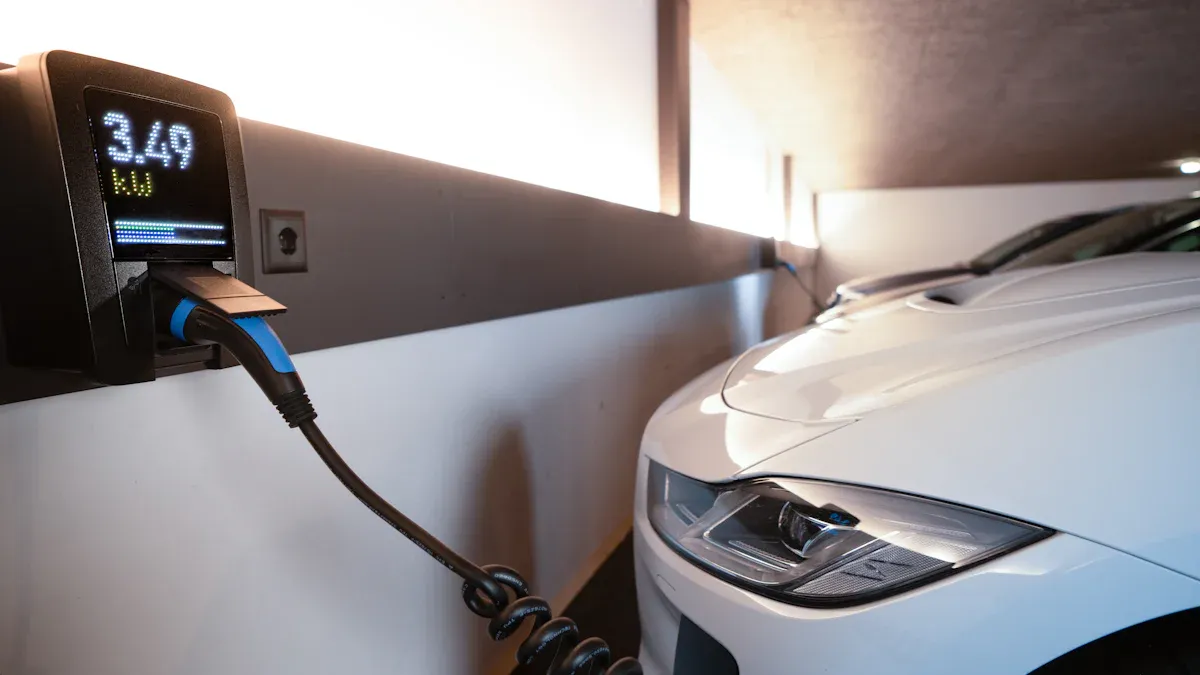
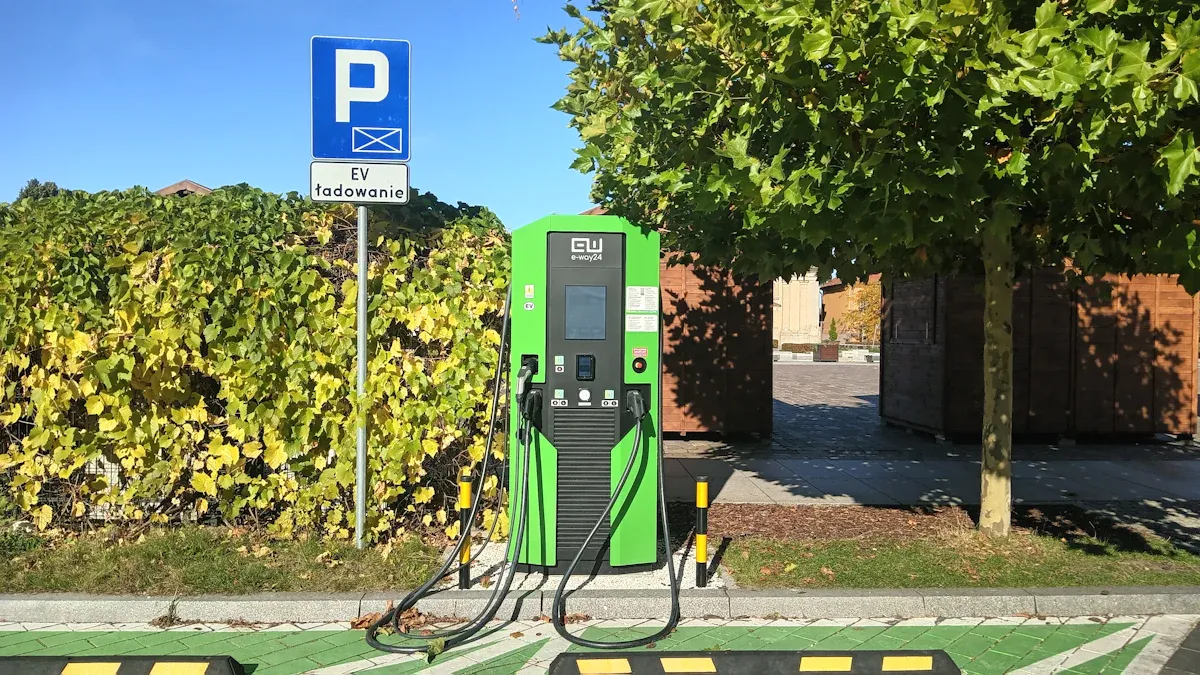
Driving your EV from the U.K. to France is an accessible electric road trip. The country supports this travel with around 110,000 public chargers, making driving in France convenient for any EV. An owner’s standard UK cables connect directly to these public chargers, so the main EV charging challenge is not on the public network.
An adaptor is only required for specific charging situations, like using a domestic socket. These EV charging adapters are heavy-duty; standard travel adaptors are unsafe for this purpose.
For travelling Europe, reliable Soluciones de recarga de vehículos eléctricos de avanzada Fabricantes de cargadores para VE ensure cargadores portátiles para vehículos eléctricos connect safely to any compatible Cargador EV with the correct adapter.
Public EV Charging in France: The Good News

EV drivers planning a trip to France will find the public charging infrastructure remarkably straightforward. The primary public chargers across the country use the same connectors as those in the UK. This compatibility eliminates the need for adapters for the vast majority of charging scenarios, making the journey much simpler.
AC Fast Charging: Your Type 2 Cable is All You Need
The Universal Type 2 Standard
The Type 2 connector is the universal standard for AC charging across Europe, including France. This is excellent news for UK drivers. Your standard Type 2 to Type 2 cable, which you use for most public charging at home, is the only cable needed for these stations. Technologically advanced EV charging solution providers like TPSON ensure their high-quality EV charging cables meet these universal standards for reliable performance.
Finding AC Chargers in France
AC charging points are widespread throughout France. Drivers can find them in various locations:
- Town centers and car parks
- Supermercados (
hypermarchés) - Hotels and tourist destinations
These AC charging points typically deliver power between 7 kW and 22 kW. This makes them ideal for “destination charging,” where the electric vehicle can replenish its battery over several hours while the driver shops, dines, or rests overnight.
DC Rapid Charging: Plug and Go with No Adapter
The Convenience of Tethered CCS Cables
For fast charging on the move, DC rapid chargers are the best option. A major convenience of these stations is that they have their own cables attached, or “tethered.” An EV driver simply pulls up, selects the correct connector for their electric vehicle, and plugs directly into their car. This plug-and-go process removes any need to use your own cables for rapid charging.
CCS as the European Standard
The Combined Charging System (CCS) is the established standard for DC rapid charging in Europe. Nearly all modern electric cars from European and American brands sold in the UK use the CCS standard. This means your EV is ready for the vast majority of rapid public chargers in France without any adapter. The extensive network of CCS charging stations supports a seamless long-distance road trip.
Consejo: Always check your EV’s specifications to confirm it uses a CCS port. While it is the standard, a few models use other connectors like CHAdeMO.
Identifying CCS Chargers on Your Route
Planning is key to a smooth driving experience. Before driving, drivers should use EV routing apps to identify CCS charging points along their intended path. These high-speed stations are strategically located along major motorways (péages), making it easy to incorporate a quick charging stop into your journey. Locating these public charging stations in advance ensures a stress-free electric driving adventure.
Your Guide to EV Charging Adapters for France
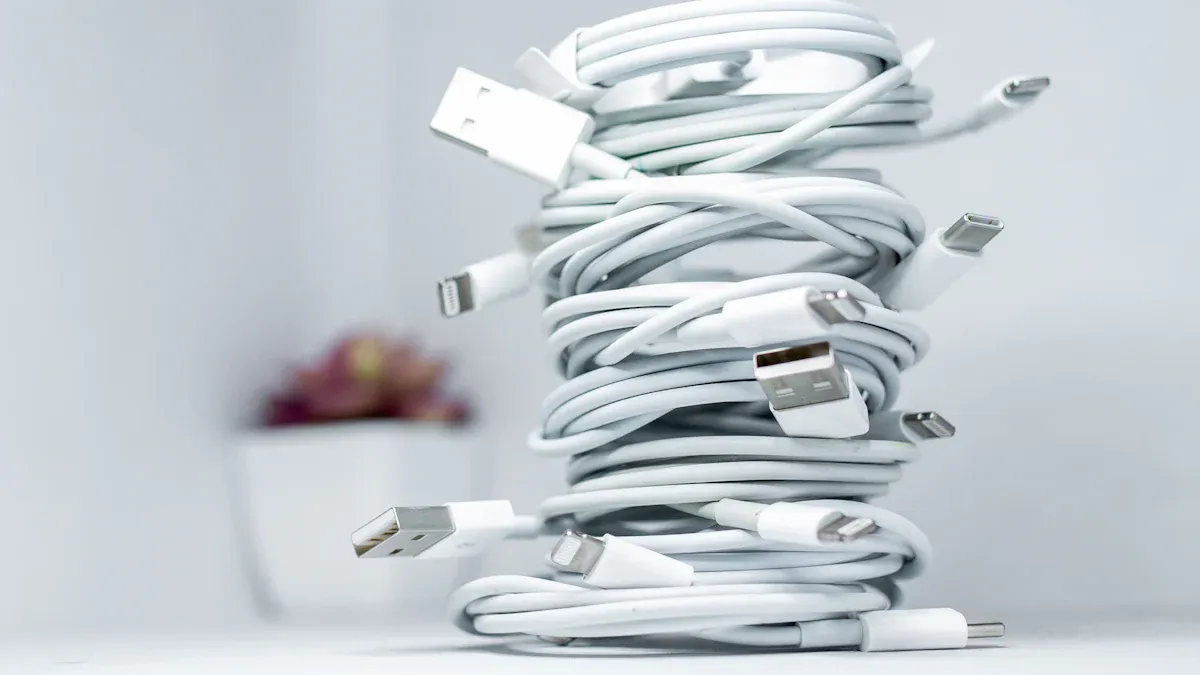
While public charging points in France are highly compatible with UK electric vehicles, certain situations demand a specific adaptor. This is particularly true when an EV driver needs to charge from a domestic wall socket at a holiday home, gîte, or a friend’s house. Understanding which adaptor to pack is crucial for a successful trip.
The “Granny Charger” Adapter: The One You Might Need
What is a “Granny Charger”?
The term “granny charger” refers to the standard portable EV charger that comes with most electric vehicles. It is officially known as a Mode 2 charging cable. This portable charger allows an EV to plug into a regular domestic wall socket for slow, overnight charging. A granny charger typically adds around six to eight miles of range per hour of charging, making it a convenient backup or overnight solution.
The French Domestic Socket (Type E)
France uses a “Type E” domestic socket. It features two round pins and a prominent male earth pin that protrudes from the socket itself. This design is different from the UK’s three-pronged Type G plug. A standard French Type E domestic socket is rated for 230-250V and a maximum current of 16A, providing a reliable power source for slow EV charging when the correct adaptor is used.
Why Your UK Plug Won’t Fit
The physical difference between a U.K. Type G plug and a French Type E socket makes them incompatible. The UK plug’s rectangular pins and different earth pin configuration will not fit into the French socket’s round pinholes and central earth pin receptacle. Therefore, an EV driver must use a specific adaptor to connect their UK-plugged granny charger to the French mains.
Choosing the Right Domestic Socket Adapter
Selecting the correct adaptor is a matter of safety, not just convenience. The high, continuous electrical load of EV charging requires a robust solution.
Safety Warning: Avoid Standard Travel Adapters
Critical Safety Alert: Standard travel adaptors are not safe for EV charging. These small, lightweight adaptors are designed for low-power devices like phone chargers or laptops. An EV requires a sustained high current for many hours, which can cause standard travel adaptors to overheat, melt, and create a significant fire risk. The continuous load is far greater than what these small devices are built to handle.
What to Look for in a Heavy-Duty Adapter
For safe EV charging, a driver must use a heavy-duty, high-quality adaptor specifically designed for high-current applications. These EV charging adapters are built with thicker wiring and more robust components to manage the heat generated during prolonged charging sessions. A quality adaptor ensures both safety and reliability for your electric vehicle.
One excellent option is a Schuko/French universal adaptor. This type of adaptor is designed to work safely with both German “Schuko” (Type F) and French (Type E) sockets. A Schuko/French universal adapter provides a versatile and secure connection for your portable EV charger across much of mainland Europe.
Recommended Adapter Features
When purchasing an adapter for your driving trip, look for these key features:
- Heavy-Duty Construction: The adaptor should be clearly marketed for high-current use, not as a simple travel item.
- Correct Amperage Rating: Ensure the adaptor is rated for at least 16A to match the capacity of the French socket.
- IP Rating for Outdoor Use: If there is any chance of charging outdoors, choose an adaptor with a high Ingress Protection (IP) rating. A rating of IP65 or higher is recommended for weatherproof travel adaptors, ensuring protection against dust and water jets.
- Reputable Manufacturer: Purchase from a trusted supplier specializing in electrical safety or EV equipment, such as the advanced solutions offered by TPSON.
By investing in the right heavy-duty Schuko/French universal adapter, an EV driver ensures their charging setup is safe and effective for the entire duration of their stay in France.
Campsite and Gîte Charging: The Other Key Adapter
Beyond public charging points, many travelers stay at campsites or self-catering gîtes. These locations often provide a different type of power connection that requires another essential adaptor for EV charging. This setup is perfect for overnight charging while the driver and their family rest.
Understanding the Blue CEE “Commando” Socket
What is a CEE Socket?
A CEE socket, often called a “Commando” plug, is a robust, industrial-style electrical connector. It is designed for higher power and outdoor use, making it the standard for electric hook-ups at campsites across Europe, including France. Its durable, weatherproof design ensures a safe and secure connection for sustained power draws, which is ideal for charging an electric vehicle.
The 16A vs. 32A Blue Sockets
Campsites typically offer blue, single-phase CEE sockets. Drivers will most commonly encounter the 16-amp (16A) version, identifiable by its smaller physical size. A less common but more powerful 32-amp (32A) version also exists. The power delivery differs significantly between them.
- A 16A CEE socket generally provides up to 3,7 kW of power.
- A 32A CEE socket can deliver up to 7,4 kW of power.
While both are effective for overnight charging, the 32A socket can replenish an EV’s battery about twice as fast. Some three-phase CEE sockets can deliver even higher power, up to 11 kW for a 16A version and 22 kW for a 32A version, though these are less common at campsites.
The Essential Campsite EV Charging Adapter
To use these CEE charging points, a driver needs the correct adapter to connect their charging equipment. There are two primary options for this task.
CEE 16A to UK 3-Pin Adapter
The most versatile solution is an adapter that connects the blue 16A CEE socket to a U.K. 3-pin socket. This allows the driver to plug their standard “granny charger” (Mode 2 portable charger) into the campsite’s power post.
La seguridad ante todo: When using this type of adapter, the driver must manually reduce the current setting on their portable charger. A U.K. 3-pin plug is rated for a maximum of 13A, but for continuous EV charging, it is safest to set the charger to 10A. This prevents overloading the adaptor and plug, ensuring a safe charging session. Certified EV charging adapters are available from specialist retailers.
CEE 16A to Type 2 Adapter Option
A more direct and efficient method is using a dedicated CEE 16A to Type 2 cable. This cable has a blue CEE plug on one end and a Type 2 connector on the other, plugging directly into the EV. This approach eliminates the need for the granny charger and the UK plug bottleneck, allowing the EV to draw the full 16A (3.7 kW) from the socket safely. This is an excellent piece of equipment for frequent campsite travel.
Important Tips for Campsite Charging
Charging an electric vehicle at a campsite requires more than just the right adaptor. A driver must also consider the site’s specific rules and electrical limitations for a smooth driving experience.
Checking for Low Amperage Limits
Campsite electric hook-ups in France do not all offer the same amount of power. The available current can vary widely.
- Many sites offer different amperage levels, such as 2A, 4A, 6A, or 10A.
- The overall mains supply on European campsites typically ranges from 3A to 20A.
Before plugging in, a driver must confirm the amperage limit of their specific pitch. Most portable EV chargers allow the user to adjust the charging current. Setting the charger to a level at or below the campsite’s limit is crucial to avoid tripping the circuit breaker, which could cut power to the driver and their neighbors.
Understanding Reverse Polarity Risks
Some older European electrical installations may have “reverse polarity,” where the live and neutral wires are switched. While this does not affect simple appliances, it can pose a risk to complex electronics like an EV charger. High-quality, modern portable chargers, such as those from advanced Proveedores de soluciones de recarga de VE like TPSON, often have built-in protection that detects this fault and will not begin a charging session until it is rectified. Using a quality charger provides an essential layer of safety for your electric car.
Always Ask for Permission First
Finally, a driver should always ask the campsite or gîte owner for permission before charging their EV. An electric vehicle consumes a significant amount of electricity compared to other camping equipment. Most site owners are accommodating but need to be informed. They can confirm if the electrical system can handle the load and will advise on any additional fees for the electricity used during the charging process. This simple courtesy ensures a positive experience for everyone.
Legacy and Niche Adapters: Are They Necessary?
While the vast majority of EV drivers will only need the adapters discussed previously, some legacy connectors still exist. Understanding these niche options helps drivers determine what is truly essential for their trip and what can be left behind. For most modern electric vehicles, these adapters are not a necessary purchase.
The Type 3c to Type 2 Adapter
What is a Type 3c Connector?
The Type 3c connector, also known as a “Scame” plug, was an early standard for EV charging, particularly in France. Its defining feature is a protective shutter over the pins, designed as an extra safety measure. It was a predecessor to the now-dominant Type 2 standard.
Are Type 3c Sockets Still Common?
No, Type 3c sockets are now extremely rare on the public charging network. The European Union mandated the Type 2 connector as the universal standard, so new installations do not use Type 3c. A driver might occasionally find one on an older, private charger at a hotel or office, but they are not a reliable source of power for a road trip.
Is This Adapter Worth Buying Today?
For nearly all drivers, purchasing a Type 3c to Type 2 adaptor is not a worthwhile investment. The high cost of this specialized adaptor far outweighs the minimal chance of ever needing it. The funds are better allocated toward a quality granny charger adaptor or a roaming payment pass.
The CHAdeMO Connector in France
For Nissan Leaf and Other CHAdeMO EVs
CHAdeMO is a DC rapid charging standard developed in Japan. It is primarily used by Nissan and a few other Asian manufacturers. It is not an adapter issue but a different type of connector altogether. An ev using this standard cannot use a CCS charger.
Popular models in the U.K. that use the CHAdeMO standard include:
- Nissan Leaf
- Lexus UX 300e
- Mitsubishi Outlander PHEV
- Kia Soul EV (primera generación)
- Citroen C-Zero and Peugeot iOn
Finding CHAdeMO Chargers
The CHAdeMO network in France is still functional, though it is not expanding as rapidly as the CCS network. Major operators like Ionity and TotalEnergies often include a CHAdeMO connector alongside their CCS chargers on motorway service stations. Drivers of these vehicles must use routing apps like Chargemap to filter specifically for CHAdeMO locations to plan their journey effectively.
No Adapter Needed, Just the Right Charger
It is critical to understand that a CHAdeMO connection does not require an adapter. Like CCS, the charger unit has a tethered cable that plugs directly into the vehicle’s port. The challenge for a CHAdeMO driver is not carrying the right adaptor but planning a route that specifically includes compatible charger locations.
Essential Pre-Trip Planning for EV Charging in France
Successful EV travel is less about adapters and more about smart planning. Before driving your EV in France, a driver should prepare with the right digital tools and payment methods. This preparation ensures a smooth and stress-free road trip.
Must-Have Charging Apps for Your Electric Vehicle
Chargemap: The French Favourite
Chargemap is the most popular app for finding estaciones de carga in France. It is an indispensable tool for any electric road trip. The platform boasts a community of 2 million electric vehicle drivers across Europe, providing up-to-date information and user reviews. Its comprehensive map helps drivers locate nearly every public charger available.
Un mejor planificador de rutas (ABRP)
For detailed journey planning, A Better Routeplanner (ABRP) is an excellent choice. This app does more than just encontrar estaciones; it calculates an entire route with optimized charging stops. ABRP’s sophisticated algorithms consider many factors for a successful travel experience.
- It accounts for elevation, weather, and driving speed.
- It supports a wide range of EV models with customizable settings.
- It can integrate with OBD-II devices for highly accurate energy consumption data.
Your Car Manufacturer’s App
A driver should not overlook their car’s native app. These applications often provide real-time battery status and can send navigation for charging stations directly to the car’s infotainment system. They are a reliable part of the EV charging toolkit, especially for finding chargers within the car’s preferred network.
Payment Methods: Cards and RFID Passes
The Chargemap Pass Explained
The Chargemap Pass simplifies payment across the vast European EV charging network. For a one-time €20 fee, this RFID card provides access to over 700,000 charging points. A driver can use the app to filter for stations compatible with the pass, creating a seamless payment experience across a wide network of chargers. This is a key tool for driving your EV abroad.
Using Contactless Bank Cards
Many ultra-rapid charging stations along French motorways now accept contactless credit or debit cards. This offers great convenience for quick stops. However, a driver should not rely on this method exclusively. Many older or slower stations still require a dedicated network RFID card or app for payment.
Other Roaming Networks (Shell Recharge, etc.)
Beyond Chargemap, other roaming services like Shell Recharge offer a single-card solution for accessing a broad network of chargers. These networks provide another excellent option for simplifying payments during a long-distance driving trip. Having access to more than one network can be a lifesaver if one set of stations is busy or out of service.
Planning Your First Long-Distance Charge
Best Practices for Arrival Battery Levels
Consejo profesional: Plan to arrive at your next charger with at least 15-20% battery remaining. This buffer provides a crucial safety margin in case a charger is occupied or out of service, allowing the driver to reach the next available station without anxiety.
Factoring Charging Time into Your Journey
A successful electric road trip incorporates charging time into the travel schedule. A 20-80% rapid charge typically takes 25-40 minutes. Drivers can use this time for a meal or rest break. Planning these stops makes the charging process feel like a natural part of the journey, not a delay.
Understanding French Toll Road (Péage) Chargers
Major French toll roads (péages) have an excellent and expanding network of high-speed charging stations. These are often located at the main service areas (aires). While convenient, they can be more expensive. Using a reliable portable charger from a provider like TPSON at overnight stops can help manage costs for the overall electric travel.
Driving your EV in France is a simpler road trip than many drivers think. For a successful electric travel experience, planning is more important than packing numerous ev charging adapters. An electric vehicle owner finds their standard EV charging cables work at most public chargers and charging stations.
The one crucial adapter is a heavy-duty model for slow charging; a driver must avoid unsafe travel adapters. A second adapter for campsite stations is also a wise adapter to pack for this driving road trip.
Smart planning ensures a smooth EV charging experience at all stations. Driving your EV with the right apps to find public chargers and charging stations is key.
PREGUNTAS FRECUENTES
Do I need an adapter for public chargers in France?
No. A driver does not need an adapter for public AC or DC rapid chargers. The U.K.’s Type 2 and CCS connectors are the European standard. They plug directly into the vast majority of public charging stations across France.
What is the one essential adapter to pack?
The most crucial adapter is a heavy-duty Schuko/French (Type E) to U.K. 3-pin converter. This allows a driver to safely use their portable “granny charger” with a French domestic socket. Technologically advanced providers like TPSON offer certified, safe options.
Can a standard travel adapter be used for charging?
Absolutely Not. Standard travel adapters are not safe for the high power draw of EV charging. They can overheat and create a significant fire risk. A driver must only use a heavy-duty adapter rated for high-current use.
What adapter is needed for campsites?
For campsite charging, a driver needs an adapter for the blue CEE “Commando” socket. The most common solutions are:
- A CEE 16A to U.K. 3-pin adapter for a granny charger.
- A direct CEE 16A to Type 2 charging cable.
How can a driver pay for charging in France?
Payment methods vary. A driver can use an RFID card like the Chargemap Pass, a roaming network card (e.g., Shell Recharge), or a contactless bank card at many newer rapid chargers. Carrying multiple options is the best strategy.
What is the best app for finding chargers in France?
Chargemap is the most popular and comprehensive app for locating chargers in France. Its large community provides up-to-date information and user reviews. A Better Routeplanner (ABRP) is also excellent for detailed journey planning with charging stops.