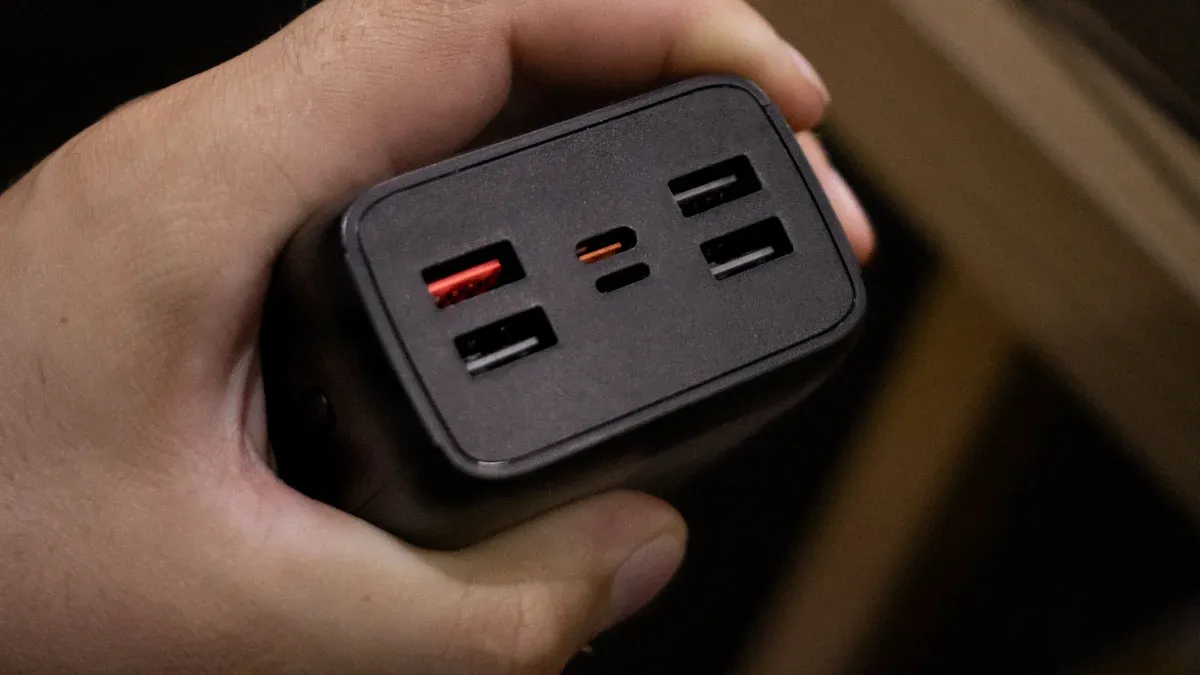
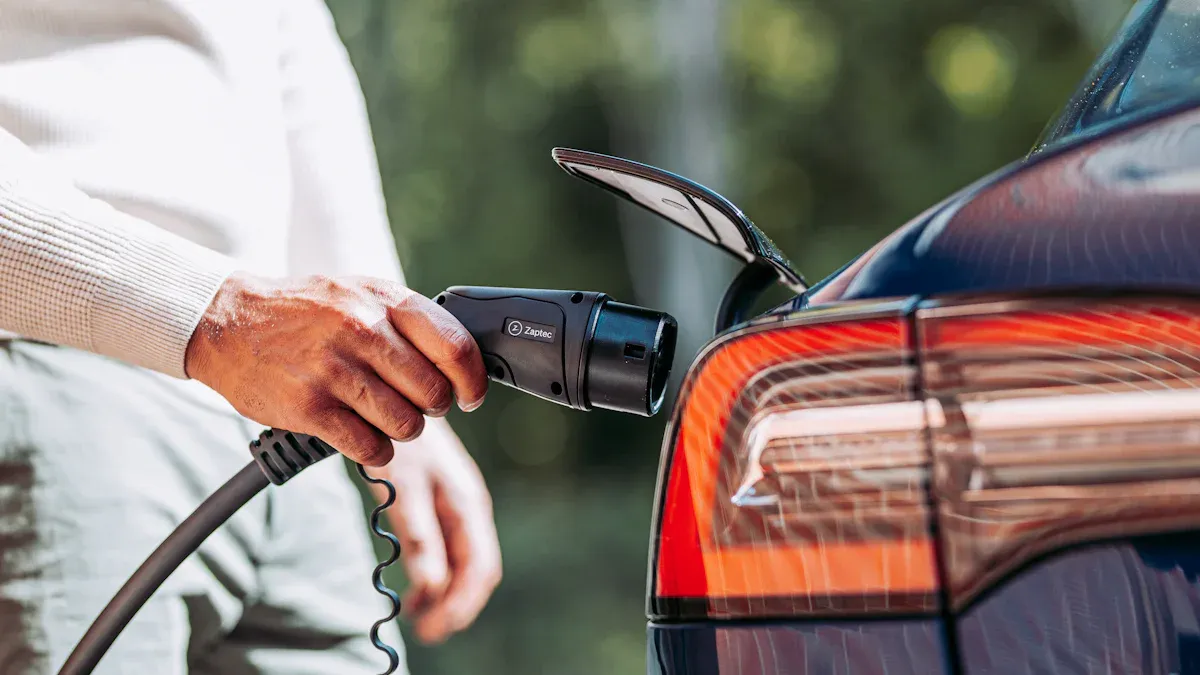
A typical Level 2 Cargador EV uses about 7,200 watts (7.2 kilowatts) of power. This setup has become the standard for home ev charging. It provides a full charge overnight for most electric vehicles. Research shows over 80% of owners charge their cars at home, making this a popular solution. However, the power needed varies widely. Fabricantes de cargadores para VE ofrecen diversas Soluciones de recarga de vehículos eléctricos. The range spans from 1,400 watts for basic cargadores portátiles para vehículos eléctricos to over 19,000 watts for a high-end charger.
Understanding Power for Your Electric Car Charger
To choose the right electric car charger, one must first understand the basic electrical terms involved. These concepts explain how quickly a charger can add energy to a vehicle and how that energy is measured for billing.
Watts, Kilowatts, and Amps Explained
The specifications on any charger involve a few key units. Understanding the difference between power and current is fundamental.
Power vs. Electrical Current
Power and current are related but distinct concepts. Think of electricity flowing through a wire like water through a hose.
- Current (Amps or A): This measures the volume of electrical charge flowing. It is like the amount of water moving through the hose.
- Voltage (Volts or V): This is the electrical potential difference, or pressure, pushing the current. It is similar to the water pressure in the hose.
- Power (Watts or W): This measures the rate of energy transfer. It is the total work the electricity can do at any moment. A kilowatt (kW) is simply 1,000 watts.
A 7,2 kW charger, for instance, can deliver 7.2 kilowatts of power to an EV’s battery in one hour.
How Watts and Amps Relate
The relationship between these units is simple and direct. Power is the product of voltage and current. This formula helps determine a charger’s power output.
For a typical Level 2 charger in the US, the circuit provides 240 volts. If a charger is set to draw 30 amps, its power output is:
240 Volts × 30 Amps = 7,200 Watts (or 7.2 kW)
This calculation is essential for matching a charger to a home’s electrical system.
Kilowatt-Hours (kWh): The Unit on Your Bill
While watts measure the rate of power, your utility company bills you for the total energy you consume. This is where the kilowatt-hour (kWh) comes in.
Measuring Energy, Not Power
A kilowatt-hour (kWh) is a unit of energy, not power. It is officially defined as the total energy consumed when a 1,000-watt appliance runs for one hour. If your 7.2 kW charger runs for one hour, it consumes 7.2 kWh of energy. Your electric bill shows your total consumption in kWh.
How kWh Connects to Your EV Battery Size
The capacity of an electric vehicle’s battery is also measured in kWh. A car with a 60 kWh battery requires 60 kWh of energy to go from empty to full. If you add 30 kWh of energy, you have filled the battery halfway. The size of your battery in kWh and the power of your charger in kW determine how long it takes to recharge. A larger battery pack, measured in kWh, will take longer to fill than a smaller one. The cost of a full charge depends on the battery’s total kWh capacity and the price per kWh from your utility.
Power Needs for Different Home EV Charging Levels

The power an EV charger requires depends directly on its charging level. Home charging solutions are categorized into two main types: Level 1 and Level 2. Each has distinct power requirements, installation needs, and charging speeds.
Level 1 Charger: The 120V Basic Option
A Level 1 charger is the most basic charging method available. It uses a standard electrical outlet, making it universally accessible without any special installation.
Power Usage: 1,400 to 1,900 Watts
Level 1 chargers plug into a common 120-volt household circuit. These circuits typically deliver 12 to 16 amps of current. Using the power formula, this results in a power output between 1,400 watts (1.4 kW) and 1,900 watts (1.9 kW). This low power draw is gentle on a home’s electrical system.
Required Circuit: Standard Household Outlet
The primary advantage of a Level 1 charger is its simplicity. It requires no electrical modifications and works with any standard three-prong outlet.
Nota: For safety and consistent performance, a Level 1 charger should be plugged into a dedicated circuit. Using it on a circuit with other appliances can cause the breaker to trip.
Best For: Low-Mileage Drivers & PHEVs
The trade-off for this convenience is slow charging speed. A Level 1 charger typically adds only 3 to 5 miles of range for every hour of charging. This makes it a practical solution for:
- Vehículos eléctricos híbridos enchufables (PHEV): These vehicles have smaller batteries that can be fully recharged overnight.
- Conductores con poco kilometraje: An owner who drives 30-40 miles per day can easily replenish that range with 8-10 hours of overnight charging.
Level 2 Charger: The 240V Home Charging Standard
En Cargador de nivel 2 is the most common and recommended solution for dedicated home charging. It offers a significant boost in charging speed by using a higher-voltage circuit.
Power Usage: 3,300 to 19,200 Watts
Level 2 chargers operate on a 240-volt circuit, similar to an electric dryer or oven. The power they deliver varies based on the amperage of the circuit, which can range from 16 amps up to 80 amps. This results in a wide power spectrum, from 3.3 kW all the way to 19.2 kW for the most powerful residential models.
Common Home Setup: 7,200 Watts (30A on 240V)
Most EV owners find that a 7,200-watt (7.2 kW) charger provides the perfect balance of speed and electrical demand. This setup, which runs on a 40-amp breaker, can fully charge most EVs overnight. For an EV with a 60 kWh battery, a 7.2 kW charger can deliver a full charge in about 9 hours, accounting for a typical 10% efficiency loss during the charging process. This speed ensures even long-range EVs are ready to go each morning.
Required Circuit: Dedicated 240V Outlet
Installing a level 2 charger is a more involved process that requires professional expertise. A licensed electrician must install a dedicated circuit that runs directly from the main electrical panel. Key installation requirements include:
- Un dedicado 208V or 240V circuit.
- A two-pole circuit breaker, typically 40 or 50 amps.
- Heavy-gauge wiring to handle the continuous electrical load safely.
- An assessment of the home’s main electrical panel to ensure it has enough capacity. Older homes with 100-amp service may need an upgrade.
Hiring an experienced electrician is crucial. They will ensure the installation is safe, compliant with local codes, and correctly sized for both the charger and the home’s electrical system.
How Power Usage Affects Your EV Charging Cost

The power of a charger influences speed, but the energy consumed determines the final bill. Understanding how to calculate the cost to power an electric car is essential for every owner of electric vehicles. The calculation is straightforward and empowers owners to manage their expenses effectively.
The Formula for Calculating Charging Cost
An owner can estimate their imputación de gastos with a simple three-step formula. This calculation combines the charger’s power, the duration of the charging session, and the local electricity rate.
Step 1: Find Your Charger’s Kilowatt Rating
First, identify the power output of the charger in kilowatts (kW). This is usually listed on the unit itself. For example, a common Level 2 charger has a rating of 7.2 kW. This figure represents the rate of energy transfer.
Step 2: Determine Your Charging Time in Hours
Next, determine how long the charger will run. If a 7.2 kW charger runs for one hour, it consumes 7.2 kilowatt-hours (kWh) of energy. If it runs for five hours, it consumes 36 kWh (7.2 kW × 5 hours).
Step 3: Know Your Electricity Rate ($/kWh)
Finally, find the price of electricity on a recent utility bill. This rate is expressed in dollars or cents per kilowatt-hour ($/kWh). This is the amount the utility company charges for each kWh of energy consumed.
The basic formula to find the total cost of a charging session is:
Total Energy Consumed (kWh) × Your Electricity Rate ($/kWh) = Total Cost
Example Cost Scenarios for Electric Vehicles
Applying this formula to real-world situations clarifies the typical cost of home charging.
Daily Cost for an Average Commute
An average American commute is about 40 miles round-trip. Most EVs use approximately 1 kWh of energy to travel 3-4 miles. A 40-mile drive, therefore, requires about 12 kWh of energy. With a national average electricity rate of around $0.17 per kWh, the daily charging cost is:
12 kWh × $0.17/kWh = $2.04
This makes the daily cost to power an electric car significantly lower than refueling a gasoline vehicle.
Monthly Cost for a 7.2 kW Charger
An owner driving 1,200 miles per month would need roughly 360 kWh of energy. The total monthly charging cost at an average rate of $0.17 per kWh would be:
360 kWh × $0.17/kWh = $61.20
This monthly cost is a fraction of what most drivers spend on gasoline, highlighting one of the key financial benefits of EV ownership.
Saving Money with Time-of-Use (TOU) Rates
Many utility companies offer special rate plans that can dramatically lower the cost of EV charging. These are known as Time-of-Use (TOU) plans.
What Are TOU Plans?
TOU plans are pricing structures that vary the cost of electricity based on the time of day. This approach helps manage demand on the electrical grid.
- Horas punta: Electricity is most expensive during periods of high demand, such as late afternoons and early evenings when people return from work.
- Fuera de horas punta: Electricity is cheapest late at night and in the early morning when overall demand is low.
- Smart Meter Requirement: Most TOU plans require a smart meter, which automatically tracks and reports energy usage by the hour to the utility.
The Benefit of Off-Peak Charging
The financial advantage of TOU plans is significant. By scheduling charging sessions during off-peak hours, EV owners can pay a much lower rate per kWh. As electricity rates vary widely across the United States, savings can be substantial in high-cost states.

For example, some utilities in California offer rates that are 30-50% lower during off-peak windows. An owner can program their vehicle or charger to begin charging automatically after 9 PM or midnight to take advantage of these savings.
| Utility Provider | Región | Peak Rate (¢/kWh) | Off-Peak Rate (¢/kWh) | Horas punta |
|---|---|---|---|---|
| PG&E (E-TOU-C) | CA | ~26–29 | ~18–20 | 4–9 PM daily |
| Southern California Edison | CA | Varía | Varía | 4–9 PM weekdays |
| Pacific Power | WA, OR, CA | ~28 | ~10 | 2–10 PM (summer) |
By shifting a 12 kWh daily charging session to an off-peak rate of $0.10/kWh instead of a peak rate of $0.28/kWh, an owner saves over 60% on their charging cost for that day.
Factors That Determine Your Actual Power Needs
Choosing the right home charging setup involves more than just picking a charger off the shelf. An owner’s specific power requirements depend on three critical elements: the vehicle’s capabilities, daily driving patterns, and the home’s existing electrical infrastructure. A careful review of these factors ensures a safe and efficient charging experience.
Your Vehicle’s Onboard Charger Limit
The electric vehicle itself plays a major role in determining charging speed. A wall charger can only deliver as much power as the car is designed to accept.
How Your EV Limits Charging Speed
Every electric vehicle contains an onboard charger. This component converts the alternating current (AC) from a wall outlet into direct current (DC) to store in the battery. This onboard unit has a maximum power rating, measured in kilowatts (kW). If a home has a 11.5 kW charger but the car’s onboard charger is limited to 7.2 kW, the charging session will not exceed 7.2 kW.
Finding Your Car’s Max AC Charging Rate
Identifying a vehicle’s maximum AC charging rate is a straightforward process. This specification is crucial for matching a home charger to the car’s capabilities. Owners can find this information in several places:
- The owner’s manual.
- The vehicle’s official specification sheet.
- Documentation provided at the time of purchase.
If the documentation is not readily available, an owner can also contact the car manufacturer or an authorized dealer for the correct specification.
Your Daily Driving Habits
An owner’s daily routine directly influences their charging needs. The distance driven each day determines how much energy must be replenished overnight.
Low vs. High Mileage Needs
A driver who commutes 20 miles per day can easily replenish that range with a lower-power charger or even a Level 1 setup. However, a high-mileage driver covering 80+ miles daily will benefit from a more powerful Level 2 charger to ensure the battery is full each morning. More demanding driving requires faster charging.
Calculating Miles Added Per Hour of Charging
The number of miles added per hour of charging depends on both the charger’s output and the car’s efficiency. Vehicle efficiency is measured in miles per kilowatt-hour (miles/kWh). A car with excellent efficiency (5+ miles/kWh) will gain more range in an hour than a less efficient car (under 3 miles/kWh) using the exact same charger.
Your Home’s Electrical Panel Capacity
The final piece of the puzzle is the home’s electrical system. The main electrical panel must have enough capacity to support the continuous load of an EV charger.
How to Assess Your Main Panel
The main electrical panel, or breaker box, distributes electricity throughout the home. The total capacity is indicated on the main breaker, typically labeled with a number like “100A” or “200A”. An owner should also check for available physical space for a new two-pole breaker required for a Level 2 charger.
When an Electrical Upgrade is Necessary
Older homes with 100-amp service or less may not have sufficient capacity for a powerful Level 2 charging station, especially with other large appliances running. If the panel is already full or lacks the required capacity, an electrical service upgrade performed by a licensed electrician becomes necessary for a safe installation.
Matching an Electric Car Charger to Your Home’s System
Selecting the right electric car charger requires a careful match between the device, the vehicle, and the home’s electrical system. Technologically advanced electric vehicle charging solution providers like TPSON offer a range of products to meet diverse needs. Safety codes and installation types are key considerations in this process.
The 80% Rule for Electrical Circuits
Electrical safety standards are paramount for high-power installations. The “80% Rule” is a fundamental principle that ensures a circuit does not become overloaded.
Understanding Continuous Loads
The National Electrical Code (NEC) defines a continuous load as any device that runs at maximum power for three or more hours. EV charging sessions easily meet this definition. For these loads, the NEC mandates specific safety margins to prevent overheating and potential hazards. The circuit should only be loaded to 80% of its maximum rating.
Sizing Your Breaker Correctly
Properly sizing the circuit breaker is a critical safety step. An electrician will apply a 125% sizing factor to account for the continuous load. This means the breaker must be rated for 125% of the charger’s amperage draw.
Formula for Safety:
Breaker Size (Amps) = Charger's Maximum Amperage × 1.25
For example, a 40-amp charger requires a 50-amp circuit breaker (40A × 1.25 = 50A). This ensures neither the breaker nor the wiring will overheat during a long charging session.
Common Home Charger Amperage Setups
Home chargers are available in several common amperage configurations. Each one offers a different charging speed and has specific circuit requirements.
16-Amp Chargers (3.8 kW)
A 16-amp charger delivers about 3.8 kW of power. This setup is a significant step up from Level 1 charging. It is an excellent choice for plug-in hybrids (PHEVs) or for EV owners with shorter daily commutes.
30/32-Amp Chargers (7.2-7.7 kW)
En 32-amp charger is the most popular home charging solution, providing about 7.7 kW. This power level can fully charge most electric vehicles overnight, making it a practical and efficient standard for the majority of EV owners.
40/48-Amp Chargers (9.6-11.5 kW)
For maximum speed, 40-amp and 48-amp chargers deliver 9.6 kW and 11.5 kW, respectively. These powerful units are ideal for long-range EVs, such as the Tesla Model S or Y. A 48-amp charger can add over 40 miles of range per hour, ensuring even a nearly empty battery is full by morning.
Instalaciones fijas frente a instalaciones enchufables
An owner must also choose between a hardwired or a plug-in installation for their charger.
Benefits of a Hardwired Charger
A hardwired charger is connected directly to the home’s electrical circuit. This permanent installation is often safer, more durable, and better suited for outdoor locations where it is protected from the elements. Some high-amperage chargers (above 40 amps) may require a hardwired setup.
Flexibility of a Plug-In Charger
A plug-in charger connects to a 240V outlet, similar to an electric dryer. This offers greater flexibility. An owner can easily unplug the unit for replacement or take it with them if they move.
Do I Need an Electrical Panel Upgrade for Home Charging?
Installing a Level 2 charger is a significant electrical project. Many homeowners wonder if their current system can handle the added demand. An electrical panel upgrade is sometimes necessary to ensure a safe and reliable installation.
Signs Your Panel May Be Insufficient
Several clear signs indicate a home’s electrical panel may not be up to the task of supporting a new EV charger. Recognizing these indicators is the first step in assessing a home’s readiness.
Older Homes with 60-100 Amp Service
Homes built several decades ago often have electrical service rated for 60 or 100 amps. These systems were not designed for the high, continuous power draw of modern appliances and electric vehicles.
- Panels installed before 2008 may lack modern safety features like proper GFCI (Ground Fault Circuit Interrupter) protection.
- Units housed in wooden enclosures or older plastic units showing heat damage require replacement.
- A 100-amp service may struggle to support a powerful charger alongside other major appliances like an HVAC system or an electric stove.
A Full Breaker Box with No Space
A visual inspection of the breaker box can reveal a lot. If the panel has no empty slots, there is no physical space to add the new two-pole breaker required for a Level 2 charger. Furthermore, frequent tripping of existing circuit breakers suggests the system is already operating near its capacity.
The Process of a Panel Upgrade
Upgrading an electrical panel is a job for a professional. The process is systematic and ensures the home’s electrical system is safe, compliant, and ready for future needs.
Consultar a un electricista autorizado
The first step is to consult a licensed electrician. They will perform a thorough assessment and manage the entire project. The process typically includes:
- Initial Survey: The electrician inspects the current panel and wiring.
- Detailed Quote: They provide an itemized quote for materials and labor.
- Permisos: The electrician obtains all necessary permits from local authorities to ensure the work complies with building codes.
- Instalación: They remove the old breaker box and install the new, higher-capacity unit.
- Testing & Certification: The electrician conducts comprehensive tests and issues a certificate of electrical inspection.
Typical Costs and Timelines
The cost of a panel upgrade varies based on the required capacity and local labor rates. A standard upgrade can often be completed in one to two days.
Nota: These costs are estimates. An owner should always get a detailed quote from a qualified electrician.
| Panel Rating | Estimated Material Cost | Typical Labor & Certification |
|---|---|---|
| 100 A | $120–$220 | $350–$550 |
| 200 A | $220–$320 | $450–$750 |
Alternatives to a Full Panel Upgrade
A full panel upgrade is not always the only option. Modern technology offers intelligent solutions that can help homeowners avoid this major expense.
Smart Splitters and Outlet Sharing Devices
A smart splitter allows two high-power devices, like an EV charger and a clothes dryer, to share a single 240V circuit. The device automatically switches power to only one appliance at a time, preventing an overload.
EV Chargers with Load Management Systems
Many modern chargers come with built-in load management. These systems monitor a home’s total electricity usage in real time. When overall demand is high, the system automatically reduces the power going to the EV charger. This intelligent power allocation ensures the panel is never overloaded, making it a safe and effective solution for homes with limited electrical capacity. This technology makes home ev charging accessible without costly upgrades.
For most EV owners, a 7.2 kW Level 2 charger represents the ideal standard for home charging. This setup balances fast charging speeds with a manageable electrical load for modern homes. The average monthly charging cost typically ranges from $50 to $70, a significant saving. This low cost makes ev charging a smart financial choice. Owners should always consult a qualified electrician to assess their home’s capacity before any installation.
PREGUNTAS FRECUENTES
How much electricity does a Level 2 charger use?
A 7.2 kW charger uses 7.2 kWh per hour. An owner can find out how much electricity is used by multiplying the charger’s kW rating by the hours charged. This calculation shows the total kWh consumed and helps track electricity usage in kWh.
What is the average monthly cost for home EV charging?
The average monthly cost for home ev charging is $50-$70. This cost depends on how much electricity the driver uses, their vehicle’s efficiency in miles per kWh, and the local rate per kWh.
Can any home install a Level 2 electric car charger?
Most modern homes can support a Level 2 electric car charger. Older homes may need an upgrade. An electrician must assess how much electricity the panel can supply in kWh and if it can handle the added electricity usage.
How much electricity do electric vehicles use per mile?
Most electric vehicles consume about 1 kWh to travel 3 to 4 miles. This efficiency (miles per kWh) helps estimate how much electricity a trip requires. Knowing the kWh per mile is key to understanding overall electricity usage.
How do I calculate my monthly electricity consumption for my electric vehicle?
An owner can estimate their monthly electricity consumption by dividing monthly miles by their car’s miles per kWh rating. This reveals the total kWh needed. Knowing how much electricity is used helps manage the cost of ev charging.
How much electricity do different EV models need?
It varies by battery size.
- A smaller electric vehicle might have a 40 kWh battery.
- A larger one could have a 100 kWh battery.
The battery size in kWh determines how much electricity is needed for a full charge.
Why is kWh important for electric vehicles?
The kWh unit measures both battery capacity (e.g., 60 kWh) and energy consumption. It directly connects to range and charging time. Understanding kWh helps owners know how much electricity their car holds and uses.