An EV owner might ask, “How often should I charge my EV to 100%?” The answer is simple: rarely for daily driving. The ideal daily charging range for optimal battery health is between 20% and 80%. A full 100% charge should be reserved for times when an EV driver absolutely needs the maximum range for a long trip. This charging practice helps preserve the electric vehicle’s battery longevity. TPSON, a technologically advanced company among Fabricantes de carregadores para veículos eléctricos, provides smart Soluções de carregamento de veículos eléctricos, including a reliable Carregador de veículos eléctricos e carregadores portáteis para veículos eléctricos, to help EV owners manage their charging habits effectively.
The Science Behind the 80% Rule

The recommendation to limit daily charging to 80% is not arbitrary. It is rooted in the chemistry of the lithium-ion batteries that power every modern EV. Understanding this science helps an EV owner protect their investment and maximize battery health.
Understanding Your EV’s Lithium-Ion Battery
How a Lithium-Ion Battery Works
An EV battery stores and releases energy by moving lithium ions between two electrodes: a cathode and an anode. During charging, ions move from the cathode to the anode. During discharging (powering the EV), they move back. This constant movement enables the electric vehicle to run.
What is State of Charge (SoC)?
State of Charge (SoC) is the battery’s current charge level, expressed as a percentage. A 100% SoC means the battery is full, while 0% means it is empty. An EV driver monitors SoC to know their available range.
The Concept of Battery Cycles and Degradation
A charge cycle represents one full discharge and recharge, from 100% to 0% and back. However, partial cycles also count. Over time, each charging cycle contributes to gradual, irreversible capacity loss, known as battery degradation. Smart charging habits can slow this process significantly.
Why a 100% Charge Creates Stress
Consistently charging an EV to 100% places significant stress on the battery components, accelerating wear. This is a key reason to avoid full charging for daily use.
Chemical Stress at High Voltages
High voltage at a full state of charge induces chemical stress. The battery’s internal materials become less stable. For example, in certain cathode chemistries:
- High charge states can cause irreversible structural changes.
- The cathode may experience significant oxygen oxidation and loss from its surface.
- These reactions lead to a permanent loss of capacity and voltage.
Heat Generation During Full Charges
The final stage of charging, from 80% to 100%, generates more heat. Heat is a primary enemy of battery health. Elevated temperatures during charging speed up the chemical reactions that degrade battery cells, reducing the overall lifespan of the EV battery.
The Impact on the Battery Cathode
Sustained high voltages from full charging directly harm the cathode. When an EV battery is charged beyond its designed full capacity, chemical reactions can trigger an exothermic failure. This process damages the cathode’s crystalline structure, leading to permanent performance loss.
The Dangers of a Low State of Charge
Just as a high SoC is stressful, a very low SoC is also damaging. An EV owner should avoid letting the battery drop to extremely low levels.
The Risks of Deep Discharging Below 20%
Using an EV battery below a 20% charge level can cause over-discharge. This state triggers irreversible chemical reactions inside the battery. These reactions cause irreparable damage, reduce the battery’s total capacity, and shorten its operational life.
Why Staying Above 20% is a Safe Bet
Dica profissional: Think of the 20% to 80% range as the “comfort zone” for your EV battery. Keeping the charge within this window minimizes stress at both high and low extremes. This simple habit is the most effective way to preserve long-term battery health and performance. Advanced charging solutions from providers like TPSON can help automate this process, making smart charging effortless.
The Practical Downsides of Daily Full Charges
Beyond the chemical stress on the battery, daily full charges introduce practical issues that affect an EV’s performance and an owner’s wallet. These downsides impact both driving efficiency and long-term vehicle value.
Reduced Regenerative Braking
One of the most immediate effects of a 100% charge is the reduction or complete loss of regenerative braking.
What is Regenerative Braking?
Regenerative braking is a core feature of an EV. When a driver lifts their foot off the accelerator, the electric motor reverses its function. It acts like a generator, converting the car’s kinetic energy into electricity and sending it back to the battery. This process helps slow the EV down while recapturing energy.
Why a Full Battery Can’t Recapture Energy
A battery at 100% state of charge has no available capacity to store more energy. The Battery Management System (BMS) prevents overcharging to protect the cells. Consequently, the regenerative braking system cannot send power back to a full battery. The EV has nowhere to put the recaptured energy.
The Impact on Efficiency and Driving Feel
Nota: With regenerative braking disabled, the EV must rely solely on its mechanical friction brakes to slow down. This change has two main effects:
- Reduced Efficiency: The energy that would normally be recaptured during deceleration is lost as heat through the brakes. This makes the EV less efficient, especially in stop-and-go traffic.
- Inconsistent Driving Feel: Drivers accustomed to “one-pedal driving” will find the EV coasts more freely, requiring more frequent use of the brake pedal.
Accelerated Battery Degradation
The most significant long-term consequence of improper charging habits is accelerated battery degradation.
Defining Battery Degradation vs. Capacity Loss
Battery degradation refers to the irreversible aging of the battery’s internal components. Capacity loss is the measurable result of this degradation. An EV owner experiences it as a reduction in the total range the EV can travel on a single charge compared to when it was new.
How Daily Full Charges Speed Up Aging
Routine full charges force the battery to remain at a high voltage, which accelerates the chemical reactions that degrade the cathode and electrolyte. This constant stress speeds up the natural aging process. Over months and years, this habit leads to a faster decline in battery capacity than a proper charging routine would.
Long-Term Financial Implications of Poor Charging Habits
Poor charging habits have direct financial costs. An electric vehicle with a significantly degraded battery has a lower resale value. In a worst-case scenario, premature battery failure could lead to an expensive replacement. Adopting a smart charging strategy is crucial. Technologically advanced providers like TPSON offer charging solutions that help EV owners automate healthier charging cycles, protecting their investment. Limiting daily charging is a simple step to preserve the EV battery’s health.
When It Is Okay (and Necessary) to Charge My EV to 100
While the 20-80% rule is ideal for daily driving, there are specific situations where a full 100% charge is not only acceptable but also necessary. Understanding these exceptions helps an EV owner use their vehicle to its full potential without causing undue harm to the battery.
Preparing for a Long-Distance Trip
The most common reason to charge an EV to 100% is to prepare for a road trip that exceeds the vehicle’s 80% range estimate.
Maximizing Your Range for the Road
A long journey requires every kilometer of range available. In this scenario, the benefit of reaching a destination without an extra charging stop outweighs the minor stress of a single full charge. Charging to 100% provides the maximum possible starting range, giving the driver more flexibility and peace of mind on the road.
The “Charge Just Before You Leave” Strategy
A battery is most stressed when it sits at a 100% state of charge for an extended period. To mitigate this, an EV driver should time their charging to finish just before they plan to depart.
Dica profissional: Use your EV or a smart charger app, like those compatible with TPSON solutions, to schedule your charging session. Set it to reach 100% around your departure time. This ensures the EV battery spends minimal time at its maximum voltage.
Planning Your Trip with Charging Stops
Even with a full charge, long-distance travel in an EV requires planning. Drivers should use their vehicle’s navigation system or a third-party app to map out necessary DC fast charging stations along their route. This proactive planning prevents range anxiety and ensures a smooth journey.
Battery Management System (BMS) Calibration
Occasionally, a full charge is recommended to help the vehicle’s computer system maintain accuracy.
What is the BMS and What Does It Do?
The Battery Management System (BMS) is the electronic brain of the EV battery pack. It monitors key metrics like temperature, voltage, and current. Its most important job for the driver is to calculate the battery’s State of Charge (SoC) and the corresponding estimated range.
Why Calibration is Sometimes Needed for Accuracy
The BMS tracks how often batteries are fully charged. If an EV is only ever partially charged (e.g., from 30% to 70%), the BMS can lose its precise sense of the battery’s upper and lower limits. Manufacturers advise that occasional full charges are crucial for the BMS to recalibrate. This process allows the system to fully charge each individual cell to its maximum capacity, ensuring accurate battery readings. A sudden range change after a firmware update might also indicate the need for recalibration, as the system now has a more precise reading.
Always Check Your Owner’s Manual First
Importante: Before you charge my EV to 100 for calibration, always consult the owner’s manual. The manufacturer provides specific guidelines on if and how often this should be done. Some brands may recommend it once every few months, while others may have different instructions.
The LFP Battery Exception
Not all EV batteries are the same. The rise of Lithium Iron Phosphate (LFP) batteries has changed the charging conversation for some owners.
Introducing Lithium Iron Phosphate (LFP) Batteries
Lithium Iron Phosphate (LFP) is a type of lithium-ion battery chemistry that is becoming more common, especially in standard-range electric vehicle models. It offers excellent safety and a long cycle life, and its charging requirements differ significantly from more traditional Nickel Manganese Cobalt (NMC) batteries.
Why LFP Batteries Tolerate a 100% Charge
LFP cells can be safely charged to 100% in each cycle. Their chemistry is inherently more robust. Key advantages include:
- LFP batteries have strong covalent bonds in their cathode materials.
- This robust cathode chemistry contributes to exceptional structural integrity.
- The strong bonds enhance thermal stability, reducing risks associated with high states of charge.
- LFP cells tolerate a full depth of discharge without inducing significant structural stress.
Because of this stability, manufacturers of EVs with LFP batteries often recommend a regular 100% charging routine to ensure the BMS remains accurate.
How to Know if Your EV Has an LFP Battery
The easiest way to determine your EV battery type is to check the owner’s manual. Additionally, many vehicles with LFP batteries will state this directly on the charging screen in the infotainment system. They might even display a message recommending the owner to charge my EV to 100 at least once a week. This regular full charging helps the BMS provide an accurate range estimate, a known challenge with LFP chemistry’s flat voltage curve.
Building the Best EV Charging Routine: The 20-80 Rule

Establishing the best ev charging routine is the most impactful step an owner can take to protect their vehicle’s battery. The Regra 20-80 is the foundation of this routine. It provides a simple yet powerful framework for preserving battery longevity and performance.
What is the 20-80 Rule?
A Simple Guideline for Maximum Battery Life
The 20-80 rule is a straightforward guideline: for daily driving, an EV owner should aim to keep their battery’s state of charge between 20% and 80%. This means plugging the EV in for charging before it drops below 20% and stopping the session once it reaches 80%. This practice avoids the stress associated with very low or very high charge levels, contributing directly to better long-term saúde da bateria.
The Scientific “Sweet Spot” for Battery Health
Lithium-ion batteries are most stable when they are neither full nor empty. The 20% to 80% range represents a chemical “sweet spot” where voltage is moderate and internal stress is minimized.
- Operating within this window reduces the rate of chemical degradation on the cathode.
- It minimizes heat generation during charging, another factor that accelerates aging.
- This simple habit keeps the battery in its comfort zone, slowing capacity loss over the vehicle’s lifespan.
How to Implement Your Charging Strategy
Adopting the 20-80 rule is easy, as modern EV technology provides multiple ways to automate the process. An owner can set their preferred charging limits with just a few taps.
Using Your Vehicle’s Infotainment System
Most electric vehicles allow the owner to set a maximum charge level directly through the central touchscreen. In the vehicle’s settings menu, there is typically a charging section where a slider or input field lets the user cap the charge at 80% for daily use. The EV will then automatically stop charging when it hits this target.
Setting Limits Through Your EV’s Mobile App
For added convenience, nearly every EV manufacturer offers a mobile app. This app allows an owner to remotely monitor and control their vehicle’s charging. An owner can set the 80% limit, start or stop a session, and view the current state of charge from anywhere, ensuring their charging routine is always on track.
Programming a Smart Home Charger
A smart home charger offers the highest level of control and data. Technologically advanced providers like TPSON offer solutions that integrate seamlessly into a connected home.
Smart Charger Features 💡 Wi-Fi-enabled smart chargers give an owner granular control via a dedicated smartphone app. Key features often include:
- Controlo remoto: Start, stop, and monitor charging sessions from anywhere.
- Programação: Program the charger to operate during off-peak hours for lower electricity costs.
- Real-Time Energy Tracking: Some models provide detailed data on energy consumption, helping owners manage their usage effectively.
Developing a Healthy Charging Habit
Technology makes the 20-80 rule easy to follow, but developing the right habits ensures the best charging routine becomes second nature.
The “Plug-In Every Night” Mentality
Adopting a “plug-in every night” habit offers significant benefits. This practice of charging every night ensures the EV is always ready for the next day’s commute or any unexpected trips, effectively eliminating range anxiety. Furthermore, a plugged-in EV can use grid power for preconditioning. This allows the owner to heat or cool the cabin e warm the battery before departing, preserving the battery’s charge for driving and maximizing range, especially in extreme temperatures. This makes charging every night a cornerstone of an effective charging routine.
Topping Off vs. Waiting for Low Battery
Contrary to habits formed with gasoline cars, an electric vehicle battery benefits from frequent, shallow charges rather than waiting for it to be nearly empty. Topping off the EV each night to maintain the 20-80% range is much healthier than running it down to 5% and then charging it back up. This charging routine minimizes deep discharge cycles, which are stressful for the battery. For very short daily trips, charging every two or three days may be sufficient, as long as the state of charge remains comfortably within the ideal window.
Advanced Charging Knowledge for EV Owners
Understanding the nuances of different charging methods and environmental factors empowers an EV owner to make informed decisions. This advanced knowledge helps optimize both charging efficiency and long-term battery health.
AC vs. DC Fast Charging: What’s the Difference?
Electric vehicles use two types of electrical current for charging: Alternating Current (AC) and Direct Current (DC). The vehicle’s battery stores energy as DC, so AC power from the grid must be converted.
Level 1 and 2 (AC) Charging Explained
AC charging uses the EV’s onboard converter to change AC grid power to DC power for the battery. This is the most common method for home and workplace charging.
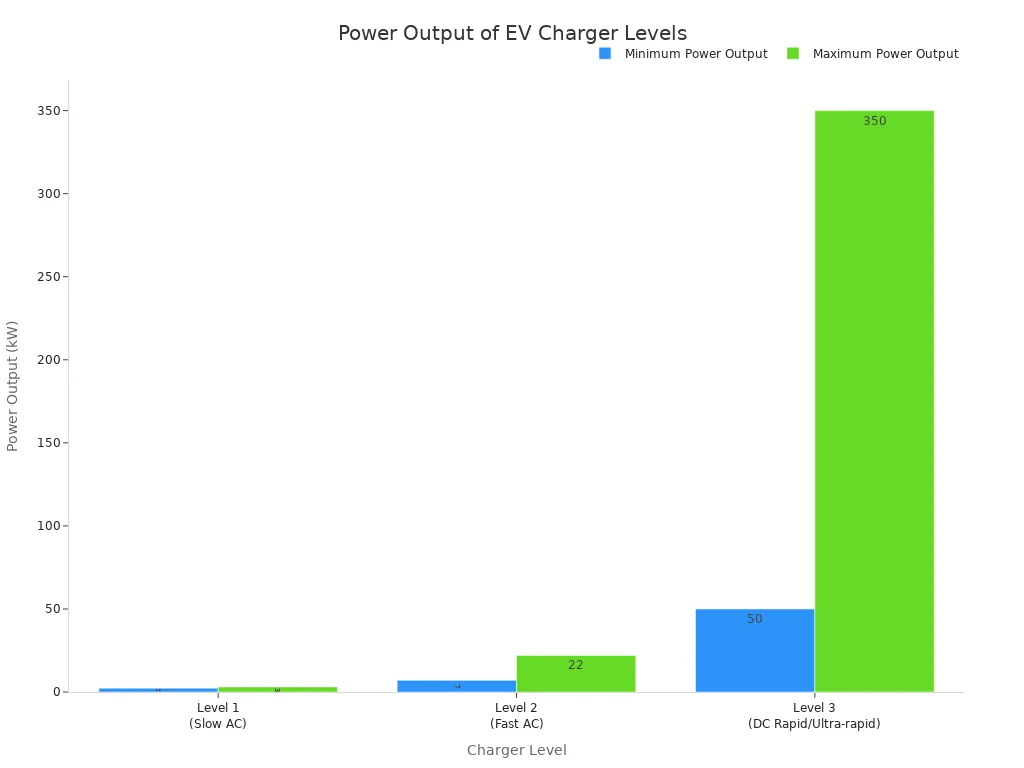
- Carregamento de nível 1: This uses a standard household outlet, delivering about 2-3 kW. It is the slowest charging method, adding only a few miles of range per hour.
- Carregamento de nível 2: This requires a dedicated charger, like those from fornecedores tecnologicamente avançados such as TPSON. It provides 7-22 kW and can fully charge most EVs overnight. This is the ideal solution for daily charging.
Level 3 (DC) Fast Charging Explained
DC fast charging bypasses the vehicle’s onboard converter. It supplies high-power DC electricity directly to the battery. This allows for much faster charging speeds, making it perfect for road trips. Power outputs range from 50 kW to over 350 kW. A rapid DC charger can often bring a battery to 80% in under an hour.
| Caraterística | Level 1 (Slow AC) | Level 2 (Fast AC) | Level 3 (DC Rapid/Ultra-rapid) |
|---|---|---|---|
| Potência de saída | 2,3-3 kW | 7-22 kW | 50-350 kW |
| Velocidade de carregamento | 8–10 hours for 100 miles | 2-5 horas para 100 milhas | 20–40 minutes for 100–200 miles |
| Tipo de conetor | Ficha de 3 pinos | Tipo 2 | CCS (most common) or CHAdeMO |
How Frequent DC Fast Charging Affects Battery Health
While convenient, frequent DC fast charging can accelerate battery degradation. The high currents generate more heat and electrical stress on the cells. However, modern EVs have sophisticated Battery Management Systems (BMS) that manage heat to mitigate damage. Studies show that frequent fast charging may increase annual capacity loss by only about 0.1% compared to a vehicle that never uses it. For daily charging, AC charging remains the gentler and more cost-effective option.
The Impact of Temperature on Charging
Ambient temperature significantly affects charging speed and efficiency. Both extreme cold and heat present challenges.
Best Practices for Charging in Extreme Cold
Cold temperatures slow the chemical reactions inside a battery. This increases internal resistance and reduces the battery’s ability to accept a charge.
Cold Weather Tip 🥶
In cold weather, the BMS will limit charging power to protect the battery, resulting in a slower charging session. An owner should plug the vehicle in upon arrival while the battery is still warm from driving to achieve a faster charging rate.
Best Practices for Charging in Extreme Heat
Extreme heat also stresses the battery. The BMS will activate the battery’s cooling system during charging to keep it within a safe temperature range. An owner should try to park in a shaded or cool location when charging on hot days to reduce the load on the cooling system.
O papel do pré-condicionamento da bateria
Battery preconditioning is a vital feature for optimizing charging. The system automatically warms or cools the battery to its ideal temperature (typically 15-35°C) before a charging session begins. This process ensures faster, more efficient charging and minimizes thermal stress, which is crucial for protecting the battery during DC fast charging in non-ideal temperatures.
Debunking Common EV Charging Myths
Misinformation about EV charging can prevent owners from developing healthy habits. Understanding the facts helps an owner protect their vehicle’s battery and maximize its lifespan.
Myth: You Must Charge to 100% to “Fill the Tank”
Breaking the Gasoline Mindset
Drivers new to electric vehicles often carry over habits from gasoline cars. The “fill the tank” mentality does not apply to EV batteries. Unlike a gas tank, a lithium-ion battery experiences stress at very high states of charge. Routine full charges accelerate degradation, a concept foreign to internal combustion engine vehicles.
Why an EV is More Like a Smartphone
An EV owner should think of their vehicle’s battery like a smartphone battery. Most people plug their phones in at night and unplug them in the morning without worrying if they are 100% full. An EV benefits from the same behavior. Frequent, partial charging is healthier for the battery than consistently pushing it to its maximum capacity.
Myth: Not Charging to 100% Will Harm the Battery
Why Partial Charging is Healthier
Some owners worry that not performing full charges will somehow damage the battery. The opposite is true. A lithium-ion battery is most stable and least stressed when kept away from its upper and lower limits. A partial charging routine, such as the 20-80 rule, is the single best practice for preserving long-term battery health.
Understanding Battery Memory Effect (or Lack Thereof)
This myth originates from a real phenomenon in older battery technologies. The “memory effect” was observed in nickel-cadmium (NiCad) batteries, which could “forget” their full capacity if repeatedly charged from the same partial state.
Fact Check: Modern lithium-ion batteries do not suffer from the memory effect. Their chemistry is entirely different. An EV battery retains its maximum charge potential regardless of whether an owner initiates charging at 20%, 40%, or 60%.
Myth: You Should Drain the Battery Completely Before Charging
Why Deep Discharging is Harmful
Allowing an EV battery to drain to 0% is one of the most harmful things an owner can do. Deep discharging puts significant stress on the battery cells. This can lead to irreversible chemical changes and permanent capacity loss. Parking an EV for an extended period with a depleted battery can cause severe, lasting damage.
The Benefits of Frequent, Shallow Charges
An EV battery thrives on frequent, shallow charging cycles. Instead of waiting for the battery to get low, an owner should adopt a habit of plugging in regularly. This practice keeps the state of charge within the ideal 20-80% window. This simple routine minimizes stress and is far more beneficial than deep discharge cycles.
An owner preserves optimal saúde da bateria by keeping the charge between 20% and 80% for daily use. They should only charge my ev to 100 for special occasions like road trips.
Adopting a smart charging routine is the single most effective action for long-term vehicle care. This consistent charging routine maintains performance and resale value.
Technologically advanced providers like TPSON offer solutions to simplify this charging routine. Ultimately, a healthy charging routine protects saúde da bateria and is essential when an owner does not need to charge my ev to 100.
FAQ
Is it bad to leave an EV plugged in overnight?
No, it is not bad. Modern electric vehicles have a Battery Management System (BMS) that automatically stops the charging process once the set limit is reached. Leaving the EV plugged in is safe and ensures the vehicle is ready for the next day’s use.
How much range is lost by charging to only 80%?
An owner loses 20% of the vehicle’s total possible range. For most daily commutes, the range available at an 80% charge is more than sufficient. This practice preserves long-term battery health, which is a worthwhile trade-off for daily driving.
Does the 80% rule apply to all EVs?
The 80% rule primarily applies to EVs with NMC or NCA batteries. Vehicles with LFP batteries are an exception. Manufacturers often recommend charging LFP batteries to 100% regularly. An owner should always consult their vehicle’s manual for specific guidance.
Will one 100% charge damage my battery?
A single 100% charge for a long trip will not cause significant harm. Battery degradation results from the cumulative stress of routine full charges. An occasional full charge, especially just before departure, is perfectly acceptable when maximum range is needed.
How can an owner easily follow the 20-80 rule?
An owner can easily implement this rule using several methods:
- Setting the charge limit in the vehicle’s infotainment system.
- Using the manufacturer’s mobile app to control charging.
- Programming a smart home charger from a provider like TPSON.
Why is my EV charging slower than expected?
Charging speed can be affected by several factors.
Possible Reasons:
- Cold Temperatures: A cold battery accepts charge more slowly.
- High State of Charge: Charging naturally slows down as the battery approaches its limit.
- Shared Power: Some public chargers split power between two vehicles.