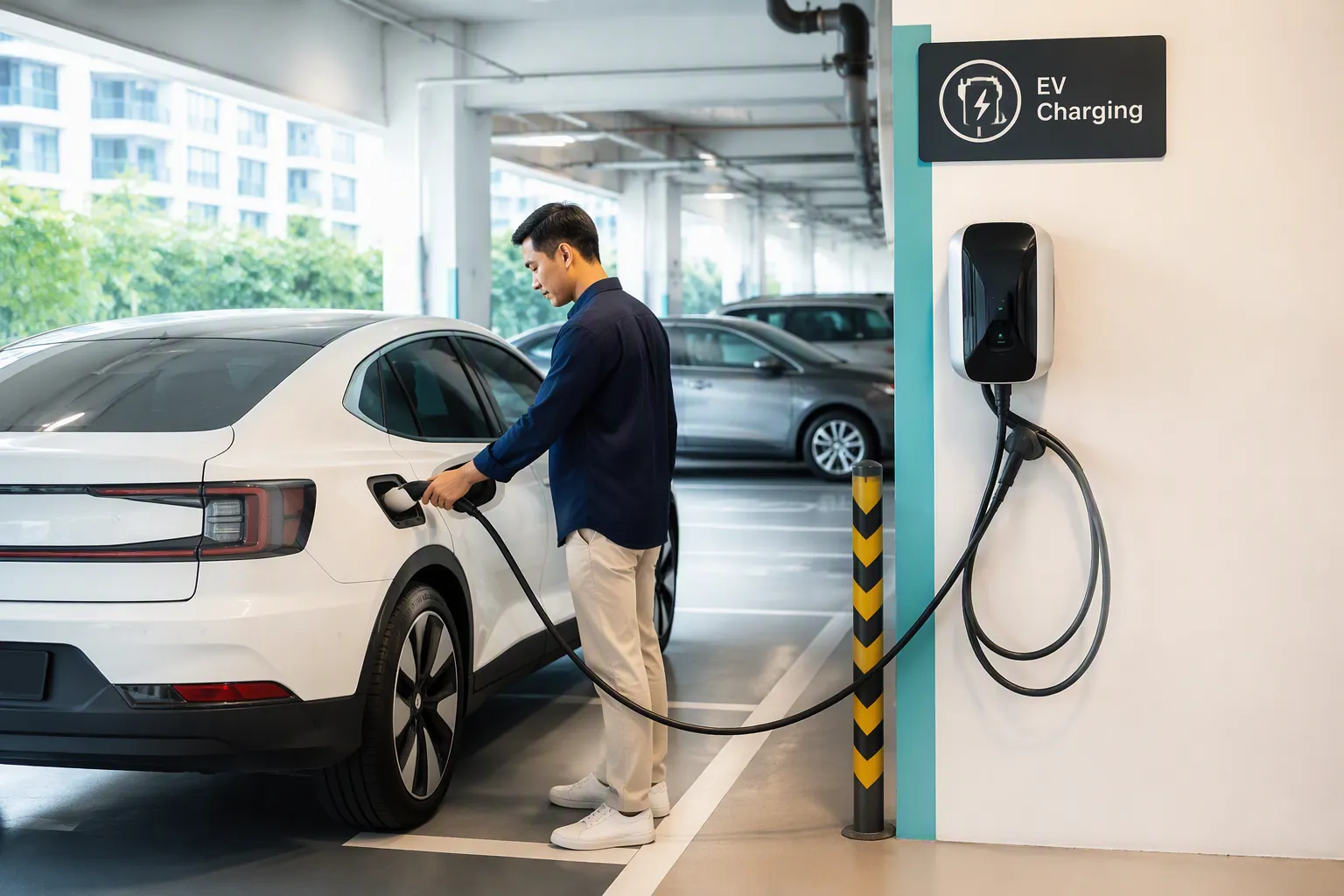
EV charger cable management is the simplest way to keep a garage safe, tidy, and consistently “ready to charge.” The best solution is the one that prevents trip hazards, protects the charging connector from impacts and contamination, and keeps the cable from being pinched by a garage door or run over. In practice, that usually means combining a wall-mounted holster, a dedicated cable path, and a routine for wrapping and stowing the cord after every session.
For homeowners and site operators planning long-term charging, a well-managed cable setup is more than appearance—it supports charger uptime, reduces avoidable wear, and helps maintain a consistent expérience utilisateur.
- Why cable management matters (safety, reliability, resale)
- Core principles for a tidy, durable EV charging setup
- Cable management solutions (what to use and where)
- Layout templates for common garage and driveway scenarios
- Data charts: cable length, charging levels, and what “normal” looks like
- Choosing EVSE with cable management in mind (home, fleet, mobile)
- Maintenance checklist and replacement triggers
- FAQ (6 questions)
- Références et liens externes
Why cable management matters (safety, reliability, resale)
A charging cable on the floor is a predictable failure point. It gets stepped on, rolled over, kinked, slammed by doors, or dragged across concrete. Even when it “still works,” the setup can become a daily frustration that discourages consistent home charging—one of the key habits that makes EV ownership convenient. Car and Driver’s long-term testing perspective is blunt: most drivers will want to charge at home as much as possible, and a dependable routine matters for that. A clean cable setup supports that routine.
Safety payoff
Fewer trip hazards
A routed, stored cable keeps walking paths clear and reduces accidental yanks on the connector.
Reliability payoff
Less strain + fewer drops
The connector lives in a holster; the cord is not twisted into tight coils or crushed under tires.
Usability payoff
Fast “plug-in and go”
A consistent storage position reduces friction and supports scheduled charging habits.
Visual payoff
A garage that stays organized
The EVSE area looks intentional—especially important in multi-driver households and shared parking.
Core principles for a tidy, durable EV charging setup
Principle 1: Keep the connector off the ground
The charging handle is the most handled part of an EVSE. A holster keeps it away from dust, puddles, salt residue, and accidental impact. For outdoor-capable home chargers, this also supports predictable daily use in wet or snowy seasons.
Principle 2: Reduce bend stress and “memory” kinks
Most cable damage in garages is not dramatic; it is incremental. Tight loops and repeated sharp bends near the strain relief accelerate wear. A good setup routes the cord with wide, gentle curves and avoids forcing it to fold. This is especially relevant for heavy-gauge charging cords commonly used on Level 2 equipment.
Principle 3: Remove the “pinch points”
- Garage doors: cords caught under a door edge are a common, avoidable issue.
- Car tires: avoid routing where the cable can end up under a wheel during parking corrections.
- Walkways: route along walls, not across the shortest path between doors.
Principle 4: Design for the real parking position (not the ideal one)
A tidy installation assumes real life: one person backs in, another pulls forward; a second car occasionally parks tight; groceries go in and out. Cable management should be chosen based on the most frequent, not the cleanest, parking behavior. This is where **garage EV charging layout** planning beats buying accessories blindly.
Cable management solutions (what to use and where)
Wall-mounted holsters and docks
A holster is the baseline. It keeps the handle at a consistent height and prevents the connector from dragging. Many modern EVSE packages include cable management features; for example, Smart Charge America’s listing for the Emporia Classic notes integrated cable management and a 25-foot charging cable, while ChargePoint Home Flex is commonly sold with built-in cord-wrapping design.
Best use cases
- Single-bay garages where the vehicle always parks in the same spot
- Driveway charging where the connector must stay clean and visible
- Shared parking where consistency reduces confusion
Cable hooks, hangers, and wall loops
A simple hook system works when the cable is not overly stiff and when there is adequate wall space. The key is avoiding tight coils: wide loops reduce strain and keep the cord easy to deploy. This is an excellent option for budgets that prioritize function over aesthetics.
Retractable reels (use carefully)
Retractable systems look clean, but they must match the cable’s thickness and stiffness. If the reel forces tight radii, it can encourage the same kind of bending stress that causes “permanent curl.” If used, the setup should allow a large-diameter spool and smooth pull path.
Any solution that keeps the cable coiled tightly or under constant spring tension can increase long-term wear. When uncertain, favor a wide-loop wall wrap and a reliable connector holster.
Ceiling-mounted guidance (tracks and pulleys)
For garages with limited wall space or where the charge port location varies (front-left vs rear-right), a ceiling path can remove the cord from walkways. This approach is common in workshops because it keeps the floor clear and reduces tire risk. It is also a practical answer for **two-car garage EV charger** setups where the EVSE is centered between parking positions.
Floor cord covers and threshold ramps
Floor protection is a last defense, not the primary plan. It can reduce trip risk and abrasion when a cable must cross a walking path. However, if a cover becomes a “speed bump,” it may create new problems (e.g., catching tool carts). For frequent use, rerouting the cable is usually the better fix.
Layout templates for common garage and driveway scenarios
Template A: Charger on the side wall (most common)
- Mount holster at chest height near the EVSE
- Use two wide wall hooks for large loops
- Route cable along baseboard line to avoid shoulder/door edges
Template B: Charger centered between two vehicles
- Use ceiling guidance to reach either vehicle without dragging
- Store the connector in a central holster
- Keep slack above bumper height to avoid tire paths
Template C: Driveway charging from an interior garage wall
- Create a dedicated “exit point” for the cable (avoid the door pinch zone)
- Use a weather-sheltered holster position
- Keep the cable off the driveway where it can be driven over
Template D: Multi-unit or shared parking (condos, workplaces)
Shared environments benefit from standardized behavior: clear storage location, visible instructions, and consistent cord placement. ChargePoint emphasizes a unified platform approach (software, services, stations, and driver experience) to make charging easy across organizations, and in shared parking, “easy” includes the physical experience at the station—cable stowage included.
Data charts: cable length, charging levels, and what “normal” looks like
Chart 1 — Typical charging levels and why cable handling differs
Cable implication: Level 2 home cords are typically thicker and stiffer than Level 1 cords, so management systems should prioritize wide bends and easy handling.
Chart 2 — “Typical” cable lengths seen in real products
Interpretation: the difference between 23 and 25 feet sounds minor, but it can change whether the cable crosses a walkway. Layout-first planning often prevents messy “over-cable.”
Chart 3 — Portable DC: short default cables change the management goal
Portable DC is managed differently: the unit moves to the vehicle, so the cable path should prioritize fast deployment and safe stowage for transport rather than long wall routing.
Choosing EVSE with cable management in mind (home, fleet, mobile)
Home charging: cable handling should be part of the purchase decision
Cable length, stiffness, and built-in storage determine how often a homeowner fights the cord. Smart Charge America’s product catalog shows how common 23–25 foot cords are across mainstream home chargers, and Car and Driver’s testing reinforces that Level 2 is the practical home standard for overnight charging. In that environment, good cable management is not an accessory; it is a daily usability feature.
Examples from cited product information
| EVSE example | Evidence from provided sources | What it implies for cable management |
|---|---|---|
| Emporia Classic Level 2 | Up to 48A hardwired / 40A plug; includes a durable 25′ charging cable; built-in GFCI; NACS or J1772 options | Plan for thicker Level 2 cord handling; wide loops + holster reduce strain and clutter |
| ChargePoint Home Flex | Smart Charge America listing notes a 23-foot cable; scheduling and app-based tracking highlighted | Shorter cable reduces “extra slack,” but layout must ensure it reaches without crossing walkways |
| Connecteur mural universel Tesla | Car and Driver notes a 24-foot cable and built-in cord management | Cable management is integrated; placement still determines whether the cord drags or pinches |
Commercial public charging: cable stowage supports consistent driver experience
ChargePoint positions itself as an EV charging platform that combines software, services, stations, and a driver experience network—emphasizing seamless discovery, starting, and paying for charging through the ChargePoint app and partner integrations (including Apple CarPlay and Android Auto). In public environments, cable handling is part of the station’s “quality”: it affects how quickly a driver can begin charging and whether the station area stays orderly.
Road trips: amenities reduce cable chaos, but site design still matters
Love’s describes a network with 100+ chargers across 36 locations in 14 states, with new fast-charging locations added frequently through 2026. Those travel-stop sites are designed around throughput: efficient entry/exit, amenities while charging, and 24/7 staffing. In those environments, the cable should be easy to handle quickly, even for first-time users.
Mobile and emergency charging: manage for transport, not wall aesthetics
TPSON’s portable DC TP-DC Compact Series is designed around mobility: 20/30/40 kW modules, an all-in-one design with wheel mobility, and a default 5-meter cable. Applicable scenes include emergency roadside assistance, fleet logistics, events, and dealerships. For these use cases, “cable management” often means secure stowage for movement, fast setup, and preventing cable damage during relocation. For more on TPSON’s portfolio, see Chargeurs de VE.
TPSON’s broader positioning emphasizes safety, diagnostics, and smart energy management via its patented Algorithme actuel des empreintes digitales, with a track record of deployments and R&D capability described on its corporate pages. Those priorities align with the practical goal of cable management: reduce avoidable failure, detect problems early, and keep charging predictable.
Selecting the right accessories by goal (quick decision guide)
Goal: “No cable on the floor”
- Ceiling path + central holster
- Wall loops at shoulder height, with slack stored above bumper level
Goal: “Fastest daily routine”
- Holster mounted exactly where the driver naturally stands when plugging in
- One wrap zone (no multiple hooks that require extra steps)
Goal: “Two EVs, one charger area”
- Central mount + overhead guidance to reach either charge port
- Clear stowage position so the next driver finds it immediately
Goal: “Outdoor driveway charging”
- Weather-aware placement (avoid low points where water pools)
- Connector holster protected from direct spray and impact
- Route the cord to avoid sidewalks and tire lines
Maintenance checklist and replacement triggers
Monthly inspection (5 minutes)
- Look for scuffs, flattening, or cuts along the first 1–2 meters from the handle (highest stress zone).
- Confirm the connector holster holds the handle securely (no wobble).
- Check that the wrap method does not force sharp bends near the strain relief.
- Verify the cable is not being pinched by doors or stored under heavy objects.
Replace or service if any of the following occurs
- Visible insulation damage or exposed conductor
- Connector feels loose, intermittent, or physically cracked
- Repeated charging interruption with no clear vehicle-side cause
- Persistent overheating or a warm plug/handle during normal operation
FAQ (6 questions)
1) What is the most effective EV charger cable management solution for a tidy garage?
The most effective baseline is a wall-mounted connector holster plus wide-loop cable storage on the wall. It keeps the connector off the floor and prevents tight bends, which is a practical balance of safety and cable longevity.
2) How should a Level 2 EV charging cable be wrapped to avoid damage?
Wide loops with minimal twist are the safest approach. Avoid tight coils and sharp bends near the strain relief. A consistent wrap routine reduces “memory” kinks in thicker Level 2 cords.
3) Is a longer cable always better?
Not always. Common home-cable lengths in cited products fall around 23–25 feet (for example, ChargePoint Home Flex at 23 feet via Smart Charge America’s listing, and Emporia Classic at 25 feet per Emporia). A longer cable can create extra slack that ends up on the floor unless storage is designed for it.
4) What cable length is typical for portable DC chargers?
Portable systems can be shorter because the unit moves to the vehicle. TPSON’s TP-DC Compact Series lists a default cable length of 5 meters. That shifts the management goal from wall routing to stowage for transport and rapid deployment.
5) Does cable management matter for commercial/public charging stations?
Yes. ChargePoint frames charging as a unified platform and driver experience, and in public settings the physical experience at the station matters. A tidy, predictable cable position reduces friction for first-time users and supports throughput.
6) Which TPSON pages explain its EV charger portfolio and company credibility?
TPSON’s product overview is on Chargeurs de VE, and the company background—founded in 2015 in Hangzhou, with patented Current Fingerprint Algorithm and listed milestones—is summarized on Fabricant de bornes de recharge pour véhicules électriques.
Références et liens externes
The following sources were used for factual statements (charging levels, cable lengths, product features, company/network claims). These are provided as outbound references.
- Antécédents et étapes clés de l'entreprise TPSON : https://tpsonpower.com/about/
- TPSON EV charger portfolio overview: https://tpsonpower.com/ev-chargers/
- TPSON AC EV charger category page: https://tpsonpower.com/ac-ev-chargers/
- TPSON portable DC charger specs (20/30/40 kW; default 5 m cable; DC 50–1000V): https://tpsonpower.com/portable-dc-ev-charger/
- ChargePoint platform claims (founded 2007; app and partner integrations; “over 5,000 brands”): https://www.chargepoint.com/
- Love’s EV charging network footprint and expansion through 2026: https://www.loves.com/ev-charging
- Emporia Classic specs (up to 48A hardwired / 40A plug; 25′ cable; built-in GFCI): https://shop.emporiaenergy.com/products/emporia-ev-charger
- Smart Charge America EVSE catalog (ChargePoint Home Flex listing details; product library context): https://smartchargeamerica.com/electric-car-chargers/
- Car and Driver tested overview (charging levels; typical home charger behavior; Tesla Universal Wall Connector cable length): https://www.caranddriver.com/shopping-advice/a39917614/best-home-ev-chargers-tested/
Required internal anchors included naturally in the article: Chargeurs de VE, Fabricant de bornes de recharge pour véhicules électriques, Chargeurs de VE en courant alternatif, Chargeurs DC EV.