Charging time for electric vehicles varies widely. Some drivers use an EV-Ladegerät at home and see a full battery in 8-12 hours. Others visit public stations from leading Hersteller von EV-Ladegeräten and reach 80% in as little as 15 minutes. Factors such as battery size, charger type, and state of charge all impact how long does it take to charge an EV. Anyone who wants to charge an electric car should review these details before every trip.
What Affects Charging Time When You Charge an Electric Car?
Battery Size and Capacity
Small vs. Large Battery Packs
Battery size plays a major role in determining how long it takes to charge an electric car. Smaller battery packs, such as those found in compact models, require less energy to reach full capacity. Larger battery packs, often installed in SUVs or long-range vehicles, need more time and power to charge completely. Drivers should consider battery size when planning their charging routine.
Impact on Charging Time
Charging time increases as battery capacity grows. The following table shows how battery size affects charging duration across different charger types:
| Batteriegröße (kWh) | Charging Time at 7 kW AC Charger | Charging Time at 50 kW DC Fast Charger | Charging Time at 150 kW DC Ultra-Rapid Charger |
|---|---|---|---|
| 30 kWh | 4-5 hours | 30-40 Minuten | ~ca. 20 Minuten |
| 60 kWh | 8-9 hours | 1-1.5 hours | ~40 minutes |
| 90 kWh | 12-14 hours | 2-2.5 hours | ~1 Stunde |
A driver with a 30 kWh battery can expect a much shorter charging time than someone with a 90 kWh pack, especially when using the same charger.
Ladegerättyp und Ausgangsleistung
Level 1 (Standard Outlet)
Level 1 charging uses a standard household outlet. This method delivers low power output, making it the slowest way to charge an electric car. Level 1 suits drivers who travel short distances and have plenty of time to recharge overnight.
Level 2 (Home Fast Charger)
Level 2 chargers provide higher power output and faster charging speeds. Many homeowners install these chargers for daily use. Level 2 charging works well for most drivers, offering a balance between speed and convenience.
DC Fast Charging and Ultra-Rapid Charging
Public stations often feature DC fast chargers and ultra-rapid chargers. These units deliver high power output, reducing charging time dramatically. Drivers use these chargers for quick top-ups during road trips or busy days.
The table below compares charger types and their impact on charging speed and range:
| Ladegerät Typ | Typische Leistungsabgabe | Estimated Charge Time from Empty | Estimated Electric Range per Hour of Charging |
|---|---|---|---|
| Stufe 1 | 1 kW | 5 – 6 hours | 2 – 5 miles |
| Stufe 2 | 7 kW - 19 kW | 1 – 2 hours | 10 – 20 miles |
| DC-Schnellaufladung | 50 - 350 kW | 20 Minuten - 1 Stunde | 180 – 240 miles |
This table helps answer the question: how much range do you get per hour of charging? DC fast charging provides the greatest range in the shortest time.
Current Charge Level and Charging Times
Empty vs. Partial Charge
The current state of charge affects how quickly an electric car charges. Batteries charge faster when nearly empty and slow down as they approach full capacity. Drivers notice shorter charging times when topping up from a low state of charge.
Top-Up vs. Full Charge
Charging from 80% to 100% takes longer due to a process called tapering. Most drivers prefer partial top-ups for daily use, which saves time and preserves battery health.
The table below illustrates how state of charge influences charging speed:
| State of Charge (SOC) | Aufladegeschwindigkeit | Anmerkungen |
|---|---|---|
| 20% | Schnell | EVs charge quicker at lower SOCs |
| 80% | Langsamer | Charging speed decreases as SOC increases |
| 100% | Very Slow | Charging from 80% to 100% takes longer due to tapering effect |
Understanding these factors allows drivers to optimize electric car charging and plan their schedules efficiently.
Temperature, Environment, and Charging Time
Cold Weather Effects
Cold weather can significantly slow down electric vehicle charging. Low temperatures increase the battery’s internal resistance, making it harder for the battery to absorb energy. The battery management system (BMS) often limits charging rates in cold conditions to protect the battery from damage. Drivers may notice the following effects in winter:
- Charging sessions take longer than usual.
- The vehicle may draw less power from the charger.
- The BMS may restrict charging speed until the battery warms up.
For example, a premium electric vehicle charged from 10% to 80% in 29 minutes at 107 kW when the temperature was 25 °C. At -30 °C, the same vehicle needed 52 minutes and could only draw 50 kW. These differences highlight the impact of cold weather on charging efficiency.
Hot Weather Effects
High temperatures also affect charging performance. The BMS adapts the charging rate based on the battery’s temperature to prevent overheating. In extreme heat, the system may slow down or even pause charging to maintain safety. Drivers in hot climates should expect:
- Reduced charging speeds during very hot days.
- Occasional pauses in charging if the battery gets too warm.
- Increased use of cooling systems, which can draw additional power.
Tipp: Parking in shaded areas or garages can help maintain optimal battery temperature and improve charging efficiency.
Vehicle Charging Limits and How Fast Do Electric Cars Charge
Maximale Laderate
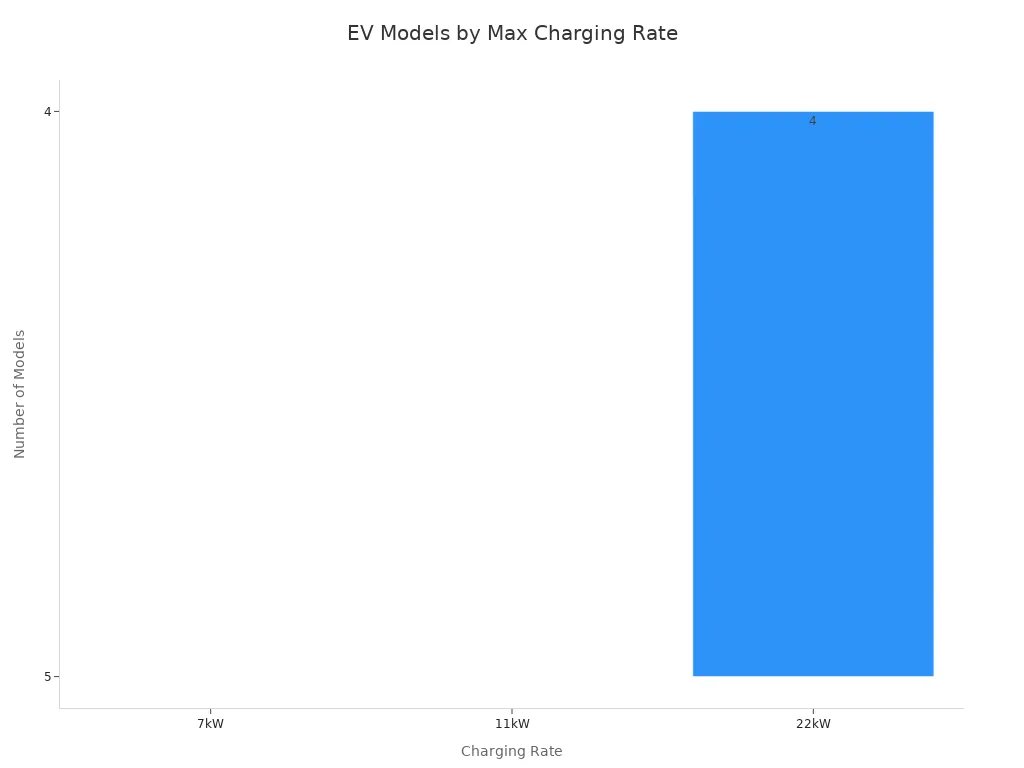
Each electric vehicle supports a specific maximum charging rate. This rate determines how quickly the battery can accept power, regardless of the charger’s capabilities. Using a charger with a higher output than the car’s maximum rate will not speed up charging. The table below shows typical maximum charging rates for popular models:
| Charging Rate | Supported Models |
|---|---|
| 7kW | Nissan Leaf, BMW i3, Mini Electric, Volkswagen ID.3, Tesla Model 3 Standard Range |
| 11kW | Tesla Model 3 Long Range and Performance, Audi e-tron, Mercedes EQC, Porsche Taycan, Volkswagen ID.4 (with upgraded charger) |
| 22kW | Renault Zoe, Smart EQ models, Mercedes EQS, Some Tesla models with the optional upgraded charger |
Manufacturer Restrictions
Manufacturers set restrictions to protect battery health and ensure safety. These limits include:
- Capping the maximum charging rate for each model.
- Adjusting charging speeds based on battery temperature and state of charge.
- Updating software to optimize charging profiles over time.
Drivers should consult their vehicle’s manual or manufacturer’s website to understand the specific charging limits for their model. Knowing these restrictions helps drivers choose the right charger and plan charging sessions more efficiently.
Home Charging Times: How Long Does It Take to Charge an EV?
Level 1 Charging (Standard Wall Outlet)
Typical Charging Time at Home
Level 1 charging uses a standard 120-volt wall outlet. This method provides a slow but steady way to charge an electric car at home. Most vehicles gain about 2 to 5 miles of range per hour. Charging a large battery from empty can require more than 30 hours. Drivers who travel short distances each day often find Level 1 charging sufficient.
- Delivers 2-5 Meilen Reichweite pro Stunde.
- Charging a large battery may take over 30 hours.
- Suits drivers with daily commutes under 40 miles.
Best Use Cases for Level 1
Level 1 charging works best for specific scenarios. Many owners choose this method for its simplicity and low cost.
- No significant upfront investment required.
- No professional installation needed.
- Ideal for plug-in hybrid electric vehicles (PHEVs).
- Fits drivers with short daily commutes.
- Overnight charging meets most needs.
Level 2 Charging (Dedicated Home Charger)
Average Charging Time for Level 2
Level 2 chargers use a 240-volt outlet and deliver faster charging speeds. Most homeowners install these units for daily use. The table below shows typical charging times and distances for Level 2 charging.
| Charging Time (Hours) | Distance Charged (Miles) |
|---|---|
| 4 | 40 |
| 24 | 73 |
Level 2 charging allows drivers to charge an electric car much faster than Level 1. Many users prefer this method for its convenience and efficiency.
Installation und Kostenüberlegungen
Installing a Level 2 home charging station involves several factors. Costs vary based on the complexity of the installation and local requirements.
- Installation costs range from $800 bis $2.500, with an average of $1,700.
- Permits typically cost between $50 and $800, averaging $310.
- New EV charging circuits or electrical upgrades often require a permit.
- Existing outlets may not need a permit.
- Additional costs can arise from electrical panel upgrades or site conditions.
Tipp: Homeowners should consult a licensed electrician before installing a Level 2 charger. This step ensures safety and compliance with local codes.
Overnight Charging and Daily Top-Ups
Full Charge While You Sleep
Overnight charging fits seamlessly into most routines. Many electric vehicle owners plug in their cars at night and wake up to a full battery. Charging at lower temperatures during the night supports battery health and longevity.
- Overnight charging aligns with daily schedules.
- Lower temperatures at night benefit battery life.
- Most drivers find their vehicles ready each morning.
Partial Top-Ups for Daily Use
Daily top-up charging offers convenience and supports battery health. Plugging in every night keeps the battery within an optimal range.
- Charging daily is safe when kept within recommended levels.
- Maintaining battery between 20% and 80% reduces stress and extends lifespan.
- Avoiding full charges except for long trips helps prevent battery degradation.
Anmerkung: Regular partial charging provides enough range for daily use and helps preserve battery performance over time.
Public Charging Times: How Fast Do Electric Cars Charge?

Öffentliche Ladestationen have transformed the way drivers charge an electric car on the go. Fast EV chargers and rapid EV chargers now offer impressive speeds, making it possible to add significant range in a short period. Understanding how fast do electric cars charge at these public charging points helps drivers plan their journeys with confidence.
DC Fast Charging and Rapid Charging
Charging Time Range for DC Fast Chargers
DC fast chargers deliver high power directly to the battery, bypassing the vehicle’s onboard charger. Most electric vehicles can reach 80% charge in under an hour at these stations. Some models achieve this in as little as 30 minutes. Charging from 20% to 80% typically takes between 20 minutes and eight hours, depending on the charger’s output and the vehicle’s battery size. Drivers who rely on fast EV chargers benefit from reduced downtime and greater flexibility during busy days.
Where to Find Fast and Ultra-Rapid Chargers
Öffentlich charging networks have expanded rapidly, making fast EV chargers and rapid EV chargers accessible in many locations. The table below highlights some of the most prominent networks and their presence:
| Gebührenerhebungsnetz | Standorte | Devices | Anmerkungen |
|---|---|---|---|
| Fastned | 26 | 150 | Best EV charging network 2025 in the Medium rapid/ultra-rapid category |
| IONITY | 37 | 270 | EV Driver Recommended title, known for reliability |
| Sainsbury’s Smart Charge | 62 | K.A. | New network with 150kW hubs linked to Nectar rewards |
| Fischadler | 380 | 1200 | High satisfaction for ease of use, rolled out most chargers in 2024 |
| Be.EV | 179 | 579 | Focus on big green hubs for a great charging experience |
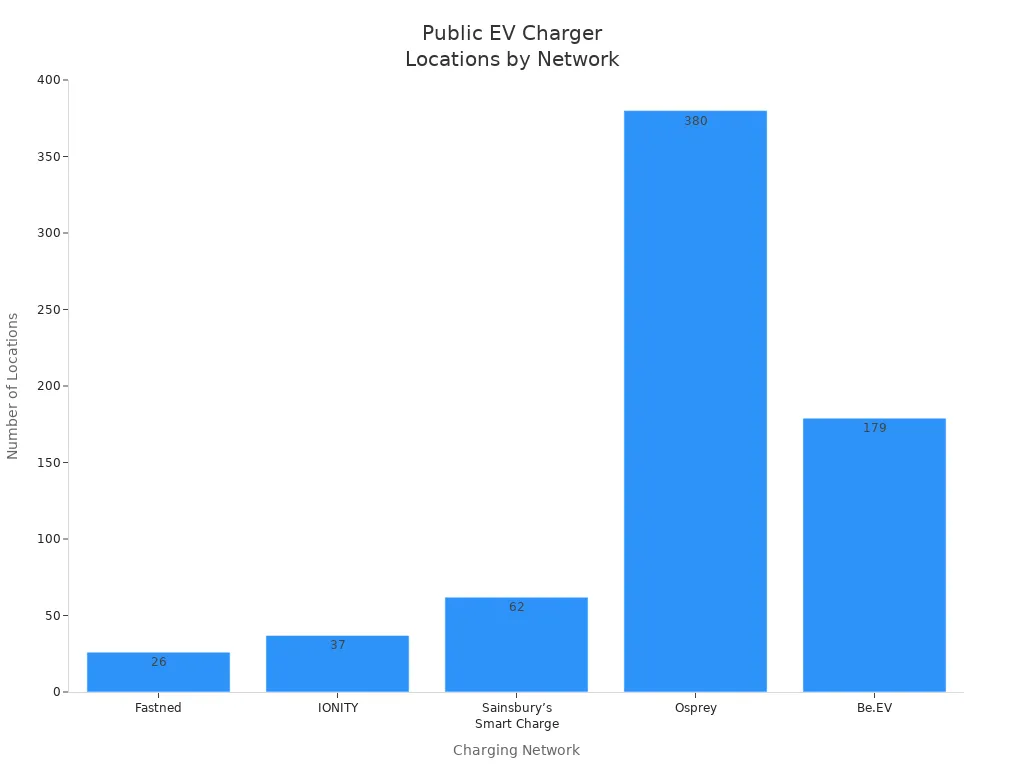
These networks place charging points at strategic locations, including highways, shopping centers, and city hubs, ensuring drivers can find a charger when needed.
Ultra-Rapid Charging Times
15-Minute Charging Scenarios
Ultra-rapid DC chargers represent the cutting edge of public charging technology. These chargers can deliver enough power to charge an electric car to 80% in just 10 to 20 minutes. Some platforms, such as the BYD Super e-Platform, push the boundaries even further. This technology enables a five-minute charge that provides up to 250 miles of range. The platform can add 1.2 miles of range per second, dramatically reducing charging time and making quick stops more productive.
- Ultra-rapid DC chargers: 80% charge in 10–20 minutes
- BYD Super e-Platform: 250 miles in 5 minutes, 1.2 miles per second
Best Use Cases for Ultra-Rapid Charging
Ultra-rapid chargers (150kW and above) serve drivers who need to minimize downtime, especially during cross-country trips. These chargers deliver power up to 150kW or even 300kW, making them the ultimate choice for those who want to get back on the road quickly. The deployment of rapid EV chargers and ultra-rapid charging points has become a gamechanger for motorists. The increased speed not only makes charging more convenient but also significantly reduces range anxiety.
| Ladegerät Typ | Leistung | Bester Anwendungsfall |
|---|---|---|
| Ultra-schnelles Ladegerät | 150kW+ | Long-distance travel, quick top-ups on highways |
| Rapid EV Charger | 50-150kW | Fast charging during errands or short stops |
Anmerkung: Ultra-rapid charging is ideal for drivers on tight schedules or those traveling long distances.
Charging While Out and About
Charging at Shopping Centers and Restaurants
Many drivers take advantage of fast EV chargers while running errands or dining out. Charging points at supermarkets, malls, and restaurants provide a convenient way to top up the battery during everyday activities.
- 26% of EV drivers charge at supermarkets.
- 22% charge while shopping or dining at malls and department stores.
- Most vehicles can gain 20–25% charge in one to two hours at these locations.
This approach allows drivers to maximize their time and keep their vehicles ready for the next journey.
Planning for Road Trips
Long road trips require careful planning to ensure a smooth experience with minimal delays. Drivers should use fast EV chargers (Level 3) for quick stops and Level 2 chargers for overnight stays at hotels or attractions. Planning with buffer time helps account for potential waits, slower charging rates, or unexpected issues. Choosing accommodations with charging points and preparing the vehicle before departure further streamlines the trip.
- Utilize fast EV chargers for quick stops.
- Use Level 2 chargers for overnight or extended stops.
- Plan buffer time for waiting or slower charging.
- Select EV-friendly hotels with charging points.
- Check real-time charger availability before leaving.
- Plan the first charging stop at 20–30% battery.
- Pack alternative charging options in case of busy stations.
- Prepare the vehicle and use energy-saving driving techniques.
- Follow charging etiquette at public stations.
Tipp: Smart planning and awareness of available charging points make long-distance travel with an electric vehicle both practical and stress-free.
Real-World Charging Time Examples for Popular Electric Cars
Charging Times for Tesla Model 3, Nissan Leaf, and Chevrolet Bolt
Home Charging Example
Charging times for electric vehicles vary based on the model and the type of charger used at home. The Nissan Leaf, with a 40 kWh battery, typically requires 35 to 40 hours to charge fully using a Level 1 outlet. A Level 2 home charger reduces this time to about 8 to 10 hours. The Tesla Model 3 Long Range, which features a larger 75 kWh battery, takes approximately 45 to 50 hours on Level 1 and 8 to 10 hours on Level 2. The Chevrolet Bolt EUV, equipped with a 65 kWh battery, needs 30 to 35 hours on Level 1 and 7 to 8 hours on Level 2. These examples show how battery size and charger type influence electric car charging times at home.
Tipp: Most drivers prefer Level 2 charging at home for overnight convenience and faster turnaround.
Public Fast Charging Example
Public fast chargers offer a significant reduction in charging times for these popular models. The Nissan Leaf can reach 80% charge in about 30 to 45 minutes at a DC fast charger. The Tesla Model 3 Long Range achieves a similar result in just 25 to 30 minutes. The Chevrolet Bolt EUV typically charges to 80% in 30 to 40 minutes. These public charging stations use higher power outputs, making them ideal for quick top-ups during busy days or long trips.
- Nissan Leaf: 30–45 minutes (DC fast charger)
- Tesla Model 3 LR: 25–30 minutes (DC fast charger)
- Chevrolet Bolt EUV: 30–40 minutes (DC fast charger)
Quick Reference Table: Charging Times by Model and Method
The table below summarizes electric car charging times for the Nissan Leaf, Tesla Model 3 Long Range, and Chevrolet Bolt EUV across different charging methods.
| Elektrofahrzeug | Batteriegröße (kWh) | Level 1 Charging Time | Level 2 Charging Time | DC Fast Charger Time |
|---|---|---|---|---|
| Nissan Leaf | 40 | 35 to 40 hours | 8 to 10 hours | 30 to 45 minutes |
| Tesla Model 3 LR | 75 | 45 to 50 hours | 8 to 10 hours | 25 to 30 minutes |
| Chevrolet Bolt EUV | 65 | 30 to 35 hours | 7 to 8 hours | 30 to 40 minutes |
This quick reference helps drivers compare electric car charging times and select the best charging method for their needs. Understanding these real-world examples allows drivers to plan their routines and road trips with confidence.
How to Estimate Your Charging Time for Any Electric Car
Simple Charging Time Formula
Step-by-Step Calculation
Drivers can estimate how long it takes to charge an electric car by using a straightforward formula. This formula considers the battery’s capacity and the actual power delivered by the charger. The calculation helps owners plan their charging sessions and avoid surprises.
Tipp: Always check the actual power output of the charger and the maximum charging rate supported by the vehicle.
The standard formula for estimating charging time is:
Charging Time (hours) = Battery Capacity (kWh) ÷ Actual Power (kW)
This formula gives a reliable estimate for most charging scenarios. However, real-world factors such as temperature, battery management systems, and charging efficiency can affect the final result.
Example Calculation for Your EV
Consider a vehicle with a 60 kWh battery using a 7 kW home charger. To calculate charging times, divide the battery size by the charger’s power:
Charging Time = 60 kWh ÷ 7 kW ≈ 8.6 hours
If the same vehicle uses a 50 kW DC fast charger, the calculation changes:
Charging Time = 60 kWh ÷ 50 kW = 1.2 hours
These examples show how charger power dramatically influences charging duration. Owners should always use the actual power delivered, not just the maximum rating, for the most accurate estimate.
Charging Time Table: Battery Size vs. Charger Power
Quick Lookup Chart for Charging Times
A charging time table serves as a quick reference for electric vehicle owners. It allows them to estimate charging durations based on various battery sizes and charger types. By understanding the interplay between battery capacity and charger output, owners can effectively plan their charging sessions and daily routines.
| Batteriegröße (kWh) | 3.7 kW Charger | 7 kW Charger | 22 kW Ladegerät | 50 kW DC Fast Charger |
|---|---|---|---|---|
| 30 | 8.1 hours | 4.3 hours | 1.4 hours | 0.6 hours |
| 40 | 10.8 hours | 5.7 hours | 1.8 hours | 0.8 hours |
| 60 | 16.2 hours | 8.6 hours | 2.7 hours | 1.2 hours |
| 80 | 21.6 hours | 11.4 hours | 3.6 hours | 1.6 hours |
Several factors influence charging time:
- Batteriegröße: Larger batteries take longer to charge.
- Aufladegeschwindigkeit: Different chargers provide varying speeds, affecting total charge time.
- Zustand der Ladung: A lower initial charge level results in shorter charging times.
- Temperatur: Colder temperatures can slow down the charging process.
- Ladeinfrastruktur: Availability of charging stations can impact waiting times.
- Vehicle Make and Model: Different vehicles have different charging capacities.
- Power Supply: The capacity of the power supply can affect charging duration.
Drivers who use these tables can quickly calculate charging times for their specific vehicle and charger combination. This approach simplifies planning and helps avoid unexpected delays.
Comparing Charging Methods: Charging Times at a Glance
Home vs. Public Charging Time Comparison
Speed Comparison
Home charging and öffentliche Abgaben offer different experiences for electric vehicle owners. Home charging allows drivers to plug in overnight, ensuring a full battery by morning. Public charging, especially at fast or ultra-rapid stations, delivers much quicker results but may require planning and travel to a charging location. In der nachstehenden Tabelle sind die wichtigsten Unterschiede aufgeführt:
| Methode der Aufladung | Bequemlichkeit | Kosten | Erreichbarkeit |
|---|---|---|---|
| Aufladen zu Hause | Plug in overnight for a full charge | Typically lower electricity rates | Best for daily use, not for travel |
| Öffentliche Abgaben | Convenient for travel, may require planning | Rates vary widely, can be more expensive | Useful for long-distance travel or when away from home |
Charging times also differ significantly. Level 1 home charging can take 10 to 40 hours for a full charge, while Level 2 reduces this to 1 to 20 hours. Public DC fast charging can replenish a battery from 20% to 80% in as little as 7 minutes, up to 2 hours for larger batteries.
Kostenvergleich
Charging at home remains the most economical option for most drivers. Home electricity rates average around 10p per kWh, resulting in a total cost of £12.00 for an 80% charge. In contrast, public fast charging can cost 50p per kWh, with rapid and ultra-rapid charging reaching up to 73p per kWh. The total cost for an 80% charge at an ultra-rapid charger can reach £35.04. The chart below illustrates these differences:
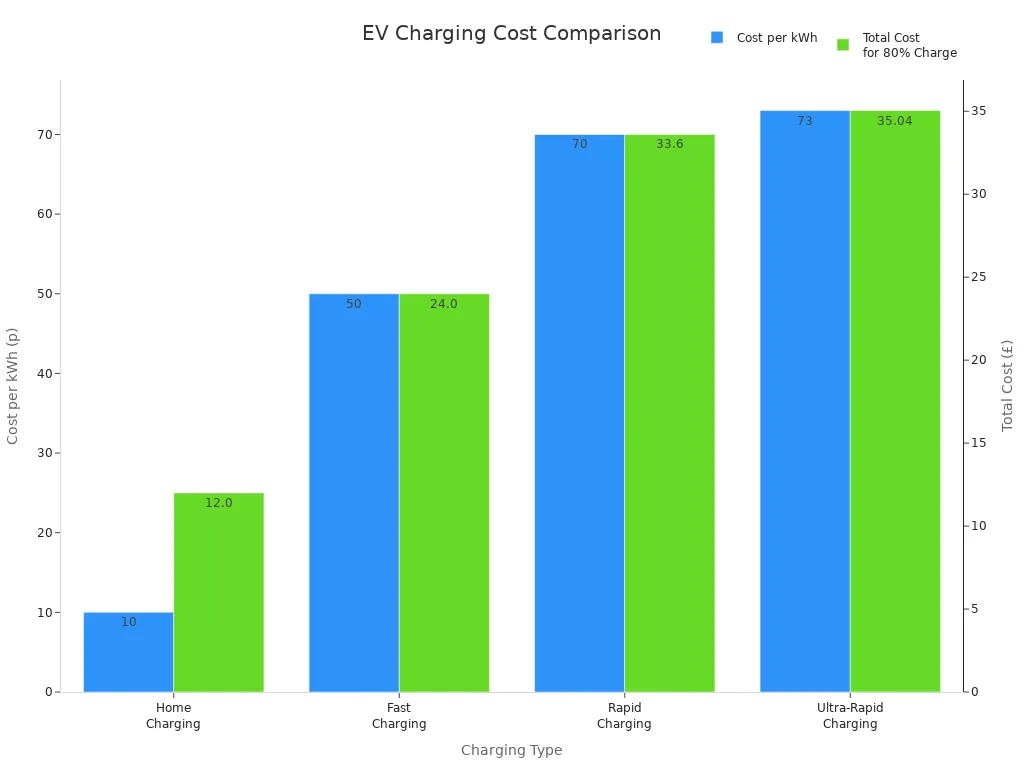
Home charging at 10p per kWh versus public charging at 55p per kWh results in a 450% increase in cost. The difference grows to 690% when comparing home charging to rapid public charging.
Fast vs. Slow Charging: Pros, Cons, and When to Use Each
Vor- und Nachteile der einzelnen Methoden
The choice between fast and slow charging depends on the driver’s needs and circumstances. The table below summarizes the main advantages and disadvantages:
| Art der Aufladung | Vorteile | Benachteiligungen |
|---|---|---|
| Schnelles Aufladen | – Reduces charging time significantly, ideal for users with tight schedules. – Convenient for long-distance travel, allowing quick battery top-ups. – Enhances accessibility as more stations are deployed. | – High setup costs for infrastructure may limit availability. – Frequent rapid charging can stress the battery, affecting lifespan. – Dependence on the availability of charging stations. |
| Langsames Aufladen | – More economical to install, suitable for home use. – Less stress on the electricity grid due to lower power usage. – Accessible without expensive equipment. | – Takes longer to charge, unsuitable for rapid recharges. – Not ideal for frequent long-distance travel. – May not be practical in high-demand public locations. |
Best Scenarios for Each Charging Type
Drivers benefit from using fast charging during long trips or emergencies. Fast charging minimizes downtime and alleviates range anxiety, making it practical for vacations and road trips. Slow charging works best for daily routines, overnight charging, and situations where time is not a constraint.
- Long Trips: Fast charging is ideal for road trips, allowing quick recharges to cover long distances efficiently.
- Emergency Situations: It provides a rapid boost when urgent travel is necessary.
- Daily Use: Slow charging at home supports regular commutes and battery health.
Quick Comparison Chart: Charging Methods and Times
The table below provides a quick reference for charging times across the most popular methods, measured from 20% to 80% state of charge:
| Methode der Aufladung | Charging Time (from 20% to 80% SoC) |
|---|---|
| Stufe 1 (AC) | 10hr – 40hr |
| Stufe 2 (AC) | 1hr – 20hr |
| Level 3 (DC) | 7min – 2hr |
Drivers can use this chart to select the best charging method for their needs and plan their schedules accordingly. Understanding these differences in charging times helps maximize convenience and minimize costs.
Tips to Reduce Charging Time and Make Charging Easier
Maximizing How Fast Your Electric Car Charges
Die Wahl des richtigen Ladegeräts für Ihre Bedürfnisse
Selecting the optimal charging solution can significantly reduce charging time. Level 2 chargers, which use a 240-volt outlet, provide a faster and more efficient charging experience for daily use compared to Level 1 chargers. Drivers who frequently travel long distances or require quick turnarounds benefit from installing a Level 2 charging solution at home or seeking out high-power öffentliche Ladestationen. The location of chargers also impacts convenience and speed. The table below outlines the benefits of different charger locations:
| Standort Typ | Vorteile |
|---|---|
| Highways and Rest Stops | Continuous traffic from long-haul travelers, reducing range anxiety. |
| Urban Centers | High density of offices and retail spaces ensures a steady flow of drivers. |
| Retail Hubs | Attracts drivers combining errands with charging, benefiting local businesses. |
| Residential Areas | Addresses needs of EV owners without home chargers. |
| Arbeitsstätten | Regular customer base during work hours ensures predictable usage. |
| Tourist Destinations | Attracts both local users and tourists, increasing exposure and utilization. |
Drivers should match their charging solution to their lifestyle and typical driving patterns for maximum efficiency.
Aufladen außerhalb der Hauptgeschäftszeiten
Charging during off-peak hours not only saves money but also helps reduce charging time due to lower grid demand. Many utilities offer discounted rates for charging at night or during periods of low electricity usage. Automated scheduling features in most electric vehicles allow drivers to program charging sessions to start during these times. Participating in utility programs or responding to real-time pricing can further optimize costs and efficiency.
Tipp: Check your utility provider’s website for off-peak hours or contact customer service if the information is not available online. Using mobile apps to control charging remotely makes it easy to set desired charging times.
Planning Your Charging Routine for Convenience
Scheduling Charging Sessions
A consistent charging routine ensures the vehicle is always ready when needed. Drivers should assess their typical daily mileage and determine how much charge to add each night. Scheduling charging to complete just before departure maximizes battery efficiency and takes advantage of a naturally warmed battery after driving. Maintaining the battery between 20% and 80% for daily use helps preserve battery health and avoids unnecessary long charging sessions.
- Maintain battery charge between 20% and 80% for daily use.
- Avoid frequent charging to 100% unless preparing for a long trip.
- Schedule charging to finish before the next drive.
Preconditioning the battery while connected to power optimizes temperature and improves charging speed, especially in extreme weather.
Using Charging Apps and Tools
Charging apps and tools simplify the process of finding available charging points and managing charging sessions. These apps provide real-time information on charger availability, pricing, and estimated charging times. Many allow users to start, stop, or schedule charging remotely. Drivers who use these tools can plan routes, avoid busy stations, and ensure their vehicle receives the right amount of charge without overcharging.
- Familiarize yourself with your vehicle’s charging options and features.
- Use scheduling features to take advantage of off-peak rates.
- Enable eco mode to optimize charging and vehicle performance.
Consistent use of these strategies streamlines the charging experience and minimizes downtime.
Charging time for electric cars depends on battery size, charger type, and charging method. Drivers who install a home charging station enjoy overnight convenience, while public fast charging stations offer quick boosts for busy schedules. Key takeaways for electric vehicle owners include:
- Charging times vary with battery and charger.
- Partial recharges often save time and support battery health.
- Home wallbox chargers add 30-40 miles per hour, ideal for daily top-ups.
- Charging network apps help plan efficient routes.
- Preconditioning the battery before rapid charging improves efficiency.
With these strategies, anyone can confidently charge an electric car and plan stress-free trips.
FAQ
Wie lange dauert es, ein Elektroauto zu Hause aufzuladen?
Charging at home with a Level 2 charger usually takes 8 to 12 hours for a full battery. Level 1 charging from a standard outlet may require 24 hours or more, depending on battery size.
Can you charge an electric car in the rain?
Yes, electric vehicles and charging stations have weatherproof designs. Charging in the rain remains safe due to built-in safety features and strict industry standards.
Does frequent fast charging damage the battery?
Frequent use of DC fast charging can accelerate battery wear over time. Most manufacturers recommend using fast charging for occasional top-ups and relying on slower charging for daily use.
What is the best time to charge an electric car?
Charging during off-peak hours, typically overnight, reduces electricity costs and supports grid stability. Many utilities offer lower rates at night, making this period ideal for most drivers.
How much does it cost to charge an electric car?
Home charging costs average between $0.10 and $0.20 per kWh. Public fast charging rates vary, often ranging from $0.30 to $0.60 per kWh. Actual costs depend on location and provider.
Can all electric cars use any public charger?
Not all electric vehicles support every charger type. Compatibility depends on the vehicle’s charging port and the station’s connector. Drivers should check their car’s specifications before using a new charging network.
Is it necessary to charge to 100% every time?
Charging to 100% is not necessary for daily driving. Most experts recommend keeping the battery between 20% and 80% to extend battery life and maintain optimal performance.
How do you find nearby charging stations?
Drivers can use mobile apps, in-car navigation, or online maps to locate nearby charging stations. Many apps provide real-time availability, pricing, and directions for added convenience.