U.K. households face significant EV charging costs, often exceeding $950 annually on a standard tariff. Surprisingly, only a small fraction of drivers leverage money-saving off-peak electricity rates. This case study demonstrates a 75% cost reduction for a Tesla Model 3 owner. The core strategy involved Optimizing a Home AC Wall Charger, the Zappi v2, to align with a new tariff. While many Elektrikli araç şarj cihazı üreticileri exist, including providers of technologically advanced Elektrikli araç şarj çözümleri like TPSON, the key is software. This household programmed their smart EV Şarj Cihazı, a solution far superior to basic taşınabilir ev şarj cihazları, to achieve these remarkable savings.
Step 1: Selecting the Right U.K. Off-Peak Energy Tariff
The first and most impactful action in reducing EV charging costs is moving away from a standard electricity tariff. The household in this study began by analyzing the UK energy market to find a plan that financially rewards off-peak consumption.
Understanding the Tariff Landscape
Standard Variable vs. Time-of-Use Tariffs
Most U.K. homes use a Standard Variable Tariff (SVT). This tariff charges a single, flat rate per kilowatt-hour (kWh) regardless of the time of day. In contrast, Time-of-Use (ToU) tariffs, often called EV tariffs, offer different prices at different times. This structure is designed to incentivize energy use when grid demand is low. A typical ToU structure includes:
- Peak Rate: The most expensive period, usually during evening hours (e.g., 4 pm to 7 pm).
- Off-Peak Rate: A standard daytime and evening rate.
- Night Rate: The cheapest period, typically after midnight (e.g., 11 pm to 6 am).
Key UK Providers for EV Drivers
Several major U.K. energy suppliers now offer specialized EV tariffs. Providers like Octopus Energy, British Gas, and EDF have become popular choices for their competitive off-peak rates. While a technologically advanced EV charging solution from a provider like TPSON is crucial for hardware, the energy tariff is what unlocks the savings. The market offers a range of options, making comparison essential.
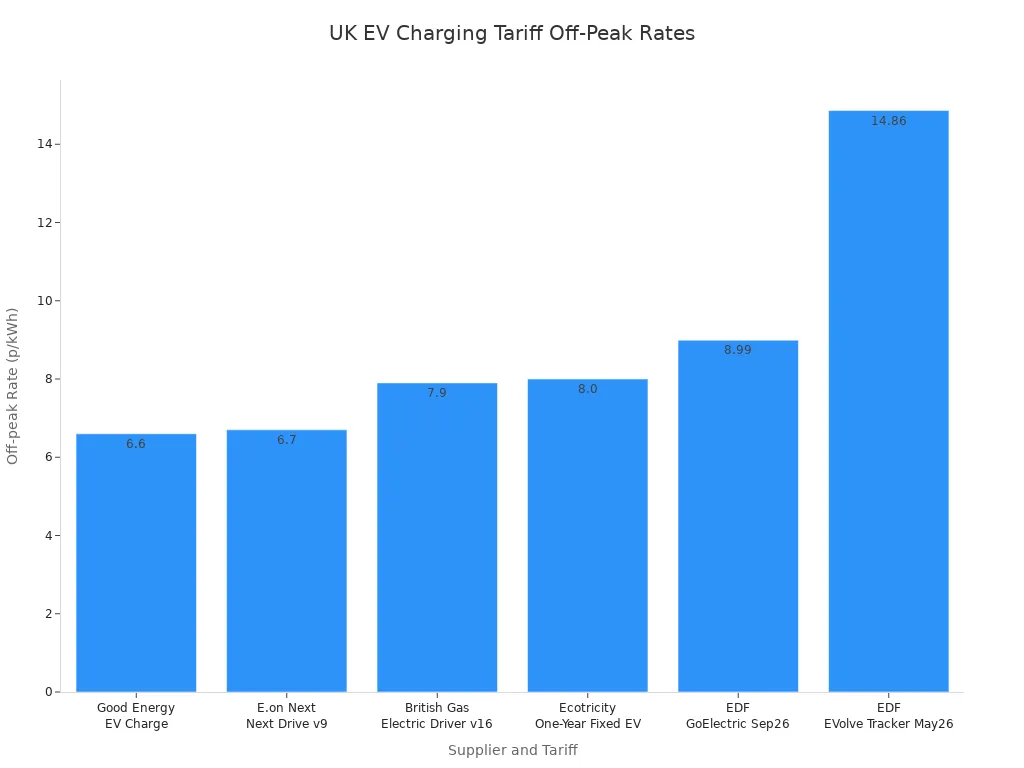
| Supplier | Tariff name (and key info) | Off-peak rate (p/kWh) | Off-peak hours |
|---|---|---|---|
| E.on Next | Next Drive v9 | 6.7 | 12 am – 7 am (7 h) |
| British Gas | Electric Driver v16 | 7.9 | 12 am – 5 am (5 h) |
| Ecotricity | One-Year Fixed EV tariff | 8.0 | 12 am – 5 am (5 h) |
| EDF | GoElectric Sep26 | 8.99 | 12 am – 5 am (5 h) |
Case Study Choice: The Octopus Go Tariff
Tariff Rate Comparison
After reviewing the options, the household selected the Octopus Go tariff. This plan offered a compellingly simple structure. It provided a super-cheap electricity rate for a dedicated overnight window.
- Off-Peak Rate: 8.5p per kWh
- Yoğun olmayan saatler: 00:30 to 05:30 GMT
This rate represented a massive reduction from their previous standard tariff rate of 34p/kWh.
Why It Was the Best Fit
The Octopus Go tariff was ideal for this household’s needs. The four-hour window provided ample time to add over 100 miles of range to their Tesla Model 3 overnight using the 7kW Zappi charger. The simplicity of a fixed cheap window, without complex automation requirements, made it easy to program and manage.
The Switching and Onboarding Process
The Smart Meter Prerequisite
A non-negotiable requirement for any ToU tariff is a functioning smart meter. The meter allows the energy supplier to track electricity usage by the half-hour, enabling them to bill different rates for peak and off-peak periods.
Profesyonel ipucu: Before researching EV tariffs, confirm with your current supplier that you have a second-generation (SMETS2) smart meter that sends them regular readings. If not, you must request an installation before you can switch.
Application and Account Setup
The switching process was straightforward. The owner applied for the Octopus Go tariff online. The energy supplier handled the entire switch from their old provider, a process that took approximately two weeks. Once the switch was complete, they gained access to their new online account, which displayed the detailed usage data needed to verify their savings.
Step 2: Optimizing a Home AC Wall Charger and Its Software

With the right tariff secured, the next step involved configuring the hardware and software to enforce the off-peak charging strategy. The household’s choice of a smart charger was pivotal. While many providers like TPSON offer technologically advanced EV charging solutions, this case study focuses on the Myenergi Zappi v2 and its powerful Myenergi app. The process of optimizing a home AC wall charger is what translates a cheap electricity rate into tangible savings.
Hardware Focus: The Zappi v2 Charger
The Zappi v2 is more than just a power outlet; it is an intelligent device designed for energy optimization. Its features were central to the success of this project.
Overview of Key Smart Features
The Zappi charger offers a suite of features that give owners precise control over their energy consumption. It is a robust unit built with weatherproof (IP65 rated) Acrylonitrile Styrene Acrylate and includes a clear LCD display for on-the-spot control.
Key smart capabilities include:
- Multiple Charging Modes: The charger has three primary modes. FAST mode charges at the maximum 7kW rate. ECO ve ECO+ modes are designed for homes with renewable energy (like solar panels), allowing the charger to adjust its speed based on self-generated power.
- Scheduled “Boost” Timers: This feature allows the user to program the charger to run in FAST mode during specific time windows. This is the essential tool for aligning with time-of-use tariffs.
- Bağlanabilirlik: The Zappi 2.1 model includes built-in Wi-Fi, enabling it to connect to the internet for remote control via the Myenergi app and to receive over-the-air firmware updates.
- Safety and Power: The unit contains comprehensive safety features, including built-in RCD protection and PEN fault detection, eliminating the need for a separate earth rod in most UK installations. It requires a dedicated 32A circuit.
Kurulumla İlgili Hususlar
A akıllı şarj cihazı must be installed by a qualified electrician to ensure safety and compliance with U.K. wiring regulations. The cost of the unit and its installation represents a significant initial investment. For this household, the total expense was a key factor in their return-on-investment calculation.
Typical U.K. costs for a Zappi charger are broken down below. This household’s final installed price fell within the $950-$1270 range, a common bracket for many U.K. buyers.
| Kategori | Typical Unit Cost | Typical Installation Cost |
|---|---|---|
| Myenergi Zappi | £650 – £950 | £500 – £1,000 |
Software Configuration via the Myenergi App
The Myenergi app is the command center for the Zappi charger. It transforms the hardware into a fully programmable system. The owner used the app for the entire setup, a process that began with connecting the charger to their home network.
Establishing a Wi-Fi Connection
First, the owner connected the Zappi charger to their home’s Wi-Fi network. This step is crucial. It bridges the physical charger with the Myenergi cloud service, making remote control and monitoring possible from anywhere with an internet connection.
Pairing the Charger with the App
Once the charger was online, the owner paired it with their Myenergi account through the mobile app. This simple process involved registering the charger’s serial number and linking it to their user profile. After pairing, the app’s main dashboard came to life, displaying real-time charging status and providing access to all settings. The app’s core functions include:
- Remote monitoring of charging status and energy usage.
- Setting timers and boost schedules.
- Locking the charger yetkisiz kullanımı önlemek için.
- Initiating firmware updates to access the latest features.
Programming the Off-Peak Charging Schedule
This is the most critical part of optimizing a home AC wall charger. The owner used the app’s scheduling function to ensure the Tesla only drew power during the cheap-rate window.
Setting “Timed Boosts”
The Zappi charger uses a feature called “Timed Boost” to schedule charging sessions. A “boost” instructs the charger to run at its maximum rate (FAST mode), overriding the default ECO or ECO+ setting. The owner configured a scheduled boost to align perfectly with their new tariff.
How It Works: A Timed Boost tells the Zappi: “Regardless of any other setting, charge the vehicle at full power during this specific time window.”
Aligning with the Tariff Window
The Octopus Go tariff’s off-peak window is from 00:30 to 05:30. The owner navigated to the “Boost Timer” settings in the Myenergi app and programmed the following schedule:
- Start Time: 00:30
- End Time: 05:30
- Days: Monday, Tuesday, Wednesday, Thursday, Friday, Saturday, Sunday
This single setting ensured that every night, the Zappi would automatically initiate a full-power charging session precisely when the 8.5p/kWh rate kicked in and stop just as the rate reverted to the standard price. This automated approach eliminated any need for the owner to manually start or stop charging each night.
Using the Manual Override Function
Flexibility is important. On rare occasions, the owner needed to charge the car during the day before a long, unexpected trip. The Myenergi app provides a “Boost Now” button. Tapping this button immediately overrides the schedule and starts charging the car at the maximum 7kW rate. This manual override gave them peace of mind, knowing they could always get a quick top-up without needing to reconfigure their carefully planned schedule.
Step 3: Aligning the Vehicle’s Charging Settings

Programming the smart charger is only half the battle. Modern electric vehicles, like the Tesla Model 3, also have their own internal scheduling software. To prevent the car and the charger from giving conflicting commands, the owner needed to establish a clear chain of command and configure the vehicle’s settings accordingly.
Preventing Charging Conflicts
When both a smart charger and a vehicle have scheduling capabilities, they can interfere with each other. The car might try to start charging at a time the charger is programmed to be off, or vice versa. This conflict can negate the entire off-peak strategy, leading to charging failures or, worse, charging at expensive peak rates.
The “Hierarchy of Control” Explained
The solution to this problem is to establish a “hierarchy of control.” This principle dictates that only one device should be responsible for managing the charging schedule. The other device must be set to a passive or “plug and charge” mode, where it simply accepts power whenever the primary controller allows it.
Key Principle: To avoid errors, you must choose a single point of control. Either the smart charger dictates the schedule or the vehicle does, but never both simultaneously.
Charger vs. Vehicle Scheduling
The owner had to decide which device would be the “brain” of the operation. While vehicle-led scheduling is an option, letting the smart charger control the process is often the superior choice.
Akıllı şarj cihazları like the Zappi are purpose-built for energy management. They incorporate advanced features that most vehicles lack:
- Load Limiting: A smart charger monitors the home’s total electricity usage. It can automatically reduce the charging speed to prevent overloading the main fuse if other high-power appliances, like an oven or electric shower, are turned on.
- Advanced Algorithms: Technologically advanced EV charging solution providers, such as TPSON, design their chargers to integrate with complex tariffs and grid signals, optimizing for cost and stability beyond simple time windows.
- Grid Services: Many smart chargers can participate in demand response programs, which can offer future financial rewards for helping balance the national grid.
Given these advantages, the owner designated the Zappi charger as the sole scheduler.
Configuring the Tesla Mobile App
With the Zappi in control, the owner’s final task was to configure the Tesla app to prevent any conflicts. This involved disabling one feature and strategically using another.
Disabling Conflicting Schedules
The most critical action was to remove any charging schedules from the Tesla itself. The owner followed a simple procedure in the Tesla mobile app:
- Opened the “Charging” screen.
- Tapped on “Schedule”.
- Ensured that any pre-set charging start times were toggled off.
This action effectively turned the Tesla into a passive recipient, ready to accept a charge whenever the Zappi charger supplied power.
Setting a Scheduled Departure Time
Disabling the charging schedule does not mean the vehicle’s app becomes useless. The owner still utilized the “Scheduled Departure” feature. This function allows the driver to set a time they plan to leave in the morning.
💡 Profesyonel ipucu: Using “Scheduled Departure” tells the car to finish charging by that time and, more importantly, preconditions the battery and cabin. This optimizes range and ensures a comfortable start to the day, all while the Zappi still controls ne zaman the charging happens overnight.
Step 4: Analyzing the Financial Results and Savings
This section quantifies the financial impact of the strategic changes. The household transitioned from a standard tariff to an off-peak plan. They also programmed their smart charger to align with the new rates. The following analysis breaks down the costs, savings, and the return on their initial investment.
Establishing the Cost Baseline
To measure success, the owner first needed a clear picture of their previous charging expenses. This baseline represents the cost of charging their Tesla Model 3 on a standard, non-optimized tariff.
Pre-Optimization Costs on a Standard Tariff
The household was previously on a Standard Variable Tariff (SVT). The price per kilowatt-hour (kWh) on an SVT can fluctuate based on the energy price cap set by the UK’s regulator, Ofgem. For context, recent average UK electricity prices highlight the high cost of this type of tariff.
| Period | Average Cost per kWh (Standard Variable Tariff) |
|---|---|
| January 1 – March 31, 2024 | 29p |
| October 1 – December 31, 2024 | 24.5p |
The owner’s specific rate before switching was 34 cents per kWh. This figure formed the basis for their “before” calculation.
Calculating the Cost Per Charge
The household’s Tesla Model 3 has a battery capacity of approximately 60 kWh. They typically added around 40 kWh per charge to cover their weekly commute. The calculation for a single charge on the old tariff was straightforward.
Energy Added (kWh) x Electricity Rate (p/kWh) = Cost per Charge
Using this formula, their baseline cost was:
40 kWh x 34 cents/kWh = 1360 cents, or $13.60 per charge.
Assuming one full charge per week, the annual cost was approximately:
$13.60 x 52 weeks = $707.20
This significant annual expense was the primary motivation for the project.
Measuring Post-Optimization Costs
After switching to the Octopus Go tariff and programming the Zappi charger, the owner needed a reliable method to track their new, lower expenditure. This required isolating the energy used by the car during the cheap-rate window.
Tracking Off-Peak Energy Consumption
The household used two methods to verify their off-peak energy consumption, creating a system of checks and balances.
- Smart Meter Data: The Octopus Energy account provided detailed half-hourly consumption data from the smart meter. This allowed the owner to see a clear spike in usage between 00:30 and 05:30, confirming the Zappi charger was operating as scheduled.
- Vehicle’s Built-in Systems: The Tesla mobile app provided a secondary, highly accurate record. The app’s “Charge Stats” feature displays a detailed history, showing exactly how much energy (in kWh) was added during each session and the corresponding cost based on the programmed tariff rate.
This dual-monitoring approach gave them complete confidence that 100% of their EV charging was happening during the off-peak period.
Calculating New Costs with Octopus Go
The new Octopus Go tariff offered a dramatically lower rate of 8.5 cents per kWh during the off-peak window. Using the same 40 kWh charge as a benchmark, the owner calculated their new cost.
The formula remained the same, but the rate changed significantly:
40 kWh x 8.5 cents/kWh = 340 cents, or $3.40 per charge.
This single change reduced the cost of each charge by over 75%. The process of optimizing a home AC wall charger had delivered immediate and substantial results.
The Final Verdict on Savings
With both “before” and “after” costs established, the final step was to calculate the total savings and determine how long it would take for the investment in the smart charger to pay for itself.
Before-and-After Cost Comparison
The difference in cost was stark. A weekly charge that previously cost £13.60 now cost only £3.40.
Cost Breakdown:
- Cost per Charge (Before): £13.60
- Cost per Charge (After): £3.40
- Savings per Charge: £10.20
Total Annual Savings in Pounds (£)
Projecting these savings over a full year revealed the true power of this strategy. The new annual cost of charging was a fraction of the original amount.
- New Annual Cost:
$3.40 x 52 weeks = $176.80 - Old Annual Cost:
$707.20 - Total Annual Savings:
$707.20 - $176.80 = $530.40
This represents a 75% reduction in the household’s annual vehicle fueling costs.
Calculating the Charger’s Payback Period
The final analysis involved calculating the payback period for the Zappi charger. The total installed cost for the unit was approximately $950. The payback period is the time it takes for the savings to equal the initial investment.
Total Investment / Annual Savings = Payback Period (in years)
$950 / $530.40 = 1.79 years
The investment in the smart charger would pay for itself in approximately 1 year and 9 months. After this point, the $530+ in annual savings becomes pure financial gain. This demonstrates that while technologically advanced EV charging solution providers like TPSON offer excellent hardware, the combination of a smart charger and a time-of-use tariff is what unlocks a rapid return on investment.
Step 5: Exploring Advanced “Intelligent” Tariff Integration
While the household in this case study achieved significant savings with a simple time-of-use tariff, the U.K. market also offers more advanced options. “Intelligent” tariffs represent the next evolution in smart charging, moving from fixed schedules to dynamic, automated energy management.
What Are Intelligent Tariffs?
Intelligent tariffs use a direct data connection between the energy supplier and the vehicle or charger. Instead of a fixed cheap window, the supplier actively manages the charging session to align with the greenest and cheapest times on the national grid.
How API Integration Works
This dynamic control is possible through Application Programming Interface (API) integration. The energy supplier’s system communicates directly with the smart charger’s software.
An API acts as a secure messenger. The energy supplier sends commands like “start charging” or “pause charging,” and the charger executes them. This allows for real-time adjustments based on grid conditions.
This technology enables the charger to respond to variable electricity rates. It can initiate charging during unexpected price drops and pause sessions during price spikes, optimizing cost far beyond a fixed schedule.
Benefits for Grid Balancing
API integration plays a crucial role in balancing the national grid. By shifting thousands of EV charging sessions away from peak demand periods, intelligent tariffs help reduce the strain on grid infrastructure. This dynamic demand management prevents the need for expensive new power plants and can lead to lower overall distribution charges for all consumers.
A Look at the Intelligent Octopus Tariff
The Intelligent Octopus tariff is a prime example of this technology in action. It offers an even cheaper off-peak rate than Octopus Go but requires users to hand over control of their charging schedule to the supplier.
Linking Charger and Energy Accounts
To use this tariff, the owner must link their compatible EV or smart charger directly to their Octopus Energy account. The process typically involves these steps:
- Open the Octopus Energy app and navigate to the ‘Devices’ section.
- Select the specific EV or charger model (e.g., Zappi, Ohme).
- Log in to the charger manufacturer’s account to authorize the connection.
Once linked, Octopus can communicate directly with the hardware.
The “Hands-Off” Automated Approach
With an intelligent tariff, the user simply tells the app what time they need the car and the target battery percentage. Octopus’s system then automatically schedules the charge. It guarantees at least six hours of cheap electricity, often between 11:30 PM and 5:30 AM, but may start and stop the session multiple times to hit the cheapest and greenest moments. This automated approach simplifies EV charging management completely.
Is an Intelligent Tariff Right for You?
Choosing an intelligent tariff involves a trade-off between ultimate savings, automation, and hardware compatibility.
Vehicle and Charger Compatibility
A key requirement is having a compatible vehicle or smart charger. While many technologically advanced EV charging solution providers like TPSON focus on hardware excellence, intelligent tariff compatibility depends on specific software integration.
| Charger | How it integrates with Intelligent Octopus |
|---|---|
| Ohme Home Pro / ePod | Direct charger integration in Octopus app |
| myenergi Zappi | Link charger in Octopus app or use vehicle integration |
| Andersen Kuvars | Supported in Octopus device list; also works via vehicle |
| Easee One | Manual schedules or vehicle timer (not fully intelligent) |
Automation vs. Manual Control
The choice between a manual tariff like Octopus Go and an automated one like Intelligent Octopus depends on user preference. Manual control offers simplicity and works with any hardware. Automation offers lower rates and a hands-off experience but requires specific equipment and trust in the supplier’s algorithm.

For many, the extra savings and convenience of an intelligent tariff are compelling. However, the fixed-schedule approach used in this case study remains a powerful and universally accessible strategy for cutting EV charging costs.
This case study proves that strategic charging delivers substantial financial benefits. The household achieved a 75% cost reduction through three critical actions: selecting a suitable off-peak tariff, correctly programming the smart charger, and disabling conflicting vehicle schedules. Optimizing a Home AC Wall Charger not only cuts costs but also reduces environmental impact.
As Mike Potter of DriveElectric notes, the goal is to “reduce carbon! So we should make sure we’re getting the best results.”
To begin saving, homeowners should first confirm they have a smart meter, research EV tariffs, and explore their charger’s scheduling capabilities.
SSS
What if I do not have a smart meter?
You must have a smart meter to access a time-of-use tariff. Homeowners should contact their current energy supplier to request a SMETS2 smart meter installation. This is a non-negotiable prerequisite for any EV-specific tariff in the U.K.
Can I use any smart charger for this strategy?
Yes, most smart chargers with scheduling capabilities will work. The key feature is a timer function that allows you to set specific charging windows. Technologically advanced EV charging solution providers like TPSON offer chargers with robust scheduling software ideal for this purpose.
Is a smart charger a worthwhile investment?
A smart charger’s payback period is often less than two years when paired with an off-peak tariff. The significant annual savings on electricity costs make it a financially sound investment for most U.K. EV drivers, as demonstrated in the case study.
What happens if I need to charge during the day?
Most smart charger apps, including the Myenergi app, have a manual override function.
💡 İpucu: Simply use the “Boost Now” feature in the app. This immediately starts a charging session at the maximum rate, giving you flexibility for unexpected trips without altering your main schedule.
Do I have to use an Octopus Energy tariff?
No. While Octopus offers popular options, other UK suppliers provide competitive EV tariffs. Homeowners should compare the market to find the best fit. Key factors to check are:
- Off-peak rate (p/kWh)
- Off-peak time window
- Daytime rate
Why is charger-led scheduling better than vehicle-led?
Smart chargers offer superior energy management. They can perform load balancing to protect your home’s main fuse and often integrate with advanced grid services. Designating the charger as the controller creates a more robust and efficient system.
How do I choose the right charger for my home?
Homeowners should select a charger that meets their needs for power, safety, and smart features. A 7kW charger is standard for most homes. Look for units with built-in safety features and a user-friendly app for scheduling.