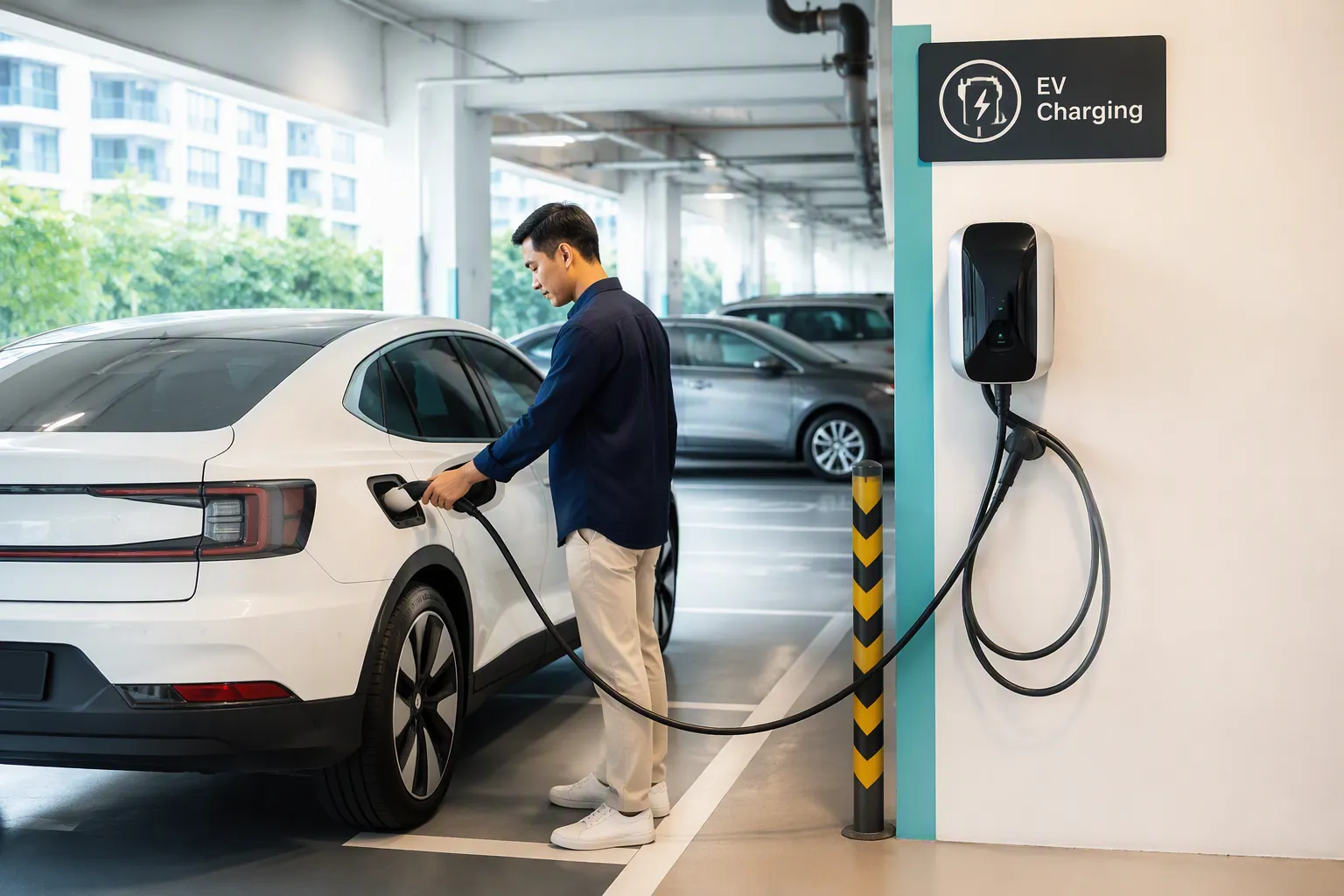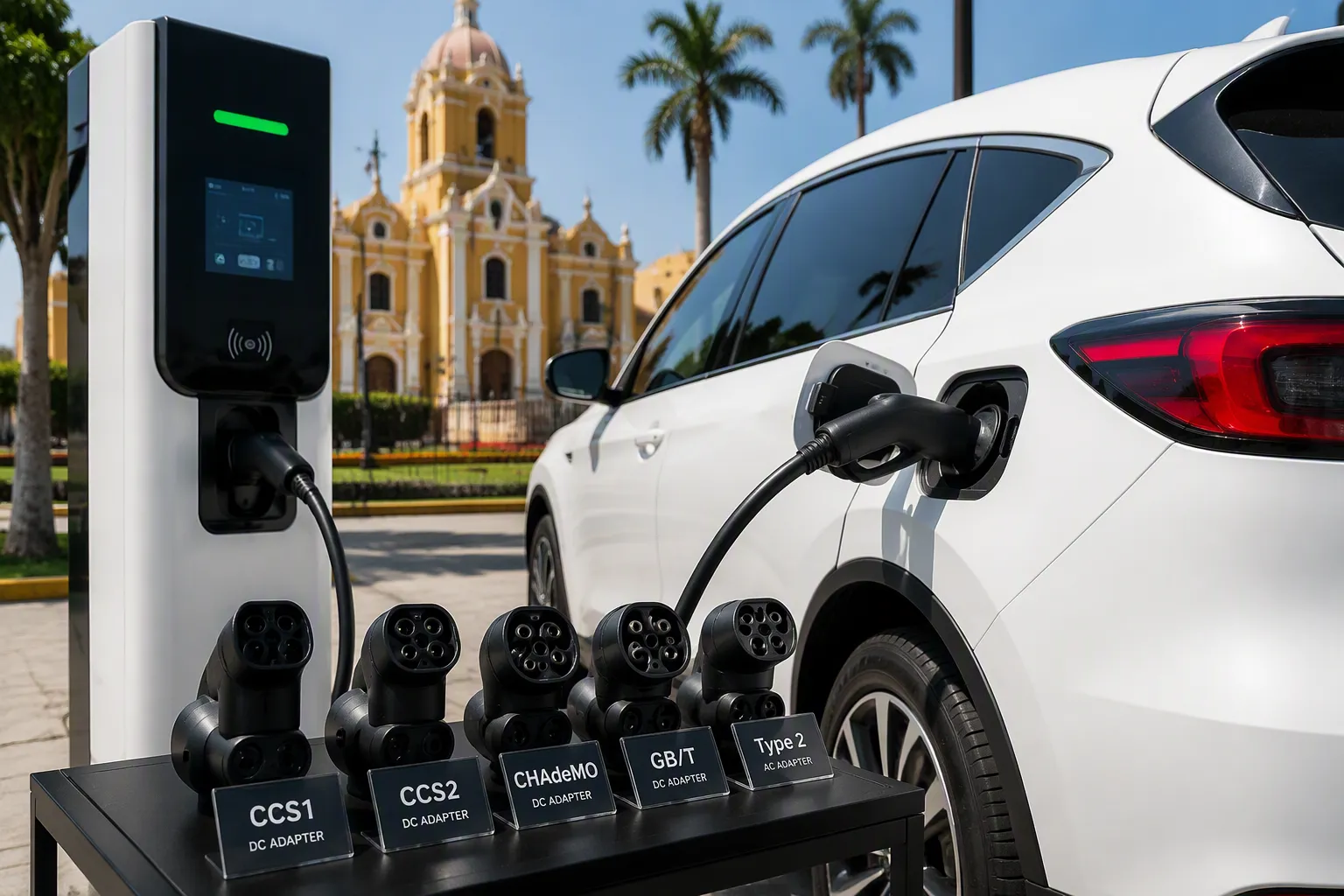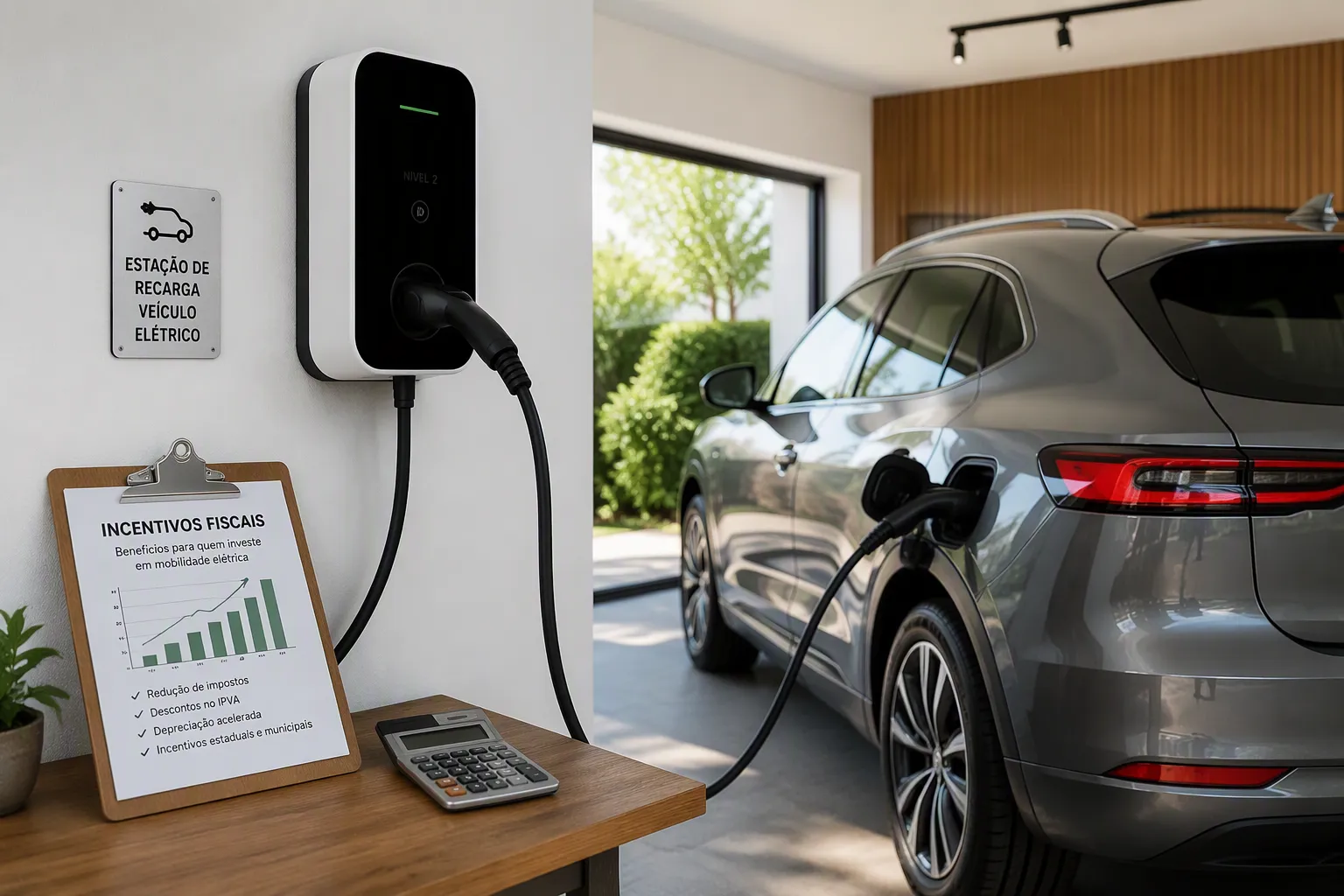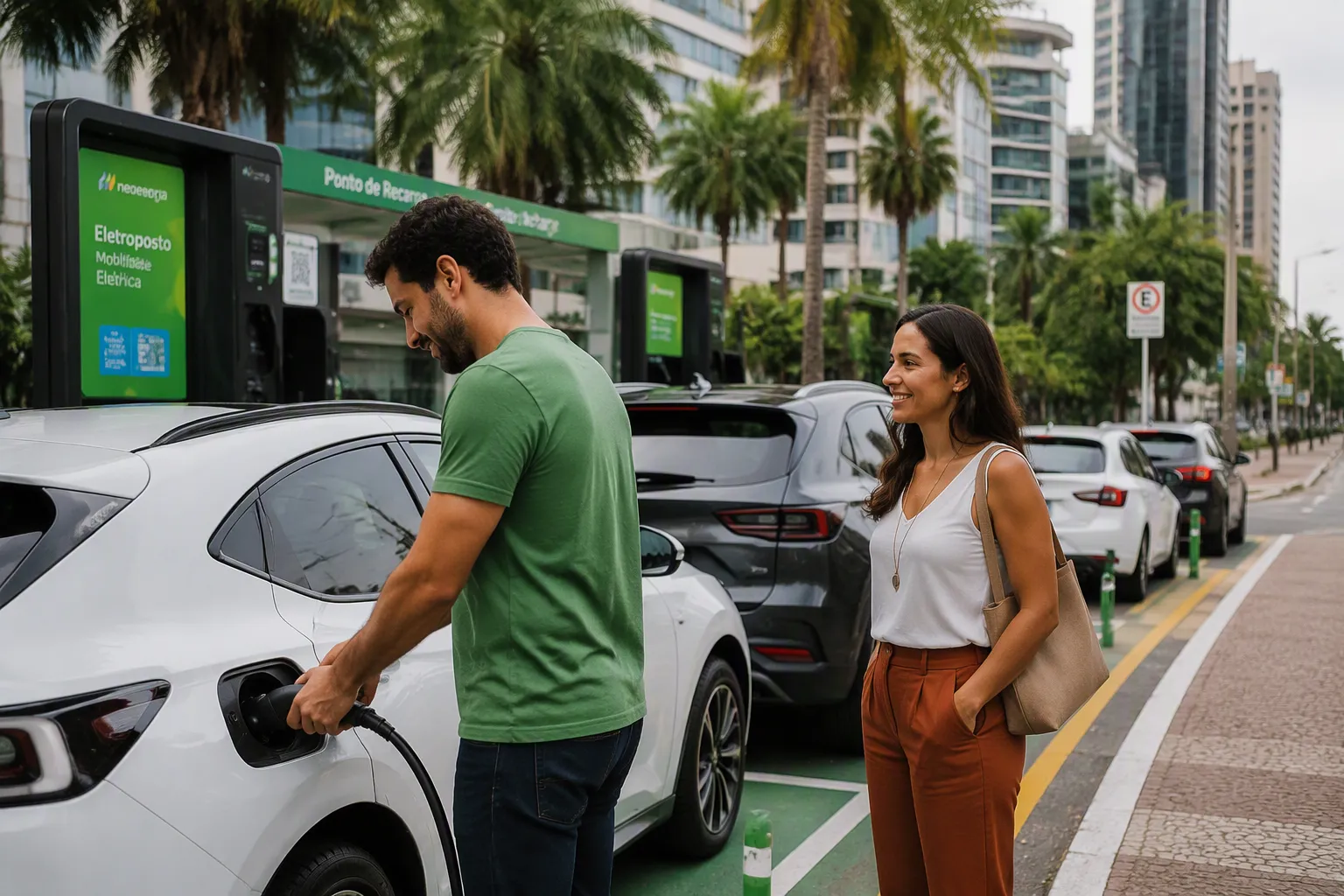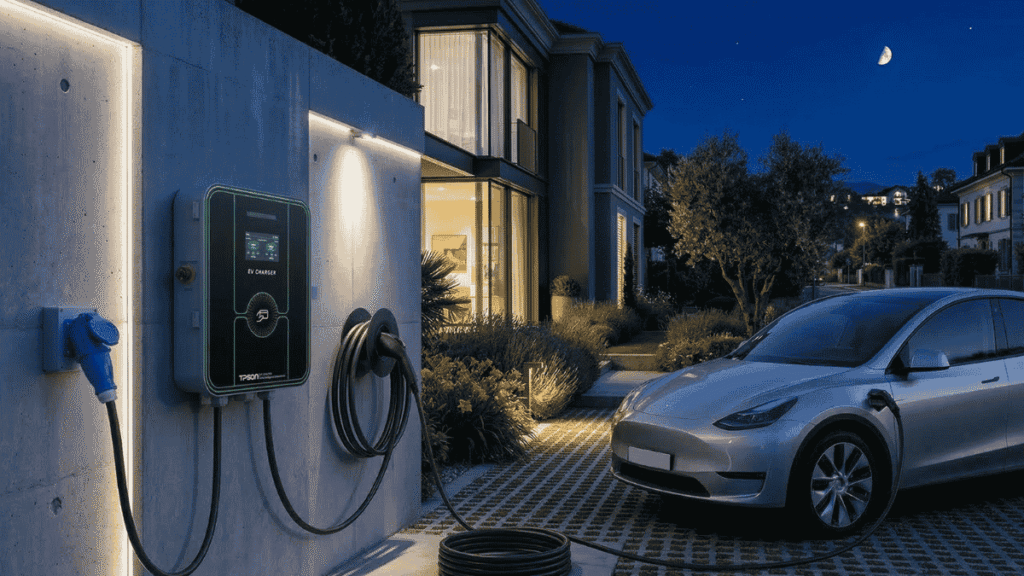
A 22 kW EV charger is often described as a major upgrade from standard home charging, delivering much faster AC replenishment than lower-power Level 2 options. But while 22 kW AC charging is common and practical in some global markets—especially where three-phase power is available—it is not automatically the best fit for every residential property. Whether it makes sense depends on your local electrical system, the vehicle’s onboard AC charging capability, installation cost, and how much charging speed you actually need.
This guide explains what a 22 kW EV charger is, how it compares with lower-power home chargers, what kinds of residential scenarios can realistically support it, and why AC charging intelligence can matter as much as raw output. The discussion is based on the supplied source material from TPSON, ChargePoint, Smart Charge America, Emporia, Love’s, and Car and Driver.
- What Is a 22 kW EV Charger?
- Why 22 kW Chargers Matter in the Global Market
- 22 kW vs. Common Home-Charging Power Levels
- Core Requirements for Using 22 kW at Home
- Why the Vehicle’s Onboard AC Charging Capability Determines Everything
- Is 22 kW Right for a Typical Home?
- What to Consider When Installing a 22 kW AC Charger
- Why Smart Load Management Is Even More Critical at 22 kW
- How TPSON Positions 22 kW AC Charging
- 22 kW AC vs. Home DC Fast Charging
- Who It’s For and Buying Recommendations
- Conclusão
A 22 kW EV charger typically refers to a high-power AC charging device, commonly found in markets that use three-phase electrical systems. Compared with the more common home Level 2 charging power levels—such as 7.7 kW, 9.6 kW, or 11.5 kW in many North American contexts—22 kW AC charging can significantly reduce charging time, especially for vehicles that support higher AC input power.
In a three-phase environment, 22 kW AC charging typically corresponds to a higher—yet still manageable—current configuration. TPSON’s AC product system clearly includes 22 kW-class products, showing that globally, 22 kW is not a niche concept, but a real-world solution for many homes, commercial destinations, and semi-public parking locations.
From TPSON’s overall product structure, Carregadores de veículos eléctricos cover both residential AC and commercial/emergency DC. That positioning itself suggests that 22 kW AC can be reasonable in certain residential scenarios—but only when the electrical infrastructure and the vehicle capabilities match.
In North America, many home-charging discussions revolve around 32A, 40A, 48A, and 50A because single-phase 240V is common. In Europe and other regions where three-phase power is more widely available, 11 kW and 22 kW AC charging is more common. 22 kW matters for three key reasons:
- It’s faster than standard residential AC charging and can meaningfully shorten replenishment time
- It is usually far less expensive than DC fast charging, making it better suited for long-term residential and destination deployments
- It can provide strong flexibility across homes, villas, shared parking, premium apartments, and light-commercial sites
ChargePoint includes both Level 2 AC and Level 3 DC within a unified platform and emphasizes open software, flexible hardware, and OCPP compatibility. This platform approach signals that high-power AC is not a “lower-end version” of DC fast charging—it’s a distinct layer of EV infrastructure.
Love’s network deployment also shows that the real world uses a mix of Level 2 and Level 3. While highway corridors clearly lean toward DC fast charging, AC charging is still retained to match different dwell times and energy needs. That further reinforces the value of higher-power AC charging in many non-high-turnover scenarios.
Placing 22 kW within the broader AC charging spectrum helps clarify where it fits:
| Tipo de carregamento | Potência típica | Common Scenarios |
|---|---|---|
| AC Nível 1 | ~1 kW | Emergency use or very low-intensity home charging |
| Basic Level 2 AC | 7.2–7.7 kW | Typical overnight home charging |
| Enhanced Level 2 AC | 9.6–11.5 kW | Faster premium home AC charging |
| AC Trifásico | 11 kW | European and other three-phase residential/commercial sites |
| High-power three-phase AC | 22 kW | Premium homes, shared parking, destination sites, light commercial |
| Carregamento rápido DC | 20 kW–350 kW+ | High-turnover sites, highway corridors, fleets, public fast charging |
Car and Driver notes in a North American home-charging context that Level 2 typically falls roughly in the 6 kW to 19 kW range. At 22 kW, you’re slightly above that common North American residential band, further suggesting that 22 kW at home is more of a “high-spec option” for certain markets and specific electrical conditions—not a universal default.
In Smart Charge America’s commercial lineup, the ChargePoint CP6000 can also deliver up to 22 kW of AC output. This again shows that 22 kW AC is a mature, real product class—its residential suitability simply depends heavily on local electrical conditions.
Whether a 22 kW EV charger can realistically be used at home isn’t about availability—it comes down to whether the following conditions are true:
22 kW AC charging typically requires a higher-spec electrical supply and, in many countries, three-phase power. If the home only has standard single-phase residential supply, 22 kW is often impractical—or too expensive to implement.
If the vehicle’s onboard AC charger can only accept around 7 kW or 11 kW, then even with a 22 kW charger installed, the vehicle will not charge at 22 kW.
If the vehicle is parked overnight for long hours, 11 kW—or even 7 kW—may already meet your needs, and the extra speed from 22 kW may not justify the additional investment.
22 kW is better suited for short-stop, frequent top-ups, premium multi-vehicle households, shared residential parking, semi-commercial apartments, or villas—not every “typical commuting household.”
Car and Driver repeatedly emphasizes in its home-charging explanations that the true determinant of AC charging speed is the onboard charger inside the vehicle. No matter how high the EVSE’s output rating is, if the vehicle’s acceptance is lower, charging power will plateau at the vehicle’s limit.
That means the value of 22 kW AC charging at home depends first on whether your vehicle can actually use—fully or close to fully—that level of input. If it can’t, 22 kW remains more of an “equipment capability” than “real-world speed.”
So when considering higher-power Carregadores AC para veículos eléctricos, confirming your vehicle’s AC charging capability is always more important than looking at wallbox power first.
For a “typical home,” the answer is usually: not necessarily—and often, it isn’t needed.
Most popular products recommended in Car and Driver’s North American home-charger testing include:
- Emporia Pro / Classic
- ChargePoint Home Flex
- Conector de parede universal Tesla
These products mostly sit in the 40A to 50A range (roughly 9.6 kW to 12.0 kW), or at 48A (about 11.5 kW). The reason is straightforward: for many households, that tier is enough to fully—or nearly fully—recharge overnight, with more manageable installation difficulty and cost.
Meanwhile, Emporia clearly distinguishes between:
- NEMA plug-in: easy to install and movable, but limited to 40A
- Hardwired: can increase to 48A
This mainstream product structure shows that the broad home market is not centered on 22 kW, but on more balanced 40A–48A options. In residential settings, 22 kW is better viewed as an upgrade for homes with the right infrastructure and clearly defined higher-power needs.
Even if your local residential electrical conditions allow it, installing 22 kW at home should involve a careful review of the following:
A implantação residencial de 22 kW CA normalmente requer alimentação trifásica. Se a energia trifásica for incomum em residências locais, os custos de implementação podem aumentar significativamente.
O carregamento CA de alta potência consome mais da capacidade elétrica disponível. Um eletricista qualificado deve realizar um cálculo de carga com base nas regras de carga contínua, outros eletrodomésticos de alta demanda da residência e planos futuros de expansão.
Problemas de coordenação de GFCI (conforme referenciado nos materiais da Emporia) devem ser avaliados antecipadamente, especialmente em potências mais altas. Carregadores residenciais de alta potência têm maior probabilidade de serem ligados diretamente, em vez de implantados como simples instalações plug-in.
Mais potência significa mais calor. O controle de temperatura, diagnósticos e proteção contra falhas tornam-se mais importantes para confiabilidade e segurança.
Se você só precisa adicionar 15–25 kWh por dia, 22 kW podem concluir a tarefa em poucas horas — e 11 kW ainda podem cobri-la facilmente durante a noite. Se o custo extra é justificado depende da sua intensidade real de uso.
À medida que a potência do carregamento CA aumenta, a importância do gerenciamento dinâmico de carga cresce rapidamente. A razão é simples: 22 kW afetam a carga total da residência muito mais do que um carregador doméstico típico. Se ar-condicionado, fornos, aquecedores de água, secadoras e outros eletrodomésticos principais estiverem funcionando simultaneamente, o carregamento de VE de alta potência tem maior probabilidade de se tornar um ponto de estresse para o sistema elétrico residencial.
O posicionamento da TPSON é representativo aqui. Seu site destaca:
- Balanceamento de carga dinâmico
- Proteção de segurança avançada
- Controlo dinâmico da temperatura
- Diagnósticos e alertas em tempo real
A visão geral da TPSON Carregadores de veículos eléctricos também observa que seus produtos CA protegem os sistemas elétricos residenciais por meio de Balanceamento Dinâmico de Carga inovador. Isso é especialmente importante para cenários residenciais de 22 kW, porque a CA de alta potência não deve ser apenas “mais rápida”, mas também “mais estável e segura”.”
A visão da Car and Driver sobre o Emporia Pro segue a mesma lógica: monitorar a carga total da residência e ajustar a saída em tempo real pode ajudar a evitar atualizações elétricas caras. Embora os produtos principais da Emporia não sejam de 22 kW, a abordagem subjacente aplica-se diretamente ao carregamento CA residencial de maior potência.
Como um fabricante de carregadores de VE que vem construindo um ecossistema inteligente de energia e carregamento em torno de seu Algoritmo de Impressão Digital de Corrente desde 2015, a linha CA da TPSON é claramente projetada para mercados globais multicontexto — não apenas para necessidades residenciais de um único país.
Com base no conteúdo fornecido da TPSON, sua estratégia geral inclui:
- Uma linha de produtos de wallbox CA
- Gerenciamento dinâmico de carga
- Compatibilidade de conectores com padrões globais
- Expansão para carregamento rápido CC comercial e de emergência
Neste sistema, a CA de 22 kW é melhor vista como um dos níveis de potência-chave da TPSON para cenários residenciais e comerciais leves internacionais. Adequa-se a usuários que possuem as condições elétricas, desejam carregamento mais rápido enquanto permanecem no ecossistema CA e não querem migrar diretamente para o carregamento rápido CC de custo mais elevado.
Do ponto de vista arquitetônico, a vantagem da TPSON não é apenas aumentar a potência, mas tornar a CA de maior potência mais segura, mais gerenciável e mais adequada para integração sistêmica de longo prazo.
Alguns usuários perguntam: se a CA de 22 kW já é rápida, como ela se relaciona com o carregamento rápido CC? A resposta é que eles atendem a diferentes níveis de necessidades.
A Car and Driver observa claramente que o carregamento rápido Nível 3 / CC geralmente não é adequado para residências típicas porque é muito caro. A Carregadores DC EV página da TPSON também posiciona seus produtos portáteis CC de 20 kW, 30 kW e 40 kW para:
- Assistência na estrada
- Frotas e logística
- Eventos e locais temporários
- Concessionárias e centros de serviço
Isso destaca o papel residencial da CA de 22 kW: ela oferece uma opção intermediária mais rápida — mas ainda relativamente gerenciável — entre o “carregamento CA doméstico padrão” e o “carregamento rápido CC mais caro”.”
Em outras palavras, se seu caso de uso residencial claramente excede o que ~11 kW podem cobrir confortavelmente, mas você não quer entrar na faixa de custo do carregamento rápido CC, a CA de 22 kW pode ser uma escolha intermediária muito atraente.
Um carregador de VE de 22 kW é mais adequado para usuários que:
- Possuem energia trifásica disponível em casa
- Possuem um veículo que suporta maior entrada de carregamento CA
- Têm uma configuração residencial premium, múltiplos VEs ou necessidades de estacionamento compartilhado
- Desejam janelas de carregamento mais curtas enquanto permanecem com o carregamento CA
- Precisam de uma solução que possa atender tanto ao uso residencial quanto comercial leve
Por outro lado, 22 kW podem não ser a melhor opção se:
- O fornecimento residencial local não suportar trifásica, ou as atualizações forem muito caras
- O limite de carregamento CA a bordo do seu veículo for relativamente baixo
- Você estaciona durante a noite por longas horas e 7–11 kW já são suficientes
- Você se importa mais com o custo de instalação do que com a velocidade máxima CA
- Se você só precisa do carregamento noturno típico, priorize níveis de potência CA residenciais mais padrão.
- Se você tem energia residencial trifásica, seu veículo suporta maior entrada CA e deseja reposição mais rápida, 22 kW vale bem a pena considerar.
- Se sua necessidade principal é maior rotatividade de veículos ou carregamento rápido de emergência móvel, você deve avaliar ainda mais as soluções CC.
Um carregador de VE de 22 kW é uma solução de carregamento CA de alta potência altamente atraente — especialmente para residências com energia trifásica, vagas de estacionamento compartilhadas, apartamentos premium, vilas e certos ambientes comerciais leves. É muito mais rápido do que o carregamento CA doméstico padrão, mas geralmente é mais fácil de implantar e mais econômico do que o carregamento rápido CC.
Mas não é uma resposta padrão para todas as residências. Os fatores que realmente determinam seu valor são as condições de fornecimento elétrico da residência, a capacidade de carregamento CA a bordo do veículo, o orçamento de instalação e suas necessidades reais de tempo de carregamento. Para muitas residências, cerca de 11 kW já são suficientes; para usuários com demandas mais altas que desejam permanecer no ecossistema CA, 22 kW podem ser uma atualização ideal.
Se você está avaliando soluções de carregamento CA de alta potência para uso residencial e comercial leve, pode começar com o Carregadores de veículos eléctricos ecossistema da TPSON, depois combinar seu Carregadores AC para veículos eléctricos caminho com opções Carregadores DC EV expansíveis para escolher uma infraestrutura de carregamento que realmente corresponda à sua propriedade.