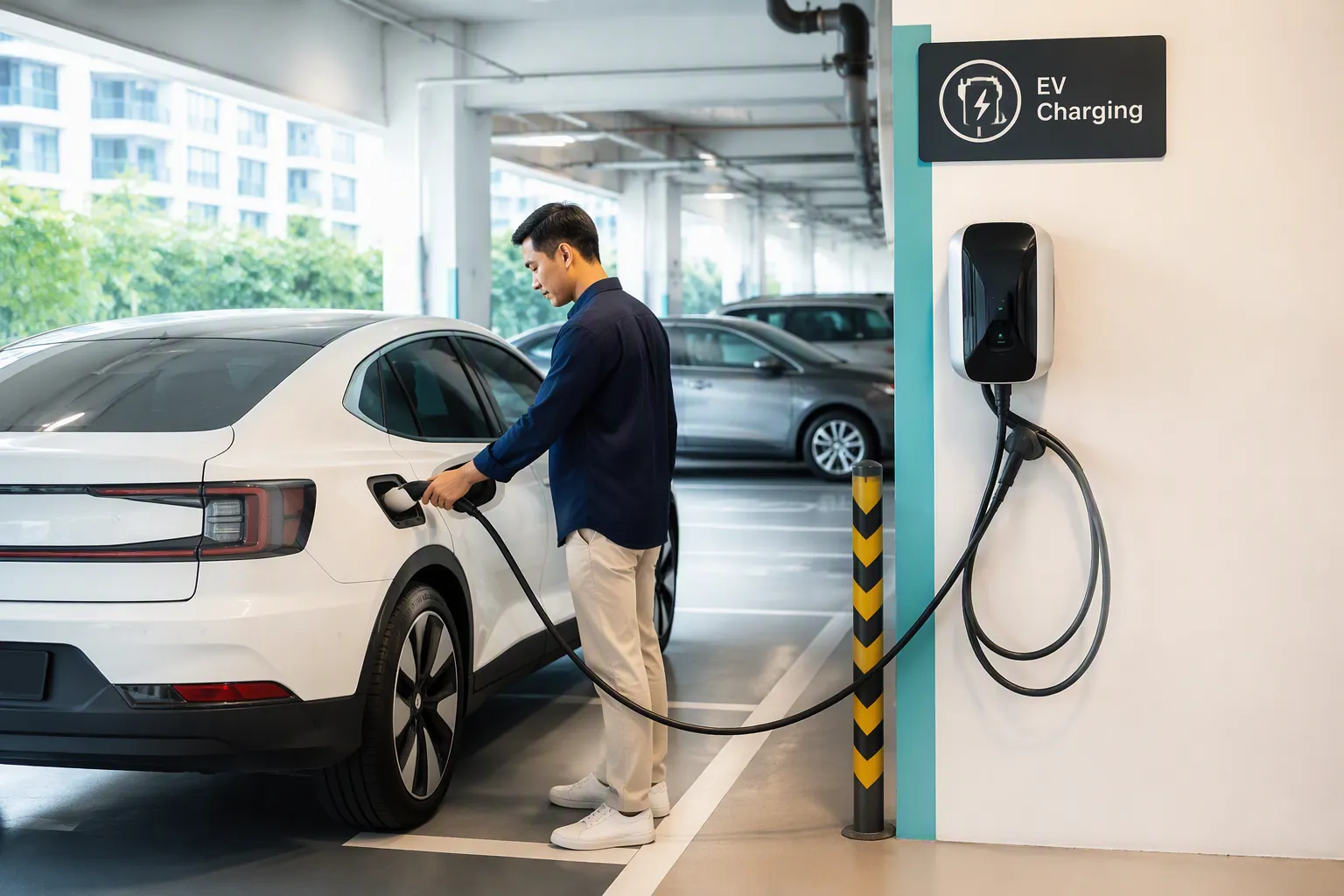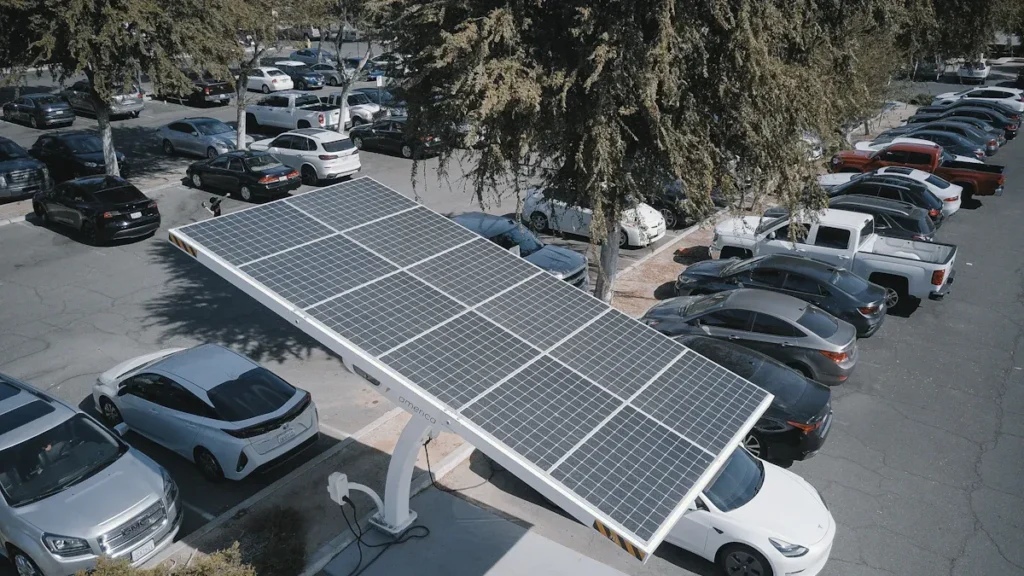
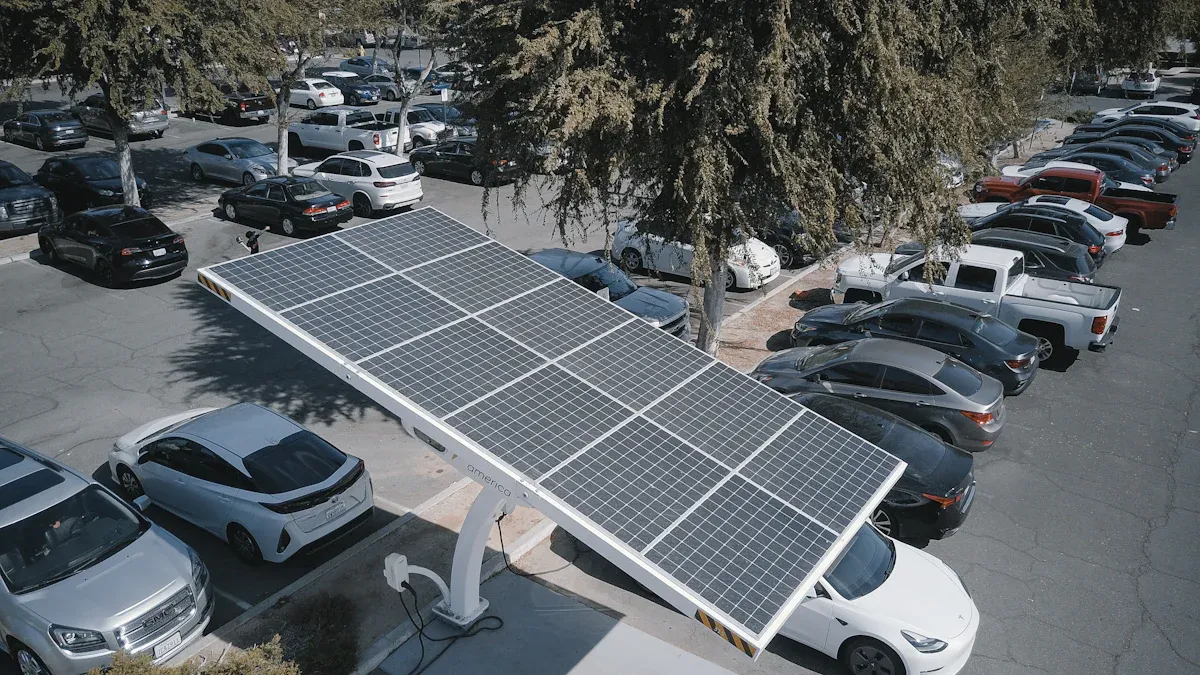
The future of green transportation hinges directly on the innovations shaping EV infrastructure. This advanced infrastructure is defined by three core pillars: intelligent grid integration for electric vehicles, superior user convenience, and universal access. As the global public charging infrastructure doubles to over 5 million points, the need for efficient EV charging becomes paramount. The future of EV charging is dynamic, with technologies like Vehicle-to-Grid (V2G) leading the way.
The V2G market alone is forecast to expand from USD 353.7 million to USD 1.7 billion by 2032.
Technologiquement avancé Fabricants de chargeurs de VE, including TPSON, are pivotal in developing the electric vehicle charging network for this electric future.
The Foundation: Expanding Access to Electric Vehicle Charging
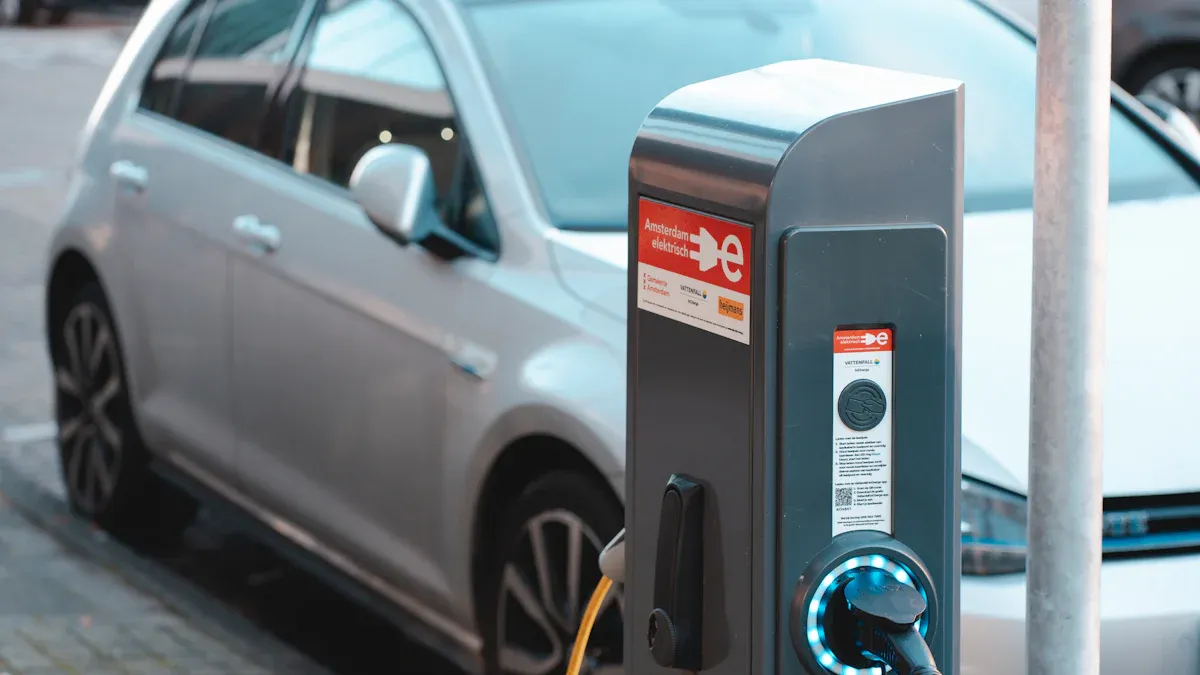
A truly green transportation future begins with universal access to charge fiable. The expansion of charging networks provides the essential groundwork for all other smart technologies. This expansion is not just about adding more stations; it involves a strategic deployment of infrastructure to serve every driver, everywhere.
Scaling the Public Charging Network
The growth of the public charging network is fundamental to eliminating range anxiety and encouraging EV adoption. Governments and private enterprises are working together to build a robust charging infrastructure.
From Urban Hubs to Rural Highways
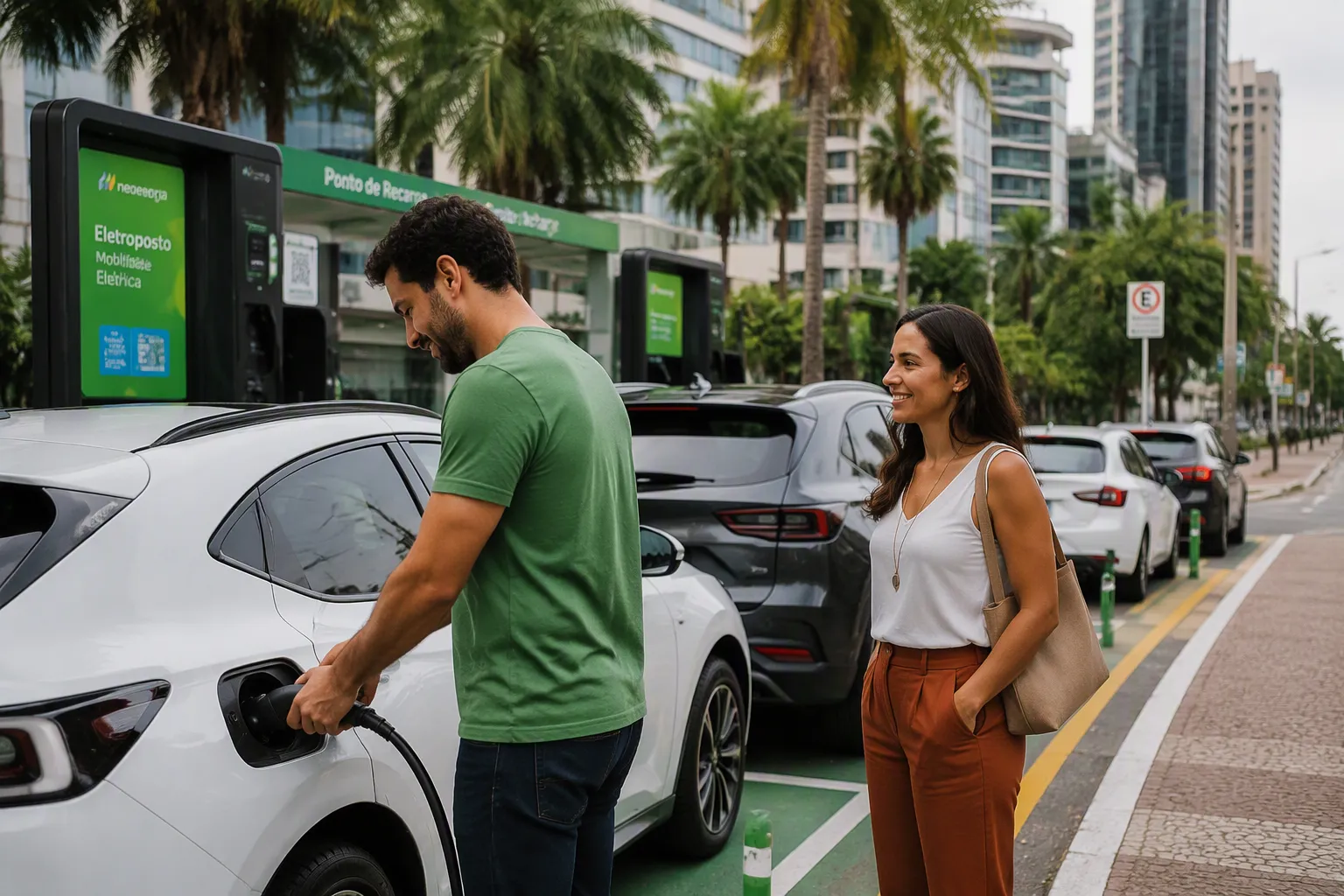
Strategic initiatives are placing charging stations in highly accessible locations. These include busy city centers, public parking areas, and critical highway corridors. States like California and New York are leading this charge, aligning the installation of charging stations with high EV ownership. This ensures drivers have confidence for both daily commutes and long-distance travel. Private businesses, from retail stores to hospitality venues, are also adding EV charging services to attract customers and capitalize on the growing demand.
The Role of DC Fast Charging
Speed is a critical factor for public charging. DC charge rapide, or ultra-fast charging technology, significantly reduces the time drivers spend waiting. The network requires a massive increase in this capability to support mainstream adoption.
- North America will need approximately 1 million more public chargers by 2030.
- Of these, about 170,000 should be new DC fast chargers, more than tripling the current count.
On-Street and Lamppost Solutions
Urban areas present unique challenges for drivers without dedicated parking. Innovative solutions like on-street charging points and chargers integrated into lampposts are vital. These technologies make electric vehicle charging a viable option for apartment dwellers and homeowners with limited space, increasing charging density in populated areas.
The NACS Revolution
Standardization is a powerful catalyst for growth. The adoption of the North American Charging Standard (NACS) is a landmark development for the EV infrastructure, promising to streamline the entire charging ecosystem.
Unifying a Fragmented Market
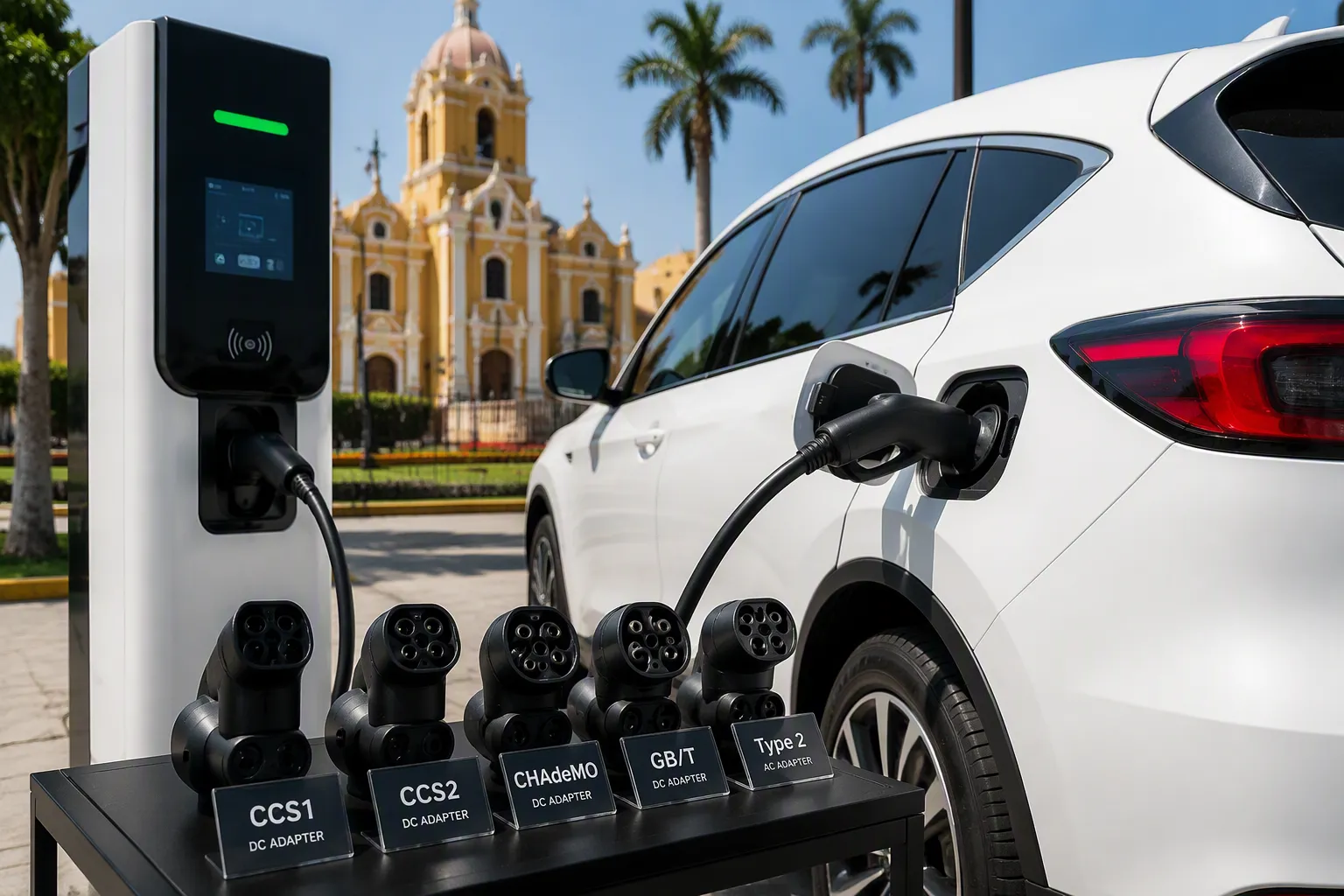
For years, the charging network operated with multiple, incompatible plug types, creating confusion for drivers. SAE International’s decision to standardize the NACS connector as SAE J3400 marks a turning point.
This move allows suppliers and manufacturers to produce and deploy a single, interoperable connector for electric vehicles and charging stations across North America, ending market fragmentation.
Simplifier l'expérience de l'utilisateur
A unified standard means EV drivers will no longer need to worry about carrying multiple adapters or finding a compatible station. This simplified “plug-and-play” experience is crucial for consumer confidence. A vast coalition of industry players has committed to this unified network.
| Catégorie | Companies Adopting NACS |
|---|---|
| Automakers | Ford, Stellantis, GM, Honda, BMW |
| Charging Networks | EVgo, FLO, ChargePoint, Electrify America |
| Hospitality | Hilton Worldwide (in partnership with Tesla) |
Accelerating Infrastructure Deployment
A single standard simplifies manufacturing and reduces costs. Standardization is projected to lower per-charger equipment and maintenance expenses by 10–15%. This makes the expansion of the charging network more economically feasible. Technologically advanced providers like TPSON are pivotal in developing the charging infrastructure in 2025 and beyond, leveraging standardized components to accelerate the deployment of reliable and efficient stations. This improved ROI encourages further investment, creating a positive feedback loop for infrastructure growth.
The Core Innovations Shaping EV Infrastructure
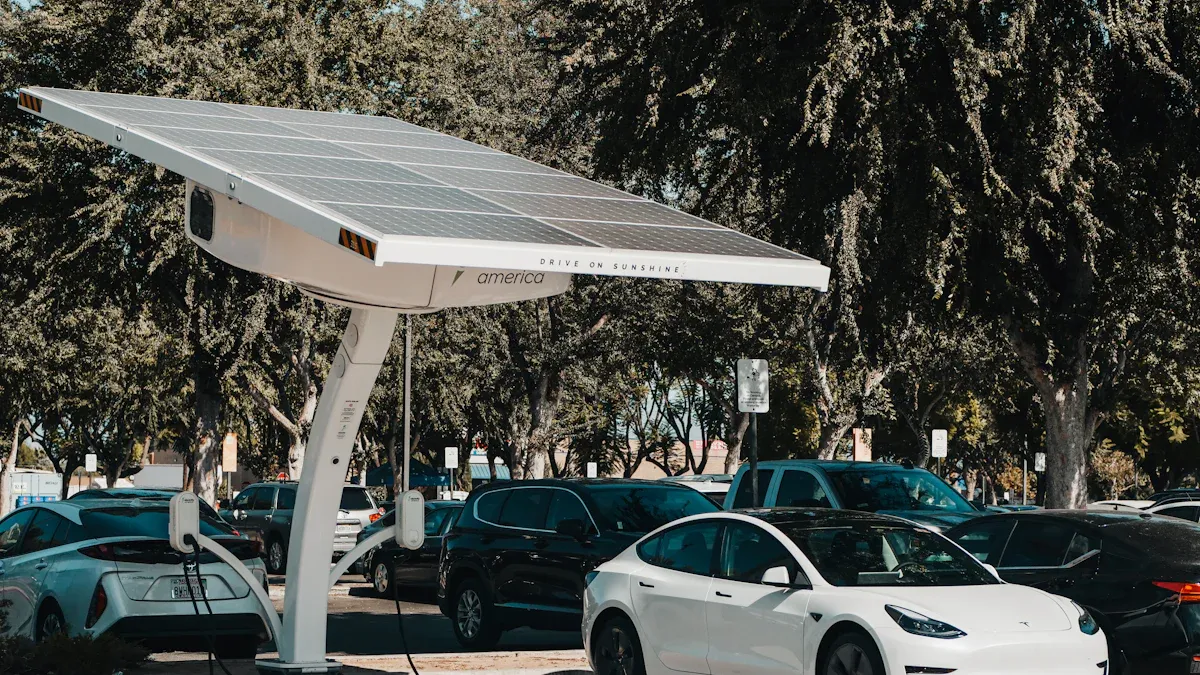
With a foundation of accessible charging points in place, the focus shifts to making the experience smarter and more convenient. The core innovations shaping EV infrastructure are centered on seamless connectivity and artificial intelligence. These advancements transform the simple act of charging into an integrated, efficient, and user-friendly process, further strengthening the EV infrastructure.
The Seamless Connection: Wireless and Plug & Charge
The ultimate goal of modern charging technology is to eliminate friction for the driver. Two key innovations, wireless charging and Plug & Charge, are making the process of powering an EV as simple as parking a car.
The Mechanics of Wireless EV Charging
Wireless, or inductive, charging allows an EV to power up without cables. The system uses a transmission pad installed on the ground or in the pavement, which sends power across a short distance to a receiver pad on the underside of the vehicle. This technology is moving from concept to commercial reality, with several companies leading its development.
- WiTricity Corporation
- InductEV Inc.
- ENRX
- Plugless Power Inc.
- HEVO Inc.
For example, HEVO Inc.’s Rezonant E8 system offers 8-kilowatt wireless capability and adheres to key safety and performance standards like UL 2750 and SAE J2954. This makes wireless charging a safe and viable option for residential garages and public parking lots.
Automating Authentication with Plug & Charge
Plug & Charge technology streamlines the payment and authorization process at public stations. It enables secure, direct communication between the electric vehicle and the charging station based on the ISO 15118 standard. Once a driver plugs in, the station automatically identifies the vehicle and its associated payment account, initiating the charging session without needing an app or RFID card.
This automated handshake is gaining widespread support. A growing coalition of automakers and charging networks are enabling this feature, creating a more unified and hassle-free experience for drivers across thousands of charging stations.
Removing Friction from the Process
Together, these technologies remove the final hurdles from the electric vehicle charging experience. Imagine an EV driver simply parking over a wireless pad at home or work, with the charging process starting automatically. For public charging, the Plug & Charge protocol eliminates the need to fumble with apps or payment cards. These innovations shaping EV infrastructure make owning an EV more convenient than a traditional gasoline car, a critical step for mass adoption.
AI-Powered Efficiency in EV Charging
Artificial intelligence (AI) is the brain behind the next generation of smart charging solutions. By analyzing vast amounts of data, AI optimizes the entire charging ecosystem for cost, efficiency, and reliability. Technologically advanced providers like TPSON are instrumental in developing these intelligent charging solutions.
Smart Charging Algorithms
AI-powered smart charging algorithms act as intelligent managers for the charging process. These systems process multiple data points to create optimal charging schedules. Key inputs include the EV’s arrival and departure times, its state of charge, the total energy required, and real-time electricity costs. The algorithm then calculates the ideal charging plan to meet the driver’s needs while minimizing strain on the power grid.
Optimizing for Cost and Time
For EV owners, the most significant benefit of AI is cost reduction. AI algorithms capitalize on variable electricity pricing, such as Time-of-Use (TOU) rates.
- The system analyzes historical data and user behavior to predict charging needs.
- It automatically schedules charging sessions during off-peak hours when electricity is cheapest.
- This intelligent scheduling directly lowers the cost of EV charging, making electric transportation more economical.
This optimization ensures the vehicle is ready when needed without incurring peak energy prices, balancing convenience with cost-effectiveness.
Predictive Analytics for Station Availability
AI also addresses a common frustration for EV drivers: arriving at a charging station to find all ports occupied or out of service. Predictive analytics use AI to forecast the availability of stations. The system analyzes a wide range of data to make its predictions.
| Type de données | Application in Predictive Analytics |
|---|---|
| Historical Usage | Identifies peak times and usage patterns for specific stations. |
| Real-Time Data | Monitors current station status and traffic conditions. |
| External Factors | Considers weather forecasts and local events that may impact demand. |
This foresight allows navigation apps and charging network platforms to guide drivers to available chargers, improving the reliability of the public EV infrastructure.
AI for Battery Health Management
Beyond cost and convenience, AI plays a vital role in preserving the most expensive component of an electric vehicle: the battery. The innovations shaping EV infrastructure include AI-driven battery management. AI algorithms can adjust charging speeds and manage battery temperature during a session. This prevents overheating and reduces degradation over time, extending the battery’s lifespan and protecting the owner’s investment in their electric vehicle.
Vehicle-to-Grid (V2G): The Future of EV Charging and Energy Symbiosis
Vehicle-to-Grid (V2G) technology represents a paradigm shift, transforming electric vehicles from simple transportation devices into active participants in the energy ecosystem. This symbiotic relationship is a cornerstone of the future of EV charging, enhancing grid stability and promoting sustainability.
EVs as Mobile Power Banks
The core principle of V2G is to treat the massive, distributed battery capacity of parked electric vehicles as a collective energy storage network.
Le concept V2G expliqué
V2G enables a two-way flow of energy between an EV and the power grid. While standard EV charging is a one-way process, V2G allows a connected EV to not only draw power from the grid but also discharge stored energy back to it when needed. This turns every compatible EV into a mobile power bank, ready to support the larger electric infrastructure.
Bidirectional Charging Hardware
This capability requires specialized hardware. Both the EV and the charging station must support bidirectional power flow. A growing number of automakers are equipping their vehicles with this technology.
- Kia EV9
- Mitsubishi Outlander (PHEV)
- Mitsubishi Eclipse Cross (PHEV)
- Nissan Leaf
These models, along with others from manufacturers like Volkswagen and Ford, are paving the way for a V2G-enabled future. Des fournisseurs technologiquement avancés comme TPSON are developing the sophisticated bidirectional charging stations essential for this EV infrastructure.
The EV as a Distributed Energy Resource
When aggregated, V2G-capable vehicles form a powerful Distributed Energy Resource (DER). Utilities can draw upon this network of batteries to manage grid load. For EV owners, participation can be financially rewarding. A demonstration project estimated that a V2G-enabled vehicle could generate approximately $1,525 annually through energy savings and demand response events.
Balancing the Grid for a Renewable Future
V2G technology is critical for creating a resilient grid capable of handling the intermittency of renewable energy sources.
Stabilizing Grid Frequency
Power grids must maintain a stable frequency to operate correctly. V2G offers a rapid response solution. A successful pilot project demonstrated how a fleet of parked EVs could store and return energy, effectively stabilizing the grid and providing instant backup during power failures. This capability turns the EV charging network into a virtual power plant.
Storing Excess Renewable Energy
Renewable energy generation from solar and wind is often variable. V2G provides a practical solution for this challenge. During periods of high sun or wind, EVs can absorb and store the excess renewable power. This stored clean energy can then be discharged back to the grid later, ensuring that valuable renewable generation is not wasted.
Reducing Peak Demand Strain
V2G helps utilities manage periods of high electricity consumption. Instead of firing up expensive and less efficient “peaker” power plants, grid operators can call upon the EV fleet to discharge energy. This reduces strain on the grid, lowers operational costs, and decreases reliance on fossil fuels for peak power generation, making the entire system more efficient.
The Expanding V2X Ecosystem
Vehicle-to-Grid is just one part of a larger “Vehicle-to-Everything” (V2X) ecosystem. This concept expands bidirectional charging capabilities to power homes, tools, and entire buildings, turning the electric vehicle into a versatile energy asset.
Véhicule à domicile (V2H)
Vehicle-to-Home (V2H) technology allows an EV to function as a backup generator for a residence, providing energy security and greater energy independence.
Powering Your Home During Outages
During a power outage, a V2H-enabled vehicle can automatically supply electricity to a house. The energy stored in a single EV battery is substantial. An average EV with a 69.5 kWh battery can power a typical home for about two days. Larger vehicles can extend this significantly; some models can supply power for three full days of normal use or jusqu'à 21 jours avec une gestion minutieuse de l'énergie. Cette capacité offre aux propriétaires une tranquillité d'esprit et une alternative fiable aux générateurs bruyants alimentés par des combustibles fossiles.
Intégration au Solaire Résidentiel
La V2H crée une puissante synergie avec les systèmes de panneaux solaires résidentiels. La batterie du VE peut stocker l'excédent d'énergie solaire produit pendant la journée. Cette énergie propre stockée peut ensuite alimenter la maison le soir ou par temps nuageux, réduisant la dépendance au réseau et abaissant les factures d'électricité. Des fournisseurs technologiquement avancés comme TPSON développent les bornes de recharge bidirectionnelles sophistiquées qui rendent cette intégration transparente possible.
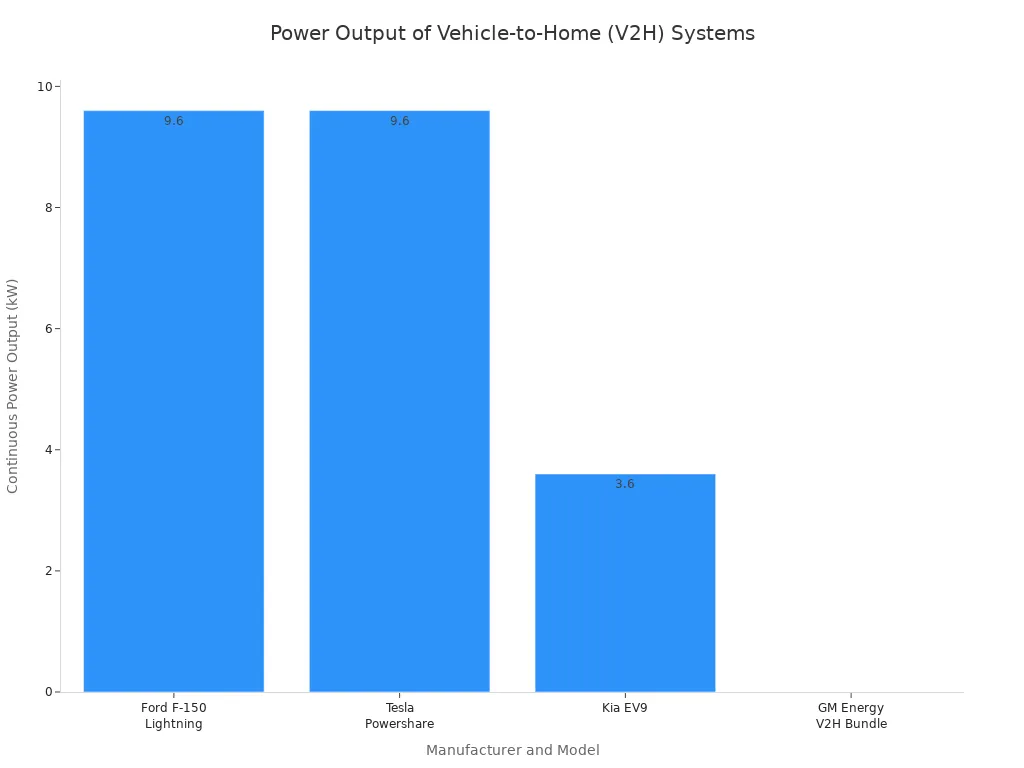
| Fabricant | Modèle/Technologie | Puissance de sortie | Compatibilité/Caractéristiques |
|---|---|---|---|
| Ford | F-150 Lightning avec Intelligent Backup Power | Jusqu'à 9,6 kW en continu | Fonctionne avec la Ford Charge Station Pro et le Home Integration System ; bascule automatiquement sur l'alimentation du VE lors des pannes ; équivalent à plus de 10 batteries domestiques. |
| Tesla | Powershare (Cybertruck) | 9,6 kW en continu (cinq prises : deux 120V 20A, une 240V 40A) | Prise en charge V2H, V2L, V2V ; agit comme une station d'alimentation mobile ; expansion prévue sur tous les modèles d'ici 2025. |
| Kia Motors | EV9 avec capacité V2H | Jusqu'à 3,6 kW en continu | Intègre l'application Kia Connect ; prend en charge V2L et V2H ; conçu pour une intégration transparente avec les systèmes énergétiques domestiques ; expansion prévue aux États-Unis d'ici 2026. |
| GM Energy | Pack V2H (Chevrolet Silverado EV First Edition RST 2024) | Alimente la maison jusqu'à 21 jours (avec une consommation d'énergie réduite) | Inclut le chargeur PowerShift et le kit d'activation V2H ; s'intègre aux panneaux solaires et aux batteries stationnaires via PowerBank ; géré via l'application GM Energy ; expansion prévue sur tous les VE basés sur Ultium d'ici 2026. |
Vehicle-to-Load (V2L)
La technologie Vehicle-to-Load (V2L) transforme un VE en source d'alimentation mobile, équipée de prises standard pour alimenter divers appareils.
Alimentation Mobile pour le Travail et les Loisirs
La fonctionnalité V2L permet aux utilisateurs de brancher directement des outils, des appareils électroménagers et des appareils électroniques sur leur véhicule. Cette fonction est incroyablement utile sur les chantiers sans accès au réseau, pour le camping ou les événements en plein air. Elle élimine le besoin de générateurs portables séparés, offrant une solution d'alimentation plus silencieuse et sans émissions.
Cas d'utilisation et Applications
L'utilité de la V2L dépend de sa puissance de sortie. Les modèles de Hyundai et Kia offrent jusqu'à 3,6 kW, suffisant pour alimenter des ordinateurs portables, des lumières et de petits appareils électroménagers. Les systèmes haute puissance, comme ceux des camionnettes électriques, peuvent fournir 7 kW ou plus. Ce niveau de puissance peut faire fonctionner des outils électriques lourds ou même fournir une charge d'urgence à un autre VE en panne.
Vehicle-to-Building (V2B)
Le Vehicle-to-Building (V2B) applique les principes de la V2H à l'échelle commerciale, permettant à une flotte de véhicules électriques de soutenir les besoins énergétiques d'un bâtiment.
Soutien aux Opérations Commerciales
Dans un système V2B, les véhicules des employés ou de la flotte d'entreprise peuvent décharger de l'énergie vers le bâtiment de bureaux pendant les heures de pointe. Cette ressource énergétique collective aide à stabiliser le réseau interne du bâtiment et fournit un tampon contre les fluctuations de puissance externes, améliorant la résilience opérationnelle.
Réduction des Coûts Énergétiques des Entreprises
Le principal avantage de la V2B est financier. En utilisant l'énergie stockée des VE pendant les périodes de prix élevés de l'électricité, les entreprises peuvent réduire considérablement leurs frais de demande de pointe.
Une étude de cas dans un grand bâtiment administratif a démontré qu'un cadre V2B pourrait permettre une réduction potentielle de la demande de pointe allant jusqu'à 37,9 %.
Une autre stratégie, où les travailleurs utilisent leurs véhicules chargés à domicile pour alimenter le bureau, projette une réduction de la demande du bâtiment allant jusqu'à 50 %, illustrant un modèle commercial rentable et écologique.
La Nouvelle Frontière : Technologies de Recharge Émergentes
Au-delà des prises et bornes conventionnelles, la nouvelle frontière de la recharge des véhicules électriques explore des méthodes révolutionnaires pour alimenter les véhicules. Ces solutions de recharge émergentes visent à résoudre des défis spécifiques pour le transport lourd et à offrir une commodité ultime à tous les conducteurs. Cela technologie de pointe redéfinit les limites de la mobilité électrique.
Recharge Mégawatt pour Véhicules Lourds
L'électrification du transport commercial nécessite une nouvelle classe d'infrastructure de recharge capable de fournir une puissance immense rapidement.
Alimentation des Camions Semi-remorques et Bus Électriques
Les véhicules électriques lourds comme les semi-remorques et les bus ont des batteries massives. La recharge rapide standard est trop lente pour les horaires de logistique et de transport public. Une nouvelle approche est nécessaire pour rendre les flottes électriques viables.
Le Système de Recharge Mégawatt (MCS)
Le Système de Recharge Mégawatt (MCS) est la réponse de l'industrie. Cette norme puissante est conçue pour fournir plus d'un mégawatt de puissance de recharge, permettant à un semi-remorque de gagner une autonomie significative pendant la pause de repos obligatoire du conducteur. Les grands constructeurs se préparent déjà à ce changement. Par exemple, MAN Truck & Bus développe des systèmes pour supporter le MCS, et Scania prévoit de sortir ses camions électriques compatibles MCS d'ici mi-2026.
Impact sur la Logistique et le Transport Public
Le MCS transformera l'industrie logistique en minimisant les temps d'arrêt des flottes électriques. Une recharge plus rapide rend le camionnage électrique longue distance pratique. Il permet également aux bus électriques de terminer leurs trajets avec de brèves sessions de recharge haute puissance dans les dépôts, améliorant l'efficacité opérationnelle.
L'Échange de Batterie comme Solution de Niche
L'échange de batterie offre une alternative à la recharge traditionnelle, en se concentrant sur la vitesse en remplaçant l'ensemble du pack de batteries.
Le Modèle de “Ravitaillement” Instantané
Ce modèle permet à un conducteur de VE d'entrer dans une station d'échange et de voir un robot échanger sa batterie déchargée contre une entièrement chargée en quelques minutes. Cette approche gagne du terrain sur des marchés spécifiques.
| Entreprise | Marché Géographique |
|---|---|
| Nio | Chine |
| Gogoro | Taïwan |
| Ample | ÉTATS-UNIS |
| Sun Mobility | Inde |
Ces entreprises ont construit des réseaux de stations pour soutenir leurs utilisateurs, prouvant la viabilité du modèle pour certains cas d'utilisation.
Surmonter les obstacles de la standardisation
L'adoption généralisée se heurte à des obstacles significatifs. La technologie nécessite des investissements massifs et fait face à des défis complexes..
- Coûts en capital élevés: La dépense initiale pour les machines robotisées, le stock de batteries de rechange et les logiciels de gestion sophistiqués est substantielle.
- Manque de standardisation : Les constructeurs de véhicules électriques utilisent des tailles de batterie, des chimies et des protocoles de communication différents, rendant une station d'échange universelle presque impossible.
- Complexité opérationnelle : Gérer l'état de santé des batteries, la logistique et les chaînes d'approvisionnement pour des milliers de packs constitue un obstacle opérationnel majeur.
Recharge dynamique et routes électriques
Le concept le plus futuriste consiste à recharger les véhicules électriques pendant qu'ils sont en mouvement.
La vision de la recharge en roulant
La recharge dynamique, ou Systèmes de Route Électrique (ERS), intègre la technologie de recharge directement dans la chaussée. Cela permet à un VE de se recharger sans fil ou via une bande de contact physique pendant qu'il roule, éliminant potentiellement l'anxiété d'autonomie et permettant l'utilisation de batteries plus petites et plus légères.
Programmes pilotes actuels et défis
Ce concept passe de la théorie à la réalité grâce à divers programmes pilotes. La Suède est un leader dans ce domaine, testant des routes électriques pour les camions et les bus entre les principaux hubs logistiques. D'autres essais sont actifs dans des lieux comme Tel Aviv pour les bus publics. Cependant, le coût immense de la modernisation des autoroutes et l'établissement d'une norme technologique unifiée restent les principaux défis pour un déploiement à grande échelle.
L'avenir logiciel-défini de la recharge
Le matériel fournit la connexion physique pour la recharge des VE, mais le logiciel définit l'expérience. L'avenir du réseau de recharge dépend de plateformes logicielles intelligentes, ouvertes et centrées sur l'utilisateur. Cette couche numérique est ce qui transforme une simple prise de courant en un composant intelligent et intégré de nos systèmes énergétiques et de transport.
Le rôle des standards ouverts
Les standards ouverts sont la pierre angulaire d'un réseau de recharge évolutif et compétitif. Ils garantissent que le matériel et les logiciels de différentes entreprises peuvent communiquer de manière transparente, évitant la fragmentation du marché et donnant du pouvoir aux opérateurs de réseau.
OCPP et l'interopérabilité
Le L'Open Charge Point Protocol (OCPP) est une norme de communication open source essentielle. Il agit comme un langage universel entre les bornes de recharge et les systèmes de gestion centraux qui les contrôlent. Ceci technologie est fondamental pour un réseau de recharge unifié.
- Il permet au matériel de borne de recharge de tout fabricant de se connecter à tout logiciel backend compatible OCPP.
- Il Il standardise les opérations essentielles comme le démarrage ou l'arrêt d'une session de recharge, le rapport d'état et la gestion des paiements..
- Cela empêche le “verrouillage fournisseur”, donnant aux opérateurs de réseau la liberté de choisir le meilleur matériel et logiciel sans être liés à un seul fournisseur.
Des fournisseurs technologiquement avancés comme TPSON construisent leurs solutions de recharge sur des standards ouverts comme l'OCPP. Cela garantit que leur matériel peut être intégré à n'importe quel réseau de recharge, soutenant l'expansion flexible de l'infrastructure publique.
Favoriser l'innovation et la concurrence
Lorsque les entreprises s'appuient sur une norme commune, elles rivalisent sur les fonctionnalités et la qualité, et non sur des connexions propriétaires. Cet environnement ouvert accélère l'innovation dans toute l'industrie. La concurrence favorisée par les standards ouverts a conduit au développement de fonctionnalités avancées, notamment :
- Intégration des réseaux intelligents: L'optimisation de la recharge pour éviter les surcharges du réseau.
- Recharge bidirectionnelle (V2G) : Permettre aux VE de renvoyer de l'énergie au réseau.
- Systèmes IoT : Utiliser l'IA et les plateformes cloud pour la surveillance en temps réel et la maintenance prédictive.
L'importance d'une mentalité centrée client
En fin de compte, le succès de la transition électrique repose sur l'expérience des conducteurs individuels. Une mentalité centrée client signifie concevoir des systèmes de recharge intuitifs, fiables et transparents pour tous les consommateurs.
Interface utilisateur et expérience (UI/UX)
Une mauvaise expérience utilisateur est un obstacle important à l'adoption des VE. Les conducteurs sont souvent confrontés à un paysage frustrant d'interfaces incohérentes et de systèmes peu fiables. Les points de friction courants incluent :
- Surcharge d'applications: De nombreux conducteurs doivent jongler avec trois à six applications différentes pour accéder à divers réseaux de recharge.
- Tarification confuse : Des structures tarifaires opaques avec des taux variables, des frais de session et des frais d'inactivité créent de la confusion et de la méfiance.
- Échecs de paiement : Les terminaux de paiement défectueux et une mauvaise connectivité réseau sont courants, entraînant des tentatives de recharge infructueuses.
Itinérance (Roaming) et systèmes de paiement
Résoudre ces problèmes nécessite de se concentrer sur l'interopérabilité et la simplicité. Les réseaux d'itinérance permettent aux conducteurs d'utiliser un compte unique sur plusieurs réseaux de recharge différents, un peu comme un téléphone mobile fonctionne sur différents opérateurs. L'objectif ultime est un processus de paiement véritablement transparent. Des technologies comme Plug & Charge, basée sur la norme ISO 15118, rendent cela réalité. Cette technologie permet à un véhicule de s'authentifier automatiquement et de manière sécurisée auprès de la borne, en gérant le paiement sans aucune intervention du conducteur. Cela supprime la dernière couche de friction de l'expérience de recharge publique.
Les innovations façonnant l'infrastructure des VE transforment les véhicules électriques au-delà du simple transport. Ils deviennent des composants actifs d'un réseau énergétique résilient, améliorant la durabilité du réseau. L'avenir de l'infrastructure des VE dépend de la convergence d'un réseau de recharge étendu, de logiciels intelligents et de la recharge bidirectionnelle. Cette synergie crée un avenir de transport véritablement durable, intégrant plus efficacement les sources d'énergie renouvelables.
Réaliser cette vision future nécessite un effort collaboratif. Les constructeurs automobiles, les services publics, les décideurs politiques et les consommateurs doivent travailler ensemble pour construire l'infrastructure intelligente et le réseau électrique pour les générations à venir.
FAQ
Qu'est-ce que la recharge intelligente ?
La recharge intelligente utilise une technologie intelligente pour gérer comment et quand un véhicule électrique se recharge. Elle optimise les sessions de recharge pour le coût, la stabilité du réseau et la commodité de l'utilisateur. Cette technologie connecte les VE, les bornes de recharge et les opérateurs de réseau en un réseau réactif.
Comment fonctionne la technologie V2G (Vehicle-to-Grid) ?
Technologie V2G permet un flux d'énergie bidirectionnel entre un VE et le réseau électrique. Un véhicule compatible peut décharger l'énergie stockée vers le réseau pendant les périodes de demande de pointe. Ce processus aide à stabiliser le système électrique et peut générer des revenus pour le propriétaire du VE.
Pourquoi la norme OCPP est-elle importante ?
Le protocole ouvert de point de charge (OCPP) garantit l'interopérabilité entre les bornes de recharge et les logiciels de gestion de différents fabricants.
Cette norme ouverte évite l'enfermement propriétaire. Elle permet aux opérateurs de réseau de construire des réseaux de recharge flexibles et compétitifs en utilisant du matériel de divers fournisseurs.
Quelle est la différence entre le V2H et le V2L ?
- Véhicule à domicile (V2H) permet à un véhicule électrique d'alimenter une maison, agissant comme un générateur de secours pendant les pannes.
- Vehicle-to-Load (V2L) transforme un véhicule électrique en une source d'alimentation mobile avec des prises pour alimenter des outils ou des appareils électroménagers.
Quel est l'objectif du système de charge mégawatt (MCS) ?
Le système de charge mégawatt (MCS) est une norme de recharge haute puissance conçue pour les véhicules électriques lourds tels que les semi-remorques et les bus. Il délivre plus d'un mégawatt de puissance. Cette capacité réduit considérablement les temps de recharge, rendant la logistique électrique et les transports publics plus pratiques.
Comment l'intelligence artificielle améliore-t-elle l'expérience de recharge des véhicules électriques ?
L'intelligence artificielle optimise les plannings de recharge pour réduire les coûts en utilisant les tarifs électriques hors pointe. L'IA prédit également la disponibilité des bornes pour éviter la frustration des conducteurs. De plus, elle gère la santé de la batterie en ajustant les vitesses de charge, ce qui prolonge la durée de vie de la batterie et protège l'investissement du propriétaire.
Quels sont les avantages de la technologie Plug & Charge ?
La technologie Plug & Charge automatise le processus d'authentification et de paiement dans les bornes de recharge publiques. Le conducteur se contente de brancher le véhicule. La borne identifie automatiquement la voiture et son compte de paiement, créant une expérience fluide et sans tracas sans nécessiter d'applications ou de cartes.