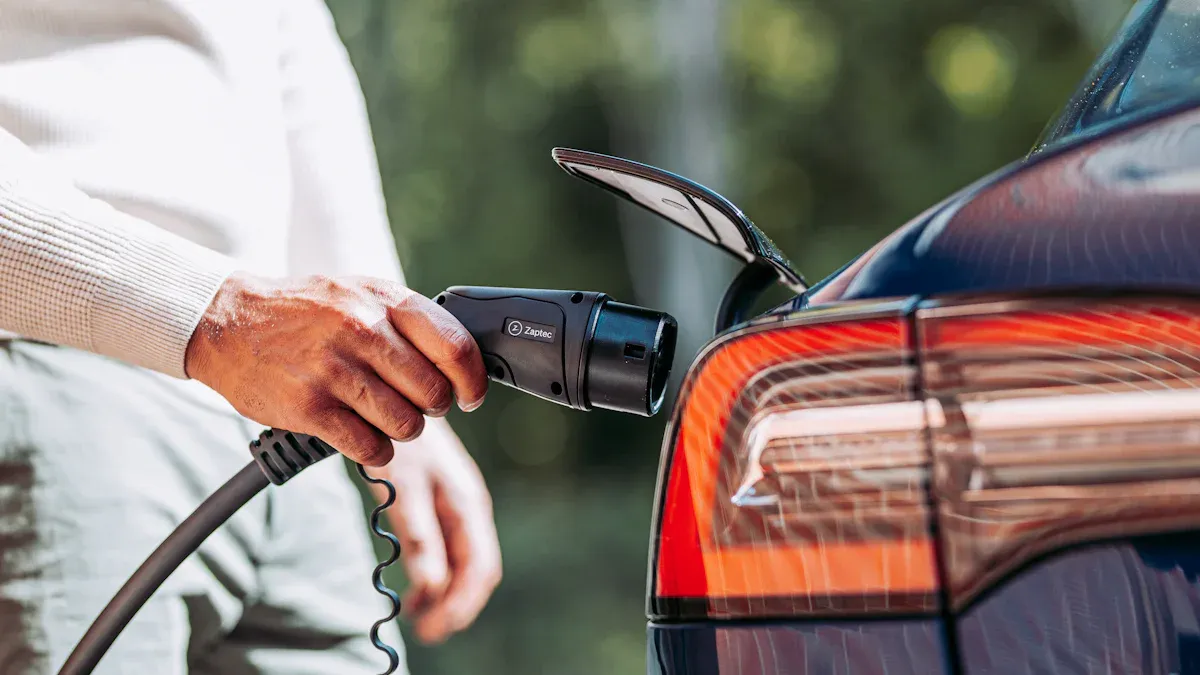
You can find EV chargers across Europe with ease as the network of public charging stations expands rapidly. In 2024, over 882,000 public charging points operate throughout the region, serving a growing number of electric vehicles. Most stations feature Type 2 and CCS connectors, which leading EV charger manufacturers supply. Fast and ultra-fast charging options now support electric car charging for both daily commutes and long-distance travel. When you need to find charging points or check the location of a public EV charging station, reliable apps and navigation systems make the process simple and efficient.
Find EV Chargers in Europe with Top Apps and Websites

Finding reliable electric car chargers across Europe is easier than ever. You can use a range of apps and websites to locate public charging stations, check real-time availability, and plan your route efficiently. These tools help you navigate the expanding EV charging network and ensure you always have access to charging points in Europe, no matter which countries you travel through.
Best Apps for Electric Car Charging
You can choose from several highly recommended apps to find EV chargers and public charging stations. Each charging app offers unique features that make public EV charging more convenient.
PlugShare
PlugShare gives you access to a global map of EV charging points. You can filter chargers by connector type, charging speed, and payment options. The app includes a Pay with PlugShare feature, allowing you to pay for charging directly within the app. PlugShare also provides user reviews and photos, helping you select the best public charging stations for your needs.
Chargemap
Chargemap covers over 450,000 charging points in Europe. The app features a user-friendly interface and integrates with Apple CarPlay and Android Auto, making it easy to find EV chargers while driving. You can use the Chargemap Pass for access to more than 1,500 networks and over 570,000 charging points in Europe. Chargemap requires a one-off payment for its payment card, which simplifies transactions at public EV charging stations.
A Better Routeplanner (ABRP)
A Better Routeplanner (ABRP) specializes in route planning for electric vehicles. You can input your vehicle details and destination, and the app calculates the most efficient route with charging stops. ABRP considers battery life, charger compatibility, and charging speeds, ensuring you reach your destination without hassle.
easyCharging
easyCharging helps you locate public EV charging stations quickly. The app provides real-time updates on charger availability and supports multiple connector types. You can manage charging sessions and receive notifications about charging status, making it easier to monitor your electric car chargers.
Tip: Zap-Map is another popular app, especially in the UK. It offers journey planning, payment options, and user reviews for over 17,000 charging locations.
Leading Websites for Public Charging Stations
Websites offer comprehensive and up-to-date information on public charging stations across Europe. You can use these platforms to compare charging points, check availability, and plan your route.
ChargeFinder
ChargeFinder provides detailed maps of public EV charging stations in several European countries, including Belgium, the UK, Germany, Norway, and the Netherlands. You can filter chargers by connector type and charging speed, ensuring compatibility with your electric vehicle.
Electromaps
Electromaps lists thousands of public charging stations and offers extensive roaming agreements with major providers. The platform supports both public and private charging points, serving over 140,000 customers. You can view real-time charger status and manage charging sessions online.
| Feature | Details |
|---|---|
| Number of Public Charge Points | 7,000 |
| Number of Private Charge Points | 10,000 |
| Total Customers | 140,000 |
| Roaming Agreements | Extensive with major providers |
Electroverse
Electroverse delivers up-to-date information on public EV charging stations throughout Europe. The website emphasizes data accuracy and timeliness, helping you find chargers with the right compatibility, pricing, and charging speeds. Electroverse also highlights local operator differences, which can impact your charging experience.
IONITY Network Locator
IONITY Network Locator focuses on fast and ultra-fast charging stations. You can locate high-speed chargers along major European routes, making long-distance travel with electric vehicles more practical. The platform provides real-time updates on charger availability and supports route planning for electric car chargers.
The EV charging network in Europe has expanded rapidly, but accessibility varies between countries. Some regions offer more public charging stations than others, which can affect your travel plans.
Features and Benefits of Each Tool
You benefit from a range of features when using these apps and websites to find EV chargers and public charging stations.
Real-time charger availability
Most platforms display live status updates for public EV charging stations. You can check which chargers are available before you arrive, reducing wait times and avoiding busy locations.
| Feature | Description |
|---|---|
| Real-Time Navigation | Provides live plan follow-up and navigation, with the ability to replan as needed. |
| Live Charging Status | Displays up-to-the-minute status for many networks. |
| Real-Time Notifications | Offers real-time updates on powering status and alerts for any issues. |
| Real-Time Charger Availability | Provides up-to-date information on available plugs at each location. |
User reviews, ratings, and photos
You can consult user reviews and ratings to choose the best public charging stations. Many apps and websites include photos and feedback from other drivers, helping you avoid unreliable chargers and select locations with good amenities.
| Feature/Benefit | Description |
|---|---|
| User reviews | Consult opinions from other drivers to choose the best charging points available across Europe. |
| Community Input | Utilizes user-generated content, offering reviews and photos for informed decision-making. |
Route planning and trip integration
Advanced route planning features allow you to integrate charging stops into your travel plans. You can calculate powering times and routes in parallel, ensuring efficient use of charging points in Europe. These tools consider battery life, charger compatibility, and estimated charging costs, helping you manage your budget and avoid delays.
| Feature/Benefit | Description |
|---|---|
| Comprehensive Input Options | Allows users to input extensive details for precise battery life calculations. |
| Synchronised Charging & Route | Calculates powering times and routes in parallel for efficient planning. |
| Estimated charging costs | Advanced features provide estimated costs based on vehicle and local tariffs. |
| Price comparison | Check rates on the app to avoid exceeding budget and choose the most economical option. |
You can use filtering options to sort charging points by connector type, power rating, and price. This ensures you find EV chargers that match your electric vehicle and charging needs.
Step-by-Step Guide to Using Apps and Websites
Locating public charging stations in Europe becomes straightforward when you follow a clear process. You can use a trusted app or website to find EV chargers, plan your route, and save your favorite locations for future trips. The following guide walks you through each step, ensuring you maximize the benefits of digital tools during your electric vehicle journey.
Downloading and setting up your chosen app
You start by selecting an app that fits your needs. Popular options include PlugShare, Chargemap, and Bonnet. These platforms offer comprehensive coverage and user-friendly interfaces.
Here’s how you can get started:
- Search for your preferred app in the App Store or Google Play.
- Download and install the app on your smartphone.
- Create an account using your email address or social media profile.
- Set up your vehicle profile, including connector type and battery capacity.
- Enable location services to allow the app to suggest nearby charging stations.
Tip: If you drive a Tesla or another brand with unique connectors, add your vehicle details to filter compatible chargers automatically.
Many drivers report frustration when they must download multiple apps for different charging networks. You can streamline your experience by choosing an app that supports several networks or offers roaming agreements. This approach reduces confusion and saves storage space on your device.
Searching for nearby public charging stations
Once you set up your app, you can begin searching for public charging stations. Most apps and websites provide intuitive search functions and interactive maps.
Follow these steps to locate a charger:
- Open the app and access the map or search feature.
- Enter your current location or destination.
- Filter results by connector type, charging speed, and payment method.
- Review real-time availability and user ratings for each station.
- Select a charging station and view directions or start route planning.
A reliable electric vehicle journey planner helps you integrate charging stops into your travel itinerary. You avoid delays and ensure your vehicle remains powered throughout your trip.
Many users find that each app has its own interface and payment structure. You can overcome this challenge by familiarizing yourself with the main features and payment options before you travel.
Note: Some apps allow you to activate a charging port directly from your phone. You simply park your car, connect the cable, and start charging with a tap.
Saving favorite chargers and locations
You can save time on future journeys by bookmarking your preferred charging stations. Most apps and websites offer this feature, allowing you to create a personalized list of reliable chargers.
Here’s how you can save and manage your favorite locations:
- Tap the “Save” or “Bookmark” icon next to a charging station.
- Organize your saved chargers by location, connector type, or charging speed.
- Access your favorites from the app’s main menu or profile section.
- Receive notifications about status updates or maintenance at your saved stations.
| Benefit | Description |
|---|---|
| Quick Access | Instantly find EV chargers you trust. |
| Trip Planning | Add favorite stations to your route in advance. |
| Status Alerts | Get notified if a charger becomes unavailable. |
Managing several apps can consume storage and data. You can simplify your experience by using a unified platform or choosing an app that covers multiple networks. This strategy enhances convenience and encourages more drivers to adopt electric vehicles.
🚗 Saving your favorite locations ensures you always have a backup plan, especially in remote areas where charging options may be limited.
Using Your Car’s Navigation System to Find EV Chargers

Accessing Public Charging Station Information
Built-in navigation features for electric car charging
Your electric vehicle’s built-in navigation system offers a seamless way to locate public charging stations across Europe. These systems provide more than just directions. They help you find the nearest EV chargers based on your current location and battery level. Many modern electric vehicles, such as Tesla models, use advanced in-car software to optimize your route and guide you to the most convenient charging points.
- You can view a map of available charging stations directly on your dashboard.
- The system calculates the best route, considering your remaining battery range.
- It displays real-time information about charger availability and compatibility.
This technology reduces the stress of searching for charging points, especially when traveling through unfamiliar regions in Europe.
Using voice commands to locate chargers
You can use voice commands to make your search for EV chargers even easier. Most electric vehicles support simple voice prompts, allowing you to keep your hands on the wheel and eyes on the road. For example, you might say, “Find the nearest charging station,” and your navigation system will display a list of options. This feature saves time and enhances safety during your journey.
Tip: Practice using different voice commands before your trip. Each car brand may have unique phrases for locating public charging stations.
Updating Maps and Software for Europe
Checking for the latest software updates
To ensure you always have access to the most accurate charging station data, you should regularly update your car’s navigation maps and software. Manufacturers release updates that add new charging locations and improve route planning for electric vehicles. TomTom, for instance, has mapped over 2 million EV charging points, providing comprehensive coverage throughout Europe. These updates help reduce charging anxiety by giving you reliable, up-to-date information.
| Update Type | Benefit |
|---|---|
| Map Updates | Adds new charging stations in Europe |
| Software Upgrades | Improves route planning and accuracy |
| Dynamic Data Feeds | Shows real-time charger availability |
Syncing your navigation with mobile apps
You can enhance your navigation experience by syncing your car’s system with trusted mobile apps. Many electric vehicles allow you to connect your smartphone, so you can transfer saved routes or favorite charging stations directly to your dashboard. This integration ensures you always have the latest information, whether you plan your trip at home or on the go.
Keeping your navigation system updated and connected helps you find EV chargers quickly and ensures a smooth electric driving experience across Europe.
Filtering Public Charging Stations by Charger Type and Availability
Selecting Charger Speed and Connector Type
When you search for EV charging points in Europe, you need to consider both the speed and the connector type. Not all chargers deliver the same power, and not every electric vehicle supports every connector. Understanding these differences helps you choose the right public charging stations for your needs.
Fast chargers vs. standard chargers in Europe
You will find both fast and standard chargers at public stations across Europe. Fast chargers deliver higher power, which means you can recharge your EV much quicker. Standard chargers work well for longer stops or overnight parking, but they take more time to fully charge your battery.
| Connector Type | Description | Speed | Use Case |
|---|---|---|---|
| Type 2 (Mennekes) | Standard AC connector in Europe | Up to 22 kW (home/public), 43 kW (fast chargers) | Common for most AC charging stations |
| Combined Charging System (CCS) | Combines Type 2 with DC charging pins | Up to 350 kW | Ideal for rapid charging capabilities |
Most public charging stations in Europe offer Type 2 connectors for AC charging. CCS connectors are becoming more common, especially at rapid charging points along highways and in city centers. You should always check your vehicle’s compatibility before plugging in.
CCS, CHAdeMO, Type 2, and other connectors
You will encounter several connector types at public stations:
- Type 2 (Mennekes): The standard AC connector for most European EVs. It supports charging up to 22 kW at regular stations and up to 43 kW at fast chargers.
- Combined Charging System (CCS): This connector supports both AC and DC charging. It allows for rapid charging up to 350 kW, making it ideal for quick stops.
- CHAdeMO: Less common in Europe, but still available at some public charging stations. Mainly used by certain Japanese electric vehicles.
- Other connectors: Some stations may offer Type 1 or Tesla Supercharger connectors, but these are less widespread.
Apps like Chargemap and Watts Up let you filter stations by connector type and power rating. This ensures you only see chargers that match your electric vehicle.
Checking Real-Time Availability of Chargers
You want to avoid arriving at a station only to find all chargers in use or out of service. Modern apps and websites help you check real-time status before you set out.
Live status updates for public charging stations
Many platforms display live updates for public charging stations. You can see which chargers are available, in use, or under maintenance. For example, the Charge Scheme app lets you filter by price, charging speed, and availability. Chargemap and Watts Up also provide intelligent filters, so you only view rapid charging connectors compatible with your EV.
Tip: Always refresh the app or website before you arrive at a station. Status can change quickly, especially at busy locations.
Avoiding busy or out-of-service chargers
You can save time by checking user reviews and recent activity at each station. Many apps show how often a charger is used and whether drivers have reported issues. If a charger is busy or out of service, you can quickly find alternative public charging stations nearby.
- Look for stations with multiple chargers to reduce wait times.
- Save your favorite locations for quick access during future trips.
- Use live maps to reroute if your chosen station becomes unavailable.
Charging in public becomes much easier when you use these tools. You stay informed, avoid delays, and keep your electric vehicle ready for the road.
Ensuring Compatibility and Payment Options for Electric Car Charging
Verifying Charger Compatibility with Your Electric Car
Checking your vehicle’s connector type
You need to confirm that the chargers you use match your electric vehicle’s requirements. Start by reviewing your EV’s manual or the manufacturer’s website to identify your connector type and charging speed limits. In Europe, Type 2 and CCS connectors dominate most public electric car charging points. However, some regions may use CHAdeMO or other standards. Always check the charger’s specifications before you connect. If you travel across borders, you might encounter different regional standards, so carrying the right adapters ensures you can access charging points wherever you go.
Here are the essential steps to verify compatibility:
- Know your EV’s charging details by consulting your manual or manufacturer’s website.
- Check the charger’s connector type and power output.
- Use adapters if your plug does not match the station.
- Stay aware of regional standards, especially when traveling in Europe.
- Use apps and maps to filter for compatible chargers.
- Test with a short charging session before a full charge.
- Keep your EV’s software updated for improved compatibility.
Tip: Always start with a brief charging session at a new station to confirm everything works smoothly.
Using app filters for charger compatibility
Modern apps make it easy to find compatible electric car chargers. You can filter by connector type, charging speed, and network. This feature saves you time and prevents frustration at public stations. For example, Chargemap and PlugShare both offer advanced filters and real-time updates, helping you locate the right electric car charging points for your vehicle.
| App Name | Key Features |
|---|---|
| Chargemap | Interactive map, advanced filters for connector type and power, transparent pricing, smart route planner, community insights, Chargemap Pass for compatible charging points |
| PlugShare | Displays location, plug type, compatible car models, customizable filters, real-time station status and availability |
You can rely on these tools to access charging points that fit your EV, making electric vehicle charging in Europe more convenient.
Payment Methods and Access Requirements at Public Charging Stations
RFID cards, mobile payments, and contactless options
You have several payment methods available at public charging stations. Most networks accept RFID charging cards, which allow quick authentication and payment. Many operators also support payment through their mobile app, letting you locate and pay for charging sessions directly from your phone. Some fast-charging stations accept credit or debit cards, especially those with a capacity above 50 kW. New regulations require all new high-capacity stations to include card payment terminals, making it easier for you to access charging points without special subscriptions.
- RFID charging cards: Fast authentication and payment at public stations.
- Operator’s mobile app: Locate and pay for charging sessions easily.
- Credit or debit card: Available at many fast-charging points, especially new installations.
Note: European regulations now require ad hoc payments with debit and credit cards at public charging stations, so you do not need a subscription to use most new chargers.
Subscription services vs. pay-as-you-go charging
You can choose between subscription services and pay-as-you-go charging options. Subscription models offer a fixed monthly fee for unlimited use, which benefits frequent users who rely on public electric car charging points. Pay-as-you-go options provide flexibility, allowing you to pay only for what you use without a monthly commitment. Prices can vary based on energy consumed, time spent, or fixed session fees, so always review the cost structure before you start charging.
| Charging Model | Cost Structure | Convenience |
|---|---|---|
| Subscription | Fixed monthly fee for unlimited use | Predictable for frequent users |
| Pay-as-you-go | Variable costs based on usage | Flexible, no monthly commitment |
- Subscription services give you predictable costs and convenience if you charge often.
- Pay-as-you-go cards let you use public chargers without being tied to a contract.
You should compare both charging options to find the best fit for your driving habits and budget. This approach ensures you get the most value from Europe’s growing network of EV charging points.
Local Tips and Alternative Ways to Find EV Chargers in Europe
Asking Locals and Using Community Resources
Hotel and shopping center public charging stations
You can often find public EV charging stations at hotels, supermarkets, and shopping centers throughout Europe. Many hotels have recognized the importance of supporting electric mobility. For example, Radisson has partnered with PowerGo to install chargers at 300 hotels across the continent, aiming for net zero operations by 2050. Hyatt Hotels offers free EV charging with both Level 2 and Level 3 chargers, capable of charging up to 80 kW per hour. Sheraton provides charging at over 50 locations worldwide, working with various providers to support sustainability.
| Hotel Chain | EV Charging Details |
|---|---|
| Radisson | Partnered with PowerGo to install chargers at 300 hotels in Europe, aiming for net zero operations by 2050. |
| Hyatt Hotels | Offers free EV charging with Level 2 and Level 3 chargers, capable of charging up to 80 kW per hour. |
| Sheraton | Provides EV charging at over 50 locations worldwide as part of sustainability plans, partnering with various charging providers. |
You will also find chargers at supermarkets, shopping malls, and department stores. Many establishments offer free charging as part of loyalty programs. According to recent data, 26% of EV drivers charge at supermarkets, while 22% do so while shopping or dining at malls and department stores. For example, a hotel in Tartu, Estonia, features an Enefit Volt charging station with two 50 kW fast chargers, ensuring guests have convenient access to public charging.
Tourist information centers and local maps
Tourist information centers in Europe can help you locate public EV charging stations. Staff often provide local maps that highlight charging points. You can also use digital resources for up-to-date information:
- Chargemap offers a comprehensive map for locating charging stations, with user contributions and a validation process for accuracy.
- The Easy Charging app helps you quickly find nearby charging points with advanced filters.
- The CUPRA EV Charging Map displays public charging stations directly on your car’s screen, including customer reviews.
- Google and PlugShare can help you find free charging stations at your destination.
These resources ensure you never miss a charging opportunity during your travels.
Alternative Methods for Finding Chargers
Social media groups and online EV forums
You can join social media groups and online forums dedicated to EV drivers. Members share tips about public charging locations, recent experiences, and updates on new stations. These communities often provide real-time advice, helping you avoid busy or out-of-service chargers.
European EV clubs and driver associations
European EV clubs and driver associations offer valuable support for finding public charging stations. Many organizations, such as ChargeUp Europe, work to improve the charging ecosystem for all drivers. You can access the best charging stations using apps like Chargemap, Google Maps, or Waze. A single RFID card often grants you access to nearly all public charging stations across Europe. These clubs provide expert assistance and a supportive community, available 24/7. Real-time data about charger availability enhances your charging experience and attracts more users to electric mobility.
Tip: Joining a local EV club or association gives you access to exclusive resources, expert advice, and a network of fellow drivers who can help you navigate public charging in Europe.
Planning Ahead for Hassle-Free Electric Car Charging in Europe
Mapping Your Route with Public Charging Stations
Integrating charging stops into your travel plans
You can make every trip across Europe smoother by mapping your route with public charging stations in mind. Start by using roaming apps like Spirii Go to locate chargers, compare prices, and check real-time availability. These tools help you plan each leg of your journey, considering the distance between charging points and the type of charger your vehicle needs. High-power DC chargers work best for quick top-ups during long drives, especially along major motorways. For overnight stops, look for wallbox chargers at hotels or accommodations. AC charging stations suit longer breaks, while DC fast chargers keep your travel time short.
Many drivers rely on route planners such as Chargetrip, A Better Route Planner, or TomTom Long Distance EV Routing API. These platforms offer real-time charging station status, energy cost calculations, and route optimization. You can customize your plan based on your vehicle’s range and charging preferences.
Tip: Countries like the Netherlands and Switzerland have a high density of charge points, making route planning even easier.
Backup options for remote or rural areas
Traveling through remote or rural areas in Europe requires extra preparation. Use the easyCharging app to find 24/7 support and locate available charging options. Book accommodations that guarantee charging access, rather than relying on portable chargers, which provide only limited range. If you find yourself with low battery, reduce your vehicle’s consumption, seek a mobile signal, and contact easyCharging for emergency support.
- Choose hotels or guesthouses that confirm charging availability.
- Keep a list of backup charging stations along your route.
- Prepare for unexpected situations by knowing how to reach support services.
Keeping Essential Charging Accessories for Europe
Carrying adapters and charging cables
You should always carry essential charging accessories when driving across Europe. Pack a smartphone with the Spirii Go app installed and an EV route planner like ABRP. Bring charging cables compatible with most public stations, such as Type 2 and CCS. Depending on your vehicle, a Type 2 to Schuko adapter or an emergency charging cable can prove useful. A travel-sized cleaning kit for your windscreen and lights ensures safety during your trip. Some countries require you to carry spare fuses and bulbs, so check local regulations before you leave.
- Charging cables: Type 2 and CCS for most public stations.
- Adapter: Type 2 to Schuko or emergency cable, based on your setup.
- Cleaning kit: For windscreen and lights.
- Spare parts: Fuses and bulbs if required by law.
Emergency contact numbers and support
Keep all important documents and emergency contacts within easy reach. Carry your valid driving license, vehicle registration, insurance documents, and any EV-related paperwork. Save the customer support numbers for your charging app providers, such as easyCharging or Spirii Go, in your phone. Quick access to these contacts helps you resolve issues if you encounter a problem at a charging station.
Pro Tip: Store emergency numbers and support contacts both digitally and on paper in your glove compartment.
By planning your route, preparing for rural areas, and carrying the right accessories, you ensure a hassle-free charging experience throughout Europe. This approach keeps your journey efficient and stress-free.
You can find EV chargers across Europe quickly by using top apps, websites, and your car’s navigation. These tools help you locate public charging stations, compare electric car charging points, and check real-time charger status. Always verify charger compatibility for electric car charging and plan your journey with backup public EV charging options. You improve your electric vehicle charging experience by saving favorite stations and carrying essential accessories. Public electric car charging points in many countries now offer easy payment and support. Start your next trip with confidence and enjoy seamless charging at public EV charging points and stations.
FAQ
How do you find the nearest EV charger quickly?
You can use apps like PlugShare or Chargemap. These tools show real-time locations and availability. Enable location services on your phone for the best results. Your car’s navigation system also helps you locate nearby public charging stations.
What should you do if a public charger is out of service?
Check your app for alternative stations nearby. Most apps display live status updates and user reports. Save backup charging locations before your trip. If you face issues, contact the charging network’s support number for assistance.
Can you charge your EV at any public station in Europe?
You can use most public stations if your vehicle’s connector matches the charger. Always check compatibility in your app. Some stations require specific RFID cards or mobile apps for access. Carry adapters if you plan to travel across different countries.
What payment methods work at European charging stations?
Most stations accept RFID cards, mobile payments, or contactless credit/debit cards. Newer fast chargers support direct card payments. Subscription services and pay-as-you-go options are both available. Always review payment details in your chosen app before starting a session.
How do you know if a charger is compatible with your EV?
Check your vehicle’s manual for connector types and charging speeds. Use app filters to display only compatible chargers. Most European EVs use Type 2 or CCS connectors. Carry an adapter if your car uses a less common plug.
Do you need to plan charging stops for long trips?
Yes, planning ensures you avoid running out of battery. Use route planners like ABRP or Chargetrip to map charging stops along your journey. Save favorite stations and always have backup options, especially in rural or remote areas.
What should you carry for hassle-free charging in Europe?
Pack charging cables, adapters, and your RFID card. Bring your smartphone with charging apps installed. Keep emergency contact numbers handy. A cleaning kit for your charging port and spare fuses or bulbs can also help during your trip.
Can you get help if you have trouble at a charging station?
Yes. Most charging networks offer 24/7 customer support. You can find support numbers in your app or on the charging station itself. Local EV clubs and online forums also provide advice and real-time help from other drivers.