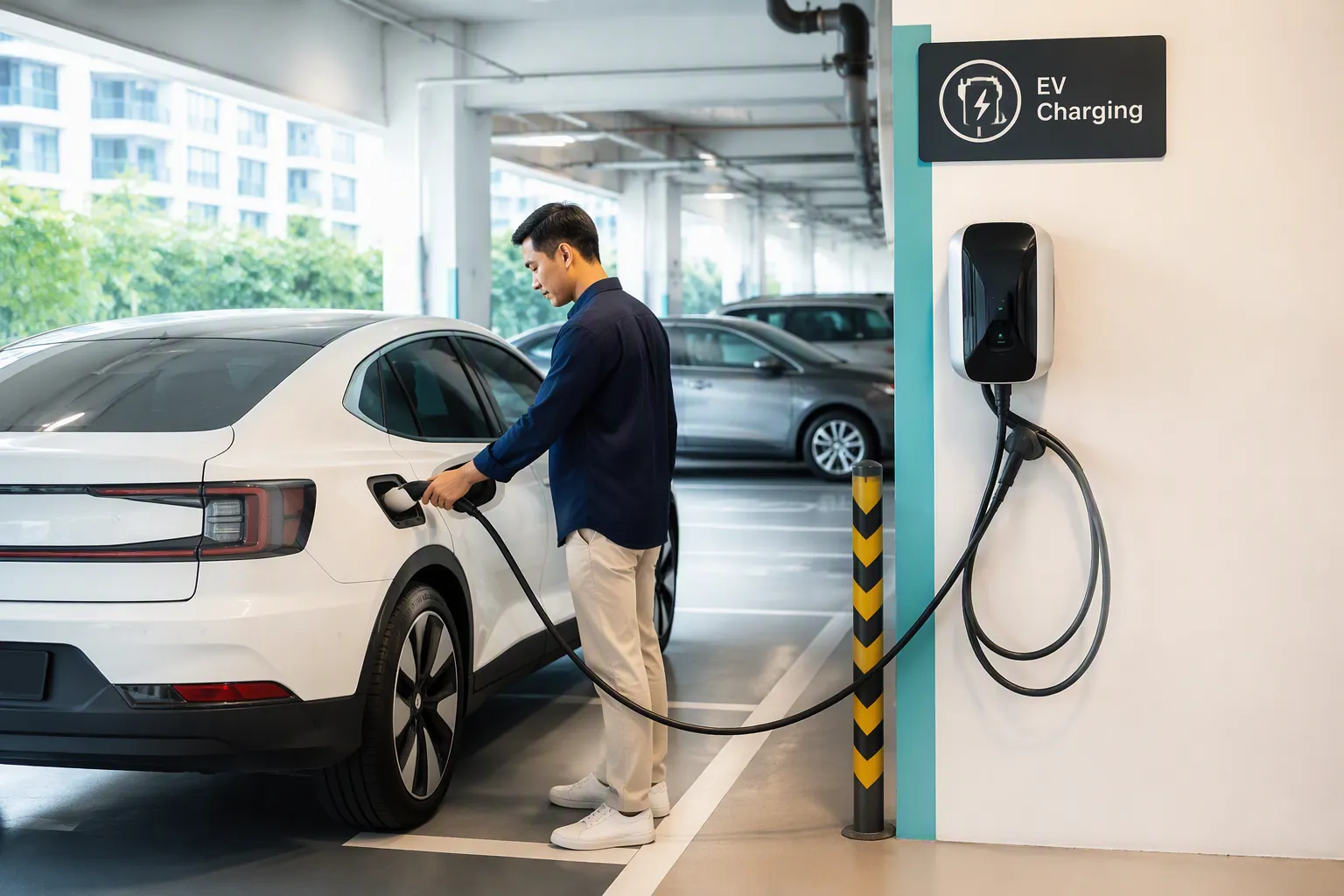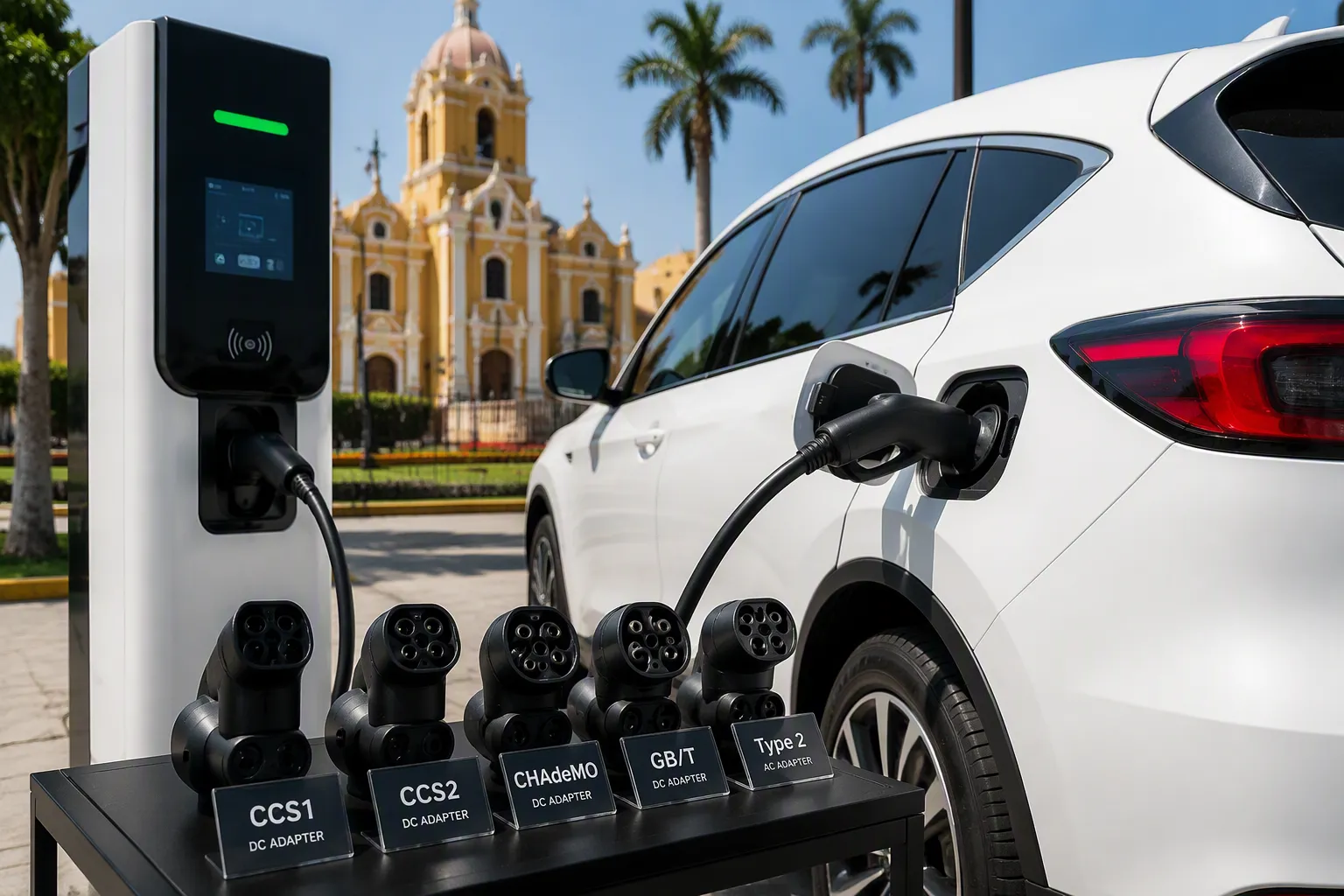
Großbritannien macht bedeutende Fortschritte in Richtung einer vollelektrischen Zukunft, mit über 1,1 Millionen reinen Elektrofahrzeugmodellen, die mittlerweile auf seinen Straßen unterwegs sind.. Hersteller von EV-Ladegeräten Das öffentliche Ladesetz wird rasch ausgebaut, um Schritt zu halten. Dennoch ist das Land nicht vollständig auf einen vollständigen Übergang vorbereitet. Die Zukunft der britischen Ladepunkte hängt davon ab, dieses Wachstum zu beschleunigen und intelligente Technologien zu integrieren.
Kritische Herausforderungen in Bezug auf gerechte Infrastruktur, Netzskapazität und politische Konsistenz müssen angegangen werden, um sicherzustellen, dass jeder E-Fahrer Zugang zu einer zuverlässigen EV-Ladegerät.
Bewertung der aktuellen britischen Ladeinfrastruktur

Die britische Ladeinfrastruktur ist ein komplexes Gefüge aus privatem Komfort und öffentlichen Herausforderungen. Das Fahrerlebnis hängt stark vom Standort, der Wohnsituation und den verfügbaren Ladegerätetypen in der Nähe ab. Dieses Gefüge zu verstehen, ist der Schlüssel zur Bewertung der nationalen Bereitschaft.
Öffentliches vs. privates Laden: Ist das Netz zugänglich?
Die Zugänglichkeit bleibt die zentrale Frage für die britischen LadeNetze. Während die Anzahl der E-Ladepunkte wächst, schaffen ihre Verteilung und Verfügbarkeit ein uneinheitliches Erlebnis für Fahrer. Der Ausbau der LadeNetze muss diese Ungleichheiten angehen.
Die Dominanz des Heimladens
Das Laden zu Hause ist die bequemste und kostengünstigste Methode für E-Fahrer. Derzeit haben, etwa 60 % der britischen Haushalte Zugang zu Stellplätzen außerhalb der Straße,, was die Installation einer privaten Ladestation ermöglicht. Diese Mehrheit genießt die Leichtigkeit des Nachtladens und startet jeden Tag mit einer vollen Batterie. Dennoch bleibt eine bedeutende Minderheit von Fahrern vollständig auf das öffentliche LadeNetz angewiesen.
Analyse des Wachstums öffentlicher Ladesäulen
Das öffentliche LadeNetz durchläuft eine Phase raschen Ausbaus. Regierung und private Unternehmen investieren stark, um die Anzahl verfügbarer Ladepunkte zu erhöhen. Dieses Wachstum ist entscheidend, um die steigende Zahl von E-Fahrzeugen auf der Straße zu unterstützen und das Vertrauen der Fahrer zu stärken. Das Ziel ist ein dichtes und zuverlässiges Netz, das Langstreckenreisen so nahtlos macht wie das Betanken eines Benziners.
Stadt-Land-Gefälle
Bei der Verfügbarkeit von Ladesäulen besteht ein erhebliches Ungleichgewicht zwischen städtischen und ländlichen Gebieten. Großstädte wie London weisen eine hohe Ladesäulendichte auf, doch selbst diese kann für die große Einwohnerzahl unzureichend sein. Ländliche Regionen haben oft nur sehr wenige Optionen, was erhebliche Zugangshürden schafft. Die Competition and Markets Authority (CMA) hat dieses Problem hervorgehoben.
Dieses Gefälle schafft ein zweigeteiltes System für E-Fahrer.
| Postleitzahlentyp | Verfügbarkeit des Ladegeräts | Implikation/Herausforderung |
|---|---|---|
| Ländlich | Begrenzte bis keine öffentlichen Ladepunkte | Erhebliche Zugangsprobleme |
| Urban | Mehr öffentliche Ladepunkte | Hohe Dichte an E-Fahrern kann dennoch zu unzureichender Infrastruktur führen |
Lösungen für Reihenhäuser ohne eigene Zufahrt
Etwa 40 % der britischen Haushalte haben keine eigene Auffahrt, insbesondere solche in Reihenhäusern. Diese Gruppe benötigt zuverlässige Ladelösungen an der Straße. Lokale Behörden erkunden mehrere Optionen:
- Laternenlader: Die Integration von Ladestationen in bestehende Straßenbeleuchtung bietet eine unauffällige Lösung.
- Gehwegpoller: Einziehbare oder feste Poller bieten dedizierte Ladepunkte.
- Gemeinschaftszentren: Zentrale Ladezentren in Wohngebieten versorgen mehrere Haushalte.
Diese Lösungen sind entscheidend, um den Besitz eines E-Fahrzeugs für Millionen von Menschen zu einer praktikablen Option zu machen.
Die Geschwindigkeitslücke: Werden Schnelllader zur Norm?
Die Ladegeschwindigkeit ist genauso wichtig wie die Verfügbarkeit von Ladestationen. Während ein großes Netz gut ist, kann ein Netz aus langsamen Ladern dennoch Engpässe und Frustration verursachen. Der Fokus verlagert sich hin zu schnelleren LadeTechnologien, um besser den Erwartungen der Fahrer gerecht zu werden.
Verhältnis von Langsam-, Schnell- und Ultraschnellladern
Die aktuelle öffentliche Ladeinfrastruktur wird von langsameren Ladern dominiert. Diese eignen sich für Nacht- oder Arbeitsplatzladung, sind jedoch für schnelles Nachladen während einer Fahrt weniger praktisch. Die Einführung von UltraschnellladeTechnologie verändert dieses Gleichgewicht, doch langsamere Einheiten stellen immer noch die Mehrheit des Netzes.
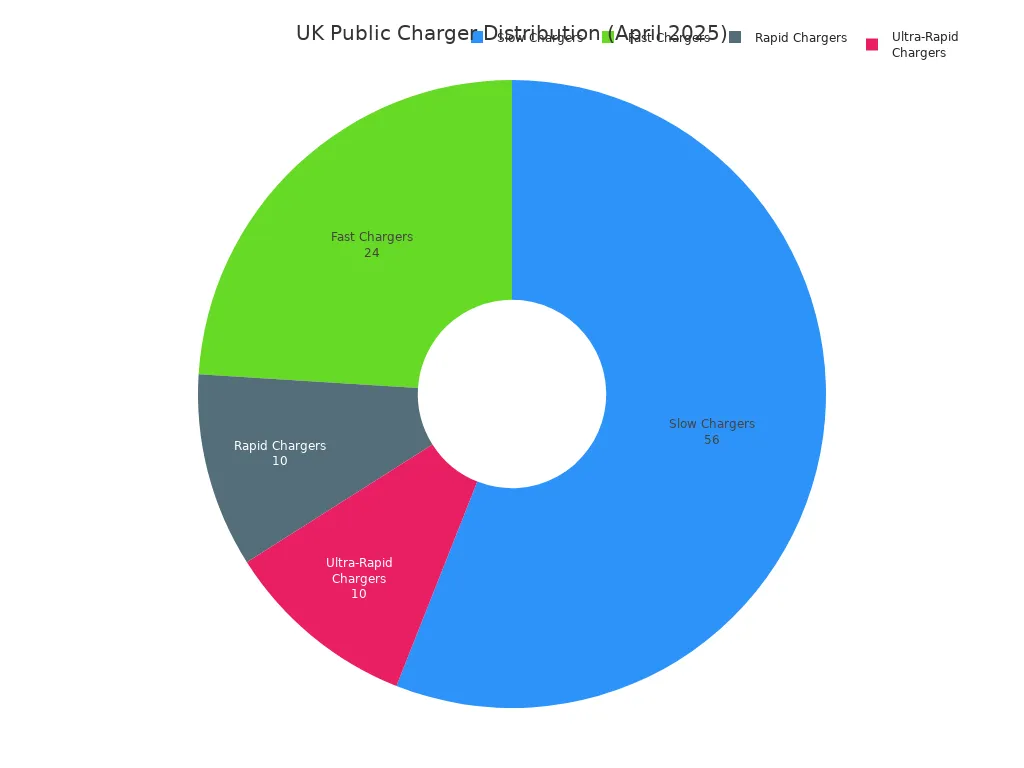
Stand April 2025 zeigt die Verteilung eine Abhängigkeit von langsameren Ladegeschwindigkeiten.
| Ladegerät Typ | Nennleistung | Netzanteil (April 2025) |
|---|---|---|
| Langsame Lader | 3 kW bis 8 kW | 56% |
| Schnelle Lader | 8 kW bis 49 kW | 24% |
| Schnelllader | 50 kW bis 149 kW | 10% |
| Ultraschnelle Lader | 150 kW plus | 10% |
Der Aufstieg dedizierter Ladezentren
Dedizierte Ladezentren werden entlang wichtiger Autobahnen und in Stadtzentren immer häufiger. Diese von Unternehmen wie Gridserve, Ionity und BP Pulse betriebenen Zentren verfügen über mehrere Hochgeschwindigkeitslader. Sie imitieren das traditionelle Tankstellenerlebnis und bieten Annehmlichkeiten wie Cafés und Toiletten, während Fahrer warten. Diese Zentren sind entscheidend für die Ermöglichung von Langstrecken-E-Mobilität.
Ausbaugeschwindigkeit im Einklang mit E-Auto-Verkäufen
Die Installation neuer E-Ladepunkte hält derzeit Schritt mit dem Wachstum der E-Auto-Verkäufe.. Der Ausbau von Ultraschnellladern ist besonders beeindruckend. Diese 150-kW+-Einheiten verzeichneten allein im letzten Jahr einen Anstieg von 51 %,, eine Wachstumsrate, die direkt die neue Generation von Elektrofahrzeugen unterstützt, die höhere Ladegeschwindigkeiten akzeptieren können. Diese Abstimmung ist entscheidend, um eine Überlastung der öffentlichen Ladekapazität zu verhindern.
Zukunftssicherung mit Hochleistungsladern
In Zukunft muss die Ladeinfrastruktur ab 2025 und darüber hinaus zukunftssicher sein. Das bedeutet, die Installation von Ultraschnellladern mit 150 kW, 350 kW oder sogar mehr zu priorisieren. Auch wenn nicht alle aktuellen E-Fahrzeuge diese Geschwindigkeiten nutzen können, stellt dies sicher, dass die Infrastruktur mit fortschreitender BatterieTechnologie relevant bleibt. Investitionen in diese Hochgeschwindigkeitslader heute verhindern kostspielige Nachrüstungen morgen und festigen das Fundament für eine vollelektrische Zukunft.
Beschleunigen staatliche Richtlinien und Investitionen den Übergang?
Government action is a powerful driver of the UK’s electric transition. Policies create market certainty, while investments can fill critical infrastructure gaps. However, the effectiveness of these interventions depends on their design, funding, and execution. An analysis of current policies reveals a mix of strong signals and significant implementation challenges that influence electric vehicle trends.
Evaluating Policy Impact on Electric Vehicle Trends
Policy decisions directly shape consumer behavior and manufacturer strategies. The UK government has used several key levers to steer the market toward electrification. The impact of these policies on electric vehicle trends provides a clear picture of what is working and where gaps remain.
The 2035 Petrol and Diesel Car Ban
The government’s plan to ban the sale of new petrol and diesel cars from 2035 is the cornerstone of its decarbonization strategy. This policy sends a clear long-term signal to the industry and consumers. However, recent data suggests a disconnect between this goal and current purchasing habits.
- Demand for new electric vehicles has stalled, holding at 18% of new car enquiries despite a mandated 28% market share for 2025.
- Current sales trajectories project EVs will only make up 45% of new car sales by 2030, far short of the 80% target.
- Affordability remains a key barrier, with 52% of drivers citing price as their main concern.
- The popularity of hybrids is rising, now accounting for 37% of new car advert views.
This data highlights a consumer base that is hesitant about the upfront cost of new EVs, leading to a surge in the used market.
Ian Plummer, Commercial Director of Auto Trader, noted: “There is genuine concern that 80% of consumers doubt the Government can meet its 2030 goal of banning new petrol and diesel vehicle sales. While the availability of affordable new and used EVs is increasing, and the £1.4 billion recently committed by the Government to support the transition is promising, it may take time for these improvements to reach and reassure the wider public.”
Assessing Past Purchase Subsidies
The UK previously offered a Plug-in Car Grant to reduce the initial cost of buying an EV. The government phased out this subsidy for cars in 2022. This move shifted the market’s focus squarely onto the total cost of ownership. While subsidies helped early adoption, their absence now magnifies the price difference between electric and internal combustion engine (ICE) vehicles. The market has responded predictably.
- A vast majority of car buyers (78%) plan to spend under £20,000.
- Only 33 new EV models are available at this price point, compared to 108 ICE and hybrid options. This affordability gap pushes many potential buyers toward the used EV market, where enquiries have surged by 92% since June 2023.
The Role of Installation Grants
The government continues to offer grants for the installation of charging points at homes and workplaces. These grants have successfully encouraged the expansion of private charging infrastructure for those with access to off-street parking. They lower the financial barrier to getting a home charger, which is the most convenient and cheapest way to handle daily charging needs. However, their impact is limited for the 40% of UK households without driveways, who remain entirely dependent on public infrastructure.
Zero Emission Vehicle (ZEV) Mandate
The ZEV mandate is a powerful policy forcing manufacturers to increase their EV sales mix. It requires that 22% of a manufacturer’s new car sales in 2024 are zero-emission, a figure that rises to 80% by 2030. This regulation is creating a “push” market, where manufacturers must prioritize EV sales to meet quotas, potentially leading to attractive deals for consumers. The mandate has spurred several key strategies among automakers.
| Manufacturer Strategy | Beschreibung |
|---|---|
| Trading ZEV Credits | Companies exceeding their targets can sell surplus credits to those falling short. |
| Banking ZEV Credits | Building a reserve of credits provides a buffer against future market changes. |
| Borrowing Allowances | A short-term solution allowing companies to borrow from future CO₂ allowances. |
This policy is directly influencing production and sales, with battery electric vehicles (BEVs) growing 21% in 2024. However, the system is complex. One premium brand, for example, exceeded its ZEV target but still faced over £17 million in potential penalties for missing separate CO₂ targets.
Investment vs. Need: Is Capital Flowing Correctly?
Building a national charging network requires immense capital investment. The government’s role is to direct public funds toward strategic gaps that the private market will not fill on its own. Assessing whether this capital is flowing correctly involves comparing government initiatives and private investment against the projected needs of an all-electric nation.
The Rapid Charging Fund’s Role
The Rapid Charging Fund (RCF) was announced in 2020 with an ambitious goal. It was allocated £950 million to help fund ultra-rapid charging infrastructure at motorway service areas. The fund specifically targeted grid connection upgrades, which are often prohibitively expensive for private operators. Unfortunately, the RCF was scrapped in 2025 after five years without issuing a single grant. The unspent capital is now expected to be folded into a broader £400 million fund, but the delay represents a significant setback for motorway charging expansion.
Private Sector Investment Surge
The private sector is the primary engine driving the rollout of ev charging points. Companies like Gridserve, Ionity, BP Pulse, and Osprey are investing billions to build out their networks. This investment is market-driven, focusing on locations with high traffic and proven demand. While this approach delivers rapid growth in profitable areas, it risks widening the gap between well-served urban centers and underserved rural regions.
Comparing Investment to Projected Needs
The scale of the challenge is enormous. The EV Energy Taskforce projects that the UK will need £7 billion of investment in its public charging network by 2035. This funding is necessary to increase the number of charge points tenfold and meet future demand. The vast majority of this capital is expected to come from private investors. The government’s role is therefore not to fund the entire network but to de-risk investment in less profitable areas and ensure equitable access for all drivers.
Upgrading Local Grid Connections
A major hidden cost in the EV transition is upgrading local electricity grids. Many ideal locations for charging hubs lack the necessary grid capacity to support multiple rapid chargers. The process of applying for and funding a substation upgrade can be slow and expensive, acting as a major barrier to the installation of charging stations. This issue requires coordinated planning between charge point operators, local authorities, and Distribution Network Operators (DNOs) to streamline investment and construction.
Overcoming Regulatory and Planning Hurdles
Beyond funding, a web of regulations and planning rules governs the deployment of charging infrastructure. These rules are intended to ensure safety, accessibility, and a positive user experience. However, they can also create delays and add costs if not designed and implemented efficiently. Recent government action has aimed to tackle some of these long-standing hurdles.
Streamlining Installation Permits
Historically, securing planning permission for new chargers has been a slow and inconsistent process, varying significantly between local authorities. This uncertainty creates risk and delays projects. The government is working to streamline these processes, treating the installation of public chargers as a national priority. Faster permit approvals are essential for accelerating the network rollout at the pace required.
Mandating Chargers in New Builds
To future-proof the nation’s housing stock, the government introduced a landmark law in 2022. This legislation mandates that all new-build homes in England with associated parking must include an electric vehicle charge point. The law also applies to buildings undergoing major renovation. This forward-thinking policy ensures that future homeowners are EV-ready from day one, supporting long-term adoption and reducing pressure on the public network.
Mandating Contactless Payments
A major frustration for early EV drivers was the need for multiple apps and subscription cards to access different charging networks. New regulations now mandate that all new public chargers above 8kW and all existing rapid chargers must offer a contactless payment option. This simple change dramatically improves the user experience, making public charging as easy as paying for fuel. This move toward standardisation is a critical step for mainstream adoption.
Standardizing Signage and Access
Finding an available and working charger remains a challenge. To address this, new regulations require operators to provide open data on the location, status, and price of their chargers in real-time. This allows drivers to use a single app to find a working unit from any provider. The rules also mandate a 99% reliability standard for rapid networks and a 24/7 helpline. Together with the standardisation of charging connectors, these measures create a more reliable and user-friendly ecosystem.
Grid Readiness: Can the UK Power an EV Nation?

The transition to electric vehicles raises a critical question: can the UK’s national grid handle the load? Powering millions of EVs requires more than just generating extra electricity; it demands a smarter, more flexible grid. The solution lies in managing national capacity, overcoming local constraints, and embracing intelligent charging technologies.
National Grid Capacity and Local Constraints
The National Grid confirms that the UK has enough power for a fully electric fleet. The real challenge is not the total energy required but managing the timing of that demand. Local infrastructure bottlenecks also present a significant hurdle to a smooth transition.
Managing Peak Demand Scenarios
Uncontrolled charging, where every driver plugs in their EV upon returning home, could create unsustainable spikes in electricity demand. The National Grid projects a manageable increase in peak load if smart technologies are widely adopted.
| Jahr | Peak Demand Increase (GW) | Percentage Increase (%) |
|---|---|---|
| 2030 | 3-8 | 4-14 |
| 2050 | 3-13 | 6-22 |
These projections depend heavily on shifting charging away from peak times. Without smart management, these figures could be significantly higher, straining the network.
The Need for Substation Upgrades
Grid capacity is not uniform across the country. Many areas face significant local constraints that prevent the installation of new rapid chargers.
- Ländliche Gebiete: These “charging deserts” often have older, single-phase grid connections, making it difficult and expensive to install the necessary infrastructure.
- Städtische Gebiete: Even in cities with more robust grids, clusters of chargers can overload local substations, creating a bottleneck for further expansion.
Integrating Renewable Energy Sources
Electric vehicles offer a unique opportunity to support the integration of renewable energy. The grid can encourage EV charging during periods of high wind or solar generation when electricity is abundant and cheap. This synergy helps balance the grid and advances national sustainability goals.
The Impact of Commercial EV Fleets
The electrification of commercial fleets presents both a challenge and an opportunity. A depot of vans charging simultaneously can place immense strain on a local grid connection. However, their predictable schedules make them ideal candidates for managed charging programs that can support grid stability.
Smart Charging: The Key to a Stable Grid
Smart charging is the most critical tool for managing the impact of EVs on the grid. It allows charging sessions to be shifted to off-peak hours automatically, reducing costs for drivers and preventing grid overload without requiring user intervention.
How Smart Tariffs Influence Behavior
Energy suppliers are increasingly offering dynamic tariffs that incentivize off-peak charging. Pilot programs from companies like Galp and ANWB have proven that drivers will change their behavior to take advantage of lower electricity prices overnight. This simple economic signal is highly effective at smoothing out demand.
The Potential of Automated Charging
Smart charging technology automates this process. Drivers simply plug in their car, and the system, guided by a mobile app, automatically schedules the charging session for the cheapest and greenest times. A program in California by MCE demonstrated this power, achieving an incredible 90% peak load reduction through managed charging.
Preventing Local Grid Overload
Smart charging directly addresses the risk of local grid overload. A UK case study at a large manufacturing site showed that uncontrolled charging by employees would create a new, damaging peak. By implementing a smart system, the EV charging load was spread across the day, completely eliminating the risk of exceeding the site’s power capacity.
Vehicle-to-Grid (V2G) Pilotprogramme
Vehicle-to-Grid (V2G) technology represents the next frontier. It allows EVs not only to draw power from the grid but also to export it back during times of high need.
The UK’s Sciurus Project, a major V2G trial, found that participants could earn an average of £80 per month by allowing their cars to support the grid. This demonstrates a clear financial benefit and a path toward a more resilient energy system.
The User Experience: Is Charging Convenient and Reliable?
A seamless user experience is the final piece of the puzzle for EV adoption. Even with enough chargers, the system fails if they are unreliable or difficult to use. The convenience of the charging experience hinges on both dependable hardware and user-friendly software.
The Challenge of Charging Infrastructure Reliability
Arriving at a public charger only to find it out of service is a major source of frustration for drivers. This issue of reliability remains a significant hurdle for the public charging infrastructure.
Understanding Charger Downtime
Charger downtime directly impacts driver confidence. While the network is improving, perfection remains elusive.
- A survey by Monta found 74% of UK charge point operators achieve uptime above 95%.
- However, only a mere 4% of operators reported an average uptime of 99.5% or higher.
This data shows that while most chargers work most of the time, a small but significant chance of failure persists across the networks.
The Importance of Maintenance
Charger failures stem from a variety of causes, ranging from grid issues to physical damage. Proactive maintenance is essential to minimize these problems. Software glitches can cause blank screens or failed payments, while simple user error, like not connecting a cable securely, also contributes to perceived failures. Vandalism and cable theft are also growing concerns.
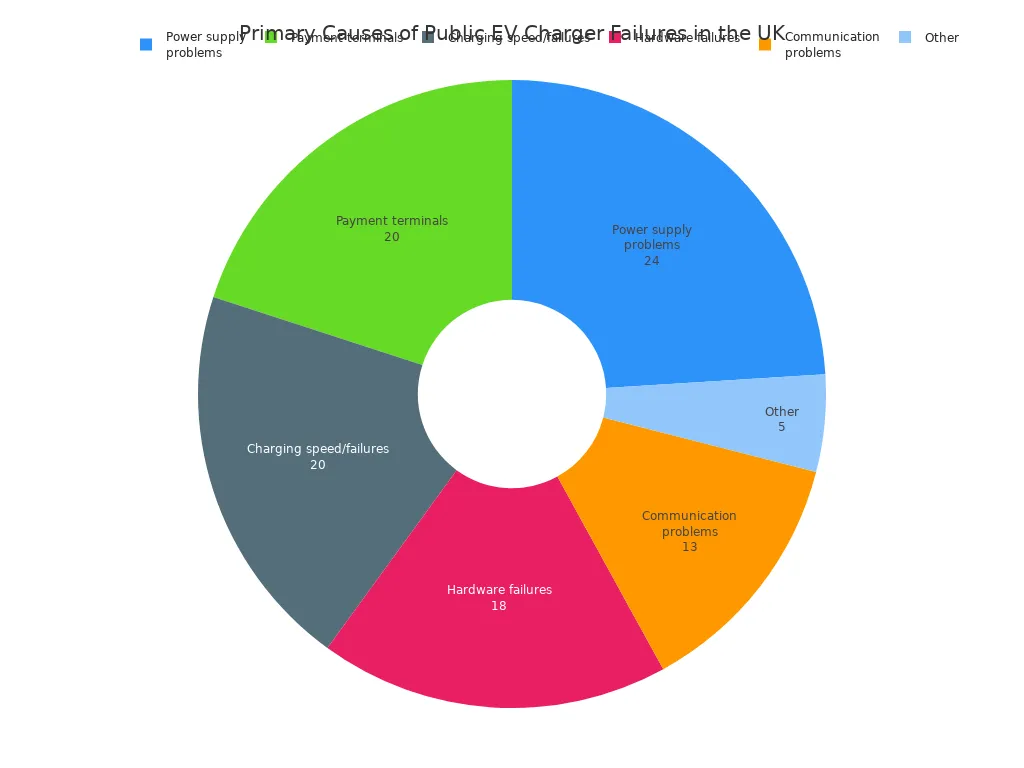
A breakdown of engineer callouts reveals the most common faults.
| Reason for Callout | Prozentsatz |
|---|---|
| Power supply problems | 24% |
| Payment terminals | 20% |
| Charging speed/failures | 20% |
| Hardware-Ausfälle | 18% |
| Communication problems | 13% |
| Andere | 5% |
Reporting and Repairing Faults
A streamlined process for reporting and repairing faults is critical. New regulations require operators to provide a 24/7 helpline, ensuring drivers can report issues at any time. The speed at which operators dispatch technicians to fix broken units directly influences network dependability.
Network Uptime Guarantees
To combat unreliability, the government is setting clear standards. New regulations will require charge point operators to meet a 99% reliability rate. This ambitious target aligns the UK with other leading EV markets like the Netherlands und exceeds the 97% uptime mandated by the National Electric Vehicle Infrastructure (NEVI) program in the United States.
Software, Apps, and Payment Systems
Beyond hardware, the digital experience of finding, using, and paying for charging is equally important. A fragmented system of apps and payment methods has historically created confusion for drivers.
The Problem of Multiple Apps
In the past, drivers needed a wallet full of RFID cards and a phone full of apps to access different charging networks. An EV driver might need apps like Zapmap, Electroverse, and Bonnet for general use, plus others like Pod Point or ChargePlace Scotland for specific locations, creating unnecessary complexity.
Roaming and Interoperability
The industry is moving toward greater interoperability. Roaming agreements allow customers of one network to use another’s chargers seamlessly. The government’s EV Infrastructure Strategy also plans new legislation to mandate payment roaming, which will improve interoperability across different EV models and charging providers.
The Push for Simpler Payments
The simplest solution is often the best. Regulations now require all new public chargers over 8kW to offer contactless payment. This move makes public charging as straightforward as paying at a supermarket, removing a major barrier for new users. While most rapid chargers now have this feature, around 90% of slower chargers still rely on apps or RFID cards.
Verfügbarkeitsdaten in Echtzeit
Finding an available charger is as important as finding one that works. New rules compel operators to provide open, real-time data on charger location, status, and price. This allows third-party apps to show drivers exactly where to find an open and operational charging point, preventing wasted journeys.
The Future of UK Charging Points: Trends and Innovations
Die future of UK charging points is being shaped by rapid technological innovation. Beyond simply adding more chargers, the industry is developing smarter, more convenient, and grid-friendly solutions. This evolution is critical for building a network that can support a fully electric nation and defines the future of EV charging.
Exploring the Future of EV Charging Technology
New charging technology aims to solve key challenges related to convenience, space, and grid integration. The future of UK charging points will likely involve a mix of these advanced systems.
Vehicle-to-Grid (V2G) at Scale
Vehicle-to-Grid (V2G) technology transforms cars into mobile energy storage units that can sell power back to the grid. While this offers huge potential for grid stability, significant hurdles remain.
- Hohe Kosten: V2G hardware currently costs between £3,700 and £6,000, with complex installation adding another £1,000-£3,000.
- Probleme mit der Kompatibilität: The technology is largely limited to vehicles with CHAdeMO connectors, awaiting wider adoption of the ISO 15118 standard for CCS-compatible cars.
- Regulatory Delays: Grid connection approvals can take months, slowing down residential installations.
The Viability of Wireless Charging
The future of EV charging includes cutting the cord entirely. Wireless, or inductive, charging allows a vehicle to recharge simply by parking over a ground-based pad. Real-world trials are already underway in the UK to test this technology. In Edinburgh, modified Vauxhall vans are testing wireless pads for commercial fleets, während a Nottingham project allows electric taxis to top up their batteries wirelessly while waiting for fares.
Battery Swapping for Niche Markets
Battery swapping offers a near-instant “refuel” by replacing a depleted battery with a fully charged one in minutes. While unlikely to become a mainstream solution for personal cars due to standardization challenges, it holds promise for commercial fleets like taxis or delivery vans, where minimizing vehicle downtime is a top priority.
Pop-Up and Mobile Charging Solutions
For the 40% of UK households without driveways, on-street charging solutions are essential. Pop-up chargers, a key innovation, address this need. Companies like Trojan Energy are installing retractable units in London that sit flush with the pavement when not in use. Ähnlich, BT Group is repurposing its old street cabinets into functional charging stations, cleverly using existing infrastructure.
Data and AI in Network Planning
Artificial intelligence is becoming a cornerstone for the future of UK charging points. By analyzing vast datasets, AI can optimize every aspect of the network, from location planning to grid management.
Predictive Analytics for Location Choice
AI algorithms analyze traffic patterns, local demographics, and existing grid capacity to predict the best locations for new charging stations. This data-driven approach ensures that investment is directed to areas with the highest potential demand, maximizing utility and return.
AI for Load Management
AI is crucial for preventing local grid overloads. Energy management systems, like those used by European operators such as Fastned, use AI to balance power across multiple chargers at a single site. The system can automatically adjust charging speeds in real-time, shifting demand away from peak hours to protect the grid.
Optimizing Charger Distribution
AI helps create a more equitable network. By identifying “charging deserts” in both urban and rural areas, it guides planners to fill critical gaps. This ensures the future of UK charging points provides fair access for all drivers, regardless of their location.
Enhancing the Driver Experience
Ultimately, AI improves the charging experience for every EV driver. It powers apps that provide real-time data on charger availability, predict wait times, and suggest alternative charging locations. This intelligence removes uncertainty and makes public charging more reliable and stress-free.
The UK is on a promising trajectory but is not yet fully prepared for a 100% electric vehicle fleet. While the nation is on track to meet its 300,000 public charger target by 2030, significant hurdles persist.
Achieving full readiness requires a united effort. This involves effective planning, smart charging integration, and building a reliable charging infrastructure to ensure a positive driver experience.
Key challenges in equitable access and local grid modernization must be overcome. The outlook is one of cautious optimism; the goal is within reach, but the most critical implementation phase is now.
FAQ
How many public chargers does the UK need?
The government targets 300,000 öffentliche Ladegeräte by 2030. The EV Energy Taskforce projects a tenfold increase from current levels is necessary. This expansion requires around £7 billion in investment, mostly from the private sector, to meet future demand from a fully electric fleet.
What if I don’t have a driveway for home charging?
Local authorities are deploying on-street solutions for the 40% of households without private parking.
- Lamppost Chargers: Bestehende Straßenmöblierung nutzen.
- Pop-up-Poller: Bei Nichtgebrauch ins Pflaster einfahren.
- Gemeinschaftszentren: Mehrere Anwohner an einem zentralen Standort bedienen.
Sind öffentliche Ladesäulen zuverlässig?
Die Zuverlässigkeit verbessert sich erheblich. Neue Vorschriften verlangen von Schnellladenetzwerken eine Betriebsbereitschaft von 99 %. Betreiber müssen außerdem eine rund um die Uhr erreichbare Hotline für Störungsmeldungen bereitstellen, um Probleme schnell zu beheben und das Vertrauen der Fahrer zu stärken.
Benötige ich mehrere Apps, um mein E-Auto zu laden?
Dies wird immer seltener. Neue Vorschriften schreiben kontaktlose Zahlungsmöglichkeiten an allen neuen Schnellladesäulen vor, was die Bezahlung vereinfacht. 💳 Größere Netzzusammenarbeit und Roamingvereinbarungen bedeuten auch, dass Fahrer verschiedene Netze nutzen können, ohne separate Apps oder Karten zu benötigen.
Kann das nationale Stromnetz Millionen von E-Autos bewältigen?
Ja, der National Grid bestätigt, dass insgesamt genügend Energiekapazität vorhanden ist. Die größte Herausforderung besteht im Lastmanagement. Intelligente Ladetechnologie ist die Schlüssellösung. Sie verlagert das Laden auf Schwachlastzeiten, entlastet das Netz und senkt die Kosten für die Fahrer.
Was ist das ZEV-Mandat?
Das Zero Emission Vehicle (ZEV)-Mandat ist eine staatliche Regelung, die Automobilhersteller verpflichtet, jährlich einen steigenden Anteil emissionsfreier Fahrzeuge zu verkaufen.
| Jahr | Vorgeschriebene ZEV-Verkäufe |
|---|---|
| 2024 | 22% |
| 2030 | 80% |
| 2035 | 100% |
Diese Politik treibt den Markt durch klare Vorgaben für die Branche direkt in Richtung Elektrifizierung.