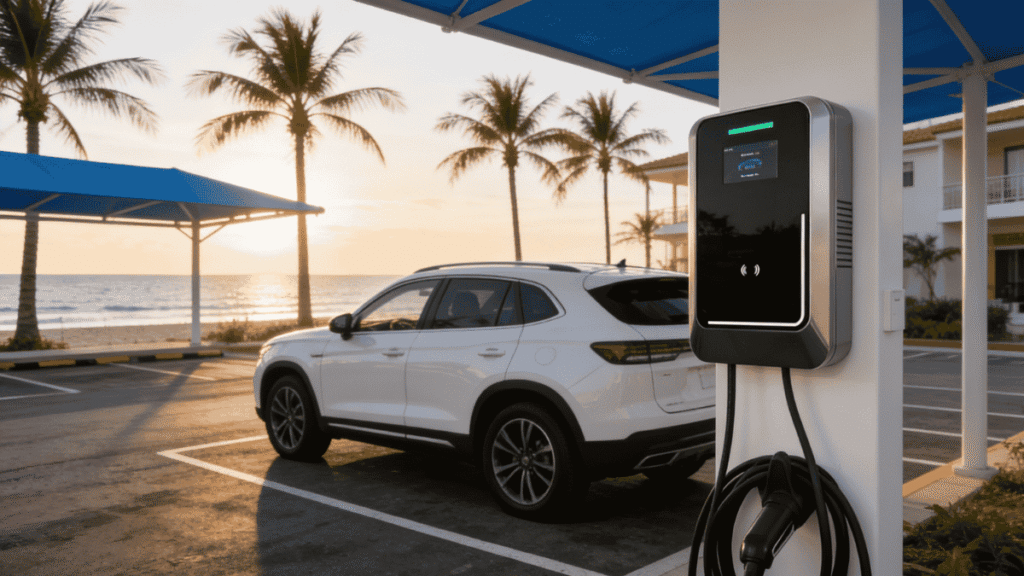
İş ve Perakende Mülkleri için Elektrikli Araç Şarj İstasyonlarının Faydaları
EV charging is no longer just an “extra amenity.” For many commercial and retail sites, it’s becoming a practical way to attract drivers, extend visit time, improve tenant satisfaction, and build a future-ready property. Modern EV charging programs can also be operated as a managed service—combining hardware, software, and support—so that site hosts don’t have to become charging experts.
This guide explains the business value of installing EV charging, what kinds of stations make sense for different property types, and how to plan a deployment that scales. Examples and concepts are supported by the source content provided from ChargePoint, Love’s, TPSON, and market listings from Smart Charge America.
1) Top business benefits of EV charging
A. Attract more drivers and increase repeat visits
EV charging helps you “meet customers where they are”—especially as EV adoption rises. ChargePoint positions itself as an EV charging platform designed to connect with drivers “when they want to charge” and emphasizes a consistent driver experience through its app and roaming partners. For retail and destination properties, this translates into higher foot traffic and stronger loyalty—because drivers will often choose stops where charging is available.
B. Increase dwell time and on-site spending
EV charging naturally creates a “productive wait” window. Love’s EV charging page highlights the strategy clearly: pairing chargers with amenities (food options, clean restrooms, dog parks, Wi?Fi) so drivers can optimize time while charging and “get back on the road quickly.” Retail sites can apply the same principle: charging encourages customers to stay longer, browse more, and spend more while they wait.
C. Create a competitive advantage for leasing and tenant retention
Charging can differentiate your property in leasing decisions. ChargePoint includes a customer quote framing EV charging as a “necessary infrastructure” and a “competitive advantage” for rental units. For commercial real estate and mixed-use properties, this benefit shows up as stronger tenant satisfaction and improved occupancy for EV-friendly sites.
D. Enable new revenue models (paid charging, access control, billing)
Many commercial charging systems support paid access and policy control—useful for retail, hospitality, paid parking, and multi-tenant environments. For example, Smart Charge America’s commercial solutions describe features such as payment processing and access control (e.g., its SCA40 solution). ChargePoint also describes operating and managing charging operations through software and services—supporting pricing policies and access controls as part of a broader platform.
E. Reduce operating friction with proactive monitoring and support
Reliability matters because “broken chargers” damage brand trust fast. ChargePoint emphasizes helping organizations reduce operating costs, increase uptime, and improve efficiency with proactive management tools and support. This is a key benefit for property owners who want EV charging to be a reliable amenity—not an ongoing maintenance headache.
F. Future-proof your site with open standards and flexible hardware choices
Charging hardware should not lock a site into a single future. ChargePoint explicitly positions platform flexibility: operate ChargePoint stations, ChargePoint Ready partner stations, or “any OCPP compliant hardware of your choice.” This matters for long-term properties because it reduces upgrade risk and supports incremental expansion.
2) Best-fit use cases by property type
| Property type | What drivers need | Recommended approach |
|---|---|---|
| Retail / shopping / big-box | Predictable dwell time; easy start/pay | Mix of Level 2 + select DC fast for turnover; clear signage and amenities |
| Commercial real estate / office / workplace | Daytime charging; controlled access; reporting | Networked Level 2 with access control and energy management |
| Apartments / multifamily parking | Reliable overnight charging; fair allocation | Managed Level 2 with load optimization and user controls |
| Travel centers / fueling & convenience | Fast turnaround + amenities | DC fast charging expansion + strong on-site experience (Love’s model) |
| Dealerships & service centers | Quick top-ups; flexible placement | Consider mobile/portable DC for operational flexibility (see TPSON example) |
3) AC vs. DC charging: which should businesses install?
A successful commercial charging plan matches charging speed to customer dwell time and site electrical capability. Love’s describes expanding DC fast chargers (Level 3) to complement an existing AC (Level 2) network—reflecting a common pattern: Level 2 covers longer stays, and DC fast serves quick turnaround needs.
AC EV chargers (Level 2): the “workhorse” for retail + workplace
Level 2 AC stations are typically the most scalable for properties where vehicles park for an hour or more (shopping, dining, movies, offices). TPSON groups its wallbox products under AC EV Şarj Cihazları. In its broader Elektrikli Araç Şarj Cihazları overview, TPSON also highlights AC chargers with Dinamik Yük Dengeleme to protect a home’s electrical system—conceptually similar to commercial energy management goals (avoid costly upgrades by managing demand).
DC fast chargers (Level 3): the throughput tool
DC fast charging matters where you want customers back on the road quickly or you’re supporting fleets and logistics. TPSON’s portable DC solution (TP?DC Compact Series) is positioned for both household and enterprise scenarios and is explicitly designed for emergency roadside assistance, fleet/logistics management, event/temporary locations, and dealerships/service centers. It offers 20kW/30kW/40kW power options, wheel mobility, and optional connectivity (Ethernet / 4G).
If most vehicles will park for hours (workplace, apartments, retail visits), prioritize Seviye 2 AC. If most vehicles will park for minutes (highway retail, travel stops, fast-turnover convenience), add DC fast where your electrical service and ROI support it.
4) Platform approach: software + hardware + services (why it matters)
For most businesses, the biggest “benefit unlock” is not a specific charger model—it’s operating charging as a managed program. ChargePoint emphasizes a unified platform: mix hardware with ChargePoint software, manage and monitor operations with an open platform, and even operate “any OCPP compliant hardware of your choice.” It also highlights driver experience integration (mobile and in-vehicle), and the ability to help reduce operating costs while improving uptime.
This matters for retail properties because the charging experience is part of your brand: discovery, availability, starting a session, payment, and reliability. It also matters for scale: adding ports is easier when your software, reporting, and access policies are already in place.
5) Deployment checklist for business sites
- Define the primary goal: attract retail customers, serve tenants, support fleets, or monetize sessions.
- Match charging level to dwell time: Level 2 for longer stays; add DC fast for quick stops (Love’s model).
- Plan for scale: choose a system that supports expansion without stranded investment (ChargePoint highlights flexible solutions and scalability).
- Erişim ve fiyatlandırmayı nasıl yöneteceğinize karar verin: ücretsiz şarj, yalnızca müşteriler, yalnızca çalışanlar, kiracı faturalandırması veya halka açık ücretli oturumlar.
- Bağlantı stratejisini onaylayın: Gereken yerlerde Wi-Fi/hücresel/Ethernet; bazı ticari çözümler sahada internet bağımsızlığını vurgular.
- Sürücü deneyimi için tasarlayın: işaretleme, aydınlatma, kablo yönetimi ve net talimatlar—ilgili yerlerde uygulama keşfi de ek olarak.
- Güvenilir bir ortak seçin: destek ve uzun vadeli operasyon odaklı satıcıları/platformları önceliklendirin (ChargePoint hizmetleri ve 7/24 sürücü desteğini vurgular).
SSS
EV şarjı yalnızca büyük mülkler için mi?
Hayır. ChargePoint, Avrupa ve Kuzey Amerika'da “her boyuttaki” kuruluş ve filoları desteklediğini belirtiyor ve ölçeklendirilebilen esnek çözümler (donanım + yazılım) sunuyor.
Hem AC hem DC şarj cihazlarına ihtiyacımız var mı?
Her zaman değil. Love's, mevcut Seviye 2 ağını tamamlamak için daha fazla DC hızlı şarj cihazı eklediğini açıklıyor. Bu yaklaşım, karışık kalış süreli yerler için uygundur. Birçok perakende ve iş yeri konumu önce Seviye 2 ile başlar, ardından kullanım ve yer gücü haklı çıkardığında DC hızlı ekler.
“Akıllı enerji” teknolojisine odaklanan bir üreticiyi seçmenin avantajı nedir?
TPSON, ürünlerini Current Fingerprint Algorithm ile güçlendirilmiş güvenlik ve enerji yönetimi etrafında konumlandırıyor, uç bilgi işlem ve AI destekli akıllı elektrik sistemlerini tanımlıyor. Mülkler için pratik avantaj, EV şarjını daha geniş elektrik güvenliği izleme, teşhis ve yük yönetimi hedefleriyle uyumlu hale getirmektir.
- Elektrikli Araç Şarj Cihazları
- EV Şarj Cihazları üreticisi olarak teknolojisini ve kilometre taşlarını tanımlar
- AC EV Şarj Cihazları
- DC EV Şarj Cihazları
- ChargePoint (platform, yazılım/hizmetler, sürücü deneyimi, esneklik, ölçek)
- Love's EV Şarj (seyir durağı şarj ağı, Seviye 2 + Seviye 3 karışımı, olanaklar)
- TPSON Taşınabilir DC EV Şarj Cihazı (kullanım durumları, 20/30/40kW özellikleri)
- Smart Charge America (erişim kontrolü/ödeme/yük optimizasyonu gibi ticari özellik örnekleri)
Not: Bu makale bilgilendiricidir ve küresel kapsamdadır. Yere özel elektrik tasarımı, izinler, erişilebilirlik ve ödeme gereksinimleri bölgeye göre değişir ve nitelikli profesyonellerle teyit edilmelidir.