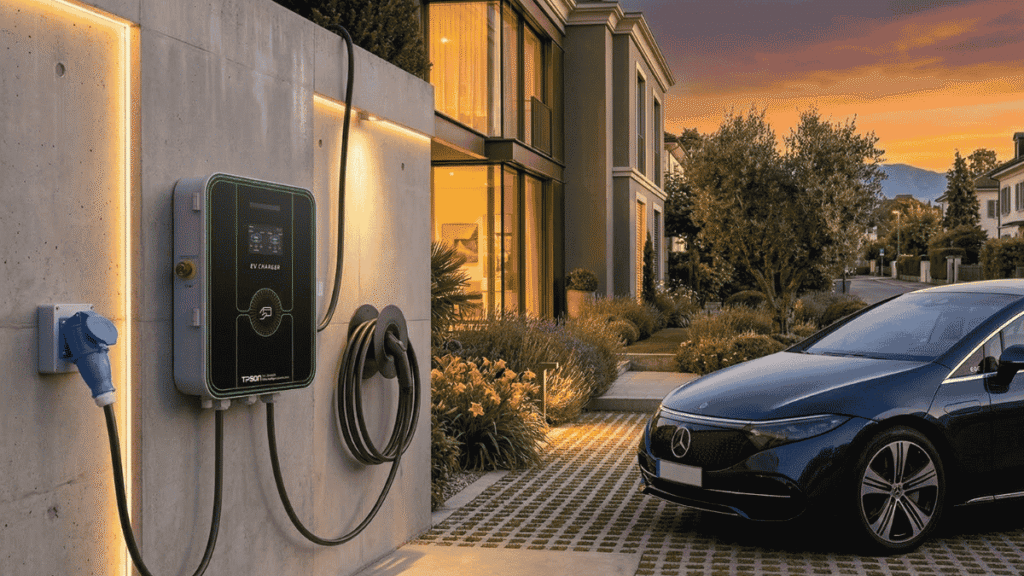
**EV charger amperage** is the amount of electrical current a charger can deliver, and it directly affects charging speed, installation requirements, circuit sizing, and overall charging efficiency. Choosing the right amperage is not about buying the highest number available. It is about matching the charger to the vehicle’s onboard charger, the site’s electrical capacity, daily driving habits, local code requirements, and long-term operating costs. For most residential users, a well-selected **Level 2 AC charger** in the 32A to 48A range is more than sufficient for overnight charging, while commercial and fleet scenarios may require higher-output AC or **DC fast charging** depending on turnaround expectations.
This guide explains how EV charger amperage works, what amperage options mean in real-world use, and how buyers can evaluate **home charging**, **commercial charging**, and **fleet charging** needs with greater technical confidence. It also draws on product and company information from TPSON, industry charging platform data, and public EV charging references to provide a practical, global view of charger selection.
- What EV charger amperage actually means
- Why amperage matters more than many buyers realize
- The relationship between amps, volts, and kilowatts
- Typical EV charger amperage levels and what they are used for
- How vehicle limits affect usable charging power
- How to choose the right amperage for home charging
- How to choose the right amperage for business and public charging
- AC charging versus DC charging amperage
- Single-phase and three-phase considerations
- Dynamic load balancing and why it changes the decision
- Installation, code, and circuit sizing considerations
- A practical decision framework for buyers
- Часто задаваемые вопросы
- Заключение
- Ссылки
Amperage, measured in amps or amperes, refers to the amount of electrical current flowing through the charging system. In EV charging, amperage helps determine how much power can be delivered to the vehicle when combined with voltage. In simple terms, more available current usually means faster charging, but only within the limits of the electrical circuit, the charging equipment, and the vehicle’s onboard charging system.
Many buyers focus on marketing labels such as 7 kW, 11 kW, or 22 kW. Those are useful, but amperage remains the underlying electrical metric that determines what the charger can safely and continuously deliver. This is especially important when specifying **AC EV Chargers** for residential and destination charging, because the charger rating must align with the available breaker size and wiring.
For organizations evaluating scalable infrastructure, amperage is also central to load planning, site design, and energy management. This is why manufacturers such as производителя зарядных станций для электромобилей TPSON emphasize compatibility, safety monitoring, and **dynamic load balancing** across their product ecosystem.
Amperage influences five core aspects of charger selection:
- Charging speed and vehicle readiness
- Electrical panel and circuit requirements
- Cable thickness, thermal performance, and installation method
- Project cost, including breaker, wire gauge, and possible panel upgrades
- Scalability for homes with multiple EVs or businesses with multiple chargers
A charger that is oversized for the site may increase installation cost without meaningful practical benefit. A charger that is undersized may create avoidable delays for users, especially in fleets, hospitality, or public parking environments. The correct amperage is therefore a design decision, not simply a product feature.
This is also why the broader category of Зарядные устройства для электромобилей should be evaluated not only by connector compatibility and certifications, but also by current output, communication options, and energy management capabilities.
The basic power formula is:
To convert watts to kilowatts, divide by 1,000.
Examples:
- 240V × 32A = 7,680W, or about **7.7 kW**
- 240V × 40A = 9,600W, or **9.6 kW**
- 240V × 48A = 11,520W, or about **11.5 kW**
- 400V × 32A three-phase can reach about **22 kW** depending on system configuration
This is where global market differences matter. In North America, many home chargers operate on 208V or 240V single-phase power. In Europe and many other regions, three-phase AC enables higher power outputs such as 11 kW or 22 kW at manageable current levels. That makes amperage analysis more nuanced than simply comparing products by one global standard.
| Сценарий зарядки | Typical Voltage | Typical Current | Approx. Power Output | Типичный пример использования |
|---|---|---|---|---|
| Level 1 AC | 120V | 8A–12A | 1.0–1.4 kW | Emergency or light daily home charging |
| Уровень 2 AC | 208V–240V | 16A–48A | 3.3–11.5 kW | Home, workplace, apartment, destination charging |
| Three-phase AC | 400V | 16A–32A | 11–22 kW | Commercial and faster residential charging in many global markets |
| Быстрая зарядка постоянного тока | High-voltage DC | Varies widely | 20 kW to 350 kW+ | Fleets, public fast charging, roadside, turnaround-critical use |
A 16A charger is often used where electrical capacity is limited or where overnight charging demand is modest. In single-phase AC, this usually means about 3.3 kW to 3.8 kW. In three-phase systems, 16A can reach about 11 kW. These chargers are relevant for small battery vehicles, low daily mileage drivers, and retrofitted sites where minimal infrastructure changes are preferred.
32A is one of the most practical EV charging current ratings globally. In North American 240V applications, it typically delivers about 7.7 kW. In European three-phase setups, it can support around 22 kW. This range is common for home charging, shared parking, and destination charging because it balances speed, installation feasibility, and cost.
A 40A charger often provides about 9.6 kW on 240V systems and is a strong option for users with higher daily driving needs, larger battery packs, or shorter overnight dwell times. Many quality residential units are offered in this range because it represents a meaningful speed increase without always requiring the heaviest possible infrastructure.
48A Level 2 charging is typically associated with hardwired installations and roughly 11.5 kW output at 240V. Car and Driver’s 2025 update on tested home chargers highlighted 48A-capable products such as Emporia Pro, Emporia Classic, and Tesla Universal Wall Connector as strong options for faster home charging where site capacity allows. This current class is highly attractive for homeowners who want future-ready charging without moving into commercial DC infrastructure.
Higher AC amperage levels, such as 80A, are more common in specialized North American commercial or premium residential applications and require careful circuit design. Commercial examples on the market include high-output AC units for workplaces and fleet depots. However, the practical value depends entirely on the vehicle’s onboard charger and the business case for faster turnaround.
One of the most common buying mistakes is assuming the charger alone determines charging speed. It does not. The vehicle’s onboard charger limits how much AC power the car can actually accept. If a vehicle can only accept 7.4 kW AC, installing an 11.5 kW home charger will not make that particular vehicle charge at 11.5 kW.
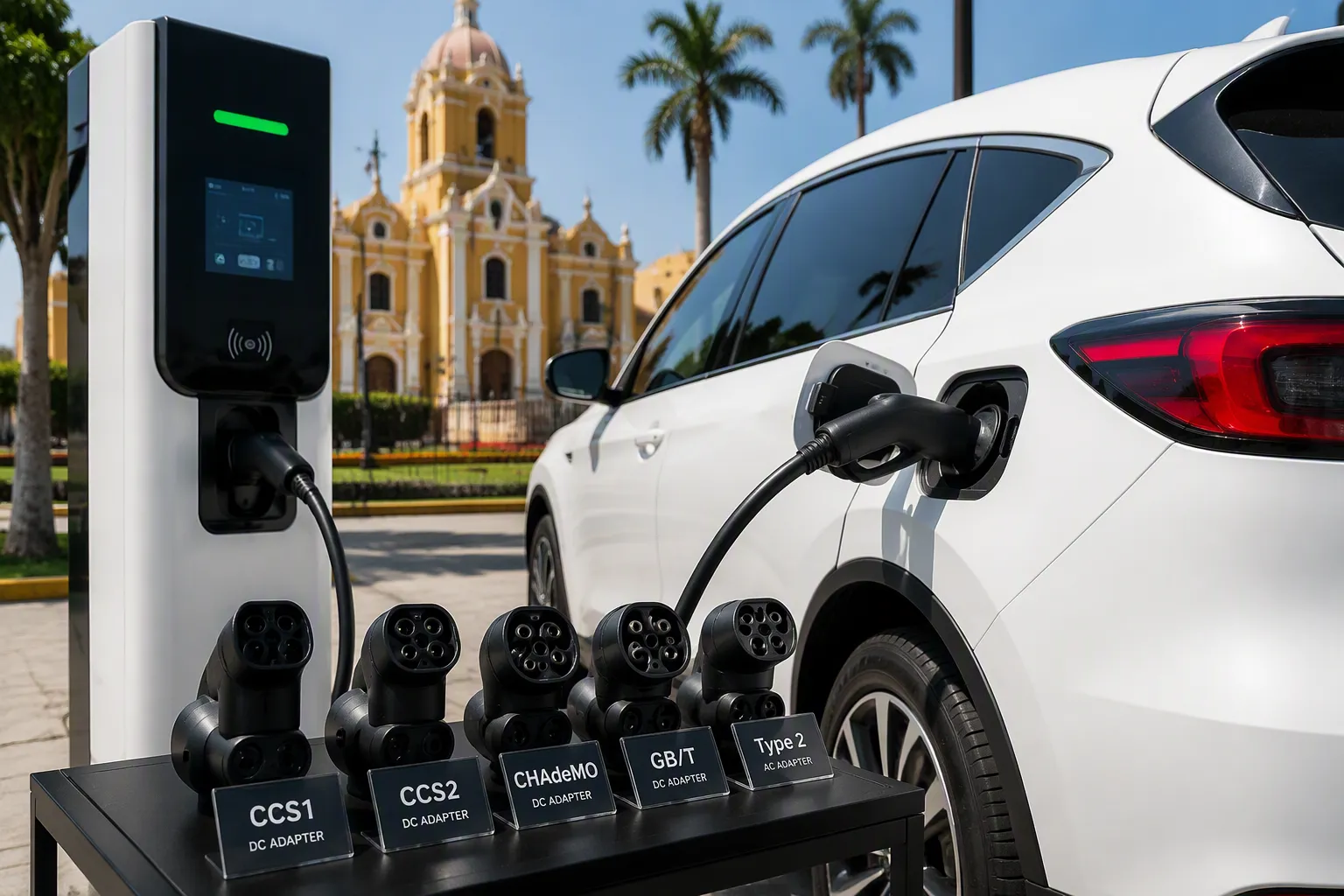
This is especially important for mixed-vehicle households or commercial properties that serve multiple brands. A site owner should assess not just charger capability, but also the charging acceptance of the vehicles expected to use it. For this reason, flexible platforms and connector options are increasingly important. TPSON’s charger portfolio, for example, emphasizes multi-standard compatibility across Type 1, Type 2, GB/T, and Tesla-oriented ecosystems, depending on market and configuration.
| Фактор | Who Sets the Limit | Impact on Charging Speed |
|---|---|---|
| Circuit capacity | Building electrical system | Sets maximum safe continuous current |
| Charger output rating | Charging equipment | Defines the charger’s top delivery capability |
| Onboard AC charger | Автомобиль | Caps the AC charging rate the vehicle can use |
| Battery condition and temperature | Vehicle battery management system | Can reduce charging power dynamically |
A practical starting point is to estimate how many kilowatt-hours must be added overnight. If a driver consumes 12 to 18 kWh per day, even a moderate Level 2 setup can usually replenish that comfortably. For many households, a 32A or 40A charger will restore daily usage overnight without difficulty.
Car and Driver notes that many households can support a 40A or 50A circuit, but not all homes have spare electrical capacity. This is where **dynamic load balancing** becomes a major value factor. Instead of requiring expensive panel upgrades, a load-managed charger can reduce its output when the rest of the home is under heavy demand and raise it again when capacity is available.
If the vehicle is parked 10 to 12 hours overnight, moderate amperage is often enough. If charging windows are shorter, or if the household has more than one EV, higher-output AC or load-sharing solutions become more attractive. Dual-EV households should also think beyond a single charger and consider whether simultaneous or sequential charging is the better operational fit.
Products such as Emporia’s home chargers distinguish clearly between NEMA plug configurations and hardwired configurations. Plug-in units offer installation flexibility and portability, but are typically limited to 40A continuous charging. Hardwired units can reach 48A and are often preferred where maximum Level 2 output is desired.
A charger should not only fit the current EV but also the likely next vehicle. Mixed households may benefit from connector flexibility, while high-mobility users may prefer the speed headroom of a 48A solution. For many buyers, **future-proofing** is less about the highest amperage and more about app control, OTA updates, connector adaptability, and power management.
Commercial charging is less about a single vehicle and more about turnover, user mix, dwell time, and business model. A workplace where cars stay parked all day has very different amperage needs from a public roadside location or a service depot.
For long dwell times, moderate AC amperage is often ideal. The goal is not necessarily the fastest possible charge, but dependable and cost-effective replenishment across multiple vehicles. This is where network management, RFID, OCPP, and current sharing matter as much as raw current rating.
Apartments and condominiums often benefit from smart chargers that support user authentication and power allocation. A lower per-port amperage combined with centralized management can produce better capital efficiency than a smaller number of very high-output ports.
These settings require a balance between charging speed and grid economics. Public charging operators increasingly deploy a mix of AC destination charging and DC fast charging to match different visit durations. Love’s, for example, states that its EV network includes both **Level 2 AC** and **Level 3 DC fast chargers**, showing how real-world site operators segment infrastructure by travel behavior and stop duration.
Fleets are highly sensitive to time windows. When vehicles must return to service quickly, amperage decisions become mission-critical. In those environments, portable or fixed **DC EV Chargers** may be preferable to high-output AC alone. TPSON’s portable DC charger page positions 20 kW, 30 kW, and 40 kW systems for emergency roadside assistance, mobile fleet charging, temporary locations, and dealerships, which reflects a growing use case for flexible DC deployment in operational settings.
AC and DC charging cannot be compared by amperage alone. In AC charging, the vehicle’s onboard charger converts AC electricity to DC for the battery. In DC charging, that conversion occurs in the charger itself, enabling much higher charging power. As a result, a lower-sounding current number in a high-voltage DC system can still represent far more power than a higher current Level 2 AC system.
TPSON’s portable DC charger illustrates this clearly. According to the product information provided, the TP-DC compact series offers 20 kW, 30 kW, and 40 kW models with a DC 50–1000V output range. Current outputs are listed as:
- TP-DC 20kW: 0–66.7A
- TP-DC 30kW: 0–100A
- TP-DC 40kW: 0–133.3A
That makes these products suitable for use cases where faster turnaround is required but full-scale high-power public DC infrastructure would be excessive or impractical.
| Тип зарядки | Typical Current Range | Typical Power Range | Best Fit |
|---|---|---|---|
| AC Уровень 2 | 16A–48A common | 3.3–11.5 kW in many homes | Home, workplace, apartment, destination charging |
| Three-phase AC | 16A–32A typical | 11–22 kW | Commercial and faster AC charging in global markets |
| Portable DC charging | Up to 133.3A in TPSON example | диапазона 20–40 кВт | Emergency, logistics, service, temporary deployment |
| Public DC fast charging | Widely variable | 50–350 kW+ | Highway, public network, heavy-use fleets |
A charger’s amperage means different things depending on the electrical architecture. In single-phase environments, increasing amperage often means rapidly increasing installation demands. In three-phase systems, substantial power can be delivered at more moderate current levels. That is why 11 kW and 22 kW AC chargers are especially common in Europe and other regions using three-phase power for commercial and residential installations.
TPSON’s wallbox product lines reflect this global orientation. Across the TW-10, TW-20, and TW-30 product families, the documented power options include 7.2 kW, 11 kW, and 22 kW, with support for smart functions such as app control, RFID, optional dynamic load balancing, and optional OCPP. Those features matter because amperage is not just a hardware parameter; it is part of a broader charging-control strategy.
One of the most important developments in charger selection is **dynamic load balancing**. Instead of sizing the entire property around the charger’s maximum current draw, a load-balancing system monitors total building demand and adjusts charging current in real time. This can prevent overloads, avoid nuisance breaker trips, and reduce the need for costly electrical upgrades.
This feature is particularly valuable in:
- Older homes with limited spare panel capacity
- Multi-EV households
- Apartment and condo parking areas
- Commercial sites adding multiple chargers gradually
TPSON’s own Dynamic Load Balancing documentation describes the charger as adjusting available charging power based on real-time household demand from appliances, lighting, and other devices. The practical implication is simple: the best charger amperage may be one that is higher on paper but intelligently throttled in operation when site conditions require it.
Это делает балансировку нагрузки при зарядке сильным стратегическим вариантом для покупателей, которые хотят оборудование с более высокими характеристиками, но не могут оправдать немедленные модернизации на стороне энергоснабжения или электрощита.
Сила тока зарядного устройства всегда должна рассматриваться совместно с электротехническими нормами и правилами для непрерывной нагрузки. Зарядка электромобиля, как правило, рассматривается как непрерывная нагрузка, что означает, что номинал цепи должен превышать непрерывный рабочий ток зарядного устройства. Общее эмпирическое правило заключается в том, что зарядное устройство в непрерывном режиме работы должно использовать не более 80 процентов номинала автоматического выключателя.
Examples:
- Зарядка на 32А обычно требует цепь на 40А.
- Зарядка на 40А обычно требует цепь на 50А.
- Зарядка на 48А обычно требует цепь на 60А.
Опубликованная информация о продукции Emporia четко отражает это, указывая на необходимость выделенной двухполюсной защиты на 50А для зарядки на 40А и двухполюсной защиты на 60А для зарядки на 48А. На той же странице также отмечается, что конфигурации с разъемами NEMA проще в установке, но ограничены 40А, тогда как прямое подключение (hardwired) поддерживает до 48А.
Еще одним важным вопросом является координация УЗО. Технические заметки Emporia подчеркивают, что зарядные устройства для электромобилей со встроенной защитой УЗО могут испытывать ложные срабатывания при использовании с некоторыми розетками, также защищенными УЗО. Это одна из причин, по которой прямое подключение часто предпочтительнее для домашней зарядки на более высоких токах.
Для коммерческих и общественных проектов сложность проектирования возрастает. Номинальный ток влияет на размеры питающих линий, защитные устройства, распределение энергии, управление кабелями, тепловой расчет, а иногда и на пользовательский опыт. Следовательно, выбор зарядного устройства должен быть интегрирован в планировку объекта на ранних этапах, а не рассматриваться как выбор оборудования на последней стадии.
- Выбирайте 32А–40А, если ночной зарядки достаточно, а запас мощности в электрощите умеренный.
- Выбирайте 48А, если важна более быстрая домашняя зарядка и допустимо прямое подключение.
- Выбирайте зарядное устройство с **подключением по Wi-Fi**, планировщиком и отчетностью в приложении, если важна оптимизация тарифов энергоснабжения.
- Отдавайте приоритет **динамической балансировке нагрузки**, если пропускная способность вводного кабеля/сети ограничена.
- Отдавайте предпочтение сетевым зарядным устройствам с RFID, управлением пользователями и балансировкой нагрузки.
- Избегайте завышения силы тока на порт, если это ограничивает общее количество точек зарядки.
- Рассматривайте системы, готовые к OCPP, для будущей гибкости в управлении.
- Подбирайте силу тока в соответствии со временем пребывания, а не максимальной теоретической скоростью.
- Делайте акцент на времени безотказной работы, долговечности кабеля и аутентификации пользователя.
- Используйте стратегии разделения мощности для эффективного увеличения общего количества портов.
- Сначала оцените требования к времени оборота (зарядки).
- Если важна гибкость, рассмотрите мобильные или переносные **зарядные устройства постоянного тока (DC) для электромобилей**.
- Внимательно оценивайте стандарты разъемов с учетом региональных и автомобильных различий.
- Моделируйте время операционной готовности, а не только номинал оборудования.
TPSON позиционирует себя как поставщика интеллектуальных систем зарядки и управления энергией, построенных вокруг своего алгоритма Current Fingerprint. Согласно опубликованным материалам компании на сайте, бизнес работает с 2015 года и специализируется на умных зарядных устройствах для электромобилей и энергетических решениях с особым акцентом на безопасность, эффективность, совместимость и диагностику.
В рамках портфолио зарядных устройств:
- Зарядные устройства переменного тока для электромобилей такие как TW-10, TW-20 и TW-30, ориентированы на домашние и коммерческие потребности уровня 2 (Level 2) и обладают интеллектуальными функциями, включая управление через приложение, RFID, опции OCPP и балансировку нагрузки.
- Настенная станция TW-40 с двумя пистолетами предназначена для общих и высокопроизводительных применений на переменном токе (AC), где одновременная зарядка двух автомобилей повышает использование объекта.
- Зарядные устройства постоянного тока для электромобилей в портативной серии TP-DC удовлетворяют потребности в мобильной, аварийной, логистической и временной зарядке классами 20 кВт, 30 кВт и 40 кВт.
Для покупателей, сравнивающих стратегии выбора силы тока в средах переменного и постоянного тока, эта архитектура продукта отражает практический принцип: выходной ток следует выбирать в соответствии с вариантом использования, а не изолированно от модели развертывания, контроля доступа и управления энергией.
Несколько отраслевых источников подтверждают идею о том, что выбор силы тока должен быть контекстным.
- ChargePoint описывает зарядку электромобилей как экосистему, включающую программное обеспечение, аппаратное обеспечение, открытую совместимость OCPP