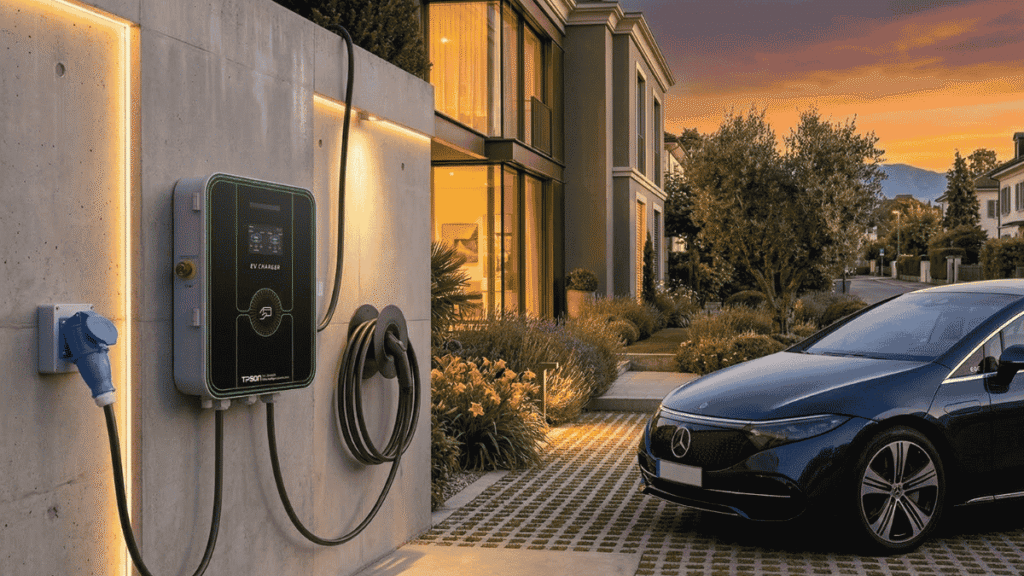
**EV charger amperage** is the amount of electrical current a charger can deliver, and it directly affects charging speed, installation requirements, circuit sizing, and overall charging efficiency. Choosing the right amperage is not about buying the highest number available. It is about matching the charger to the vehicle’s onboard charger, the site’s electrical capacity, daily driving habits, local code requirements, and long-term operating costs. For most residential users, a well-selected **Level 2 AC charger** in the 32A to 48A range is more than sufficient for overnight charging, while commercial and fleet scenarios may require higher-output AC or **DC fast charging** depending on turnaround expectations.
This guide explains how EV charger amperage works, what amperage options mean in real-world use, and how buyers can evaluate **home charging**, **commercial charging**, and **fleet charging** needs with greater technical confidence. It also draws on product and company information from TPSON, industry charging platform data, and public EV charging references to provide a practical, global view of charger selection.
- What EV charger amperage actually means
- Why amperage matters more than many buyers realize
- The relationship between amps, volts, and kilowatts
- Typical EV charger amperage levels and what they are used for
- How vehicle limits affect usable charging power
- How to choose the right amperage for home charging
- How to choose the right amperage for business and public charging
- AC charging versus DC charging amperage
- Single-phase and three-phase considerations
- Dynamic load balancing and why it changes the decision
- Installation, code, and circuit sizing considerations
- A practical decision framework for buyers
- Pertanyaan yang sering diajukan
- Kesimpulan
- Referensi
Amperage, measured in amps or amperes, refers to the amount of electrical current flowing through the charging system. In EV charging, amperage helps determine how much power can be delivered to the vehicle when combined with voltage. In simple terms, more available current usually means faster charging, but only within the limits of the electrical circuit, the charging equipment, and the vehicle’s onboard charging system.
Many buyers focus on marketing labels such as 7 kW, 11 kW, or 22 kW. Those are useful, but amperage remains the underlying electrical metric that determines what the charger can safely and continuously deliver. This is especially important when specifying **AC EV Chargers** for residential and destination charging, because the charger rating must align with the available breaker size and wiring.
For organizations evaluating scalable infrastructure, amperage is also central to load planning, site design, and energy management. This is why manufacturers such as Bagi seorang TPSON emphasize compatibility, safety monitoring, and **dynamic load balancing** across their product ecosystem.
Amperage influences five core aspects of charger selection:
- Charging speed and vehicle readiness
- Electrical panel and circuit requirements
- Cable thickness, thermal performance, and installation method
- Project cost, including breaker, wire gauge, and possible panel upgrades
- Scalability for homes with multiple EVs or businesses with multiple chargers
A charger that is oversized for the site may increase installation cost without meaningful practical benefit. A charger that is undersized may create avoidable delays for users, especially in fleets, hospitality, or public parking environments. The correct amperage is therefore a design decision, not simply a product feature.
This is also why the broader category of Pengisi Daya Mobil Listrik should be evaluated not only by connector compatibility and certifications, but also by current output, communication options, and energy management capabilities.
The basic power formula is:
To convert watts to kilowatts, divide by 1,000.
Examples:
- 240V × 32A = 7,680W, or about **7.7 kW**
- 240V × 40A = 9,600W, or **9.6 kW**
- 240V × 48A = 11,520W, or about **11.5 kW**
- 400V × 32A three-phase can reach about **22 kW** depending on system configuration
This is where global market differences matter. In North America, many home chargers operate on 208V or 240V single-phase power. In Europe and many other regions, three-phase AC enables higher power outputs such as 11 kW or 22 kW at manageable current levels. That makes amperage analysis more nuanced than simply comparing products by one global standard.
| Charging Scenario | Typical Voltage | Typical Current | Approx. Power Output | Kasus Penggunaan Umum |
|---|---|---|---|---|
| Level 1 AC | 120V | 8A–12A | 1.0–1.4 kW | Emergency or light daily home charging |
| Level 2 AC | 208V–240V | 16A–48A | 3.3–11.5 kW | Home, workplace, apartment, destination charging |
| Three-phase AC | 400V | 16A–32A | 11–22 kW | Commercial and faster residential charging in many global markets |
| Pengisian Cepat DC | High-voltage DC | Varies widely | 20 kW to 350 kW+ | Fleets, public fast charging, roadside, turnaround-critical use |
A 16A charger is often used where electrical capacity is limited or where overnight charging demand is modest. In single-phase AC, this usually means about 3.3 kW to 3.8 kW. In three-phase systems, 16A can reach about 11 kW. These chargers are relevant for small battery vehicles, low daily mileage drivers, and retrofitted sites where minimal infrastructure changes are preferred.
32A is one of the most practical EV charging current ratings globally. In North American 240V applications, it typically delivers about 7.7 kW. In European three-phase setups, it can support around 22 kW. This range is common for home charging, shared parking, and destination charging because it balances speed, installation feasibility, and cost.
A 40A charger often provides about 9.6 kW on 240V systems and is a strong option for users with higher daily driving needs, larger battery packs, or shorter overnight dwell times. Many quality residential units are offered in this range because it represents a meaningful speed increase without always requiring the heaviest possible infrastructure.
48A Level 2 charging is typically associated with hardwired installations and roughly 11.5 kW output at 240V. Car and Driver’s 2025 update on tested home chargers highlighted 48A-capable products such as Emporia Pro, Emporia Classic, and Tesla Universal Wall Connector as strong options for faster home charging where site capacity allows. This current class is highly attractive for homeowners who want future-ready charging without moving into commercial DC infrastructure.
Higher AC amperage levels, such as 80A, are more common in specialized North American commercial or premium residential applications and require careful circuit design. Commercial examples on the market include high-output AC units for workplaces and fleet depots. However, the practical value depends entirely on the vehicle’s onboard charger and the business case for faster turnaround.
One of the most common buying mistakes is assuming the charger alone determines charging speed. It does not. The vehicle’s onboard charger limits how much AC power the car can actually accept. If a vehicle can only accept 7.4 kW AC, installing an 11.5 kW home charger will not make that particular vehicle charge at 11.5 kW.
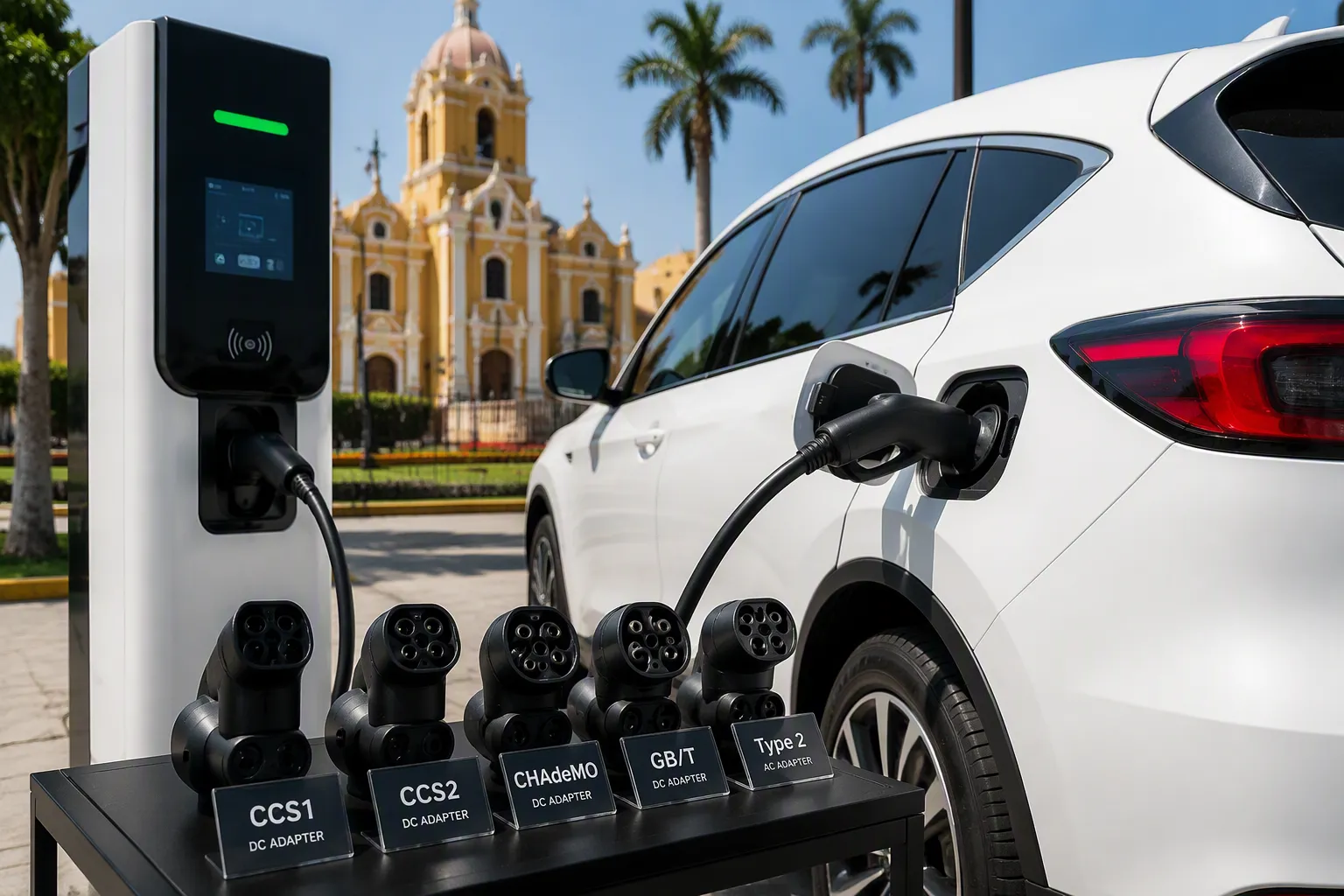
This is especially important for mixed-vehicle households or commercial properties that serve multiple brands. A site owner should assess not just charger capability, but also the charging acceptance of the vehicles expected to use it. For this reason, flexible platforms and connector options are increasingly important. TPSON’s charger portfolio, for example, emphasizes multi-standard compatibility across Type 1, Type 2, GB/T, and Tesla-oriented ecosystems, depending on market and configuration.
| Faktor | Who Sets the Limit | Impact on Charging Speed |
|---|---|---|
| Circuit capacity | Building electrical system | Sets maximum safe continuous current |
| Charger output rating | Charging equipment | Defines the charger’s top delivery capability |
| Onboard AC charger | Kendaraan | Caps the AC charging rate the vehicle can use |
| Battery condition and temperature | Vehicle battery management system | Can reduce charging power dynamically |
A practical starting point is to estimate how many kilowatt-hours must be added overnight. If a driver consumes 12 to 18 kWh per day, even a moderate Level 2 setup can usually replenish that comfortably. For many households, a 32A or 40A charger will restore daily usage overnight without difficulty.
Car and Driver notes that many households can support a 40A or 50A circuit, but not all homes have spare electrical capacity. This is where **dynamic load balancing** becomes a major value factor. Instead of requiring expensive panel upgrades, a load-managed charger can reduce its output when the rest of the home is under heavy demand and raise it again when capacity is available.
If the vehicle is parked 10 to 12 hours overnight, moderate amperage is often enough. If charging windows are shorter, or if the household has more than one EV, higher-output AC or load-sharing solutions become more attractive. Dual-EV households should also think beyond a single charger and consider whether simultaneous or sequential charging is the better operational fit.
Products such as Emporia’s home chargers distinguish clearly between NEMA plug configurations and hardwired configurations. Plug-in units offer installation flexibility and portability, but are typically limited to 40A continuous charging. Hardwired units can reach 48A and are often preferred where maximum Level 2 output is desired.
A charger should not only fit the current EV but also the likely next vehicle. Mixed households may benefit from connector flexibility, while high-mobility users may prefer the speed headroom of a 48A solution. For many buyers, **future-proofing** is less about the highest amperage and more about app control, OTA updates, connector adaptability, and power management.
Commercial charging is less about a single vehicle and more about turnover, user mix, dwell time, and business model. A workplace where cars stay parked all day has very different amperage needs from a public roadside location or a service depot.
For long dwell times, moderate AC amperage is often ideal. The goal is not necessarily the fastest possible charge, but dependable and cost-effective replenishment across multiple vehicles. This is where network management, RFID, OCPP, and current sharing matter as much as raw current rating.
Apartments and condominiums often benefit from smart chargers that support user authentication and power allocation. A lower per-port amperage combined with centralized management can produce better capital efficiency than a smaller number of very high-output ports.
These settings require a balance between charging speed and grid economics. Public charging operators increasingly deploy a mix of AC destination charging and DC fast charging to match different visit durations. Love’s, for example, states that its EV network includes both **Level 2 AC** and **Level 3 DC fast chargers**, showing how real-world site operators segment infrastructure by travel behavior and stop duration.
Fleets are highly sensitive to time windows. When vehicles must return to service quickly, amperage decisions become mission-critical. In those environments, portable or fixed **DC EV Chargers** may be preferable to high-output AC alone. TPSON’s portable DC charger page positions 20 kW, 30 kW, and 40 kW systems for emergency roadside assistance, mobile fleet charging, temporary locations, and dealerships, which reflects a growing use case for flexible DC deployment in operational settings.
AC and DC charging cannot be compared by amperage alone. In AC charging, the vehicle’s onboard charger converts AC electricity to DC for the battery. In DC charging, that conversion occurs in the charger itself, enabling much higher charging power. As a result, a lower-sounding current number in a high-voltage DC system can still represent far more power than a higher current Level 2 AC system.
TPSON’s portable DC charger illustrates this clearly. According to the product information provided, the TP-DC compact series offers 20 kW, 30 kW, and 40 kW models with a DC 50–1000V output range. Current outputs are listed as:
- TP-DC 20kW: 0–66.7A
- TP-DC 30kW: 0–100A
- TP-DC 40kW: 0–133.3A
That makes these products suitable for use cases where faster turnaround is required but full-scale high-power public DC infrastructure would be excessive or impractical.
| Jenis Pengisian Daya | Typical Current Range | Typical Power Range | Paling Cocok |
|---|---|---|---|
| AC Level 2 | 16A–48A common | 3.3–11.5 kW in many homes | Home, workplace, apartment, destination charging |
| Three-phase AC | 16A–32A typical | 11–22 kW | Commercial and faster AC charging in global markets |
| Portable DC charging | Up to 133.3A in TPSON example | rentang 20–40 kW | Emergency, logistics, service, temporary deployment |
| Public DC fast charging | Widely variable | 50–350 kW+ | Highway, public network, heavy-use fleets |
A charger’s amperage means different things depending on the electrical architecture. In single-phase environments, increasing amperage often means rapidly increasing installation demands. In three-phase systems, substantial power can be delivered at more moderate current levels. That is why 11 kW and 22 kW AC chargers are especially common in Europe and other regions using three-phase power for commercial and residential installations.
TPSON’s wallbox product lines reflect this global orientation. Across the TW-10, TW-20, and TW-30 product families, the documented power options include 7.2 kW, 11 kW, and 22 kW, with support for smart functions such as app control, RFID, optional dynamic load balancing, and optional OCPP. Those features matter because amperage is not just a hardware parameter; it is part of a broader charging-control strategy.
One of the most important developments in charger selection is **dynamic load balancing**. Instead of sizing the entire property around the charger’s maximum current draw, a load-balancing system monitors total building demand and adjusts charging current in real time. This can prevent overloads, avoid nuisance breaker trips, and reduce the need for costly electrical upgrades.
Fitur ini sangat berharga dalam:
- Rumah tua dengan kapasitas panel cadangan terbatas
- Rumah tangga dengan beberapa kendaraan listrik
- Area parkir apartemen dan kondominium
- Situs komersial yang menambahkan beberapa pengisi daya secara bertahap
Dokumentasi Dynamic Load Balancing TPSON sendiri menjelaskan pengisi daya ini menyesuaikan daya pengisian yang tersedia berdasarkan permintaan rumah tangga secara real-time dari peralatan, pencahayaan, dan perangkat lainnya. Implikasi praktisnya sederhana: ampere pengisi daya terbaik mungkin secara teori lebih tinggi, tetapi secara cerdas dikurangi pengoperasiannya ketika kondisi situs mengharuskannya.
Hal ini membuat pengisian daya dengan penyeimbangan beban menjadi pilihan strategis yang kuat bagi pembeli yang menginginkan peralatan berating lebih tinggi tetapi tidak dapat membenarkan peningkatan sisi utilitas atau panel secara langsung.
Ampere pengisi daya harus selalu dipertimbangkan bersama dengan kode listrik dan aturan beban berkelanjutan. Pengisian kendaraan listrik umumnya diperlakukan sebagai beban berkelanjutan, yang berarti rating sirkuit harus melebihi arus operasi berkelanjutan pengisi daya. Aturan praktis umumnya adalah pengisi daya sebaiknya menggunakan tidak lebih dari 80 persen rating pemutus sirkuit dalam operasi berkelanjutan.
Examples:
- Pengisian 32A biasanya memerlukan sirkuit 40A
- Pengisian 40A biasanya memerlukan sirkuit 50A
- Pengisian 48A biasanya memerlukan sirkuit 60A
Informasi produk yang diterbitkan Emporia mencerminkan hal ini dengan jelas, mencantumkan perlindungan kutub ganda 50A khusus untuk pengisian 40A dan perlindungan kutub ganda 60A untuk pengisian 48A. Halaman yang sama juga mencatat bahwa konfigurasi steker NEMA lebih mudah dipasang tetapi terbatas hingga 40A, sedangkan instalasi hardwired mendukung hingga 48A.
Masalah relevan lainnya adalah koordinasi GFCI. Catatan teknis Emporia menyoroti bahwa pengisi daya EV dengan perlindungan GFCI bawaan dapat mengalami trip gangguan ketika dipasangkan dengan instalasi outlet tertentu yang dilindungi GFCI. Ini adalah salah satu alasan mengapa instalasi hardwired sering lebih disukai untuk pengisian daya residensial berampere lebih tinggi.
Untuk proyek komersial dan publik, kompleksitas desain semakin meningkat. Rating arus memengaruhi ukuran feeder, perangkat proteksi, distribusi daya, manajemen kabel, desain termal, dan terkadang bahkan pengalaman pengguna. Akibatnya, pemilihan pengisi daya harus diintegrasikan sejak dini ke dalam perencanaan situs, bukan diperlakukan sebagai pilihan peralatan tahap akhir.
- Pilih 32A hingga 40A jika pengisian semalaman sudah cukup dan ruang kepala panel sedang
- Pilih 48A jika pengisian rumah yang lebih cepat berharga dan hardwiring dapat diterima
- Pilih pengisi daya dengan **konektivitas Wi-Fi**, penjadwalan, dan pelaporan aplikasi jika optimasi tarif utilitas penting
- Prioritaskan **penyeimbangan beban dinamis** jika kapasitas layanan terbatas
- Utamakan pengisi daya terhubung jaringan dengan RFID, manajemen pengguna, dan penyeimbangan beban
- Hindari membangun ampere per-port berlebihan jika hal itu membatasi jumlah total titik pengisian
- Pertimbangkan sistem siap OCPP untuk fleksibilitas back-office di masa depan
- Sesuaikan ampere dengan waktu tunggu, bukan kecepatan teoritis maksimum
- Tekankan waktu aktif, daya tahan kabel, dan autentikasi pengguna
- Gunakan strategi berbagi daya untuk meningkatkan jumlah port total secara efisien
- Tinjau terlebih dahulu persyaratan waktu perputaran
- Jika fleksibilitas penting, pertimbangkan **Pengisi Daya EV DC** yang portabel atau mudah dipindahkan
- Evaluasi standar konektor dengan cermat di berbagai variasi regional dan kendaraan
- Modelkan waktu aktif operasional, bukan hanya rating peralatan
TPSON memposisikan dirinya sebagai penyedia sistem pengisian daya dan manajemen energi cerdas yang dibangun di sekitar Algoritma Sidik Jari Arus (Current Fingerprint Algorithm). Menurut materi situs web yang diterbitkan perusahaan, bisnis ini telah beroperasi sejak 2015 dan berfokus pada pengisi daya EV cerdas dan solusi energi dengan penekanan lebih luas pada keamanan, efisiensi, kompatibilitas, dan diagnostik.
Dalam portofolio pengisian daya:
- Pengisi Daya Mobil Listrik AC Seperti TW-10, TW-20, dan TW-30 menargetkan kebutuhan Level 2 rumah dan komersial dengan fungsi cerdas termasuk kontrol aplikasi, RFID, opsi OCPP, dan penyeimbangan beban.
- Wallbox dual-gun TW-40 menargetkan aplikasi AC bersama dan throughput lebih tinggi di mana pengisian dua kendaraan secara bersamaan meningkatkan pemanfaatan situs.
- Pengisi Daya Mobil Listrik DC Dalam seri portabel TP-DC memenuhi kebutuhan penerapan seluler, darurat, logistik, dan sementara dalam kelas 20 kW, 30 kW, dan 40 kW.
Bagi pembeli yang membandingkan strategi ampere di lingkungan AC dan DC, arsitektur produk tersebut mencerminkan prinsip praktis: output arus harus dipilih sesuai dengan kasus penggunaan, tidak terpisah dari model penerapan, kontrol akses, dan manajemen energi.
Beberapa referensi industri memperkuat gagasan bahwa pemilihan ampere harus kontekstual.
- ChargePoint menggambarkan pengisian daya EV sebagai ekosistem yang melibatkan perangkat lunak, perangkat keras, kompatibilitas OCPP terbuka