An EV charger is a crucial accessory for any electric vehicle owner. For most drivers, upgrading to level 2 charging is absolutely worth the investment. This upgrade provides unmatched daily convenience. It also eliminates range anxiety by ensuring the car is fully charged overnight. The final decision, however, depends on personal factors. These include specific daily mileage, battery size, and access to other EV charging solutions. Many EV charger manufacturers offer various options, including portable ev chargers, but a home unit offers the most reliable level 2 charging experience.
The Core Benefits: Why a Level 2 EV Charger is a Game-Changer

Upgrading to a Level 2 charger transforms the electric vehicle ownership experience. The primary benefits revolve around speed, convenience, and long-term vehicle health. These advantages make the investment a logical step for most daily drivers.
Benefit 1: Drastically Faster Charging Speeds
The most immediate and noticeable improvement is the significant reduction in charging time. This speed provides flexibility and peace of mind.
The Level 1 vs. Level 2 Time Difference
A standard Level 1 charger, which plugs into a typical wall outlet, adds only about 2 to 5 miles of range per hour. For an electric vehicle with a 60 kWh battery, a full charge using a Level 1 charger can extend beyond 20 hours. In stark contrast, a Level 2 charger dramatically shortens this wait. Level 2 chargers can deliver approximately 15-25 miles of range per hour. A 60 kWh EV battery, when charged from empty to full with a Level 2 charger, typically takes just under eight hours, fitting perfectly into an overnight schedule.
Eliminating Overnight Charging Anxiety
The slow pace of Level 1 charging can create anxiety. A driver who arrives home with a nearly empty battery may find their car is not fully charged by the next morning. This situation forces them to alter their plans or seek out a public charger. Level 2 charging eliminates this concern entirely. It provides enough power to replenish even a large battery overnight, ensuring the vehicle is ready for the next day’s journey.
Enabling Spontaneous Trips with a Full Battery
A Level 2 charger offers the flexibility for unplanned travel. If an unexpected evening errand arises, a few hours of charging can add significant range. This capability means drivers are not tethered to a strict charging schedule. The ability to quickly top off the battery provides a sense of freedom that Level 1 charging cannot match, making the EV feel as ready and capable as a gasoline-powered car.
Benefit 2: Unmatched Daily Convenience and Reliability
Beyond speed, the daily convenience of a dedicated home charging station is one of the most compelling benefits of a Level 2 setup.
The “Wake Up to a Full Tank” Guarantee
The ultimate convenience for an EV owner is starting each day with a fully charged vehicle. A Level 2 charger makes this a reality. The routine is simple: park, plug in, and wake up to a full battery. This removes the mental task of planning trips around the car’s state of charge. This reliable home charging process is a cornerstone of a positive EV ownership experience.
Avoiding the Hassle of Public Charging Stations
Relying on public electric vehicle charging infrastructure can be a frustrating experience. Drivers often encounter a wide range of issues that lead to wasted time and stress. Common problems reported by EV owners include:
| Problem Category | Percentage of Respondents |
|---|---|
| Charging station occupied by another EV | 26% |
| Charging station out of order | 24% |
| Charging station not functioning properly | 21% |
| Long queue or waiting time for a charger | 19% |
| Parking space occupied by a non-EV | 17% |
| Issue with payment method or system | 14% |
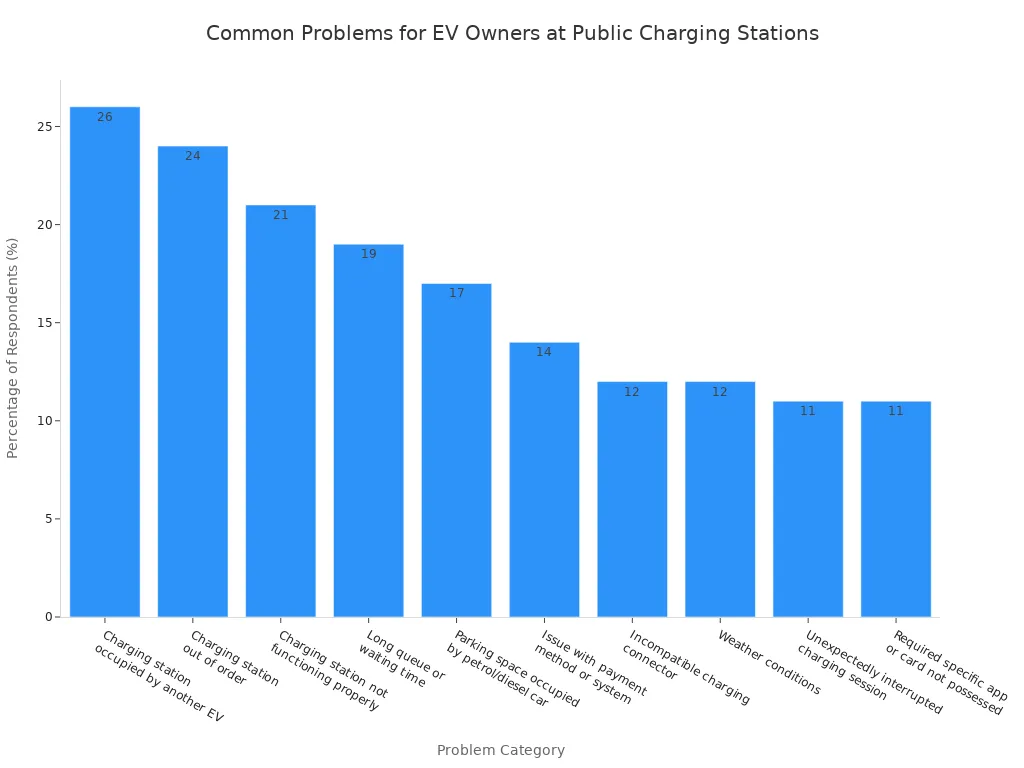
Other issues include needing multiple apps for different networks, unclear instructions, and cables that are too short. A dedicated home unit bypasses all these potential headaches.
A Dedicated Charging Spot, Every Time
A home installation guarantees access to a working, available charger every single day. There is no need to wait in line or worry if a station will be functional upon arrival. This reliability is invaluable, especially for drivers who depend on their vehicle for daily commutes and responsibilities. The peace of mind that comes with a personal, dedicated charging spot cannot be overstated.
Benefit 3: Maximizing Your EV’s Potential and Battery Health
A Level 2 charger not only improves the daily driving experience but also helps maintain the vehicle’s most expensive component: the battery.
Supporting Large-Battery, Long-Range EVs
Modern EVs increasingly feature large batteries that offer extensive range. For these vehicles, a Level 1 charger is often impractical for daily use, as it can take several days to achieve a full charge from empty. Level 2 charging is essential to properly support these long-range models, ensuring their full capacity is accessible on a daily basis. Technologically advanced electric vehicle charging solution providers like TPSON offer units designed to efficiently manage the power needs of these larger batteries.
Promoting Healthier Charging Habits
Proper charging habits are crucial for extending battery lifespan. EV manufacturers generally recommend maintaining a charge between 20% and 80% for daily use.
Pro Tip: The ’20-80 rule’ helps prolong battery life by reducing the stress caused by frequent full charges or deep discharges.
Level 2 charging is ideal for this practice. It allows for controlled, overnight charging sessions that can be set to stop at 80% or 90%, which is optimal for lithium-ion battery health. While occasional charging to 100% is fine for long trips, limiting the use of high-power DC fast chargers for daily needs and relying on a Level 2 ev charger at home is the recommended strategy for long-term battery preservation.
Preparing for Extreme Weather Conditions
Cold weather can significantly reduce an EV’s range and slow down charging speeds. In frigid temperatures, a Level 1 charger may struggle to add any meaningful range overnight, as some energy is used just to warm the battery. A more powerful Level 2 charger has sufficient output to both condition the battery and charge it effectively, ensuring the vehicle has adequate range even on the coldest winter mornings. This capability provides critical reliability when weather conditions are challenging.
Benefit 4: Significant Long-Term Cost Savings
While a Level 2 charger requires an upfront investment, it unlocks substantial long-term financial benefits. The cost savings accumulate over time, often making the initial expense a wise financial decision for daily drivers. These savings come from leveraging cheaper electricity rates and avoiding the high costs of public charging networks.
Home Electricity vs. Public Charging Rates
The most direct financial advantage comes from the price difference between residential electricity and commercial public charging. Charging an EV at home is consistently cheaper than using a public station. The cost per kilowatt-hour (kWh) at home is often less than half the price of a public DC fast charger.
This price gap creates significant savings. The table below illustrates the typical cost differences drivers can expect.
| Charging Type | Average Cost per kWh (USD) |
|---|---|
| Home Charging (Residential Rate) | ~$0.15 |
| Public Level 2 Charging | ~$0.20 – $0.35 |
| DC Fast Charging (e.g., Tesla Supercharger) | ~$0.25 – $0.50 |
For an EV owner who drives 1,000 miles per month, the savings from exclusive home charging can easily amount to hundreds of dollars per year compared to relying on public infrastructure.
Capitalizing on Off-Peak Utility Rates
Many utility companies offer special rate plans, such as Time-of-Use (TOU) plans, that provide cheaper electricity during off-peak hours. These hours typically fall late at night when overall demand on the power grid is low. A Level 2 charger is perfectly suited to take advantage of these lower rates.
Smart Savings Tip: 💡 Many modern “smart” chargers can be programmed through an app. Owners can set their charger to begin a session only when off-peak rates are active, ensuring they always get the lowest possible price for their electric vehicle charging without any manual effort.
By scheduling charging sessions overnight, EV owners can reduce their costs even further. This strategy maximizes one of the key financial benefits of owning an EV.
Reducing Reliance on Expensive DC Fast Chargers
DC fast chargers are essential for long-distance road trips, providing hundreds of miles of range in under an hour. However, this speed and convenience come at a premium price. Using them for daily charging needs is the most expensive way to power an EV. A reliable level 2 charging setup at home eliminates the need to use these costly stations for routine driving. Drivers can reserve DC fast chargers for their intended purpose: long journeys. This disciplined approach to charging is a cornerstone of cost-effective EV ownership, and consistent level 2 charging makes it possible.
Understanding the True Cost of Level 2 Charging

While the advantages are clear, a homeowner must understand the total investment required for a Level 2 charger. The true cost is a combination of three main components: the charging unit, professional installation, and any associated permits or fees. Analyzing these elements provides a complete financial picture.
Cost Component 1: The Charger Unit Itself
The first expense is the charging hardware. Prices vary based on features, brand, and power output. Buyers can choose between basic models and more advanced “smart” units.
Entry-Level Chargers: $300 – $500
Basic, non-smart chargers are the most affordable option. These units function as simple power delivery devices. They reliably charge an EV but lack advanced features like connectivity or scheduling. They are a great choice for budget-conscious owners who just need a faster charge without extra functionality.
Smart Chargers with Wi-Fi: $500 – $700+
Smart chargers represent a step up in technology and price. These units connect to a home’s Wi-Fi network, unlocking a host of benefits through a smartphone app. Key features often include:
- Remote Control: Users can start or stop a charging session from anywhere using their phone.
- Scheduled Charging: Owners can program the ev charger to operate during off-peak utility hours, significantly lowering electricity costs.
- Energy Monitoring: Apps allow for detailed tracking of electricity consumption and spending.
- Smart Home Integration: Many units, like those from Zaptec, can integrate with home energy systems and receive software updates over Wi-Fi.
Some advanced systems, like the EcoFlow PowerPulse EV Charger, integrate with home battery systems. This allows the charger to automatically use excess solar power or cheap off-peak electricity, potentially saving owners over $1,000 annually.
Portable vs. Hardwired Options
Buyers must also choose between a portable or a hardwired unit.
- Portable (Plug-in): These chargers plug into a 240-volt outlet (like one for an electric dryer). They offer flexibility, as an owner can take the charger with them if they move.
- Hardwired: An electrician wires these units directly into the home’s electrical system. This permanent installation is often considered more durable and weatherproof.
Cost Component 2: Professional Installation
Installation by a licensed electrician is crucial for safety and is often the most variable part of the total cost. The price can range from a few hundred to several thousand dollars depending on the complexity of the job.
Simple Installation Near a Breaker Panel
A straightforward installation is the most affordable scenario. If the garage or parking spot is located close to the home’s main electrical panel, the job is much simpler.
An installation is considered simple when the electrician only needs to add a new 240-volt circuit and run a short length of wire. In these cases, the total cost for professional installation typically ranges from $500 to $2,000.
Complex Installation with Long Conduit Runs
Costs increase significantly when the charger is installed far from the breaker panel. The ideal locations for installing level 2 chargers are those that minimize the distance wire must travel. A detached garage or an outdoor parking space may require the electrician to run wiring over a long distance. This often involves trenching to bury conduit underground or drilling through multiple walls, which adds considerable labor and material costs.
Potential Electrical Panel Upgrades
An older home may require an electrical panel upgrade to support the demands of level 2 charging. This becomes necessary if the existing panel lacks the physical space for a new double-pole breaker or does not have enough capacity to handle the additional electrical load. Panel upgrades are a significant expense but are essential for the safe operation of the system. The following table shows potential added costs.
| Cost Factor | Estimated Additional Cost (USD) |
|---|---|
| Electrical Panel Upgrade | $500 – $2,500+ |
| Trenching (per foot) | $10 – $30 |
Cost Component 3: Permits and Financial Incentives
The final cost component involves administrative tasks and potential savings. Navigating permits and incentives is a key step in managing the overall budget.
Navigating Local Electrical Permit Requirements
Most municipalities require an electrical permit for installing a new 240-volt circuit. The electrician typically handles this process. The permit ensures the work is inspected and complies with local safety codes. The cost is usually minor but is an important part of a legal and safe installation.
Federal Tax Credits for EV Supply Equipment
The U.S. federal government offers a tax credit to help offset the cost of purchasing and installing residential charging equipment.
Homeowners can claim a tax credit for 30% of the total cost, up to a maximum of $1,000. This credit, claimed using IRS Form 8911, is available to residents in eligible low-income or non-urban census tracts.
This federal program provides substantial financial relief for qualifying individuals.
State and Local Utility Rebate Programs
Beyond federal support, many states, cities, and local utility companies offer their own incentives. These programs can include direct rebates on the purchase of a charger, discounts on installation, or special electricity rates for EV owners. These local incentives can be combined with the federal tax credit, further reducing the net cost of upgrading to level 2 charging. Owners should research all available programs in their area to maximize their savings.
When a Level 2 Charger Might NOT Be Worth It
Despite the clear benefits, investing in level 2 charging is not a universal necessity. Certain situations and lifestyles make the high upfront cost difficult to justify. For some drivers, sticking with a basic Level 1 charger or relying on public options is a more practical and financially sound decision.
Scenario 1: You Have a Very Short Daily Commute
The primary advantage of a Level 2 charger is speed. If a driver’s daily mileage is low, that speed becomes a luxury rather than a requirement.
Calculating Your Daily Range Replenishment Needs
A standard Level 1 charger, which uses a 120-volt outlet, can replenish a surprising amount of range overnight. These chargers typically add between 2 to 5 miles of range for every hour they are plugged in. An EV owner can perform a simple calculation:
- Miles per hour of charging: ~3 miles
- Overnight charging window: 8-10 hours
- Total range added overnight: 24-30 miles
When Level 1 Charging is “Good Enough”
For a driver with a daily commute of 20 miles, a Level 1 charger is perfectly adequate. It can easily replace the consumed range during an overnight session. In this scenario, the thousands of dollars saved by forgoing a Level 2 installation can be allocated elsewhere. The standard charger that comes with the vehicle is often “good enough” for these low-mileage needs.
Scenario 2: You Have Reliable and Free Charging Elsewhere
Consistent access to charging away from home can eliminate the need for a dedicated home unit. This is especially true if the external charging is free or very low-cost.
The Perk of Free Workplace Charging
Many companies now offer free EV charging as an employee benefit. This perk is a game-changer. An employee who can charge their vehicle for eight hours while at work may never need to plug in at home. Reliable access to home or workplace chargers is a key factor, and a free workplace option often negates the need for a home upgrade.
Living Near Abundant and Affordable Public Chargers
Some urban residents may find themselves surrounded by public charging infrastructure. Cities like Los Angeles are actively installing hundreds of public Level 2 chargers on streetlights and power poles. However, this option depends heavily on location. While Level 2 chargers outnumber fast chargers, the national ratio is still over 12 EVs for every public port. This can lead to competition and waiting. This scenario is only viable if chargers are consistently available, functional, and affordable.
Scenario 3: You Are a Renter or Live in an Apartment
For non-homeowners, installing an ev charger presents significant logistical and financial hurdles. These challenges are often the biggest barrier to Level 2 adoption.
The Challenge of Getting Landlord Approval
Renters must get permission from their landlord or property manager before any electrical work can be done.
Landlords frequently deny these requests. Their concerns often revolve around installation costs, electrical safety, insurance liability, and potential property damage. Many rejections stem from a simple misunderstanding of the process and available solutions.
Prohibitive Installation Costs in Multi-Unit Dwellings
Even with landlord approval, the cost of installation in an apartment building or condo can be extremely high. Running wiring from a central electrical room to a dedicated parking spot, which may be several floors or a long distance away, requires significant labor and materials. These complex installations can make the project financially unfeasible for a tenant.
Exploring “Right to Charge” Laws in Your State
To address these issues, some states have enacted “Right to Charge” laws. These regulations can prevent landlords and homeowners’ associations from unreasonably restricting the installation of EV chargers. Renters facing opposition should research their state and local laws, as these protections may provide the legal leverage needed to secure approval for an installation.
How to Decide: A Step-by-Step Guide for Your EV Charger Needs
Making an informed decision requires a careful analysis of personal needs and potential costs. This step-by-step guide helps EV owners determine if an upgrade to level 2 charging is the right choice for their specific situation.
Step 1: Analyze Your Driving Habits
The first step is to understand daily energy consumption. This data provides the foundation for all other calculations.
Calculate Your Average Daily Mileage
An owner should track their driving for a typical week or month. They can record the odometer reading each day or use their vehicle’s trip computer. Summing the total miles and dividing by the number of days reveals a reliable average daily mileage.
Determine Your Car’s Efficiency in Miles per kWh
Every electric vehicle has an efficiency rating, similar to a gasoline car’s MPG. This is measured in miles per kilowatt-hour (miles per kWh). Many modern EVs display this figure on the dashboard. A higher number indicates better efficiency. The inverse, kWh per mile, shows how much energy the car uses to travel one mile. For example, an efficiency of 4 miles per kWh is the same as 0.25 kWh per mile.
Identify How Many kWh You Use Daily
With the average mileage and efficiency known, an owner can calculate their daily energy use. The formula is simple:
(Average Daily Mileage) / (Miles per kWh) = Daily kWh ConsumedA person who drives 40 miles a day in a car that gets 4 miles per kWh uses 10 kWh of energy daily.
Step 2: Evaluate Your Overnight Charging Window
Next, an owner must determine if a basic Level 1 charger can meet their daily energy needs within their available time.
How Many Hours is Your Car Parked Overnight?
Most people park their car for 8 to 12 hours overnight. An owner should identify their typical window for electric vehicle charging. This is the total time the car is parked and can be plugged in.
Can a Level 1 Charger Keep Up with Your Needs?
A standard Level 1 charger adds about 1.2 kW of power per hour. In a 10-hour overnight session, it can replenish approximately 12 kWh. If a driver’s daily consumption is 10 kWh, a Level 1 charger is sufficient. If their daily need is 20 kWh, it will fall short, making a Level 2 unit necessary.
Step 3: Research Your Total Potential Cost
The final step involves gathering real-world cost data for the complete installation.
Get Quotes from Licensed Electricians
An owner should contact several licensed electricians for quotes. To get an accurate estimate, they must provide key information:
- The type of ev charger they want (plug-in or hardwired).
- The capacity of their home’s electrical panel (e.g., 40 or 50 amps available).
- The distance from the panel to the desired charger location.
Research Available Charger Models and Features
Owners should compare different charger models. They need to decide if the features of a smart charger, like scheduled charging and energy tracking, are worth the extra cost compared to a basic unit.
Investigate All Local, State, and Federal Incentives
An essential part of budgeting is researching financial aid. Owners should search for all available state, local, and federal incentives. These programs can significantly reduce the final cost of purchasing and installing the equipment.
Step 4: Make the Final Calculation
The final decision combines objective financial data with subjective personal values. An owner must weigh the upfront investment against the long-term benefits to determine if the upgrade is truly worthwhile for their lifestyle.
Comparing Upfront Cost vs. Long-Term Savings
An owner can calculate a clear financial break-even point. The first step is to determine the net upfront cost. This is the total price of the charger and installation minus any federal, state, or local incentives. Next, the owner should estimate their monthly savings by charging at home instead of using public stations.
The final calculation is straightforward:
(Net Upfront Cost) / (Estimated Monthly Savings) = Months to Break Even
For example, a net cost of $1,500 with monthly savings of $50 means the investment will pay for itself in 30 months. This formula provides a concrete timeline. It helps an owner see the upgrade not as an expense but as an investment that yields tangible returns over time. A shorter break-even period makes the financial case for level 2 charging much stronger.
Placing a Personal Value on Convenience and Time
Some of the most significant benefits of a home charger are not easily measured in dollars. The value of convenience and time is a crucial, personal part of the equation. An owner should consider the non-financial advantages.
- Peace of Mind: Waking up to a fully charged vehicle every day eliminates range anxiety and the mental load of planning around charging stops.
- Time Savings: A home unit removes the need to locate, travel to, and wait at public charging stations, freeing up valuable time.
- Reliability: A dedicated home charger guarantees a functional and available power source, avoiding the common frustrations of broken or occupied public units.
- Flexibility: The ability to quickly add significant range enables spontaneous trips without worry.
Ultimately, an owner must ask themselves what this improved quality of life is worth. For many, the daily ease and reliability offered by a home charger provide a value that extends far beyond the financial savings. This personal assessment is often the deciding factor.
For most homeowners, a Level 2 charger offers significant benefits. The unmatched convenience of reliable home charging fundamentally improves the ownership experience. However, the high cost may not be justified for drivers with very low mileage or significant installation barriers. Owners should use the guide in this article to analyze their personal needs, potential costs, and available incentives. This analysis will help them find the right solution for their convenience.
FAQ
Can an owner install a Level 2 charger themselves?
No. A licensed electrician must perform the installation. This work involves high voltage and requires a permit. Professional installation ensures the system is safe, compliant with local codes, and eligible for any available rebates.
Does a Level 2 charger need a special plug?
Yes, most plug-in models use a 240-volt outlet, like those for an electric stove or dryer. An electrician can install the correct receptacle. Alternatively, a hardwired charger connects directly to the home’s electrical panel.
Will a Level 2 charger significantly increase an electricity bill?
An owner’s bill will increase, but home charging remains cheaper than public options. Smart chargers help manage costs by scheduling sessions during off-peak hours when electricity rates are lowest, maximizing savings.
Is a “smart” charger worth the extra cost?
For many owners, yes. Smart chargers offer valuable features through a mobile app.
- Scheduled charging for off-peak rates
- Energy usage tracking
- Remote start and stop functionality
These features provide convenience and can lead to significant long-term savings.
Can Level 2 charging damage an EV’s battery?
No, Level 2 charging is ideal for long-term battery health. It is less stressful on the battery than repeated DC fast charging. It perfectly supports the recommended practice of charging to 80% for daily use.
How much power does a Level 2 charger draw?
A Level 2 charger typically requires a dedicated 240-volt circuit with a 40-amp or 50-amp breaker. An electrician will confirm if the home’s electrical panel has enough capacity to handle this additional load safely.
What is the difference between a plug-in and a hardwired charger?
A plug-in charger offers flexibility, as an owner can take it with them if they move. A hardwired unit is permanently installed by an electrician, providing a more durable and often weatherproof connection.