Malaysia’s electric vehicle market is expanding rapidly. This growth drives a high demand for accessible Solusi pengisian daya kendaraan listrik from various Produsen pengisi daya EV.
| Metrik | Nilai |
|---|---|
| EV sales in 2023 (thousands) | 10 |
| Annual growth (2023) | 286% |
Using a Level 1 Charger in a condo car park is possible but requires explicit, written permission from building management. Unauthorized use of any Pengisi Daya Listrik, termasuk pengisi daya ev portabel, is a serious breach of strata bylaws. It also poses significant safety risks. Success depends on three non-negotiable conditions: official approval, a professional electrical assessment, and strict adherence to safe usage protocols.
The First Hurdle: Securing JMB/MC Permission
An EV owner’s journey to home charging in a strata property begins with a formal dialogue with the building’s management. Navigating this step correctly is critical for a safe and legal outcome.
Why You MUST Get Approval First
Attempting to charge an EV without authorization is a serious violation. It disregards established rules and creates significant risks for the entire community.
Common Area Outlets Are Not for Personal Use
The power sockets found in car parks, lobbies, and other common areas serve a specific purpose. They are intended for maintenance and cleaning staff to power their equipment.
Catatan: These outlets are part of the common property. Their electricity consumption is paid from the maintenance fund contributed by all residents. Personal use constitutes an unauthorized appropriation of shared resources.
Your Duties Under the Strata Management Act
The Strata Management Act (SMA) 2013 and its accompanying regulations govern life in a shared residential building. A key principle is that no resident can use common property for their exclusive benefit without approval. Tapping into the common area power supply for personal EV charging is a direct breach of these bylaws.
Potential Penalties for Unauthorized Charging
The Joint Management Body (JMB) or Management Corporation (MC) has the authority to enforce building rules. An owner caught charging without permission may face several consequences:
- A formal warning letter.
- Fines as stipulated in the building’s by-laws.
- Disconnection of the power supply to the outlet.
- Liability for any damages caused, such as an electrical fire.
How to Formally Request Permission
A professional and well-prepared request increases the chances of a positive response. It shows respect for the management’s authority and demonstrates a commitment to safety.
Step 1: Draft a Formal Letter to Management
An EV owner should compose a formal letter or email to the JMB/MC. The communication must be polite, clear, and professional. It should state the intention to use a Level 1 charger and request a meeting to discuss the proposal.
Step 2: Provide All Essential Information
A successful proposal includes comprehensive details. This allows the management to make an informed decision.
| Information to Provide | Example Detail |
|---|---|
| Vehicle Details | Make, Model, and Battery Capacity (e.g., Tesla Model 3, 54 kWh) |
| Charger Specifications | Brand, Model, Power Rating (e.g., 2.3 kW), SIRIM certification number |
| Proposed Location | Specific parking bay number and nearest socket location |
| Proposed Usage | Overnight charging, 10 PM to 6 AM, approximately 3 times a week |
Step 3: Presenting Your Safety Case
The owner must proactively address the management’s primary concern: safety. The proposal should highlight that the charger and any necessary extension cord are SIRIM-approved. It should also include a commitment to hire a certified electrician to inspect the socket’s suitability for continuous load.
What to Do If Your JMB/MC Says No
A rejection is not the end of the road. It is an opportunity to understand concerns and collaborate on a solution.
Understanding Their Concerns and Liabilities
Management bodies are responsible for the safety and financial well-being of the entire property. Their concerns are valid and often revolve around:
- Fire Risk: Overloading old or shared circuits.
- Liability: Who is responsible if an accident occurs?
- Cost: How to fairly bill for the electricity used.
- Precedent: Allowing one resident may open the floodgates to unmanageable requests.
Proposing Viable Alternative Solutions
An owner can address these concerns by proposing solutions. They might offer to install a separate electricity meter at their own cost. Another option is to use a plug-in power meter to track usage for fair billing. Proposing a limited, supervised trial period can also build trust.
The Long-Term Goal: Official EV Charging Bays
The most sustainable solution is the installation of dedicated Pengisian daya listrik bays. An EV owner can work with other interested residents to petition the JMB/MC. They can present information on government grants, potential ROI for the building, and the benefits of future-proofing the property. This collaborative approach turns a personal need into a community-wide improvement.
Understanding Your Level 1 Charger and Its Requirements
After securing permission, an EV owner must understand the technical aspects of their equipment. This knowledge is fundamental to ensuring a safe and efficient charging process. It involves knowing the charger’s capabilities, selecting certified accessories, and verifying the presence of critical safety devices.
What Exactly Is a Level 1 Charger?
A Pengisi daya level 1 is the most basic type of charging equipment. It allows an EV to be charged from a standard wall socket, making it a convenient option if the electrical infrastructure is deemed safe and suitable.
AC Charging vs. DC Charging
Electric vehicle batteries store Direct Current (DC) power. The Malaysian power grid supplies Alternating Current (AC). A Level 1 charger delivers AC power to the vehicle. The car’s onboard converter then changes this AC power to DC power to charge the battery. DC fast chargers perform this conversion externally, allowing them to deliver DC power directly to the battery for much faster charging.
Typical Power Draw and Charging Speed
A Level 1 AC slow charger typically has a power output of 1,4-2,3 kW. It uses a standard household outlet as its source. This low power output results in a slow charging speed. An owner can expect to gain only a few kilometers of range per hour of charging.
| Jenis Pengisi Daya | Keluaran Daya | Range Gained Per Hour | Full Charge Time (60kWh battery) |
|---|---|---|---|
| Level 1 | 2.3kW | 3-8 km | 20-30 hours |
| Level 2 (Home) | 7.4kW | 40-48 km | 6-10 hours (overnight) |
| DC Fast (Rapid) | 50-149kW | N/A | 30-60 minutes (10-80%) |
Ideal Use Cases for Slow Charging
The slow speed of a Level 1 charger makes it ideal for specific situations. It is best suited for overnight charging where the vehicle will be parked for 8-12 hours. It is also a practical solution for plug-in hybrid electric vehicles (PHEVs) with smaller batteries that do not require rapid charging.
Choosing the Right Charging Equipment
The safety of a charging setup depends entirely on the quality of the equipment used. Using uncertified or underrated products creates a severe fire hazard.
The Mandate for SIRIM Certification
In Malaysia, all electrical equipment, including pengisi daya EV portabel and extension cords, must be certified by SIRIM. This certification confirms the product has been tested and meets national safety standards. An owner must never use a charger that lacks a valid SIRIM label. Technologically advanced providers like TPSON ensure their solutions meet these stringent local requirements.
Selecting a Heavy-Duty, SIRIM-Approved Extension Cord
If an extension cord is necessary, it must be a heavy-duty model specifically rated for the charger’s continuous power draw. The cord should be as short as possible to minimize voltage drop and potential overheating.
Why Standard Household Extension Cords Are Unsafe
Standard indoor extension cords are extremely dangerous for EV charging. They are not designed for high, continuous electrical loads.
- Wire Gauge: These cords have thin wires (e.g., 16 AWG) that cannot safely carry the current needed for charging. This leads to overheating and can melt the insulation.
- Insulation: They lack the reinforced, weather-resistant sheathing required for use in a car park, making them vulnerable to moisture and physical damage.
Peringatan: Using a standard household extension cord for EV charging is a major fire risk and will void any approval from management.
Essential Electrical Protective Devices
Modern electrical circuits contain devices that automatically shut off power during a fault. An owner must confirm these are present and functional on the circuit they intend to use.
Role of a Residual Current Device (RCD)
An RCD is a life-saving device that protects against electric shock. It continuously monitors the current flowing in the live and neutral wires. If it detects an imbalance, which could mean electricity is leaking to the ground through a person, the RCD rapidly disconnects the power supply in milliseconds to prevent serious injury.
Function of a Miniature Circuit Breaker (MCB)
An MCB protects the electrical circuit from overcurrent. During a long charging session, if the circuit draws too much power (overload), a bi-metallic strip inside the MCB heats up and bends. This action trips a switch, breaking the circuit and preventing the wiring from overheating and causing a fire.
How to Confirm These Devices Are Installed
An owner can typically find the RCD and MCB in the building’s electrical distribution board (DB box) that serves the car park area. The devices are usually labeled. However, a certified electrician must perform the final verification to ensure they are correctly installed, functional, and rated for the intended load.
The Critical Safety Check: Assessing the Car Park Socket
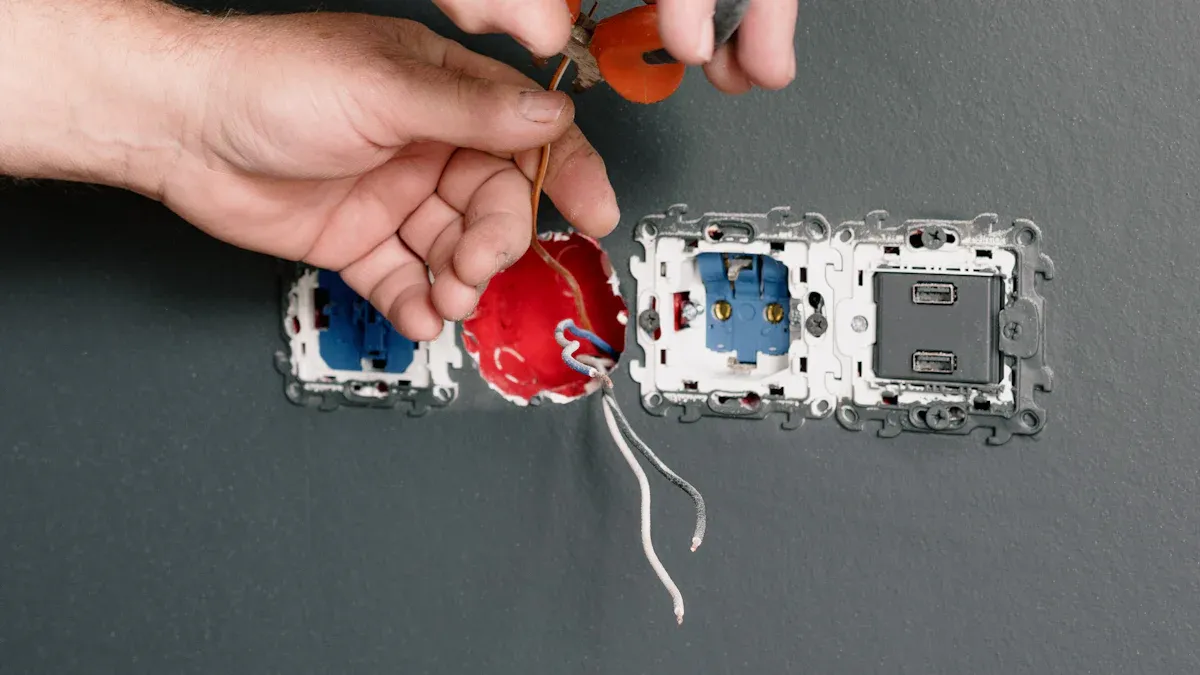
Securing management’s permission is only the first step. The next, and arguably most critical, phase involves a technical validation of the electrical infrastructure. An EV owner must never assume a car park socket is safe for the high, continuous load of EV charging. A professional assessment is non-negotiable to prevent fire and electrical hazards.
Why You Must Hire a Certified Electrician
Evaluating an electrical circuit for EV charging is a complex task that requires specialized knowledge and tools. It is not a do-it-yourself project. Attempting to self-assess can lead to a false sense of security and catastrophic failure. Only a certified professional can accurately determine the safety and suitability of the existing wiring.
The Scope of a Professional Inspection
A qualified electrician performs a thorough inspection that goes far beyond a simple visual check. Their assessment covers the entire circuit, from the distribution board (DB) to the socket outlet. The inspection includes:
- Confirming the socket is on a dedicated circuit.
- Verifying the presence and correct rating of RCD and MCB protection.
- Measuring the wire gauge to ensure it can handle the continuous current.
- Inspecting the physical condition of the socket for wear, heat damage, or loose connections.
- Checking for correct polarity and earth connection.
Finding a Qualified Professional
In Malaysia, an EV owner should engage an electrician registered with the Energy Commission (Energy Commission). These professionals are certified and possess the necessary competencies to work on electrical installations safely. An owner can request to see the electrician’s competency certificate to verify their credentials before any work begins.
Key Electrical Assessment Points
The electrician will focus on several key factors that determine if a socket can safely support a Level 1 charger. Each point is critical to mitigating the risk of fire and electrical damage.
Verifying a Dedicated Circuit
A dedicated circuit is an electrical line that serves a single outlet. This is the gold standard for EV charging. It ensures the charger does not have to share electrical capacity with other devices, such as car park lighting, water pumps, or other sockets. A dedicated circuit prevents overloads and ensures a stable power supply.
Checking Wire Gauge and Socket Condition
The physical components of the circuit must be robust enough for the task. An electrician will pay close attention to the wiring and the socket itself.
- Socket Quality: The socket should be a high-quality, branded model (e.g., MK, Schneider). Older, unbranded, or worn-out sockets can have loose internal contacts that generate heat. The electrician will check for any signs of damage, such as cracks or brown scorch marks.
- Best Practices: While not yet standard in Malaysia, international regulations offer a glimpse into best practices. In the UK, sockets intended for EV charging must meet specific standards (BS 1363-2) and be marked ‘EV’ to show they have passed rigorous tests for continuous load.
- Wire Gauge: The thickness of the electrical wire, or its gauge, determines how much current it can safely carry. Thinner wires have higher resistance and will overheat under a continuous load. The National Electrical Code (NEC) in the US requires wiring to be sized for 125% of a charger’s continuous load, a crucial safety margin.
| Daya Pengisi Daya | Tegangan | Calculated Current | Minimum Wire Size (Copper) |
|---|---|---|---|
| 9,6 kW | 240 V | 40 A | 8 AWG |
| Commercial Chargers | >50 A | N/A | 6 AWG or larger |
For a typical 2.3 kW Pengisi daya level 1 drawing around 10A, the existing wiring must be robust enough to handle this load for many hours without fail. The electrician will confirm the wire gauge is adequate for the entire length of the circuit.
The Fire Risk of Overloading a Shared Circuit
The single greatest danger is plugging a charger into a non-dedicated, or shared, circuit. These circuits are common in older buildings and are designed for intermittent, low-power use like vacuum cleaners or temporary lighting.
🔥 Critical Warning: Connecting an EV charger to a shared circuit is extremely hazardous. If other appliances or lights are active on the same circuit, the total current draw can easily exceed the circuit breaker’s rating. This overload causes the wiring inside the walls to heat up dangerously, potentially melting the insulation and igniting a fire.
An electrician’s verification of a dedicated circuit is the only way to eliminate this severe risk.
A Practical Guide to Safe Use of a Level 1 Charger
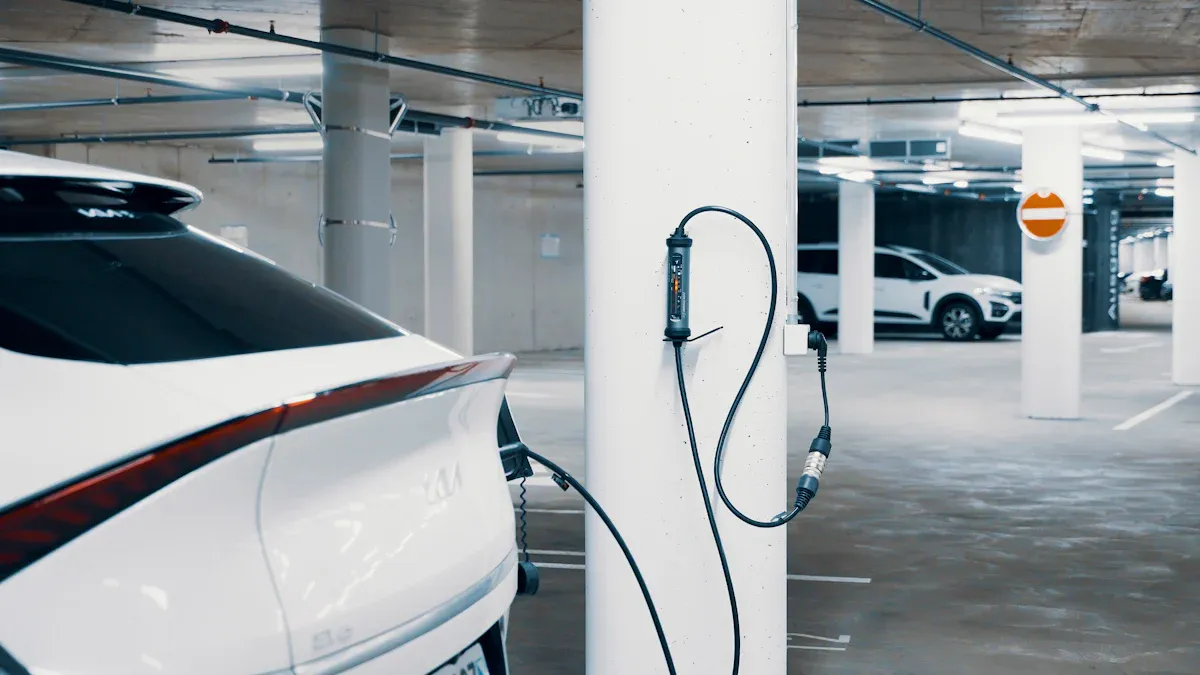
Once an EV owner receives JMB/MC approval and an electrician’s clearance, the responsibility shifts to day-to-day safe operation. A car park is a shared, dynamic environment. Adhering to strict practical guidelines is essential to protect people and property.
Mastering Cable Management in a Public Space
A loose charging cable is a significant liability. Improperly managed cables create serious trip hazards, especially for individuals with limited mobility or sensory impairments. This can lead to injuries and legal liability for the EV owner.
Using Heavy-Duty Floor Cable Protectors
If the charging cable must cross an area with even minimal foot traffic, a heavy-duty floor cable protector is mandatory. These protectors are made from robust materials like hard rubber and thermoplastic polyurethane. They are designed to withstand the weight of vehicles and prevent trips.

An owner should select a protector that is rated for car park use and can fully encase their charging cable.
| Property | Detail Example (3-Channel Protector) |
|---|---|
| Material | Hard rubber body, Polypropylene cover |
| Dimensi | 960mm L x 600mm W x 75mm H |
| Max Vehicle Load | 10,000kg per axle |
| Fitur Utama | Anti-slip hinged top, withstands heavy traffic |
| Kesesuaian | Interior and exterior car parks |
Tip: Choose a protector with high-visibility colors like yellow and black. This further reduces the risk of someone tripping over it. Always ensure the protector is placed flat on the ground and does not create an obstruction.
Safe Cable Routing Rules
Proper routing is the first line of defense against accidents. The goal is to keep the cable completely out of walkways and driving paths.
- Route along walls. The safest path for a cable is directly against a wall or pillar, away from feet and tires.
- Use the shortest possible cable. An owner should use a SIRIM-approved extension cord that is only as long as necessary. Excess cable length creates clutter and increases trip hazards.
- Avoid crossing walkways. Never trail a cable across a pavement or shared walkway. Best practices, such as those outlined in UK regulations, explicitly prohibit cables from crossing public footpaths.
- Remove when finished. The charger and all cables must be completely removed and stored securely once charging is complete.
Why Suspending Cables Is a Hazard
An owner must never suspend or hang a charging cable overhead across a walkway or parking space. This practice is extremely dangerous and is not permitted, even with cable ramps. A suspended cable can be an unseen hazard for taller individuals or vehicles. In many jurisdictions, the EV owner is held legally liable for any injuries or damages that arise from such hazardous cable placement.
Weatherproofing Your Charging Setup
Malaysian weather can be unpredictable, with sudden downpours. Water and high-voltage electricity are a lethal combination. An EV owner must take active steps to weatherproof their entire charging setup.
Protecting Connections from Rain and Moisture
The most vulnerable points of a charging setup are the connections: where the charger plugs into the extension cord and where the extension cord plugs into the wall socket. These points must be shielded from rain and moisture at all times. Even a small amount of water ingress can cause a short circuit, damage the equipment, or create a severe electric shock risk.
Using a Weatherproof Enclosure Box
A practical solution is to use a purpose-built weatherproof enclosure box. These boxes are designed to house electrical connections and protect them from the elements.
An owner should look for a product with at least an IP54 rating. This rating signifies that the enclosure is protected against dust ingress and splashes of water from any direction. A product like the Masterplug WBX Outdoor Weatherproof Box is an example of a suitable temporary solution. It is spacious enough for a plug and socket connection and features multiple cable exit points.
These enclosures are for temporary connections only and are not a substitute for permanent, hardwired outdoor sockets.
The Danger of Charging Near Puddles
An EV owner must never initiate a charging session if there are puddles of water around the socket, the car, or along the cable path. Water is an excellent conductor of electricity. A damaged cable or faulty connection in contact with a puddle can energize the water, creating a large, invisible, and deadly electrocution hazard for anyone who steps into it. If the area is wet, charging must be postponed until it is completely dry.
How to Monitor Your Charging Session
Using a Level 1 charger is not a “plug-and-forget” activity, especially in a shared environment. Active monitoring is a critical safety protocol to prevent overheating and respond to environmental changes.
The “First-Time” Supervision Rule
During the first few charging sessions with a new setup, the EV owner should remain nearby and supervise the process for at least the first hour. This allows them to confirm that the system is operating correctly and that no components are showing signs of stress.
Periodically Checking for Overheating
A continuous high-power draw can cause components to overheat, creating a fire risk. An owner should periodically and safely check the plug, the socket, and the cable for excessive heat. Warning signs of a dangerous overheating issue include:
- A distinct burning smell.
- Visible scorch marks or discoloration on the plug or socket faceplate.
- Melted plastic around the plug connections.
- The plug or socket feeling unusually hot to the touch.
If any of these signs are present, the owner must immediately stop the charging session and contact the certified electrician to re-inspect the circuit. A cracked or scorched socket often indicates a dangerous loose connection behind the wall.
Unplugging During Thunderstorms
It is a critical safety measure to unplug an electric vehicle during a thunderstorm. A nearby lightning strike can induce a massive electrical surge into the power grid. This surge can travel through the wiring and destroy the vehicle’s sensitive onboard charging system, the portable charger, or both. While some chargers have built-in surge protection, the immense power of a lightning strike can easily overwhelm these devices. The safest action is always to disconnect.
Managing Costs and Car Park Etiquette
Successful Level 1 charging involves more than just technical safety. An EV owner must also address financial transparency and demonstrate respect for shared spaces. Establishing fair cost management and practicing good car park etiquette are crucial for maintaining a positive relationship with management and neighbors.
How to Handle Electricity Costs Fairly
The electricity from a common area socket is a shared utility, paid for by all residents through maintenance fees. An EV owner has a responsibility to ensure they cover their personal consumption accurately and transparently.
Proposing a Fair Payment System to the JMB/MC
An EV owner should proactively propose a clear payment system to the JMB/MC. This demonstrates accountability and addresses management’s valid concerns about cost. The proposal should outline a method for tracking electricity usage and a schedule for reimbursement, such as monthly or quarterly payments.
Using a Plug-in Power Meter to Track Kilowatt-hours
A simple and effective tool for this purpose is a SIRIM-approved plug-in power meter. This device plugs into the wall socket, and the EV charger then plugs into the meter. It accurately measures and displays the total kilowatt-hours (kWh) of electricity consumed during charging sessions. The owner can record the kWh usage each month to calculate the cost.
How to Calculate Your Monthly Charging Cost
Calculating the cost is straightforward. The owner needs two pieces of information: the total kWh consumed (from the power meter) and the current electricity tariff from Tenaga Nasional Berhad (TNB).
The formula is:
Total kWh Consumed x TNB Tariff Rate (RM/kWh) = Monthly Charging Cost
For example, if an owner used 150 kWh in a month and the relevant tariff is RM 0.571 per kWh, the cost would be 150 kWh x 0.571 = RM 85.65. This calculation provides a transparent basis for reimbursement to the JMB/MC.
Car Park Etiquette for EV Owners
Using a common area outlet requires courtesy and consideration for others. Good etiquette prevents conflicts and ensures the arrangement remains viable long-term.
Avoid Hogging the Power Outlet
The power outlet is a shared resource. An EV owner must practice fairness, especially if other residents also have permission to charge.
- An owner should promptly move their vehicle once it is sufficiently charged. This frees up the outlet for the next person.
- They should adhere to a first-come, first-served principle when others are waiting.
- It is important to never unplug another vehicle without explicit permission.
Keep Your Charging Area Clean and Tidy
A tidy charging space is a safe space. After each charging session, the owner must neatly coil and store all equipment, including the charger and any extension cords. Leaving cables tangled on the floor creates a trip hazard and reflects poorly on the owner.
Communicating Clearly with Neighbors and Management
Open communication is key to a harmonious environment. An EV owner should be approachable and willing to discuss their charging schedule with neighbors.
Engaging in polite conversation helps coordinate charging times and prevents misunderstandings. Leaving a note on the dashboard with an expected return time is a simple, effective way to cooperate with other drivers who may need the space or outlet.
An EV owner must confirm every safety requirement before charging. Do not plug in a Level 1 Charger unless these conditions are met:
- Written approval from the JMB/MC is in hand.
- A certified electrician has approved the socket for continuous load.
- The charger and extension cord are SIRIM-approved and correctly rated.
- A safe plan for cable management and weatherproofing exists.
Safety and official permission are paramount. The risks of fire, electrical shock, and legal penalties are too high if any step is missed. For a sustainable future, owners should collaborate with their JMB/MC to install dedicated Stasiun pengisian daya kendaraan listrik.
PERTANYAAN YANG SERING DIAJUKAN
Is a Level 1 charger fast enough for daily use?
A Pengisi daya level 1 is suitable for drivers with short daily commutes. It is also ideal for plug-in hybrids (PHEVs) with smaller batteries. An owner can expect it to replenish about 3-8 km of range per hour, making overnight charging a practical solution for many.
What if my condo car park has no sockets?
An owner cannot proceed if no socket is available near their parking bay. They should collaborate with other residents to formally request that the JMB/MC install new, dedicated outlets or official EV charging stations for community use. Unauthorized electrical work is strictly prohibited.
Can I install my own power socket?
No. An individual resident cannot install their own socket in a common area. All electrical work on common property requires formal approval from the JMB/MC. The installation must also be performed by a certified electrician hired by the management.
Is a Level 2 charger a better option for a condo?
A Level 2 charger offers much faster charging but requires a dedicated, high-power electrical circuit. It is a superior long-term solution. However, its installation is more complex and costly, demanding significant JMB/MC involvement and professional planning from the outset.
What is the main risk of unapproved charging?
The primary risk is fire. Using an uninspected socket or an improper extension cord can overload the building’s wiring. This can cause overheating within the walls, leading to a fire that endangers the entire property and all its residents.
How much does a certified electrician’s inspection cost?
The cost for a professional inspection can vary. An owner can expect to pay between RM150 to RM400. This fee depends on the complexity of the building’s wiring and the location. It is a necessary investment for safety assurance.
Can I use a regular extension cord just once?
Absolutely not. A standard household extension cord is a severe fire hazard for EV charging. Its thin wires cannot handle the continuous high current. Using one, even for a short time, can cause it to overheat, melt, and potentially start a fire.