


An electric vehicle (EV) owner needs to understand the biaya untuk mengisi daya mobil listrik at home. The price for a full charge typically ranges from $3 to $15. This cost depends on the vehicle’s battery size and local electricity rates. A simple calculation determines the final price.
Formula for a Full Charge:
(Vehicle Battery Size in kWh) x (Electricity Rate per kWh) = Total Cost
Home charging offers significant savings compared to gasoline. Drivers often save hundreds of dollars annually on fuel and maintenance. This makes home charging a very economical choice for EV owners. The right Pengisi Daya Listrik, whether from established Produsen pengisi daya EV or a more flexible option like pengisi daya EV portabel, is key to efficient Solusi pengisian daya kendaraan listrik. Knowing how much it costs to charge an electric car empowers drivers to manage their expenses effectively.
| Kategori | Gasoline Car (Annual) | Electric Car (Home-Charged, Annual) |
|---|---|---|
| Biaya Bahan Bakar | $1,400 | $500 |
| Biaya Pemeliharaan | $1,200 | $400 |
| Total Savings | $900 (Fuel) | $800 (Maintenance) |
The Key Factors That Determine Your Home Charging Cost
Calculating the exact biaya untuk mengisi daya mobil listrik involves more than just plugging it in. Several key variables influence the final price on a driver’s utility bill. Understanding these factors empowers owners to manage their expenses effectively.
Your Local Electricity Rate (per kWh)
The single most significant factor is the price of electricity. This rate varies widely based on location, utility provider, and the time of day.
Understanding Your Utility Bill
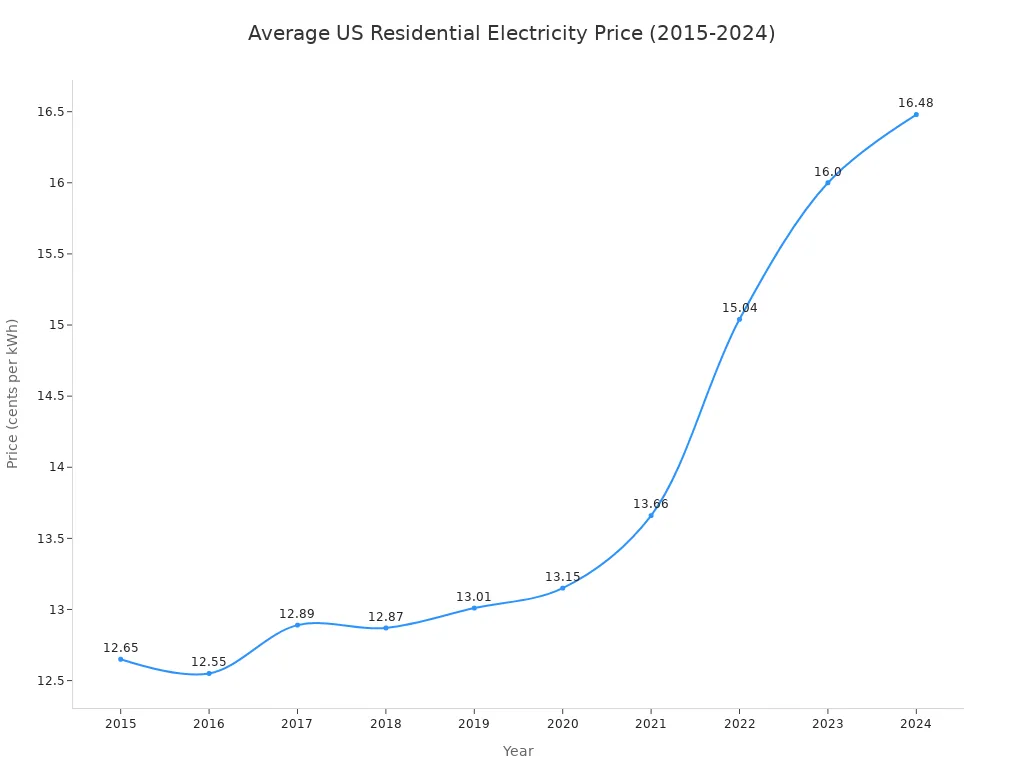
A utility bill shows electricity consumption in kilowatt-hours (kWh). The price per kWh is the core component of your charging cost. Nationwide, residential energy prices have steadily increased over the past decade.
| Tahun | Residential Price (¢/kWh) |
|---|---|
| 2015 | 12.65 |
| 2016 | 12.55 |
| 2017 | 12.89 |
| 2018 | 12.87 |
| 2019 | 13.01 |
| 2020 | 13.15 |
| 2021 | 13.66 |
| 2022 | 15.04 |
| 2023 | 16.00 |
| 2024 | 16.48 |
Time-of-Use (TOU) vs. Flat-Rate Plans
Utility companies offer different rate structures. A flat-rate plan charges the same price per kWh regardless of the time. A Time-of-Use (TOU) plan has variable energy tariff prices, with higher costs during peak demand hours (like late afternoons) and lower costs during off-peak hours (like overnight).
Special EV Rate Plans
Many utilities now provide special rate plans for EV owners. These plans often offer the lowest rates during late-night hours, making overnight home charging extremely economical. Owners should contact their provider to see if such a plan is available.
Your Electric Vehicle’s Battery Size (kWh)
The size of a vehicle’s battery determines how much energy it can store. A larger battery holds more energy and costs more to fill from empty.
Apa itu Kilowatt-Jam (kWh)?
A kilowatt-hour (kWh) is a unit of energy. It represents the amount of energy consumed by a 1,000-watt appliance running for one hour. EV battery capacity is measured in kWh.
How to Find Your EV’s Battery Size
An owner can find their vehicle’s battery size in the owner’s manual, on the manufacturer’s website, or on the vehicle’s specification sheet.
Your Vehicle’s Efficiency (Miles per kWh)
Efficiency measures how far an EV can travel on one kilowatt-hour of energy. Better efficiency lowers the overall cost of electric car charging.
What Efficiency Means for Cost
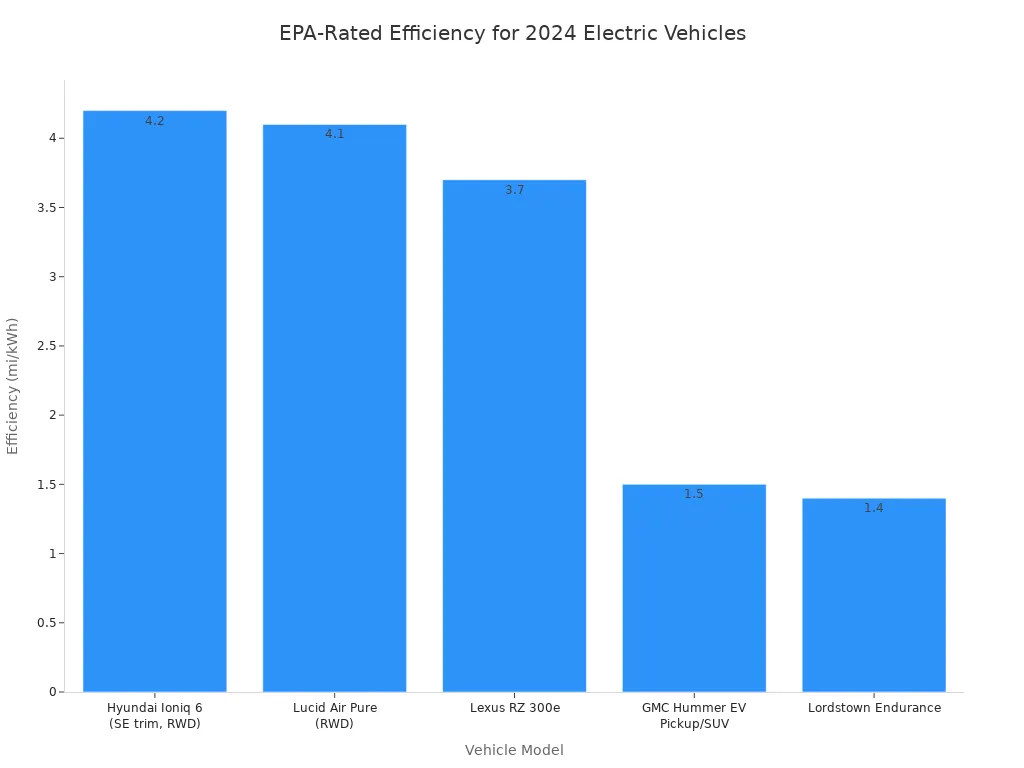
A more efficient car requires less energy to travel the same distance. This directly reduces the cost per mile. For example, the Hyundai Ioniq 6 is far more efficient than a GMC Hummer EV, meaning it costs less to drive.
| Model | Efficiency (mi/kWh) |
|---|---|
| Hyundai Ioniq 6 (SE trim, RWD) | 4.2 |
| Lucid Air Pure (RWD) | 4.1 |
| Lexus RZ 300e | 3.7 |
| Lordstown Endurance | 1.4 |
| GMC Hummer EV Pickup/SUV | 1.5 |
Factors Affecting EV Efficiency
Kiat Pro: Driving style is a primary factor influencing efficiency. Smooth driving with gentle acceleration and braking conserves battery power. Aggressive driving forces the motor to work harder and drains the battery faster.
Other factors include terrain, weather (cold temperatures reduce efficiency), and tire pressure.
The Type of Home Charger You Use
The hardware a driver uses for charging directly influences speed and energy efficiency. There are two primary levels for home charging, each with distinct characteristics that affect the overall experience and, to a lesser extent, the cost.
Pengisi daya Level 1 adalah metode pengisian daya paling dasar. Ia menggunakan outlet dinding rumah tangga standar 120-volt. Pengisi daya ini seringkali portabel dan disertakan dalam pembelian kendaraan listrik baru. Mereka tidak memerlukan instalasi khusus.
Level 1 charging uses a standard 120-volt wall outlet, the same kind used for a phone or a lamp. Every electric vehicle comes with a Level 1 cordset, making it the most accessible charging method. However, it is also the slowest.
This method provides a very slow trickle of power. It typically adds only 3 to 7 miles of range for every hour of charging. A full charge for a typical battery electric vehicle (BEV) can take anywhere from 22 to over 40 hours.
Catatan: Level 1 charging is often insufficient for daily drivers who need to replenish significant range overnight. It is best suited for plug-in hybrid vehicles (PHEVs) with smaller batteries or as an occasional, emergency charging option for BEV owners.
Furthermore, Level 1 charging can be less energy-efficient than dedicated chargers. The longer charging duration means the vehicle’s onboard systems run for an extended period, leading to slightly higher energy loss.
Pengisi daya Level 2 adalah solusi pengisian daya rumah yang paling umum. Ia beroperasi pada sirkuit 240-volt, mirip dengan pengering atau oven listrik. Penyedia yang canggih secara teknologi seperti TPSON menawarkan berbagai solusi pengisian daya kendaraan listrik ini.
Level 2 charging is the most common and practical method for home use. It requires a dedicated 240-volt circuit, similar to what an electric stove or clothes dryer uses. A dedicated home ev charger must be installed to use this method. The performance improvement over Level 1 is substantial.
A Level 2 system dramatically reduces charging time, making overnight charging a viable reality for any EV owner. This level of electric car charging is not only faster but also more energy-efficient than Level 1, minimizing energy waste during the power transfer. Technologically advanced electric vehicle charging solution providers like TPSON specialize in these more powerful and efficient systems.
The differences between the two levels are significant.
| Fitur | Pengisian Daya Level 1 | Pengisian Daya Level 2 |
|---|---|---|
| Keluaran Daya | 1-1,8 kW | 3-22 kW |
| Kisaran Ditambahkan Per Jam | 3-7 miles | 10–75 mil |
| Full Charge (60 kWh) | >20 hours | 6-8 hours |
Ultimately, while Level 1 is a convenient backup, a Level 2 charger is the standard for homeowners seeking to maximize convenience and efficiency.
How to Calculate the Cost to Charge an EV at Home
Calculating the precise biaya untuk mengisi daya mobil listrik at home is a straightforward process. It empowers an owner to forecast expenses and identify savings opportunities. The calculation requires just a few key pieces of information from a driver’s utility bill and vehicle specifications.
Langkah 1: Cari Tarif Listrik Anda
The foundation of any charging cost calculation is the price of electricity. This figure is the multiplier for every kilowatt-hour the vehicle consumes.
Locating the Cents-per-kWh on Your Bill
An owner’s electric bill contains all the necessary rate information. The key figure to find is the price per kilowatt-hour (kWh), often listed under “Supply Charges” or “Delivery Charges.”
The rate is typically expressed in cents or fractions of a dollar per kWh (e.g., 17.5¢/kWh or $0.175/kWh). The average U.S. electricity rate is approximately $0.175/kWh, but local prices can be much higher or lower.
Identifying Off-Peak vs. Peak Rates
Many utility providers offer Time-of-Use (TOU) plans that present a major opportunity for savings. These plans charge different rates depending on the time of day.
- Jam Sibuk: These are periods of high electricity demand, usually in the late afternoon and early evening. Rates are highest during this time.
- Jam-jam di luar jam sibuk: These are periods of low demand, typically overnight. Rates are significantly lower, making this the ideal time to charge an EV.
Rate structures vary widely by region and provider. For example, rates in California can differ substantially from those in other states.
| Penyedia Utilitas | Wilayah | Tarif Puncak (¢/kWh) | Tarif Luar Jam Sibuk (¢/kWh) |
|---|---|---|---|
| Pacific Power | WA, OR, CA | ~28 | ~10 |
| PG&E (E-TOU-C) | CA | ~26–29 | ~18–20 |
| Southern California Edison | CA | Bervariasi | Bervariasi |
An owner should contact their utility provider to see if a special EV or TOU rate plan is available. Switching plans can dramatically lower the overall biaya untuk mengisi daya mobil listrik.
Step 2: Determine Your Charging Needs
After identifying the electricity rate, the next step is to understand the vehicle’s energy requirements. This involves its battery size and how much energy it needs for daily driving.
Calculating Cost Per Full Charge
The simplest calculation determines the price of charging an EV battery from empty to full. The formula combines the electricity rate with the battery’s capacity.
Formula for a Full Charge:
(Battery Size in kWh) x (Electricity Rate in $/kWh) = Cost for a Full Charge
For example, a vehicle with a 60 kWh battery charged at a rate of $0.15/kWh would cost $9.00 for a full charge (60 x 0.15 = 9.00).
Calculating Cost Per Mile
A more practical metric for many drivers is the cost per mile. This figure helps compare EV operating costs directly to a gasoline car’s cost per mile. An owner can calculate this by dividing the cost of a full charge by the vehicle’s total range.
Formula for Cost Per Mile:
(Cost for a Full Charge) / (Vehicle's Range in Miles) = Cost Per Mile
Using the previous example, if the $9.00 charge provides 250 miles of range, the cost per mile is $0.036, or 3.6 cents per mile (9.00 / 250 = 0.036).
Step 3: Putting It All Together with Real-World Examples
Applying these formulas to real-world scenarios demonstrates how the cost to charge ev can vary based on the vehicle and driving habits.
Example 1: A Commuter with a Mid-Size EV
Consider a driver with a Tesla Model 3 Standard Range who primarily uses it for their daily commute.
- Vehicle Battery: ~57.5 kWh
- Tarif Listrik: National Average ($0.175/kWh)
- Daily Commute: 40 miles (The average American driver commutes about 20 miles each way)
First, calculate the cost for a full charge. A Tesla Model 3 is highly efficient and costs approximately $9.20 for a full charge that delivers around 270 miles of range. However, this driver only needs to replenish the energy used for their 40-mile commute. If the car gets 4 miles per kWh, it uses 10 kWh for the commute (40 miles / 4 mi/kWh).
The daily charging cost would be just $1.75 (10 kWh x $0.175/kWh).
Example 2: A Long-Distance Driver with a Large-Battery EV
Now, consider an owner with a Ford F-150 Lightning with the extended-range battery who needs to maximize range for longer trips.
- Vehicle Battery: 131 kWh ⚡
- Tarif Listrik: Off-Peak Rate ($0.12/kWh)
This owner wisely charges during off-peak hours to save money. The calculation for a full charge shows a higher total cost due to the massive battery size, but the strategic timing keeps the rate low.
131 kWh (Battery Size) x $0.12/kWh (Off-Peak Rate) = $15.72
Even with a large truck, the cost for a full charge remains under $16 when using an off-peak charging strategy. This example highlights how both battery size and electricity rates are critical components in determining the final cost to charge an electric car.
Estimating Your Monthly and Annual Cost to Charge an Electric Car
An owner can move from daily costs to long-term budgeting with a few simple calculations. Forecasting monthly and annual expenses provides a clear picture of the financial benefits of EV ownership. This process helps drivers understand their total transportation energy spending.
How to Calculate Your Monthly EV Charging Cost
Menghitung biaya bulanan biaya untuk mengisi daya mobil listrik adalah cara praktis untuk mengelola anggaran rumah tangga. Perhitungan ini dikembangkan dari rumus biaya per mil dengan mempertimbangkan total jarak berkendara bulanan.
Rumus Biaya Bulanan
Pemilik pertama-tama perlu menentukan rata-rata jarak tempuh bulanan mereka. Ini dapat ditemukan dengan memeriksa odometer kendaraan selama beberapa bulan atau menggunakan data perjalanan dari aplikasi mobil. Rumus ini menggabungkan jarak tempuh, efisiensi, dan harga listrik.
Rumus Biaya Bulanan:
(Total Mil Bulanan / Efisiensi Kendaraan dalam mi/kWh) x Tarif Listrik dalam $/kWh = Biaya Bulanan
Sebagai contoh, pengemudi yang menempuh 1.200 mil dalam sebulan dengan mobil yang memiliki efisiensi 4 mil/kWh akan menggunakan energi 300 kWh. Dengan tarif listrik $0,175/kWh, biaya bulanannya adalah $52.50.
Contoh Biaya Bulanan Berdasarkan Jarak Tempuh
Biaya bulanan sangat bervariasi tergantung kebiasaan berkendara dan strategi pengisian daya. Pengemudi yang memanfaatkan tarif di luar jam sibuk akan melihat penghematan signifikan dibandingkan dengan yang mengisi daya dengan tarif flat. Total biaya mengisi daya mobil listrik berhubungan langsung dengan jumlah mil yang ditempuh.
Tabel di bawah ini menggambarkan perkiraan pengeluaran bulanan untuk kendaraan dengan efisiensi 4 mil/kWh.
| Jarak Tempuh Bulanan | Tarif Listrik (per kWh) | Perkiraan Biaya Bulanan |
|---|---|---|
| 1.000 mil | $0,175 (Rata-rata Nasional) | $43.75 |
| 1.000 mil | $0,10 (Tarif Luar Jam Sibuk) | $25.00 |
| 1.500 mil | $0,175 (Rata-rata Nasional) | $65.63 |
| 1.500 mil | $0,10 (Tarif Luar Jam Sibuk) | $37.50 |
Seperti yang ditunjukkan, pengemudi yang menempuh 1.000 mil per bulan dapat menghabiskan hanya $25 dengan menggunakan tarif luar jam sibuk yang rendah. Ini menyoroti kekuatan finansial dari pengisian daya mobil listrik yang cerdas.
Memproyeksikan Pengeluaran Pengisian Daya Mobil Listrik Tahunan
Memproyeksikan biaya tahunan memberikan perspektif terbaik tentang penghematan yang diberikan mobil listrik. Hal ini memungkinkan perbandingan langsung dan setara dengan biaya bahan bakar dari kendaraan bensin tradisional.
Mengekstrapolasi Biaya Bulanan ke Angka Tahunan
Pemilik dapat dengan mudah memperkirakan pengeluaran pengisian daya tahunan mereka. Mereka cukup mengalikan biaya bulanan rata-rata dengan dua belas.
Biaya Pengisian Daya Bulanan x 12 = Biaya Pengisian Daya Tahunan
Pengemudi yang menghabiskan $45 per bulan untuk pengisian daya di rumah akan memiliki perkiraan pengeluaran tahunan sebesar $540. Proyeksi sederhana ini adalah alat yang ampuh untuk perencanaan keuangan jangka panjang.
Perbandingan Biaya Tahunan: Mobil Listrik vs. Mobil Bensin
Nilai sebenarnya dari pengisian daya di rumah menjadi jelas ketika dibandingkan dengan biaya bensin. Kendaraan mesin pembakaran internal (ICE) secara signifikan lebih mahal untuk diisi bahan bakar selama setahun.
Mari bandingkan mobil listrik dan mobil bensin yang sama-sama menempuh 12.000 mil per tahun.
- Asumsi Mobil Listrik: Efisiensi 4 mi/kWh, tarif listrik $0,15/kWh.
- Asumsi Mobil Bensin: Ekonomi bahan bakar 25 MPG, harga bensin $3,50/galon.
| Jenis Kendaraan | Jarak Tempuh Tahunan | Biaya Bahan Bakar/Energi Tahunan |
|---|---|---|
| Kendaraan Listrik | 12,000 | $450 |
| Kendaraan Bensin | 12,000 | $1,680 |
| Tabungan Tahunan | $1,230 |
Hasilnya mencolok. Biaya tahunan untuk mengisi daya mobil listrik dalam skenario ini lebih dari $1.200 lebih rendah daripada biaya mengisi bahan bakar mobil bensin. Penghematan ini menunjukkan salah satu alasan paling menarik untuk beralih ke transportasi listrik.
Apakah Ada Biaya Tersembunyi Lain untuk Pengisian Daya di Rumah?
Biaya listrik adalah pengeluaran berulang utama untuk pengisian daya di rumah. Namun, beberapa faktor lain berkontribusi pada total biaya kepemilikan mobil listrik. Ini termasuk biaya instalasi satu kali dan variabel yang mempengaruhi konsumsi energi.
Biaya Satu Kali untuk Instalasi Pengisi Daya Level 2
Sementara pengisian daya Level 1 menggunakan stopkontak standar, sebagian besar pemilik memilih pengisi daya Level 2 yang lebih cepat. Peningkatan ini melibatkan beberapa biaya di muka.
Biaya Perangkat Keras untuk Pengisi Daya Level 2
Stasiun pengisian daya Level 2 berkualitas tinggi biasanya berharga antara $400 dan $800. Harga bervariasi berdasarkan merek, daya keluaran (amper), dan fitur cerdas seperti konektivitas Wi-Fi.
Biaya Teknisi Listrik dan Instalasi
Seorang teknisi listrik berlisensi harus melakukan instalasi. Biaya tenaga kerja dapat berkisar dari $300 hingga lebih dari $1.000, tergantung pada kompleksitas pekerjaan dan tarif tenaga kerja regional.
Izin dan Potensi Peningkatan Panel
Sebagian besar kotamadya memerlukan izin untuk pekerjaan listrik jenis ini. Rumah dengan kabel yang lebih tua mungkin juga memerlukan peningkatan panel listrik untuk mendukung kebutuhan daya pengisi daya. Pekerjaan tambahan ini dapat menambah biaya antara $500 dan $2.000 untuk biaya memasang pengisi daya mobil listrik di rumah.
Memahami Ketidakefisienan Pengisian Daya dan Kehilangan Energi
Energi yang keluar dari stopkontak dinding tidak sama jumlahnya dengan yang akhirnya masuk ke baterai. Sebagian energi selalu hilang selama proses pengisian daya.
Bagaimana Energi Hilang Selama Pengisian Daya
Kehilangan energi terjadi karena beberapa alasan:
- Konversi AC ke DC: Pengisi daya mengubah arus bolak-balik (AC) dari jaringan menjadi arus searah (DC) untuk baterai, sebuah proses yang menghasilkan panas dan menyia-nyiakan sebagian energi.
- Sistem Onboard: Sistem manajemen baterai kendaraan dan kipas pendingin mengonsumsi daya selama pengisian.
- Resistansi Kabel: Sejumlah kecil energi hilang sebagai panas di dalam kabel pengisian daya itu sendiri.
Mempertimbangkan Kehilangan 10-15% dalam Perhitungan Anda
For more accurate cost estimates, an owner should increase their calculated energy consumption by 10-15%. If a car needs 40 kWh, it might actually draw 44-46 kWh from the wall to get the job done.
The Impact of Battery Health and Ambient Temperature
A battery’s physical condition and the surrounding temperature directly influence charging costs. These factors change how much energy the battery can hold and how efficiently it accepts a charge.
How Battery Degradation Affects Capacity
EV batteries lose a small amount of their maximum capacity over time. Studies show an average degradation rate of about 1.8% per year. This means a car with a 300-mile range could lose about 5 miles of range annually. While this loss is gradual, it means the battery holds slightly less energy with each passing year.
Why Cold Weather Increases Charging Costs
Charging an EV in freezing conditions requires more energy. When temperatures drop below 32°F (0°C), the vehicle’s battery management system must use energy to warm the battery to an optimal temperature. This heating process consumes electricity from the charger before it even begins filling the battery, leading to higher energy usage and increased charging costs.
Proven Strategies to Lower Your Home EV Charging Bill
An EV owner can actively reduce their home charging expenses with several proven strategies. By optimizing charging times, leveraging utility programs, and adopting smarter habits, drivers can significantly lower their monthly electricity bills. These methods empower owners to take control of their transportation costs.
Optimize Your Charging Schedule
Timing is everything when it comes to cost-effective charging. An owner can save a substantial amount of money simply by choosing when to plug in their vehicle.
Mengisi Daya Selama Jam Sibuk
The most effective way to lower charging costs is to use a Time-of-Use (TOU) electricity plan. These plans offer lower energy prices during periods of low grid demand. Off-peak hours are typically late at night, often between 8 PM and 4 PM the next day, and on weekends. An owner should contact their utility provider for the specific schedule. Switching to a TOU plan and charging overnight can reduce annual electric car charging costs by hundreds of dollars.
Using Your Vehicle’s “Scheduled Charging” Feature
Modern EVs and smart chargers make it easy to take advantage of off-peak rates. Owners can use their vehicle’s infotainment system or a smartphone app to set a specific charging schedule.
Kiat Pro: An owner can program their car to begin charging automatically at 10 PM and stop by 6 AM. This ensures the vehicle only draws power when electricity is cheapest, maximizing savings without any manual effort.
Take Advantage of Utility Programs
Utility companies and government agencies offer programs designed to make EV ownership more affordable. These incentives can reduce both recurring and upfront costs.
Finding Special EV Rate Plans
Many utility providers offer dedicated rate plans for EV owners. These plans often feature the lowest possible off-peak rates to encourage overnight charging. An owner should check their provider’s website or call customer service to inquire about available EV-specific tariffs.
Applying for Rebates and Incentives
Government programs can help offset the cost of installing a home charger.
- Federal Tax Credit: The Alternative Fuel Refueling Property Tax Credit (30C) offers a credit of 30% of the cost, up to $1,000, for charger hardware and installation. Eligibility often depends on the home’s location in a designated low-income or non-urban area.
- State and Local Rebates: Many states offer their own incentives. For example, California provides rebates up to $1,000, while New York offers up to $5,000 for charging stations. An owner can check the U.S. Department of Energy’s database to find local programs.
Adopt Smarter Charging and Driving Habits
Daily routines have a direct impact on battery health and charging costs. Small adjustments can lead to long-term savings and a longer battery lifespan.
Avoid Charging to 100% Daily
EV manufacturers recommend charging the battery to about 80% for daily use. Routinely charging to 100% puts extra strain on the battery cells, which can mempercepat degradasi dari waktu ke waktu. The battery management system also slows the charging rate significantly as it nears full capacity to prevent overheating, making that last 20% less efficient. An owner should only charge to 100% when needed for a long trip.
Use Preconditioning While Plugged In
The preconditioning feature warms or cools the vehicle’s cabin and battery to an optimal temperature before a drive. When an owner activates this feature while the car is still plugged in, the vehicle draws power from the grid instead of its own battery. This simple action ensures the driver starts their journey with maximum range and a battery that is already operating at peak efficiency.
Consider a Long-Term Investment in Solar
For the ultimate reduction in charging costs, an owner can invest in a home solar panel system. This strategy transforms a home into a personal power plant, generating clean energy that can fuel an electric vehicle for free. It represents a significant long-term financial and environmental commitment.
How Solar Panels Can Offset Charging Costs
Solar panels generate electricity from sunlight. This power can directly charge an EV during the day. An owner essentially drives on sunshine, eliminating the cost of pulling electricity from the grid for their vehicle. The process creates a self-sufficient energy ecosystem for transportation needs.
Most residential solar systems are connected to the utility grid. This connection offers two key benefits:
- Direct Usage: When the sun is shining, the home and EV charger can draw power directly from the solar panels.
- Pengukuran Bersih: If the panels produce more electricity than the home consumes, the excess power is sent back to the grid. The utility company often provides a credit for this energy, which can offset the cost of electricity used at night or on cloudy days.
By generating their own power, an owner can effectively lock in their “fuel” price for decades, protecting them from rising utility rates. This makes the cost to charge an electric car predictable and often close to zero.
Calculating the ROI of Solar for Your EV
The Return on Investment (ROI) determines how long it takes for a solar panel system to pay for itself through energy savings. Calculating the ROI involves comparing the total upfront cost of the system against the annual savings it generates.
An owner should consider several factors for an accurate ROI calculation:
- Total System Cost: Ini mencakup panel, inverter, tenaga kerja instalasi, dan perizinan yang diperlukan.
- Insentif dan Rabat: Biaya akhir dikurangi melalui kredit pajak federal, rabat negara bagian, dan insentif lokal.
- Tabungan Tahunan: Ini adalah nilai total listrik yang dihasilkan sistem. Termasuk biaya pengisian EV yang dihindari dan penghematan pada tagihan listrik rumah tangga reguler.
Contoh yang disederhanakan mengilustrasikan potensi ROI.
| Faktor | Nilai Contoh |
|---|---|
| Biaya Sistem Kotor | $20,000 |
| Kredit Pajak Federal (30%) | -$6,000 |
| Biaya Sistem Bersih | $14,000 |
| Penghematan Tahunan Pengisian EV | $600 |
| Penghematan Listrik Rumah Tahunan | $1,200 |
| Total Penghematan Tahunan | $1,800 |
Dalam skenario ini, periode pengembalian modal akan sekitar 7,8 tahun ($14.000 / $1.800 per tahun). Setelah titik ini, energi surya yang dihasilkan menjadi keuntungan murni, menjadikannya strategi keuangan jangka panjang yang kuat bagi setiap pemilik EV.
Biaya pemilik untuk mengisi daya EV di rumah adalah perhitungan sederhana. Biasanya berkisar antara $3 hingga $15 untuk pengisian penuh. Pengeluaran spesifik pengemudi tergantung pada tarif utilitas, kendaraan, dan kebiasaan mengemudi. Praktik pengisian mobil listrik cerdas memberi pemilik kendali signifikan atas angka ini.
Pada akhirnya, pengisian daya di rumah tetap menjadi metode paling nyaman dan hemat biaya untuk kepemilikan EV. Ini menawarkan penghematan substansial dibandingkan dengan pengeluaran berulang untuk bensin.
PERTANYAAN YANG SERING DIAJUKAN
Mana yang lebih murah: mengisi daya di rumah atau di stasiun umum?
Pengisian daya di rumah hampir selalu lebih terjangkau. Stasiun pengisian cepat DC publik menawarkan kecepatan dan kenyamanan dengan harga premium.
Pemilik yang mengisi daya di rumah, terutama pada paket tarif di luar jam sibuk, akan melihat biaya per mil terendah yang mungkin untuk kendaraan listrik mereka.
Berapa banyak biaya tambahan yang akan ditanggung oleh pengisi daya Level 2 pada tagihan listrik saya?
Biaya tambahan tergantung pada jarak tempuh dan tarif listrik. Pengemudi rata-rata yang menempuh 1.000 mil per bulan mungkin melihat peningkatan $30 hingga $60. Pengisi daya cerdas dan aplikasi kendaraan dapat melacak pengeluaran ini secara tepat.
Apakah saya memerlukan meteran khusus untuk pengisi daya EV saya?
Meteran khusus biasanya tidak diperlukan. Namun, beberapa perusahaan utilitas menawarkan meteran kedua opsional untuk pelanggan dengan paket tarif EV khusus. Ini dapat membantu pemilik mengakses tarif pengisian daya terendah yang mungkin.
Apakah mengisi daya EV di rumah menggunakan banyak listrik?
Pengisi daya EV mengonsumsi daya dalam jumlah signifikan, mirip dengan perangkat besar seperti pengering listrik. Pemilik dapat mengelola konsumsi ini secara efektif dengan menjadwalkan sesi pengisian daya pada jam di luar sibuk ketika permintaan jaringan rendah.
Dapatkah saya menggunakan kabel ekstensi biasa untuk pengisian daya Level 1?
Pemilik harus menghindari penggunaan kabel ekstensi rumah tangga standar. Kabel ini tidak dirating untuk penarikan daya berkelanjutan dan dapat menimbulkan bahaya kebakaran. Untuk penggunaan sementara, kabel ekstensi tebal berukuran 12-gauge adalah persyaratan keamanan minimum.
Bagaimana saya dapat melacak biaya pengisian daya EV saya?
Banyak EV modern dan pengisi daya cerdas menyediakan alat untuk memantau penggunaan energi.
- Aplikasi Kendaraan: Sebagian besar aplikasi pabrikan menunjukkan riwayat pengisian daya dan energi yang ditambahkan.
- Aplikasi Pengisi Daya Cerdas: Aplikasi khusus untuk pengisi daya menawarkan laporan terperinci tentang konsumsi dan biaya.




