An electric vehicle (EV) owner can absolutely charge their EV at home using a home solar panel system, especially with the right Chargeur de VE. This integration, often facilitated by integrating AC Wall Charger technology, unlocks significant long-term savings and powers the vehicle with 100% renewable energy. As EV sales are projected to reach 1.6 million units in 2025, the synergy between solar power and Solutions de recharge pour véhicules électriques becomes increasingly relevant. This guide, informed by advancements from leading Fabricants de chargeurs de VE and the availability of options like chargeurs portables pour VE, serves as a blueprint for making solar EV charging a reality, creating a truly sustainable energy ecosystem at home.
How Solar Panel EV Charging Works: The Basics
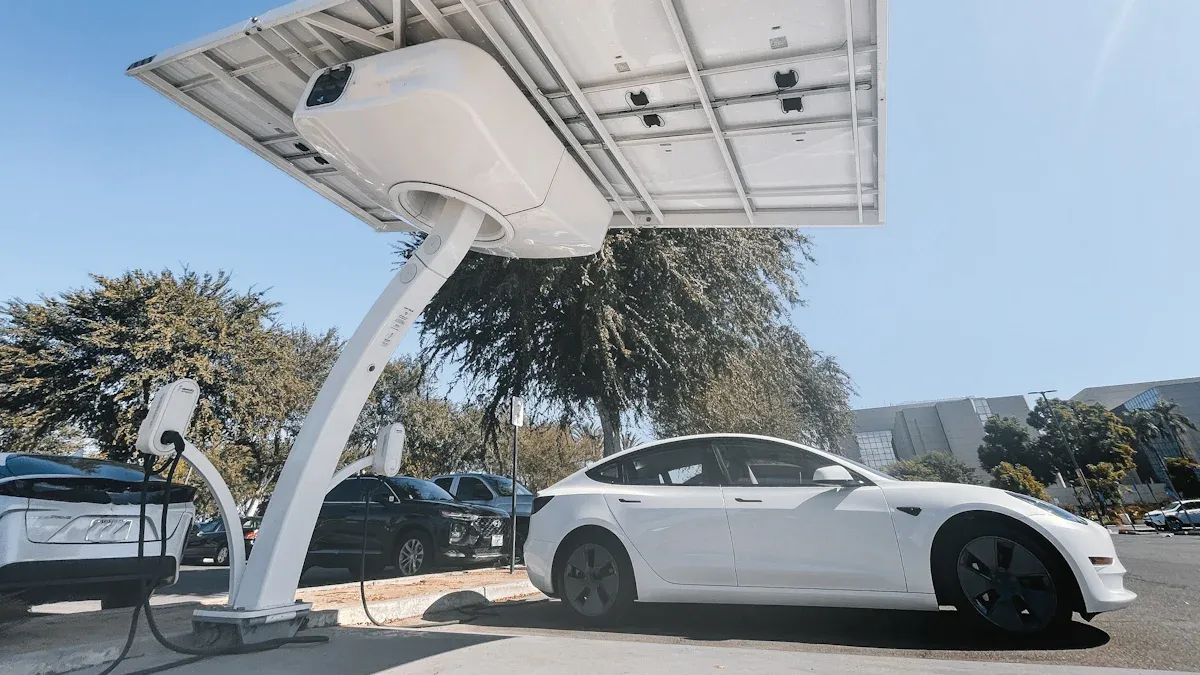
Understanding solar panel EV charging begins with tracing the journey of energy from the sun to your vehicle. This process transforms sunlight into usable power for your EV, creating a self-sufficient ecosystem for your home. The entire system works seamlessly to provide clean energy for transportation.
The Path of Solar Energy
From Sunlight to Your Car Battery
The journey of solar-powered EV charging is a marvel of modern technology. Solar panels on a roof capture photons from sunlight. They convert this light into direct current (DC) electricity. This DC power then flows to an inverter. The inverter’s job is to change the DC electricity into alternating current (AC) electricity, the standard form of energy used in a home. From there, the AC power travels to your EV charger, which manages the final delivery of energy to your EV’s battery. This completes the path for charging your EV with solar.
The Role of Each Component
Each part of the solar panel charging setup plays a critical role. A successful integration depends on these components working together.
- Panneaux solaires: These capture sunlight and are the source of all the solar energy.
- Inverter: This device is the brain of the solar power system, converting DC power to usable AC power.
- AC Wall Charger: This is the final link in the chain. Advanced electric vehicle charging solutions, like those from providers such as TPSON, manage the flow of AC power into the EV. A smart charger can communicate with the solar system to optimize charging.
- Your EV: The electric vehicle receives the AC power and its onboard charger converts it back to DC to store in the battery pack.
Direct Solar Charging vs. Grid Power
A key advantage of this setup is the flexibility to choose your energy source. You can prioritize pure solar energy or use the grid for faster charging. This choice directly impacts your costs and environmental footprint.
Charging Your EV with Solar During the Day
The most economical method is to charge your EV during peak sunlight hours. Smart chargers enable specific modes for this purpose. This strategy ensures your electric car charging is powered almost entirely by free, clean solar energy.
Remarque : True solar charging often requires a minimum amount of excess solar production, typically around 1.4kW, to begin. If solar power dips below this level, the charging session may pause to avoid drawing from the grid.
When the Grid Provides Backup Power
There are times when solar power alone is not enough. This happens on cloudy days, at night, or when you need a faster charge than the available solar can provide. In these scenarios, the system intelligently blends solar and grid energy.
- Solar & Grid Mode: The charger uses all available excess solar energy. It then pulls just enough power from the grid to meet the minimum threshold for stable charging or to reach a desired charging speed. This minimizes grid reliance while ensuring the EV charging session continues without interruption.
- Grid-Only Mode: When solar charging is turned off or unavailable, the charger functions like a standard EV charger. It draws all its power from the grid. Even in this mode, if the sun is shining, the system will use any available solar energy first before pulling from the grid.
Designing Your Solar EV Charging System
Creating an effective solar EV charging system requires careful planning. A homeowner must consider the size of the solar array, the type of inverter, and the capabilities of the EV charger. A well-designed system ensures that an EV receives clean energy efficiently, maximizing both savings and sustainability.
Sizing Your Solar Panel Array
Properly sizing a solar panel array is the most critical step. The system must generate enough electricity for both the vehicle and the home. This calculation involves three main factors.
Step 1: Calculate Your Daily Driving Needs
First, a homeowner should determine the daily energy consumption of their EV. This depends on the car’s efficiency and the average distance driven each day. Most modern electric cars average between 0.222 and 0.333 kWh per mile.
For example, a person driving 40 miles per day in a car that consumes 0.25 kWh/mile would need 10 kWh of energy just for their EV (40 miles x 0.25 kWh/mile).
The efficiency of popular 2025 models varies, as shown below:
| EV Model (2025) | Average kWh per mile |
|---|---|
| Mercedes CLA Electric | ~0.196 kWh/mile |
| Tesla Model 3 (latest) | ~0.200-0.213 kWh/mile |
| Fiat 500e | ~0.208 kWh/mile |
| Hyundai Kona Electric 2025 | ~0.233 kWh/mile |
| VW ID.4 and ID.3 | ~0.233-0.244 kWh/mile |
| Larger SUVs and premium EVs | ~0.250-0.333 kWh/mile |
Step 2: Factor in Home Energy Consumption
The solar panel system must also power the household. A homeowner can find their average daily energy usage on their utility bill, usually listed in kilowatt-hours (kWh). Adding the home’s daily consumption to the EV’s daily charging needs gives the total daily energy target for the solar array.
Exemple : If a home uses 20 kWh per day and the EV needs 10 kWh, the solar array must generate at least 30 kWh daily.
Step 3: Account for Your Climate and Sun Hours
The amount of solar power a system can generate depends heavily on the local climate. The key metric is “peak sun hours,” which measures the daily average of solar intensity. A location with 5 peak sun hours will generate more energy than a location with only 3. An installer can provide precise data for a specific address.
A Quick Calculation Formula for Panel Count
A homeowner can estimate the number of solar panels needed with a simple formula. This provides a good starting point for discussions with an installer.
Total Panels = (Daily Energy Needs in kWh) / (Peak Sun Hours x Panel Wattage in kW)
For instance, using our 30 kWh target in a location with 4 peak sun hours and using 400-watt (0.4 kW) panels:
30 kWh / (4 hours x 0.4 kW) = 18.75
This homeowner would need approximately 19 solar panels to meet their daily energy needs for both their home and EV.
Choosing the Right Inverter
The inverter is the heart of the solar-powered EV charging setup. It converts DC electricity from the solar panels into AC electricity for the home and EV charger. There are three main types to consider.
Standard String Inverters
String inverters are a common and cost-effective choice. They connect a group (or “string”) of solar panels to a single inverter. This simple design makes them easy to troubleshoot. However, their performance is limited by the weakest panel in the string. If one panel is shaded or dirty, the output of the entire string drops. Expanding a system with a string inverter can also be difficult.
Microinverters and Power Optimizers
Microinverters offer a more advanced solution. A small inverter is installed on each individual solar panel. This design allows each panel to operate independently at its maximum potential. It completely solves the shading issue that affects string inverters. Microinverters also make it easy to monitor individual panel performance and expand the system later. While the initial cost is higher, they often come with longer 25-year warranties compared to the 8-12 years for string inverters.
| Fonctionnalité | String Inverter | Microinverter |
|---|---|---|
| Performance in Shade | Output of all panels drops to match the weakest one. | Only the shaded panel is affected; others perform normally. |
| System Expansion | Difficult; may require a second inverter. | Easy; panels can be added one at a time. |
| Contrôle | Shows overall system production only. | Allows for detailed monitoring of each panel. |
| Coût initial | Plus bas. | Higher. |
| Typical Warranty | 8-12 years. | 25 years. |
Hybrid Inverters for Battery Readiness
A hybrid inverter is the most forward-thinking option. It combines a solar inverter and a battery inverter into one unit. This makes it the ideal choice for homeowners who plan to add a home battery now or in the future.
- It can store excess DC solar energy directly into a battery without needing extra equipment.
- It simplifies the installation process when adding a battery, reducing future costs.
- It can manage power from solar panels, the battery, and the grid simultaneously.
Selecting an AC Wall Charger for Solar
The final piece of the puzzle is the home EV charger. The choice between a standard charger and a smart charger will determine how effectively a homeowner can use their solar power.
Standard “Dumb” Level 2 Chargers
A standard, or “dumb,” Level 2 charger performs one function: it delivers power to the EV as quickly as possible. It does not communicate with the solar system. When a car is plugged in, it will draw power from any available source, including the grid, even if the sun is shining. This can lead to missed opportunities for free solar charging.
Solar-Aware “Smart” Level 2 Chargers
A “smart” solar EV charger is essential for maximizing a solar investment. These chargers, offered by advanced providers like TPSON, integrate with the solar system to enable intelligent charging. Key features that differentiate a smart solar station de recharge à domicile inclure :
- Energy Flow Management: They monitor solar production and home energy use in real-time.
- “Solar Only” Mode: They can be set to charge the EV using only excess solar power, ensuring 100% clean energy and zero cost.
- Programmation intelligente : A user can schedule charging sessions via a mobile app to align with peak sun hours or off-peak electricity rates.
- Surveillance à distance : They provide detailed data on energy sources, charging costs, and session history directly to a smartphone.
This level of control is what makes integrating AC wall charger technology with a solar installation so powerful for EV owners.

Many smart chargers on the market in 2025 offer robust solar integration, giving homeowners plenty of options for their solar panel charging setup.
The Home Battery Decision
Adding a home battery elevates a solar installation from a simple power generator to a complete energy management system. For an EV owner, this decision is pivotal, unlocking new levels of efficiency, savings, and energy independence. It bridges the gap between daytime solar production and nighttime EV charging needs.
Why You Might Need a Battery
A home battery acts as a personal energy reservoir. It stores the abundant solar power generated during the day for use whenever it is needed. This capability offers several profound advantages for homeowners looking to maximize their solar investment. The primary reasons for adding a battery to a solar EV charging setup include:
- Indépendance énergétique: A battery stores surplus solar energy for use at night or during overcast weather, significantly reducing reliance on the utility grid.
- Backup Power: It provides seamless power during grid outages, keeping essential appliances and the EV charger operational.
- Maximized Solar Use: Storing excess energy ensures that every kilowatt-hour of solar power is captured and used, either for the home or for the EV.
- Cost Reduction: Using stored solar energy instead of purchasing grid electricity, especially during expensive peak hours, leads to lower utility bills.
Charging Your EV at Night with Stored Solar
The most common challenge for solar EV owners is the mismatch between when their car is home and when the sun is shining. Most people are at work during peak solar production hours. A battery elegantly solves this problem.
The system stores clean solar energy all day in the battery. When the owner returns home in the evening, they can plug in their EV. The charger then draws power directly from the battery. This allows a homeowner to charge their EV overnight using 100% solar energy, even though the sun has set.
Principaux enseignements : A battery makes your home energy system more efficient and self-sufficient. It creates a perfect cycle: generate solar power by day, store it, and then use that stored energy for charging your EV at night. This strategy is the ultimate way to achieve true energy freedom.
Battery Sizing for EV Charging
Choosing the right size battery is critical for meeting overnight charging goals. The battery must have enough capacity to replenish the energy used during a typical day’s commute.
The average 2025 EV has a battery capacity between 60 kWh and 75 kWh. However, a homeowner does not need a battery that large just for daily charging. The goal is to replace the daily usage, not fill the entire EV battery from empty every night. A more important factor is accounting for energy loss. When energy moves from the solar panels to the battery and then to the EV, some is lost in the conversion process. This “round-trip efficiency” loss is typically 10-15%.
Therefore, to deliver a specific amount of energy to the EV, the battery must hold slightly more.
| Daily Driving Needs | Energy Loss (10-15%) | Required Battery Storage |
|---|---|---|
| 10 kWh | ~1.0 – 1.5 kWh | 11.0 – 11.5 kWh |
| 15 kWh | ~1.5 – 2.3 kWh | 16.5 – 17.3 kWh |
| 20 kWh | ~2.0 – 3.0 kWh | 22.0 – 23.0 kWh |
A qualified installer can help a homeowner analyze their driving habits and recommend a perfectly sized battery system. This ensures the battery can handle the nightly EV charging load without being excessively large or expensive.
The Financial Equation: Costs vs. Savings in 2025
Understanding the financial implications is crucial for any homeowner considering a solar EV charging system. This involves weighing the initial investment against the long-term savings on energy and fuel. In 2025, the numbers are more favorable than ever, making this a financially sound decision for many.
Coûts d'investissement initiaux
The total cost of a solar and EV charging setup consists of three main components: the solar panels, the EV charger, and an optional home battery. Each part has its own price range.
Solar Panel System Costs
The largest portion of the investment is the solar panel system itself. In 2025, thanks to efficient mass production, the average cost for residential solar is between $2.62 and $3.02 per watt. For the 7.6 kW system (19 panels x 400W) from our earlier example, a homeowner could expect a total cost between $19,912 and $22,952 before incentives. The price of solar panels alone is estimated to be around $2 to $3 per watt, with variations based on brand, efficiency, and warranty.
EV Wall Charger and Installation Costs
A quality Level 2 home EV charger typically costs between $500 and $1,200. Installation by a qualified electrician can add another $500 to $1,500, depending on the complexity of the wiring. A homeowner should budget for a total between $1,000 and $2,700 for this part of the project.
Home Battery Costs
Adding a home battery significantly increases the upfront cost but also maximizes the system’s value. In 2025, the price for a battery system varies by capacity and manufacturer. A homeowner can use the following table as a general guide for hardware costs.
| System Capacity | Typical Price Range (Hardware Only) |
|---|---|
| 10 kWh | $10,000 – $15,000 |
| 15 kWh+ | $15,000 – $25,000 |
Installation costs for a battery can add an additional $2,000 to $4,000.
Incentives and Rebates for Integrating AC Wall Charger
Governments and utility companies offer a range of incentives to lower the financial barrier for adopting clean energy technologies. These programs can dramatically reduce the net cost of a solar and EV charging installation.
The Federal Residential Clean Energy Credit
The most significant incentive is the Federal Residential Clean Energy Credit. This program allows homeowners to claim a tax credit for 30% of the total cost of their solar panel system and battery storage. For a $35,000 system, this translates to a $10,500 reduction in tax liability. A separate credit for the home EV charger installation covers 30% of the cost, up to a maximum of $1,000.
State and Local Government Incentives
Many states offer their own rebates and tax credits that can be combined with federal incentives. These programs make solar and EV adoption even more affordable. Some of the most generous states in 2025 include:
- California: Offers rebates up to $2,000 for home charging installation.
- New York: Provides incentives up to $5,000 in rebates.
- Colorado, Oregon, and Massachusetts: Have similar robust rebate programs for homeowners.
Conseil : A homeowner should always check their state and local government websites for the latest available incentives, as programs can change.
Remises accordées par les entreprises de services publics
Local utility companies often provide their own rebates for installing a smart EV charger or a battery system. These programs help manage grid demand and encourage efficient energy use. Rebates can range from a few hundred to over a thousand dollars, further reducing the initial investment.
Calculating Your Long-Term Savings
The true financial power of a solar EV charging setup reveals itself over time. By generating their own clean energy, homeowners can drastically cut or even eliminate their electricity and transportation fuel costs.
Solar Charging vs. Grid Charging Costs
The fundamental saving comes from replacing expensive grid electricity with free solar energy. While the average grid electricity rate is around $0.17 per kWh, the “fuel” from a paid-off solar system is effectively free. For an EV that needs 10 kWh per day, charging with solar saves $1.70 daily, or over $620 per year, compared to using the grid. Over the 25-year lifespan of the solar panels, these savings on transportation fuel alone can amount to tens of thousands of dollars.
Factoring in Time-of-Use (TOU) Electricity Rates
Time-of-Use (TOU) rates, common in states like California, create another opportunity for savings. Under a TOU plan, electricity costs more during “peak” hours (usually late afternoon and early evening) and less during “off-peak” hours (overnight).
- Without a Battery: A homeowner can use a smart charger to schedule EV charging for the cheapest off-peak hours, avoiding high peak rates.
- With a Battery: The savings are even greater. The system can store free solar energy during the day and use it to power the home and charge the EV during expensive peak hours, completely avoiding grid costs when they are highest.
This strategy of avoiding high-cost grid energy is a cornerstone of maximizing the financial return of a solar and battery system.
Estimating Your Return on Investment (ROI)
Return on Investment (ROI) measures how long it takes for the system’s savings to pay back the initial investment. A simple formula provides a solid estimate:
ROI = (Net Profit / Total Investment) * 100
Here, Net Profit is the total savings on electricity and fuel minus any maintenance costs. Total Investment is the final cost of the system after all incentives and rebates. Most homeowners find that a solar and EV charging system pays for itself within 5 to 10 years. After the payback period, all the energy the system produces represents pure profit for the remainder of its 25+ year lifespan.
Smart Charging Strategies to Maximize Solar Use
A homeowner with a solar installation can employ several strategies to ensure their EV runs on clean, free energy. The right approach depends on their daily schedule, the hardware they install, and their energy goals. These methods transform a standard home EV charger into a powerful tool for sustainability.
The “Charge During the Day” Method
The most direct strategy for charging your EV with solar is to plug it in when the sun is brightest. This simple method maximizes the use of self-generated solar power.
Aligning EV Charging with Peak Sun Hours
A homeowner can align their EV charging sessions with peak solar production hours, typically from late morning to mid-afternoon. During this window, the solar panels generate more electricity than the home consumes. This excess solar energy flows directly to the EV, providing a clean and cost-free charge.
Ideal for Remote Work or Flexible Schedules
This method is perfectly suited for individuals who work from home or have flexible schedules. They can easily plug in their EV during the day. This ensures the vehicle is ready for evening errands or the next day’s commute, all powered by the sun.
Leveraging a Smart EV Charger
A chargeur intelligent, like those from advanced providers such as TPSON, unlocks more sophisticated solar charging capabilities. It communicates with the solar system to optimize energy flow.
Using “Solar Only” Charging Mode
Many smart chargers feature a “Solar Only” or “Super Eco” mode. This setting instructs the charger to use only surplus solar power. The system detects when the solar panels are sending excess energy to the grid and diverts it to the EV instead. If solar production drops, the app may show a “Waiting for solar” message, and the charging session will pause to avoid drawing expensive grid power.
Setting Charging Schedules via an App
Smart charger apps give homeowners complete control. A user can create schedules to automatically start and stop charging sessions. This allows them to align charging your EV with peak sun hours or low-cost, off-peak grid rates without needing to be physically present.
Monitoring Your Energy Flow in Real-Time
Real-time monitoring is a key feature of a smart solar-powered ev charging setup. Mobile apps provide a clear view of where energy is coming from and where it is going.
Conseil de pro : Applications comme
mySolarEdgeetev.energyoffer detailed insights. They allow a user to track solar production, home consumption, and EV charging status simultaneously, empowering them to make informed decisions about their energy usage.
Integrating with a Home Battery
Adding a battery to the system creates the ultimate solar charging solution. It provides complete energy independence and flexibility.
Storing Excess Solar for Evening Charging
A home battery stores the abundant solar energy generated during the day. This stored energy is then available for use at any time. A homeowner can return from work in the evening and charge their EV overnight using 100% clean solar power captured hours earlier. This strategy maximise l'autoconsommation of the solar energy produced.
Creating a Truly Off-Grid Charging Cycle
The combination of solar panels, a battery, and a smart charger creates a self-sufficient ecosystem. The system’s software uses ‘self-consumption optimization’ features. It prioritizes using solar energy to power the home and charge the battery before sending any to the grid. This creates a perfect cycle: generate solar, store it, and then use that stored energy to charge your EV. This approach minimizes grid reliance and offers true energy freedom.
The Installation Process for Solar EV Charging

Successfully integrating solar panels with an EV charger requires professional expertise. The installation process is a structured journey from initial consultation to final activation, ensuring the system is safe, efficient, and compliant.
Finding and Vetting a Qualified Installer
Choosing the right installer is the most important decision a homeowner will make. A qualified professional ensures the solar EV charging system performs optimally for decades.
Look for NABCEP Certification
Homeowners should prioritize installers with credentials from the North American Board of Certified Energy Practitioners (NABCEP). This certification is a widely recognized benchmark for technical competency in the solar industry.
- NABCEP provides a directory of certified professionals, making it easier to find a qualified installer.
- Holding a NABCEP credential signifies a high level of training and expertise in solar technology.
Many regions require or prefer NABCEP certification for an installation to qualify for rebates, highlighting its importance.
| Region Example | NABCEP Requirement Guideline |
|---|---|
| Alabama | Requires NABCEP or equivalent certification. |
| Connecticut | Requires at least one NABCEP certified employee. |
| Delaware | NABCEP certification is preferred for rebate eligibility. |
| New York (en anglais) | Requires NABCEP certification or specialized training. |
Why You Should Get Multiple Quotes
A homeowner should always obtain at least three quotes from different installers. This practice allows for a thorough comparison of costs, proposed equipment, and warranty terms. It also provides insight into each company’s professionalism and customer service, helping the homeowner select the best partner for their project.
The Key Steps of Installation
The installation of a solar panel system follows a clear, multi-stage process. Each step is essential for a successful outcome.
Site Assessment and System Design
The process begins with a detailed site assessment. An installer visits the home to evaluate the roof’s condition, orientation, and any potential shading issues. They use this data to design a custom solar array that maximizes energy production. This phase also determines the optimal placement for the inverter and any battery storage.
Permitting and Paperwork
Before any work begins, the installer must secure all necessary permits from local authorities and the utility company. A reputable installer manages this entire process, ensuring the project complies with all local building and electrical codes. This step prevents future legal or operational issues.
The Installation Day
Once permits are approved, the physical installation can begin. This phase typically takes one to three days. The crew will:
- Install secure mounting hardware on the roof.
- Attach the solar panels to the mounting rails.
- Wire the panels and connect them to the inverter.
- Install the EV charging station, often from a provider like TPSON, and integrate it with the new solar system.
Inspection and Permission to Operate (PTO)
After the installation is complete, a representative from the local municipality or utility company will conduct a final inspection. They verify that the system was installed correctly and meets all safety standards. Upon passing inspection, the utility grants Permission to Operate (PTO). This is the final green light, allowing the homeowner to officially turn on their system and start charging their EV with clean solar energy.
The Future is Here: Advanced Solar Integration
The synergy between solar power and electric vehicles is evolving beyond simple one-way charging. The next frontier is bidirectional charging, a technology that allows an EV to both receive and send power. This transforms the vehicle from a mere energy consumer into an active participant in a home’s energy ecosystem.
Bidirectional Charging: V2H and V2G
Bidirectional charging unlocks two powerful capabilities: Vehicle-to-Home (V2H) and Vehicle-to-Grid (V2G). Both technologies use a special bidirectional charger to manage a two-way flow of energy, but they serve distinct purposes. This advanced form of ev charging is set to redefine how homeowners interact with their solar installations.
What is Vehicle-to-Home (V2H)?
Vehicle-to-Home (V2H) technology enables an EV to function as a mobile power source for a home. A bidirectional charger converts the DC power from the EV’s battery into AC power that the house can use. This allows a homeowner to power their residence directly from their car, a particularly useful feature during a grid outage. The system requires a compatible EV and a bidirectional charger that supports either the CHAdeMO or CCS charging standard.
In 2025, a growing number of vehicles support this technology, including:
- Nissan Leaf
- Hyundai Ioniq 5
- Kia EV6
- Mitsubishi Outlander PHEV
Using Your EV as a Home Battery
With V2H, an EV effectively becomes a large, portable battery. A homeowner can charge your ev with excess solar energy during the day. Later, during peak evening hours or a power outage, the car can send that stored energy back to power the house. This strategy maximizes the use of self-generated solar power and provides a reliable backup energy source, enhancing a home’s resilience and independence from the grid. This charging method turns a parked EV into a valuable asset for the solar system.
The Promise of Vehicle-to-Grid (V2G)
Vehicle-to-Grid (V2G) technology takes the concept a step further. Instead of just powering the home, V2G allows an EV to export its stored energy back to the broader electricity grid. This capability helps utility companies balance supply and demand, especially during peak usage times. In return for providing this grid-stabilizing service, EV owners can receive payments or credits from their utility provider. While V2H focuses on household energy independence, V2G positions the EV as a contributor to the stability of the entire energy network.
| Fonctionnalité | Véhicule à domicile (V2H) | Véhicule au réseau (V2G) |
|---|---|---|
| Energy Flow | EV battery to the home’s circuits | EV battery to the electricity grid |
| Primary Benefit | Backup power and maximizing solar use | Grid stabilization and potential earnings |
| Main Goal | Energy independence for the homeowner | Supporting the regional power supply |
This technology represents the ultimate integration of personal transport and renewable solar energy infrastructure.
In 2025, integrating an AC wall charger with a solar system is a financially and environmentally sound investment. This sustainable solar EV charging setup offers homeowners significant benefits.
- Powering an EV with 100% renewable energy lowers a home’s carbon footprint.
- A solar-powered EV charging system creates greater energy independence.
- Fueling an EV with free solar energy dramatically reduces operating costs.
The right solar EV charger and system size depend on driving habits and location. A smart home EV charger, like those from advanced providers such as TPSON, is key. It enables a homeowner to charge your EV with solar during the day. Adding a battery allows a user to charge your EV at night with stored renewable energy. This method of charging your EV with solar makes a truly sustainable lifestyle achievable.
FAQ
Can I charge my EV on cloudy days?
Yes, a homeowner can still recharger leur VE on cloudy days. Solar panels produce some power even in overcast conditions. The system will simply supplement the solar energy with power from the grid to ensure a consistent and stable charging session for the vehicle.
Do I need a battery to charge my EV with solar?
A battery is not strictly necessary but is highly recommended. It stores excess solar energy generated during the day. This allows a homeowner to charge their EV at night using 100% clean, stored solar power, maximizing energy independence and savings.
How long does it take to charge an EV with solar?
Vitesse de chargement depends on solar production and the charger’s settings. In “Solar Only” mode, the speed varies with the sun’s intensity. For faster charging, a system can blend solar and grid power to reach the charger’s maximum output, ensuring flexibility.
What happens if my solar panels don’t produce enough power?
Smart charging systems automatically handle this situation. If solar production drops below the required level, the charger will pause to avoid using grid power. Alternatively, it can pull just enough grid energy to maintain a stable charge, depending on the user’s settings.
Can any EV charger work with solar panels?
While any charger can use solar energy, a smart charger is essential for optimization. Advanced providers like TPSON offer solutions with “Solar Only” modes. These chargers intelligently manage energy flow, ensuring the EV uses free solar power whenever it is available.
How much roof space do I need for solar EV charging?
The required roof space depends on total energy needs. A homeowner must account for both household consumption and daily driving distance. An installer performs a site assessment to design a system with enough panels to meet these combined energy demands effectively.