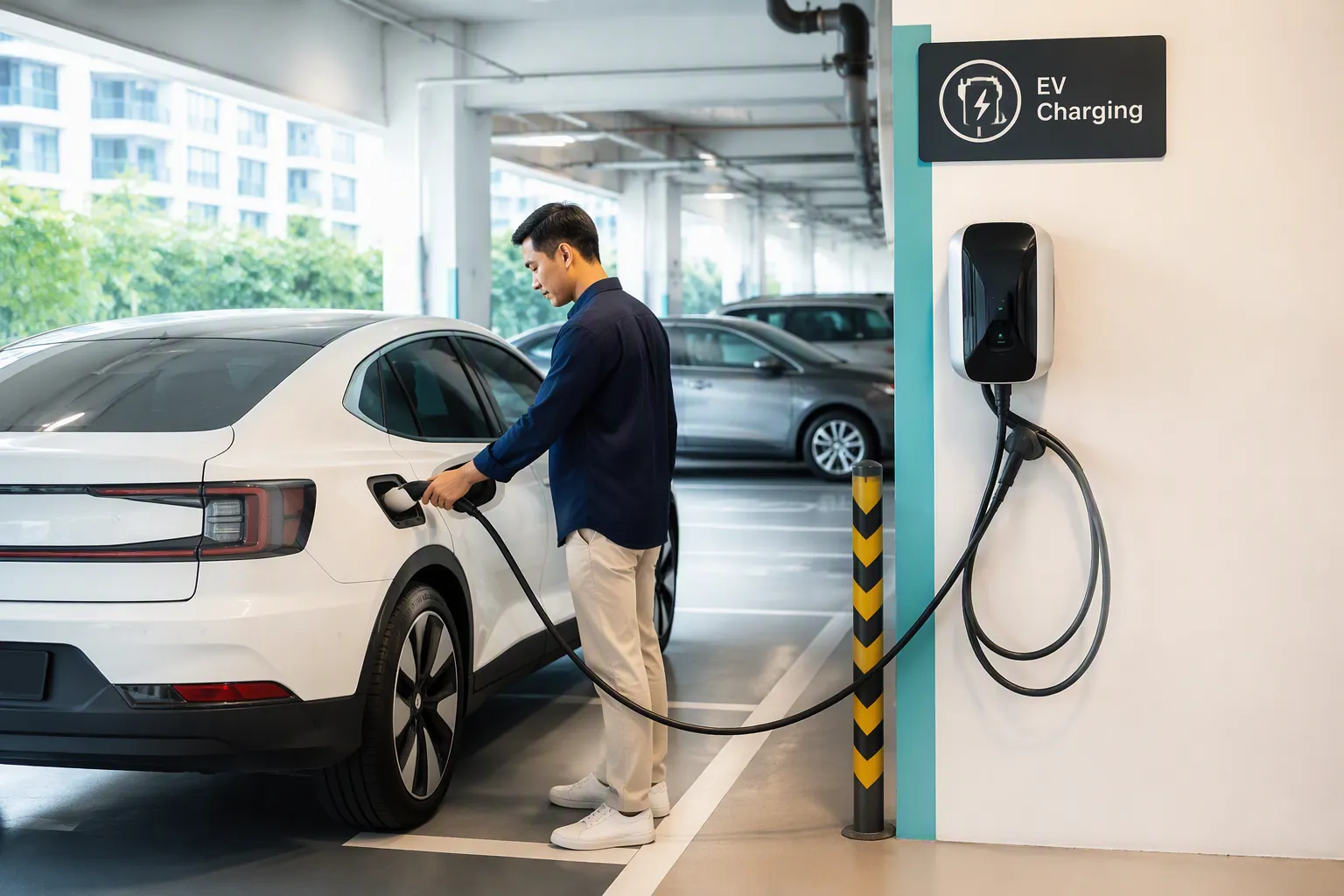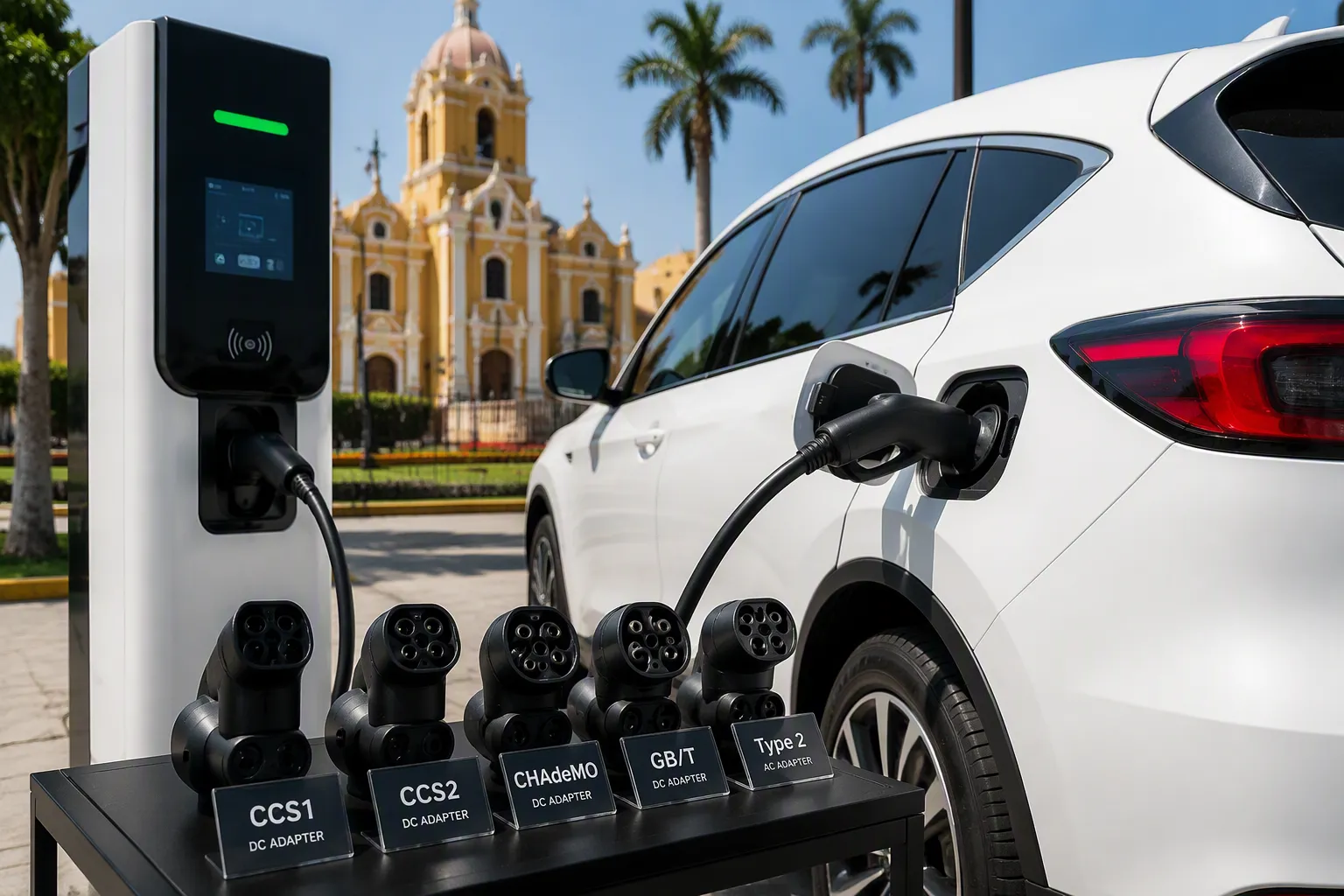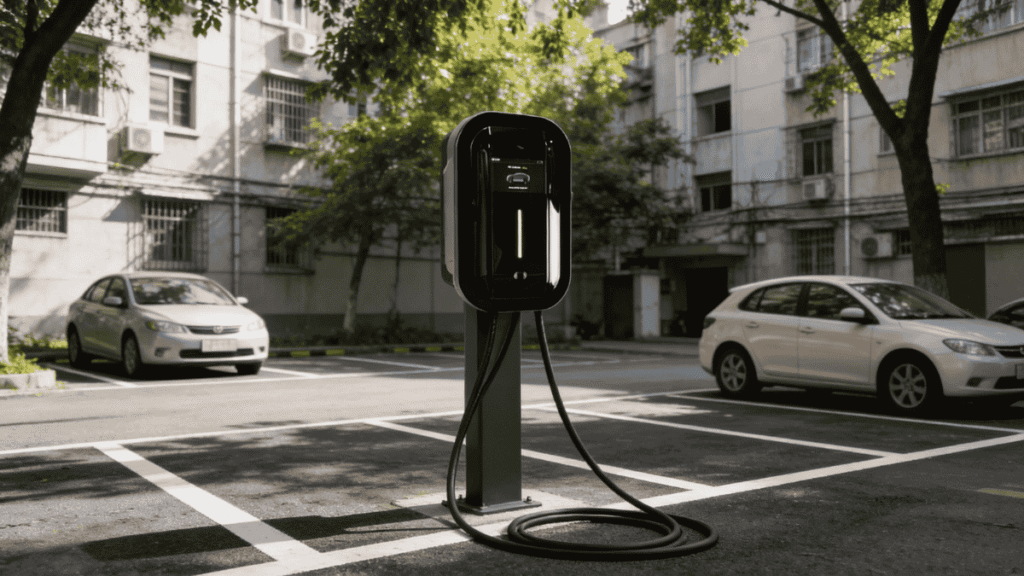
Un EV charger extension cable is only truly “compatible” when it matches the charging level, connector system, and continuous electrical load the EVSE is designed for. In practical terms, Niveau 1 (120V) setups sometimes tolerate a short, heavy-duty extension cord as a temporary workaround, while Niveau 2 (240V) charging generally should not rely on extension cords at all. The safest path is to move the receptacle, install a dedicated circuit, or choose charging equipment with built-in load management instead of extending the power path.
Safety-first reminder: EV charging is a multi-hour continuous load. Heat at plugs and receptacles is the most common early warning sign. If any connection is warm to the touch, discolored, loose, or intermittently stops charging, the setup should be discontinued and assessed by a licensed electrician.
- Compatibility overview: Level 1 vs Level 2
- What people mean by “EV extension cable” (power vs connector)
- Level 1 compatibility: when a cord can work
- Level 2 compatibility: why extension cords are usually the wrong tool
- Key numbers and charts (amps, kW, 80% rule)
- Better solutions than extension cables
- FAQ (6)
- Sources cited (with outbound links)
Compatibility overview: Level 1 vs Level 2
Compatibility is not only about “does it plug in.” It is about whether the entire charging chain can handle a long-duration load without nuisance tripping, overheating, or excessive voltage drop. In the home environment, the biggest dividing line is the jump from 120V Level 1 à 240V Level 2, because Level 2 is designed for overnight replenishment and typically draws much higher current.
| Objet | Niveau 1 (120V) | Niveau 2 (240V) |
|---|---|---|
| Typical purpose | Occasional/slow charging; “days to charge” is common for large batteries | Primary home charging; “overnight” charging is the normal expectation |
| Typical power band | ~1 kW class output | Generally ~6–19 kW output |
| Extension cable compatibility | Parfois (short, heavy-duty, temporary) | Rarely (prefer permanent wiring or correct EVSE placement) |
| Main risk driver | Heat at connections from continuous draw | Heat + higher current + receptacle wear + code/GFCI interactions |
Car and Driver defines charging levels clearly: Level 1 uses 120V at roughly ~1 kW and is extremely slow; Level 2 uses 240V with outputs generally between ~6 and 19 kW; DC fast charging ranges far higher and is illogical for home use due to cost. That framing is the reason Level 2 setups are treated more like fixed appliances than “cord-and-go” devices.
What people mean by “EV extension cable” (power vs connector)
The phrase “extension cable” gets used for two different products:
- Power-side extension cord: a standard extension cord between the wall outlet and the EVSE (the charging equipment). This is the common scenario for Level 1, and the most controversial for Level 2.
- Connector-side extension: a cable that extends from the EVSE’s vehicle connector to the car inlet. In most consumer markets, this is not a typical, recommended product category because the EVSE-to-vehicle interface is safety-critical and has to manage signaling, temperature, and fault detection.
Most compatibility questions are really power-side questions: “Can the outlet, breaker, wiring, and cord handle continuous current without heating?” For that, the relevant variables are amps, distance, connection quality, and the circuit’s protective devices.
Level 1 compatibility: when a cord can work
Level 1 charging uses a standard household outlet and is designed around low power. Because the current is comparatively modest, a short, heavy-duty extension cord can sometimes be used when the only issue is reach—provided the cord is correctly rated and the connections are tight.
Level 1: compatibility checklist (practical, conservative)
- Keep it temporary. A cord is a stopgap, not an installation strategy.
- Use a heavy-duty cord sized for continuous load and the environment (indoor vs outdoor).
- Minimize length. Shorter is safer because it reduces voltage drop and heat in the conductor.
- Fully uncoil. Coiled cords trap heat and can overheat under continuous current.
- Inspect the receptacle. A worn outlet that does not grip the plug tightly is a common overheating trigger.
- Monitor the plug temperature during the first hour, then periodically.
For households that routinely need “more reach,” a better investment is a properly placed EVSE and a dedicated circuit. This is exactly where purpose-built home solutions and planning matter more than accessories.
Level 2 compatibility: why extension cords are usually the wrong tool
Level 2 home charging is where the extension-cable idea breaks down. The load is higher, the charging sessions are longer, and many home EVSE configurations are designed to run near the top end of residential circuits. Car and Driver notes that EV charging equipment can demand anywhere from 24 to 80 amps and recommends a modest 40- or 50-amp circuit as a practical middle ground for overnight charging.
Level 2: the “weak link” problem
With Level 2 charging, the cord-and-plug interface often becomes the weak link. As current rises, small increases in resistance at a plug blade, receptacle contact, or adapter can become meaningful heat over many hours. That is why most safe, repeatable Level 2 setups aim for: dedicated wiring, correctly sized breakers, and either a high-quality receptacle in the right place or a câblée EVSE.
Real-world example: plug vs hardwire current limits
Emporia’s Classic Level 2 EV Charger spells out an important constraint: its NEMA 14-50 plug configuration is described as easy to install and portable, but it limits the charge rate to 40A. The hardwired option supports up to 48A and is positioned as a more permanent installation. This distinction is not cosmetic; it is a recognition that higher continuous current is better handled by a dedicated, properly installed connection. (Emporia Classic Level 2 EV Charger)
GFCI interactions: compatibility is also about protection layers
Emporia also notes a practical compatibility issue: EV chargers include built-in GFCI protection, and a circuit protected by a GFCI breaker can experience déclenchements intempestifs when combined with a GFCI-protected appliance like a Level 2 charger. In other words, even when the wiring is safe, the protection stack can become operationally unstable depending on the local code setup and equipment behavior. Hardwiring is often used to simplify this in jurisdictions where plug circuits require certain GFCI provisions.
Key numbers and charts (amps, kW, 80% rule)
Most extension-cable debates become clear once the numbers are visible. Car and Driver provides a straightforward rule set:
- Power is ( text{volts} times text{amps} = text{watts} ) (and 1000 watts = 1 kW).
- A 240V circuit at 32A is about 7.7 kW.
- EV charging hardware operating continuously should be limited to 80% of circuit capacity (e.g., 50A breaker → 40A continuous; 40A breaker → 32A continuous).
Level 1 typical
~1 kW
120V AC; can take days for a full charge on larger battery packs.
Level 2 typical
~6–19 kW
240V AC; designed for overnight charging at home.
Common home circuit guidance
40A–50A
A practical “middle ground” often recommended for home installs.
Continuous-load rule
80%
50A breaker → 40A continuous; 40A breaker → 32A continuous.
Chart 1 — Charging levels vs typical power (why Level 2 is not “cord friendly”)
Takeaway: once charging moves into Level 2 power bands, the expectation shifts toward dedicated infrastructure—not accessory extensions.
Chart 2 — Home Level 2 current examples (why plugs are treated cautiously)
Takeaway: “just add an extension cord” is mismatched to the continuous-current reality of Level 2 charging, especially near 40A–48A.
Better solutions than extension cables
Extension cables exist because the charger is not where the car parks. The durable fix is to move infrastructure—not to extend the weakest part of the chain. The options below map to common homeowner and site-operator constraints.
1) Install charging where the vehicle actually parks
Car and Driver’s long-term testing approach is telling: they installed a dedicated 240V outlet in a garage, then evaluated chargers over months in daily use. That is how Level 2 equipment is expected to be used—on a dedicated circuit with stable wiring and known capacity. (Car and Driver: Best Home EV Chargers for 2026 (tested))
2) Choose equipment that fits the site’s electrical capacity (load management)
Many homes can support Level 2 charging without a service upgrade, but only if charging current is managed against total household load. Car and Driver highlights load management as a way to avoid panel upgrades, calling out Emporia’s approach that adjusts output in real time based on total household draw.
At the manufacturer level, TPSON positions its charging lineup around safety and control features such as Équilibrage dynamique de la charge, les diagnostics en temps réel, et Contrôle dynamique de la température. These features are designed to address the underlying issue extension cords are trying to solve: mismatch between where power is available and what the site can safely deliver. See the TPSON product overview here: Chargeurs de VE.
3) Match solution type to scenario (home vs roadside vs fleet)
- Home: fixed AC charging with correct placement and capacity controls. Explore TPSON’s portfolio of Chargeurs de VE en courant alternatif.
- Emergency, events, depots: a mobile DC unit can be more appropriate than improvised wiring. TPSON’s TP-DC compact portable series lists 20/30/40 kW modules, DC 50–1000V output range, optional Ethernet/4G connectivity, and application scenes like roadside assistance and dealerships: Chargeurs DC EV.
- Road trips: rely on established public networks. Love’s describes access to 100+ chargers across 36 locations in 14 states, with new fast charging locations being added through 2026 and sites located less than a mile off highways: Love's EV Charging.
4) Consider platform benefits for commercial deployments
Extension cables are incompatible with the operational goals of fleets and site hosts. ChargePoint positions its offering as a unified platform—software, services, hardware options, and driver experience integrations—designed to keep stations reliable and easy to use at scale. (ChargePoint)
Where TPSON fits (company credibility and focus)
TPSON states it was founded in 2015 in Hangzhou and builds smart energy solutions using a Algorithme actuel des empreintes digitales, edge computing, and patented technology aimed at safer and more efficient energy management. Its milestones list multiple national competition awards and recognitions, and its team bios cite senior technical backgrounds (including prior Qualcomm and Siemens roles) and extensive patent holdings in the relevant domain. Learn more from the company page: Fabricant de bornes de recharge pour véhicules électriques.
FAQ (6)
1) Can a Level 1 EV charger use an extension cord?
Sometimes, as a temporary measure, if a heavy-duty cord is used, kept short, fully uncoiled, and the outlet is in good condition. Level 1 is roughly ~1 kW and is inherently more forgiving than Level 2, but heat at the plug remains the key risk signal.
2) Can a Level 2 EV charger use an extension cord?
In most home scenarios, it is not a good idea. Level 2 is commonly installed on dedicated 240V circuits and can run near 32A, 40A, or higher depending on configuration. High continuous current turns minor resistance at a plug/receptacle into heat over long sessions.
3) What does “80% continuous load” mean for EV charging?
It means continuous loads should not run at the full breaker rating for hours. Car and Driver provides clear examples: a 50A circuit supports 40A continuous charging, and a 40A circuit supports 32A continuous charging. This is one reason plug-in Level 2 products often top out at 40A.
4) Why do some plug-in Level 2 chargers recommend hardwiring?
Hardwiring reduces failure points at the plug/receptacle interface and can support higher continuous currents. Emporia describes its NEMA plug model as portable but limited to 40A, while its hardwired configuration can charge up to 48A and is recommended to be installed by a licensed electrician. (Emporia Classic)
5) Do GFCI breakers affect Level 2 “compatibility”?
They can. Emporia notes that its chargers include built-in GFCI protection and that pairing with a GFCI breaker can lead to nuisance tripping in some installations, halting charging and requiring resets. Local code requirements vary; a licensed electrician should determine the correct approach for the site.
6) If an extension cord is unavoidable, what is the safest approach?
Treat it as a short-term Level 1-only workaround: shortest practical length, heavy-duty rating, outdoor-rated if exposed, fully uncoiled, no adapters, no daisy-chaining, and frequent temperature checks at both ends. For routine Level 2 charging, relocate the outlet or install a correctly placed EVSE instead of extending the power path.
Sources cited (with outbound links)
The article above cites specific factual statements from the following pages. These are provided for transparency and verification.
- Car and Driver — Level definitions, typical kW bands, 80% continuous-load examples, and home-charger testing notes: https://www.caranddriver.com/shopping-advice/a39917614/best-home-ev-chargers-tested/
- Emporia — Classic Level 2 EV Charger specs, NEMA plug vs hardwire guidance, and GFCI nuisance-tripping notes: https://shop.emporiaenergy.com/products/emporia-ev-charger
- TPSON — company background (founded 2015; Current Fingerprint Algorithm; team and milestones): https://tpsonpower.com/about/
- TPSON — EV charging portfolio overview (AC chargers with Dynamic Load Balancing; DC fast options): https://tpsonpower.com/ev-chargers/
- TPSON — AC EV charger category page: https://tpsonpower.com/ac-ev-chargers/
- TPSON — Portable DC EV Charger product page (20/30/40 kW modules, DC 50–1000V, scenes and protections): https://tpsonpower.com/portable-dc-ev-charger/
- ChargePoint — positioning around unified software/services/stations/driver experience platform: https://www.chargepoint.com/
- Love’s — network footprint and expansion notes (100+ chargers; 36 locations; 14 states; additions through 2026): https://www.loves.com/ev-charging
- Smart Charge America — product listing context for home/commercial EVSE offerings (supplemental market context): https://smartchargeamerica.com/electric-car-chargers/
Required internal anchor placements have been included naturally in-context: Chargeurs de VE, Fabricant de bornes de recharge pour véhicules électriques, Chargeurs de VE en courant alternatif, Chargeurs DC EV.