
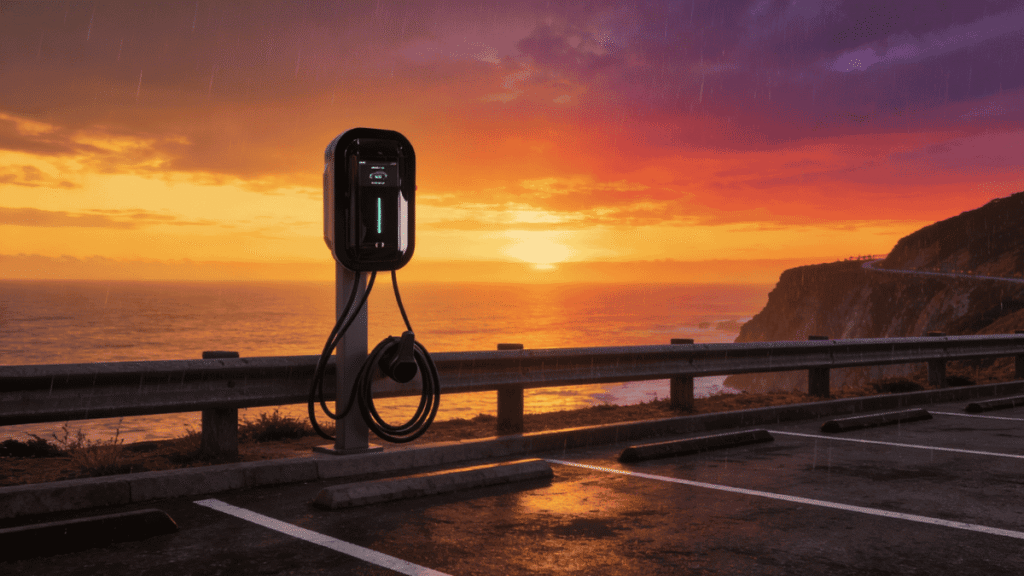
Most EV manufacturers and charging brands recommend avoiding extension cords for EV charging whenever possible—because EV charging is a long-duration, high-current load. If you must use one temporarily, the “best extension cord for EV charging” is the one that is correctly rated for the current, as short as possible, and used with strict safety checks. This guide explains what to buy (by specification), what to avoid, and how to charge more safely.
Safety warning: Extension cords can overheat, cause nuisance tripping, or create fire risk if undersized, damaged, coiled, or exposed to water. When possible, install a properly rated outlet or hardwire a charger instead.
EV charging can run for hours. Car and Driver’s EV charging overview highlights that Level 1 (120V) is very slow and can take days, while Level 2 (240V) typically charges overnight. That long run time is exactly why extension cords are risky: even a small resistance increase becomes heat over time. (Source: Car and Driver “Best Home EV Chargers for 2026, Tested”)
In practice, extension cords are only a “maybe” for short-term, low-power charging (often Level 1), when there is no safer option and you can meet all rating and inspection requirements. For regular charging, the safer approach is a proper outlet near the vehicle or a hardwired wallbox.
Rule of thumb: If you’re using an extension cord more than occasionally, you don’t need a better cord—you need a better outlet location or a permanent EVSE installation.
“Top picks” here means the safest specs to look for. Because availability differs globally, selecting by specification is more reliable than naming a single product SKU.
| Cas d'utilisation | Best extension cord spec to look for | Why it’s a “top pick” | À éviter |
|---|---|---|---|
| Level 1 (120V) emergency / occasional |
Outdoor-rated heavy-duty cord 12 AWG (minimum) / 10 AWG (better) Rated at least Ampérage maximum (or 20A if your circuit/EVSE uses it) Short length (e.g., 25 ft or less if possible) | Lower resistance = less heat for long-duration loads | 16 AWG / 14 AWG “household” cords, bargain reels, unknown ratings |
| Outdoor exposure (rain/snow risk) | Outdoor/wet-location rated cord + weather-resistant connection protection | Reduces water ingress risk at plug connection points | Cords with damaged jackets; connections sitting in puddles |
| 240V (Level 2) “cord needed” situations |
Préférer no extension cord (install outlet/hardwire). If absolutely unavoidable, only use a cord that matches the plug type and continuous current, and keep it very short. | Level 2 loads are high and continuous—risk rises fast | Improvised adapters, multi-plug splitters, coiled cords, undersized conductors |
Why no brand list? The safest “pick” varies by region, plug type, and circuit amperage. A cord that’s excellent for a 120V/12A application can be dangerously wrong for a higher-current setup. Selecting by rating and construction is the most reliable approach.
EV charging is continuous load behavior. Even home Level 2 equipment can run up to high output—Emporia’s Classic lists up to 48A with hardwire installation (and 40A with a NEMA 14?50 plug), which is far beyond what typical consumer extension cords are designed for. (Source: Emporia Classic Level 2 EV Charger page)
- Wire gauge (AWG): lower number = thicker conductor = less heat. For Level 1, 12 AWG minimum, 10 AWG preferred.
- Length: shorter is safer. Don’t buy “extra length just in case.”
- Outdoor rating: if used outside, cord and plug ends must be suitable for outdoor conditions.
- Connector quality: tight, solid contacts matter; loose blades create heat.
- Continuous current rating: make sure the cord’s rating meets or exceeds your EVSE draw.
Best practice: if your EVSE lets you reduce current (many do), set a lower amperage when using an extension cord. Less current means less heat and less voltage drop.
Before charging
Inspect + verify ratings
Check AWG, amps, outdoor rating, and plug fit.
During charging
Feel for heat
Warm is a warning; hot is a stop.
After charging
Re-check connections
Look for discoloration, melting, or odor.
- Uncoil the cord completely: coiled cords trap heat.
- Keep connections off the ground: avoid puddles and snow banks; use a weather cover if outdoors.
- No daisy-chaining: never connect extension cords together.
- No adapters unless designed for the purpose: improvised adapters create weak points and heat.
- Check for nuisance tripping issues: Emporia notes that GFCI protections can cause nuisance tripping in some configurations, especially when multiple GFCI layers exist (panel breaker + device protection). If tripping occurs, stop and consult an electrician. (Source: Emporia Classic page “GFCI Breakers” notes)
If you’re charging at home or regularly at one location, a permanent solution is safer and usually cheaper over time:
- Install a proper outlet where you park (or hardwire the EVSE).
- Choose a wallbox setup that fits your electrical capacity; load management solutions can prevent expensive upgrades.
- For a stable home/campus/workplace setup, consider a dedicated EVSE rather than improvising cords. TPSON’s lineup highlights AC chargers and Équilibrage dynamique de la charge for electrical system protection, plus DC options for commercial/emergency use cases. (Source: TPSON EV Chargers overview)
ChargePoint also emphasizes the value of a unified platform and driver experience (find/start/pay) and the ability to manage operations and improve uptime— which is another way to say: use purpose-built infrastructure instead of temporary workarounds when reliability matters. (Source: ChargePoint)
It’s not recommended. Level 2 charging is a high-current, long-duration load (e.g., Emporia Classic supports up to 48A hardwired), and most extension cords are not designed for that continuous demand. If you must, treat it as a temporary, engineered solution: correct gauge, correct plug type, shortest length, fully uncoiled, and monitored for heat. (Source: Emporia Classic specs)
For Level 1, 12 AWG is a common minimum and 10 AWG is safer, especially as distance increases. The “best” gauge is the thickest cord that matches your current draw and plug type, at the shortest length you can use.
Emporia explains that EV chargers have built-in GFCI protection, and when the circuit is also protected by a GFCI breaker (common for 14-50 outlets), it can lead to nuisance tripping. If tripping happens, stop charging and consult a professional installer. (Source: Emporia Classic “GFCI Breakers”)
Install the EVSE closer to the vehicle or install the correctly rated outlet where you park. In many cases, switching to a hardwired installation can also avoid some outlet/GFCI complications and support higher continuous current (as Emporia notes: plug models limit charge rate to 40A, while hardwire can go to 48A). (Source: Emporia “NEMA Plug vs. Hardwire”)
- Car and Driver (charging levels overview; why long charging time matters): https://www.caranddriver.com/shopping-advice/a39917614/best-home-ev-chargers-tested/
- Emporia Classic Level 2 EV Charger (48A hardwire / 40A plug; GFCI notes; install guidance): Emporia Classic Level 2 EV Charger
- TPSON EV Chargers overview (Dynamic Load Balancing positioning; AC/DC portfolio narrative): https://tpsonpower.com/ev-chargers/
- ChargePoint (platform + driver experience + uptime framing): https://www.chargepoint.com/
- TPSON About (manufacturer context): https://tpsonpower.com/about/
Internal links used in-body (as required): Chargeurs de VE · Fabricant de bornes de recharge pour véhicules électriques · Chargeurs de VE en courant alternatif · Chargeurs DC EV




