


The cost to charge an ev is a dynamic figure, not a static price. Electric vehicle owners often realize significant financial benefits compared to their gasoline-powered counterparts.
An EV driver can expect to save approximately $1,700 annually. This figure comprises roughly $900 in fuel savings and an additional $800 from reduced maintenance needs like oil changes.
Several key variables ultimately determine the final ev charging costs. These factors include the driver’s specific vehicle and the type of EV Charger selected. Technologically advanced EV charger manufacturers, such as TPSON, develop solutions that help drivers navigate these cost factors effectively.
Where You Charge: Location’s Impact on EV Charging Costs
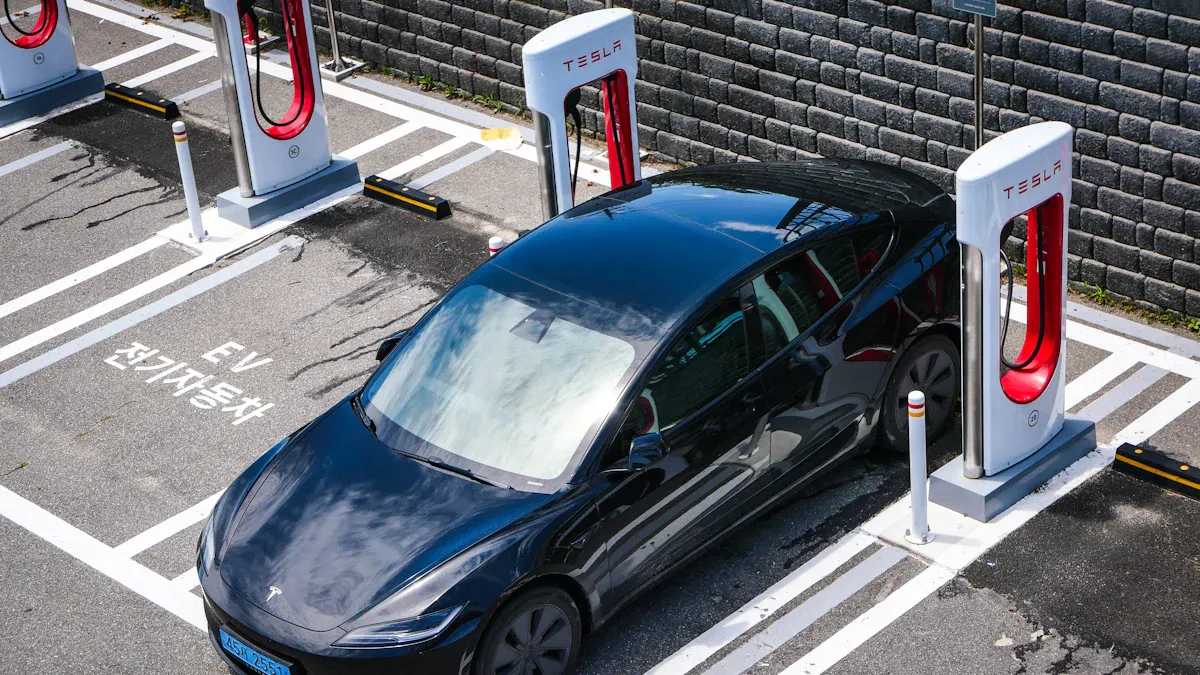
The physical location where a driver plugs in their electric vehicle is a primary determinant of the final bill. Charging costs can vary dramatically between a private garage, a public station, or an office parking lot. Understanding these differences is the first step toward managing overall ev charging costs.
Home Charging: Your Cost Baseline
For most EV owners, charging at home establishes the financial baseline. This method offers a blend of convenience and affordability that is difficult for other options to match.
Residential Electricity Rates
Home charging costs are tied directly to a household’s utility bill. In the United States, the average residential electricity rate is between 15 and 17 cents per kilowatt-hour (kWh). A driver can calculate the cost of a full charge by multiplying their specific electricity rate by their vehicle’s battery capacity. For example, charging a 65 kWh battery at 16 cents/kWh would cost approximately $10.40.
Level 2 Charger Installation Costs
While using a standard wall outlet is possible, most owners opt for a Level 2 charger for faster, more efficient charging. The one-time installation cost for this equipment is an important initial investment. Technologically advanced providers, such as TPSON, develop smart charging solutions that can help manage and optimize this home electric vehicle charging process.
The Most Affordable Option
Despite the initial setup expense, home charging remains the most economical option for daily driving needs. It leverages the lowest available electricity rates and provides unparalleled convenience.
Public Charging Networks
Public networks offer crucial infrastructure for long-distance travel and for drivers without home charging access. However, this convenience comes at a premium.
Network Pricing Differences
Different charging networks set their own prices. These can fluctuate based on the station’s location, the time of day, and the level of demand.
Per-kWh vs. Per-Minute Billing
Networks bill for energy in one of two ways. Per-kWh billing is the most straightforward, where drivers pay for the exact amount of energy transferred. Per-minute billing charges for the time connected to the charger, which can be less favorable for vehicles with slower charging capabilities.
Session Fees and Subscriptions
Many networks add session or initiation fees to each charge. To offset higher charging rates, some providers offer subscription plans.
Pro Tip: A monthly subscription can reduce rapid charging costs by 10–20%. However, these plans are most valuable for drivers who consistently use a single network, as the benefits do not transfer to competitors.
The Cost of Convenience
Ultimately, public charging is a service that prioritizes convenience and speed, especially on road trips. This service commands a higher price than charging at home.
Workplace Charging Programs
Charging at the office presents a significant opportunity for savings. Many companies now offer this as an attractive employee benefit.
Employer-Subsidized Charging
Some employers provide charging stations at a reduced cost, offering rates that are lower than public networks but potentially higher than residential electricity.
Free Charging as a Perk
The ideal scenario for a commuter is free workplace charging. This valuable perk can eliminate a significant portion of a driver’s daily running costs, making the commute virtually free of “fuel” expenses.
Destination Charging
Destination charging refers to the practice of topping up an EV’s battery while parked at a location for an extended period. Drivers find these chargers at places like shopping centres, hotels, restaurants, and tourist attractions. This method provides a convenient way to add range while engaging in other activities, turning downtime into productive charging time. It serves as a valuable supplement to home and public network charging.
Retail and Hospitality Chargers
Many businesses in the retail and hospitality sectors now install EV chargers to attract and retain customers. Offering charging as an amenity can incentivize an EV driver to choose one hotel or shopping centre over another. This strategy is becoming increasingly common across the UK.
For example, the hotel group Premier Inn partnered with the GeniePoint Network to install high-powered chargers at its locations. Customers can easily use these chargepoints by downloading the GeniePoint app. This network, powered by ENGIE, can often replenish a vehicle’s battery in about 30 minutes. This service is available at numerous hotels, including:
- Aberdeen City Centre
- Glasgow (Braehead)
- Milton Keynes (Willen Lake)
- Barrow-in-Furness
- Newark
The hardware for these installations is often supplied by technologically advanced electric vehicle charging solution providers like TPSON, which develop the reliable solutions that businesses depend on.
Free vs. Paid Destination Options
The cost structure for destination charging varies significantly from one venue to another. Some businesses offer it as a complimentary perk, while others bill for the service. Drivers should always verify the cost before plugging in. The price is typically related to the charging speed.
| Charging Speed | Typical Cost per kWh |
|---|---|
| Slow (3-7 kW) | £0.25 – £0.35 |
| Fast (7-22 kW) | £0.30 – £0.45 |
| Rapid (50-150 kW) | £0.50 – £0.79 |
Beyond per-kWh rates, some locations may apply a flat connection fee of around £0.50 to £1.00. However, free charging remains a powerful incentive. Several networks specialize in providing these destination solutions with different pricing models:
- Pod Point: Chargers are often found at supermarkets and can sometimes be free to use.
- Tesla Destination: Located at hotels and restaurants, pricing is set by the venue and is frequently offered for free to patrons.
- ZeroNet: This network serves the hospitality industry. Many of its chargers are free, with no subscription or access fees required.
Driver’s Note: 📝 Free destination charging is an excellent perk that lowers overall running costs. When charging is paid, the venue sets the price. Always use the provider’s app to check rates, as they can be higher than charging at home.
When You Charge: How Timing Affects the Cost to Charge an EV
The time of day an electric vehicle is plugged in can have as much impact on the final bill as the charging location itself. Utility companies structure their pricing in various ways, creating opportunities for significant savings or unexpected expenses. Understanding these rate structures is essential for managing the overall cost to charge an ev.
Understanding Utility Rate Structures
Electricity is not priced uniformly throughout the day or across different consumption levels. Most residential customers fall under one of several common utility plans. Each plan offers a different way to calculate the final energy bill.
Standard Fixed-Rate Plans
A fixed-rate plan provides budget predictability. Drivers pay a consistent price per kilowatt-hour (kWh) regardless of the time of day or total energy used.
- Price Stability: The rate for energy remains constant for the contract’s duration, protecting consumers from market price increases.
- Savings Method: With this plan, the only way to lower a bill is to reduce overall energy consumption.
Tiered Rate Plans
Tiered plans are designed to encourage conservation. The price per kWh increases as a household’s energy consumption crosses predefined thresholds during a billing cycle. Higher usage directly leads to higher costs, rewarding households that successfully limit their total energy use.
Time-of-Use (TOU) Rates
Time-of-Use (TOU) plans are a game-changer for EV owners. These plans feature variable charging rates based on the time of day, reflecting the grid’s overall demand. Major metropolitan areas like Los Angeles use TOU structures to encourage consumers to shift electricity use to off-peak hours. Technologically advanced charging solutions, such as those from providers like TPSON, can automate this process, ensuring the vehicle only charges when rates are lowest.
On-Peak Hour Pricing
On-peak hours represent the most expensive time to use electricity. This period typically occurs in the late afternoon and early evening when residential energy demand is at its highest. Charging an EV during these hours will result in the highest possible ev charging costs at home.
Off-Peak Hour Savings
Off-peak hours, usually overnight and on weekends, offer the lowest electricity rates and the greatest potential for savings. The financial benefit is substantial. For example, charging a 40 kWh Nissan Leaf overnight on a TOU tariff could cost as little as £2.80. Charging that same vehicle during peak daytime hours could cost over £10.
Smart Savings: An EV owner who consistently charges overnight during off-peak hours can save a significant amount annually compared to charging on a standard tariff.
Super Off-Peak Incentives
Some utility providers offer an even cheaper rate tier called “super off-peak.” This window, often in the middle of the night (e.g., 12 a.m. to 6 a.m.), provides the absolute lowest price per kWh, making it the most cost-effective time to charge.
Demand Charges Explained
Demand charges are a separate fee structure primarily impacting commercial and industrial customers, including public charging station operators. This fee is based on the highest peak power usage (measured in kilowatts) during a billing period, not the total energy consumed (kWh).
Impact on DC Fast Charging Costs
DC fast chargers draw an immense amount of power in a short time. This high power draw creates a large peak demand, triggering substantial demand charges for the station operator from their utility provider.
How Businesses Pass on Fees
To remain profitable, charging network operators must pass these demand charges on to their customers. This is a primary reason why public DC fast charging prices are significantly higher than residential electricity rates. The operator’s pricing model must account for both the energy consumed and the peak power required to deliver it.
Charger Speed and Type: A Major Factor in the Cost to Charge an Electric Car
The technology inside the charger itself plays a critical role in determining the final cost to charge an electric car. Different charging levels offer a trade-off between speed and expense. Drivers who understand these tiers can make informed decisions that align with their budget and daily needs.
Level 1 Charging (120V)
Level 1 represents the most basic and accessible charging method available. It is a useful fallback but comes with significant limitations.
Using a Standard Outlet
This method involves plugging the vehicle directly into a standard household wall socket using a portable charging cable. No special installation is required, making it available almost anywhere.
Cost and Inefficiency
While Level 1 charging uses inexpensive residential electricity, it is extremely slow. According to the U.S. Department of Energy, this method typically adds only 3 to 5 miles of range for every hour of charging. This slow energy transfer can also be less efficient, meaning a small percentage of electricity is lost during the process. It is best suited for overnight top-ups on plug-in hybrids with small batteries.
Level 2 Charging (240V)
Level 2 chargers are the most common and practical solution for the majority of EV owners. They strike an effective balance between charging speed and cost.
The Home and Public Standard
These chargers require a dedicated 240V circuit, similar to an electric oven or clothes dryer. They are the standard for home charger installations and are also widely found in public locations like workplaces and shopping centres. Technologically advanced providers like TPSON develop smart Level 2 chargers that allow for scheduled charging to take advantage of lower electricity rates.
Balancing Speed and Cost
A Level 2 charger significantly reduces charging time compared to Level 1. This efficiency, combined with low off-peak residential electricity rates, makes it the most economical choice for daily charging.
The financial advantage is substantial. Charging a 50kWh battery at home during off-peak hours might cost only £4.75, whereas the same charge at a public station could be over £32.00. This difference in ev charging costs allows owners to recoup the initial charger installation cost, often within one to two years.
DC Fast Charging (Level 3)
DC Fast Charging, also known as Level 3, prioritizes speed above all else. It is the EV equivalent of a quick stop at a petrol station.
The Premium for Speed
This method delivers direct current (DC) straight to the vehicle’s battery, bypassing the onboard charger for incredibly fast speeds. This convenience, however, comes at a significant price premium.
High-Power Charging Costs
Operators of DC fast chargers pass on high electricity demand charges to consumers, resulting in the highest per-kWh rates. The price difference between standard public charging and rapid charging is distinct.
| Charging Type | Average Cost (pence per kWh) |
|---|---|
| Public Slow/Fast (PAYG) | 52p |
| Public Rapid/Ultra-rapid (PAYG) | 76p – 79p |
When Fast Charging Makes Sense
Due to its high cost, DC fast charging is not intended for regular, daily use. Its primary purpose is to enable long-distance travel by providing a rapid range boost in 20-40 minutes. Drivers should reserve this option for road trips or emergency situations to keep their overall running costs low.
Your Utility Provider: The Foundation of Your Charging Bill
The local utility company sets the foundational price for every kilowatt-hour an EV owner uses when charging at home. This provider’s rate structure is the single most important element in a driver’s home charging bill. Understanding how these rates are determined is key to unlocking significant savings.
Geographic Rate Variation
Electricity does not have a single national price. The cost per kilowatt-hour (kWh) varies dramatically based on a driver’s location, creating different cost baselines across the country.
State-by-State Cost Differences
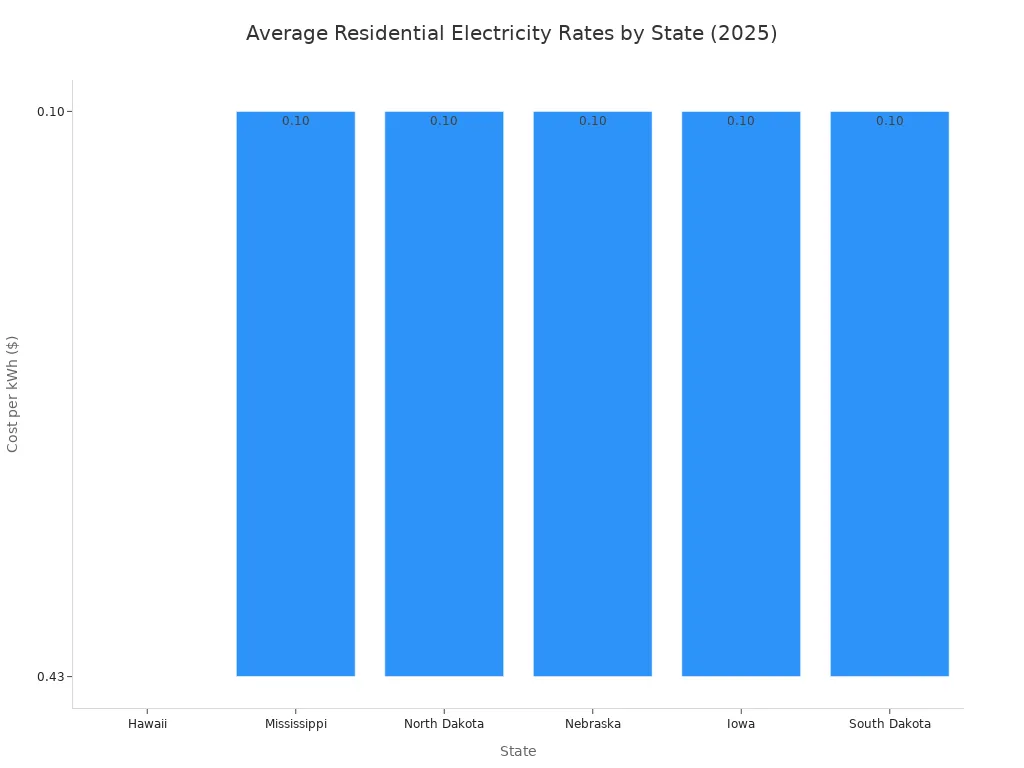
The state where a driver lives has a profound impact on charging expenses. Some states benefit from low-cost energy generation, while others face higher costs due to infrastructure and fuel sources. This disparity means a full charge can cost more than four times as much in one state compared to another.
For example, a driver in Hawaii faces some of the highest rates in the nation, while drivers in states like Mississippi and North Dakota enjoy much lower costs.
| State | Cost per kWh (2025) |
|---|---|
| Hawaii | $0.43 |
| Mississippi | $0.10 |
| North Dakota | $0.10 |
| Nebraska | $0.10 |
| Iowa | $0.10 |
| South Dakota | $0.10 |
Urban vs. Rural Utility Rates
Pricing differences also exist within states. Urban areas often have a dense customer base, which can sometimes lead to different infrastructure costs and rates compared to more sparsely populated rural regions. Drivers should always check the specific rates for their local utility district.
Standard vs. EV-Specific Plans
Utility providers offer various rate plans. While a standard plan works, enrolling in an EV-specific plan can drastically reduce charging costs.
Benefits of EV Rate Plans
EV rate plans are designed to reward off-peak energy consumption. They offer deeply discounted electricity rates during overnight hours when grid demand is low. This structure directly benefits EV owners who can schedule their charging sessions for these low-cost periods.
How to Choose the Right Plan
Choosing the right plan requires a driver to analyze their household energy use and charging habits.
- Review your utility’s website for available EV or Time-of-Use plans.
- Compare the on-peak and off-peak rates to your current flat rate.
- Consider your ability to shift charging to overnight hours.
Technologically advanced charging solutions from providers like TPSON can automate this process, ensuring the vehicle only draws power when rates are cheapest.
Renewable Energy Options
For environmentally conscious drivers, many utilities offer ways to power their vehicles with green energy.
Green Energy Surcharges
Many providers have programs that allow customers to source their electricity from 100% renewable sources like wind or solar. This option often comes with a small premium, known as a green energy surcharge, added to the monthly bill.
Solar Panel Integration
Installing a home solar panel system offers another path to sustainable charging. This approach allows an EV owner to generate their own clean electricity. While it involves a significant upfront investment, it can lead to near-zero “fuel” costs over the long term, effectively turning sunlight into driving range. ☀️
How Your Vehicle’s Specs Influence Charging Expenses
The specific electric vehicle a person drives is a fundamental variable in the charging equation. A vehicle’s battery capacity, energy efficiency, and charging hardware directly influence the final cost to charge an electric car. These internal factors are just as important as external ones like electricity rates.
Battery Size (kWh)
The size of a vehicle’s battery, measured in kilowatt-hours (kWh), is the primary determinant of the cost for a full charge. It functions much like the fuel tank in a conventional car.
Cost to Charge from Empty
A larger battery holds more energy and, consequently, costs more to fill. The calculation is simple: battery size (kWh) multiplied by the electricity price (per kWh). This direct relationship means that doubling the battery size will double the cost of a full charge, assuming the same electricity rate.
| Battery Size | Cost to Fully Charge (at 24.5p/kWh) |
|---|---|
| 100 kWh | £24.50 |
| 62 kWh | £15.19 |
| 13.8 kWh | £3.38 |
Analogy to a Gas Tank
Thinking of the battery as a gas tank helps clarify this concept. A large SUV with a 20-gallon tank costs more to fill than a compact car with a 12-gallon tank. Similarly, an EV with a 100 kWh battery will have higher ev charging costs for a full charge than a smaller vehicle with a 40 kWh battery.
Vehicle Efficiency
Efficiency measures how far a vehicle can travel on a single kilowatt-hour of energy. A more efficient car will have lower running costs because it uses less electricity to cover the same distance.
Understanding Miles/kWh
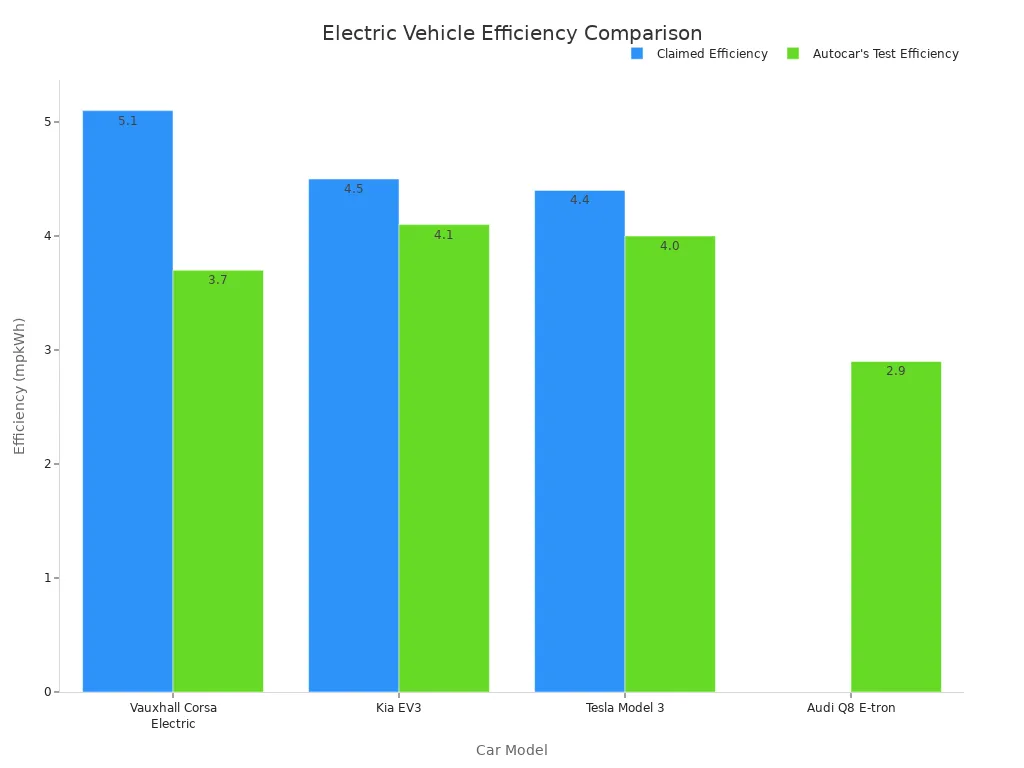
The key metric for EV efficiency is miles per kilowatt-hour (mpkWh). A higher mpkWh rating indicates better efficiency. This figure varies significantly between models.
Impact of Driving Style
A driver’s habits have a major impact on efficiency.
- Aggressive driving, with rapid acceleration and hard braking, can reduce a vehicle’s range by 15-30%.
- Conservative driving, which anticipates traffic and minimizes braking, maximizes the energy captured through regeneration. This can improve efficiency by 5-10%.
Aerodynamics and Weight
A car’s physical design also plays a role. Heavier, less aerodynamic vehicles require more energy to move. For example, the large Audi Q8 E-tron achieves around 2.9 mpkWh, making it less efficient. In contrast, a lighter, more compact vehicle like the Vauxhall Corsa Electric is more efficient.
Onboard Charger and Max Charge Rate
A vehicle’s internal hardware determines how quickly it can accept a charge, which can influence cost, especially when using per-minute billing.
AC Charging Speed Limits
For Level 1 and Level 2 charging, the vehicle’s onboard charger dictates the maximum speed. Even if a charging station can supply 22kW, a car with a 7.4kW onboard charger will only accept power at that lower rate. This bottleneck can extend charging times significantly.
DC Fast Charging Capability
DC fast charging bypasses the onboard charger, but the vehicle still has a maximum rate it can accept. This capability varies widely, with some models charging much faster than others.
Impact of the Charging Curve
Pro Tip: 💡 An EV does not charge at a constant speed. The “charging curve” shows that the vehicle accepts power fastest when the battery is between 20% and 80% full. After 80%, the charging rate slows down considerably to protect the battery’s health and longevity. For this reason, it is often more time- and cost-effective to stop a fast-charging session at 80%.
Drivers can significantly manage the cost to charge an ev by making strategic choices. The final cost to charge an electric car depends on several key actions.
- Prioritize charging at home during off-peak hours.
- Select an EV-specific utility plan for maximum savings. The financial benefits are clear.
| Customer Type | Tariff | Conditions | Annual Savings |
|---|---|---|---|
| Dual fuel customer | GoElectric Jan27 | Off-peak charging, compared to Standard Variable | £280 |
| EV customer | EDF Evolve | Off-peak charging, compared to Standard Variable | £195 |
- Use public DC fast chargers for long-distance travel, not daily needs.
- Remember the specific vehicle’s efficiency and battery size are key predictors of the cost to charge an ev.
FAQ
What is the cheapest way to charge an EV?
Home charging during off-peak hours provides the lowest cost. This method uses residential electricity rates, which are significantly cheaper than public network prices. A driver maximizes savings by using a smart charger to schedule sessions for the cheapest times.
Why is public fast charging so expensive?
Public fast chargers have high operational costs. Station operators pay utility companies “demand charges” for high power usage and pass these fees to customers. The service provides speed and convenience for long journeys, which commands a premium price.
Does a bigger battery always mean a higher running cost?
A bigger battery costs more for a single full charge. However, the overall running cost depends on vehicle efficiency (measured in miles or km per kWh). An efficient car can have lower per-mile costs, even with a large battery.
How can a driver find the best electricity plan for an EV?
A driver should check their utility provider for EV-specific or Time-of-Use (TOU) plans. These plans offer very low rates overnight. Comparing the off-peak rates to a current standard tariff will reveal the potential for significant savings.
What is a smart charger?
A smart charger is a device that connects to the internet. It allows a driver to schedule charging sessions remotely through an application. Technologically advanced providers like TPSON develop these solutions to help owners automatically charge during low-cost, off-peak hours.
Is it bad to always charge the battery to 100%?
Routinely charging to 100%, especially with a fast charger, can degrade battery health over time. Most manufacturers recommend a daily charging limit of 80-90% for longevity. A driver should only charge to 100% when preparing for a long trip.




