The discussion on how-evs-are-reducing-carbon-co2-emissions has a definitive conclusion: electric vehicles are a superior technology for reducing carbon emissions in the transport sector. While the manufacturing of EVs creates an initial carbon footprint, this is quickly offset.
Studies show that over their lifetime, electric cars emit approximately 17–30% less carbon than a comparable gasoline car, a figure that improves as energy grids become cleaner.
This advantage stems from achieving zero tailpipe emissions during operation. Advanced Soluções de carregamento de veículos eléctricos do líder Fabricantes de carregadores para veículos eléctricos like TPSON, offering everything from a stationary Carregador EV para carregadores ev portáteis, ensure these vehicles can efficiently cut carbon emissions and maximize their positive environmental impact.
The Immediate Impact: How EVs Eliminate Tailpipe Emissions

The most direct way how-evs-are-reducing-carbon-co2-emissions is by completely removing pollutants at the point of use. This immediate benefit transforms urban environments and public health long before lifecycle calculations are complete. Efficient charging from providers like TPSON, known for their technologically advanced solutions, ensures these vehicles are always ready to provide clean transportation.
The End of On-Road Exhaust Fumes
Zero Tailpipe Emissions Explained
The term zero emissões de escape is a literal description of how an electric car operates. Electric vehicles use a battery to power an electric motor, which turns the wheels. This process involves no internal combustion. Since nothing is burned, no exhaust is created, and therefore no tailpipe is needed to vent harmful gases. The result is a silent, clean operation on the road.
Contrasting with Internal Combustion Engines (ICE)
Internal combustion engine (ICE) vehicles operate by burning fossil fuels. This combustion process generates energy to move the car, but it also produces a cocktail of harmful byproducts that are released directly into the atmosphere. The key pollutants eliminated by switching to EVs include:
- Carbon dioxide (CO2)
- Nitrogen oxides (NOx)
- Particulates (soot)
- Noise pollution from engine combustion
Improving Urban Air Quality with Electric Vehicles
The shift to electric transportation has a measurable and profound effect on the air quality of cities. By removing sources of pollution from dense urban centers, EVs directly improve public health outcomes.
Reducing Smog-Forming Nitrogen Oxides (NOx)
Nitrogen oxides (NOx) are a primary component of urban smog and a known trigger for respiratory conditions like asthma. Road transport remains a leading source of these harmful emissions. Studies show a strong correlation between EV adoption and cleaner air.
A European study scored cities based on EV uptake and air quality. Cities with high EV adoption consistently ranked higher for air quality.
| Cidade | EV Adoption (EVs per 100,000 people) | Air Quality (μg/m3) | Overall Score |
|---|---|---|---|
| Oslo | 11,129 | 7.5 | 96 |
| Stockholm | 3,001 | 6 | 94 |
| Belgrade | 46 | 23.4 | 6 |
| Zagreb | 171 | 25.6 | 6 |
As seen in Oslo, where EVs have helped reduce CO2 emissions by 35%, higher adoption directly contributes to a healthier environment.
Cutting Particulate Matter for Public Health
Particulate matter (PM) consists of tiny, inhalable particles that can penetrate deep into the lungs and enter the bloodstream, causing heart and lung disease. While legislative standards have gradually reduced vehicle emissions, human-made air pollution still accounts for over 5% of total mortality in the UK each year. By eliminating exhaust, electric cars drastically cut these dangerous emissions, mitigating one of the most serious public health risks associated with vehicle traffic.
How Electric Cars Compare: A Lifecycle Emissions Deep Dive
While zero tailpipe emissions offer an immediate environmental win, a comprehensive analysis requires a look at the entire lifecycle. The topic of how-evs-are-reducing-carbon-co2-emissions becomes clearer when comparing the total footprint of an electric vehicle from factory to scrapyard against its gasoline-powered equivalent. This “cradle-to-grave” perspective accounts for manufacturing, operation, and end-of-life processing.
The Carbon “Break-Even” Point for EVs
Electric vehicles begin their life with a higher carbon footprint than conventional cars, primarily due to the energy-intensive battery manufacturing process. However, this initial “carbon debt” is not the end of the story.
Defining the Carbon Crossover
The carbon crossover, or “break-even” point, is the milestone where an EV has saved enough emissions during its operational life to completely offset the higher emissions from its production. From this point forward, every kilometer driven represents a net environmental benefit compared to a gasoline car. The vehicle moves from paying off its initial carbon debt to actively reducing overall atmospheric carbon.
How Quickly EVs Pay Off Their Carbon Debt
The time it takes to reach the break-even point varies, but data shows it happens much faster than many assume. Factors like battery size, manufacturing efficiency, and the local power grid’s cleanliness all play a role. Recent analyzes show a clear and rapid payback period for most EVs.
Studies from organizations like the International Council on Clean Transportation (ICCT) and Carbon Brief show that the break-even point is typically reached within the first two years of average driving.
| EV Model/Region | Break-Even Mileage (miles) | Break-Even Mileage (km) |
|---|---|---|
| EV in Europe (ICCT) | 11,000 | 18,000 |
| Tesla Model Y in UK (Carbon Brief) | 13,000 | 21,000 |
| New EV (General Analysis) | 20,000-32,000 | N/A |
The Final Verdict: EV vs. Gasoline Car Emissions Data
When the full lifecycle is assessed, the data provides a decisive conclusion. The higher manufacturing emissions of electric cars are consistently outweighed by their superior efficiency and zero tailpipe emissions during operation.
Total Lifecycle Emissions Comparison
Life Cycle Assessment (LCA) studies confirm that European Battery Electric Vehicles (BEVs) have significantly lower greenhouse gas (GHG) emissions than gasoline cars—between 63% and 69% lower over their lifetimes. This advantage holds true even when accounting for battery production.
Data from an IMechE report illustrates this gap and projects future improvements. A Battery Electric Vehicle (BEV) charged on a typical EU grid mix already produces fewer emissions than a diesel car. When charged with renewable energy, its advantage becomes immense.
| Fuel type | Current total CO2 emissions (g/km) | Estimated total CO2 emissions, 2030 (g/km) |
|---|---|---|
| Gasóleo | 140 | 132 |
| BEV | 117 | 94 |
| BEV (green energy) | 58 | 58 |
The following chart visualizes these differences, showing the clear downward trend for BEV emissions as grids become cleaner, while diesel emissions remain largely stagnant.
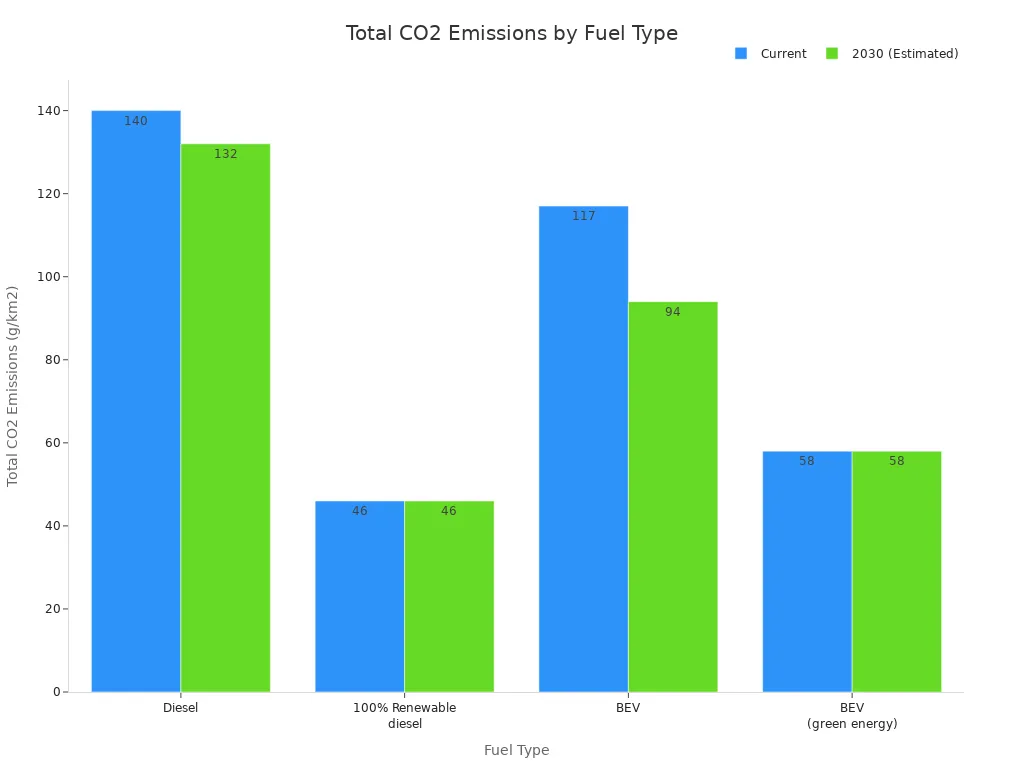
This data solidifies the role of electric vehicles as a key technology for decarbonization. The total carbon emissions are substantially lower, and this benefit grows over time.
Why Regional Differences Matter
An EV’s lifecycle emissions are not a fixed number; they are directly influenced by the source of its electricity. The carbon intensity of the local power grid is a critical variable.
- Regions with high renewables (e.g., wind, solar, hydro): In these areas, charging an EV generates very few indirect emissions. The car’s carbon payback period is shorter, and its lifetime environmental benefit is maximized.
- Regions reliant on fossil fuels (e.g., coal, natural gas): Here, charging an EV still results in lower overall CO2 emissions compared to driving a gasoline car, but the benefit is less pronounced.
This is why the ongoing “greening of the grid” is so important. As countries retire coal plants and build more renewable capacity, every EV on the road automatically becomes cleaner. Utilizing technologically advanced charging solutions from providers like TPSON ensures that this clean energy is transferred to the vehicle with maximum efficiency, further reducing waste and enhancing the positive impact of EVs.
The Carbon Cost of Manufacturing Electric Vehicles
A transparent discussion about how EVs reduce emissions must address their manufacturing phase. The production of electric vehicles, particularly their advanced battery systems, creates an initial carbon footprint. This upfront environmental cost is a critical part of the lifecycle equation, but one the industry is actively working to reduce.
Understanding Battery Production Emissions
The higher initial emissions for EVs are almost entirely due to the battery. This component requires significant energy and specific raw materials, which together define its manufacturing impact.
The Impact of Mining and Raw Materials
Producing lithium-ion batteries requires primary raw materials like lithium. Traditional extraction methods for these materials can cause environmental damage. However, the industry is innovating with more sustainable techniques. New methods like Direct Lithium Extraction (DLE) consume less water and have a smaller environmental footprint, signaling a move toward more responsible sourcing.
Energy Use in Battery Manufacturing
Battery production is an energy-intensive process. The amount of CO2 generated depends heavily on the energy source powering the factory.
Currently, producing 1 kWh of battery capacity can result in approximately 97 kg of CO2 emissions. This means a typical 60 kWh EV battery begins its life with an embedded carbon cost of around 5,820 kg.
This figure can be significantly lower if the factory operates on renewable energy, highlighting the importance of clean manufacturing.
How the Industry is Reducing its Footprint
Automakers and battery producers are making significant strides in minimizing the carbon cost of manufacturing. These efforts focus on both the materials used and the efficiency of the production lines.
Innovations in Battery Chemistry
Breakthroughs in battery chemistry are helping to diversify material inputs. New technologies are challenging the dominance of lithium-ion.
- Sodium-ion batteries are emerging as a viable alternative.
- They use abundant, cost-effective sodium resources.
- This reduces reliance on scarce materials like cobalt and graphite, which can be environmentally damaging to extract.
This innovation in new chemistries helps lower the overall carbon emissions associated with battery production.
More Efficient Production Processes
Manufacturers are re-engineering their factories to be cleaner and more efficient. Volkswagen, for example, powers its Zwickau factory entirely with renewable energy. This facility produces its electric vehicles with a significantly reduced environmental impact. By combining clean energy with carbon offsetting in the supply chain, automakers are proving that the initial emissions of EVs can be drastically lowered before the vehicles even reach the road.
The Power Grid’s Critical Role in EV Emissions

An electric vehicle has no tailpipe, but its environmental impact is directly connected to the source of its power. The electricity grid acts as the fuel supply for EVs. Therefore, the carbon intensity of that grid plays a decisive role in the vehicle’s overall emissions profile.
How Your Electricity Source Defines Your EV’s Footprint
The type of energy used for charging creates a significant difference in an EV’s total carbon footprint. This choice separates a low-emission vehicle from a nearly zero-emission one.
Charging with Renewable Energy (Solar, Wind)
Charging an EV with renewable energy is the most sustainable and environmentally friendly method. Home solar panels, for example, provide emission-free electricity directly to the vehicle. This approach allows drivers to power their cars with sunlight, effectively eliminating the upstream emissions associated with grid electricity. Using 100% green, self-produced energy maximizes the environmental benefits of driving electric.
Charging with Fossil Fuel-Based Grids
When EVs draw power from a grid reliant on fossil fuels like coal or natural gas, they are still responsible for upstream emissions. The power plant generates CO2 to produce the electricity that charges the car. However, even in this scenario, electric vehicles typically produce lower total carbon emissions than gasoline cars due to the high efficiency of electric motors and centralized power generation.
Understanding “Well-to-Wheel” Emissions
To accurately compare different vehicle technologies, experts use a “well-to-wheel” analysis. This framework assesses the total environmental impact from fuel production to its use in a vehicle, providing a complete picture of a car’s emissions.
From the Power Plant to the Pavement
Well-to-wheel (WTW) analysis is broken into two key stages:
- Well-to-Tank (WTT): This phase covers all emissions generated during the production and distribution of the fuel. For EVs, this includes emissions from the power plant that generates the electricity.
- Tank-to-Wheels (TTW): This stage measures the emissions from the vehicle’s operation. For electric vehicles, TTW emissions are always zero.
This comprehensive approach is essential for understanding the full lifecycle of vehicle emissions.
Why the Grid Energy Mix is Key
The grid’s energy mix is the single most important factor in an EV’s well-to-tank emissions. A grid with a high percentage of wind, solar, and hydropower will result in very low WTT carbon. This is the core of how-evs-are-reducing-carbon-co2-emissions on a systemic level. As grids become cleaner, the environmental advantage of every EV on the road increases. Soluções de carregamento tecnologicamente avançadas from providers like TPSON ensure that this clean energy is transferred with maximum efficiency, minimizing waste and further enhancing the positive impact of EVs.
The Greening Grid Effect: Your EV Gets Cleaner Over Time
One of the most powerful arguments for how-evs-are-reducing-carbon-co2-emissions is a dynamic process: the greening of the grid. Unlike a gasoline car whose emissions are fixed, an electric vehicle becomes cleaner to operate each year as its power source decarbonizes. This effect multiplies the environmental benefits of every EV on the road.
How Grid Decarbonization Boosts EV Benefits
The carbon footprint of an EV is directly tied to the electricity it uses. As power grids shift away from fossil fuels, the “well-to-wheel” emissions of electric vehicles plummet.
The Impact of Retiring Coal Plants
Nations are increasingly retiring coal-fired power plants, which are major sources of CO2. Each time a coal plant is replaced with a cleaner alternative, the electricity supplied to the grid becomes less carbon-intensive. This directly reduces the upstream emissions associated with charging EVs, making them an even more sustainable choice.
The Rise of Solar and Wind Power
The growth of renewable energy is accelerating the greening grid effect. In the UK, for example, renewables generated a record 47% of the nation’s electricity in the first quarter of 2020. This shift has a profound impact on EV emissions.
A UK government report estimated that battery electric vehicles already produce 66% lower greenhouse gas emissions than gasoline cars. As the grid becomes cleaner, this advantage will only grow, with EV-related emissions decreasing proportionally.
Future Projections for Grid Energy and EV Emissions
Looking ahead, the synergy between grid decarbonization and vehicle electrification presents a clear path toward significant climate goals. The long-term outlook shows that the environmental case for EVs strengthens over time.
Long-Term Emission Reduction Potential
Experts project that the combination of energy service electrification, increased renewable energy use, and improved efficiency could achieve up to 90% of the necessary reduction in energy-related emissions. As solar power is projected to become a dominant electricity source by 2050 in regions like the UK, the emissions from charging an EV will approach zero. Soluções de carregamento avançadas from providers like TPSON ensure this clean energy is transferred efficiently, maximizing the benefits.
Global Trends in Renewable Energy Adoption
While the transition is promising, global progress remains uneven. Coal and natural gas are still the main sources of electricity worldwide, with renewables contributing less than a quarter of total production. However, the trend is clear. As battery technology advances and energy production improves, electric vehicles become progressively greener. This continuous improvement solidifies their role as a critical tool for long-term decarbonization.
The Future of Sustainable EVs: Battery Recycling and Second Life
An electric vehicle’s journey does not end when it leaves the road. The long-term sustainability of EVs depends on creating a circular economy for their most critical component: the battery. By recycling and repurposing batteries, the industry can significantly reduce waste, minimize the need for new raw materials, and lower the overall carbon footprint of electric transportation.
Creating a Circular Economy for Batteries
A circular economy aims to eliminate waste by keeping materials in use. For electric vehicles, this means developing robust systems for battery collection, recycling, and reuse. This approach transforms a potential waste problem into a valuable resource stream.
The Process of Battery Recycling
The battery recycling process begins after collection. Specialized facilities carefully dismantle the battery packs to access the individual cells. These cells then undergo either pyrometallurgical (smelting) or hydrometallurgical (chemical) processes. These methods safely separate the valuable metals from other components.
A study from Stanford University highlights the efficiency of modern recycling. The process can produce less than half the greenhouse gases of traditional mining. It also requires only a quarter of the water and energy needed to extract the same materials from raw ore.
This makes recycling a far more sustainable method for sourcing battery materials.
Recovering Valuable Materials
Recycling effectively recovers a host of valuable materials from used lithium-ion batteries. After collection, recyclers carefully extract key metals. These recovered materials are then reintroduced into new supply chains. This practice reduces the need for new resource extraction and improves circularity in manufacturing. Key materials recovered include:
Extending Battery Value with Second-Life Applications
Even after a battery no longer meets the demanding standards for powering a vehicle, it retains significant capacity. A retired EV battery often has around 75% of its original storage ability. This makes it perfect for less intensive “second-life” applications.
Energy Storage for Homes and Grids
Repurposed EV batteries are ideal for stationary energy storage. B2U Storage Solutions in California successfully uses retired batteries from Honda vehicles for grid-scale energy storage. Their facilities store excess solar power and discharge it during peak demand, easing strain on the local grid. Similarly, Nottingham City Council implemented a 600kW second-life storage system at its EV fleet depot. This system stores energy from on-site solar arrays to charge its fleet, demonstrating a practical and scalable use for old batteries.
Reducing Waste and Manufacturing Demand
Giving batteries a second life is a powerful strategy for sustainability. This practice extends the battery’s useful lifespan, delaying the need for immediate recycling and reducing waste. It also lowers the total carbon footprint of the battery’s supply chain. By maximizing the value of existing materials, the demand for new mining decreases. This approach creates a more sustainable model for both the energy and automotive sectors, ensuring that the benefits of EVs extend far beyond their time on the road.
Government Policies Driving the EV Transition
Government action is a powerful catalyst accelerating the shift to electric transportation. Through a combination of financial incentives and strategic investments, policymakers are lowering barriers to adoption and building the foundational infrastructure needed for a zero-emission future. These policies directly influence both consumer choices and automaker strategies.
Incentivizing EV Adoption
Governments use two primary levers to encourage the purchase of electric vehicles: direct financial benefits for consumers and regulatory requirements for manufacturers.
Federal Tax Credits and State Rebates
Financial incentives make the upfront cost of an electric car more competitive. The U.S. government offers a Clean Vehicle Credit of up to $7,500 for new qualifying vehicles under the Inflation Reduction Act. However, strict rules apply. A car must undergo final assembly in North America and meet specific battery sourcing and component requirements. There are also MSRP and buyer income limitations. Many states supplement this federal credit with their own rebates and tax benefits, further reducing the purchase price for consumers.
Zero-Emission Vehicle (ZEV) Mandates
ZEV mandates compel automakers to produce and sell a minimum percentage of zero-emission vehicles annually. These regulations create a credit-based market with clear targets.
- Manufacturers face significant fines if they fail to meet their ZEV sales quotas.
- Companies that exceed their targets can sell surplus credits to other automakers.
- This system forces manufacturers to prioritize the release of new EV models, with brands like Audi and Vauxhall committing to all-electric lineups sooner than previously planned.
Investing in National Charging Infrastructure
A widespread and reliable rede de carregamento is essential for building driver confidence. Governments are making historic investments to eliminate range anxiety and ensure charging is as convenient as refueling.
Building a Robust Public Charging Network
The U.S. is aggressively expanding its public charging infrastructure. The Bipartisan Infrastructure Law dedicates $7.5 billion toward building a national network of 500,000 EV chargers by 2030. Programs like the National Electric Vehicle Infrastructure (NEVI) Formula Program are distributing $5 billion over five years to achieve this goal. With over 206,000 public chargers already available, the nation is on track to meet its target, making long-distance travel in EVs increasingly practical.
Supporting Home and Workplace Charging
While public chargers are crucial, most charging happens at home or at work. Government policies often include support for private charging installations through local grants or tax incentives. This strategy ensures that owners of electric vehicles have convenient and affordable charging options. Technologically advanced solutions from providers like TPSON give consumers reliable and efficient systems for home and workplace use, completing the charging ecosystem and maximizing the benefits of driving electric.
Electric vehicles are a proven and essential technology for reducing carbon emissions from transportation. While battery manufacturing creates an initial carbon footprint, zero tailpipe emissions consistently offset this debt, resulting in a lower lifecycle carbon impact than a gasoline car. The environmental case for electric cars strengthens daily. As grids integrate more renewables and battery recycling becomes widespread, they will cut carbon emissions even more effectively.
Projections show this trend accelerating:
- Global EV sales could exceed two-thirds of the market share by 2030.
- China is anticipated to reach 90% EV sales by 2030.
This trajectory solidifies the role of electric vehicles in the future of how-evs-are-reducing-carbon-co2-emissions.
FAQ
🤔 Are electric vehicles truly better for the environment?
Yes. Over their entire lifetime, EVs produce significantly fewer carbon emissions than gasoline cars. The initial carbon cost from battery manufacturing is quickly offset by zero tailpipe emissions during operation. This advantage grows as electricity grids become cleaner.
⏱️ How long until an EV becomes cleaner than a gasoline car?
An EV reaches its “carbon break-even” point relatively quickly. Most studies show this crossover happens within the first two years of average driving. After this point, every kilometer driven represents a net environmental benefit compared to a conventional car.
🔌 Do EVs pollute if charged with fossil fuel-based electricity?
EVs still offer a benefit. Centralized power plants are more efficient at generating energy than individual car engines. Therefore, even on a fossil fuel-heavy grid, the total emissions from charging and driving an EV are typically lower than a gasoline car’s emissions.
♻️ What happens to old EV batteries?
Retired EV batteries are not waste. They are first repurposed for “second-life” applications like home or grid energy storage. Afterward, specialized facilities recycle them, recovering valuable materials like lithium and cobalt for use in new batteries, creating a circular economy.
🥶 Does cold weather reduce an EV’s environmental benefit?
Cold weather reduces an EV’s range, requiring more frequent charging. However, this does not erase its core environmental advantage. The vehicle still produces zero tailpipe emissions, and its lifetime carbon footprint remains significantly lower than that of a comparable gasoline car.
✅ How can a driver maximize an EV’s positive impact?
Drivers can maximize benefits by charging with renewable energy when possible. Using efficient equipamento de carregamento also helps. Technologically advanced charging solutions from providers like TPSON ensure that clean energy is transferred with minimal waste, enhancing the EV’s overall efficiency.