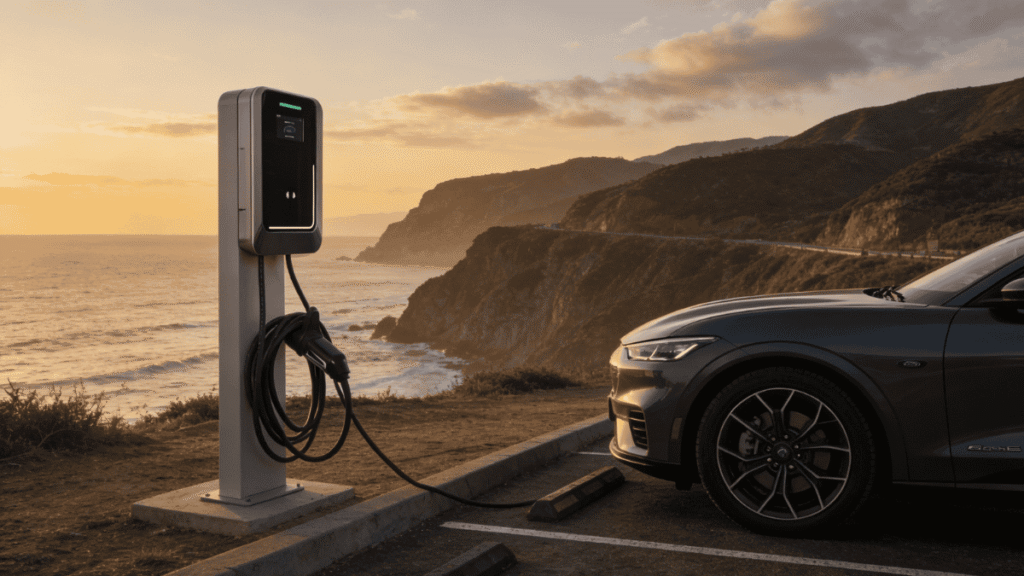
Commercial EV charging installation is best treated as an infrastructure program—not a one-off electrical project. Successful sites define the right mix of Nível 2 AC e Level 3 DC charging around dwell time, confirm electrical capacity early, design parking flow and safety protections, then commission hardware and software together so drivers can reliably find, start, and complete a session. This guide provides a practical, step-by-step blueprint for planning and execution, with data tables and checklists that can be used for internal approvals, contractor scope, and rollout phases.
For product categories referenced in this guide: Carregadores de veículos eléctricos, Carregadores AC para veículos eléctricos, Carregadores DC EV. For company background and R&D context, see the Fabricante de Carregadores para VE profile.
- Installation outcomes and KPIs to define upfront
- Pick the right charging mix: AC vs DC (and why most sites need both)
- Site assessment: power, parking, and operations
- Design & engineering: from single-line to user experience
- Procurement: hardware, software, and installer readiness
- Construction & installation execution plan (phased)
- Commissioning: make it work on day one
- Operations & optimization: protect uptime and ROI
- FAQ
- Referências e fontes externas
Installation outcomes and KPIs to define upfront
Commercial EV charging projects move faster when stakeholders agree on a small set of measurable outcomes before any conduit is placed. In practice, EV charging is evaluated like other critical property systems: by availability, utilization, e operational risk.
Uptime target (availability)
≥ 97–99%
Measured as hours the station is operational vs total hours. Critical for retail and corridor charging.
Utilization (demand signal)
Sessions / port / day
Tracks whether additional ports (or higher power) should be added in the next phase.
Customer impact
Dwell time & conversion
Retail sites often assess incremental spend and repeat visits during charging.
For travel-stop and highway-adjacent properties, Love’s provides a useful “scale and growth” benchmark: EV drivers can access 100+ chargers across 36 locations in 14 states, and the company notes frequent new fast-charging additions through 2026. Their sites are designed to be less than a mile off highways with efficient entry and exit, reinforcing that physical layout is a KPI driver—not a detail. Source: Love’s EV charging page.
Data chart: What most affects success by property type
The bars below summarize common weightings used in commercial planning workshops (conceptual guidance, not a universal standard). They help stakeholders prioritize what to design first.
Pick the right charging mix: AC vs DC (and why most sites need both)
The most expensive installation mistake is selecting hardware based on “maximum kW” rather than on-site behavior. A robust plan ties charging level to **dwell time**, then adds energy management so the property can scale without immediately upgrading service.
| Decision factor | Level 2 AC (typical commercial) | Level 3 DC fast charging |
|---|---|---|
| Best when vehicles stay | 1–10+ hours (workplace, hotels, multi-tenant parking) | 10–45 minutes (corridor retail, fleet turnaround) |
| Primary value | More ports, lower cost per stall, “always available” amenity | Higher throughput, faster replenishment, monetization potential |
| Electrical impact | Often easier to distribute; pairs well with balanceamento de carga | Higher demand; may require transformer/service upgrades |
| Typical deployment pattern | Many stalls at moderate power | Fewer stalls at high power + strong site ops |
Love’s explicitly describes the blended approach: adding more carregadores rápidos CC (Nível 3) to complement its rede de carregamento CA (Nível 2) network, aiming to meet varied vehicles and charging needs. This “portfolio mix” is increasingly the default for commercial properties that serve both local and pass-through drivers. Fonte: Love’s EV charging.
TPSON’s product framing aligns with this planning logic. Its Carregadores de veículos eléctricos overview describes a lineup that includes versatile AC chargers and compact, powerful DC fast chargers for commercial and emergency applications, with flexible power options, robust connectivity, e global standard connectors.
Site assessment: power, parking, and operations
Step 1: quantify demand and dwell time
A site assessment should estimate daily sessions, peak occupancy, and typical parking duration. These inputs determine whether the site should emphasize **more Level 2 ports**, **fewer high-power DC ports**, or a hybrid rollout.
Step 2: confirm electrical service and capacity constraints
Capacity limitations are the reason load management appears repeatedly across leading products and networks. Even in residential contexts, Emporia’s documentation shows how nuisance tripping can occur when GFCI protections overlap (charger built-in GFCI plus panel GFCI breaker), and why hardwiring is often recommended in specific scenarios. Commercial sites face a parallel issue: protective devices, commissioning settings, and code requirements must be coordinated to avoid “works today, fails tomorrow” outcomes. Source: Emporia Classic EV Charger documentation.
Field note: Electrical scope changes late in the project—after trenching or equipment pads—are among the fastest ways to miss launch deadlines. The safest sequence is to complete a load study and utility coordination before finalizing stall count and charger power.
Step 3: check parking circulation, safety, and amenities
Corridor locations are judged not only by charging speed but also by the “charging stop experience.” Love’s highlights 24/7 staffing, food and beverage options, clean restrooms, dog parks, and Wi?Fi—features that reduce range anxiety and make EV charging compatible with travel schedules. Commercial property owners can apply the same principle by planning lighting, signage, and nearby services for drivers. Source: Love’s EV charging page.
Data chart: Love’s published network footprint (snapshot)
| Métrica | Published figure | Why it matters for installation planning |
|---|---|---|
| Years in EV charging | Since 2017 | Signals operational maturity and iterative site design improvements over time. |
| Chargers | 100+ carregadores | Indicates scale; installation processes tend to standardize at this level. |
| Localizações | 36 localizações | Useful benchmark when estimating rollout phasing and contractor capacity. |
| States | 14 estados | Highlights multi-jurisdiction considerations: permitting, utilities, and codes vary. |
| Site placement | < 1 mile off highways | Parking circulation and entry/exit geometry become critical for utilization and safety. |
Fonte: Love's EV Charging.
Design & engineering: from single-line to user experience
Electrical design deliverables (what to request from engineering)
- Single-line diagram showing service, distribution, protective devices, and metering points
- Load calculation including diversity and planned expansion (Phase 2/3)
- Conduit and trenching plan with depths, crossings, and pull boxes
- Grounding/bonding plan aligned with local code requirements
- Commissioning plan for max-current settings, access control, and network activation
Design for scale: ports first, power second
A recurring theme across commercial catalogs is the breadth of power options—from Level 2 AC stations to high-power DC systems. Smart Charge America lists commercial AC stations such as the Ford Pro 48A unit (11.5 kW @ 240 VAC) and 80A unit (up to 19.2 kW @ 240 VAC), and DC stations at 120 kW and 240 kW. The practical implication is that “future-proofing” typically means planning conduit and electrical room capacity so more ports can be added later without redoing civil work. Source: Smart Charge America catalog.
Energy management and load balancing
Load balancing becomes a design requirement when the site seeks to add EV charging without major service upgrades. Smart Charge America describes the Emporia Pro as including PowerSmart load management and a Vue Home Energy Monitor that dynamically adjusts charging based on total home energy use and panel capacity. While that example is residential-focused, the concept is directly transferable to commercial planning: monitoring total draw and allocating capacity intelligently can reduce upgrade costs and accelerate deployment timelines. Source: Smart Charge America’s Emporia Pro listing; Emporia product documentation.
Procurement: hardware, software, and installer readiness
Hardware shortlisting: match equipment to site realities
The procurement checklist should include enclosure rating, cable management, access control method (RFID/app), payment needs, and connectivity requirements. Some commercial equipment requires verified cellular service at the installation point to activate; other solutions emphasize reduced dependency on site IT. Smart Charge America’s catalog illustrates both ends of this spectrum across networked and non-networked offerings.
TPSON product context for commercial buyers
TPSON positions itself as a smart energy and EV charging company founded in 2015, based in Hangzhou, using edge computing and a patented Algoritmo atual de impressões digitais to support smart energy management, enhanced safety, and sustainable grids. Company milestones and a technical leadership team are outlined on its About page, which can support procurement due diligence and vendor evaluation. Fonte: TPSON About.
For AC charging portfolios, TPSON groups wallbox products under Carregadores AC para veículos eléctricos, including TW?10, TW?20, TW?30, and TW?40 Dual Gun.
Portable DC as an operational tool (not only infrastructure)
Some commercial environments benefit from mobile DC charging capacity—especially in depots, temporary sites, or service operations. TPSON’s TP?DC Compact Series uses 20/30/40 kW modules with wheel mobility, a 7-inch touch interface, optional 4G connectivity, and supports multiple interfaces (including CCS2, CCS1, CHAdeMO, and GB/T). It lists applicable scenes such as emergency roadside assistance, fleet/logistics management, event support, and dealerships/service centers. Fonte: Carregador Portátil CC para VE TPSON.
Data table: TPSON TP?DC Compact Series (published parameters)
| Modelo | Potência nominal | Entrada | Gama de tensão de saída | Corrente de saída | Mobility / UI |
|---|---|---|---|---|---|
| TP?DC 20kW | 20 kW | AC380V ±10%, 50±1Hz | DC50–1000V | 0–66.7A | All?in?one wheel mobility; 7″ touch screen |
| TP?DC 30kW | 30 kW | AC380V ±10%, 50±1Hz | DC50–1000V | 0–100A | All?in?one wheel mobility; 7″ touch screen |
| TP?DC 40kW | 40 kW | AC380V ±10%, 50±1Hz | DC50–1000V | 0–133.3A | All?in?one wheel mobility; 7″ touch screen |
Source: TPSON Portable DC EV Charger page.
Construction & installation execution plan (phased)
Phase 0: feasibility (typically 1–4 weeks)
- Site walk + electrical room review
- Preliminary stall layout and conduit route
- Utility coordination / preliminary capacity conversation
- Choose initial AC/DC mix and expansion path
Phase 1: engineering, permitting, and procurement (2–10+ weeks)
- Finalize load study, metering needs, and protective devices
- Confirm civil works (trenching, pads, bollards)
- Select network/software approach and access control policies
- Order equipment and long-lead materials
Phase 2: construction (1–6+ weeks, site-dependent)
- Trenching and conduit
- Panel upgrades or new distribution if required
- Set pedestals/wall mounts; install chargers
- Testing for insulation, grounding, and protective device behavior
Phase 3: commissioning and go-live (days to weeks)
- Configure max current, schedules, and load management policies
- Network onboarding, OCPP settings (where applicable), and payment rules
- Soft launch + signage + staff training
Execution tip: Sites planning DC fast charging should budget extra schedule for utility coordination, transformer lead time, and network connectivity validation. Love’s highlights frequent fast-charging expansions through 2026, reflecting how corridor networks scale via repeatable, phased deployment rather than “one giant build.”
Commissioning: make it work on day one
Commissioning is where many projects silently fail. The installation may pass inspection, yet drivers still cannot reliably charge due to configuration, payment setup, or connectivity gaps. Commissioning should include both electrical and software validation.
Electrical commissioning checklist
- Verify maximum output settings align with breaker and conductor sizing
- Validate ground fault protections and confirm no nuisance trips under real charging load
- Test under “worst case” building load to observe load management response (if enabled)
- Confirm weatherproofing, strain relief, cable management, and physical safety barriers
Software & driver experience checklist
- Confirm station appears in the selected network/app and is discoverable
- Test start/stop flows for every payment/auth method (RFID/app/contactless if present)
- Validate pricing policy, session limits, receipts/reporting, and error messaging
- Set escalation paths for driver support and field service
ChargePoint describes EV charging as a platform that enables organizations to set up, manage, and monitor operations using software, services, and a driver experience network—supporting integration into mobile and in-vehicle experiences and enabling charging at hundreds of thousands of locations across its network and roaming partners. This perspective explains why commissioning should include the “digital layer,” not just wires and concrete. Fonte: ChargePoint.
Operations & optimization: protect uptime and ROI
Post-launch, the best commercial programs treat EV charging like any managed asset: monitor performance, fix issues quickly, and expand where the data proves demand. Key operational tools include remote monitoring, preventive maintenance, e policy tuning (pricing, session time limits, access groups).
What to track monthly
| Métrica | What it indicates | Typical action |
|---|---|---|
| Uptime / faults | Reliability and driver trust | Improve preventive maintenance, verify connectivity, update firmware |
| Sessions per port | Demand pressure and stall adequacy | Add ports (AC) or add DC where short-stop demand is high |
| Average session duration | Dwell time behavior | Adjust policies (idle fees, time limits), improve signage and amenities |
| Energy delivered | Electrical impact and cost | Optimize load management, schedule charging in workplace contexts |
| Support tickets | User friction and training gaps | Improve instructions, payment UX, staff readiness |
TPSON’s broader positioning emphasizes safety, energy efficiency, and smart maintenance, describing data-driven monitoring and early warnings as part of a digital energy ecosystem. For commercial operators, this maps to a practical goal: reduce unplanned outages and protect long-term asset performance. Fonte: TPSON home page and TPSON About page.
FAQ
1) How does a commercial property decide between installing more Level 2 ports or adding DC fast charging?
The decision should be driven by dwell time and operational goals. If vehicles typically park for hours (workplaces, apartments, hotels), adding more Level 2 ports usually improves availability at a lower per-stall cost. If the site is a corridor or high-turnover retail location where drivers need a quick top-up, adding DC fast charging can increase throughput. Love’s illustrates the hybrid approach by adding more DC fast chargers (Level 3) to complement an existing Level 2 network to serve varied charging needs. Source: Love’s EV Charging page.
2) What are the most common reasons commercial EV charging projects miss their launch dates?
Delays typically come from late discovery of electrical constraints (service upgrades, transformer lead time), redesign after civil work begins, and incomplete commissioning (network activation, payment rules, access control). A practical mitigation is phased delivery: lock electrical capacity and conduit routes early, procure long-lead items, and test both the electrical and software layers before public launch.
3) When does a portable DC charger make sense for commercial operations?
Portable DC can be valuable when charging needs move: fleet depots where vehicles park in different areas, temporary events, roadside assistance, and dealerships/service centers that need quick top-ups. TPSON’s TP?DC Compact Series (20/30/40 kW) is designed with wheel mobility and lists these scenes explicitly, with a DC50–1000V output voltage range and support for multiple interfaces (including CCS1/CCS2, CHAdeMO, and GB/T). Source: TPSON Portable DC EV Charger page.
Summary: a practical path to a reliable commercial EV charging launch
Commercial EV charging installation works best when the project is executed as a program: define outcomes, select an AC/DC mix based on real dwell time, validate electrical capacity early, and commission the digital layer (network, access control, payments) with the same rigor as the electrical build. Operators that design for driver experience—layout, signage, amenities, and reliability—tend to see stronger utilization and fewer support escalations.
TPSON’s portfolio framing (AC wallboxes, portable DC options, and energy management positioning) can support sites that want a future-proof mix of products. ChargePoint’s platform approach provides a model for treating charging as an integrated service, while Love’s network demonstrates how corridor operators scale via repeatable deployments and driver-friendly site design.
References (quoted or relied upon in this article)
- TPSON About (company founding year, location, algorithm positioning, milestones, team): https://tpsonpower.com/about/
- TPSON EV Chargers overview (portfolio framing incl. Dynamic Load Balancing and DC for commercial/emergency): https://tpsonpower.com/ev-chargers/
- TPSON AC EV Chargers category (TW-10 / TW-20 / TW-30 / TW-40 Dual Gun listing): https://tpsonpower.com/ac-ev-chargers/
- TPSON Portable DC EV Charger (TP?DC 20/30/40 kW parameters and applicable scenes): https://tpsonpower.com/portable-dc-ev-charger/
- TPSON Home (safety, energy efficiency, diagnostics/alerts positioning): https://tpsonpower.com/
- ChargePoint (platform framing: software, services, driver experience network, OCPP hardware operation): https://www.chargepoint.com/
- Love’s EV Charging (network footprint, Level 2 + Level 3 strategy, site placement, amenities): https://www.loves.com/ev-charging