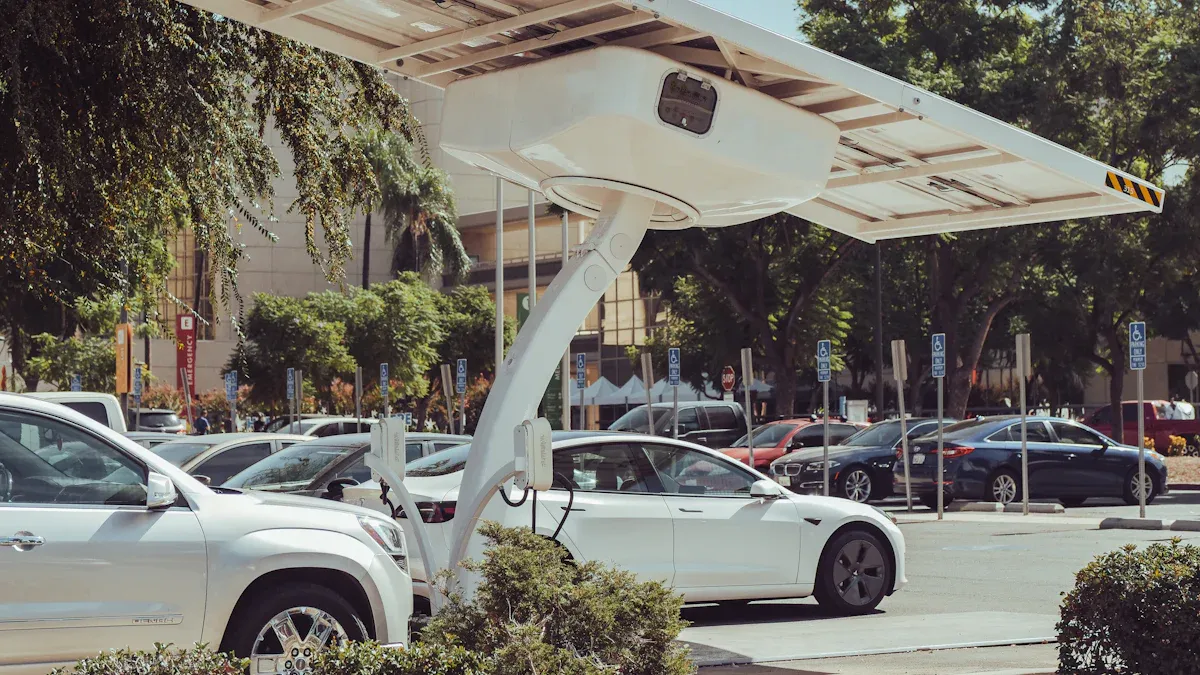
A level 2 charger delivers rapid charging for electric vehicles, making daily routines more efficient. Drivers experience greater flexibility with an EV Charger that supports advanced scheduling and monitoring features. EV charger manufacturers continue to innovate, offering solutions that simplify ownership and enhance long-term value.
- Faster charging reduces wait times.
- Enhanced convenience streamlines daily use.
- Cost savings build over years of ownership.
Investing in modern charging technology transforms the electric vehicle experience.
Level 2 Charger: Faster Charging for Electric Cars

Level 2 Charging vs. Level 1 Charging
Real-World Charging Times for 2025 EVs
Electric vehicle owners in 2025 experience a dramatic difference in charging speeds between level 1 and level 2 charging. Level 1 chargers, which use standard 120-volt outlets, typically add only 2-5 miles of range per hour. This slow pace means that larger battery packs may require more than 30 hours to reach a full charge. Level 2 charging, powered by a 240-volt outlet, delivers a much faster experience. Most EVs receive a full charge overnight, usually within 8-10 hours. The following table highlights the comparison:
| Charger Type | Range Added per Hour | Full Charge Time |
|---|---|---|
| Level 1 | 2-5 miles | 30+ hours |
| Level 2 | 10-73 miles | 4-24 hours |
Tip: Level 2 charging is ideal for drivers who need their EV ready every morning, even with larger battery capacities.
Weekly Time Savings with Level 2 Chargers
Level 2 chargers save significant time each week for busy households. While level 1 charging suits light daily drivers, it cannot keep up with the demands of modern EV owners. Level 2 charging adds approximately 10-25 miles of range per hour, allowing most vehicles to fully charge overnight. Drivers who rely on their EV for daily commutes or weekend trips benefit from reduced waiting times and increased flexibility. Families avoid the hassle of planning around slow charging schedules.
Charging Multiple Electric Vehicles at Home
Solutions for Family and Multi-Car Households
In 2025, many homes support more than one EV. Level 2 chargers offer advanced configurations, including single and dual-gun setups. A 19.2 kW level 2 charger can support simultaneous charging of two vehicles using intelligent power sharing. This feature balances available current, up to 40 amps, between both EVs. Families with multiple drivers enjoy efficient charging without overloading circuits or causing delays.
| Feature | Description |
|---|---|
| Charger Type | 19.2 kW Level 2 Charger |
| Configuration | Single and dual-gun configurations |
| Simultaneous Charging Support | Supports charging of two EVs via shared power source |
| Intelligent Power Sharing | Balances current between two EVs for optimal charging without circuit burnout |
Efficient Charging Schedules with Level 2 Chargers
Level 2 charging enables households to create efficient schedules for multiple vehicles. Intelligent power management ensures that each EV receives the necessary charge overnight. Parents and teens can plug in their cars after work or school, knowing both vehicles will be ready by morning. This flexibility supports busy lifestyles and eliminates the need for staggered charging times.
Overnight Charging Convenience
Full Battery Every Morning with Level 2 Charging
Level 2 charging provides the convenience of a full battery every morning. Drivers plug in their EV before bed and wake up to a vehicle ready for the day. This routine fits seamlessly into daily life, removing the stress of last-minute charging or unexpected delays.
Eliminating Range Anxiety for Daily Commutes
Level 2 chargers help eliminate range anxiety for daily commutes. Drivers trust that their EV will have enough power for work, errands, and activities. Fast overnight charging ensures that even after a long day, the vehicle will be prepared for the next journey. This reliability encourages more people to choose electric vehicles for their primary transportation.
Level 2 Charging: Enhanced Convenience and Flexibility
Home Installation Advantages of Level 2 Chargers
Simple Setup and What to Expect
Homeowners in 2025 find that installing level 2 chargers is straightforward. Most homes already support the required 240-volt service. Electricians install a dedicated dual-pole 40-amp circuit for exclusive use by the EV charger. Installations must comply with the National Electric Code (NEC) Article 625, which ensures safety and reliability. The following table outlines the main requirements for residential installation:
| Requirement | Details |
|---|---|
| Voltage Requirement | Requires 240-volt service, standard in most homes |
| Circuit Requirement | Dedicated dual-pole 40-amp circuit for EV charging only |
| Compliance with Electrical Code | Must adhere to NEC Article 625 for permits |
Note: Professional installation guarantees that level 2 charging meets all safety standards and maximizes performance.
Seamless Integration into Your Routine
Level 2 chargers fit easily into daily routines. Homeowners plug in their EV at night and wake up to a fully charged vehicle. The process becomes as simple as charging a smartphone. No one needs to adjust their schedule or wait for public stations. Level 2 charging provides a dependable solution for busy families and professionals.
Smart Features of Level 2 Chargers
Scheduling and Remote Monitoring Capabilities
Modern level 2 chargers offer advanced smart features that enhance the charging experience. Most models released in 2025 include:
- Wi-Fi connectivity for real-time monitoring and alerts
- Remote control to adjust power output and view charging data
- RFID card activation for secure access
- Energy monitoring to track electricity usage and costs
- App-based scheduling to set charging times from a smartphone
These features allow users to optimize charging sessions, reduce energy costs, and ensure their EV is always ready.
Integration with Home Energy and Solar Systems
Level 2 charging technology now integrates seamlessly with home solar energy systems. Homeowners can maximize solar energy use for EV charging, reducing grid dependency and utility bills. Key components include a level 2 EV charger, a solar inverter with load control, a smart electrical panel, and optional battery storage. This setup enables charging with solar power, avoids peak utility rates, and may qualify for tax incentives.
Tip: Integrating level 2 chargers with solar systems supports sustainable energy goals and long-term savings.
Compatibility with Modern Electric Car Charger Technology
Supporting New EV Models and Battery Sizes
Level 2 chargers in 2025 support a wide range of new EV models and larger battery capacities. Manufacturers design these chargers to deliver optimal charging speeds for both compact and long-range vehicles. This flexibility ensures that households with multiple EVs can charge all vehicles efficiently.
Adapting to Evolving Electric Vehicle Technology
Level 2 charging adapts to rapid changes in EV technology. Smart charging features use AI and IoT to optimize energy use based on grid demand and electricity prices. Integration with home energy management systems allows chargers to communicate with solar panels and home batteries. This approach ensures efficient charging during off-peak hours and supports greener energy consumption.
Smart level 2 charging keeps pace with the latest advancements in EV technology, providing a future-ready solution for every household.
Cost Savings and Future-Proofing with Level 2 Chargers
Lower Fuel and Maintenance Costs
Comparing Electricity vs. Gasoline Expenses
Drivers who switch to level 2 charging see a clear reduction in fuel costs. Charging an EV at home with electricity costs less per mile than fueling a gasoline vehicle. Electricity rates remain stable in most regions, while gasoline prices often fluctuate. Over time, the savings from home charging add up, especially for those who drive daily. Many households notice that their monthly energy bill increases only slightly, while their gasoline expenses drop significantly.
Reduced Wear and Tear on Electric Vehicles
Level 2 chargers help extend the lifespan of EV components. Consistent charging at home reduces the need for frequent fast charging, which can stress the battery. Smooth charging cycles support battery health and lower the risk of unexpected repairs. EVs require less maintenance than traditional cars because they have fewer moving parts. Owners benefit from fewer oil changes, brake replacements, and engine repairs.
Incentives and Rebates for Level 2 Charger Installation
Federal and State Programs in 2025
Homeowners in 2025 can take advantage of several programs to lower the cost of installing a level 2 charger. These incentives make the transition to electric vehicles more affordable:
- The federal tax credit covers up to 30% of the installation cost for a residential level 2 charger, with a maximum benefit of $1,000. This includes labor, hardware, panel upgrades, and permit fees.
- Many states offer their own rebates or tax credits, which further reduce the total out-of-pocket expense for homeowners.
Note: Combining federal and state incentives can make installing a level 2 charger much more accessible for families.
Utility Company Discounts for Level 2 Charging
Utility companies in many regions provide additional support for EV owners. These programs help offset the cost of installing level 2 chargers and encourage more people to adopt electric vehicles.
- Some utility companies offer direct rebates for installing a home electric car charger.
- State and local governments may provide extra incentives, making level 2 charging even more cost-effective.
Future-Ready Electric Car Charger Solutions
Upgrading Without Replacing Your Level 2 Charger
Level 2 chargers in 2025 feature modular designs and smart technology. Owners can upgrade software or add new features without replacing the entire unit. This approach protects the initial investment and ensures compatibility with future EV models. Smart charging adapts to new standards and optimizes energy use based on grid demand and electricity prices.
Supporting Faster Charging Standards
Manufacturers design level 2 charging equipment to support evolving industry standards. These chargers use AI and IoT to adjust charging conditions in real time. Integration with home energy management systems improves efficiency and prepares households for future needs. The following table highlights key future considerations:
| Future Considerations | Description |
|---|---|
| Fully electrified fleets | Anticipation of a shift towards fully electric vehicle fleets by 2035. |
| Employee expectations | Growing demand for workplace charging options. |
| Customer preferences | Increasing likelihood of customers choosing locations based on EV charging. |
Smart level 2 chargers ensure that homes and businesses stay ahead of changing technology and consumer expectations.
Level 2 Charger vs. Other Electric Car Charger Options
Limitations of Level 1 Chargers
Slow Charging and Daily Hassles
Level 1 chargers present several challenges for electric vehicle owners in 2025. Most drivers find these chargers insufficient for daily needs, especially as battery sizes increase. The slow charging speed stands out as the main drawback. Level 1 charging adds only 3-5 miles of range per hour, which does not meet the demands of high-mileage drivers. Charging a large battery can take over 30 hours, making it impractical for those who rely on their vehicles every day.
- Level 1 charging best suits overnight use or as a backup for secondary vehicles.
- Slow charging speed often leads to daily hassles for drivers with long commutes.
- Fully charging a large battery may require multiple days, which does not fit most lifestyles.
- The slow pace makes Level 1 chargers a poor investment for the majority of EV owners.
Not Ideal for Busy Lifestyles
Busy households need reliable and efficient charging solutions. Level 1 chargers cannot keep up with the pace of modern life. Drivers who travel long distances or have multiple vehicles in the family often experience frustration. The slow charging rate forces them to plan around their charger, rather than enjoying the flexibility that electric vehicles promise.
Public Charging Stations: Pros and Cons
Convenience vs. Cost of Public Charging
Public charging stations offer flexibility for drivers on the go. However, the cost of using these stations often exceeds the cost of home charging. Home level 2 chargers typically cost $8 to $10 for a full charge on a 40kW battery. Public level 2 charging stations may charge between $1 to $5 per hour, or $0.20 to $0.25 per kWh. DC fast charging at public stations can cost $10 to $30 for a full charge, or $0.40 to $0.60 per kWh. Public charging can be up to three times more expensive than charging at home. Some public chargers are free, but they are often in high demand and may not provide consistent access.
Availability and Waiting Times
Access to public charging stations varies by city. In Seattle, 25% of EV owners report high rates of unsuccessful charging attempts. Los Angeles sees similar issues, with 24% of owners facing problems. San Francisco and Denver also report wait times, with 18% and 14% of drivers affected, respectively. High demand and limited availability can lead to long waits, making public charging less reliable for daily use.
DC Fast Charging: When to Use Instead of Level 2 Charging
Best Use Cases for Road Trips
DC fast charging stations provide rapid charging for long-distance travel. These stations work best for road trips or emergencies when drivers need to recharge quickly. Most drivers reserve DC fast charging for situations where time is critical, as it can add significant range in a short period.
Impact on Battery Health
Frequent use of DC fast charging may lead to slightly faster battery degradation compared to level 2 chargers. Experts recommend using a combination of 240-volt and 120-volt charging for optimal battery health. Modern electric car charger designs include thermal management systems to handle high currents, so the overall impact remains minimal. Drivers should maintain the battery’s state of charge between 20% and 80% for daily use and reserve fast charging for special occasions.
Tip: Relying on level 2 chargers for daily charging helps preserve battery health and reduces long-term costs.
Real-Life Experiences with Level 2 Chargers
Homeowners Who Upgraded to Level 2 Charging
Time Saved and Stress Reduced
Homeowners who install level 2 chargers often report significant improvements in daily routines. They experience faster charging, which allows them to keep their ev ready for any trip. Many families find that the ability to charge overnight eliminates the need to visit public stations. This change reduces stress and saves time each week. Parents appreciate the convenience of plugging in their ev after work and waking up to a full battery. The streamlined process supports busy schedules and minimizes interruptions.
A typical household with multiple drivers benefits from efficient charging schedules. Level 2 chargers enable simultaneous charging for two vehicles, which prevents conflicts over access. The technology supports intelligent power management, ensuring each ev receives the necessary charge. Families no longer need to stagger charging times or worry about running out of range. The result is a smoother morning routine and more flexibility for evening activities.
Improvements in Family and Work-Life Balance
Level 2 chargers contribute to better family and work-life balance. Homeowners gain more control over their time, as they do not need to plan around slow charging or public station availability. The ability to charge at home means less time spent waiting and more time for important tasks. Parents can focus on family activities, while professionals avoid delays before commuting to work.
A table below highlights the main improvements observed by households:
| Benefit | Description |
|---|---|
| Time Savings | Faster charging reduces weekly wait times |
| Stress Reduction | Reliable home charging eliminates uncertainty |
| Flexibility | Multiple ev charging supports busy households |
| Work-Life Balance | More time for family and professional priorities |
Homeowners who upgrade to level 2 chargers often describe the transition as transformative for their daily lives.
EV Enthusiasts’ Insights on Level 2 Chargers
Tech Upgrades and Smart Features
EV enthusiasts recognize several advantages when using level 2 chargers. They value the speed, which allows quick top-ups during short stops. The convenience of home installation means they can charge without relying on public infrastructure. Many users appreciate smart features such as remote monitoring, scheduling, and integration with renewable energy systems. These upgrades help optimize charging sessions and reduce electricity costs.
A list of common benefits cited by enthusiasts includes:
- Speed: Level 2 chargers deliver rapid charging for all ev models.
- Increased Convenience: Home installation provides easy access to charging.
- Environmental Impact: Integration with solar panels reduces carbon footprint.
- Cost-Efficiency: Long-term savings on energy and maintenance.
- Home Value: EV infrastructure increases property appeal.
Smart technology in level 2 chargers adapts to evolving ev standards. Owners can upgrade software and add new features, ensuring compatibility with future vehicles. The system supports efficient energy use and helps maintain battery health.
Preparing for the Next Generation of Electric Vehicles
Level 2 chargers position households for the future of transportation. As ev technology advances, these chargers support larger batteries and faster charging rates. Enthusiasts appreciate the ability to upgrade without replacing the entire unit. The modular design and smart connectivity ensure readiness for new models and features.
Families and individuals who invest in level 2 chargers prepare for the next generation of evs. They benefit from reliable charging, lower costs, and improved sustainability. The infrastructure supports long-term goals and adapts to changing needs.
Choosing the Best Level 2 Charger for Your Electric Car
Key Features to Consider in Level 2 Chargers
Power Output and Charging Speed
Selecting a Level 2 charger with the right power output ensures efficient charging for any electric vehicle. Most modern EVs in 2025 benefit from chargers that deliver at least 40 amps of output, matching the maximum AC charging rate. Higher charging capacity reduces wait times and supports larger battery packs. Owners should also consider installation type. Plug-in chargers offer flexibility for relocation, while hardwired units provide greater security, especially for outdoor use.
| Feature | Description |
|---|---|
| Charging Capacity | At least 40 amps output for optimal charging speed |
| Installation Type | Plug-in (portable) or hardwired (secure, ideal for outdoor) |
| Weather Ratings | NEMA 3R or 4 rating for reliable outdoor performance |
Smart Connectivity Options
Level 2 chargers in 2025 often include advanced smart features. Wi-Fi connectivity enables remote monitoring and control through mobile apps. Load sharing allows multiple vehicles to charge efficiently. Integration with solar energy systems supports sustainable charging. Owners benefit from scheduling options, energy usage tracking, and secure access via RFID cards.
Tip: Smart chargers help optimize charging sessions and reduce electricity costs.
Installation Tips for Level 2 Chargers
Finding a Qualified Electrician
Professional installation guarantees safety and compliance with electrical codes. Homeowners should hire licensed electricians with experience in EV charger setups. Electricians assess the home’s electrical panel, install dedicated circuits, and ensure proper grounding. This process minimizes risks and maximizes charger performance.
Budgeting for Home Setup
The total cost for installing a Level 2 charger includes both hardware and labor. Basic chargers range from $400 to $600, while smart chargers cost between $650 and $1,200. Installation fees typically fall between $500 and $1,500, depending on the complexity of the job and local rates.
- Charger hardware: $400–$1,200
- Installation: $500–$1,500
Note: Planning for both equipment and installation costs helps avoid unexpected expenses.
Maintenance and Support for Level 2 Charging
Warranty and Service Plans
Leading manufacturers offer warranties that protect against defects and ensure reliable operation. Warranty periods vary, with some brands providing coverage for one year and others extending protection to three years or longer.
| Manufacturer | Warranty Period |
|---|---|
| Example A | 1 year |
| Example B | 3 years or longer |
| Example C | 3 years or longer |
| Example D | 3 years or longer |
Owners should review warranty terms and consider service plans for ongoing support.
Troubleshooting Common Issues
Routine maintenance keeps Level 2 chargers operating efficiently. Weekly cleaning removes dirt and oil from the charger, cord, and connectors. Owners should inspect cables for wear and replace them if connections become loose. Monitoring charging times helps detect potential problems early. Voltage checks ensure the charger maintains proper output. Visible damage or exposed wiring requires immediate attention from a professional.
| Maintenance Task | Description |
|---|---|
| Cleaning charger and connectors | Weekly removal of dirt and oil |
| Cable replacement | Replace if wear or loose connections are present |
| Inspection for damage | Address visible damage with professional help |
| Monitoring charging times | Investigate increases in charging duration |
| Voltage checks | Maintain output at 240 volts |
| Wiring inspection | Contact a professional for exposed internal wiring |
Regular maintenance and prompt troubleshooting extend the life of a Level 2 charger and ensure safe operation.
Making the Investment in Level 2 Charging
Calculating Your Return on a Level 2 Charger
Long-Term Savings Breakdown
Investing in level 2 chargers requires careful financial analysis. Owners can follow a clear process to determine the return on investment and understand the long-term benefits:
- Calculate total investment costs, including the purchase price and installation fees for level 2 chargers.
- Apply for available federal and local incentives, which can significantly reduce upfront expenses.
- Forecast annual revenue or savings by estimating how much is saved on fuel and maintenance compared to gasoline vehicles.
- Calculate annual operating costs, such as electricity usage and routine maintenance, to determine net savings.
- Determine the final ROI and payback period by comparing total savings to the initial investment.
This approach helps homeowners see how quickly level 2 chargers pay for themselves. Many find that the combination of incentives and reduced fuel costs leads to a payback period of just a few years.
Value Added to Your Home
Level 2 chargers offer more than just operational savings. They also increase property value and marketability. Homes equipped with level 2 chargers sell 13% faster than those without, according to Realtor.com. Sustainable features, including EV charging, can boost resale value by 1.5% to 3.5% based on Zillow data. In California, buyers have paid $4,000 to $6,000 more for homes with these chargers. The National Association of Property Buyers estimates that a home with a level 2 charger could see a resale value increase ranging from $3,000 to $5,000.
Note: Adding a level 2 charger not only saves money but also makes a property more attractive to future buyers.
Future-Proofing Your Electric Car Charger Experience
Staying Ahead of Technology Trends
Level 2 chargers provide a foundation for adapting to future changes in electric vehicle technology. Owners should assess the capacity of their electrical systems to ensure support for future charging needs. Choosing scalable solutions allows for easy expansion as demand grows. Strategic placement of charging stations enhances operational efficiency, while coordination with utilities ensures access to sufficient electricity. Prioritizing cybersecurity measures protects against potential threats as smart charging technology evolves.
A table below summarizes key future-proofing strategies:
| Strategy | Benefit |
|---|---|
| Scalable charger solutions | Easy expansion for more vehicles |
| Utility coordination | Reliable access to electricity |
| Cybersecurity focus | Protection from digital threats |
| Strategic placement | Improved charging efficiency |
Peace of Mind for Years to Come
Homeowners who invest in level 2 chargers gain confidence that their charging setup will remain relevant as technology advances. Before installation, evaluating the home’s electrical system ensures compatibility with modern EV requirements. Most new EVs require a 240-volt charger, which may prompt upgrades to electrical panels or wiring. By planning ahead, owners avoid costly retrofits and enjoy seamless charging for years. This proactive approach delivers peace of mind and supports a smooth transition as the EV landscape evolves.
A level 2 charger delivers faster charging, enhanced convenience, and long-term cost savings for electric vehicle owners in 2025. Recent studies highlight additional advantages:
| Benefit | Description |
|---|---|
| Economic Impact | Supports local economies with affordable charging options. |
| Accessibility | Increases affordability and meets daily needs in urban areas. |
| Flexibility in Charging Options | Offers flexible usage to fit a variety of daily routines. |
These features make a level 2 charger a smart investment for anyone seeking a reliable and future-ready EV experience.
FAQ
What is a Level 2 charger?
A Level 2 charger uses a 240-volt outlet to deliver faster charging for electric vehicles. Most models support charging rates between 16 and 80 amps. Homeowners install these chargers in garages or driveways for daily use.
How long does it take to charge an EV with a Level 2 charger?
Charging times depend on the vehicle’s battery size and the charger’s power output. Most electric vehicles reach a full charge in 4 to 10 hours. Level 2 chargers provide enough range for daily commutes overnight.
Can a Level 2 charger work with any electric vehicle?
Most Level 2 chargers use the universal J1772 connector. This connector supports nearly all electric vehicles sold in North America. Some models may require an adapter for compatibility with specific brands.
Is professional installation required for a Level 2 charger?
Licensed electricians should install Level 2 chargers. They ensure compliance with local codes and safety standards. Professional installation protects the home’s electrical system and maximizes charger performance.
Do Level 2 chargers increase home electricity bills?
Level 2 chargers use more electricity than Level 1 chargers. However, charging at home remains less expensive than gasoline. Smart chargers help manage energy use and reduce costs by scheduling charging during off-peak hours.
Are there incentives for installing a Level 2 charger?
Federal and state programs offer rebates and tax credits for Level 2 charger installation. Utility companies may provide additional discounts. These incentives lower upfront costs and encourage electric vehicle adoption.
Can Level 2 chargers integrate with solar panels?
Many Level 2 chargers support integration with home solar systems. Owners use solar energy to charge their vehicles, reducing grid dependency. This setup supports sustainability and lowers long-term energy costs.
What maintenance does a Level 2 charger require?
Routine cleaning and inspection keep Level 2 chargers operating safely. Owners should check cables for wear and monitor charging times. Professional service may be needed for repairs or electrical issues.