Drivers often discover that the cheapest time to charge an electric car falls during off-peak hours, usually between midnight and 7 AM. Electricity providers set these off-peak hours when demand drops and rates decrease. Solusi pengisian daya kendaraan listrik, termasuk pengisi daya ev portabel dan Pengisi Daya Listrik devices from reputable Produsen pengisi daya EV, help maximize savings by scheduling charging overnight. Checking local rates ensures users identify the cheapest time to charge their electric vehicle.
Smart EV owners track electricity costs to optimize their charging routines and save money.
Why the Cheapest Time to Charge Varies
Understanding Time-of-Use Rates and Off-Peak Pricing
What Are Time-of-Use Rates?
Time-of-use rates represent a pricing structure where electricity costs change based on the time of day. Utilities design these rates to reflect periods of high and low demand. During off-peak hours, electricity becomes significantly cheaper. Many providers offer a dual-rate tariff, which separates peak and off-peak pricing. This system encourages EV owners to charge their vehicles when demand is low, helping them access lower utility rates and reduce overall costs.
How Off-Peak Hours Lower Charging Costs
Off-peak hours typically occur overnight or during times when national demand drops. Charging an EV during these periods allows drivers to benefit from the lowest electricity prices. For example, homeowners who use a time-of-use tariff can see substantial savings by charging late at night or early in the morning. Smart chargers further enhance these savings by automating charging sessions to align with the best time to charge, reducing manual effort and maximizing affordability.
Peak vs. Off-Peak: What’s the Difference?
Typical Off-Peak and Peak Times by Region
Utilities define peak and off-peak hours based on regional demand patterns. The following table highlights common timeframes and price differences in major markets:
| Penyedia Utilitas | Wilayah | Tarif Puncak (¢/kWh) | Tarif Luar Jam Sibuk (¢/kWh) |
|---|---|---|---|
| Pacific Power | WA, OR, CA | ~28 | ~10 |
| PG&E (E-TOU-C) | CA | ~26–29 | ~18–20 |
Peak hours usually fall on weekdays from 9 am to 5 pm or during early evenings, while off-peak hours often start around 9 pm and continue overnight. These periods reflect when electricity demand is highest and lowest.
Why Utilities Charge More During Peak Hours
Utilities increase rates during peak hours to manage grid demand and encourage energy use when supply is abundant. Off-peak pricing helps balance the load on the grid and supports the integration of renewable energy sources. By charging during off-peak hours, EV owners help utilities maintain system stability and benefit from the cheapest time to charge.
Regional and Utility Differences in the Cheapest Time
How Location Affects the Cheapest Time to Charge
Regional differences in electricity generation and demand influence when off-peak hours occur. For instance, Northern England and Scotland often have lower electricity prices compared to London or the South East. In the United States, rates and off-peak periods can vary widely between states and even between utility providers.
Examples of Off-Peak Hours in Different States
| Faktor | Detail |
|---|---|
| Off-Peak Tariffs | Economy 7 tariffs offer 12p-18p per kWh (off-peak) vs. 30p-35p (peak). |
| Variasi Regional | Northern England and Scotland have cheaper electricity than London/South East. |
| Potensi Tabungan | Charging a 60kWh battery off-peak costs ~£10.80 vs. ~£20.40 during peak hours. |
| Supplier-Specific Tariffs | Some suppliers, like Octopus Energy, offer EV-specific tariffs with extended off-peak periods. |
Homeowners can reduce costs by charging during off-peak times, typically late at night to early morning. Many electricity suppliers offer fixed tariffs for off-peak charging, and government regulations encourage the installation of home charge points to support EV adoption.
The cheapest time to charge an electric car depends on a combination of local utility rates, regional demand, and the specific tariff chosen. Understanding these factors helps drivers identify the best time to charge and maximize savings.
How to Find the Cheapest Time to Charge in Your Area
Checking Your Utility Provider’s Rate Schedule for Off-Peak Hours
Where to Access Rate Information
Electric vehicle owners often begin their search for the cheapest time to charge by reviewing their utility provider’s rate schedule. Most providers publish this information on their official websites or through customer service portals. Individuals can also request printed materials or digital copies directly from their supplier. Many utility companies offer dedicated sections for EV charging, highlighting time-of-use tariffs and off-peak hours. TPSON recommends that drivers check these resources regularly, as rate schedules may change seasonally or with new regulatory guidelines.
Charging your electric vehicle during off-peak hours can lead to penghematan yang signifikan on electricity bills, making it a financially smart choice for EV owners.
How to Read and Compare Rate Schedules
Understanding rate schedules requires careful attention to the details. Providers typically display peak and off-peak hours in tables or charts. The following table illustrates how seasonal variations affect peak hours:
| Season | Jam Puncak | Why? |
|---|---|---|
| Summer | 2 PM – 8 PM | Afternoon heat increases air conditioning use |
| Winter | 6 AM – 10 AM & 5 PM – 9 PM | Heating demand rises in morning and evening |
| Spring/Fall | 6 AM – 10 AM & 5 PM – 9 PM | Habits remain consistent, mild temperature |
Pengemudi harus compare the cost per kWh during off-peak hours with peak rates. Many suppliers highlight off-peak tariffs, which offer lower prices for charging. By identifying these periods, EV owners can schedule charging sessions for the best time to charge and maximize savings.
Using Tools and Apps to Identify the Best Time to Charge
Utility Company Online Tools
Utility companies increasingly provide online tools that help customers pinpoint the cheapest time for charging. These platforms allow users to input their location, electricity plan, and EV model. The tools then display off-peak hours and recommend optimal charging windows. TPSON’s advanced charging solutions integrate seamlessly with these platforms, enabling automated scheduling based on real-time electricity rates.
Third-Party Apps for EV Charging Schedules
Third-party apps use smart scheduling systems and machine learning algorithms to optimize charging times. These apps analyze electricity prices, grid conditions, and off-peak hours to suggest the most cost-effective periods for charging. Users benefit from notifications and automated adjustments, ensuring their EV charges when electricity is cheapest and most environmentally friendly.
- Smart scheduling systems for EV charging use advanced algorithms and machine learning to optimize charging times.
- These systems take into account factors such as electricity prices and grid conditions.
- They aim to charge vehicles when electricity is most cost-effective and environmentally friendly.
Understanding Your Home Electricity Plan and Off-Peak Options
Fixed vs. Variable and Time-of-Use Plans
Selecting the right electricity plan is crucial for maximizing savings. Tabel di bawah ini menguraikan the main differences between fixed, variable, and time-of-use plans:
| Plan Type | Deskripsi | Struktur Biaya |
|---|---|---|
| Tarif Tetap | Charges a consistent price per kWh regardless of time or season. | Predictable, no savings from off-peak |
| Time-of-use | Prices vary by time of day; cheaper during off-peak hours. | Savings possible by shifting usage |
| Variable | Fluctuates with demand and market conditions. | Potentially higher costs during peak |
Time-of-use plans reward drivers who shift charging to off-peak hours. Fixed-rate plans offer predictability but do not provide savings from off-peak charging. Variable plans may expose users to higher costs during peak demand.
How to Switch to a Plan with Cheaper Off-Peak Rates
Switching to a plan with cheaper off-peak rates involves several steps. Electric vehicle owners must ensure eligibility and compatibility with their home charger and EV model. The process typically includes:
- Confirm your charger and EV: Check the model of your home charger and your EV’s make and model to ensure compatibility with the tariff.
- Confirm smart meter status: Ensure your smart meter is functioning correctly and sending readings to your supplier.
- Connect the app: After switching, download and connect the supplier’s app to your car or charger for automated scheduling.
New customers join any electricity tariff and connect a smart meter, while existing customers switch directly through their online account. Eligibility often requires ownership or leasing of an EV and a functioning smart meter. TPSON’s smart charging solutions support seamless integration with approved tariffs, helping drivers access the cheapest time for charging.
To be eligible for cheaper off-peak rates, you must have a connected SMETS2 smart meter and ensure that your specific EV model and home charger are compatible with the supplier’s approved list.
By following these steps, drivers can take advantage of off-peak hours and optimize their charging routines. The right plan, combined with smart technology, ensures that EV owners benefit from the lowest electricity prices and maximize their savings.
Practical Tips for Charging During Off-Peak and Maximizing Savings
Scheduling Charging Sessions for the Cheapest Time
Setting Timers on Your EV or Charger
Drivers often set timers on their EV or home charger to ensure charging occurs during off-peak hours. Many vehicles feature built-in charging timers that allow users to select the best time to charge, such as overnight between 10 p.m. and 6 a.m. This approach aligns charging with the cheapest time for electricity, reducing costs and guaranteeing the vehicle is ready for daily use. Smart chargers and apps provide additional flexibility, enabling users to define start and end times for charging sessions. Automating charging during off-peak hours ensures consistent savings and convenience.
Using Smart Charging Features and Apps
Smart charging features and apps optimize charging routines by leveraging real-time electricity pricing and advanced scheduling. These tools analyze tariff structures and forecast price fluctuations, adjusting charging rates to maximize savings. For example, apps like ev.energy allow users to customize schedules for weekdays and weekends, ensuring charging during periods when electricity rates are lowest. Multi-objective optimization algorithms balance cost reduction with charging deadlines, often reducing charging costs by up to 50% compared to unmanaged charging.
Smart chargers track electricity usage, calculate costs, and adjust schedules based on seasonal rate changes, helping drivers take full advantage of off-peak hours.
Leveraging Off-Peak and Super Off-Peak Windows
Planning Charging Around Your Routine
Drivers can plan charging sessions around their daily routines to coincide with off-peak hours. Time-based scheduling configures charging to start overnight, typically from 11 p.m. to 7 a.m., when electricity rates drop by 30-60%. Advanced systems differentiate between weekdays and weekends, allowing charging to begin at 10 p.m. on weekdays and 2 a.m. on weekends. This flexibility ensures that EV owners always benefit from the best time to charge.
Taking Advantage of Utility “Super Off-Peak” Rates
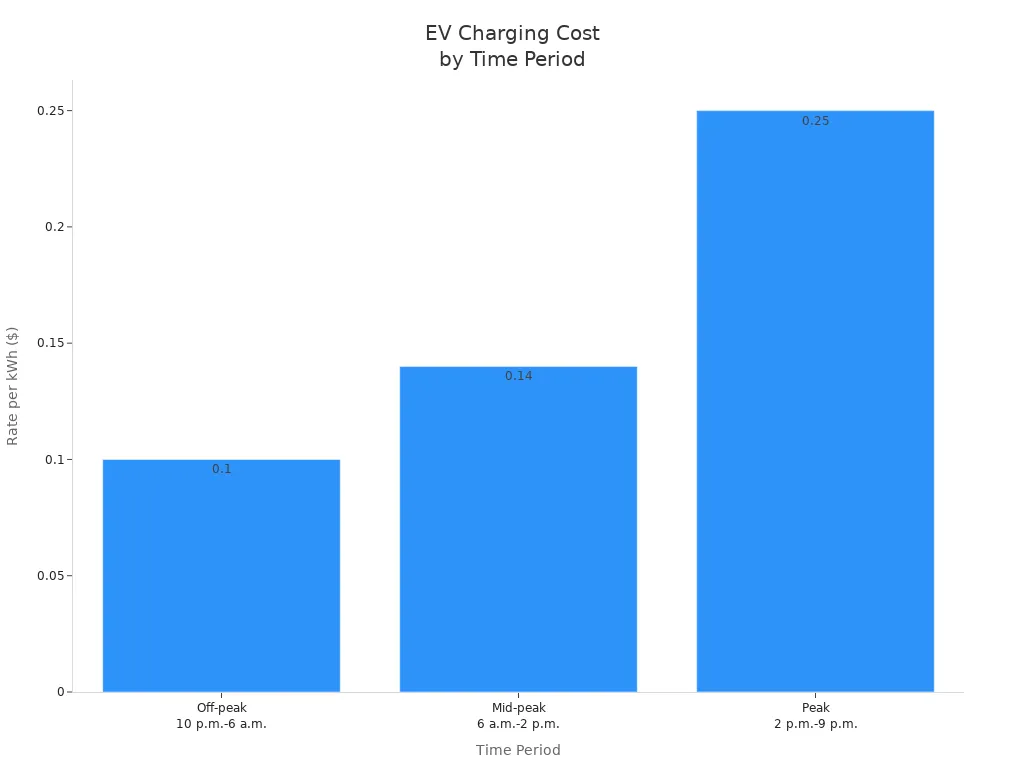
Some energy providers offer super off-peak windows with even lower rates. Automating charging during these periods can reduce costs by up to 60%. Many suppliers provide special EV tariffs with extended off-peak hours, making it easier for drivers to maximize savings. The following table illustrates typical electricity rates by time period:
| Periode Waktu | Tarif (per kWh) | Relative Cost | Catatan |
|---|---|---|---|
| Off-peak (10 p.m. to 6 a.m.) | $0.10 | Least expensive | Best time to charge for cost savings |
| Mid-peak (6 a.m. to 2 p.m.) | $0.14 | Sedang | Moderate cost |
| Peak (2 p.m. to 9 p.m.) | $0.25 or more | Most expensive | Avoid charging during this period |
Choosing the Best Charging Equipment for Off-Peak Use
Benefits of Smart Chargers for Off-Peak Charging
Smart chargers offer significant advantages for charging during off-peak hours. They enable scheduling, monitor electricity usage, and manage charging times to align with the cheapest electricity rates. Smart technology allows users to automate charging, ensuring readiness and cost efficiency. These chargers also connect to the local grid, sending and receiving signals to optimize charging based on utility programs.
Compatibility with Utility Programs and Incentives
Selecting charging equipment compatible with utility programs and incentives enhances savings. Many smart chargers integrate with EV charging apps, allowing third-party control and complex commands. This compatibility ensures that charging aligns with off-peak hours and special tariffs, maximizing cost reduction. Drivers should choose chargers that fit their home setup and charging needs, ensuring seamless integration with their electricity provider’s offerings.
Automating charging with built-in timers or smart chargers guarantees that EV owners always benefit from the lowest rates and maximize their savings.
Monitoring and Adjusting Charging Habits for the Best Time to Charge
Tracking Charging Costs and Savings
Electric vehicle owners who want to maximize savings must monitor their charging routines closely. They often install a smart EV charger to schedule charging sessions and use a smart meter to track electricity usage. Apps from energy suppliers help drivers monitor their usage and record energy consumption during cheaper rate periods. Charging during jam luar puncak can significantly reduce overall costs, as electricity prices drop when demand is low.
Charging during off-peak hours allows drivers to take advantage of lower rates and optimize their charging habits for maximum savings.
To track costs and savings, drivers should:
- Accurately track electricity usage with a smart meter.
- Enable EV-friendly tariffs that offer reduced rates during off-peak hours.
- Record energy usage during periods when electricity is cheapest.
Understanding off-peak hours is crucial for EV owners. Charging during these times leads to substantial savings because electricity demand and prices decrease. Drivers who monitor their charging habits can adjust their routines to align with the best time to charge, ensuring their electric vehicle is ready for daily use while minimizing expenses.
Adjusting for Seasonal or Rate Changes
Seasonal changes and rate adjustments impact the best time to charge an EV. Cold weather can reduce electric vehicle range by up to 20 percent, and winter conditions affect charging efficiency. Utilities often modify off-peak hours based on seasonal demand, so drivers must stay informed about these changes.
| Season | Off-Peak Charging Times |
|---|---|
| Winter Time | 1am to 8am |
| Summer Time | 2am to 9am |
Drivers should review their utility rate plans regularly and adjust their charging schedule to match updated off-peak hours. They can leverage smart chargers to set a charging schedule and modify habits as rates change. The process involves:
- Understanding utility rate plans and seasonal adjustments.
- Using smart chargers to schedule charging during new off-peak hours.
- Adjusting charging habits to maximize savings as rates fluctuate.
By monitoring charging costs and adapting to seasonal or rate changes, EV owners ensure they always benefit from the lowest electricity prices. This proactive approach helps drivers maintain optimal charging routines and maximize the value of their electric vehicle investment.
Special Considerations for the Cheapest Time to Charge
Charging with Home Solar Power vs. Off-Peak Hours
When Solar Charging Is the Cheapest Option
Homeowners with solar panels often achieve the lowest possible cost for charging their EV. They charge during daylight hours when solar generation peaks, resulting in minimal or no electricity expenses. This approach maximizes savings and reduces reliance on the grid. Many drivers prefer solar charging because it offers a sustainable solution and lowers their carbon footprint.
- Charging during off-peak hours remains hemat biaya due to reduced demand.
- Solar panel owners can charge their EV at little to no cost during the day.
- Utilizing solar power for charging leads to minimal expenses, especially during peak sunlight.
The following table compares the cost implications of different charging methods:
| Metode Pengisian Daya | Implikasi Biaya |
|---|---|
| Home Solar Power | Low to no cost during daytime charging |
| Off-Peak Utility Hours | Cheaper rates due to lower demand |
Combining Solar and Off-Peak Charging for Maximum Savings
Drivers who combine solar charging with off-peak utility rates achieve optimal savings. They use solar energy during the day and schedule charging during off-peak hours at night. Smart chargers automate this process, ensuring the EV charges when electricity is cheapest or free. This strategy also helps avoid peak grid demand and supports grid stability.
| Metode Pengisian Daya | Typical Electricity Cost per kWh | Annual EV Charging Cost (8,000 miles) | Manfaat Utama | Limitations |
|---|---|---|---|---|
| Off-Peak EV Tariff + Smart Charger | ~7–10p (off-peak) | £150–£250 | Major cost savings, automated scheduling | Dependent on tariff windows |
| Solar EV Charging + Smart Charger | ~0–2p (max solar use) | £50–£150 | Maximum savings, lowest carbon impact | Higher upfront equipment cost |
| Solar + Battery + Smart Charger | ~0–1p (stored solar) | £40–£120 | Grid independence, peak avoidance | Highest initial investment |
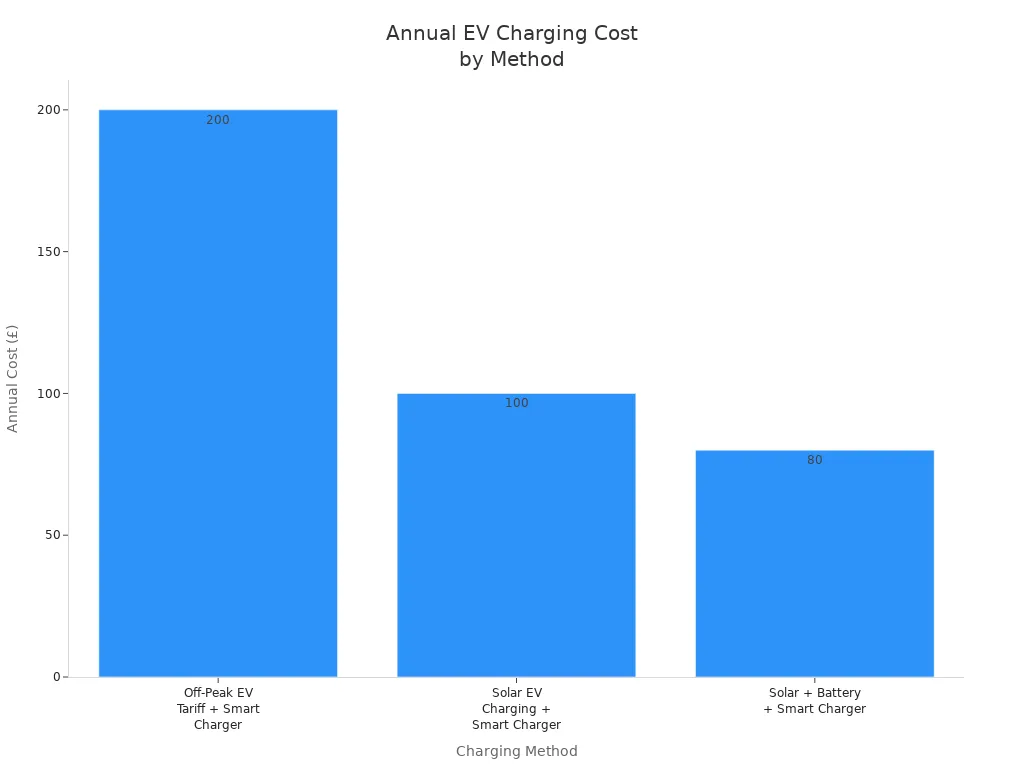
Smart charging solutions allow drivers to schedule charging sessions for both solar and off-peak hours, maximizing savings and reducing environmental impact.
Public Charging Stations and Off-Peak Pricing
Membandingkan Biaya Pengisian Daya Publik vs. Rumah
Public charging stations offer convenience, but costs vary depending on the time of day and location. Many cities provide reduced rates during off-peak hours, making public charging more affordable. For example, in Virginia, customers pay $0.05631 per kWh between 11pm and 6am, compared to $0.11005 during peak hours. PG&E’s discounted rate translates to an equivalent of $1.90 per gallon at the pump, offering substantial savings.
| Charging Scenario | Rate ($/kWh) | Annual Cost ($) | Tabungan Tahunan ($) |
|---|---|---|---|
| Peak charging scenario | 0.20 | 600 | N/A |
| Off-peak charging scenario | 0.06 | 180 | 420 |
SRP customers in Arizona save 8.6% annually with EV-specific rate plans. Many EV owners see up to 30% savings per charge by scheduling charging overnight during off-peak hours.
Finding Cheaper Public Charging Options
Drivers seeking cost-effective public charging should look for stations offering off-peak rates. Networks like Gridserve provide rapid charging solutions starting at 30p per kWh, which can be competitive for EV owners. Balancing nighttime home charging with public charging during off-peak hours helps reduce costs and supports grid efficiency.
- Off-peak electricity rates are available at many public stations, usually at night.
- Charging an electric vehicle during off-peak hours lowers overall biaya pengisian daya.
- Combining home and public charging strategies can optimize savings and alleviate grid demand.
Many public charging networks now offer discounted rates during off-peak hours, making it easier for drivers to manage costs and maintain flexibility.
Common Questions and Misconceptions About the Cheapest Time to Charge
Is It Always Cheapest to Charge at Night?
Many drivers believe that charging an EV at night always guarantees the lowest cost. This assumption does not hold true in every situation. Several factors can influence whether nighttime charging is the most economical choice:
- Charging at night may not be the cheapest if high daytime rates offset overnight savings.
- Some regions experience high peak pricing during evening hours, which can increase overall charging costs.
- Street parking limitations and high daytime electricity usage can make daytime charging more practical and affordable.
Utility providers may offer special rate plans or promotions that change the best time to charge. For example, some utilities introduce midday off-peak hours to support renewable energy integration. Drivers should always review their local rate schedules and consider their unique circumstances before deciding when to charge.
Exceptions and Special Rate Plans
Special rate plans sometimes provide off-peak pricing during the day, especially in areas with abundant solar generation. These plans may benefit drivers who work from home or have flexible schedules. Reviewing the details of each plan helps drivers identify the best time to charge based on their habits and local electricity supply.
Promotions and Utility Incentives
Utilities often run promotions or offer incentives for charging during specific periods. These incentives can include rebates, discounted rates, or loyalty programs. Staying informed about these opportunities allows drivers to maximize savings and reduce their annual charging cost.
Does Charging During Off-Peak Affect Battery Health?
Battery health remains a top concern for EV owners. The timing of charging sessions can influence battery longevity, but off-peak charging itself does not harm the battery if managed correctly. Manufacturers provide specific recommendations to help drivers maintain battery health.
Battery Health and Charging Timing
- Avoid charging to 100% unless preparing for a long trip.
- Maintain battery levels antara 20% dan 80% untuk penggunaan harian.
- Schedule charging during cooler times, such as overnight off-peak hours, to reduce thermal stress.
- Frequent charging to full capacity can strain the battery and shorten its lifespan.
Manufacturer Recommendations for Charging
| Produsen | Rekomendasi |
|---|---|
| Peugeot | Recharge completely every two weeks and fully charge from a low level every three months. |
| Volkswagen | Avoid frequent high-power charging; maintain battery with low power charging. |
| Audi | Charge after four months if not used; set daily charge target to 80% for longevity. |
Manufacturers agree that charging to 100% every night is not necessary and may even be detrimental. Following these guidelines helps drivers protect their investment and ensure reliable electric vehicle performance.
Is Switching to a Time-of-Use Plan Worth It for EV Owners?
Switching to a time-of-use plan can offer significant savings for many EV owners. The potential benefits depend on driving habits, local rates, and the ability to shift charging to off-peak hours.
Evaluating Savings Potential
- An EV owner driving 12,000 miles per year with a consumption of 4 miles per kWh requires about 3,000 kWh annually.
- Charging during peak hours at $0.20 per kWh results in an annual cost of $600.
- Charging during off-peak hours at $0.06 per kWh reduces the annual cost to $180.
- This switch can save up to $420 each year.
- In Arizona, SRP customers save an average of 8.6% annually with EV-specific rate plans.
- Many drivers achieve up to 30% savings per charge by scheduling charging overnight.
How to Make the Switch
Drivers interested in switching should contact their utility provider to review available time-of-use plans. They must confirm eligibility, ensure their home charger supports scheduled charging, and monitor their electricity usage to maximize savings. Using smart charging features and regularly reviewing rate schedules helps drivers adapt to changes and continue benefiting from the best time to charge.
Electric vehicle owners can maximize savings by charging during off-peak hours, which often represent the cheapest time to charge. They should always check their provider’s rate schedule to identify the best time to charge and take advantage of lower electricity rates. Smart charging strategies, such as dynamic load management and monitoring equipment health, help reduce costs and prevent expensive repairs. The average cost per mile for EVs remains significantly lower than gasoline vehicles, making electric charging a cost-effective choice. Drivers who utilize public charging networks and select the right charger benefit from additional savings.
- Charge during off-peak hours for reduced electricity costs.
- Use membership plans at public charging stations for discounts.
- Choose the most suitable charger for your needs.
Staying proactive and informed ensures drivers get the most value from their EV charging routine.
PERTANYAAN YANG SERING DIAJUKAN
What is the best time to charge an electric car for the lowest cost?
Most drivers find the lowest rates between midnight and 7 AM. These hours usually fall within off-peak periods when electricity demand drops. Always check the local utility’s rate schedule for the most accurate information.
Can charging during off-peak hours damage the EV battery?
Charging during off-peak hours does not harm the battery. Manufacturers recommend avoiding frequent full charges. Keeping the battery between 20% dan 80% helps maintain long-term health.
Do all utility companies offer time-of-use rates for EV charging?
Not every utility provides time-of-use rates. Some offer only fixed or variable plans. Drivers should contact their provider or visit the company’s website to review available options.
How can someone track their EV charging costs?
Drivers can use smart chargers, utility apps, or smart meters to monitor electricity usage. These tools provide real-time data and help users identify savings opportunities.
Is it cheaper to charge at home or at public charging stations?
Charging at home during off-peak hours usually costs less than public charging. Some public stations offer off-peak discounts, but home charging remains the most affordable for most drivers.
What equipment is needed to schedule off-peak charging?
A pengisi daya pintar or an EV with built-in scheduling features allows drivers to set charging times. Many models support app-based scheduling for added convenience.
Can solar panels further reduce EV charging costs?
Solar panels can lower or eliminate charging costs during daylight hours. Combining solar charging with off-peak utility rates maximizes savings and reduces reliance on the grid.