Singapore’s Electric Vehicles Charging Act 2022 mandates new developments be “EV-Ready.” This requires passive charging provisions for 1% of parking lots for all electric vehicles and other vehicles.
This legal requirement means developers must plan for sufficient electric energy capacity and clear EV infrastructure from the project’s inception. This infrastructure supports future commercial ev charging.
Failure to integrate proper EV charging solutions from EV charger manufacturers leads to costly penalties. This applies to any EV Charger or portable ev chargers. Poor planning for EV charging and the overall charging infrastructure for each EV invites delays. The EV needs its energy. The EV needs its power. It thrives on good energy. The EV requires compliant charging.
Navigating Singapore’s Mandatory EV Regulatory Framework
Successfully integrating EV charging infrastructure begins with a deep understanding of Singapore’s legal and technical landscape. The government has established a clear framework to guide developers. This ensures safety, interoperability, and the systematic expansion of the national charging network. Compliance is not optional; it is a core project requirement.
The Electric Vehicles Charging Act (EVCA) 2022 Explained
The EVCA is the cornerstone of Singapore’s EV transition. It provides the Land Transport Authority (LTA) with the regulatory power to enforce EV charging standards. For developers, this act directly shapes a project’s initial electrical and spatial design. It mandates that new buildings are prepared for the future of mobility.
Understanding “EV-Ready” Requirements
The EVCA introduces the concept of being “EV-Ready.” This requirement focuses on passive infrastructure. It does not mandate the immediate installation of chargers. Instead, it requires developers to prepare the building for the easy and cost-effective installation of chargers in the future.
An “EV-Ready” building has sufficient electrical capacity, dedicated space in switchrooms, and pre-planned routes for cabling. This proactive approach prevents expensive and disruptive retrofitting work later. The goal is to make future EV charger installation a simple, “plug-and-play” process.
Defining Passive vs. Active Provisions
The EVCA makes a critical distinction between passive and active provisions. Developers must understand this difference to meet the minimum legal requirements for their new projects. Passive provisions are the mandatory minimum, preparing the site for future charging needs.
| Provision Type | Description | Key Components |
|---|---|---|
| Passive | The foundational infrastructure required to support future EV charger installation. This is the minimum mandate under the EVCA. | Sufficient electrical power capacity, space for switchboards, and cable trays. |
| Active | A fully installed and operational EV charger. This includes the charger hardware, software, and connection to the electric grid. | The EV charger unit, dedicated circuit, and user-facing payment systems. |
Calculating the 1% Mandate for Your Project
The law requires passive provisions for a minimum of 1% of the total car and motorcycle parking lots. Developers must perform this calculation early in the design phase.
- Determine Total Lots: Sum up all planned parking lots for all vehicles in your development.
- Apply the Formula: Use the following calculation to find the minimum number of EV-Ready lots.
Minimum EV-Ready Lots = Total Parking Lots × 0.01 - Round Up: Always round the result up to the nearest whole number. For example, if a project has 350 parking lots, the calculation is
350 x 0.01 = 3.5. The developer must provide passive provisions for 4 lots.
This calculation determines the required electrical energy capacity and physical space for the EV infrastructure.
Adhering to Key Technical Codes and Standards
Beyond the EVCA, developers must ensure their EV infrastructure complies with several technical codes. These standards guarantee the safety, reliability, and interoperability of the entire electric charging system. An EV needs a safe and reliable source of energy.
TR 25:2022 for EV Charging Systems
Technical Reference 25 (TR 25) is the primary standard for EV charging systems in Singapore. It covers the technical specifications for the chargers themselves. Compliance with TR 25 ensures:
- Safety: The charger protects the EV and the user from electrical hazards.
- Interoperability: Chargers use standardized connectors (Type 2 for AC, CCS2 for DC), allowing them to service a wide range of electric vehicles.
- Performance: The equipment meets defined standards for energy delivery and efficiency.
SS 638 for Electrical Installations
Singapore Standard 638 (SS 638), formerly known as CP 5, governs all low-voltage electrical installations in buildings. The EV charging infrastructure is part of the building’s overall electrical system. Therefore, it must adhere to SS 638. This code dictates requirements for wiring, circuit protection, and switchgear to ensure the entire installation is safe and robust. The energy supply for each EV must be properly managed.
BCA’s Environmental Sustainability Codes
The Building and Construction Authority (BCA) promotes sustainability through its Green Mark scheme. Integrating EV charging provisions helps projects achieve a higher Green Mark rating. This signals a commitment to environmental responsibility. A robust EV charging plan demonstrates forward-thinking design and contributes to the building’s overall sustainability profile, making the property more attractive to green-conscious tenants.
The Official Submission and Approval Process
Navigating the approval process requires coordination with multiple government agencies. A systematic approach ensures all regulatory requirements are met without causing project delays. The process validates the safety and compliance of the proposed infrastructure.
Engaging with the Land Transport Authority (LTA)
The LTA is the lead agency for implementing the EVCA. Developers or their appointed vendors must ensure that any active chargers they plan to install are on the LTA’s list of approved models. The LTA oversees the entire EV charging ecosystem to ensure public safety and network reliability. An EV can only use an approved charger.
Fulfilling Building and Construction Authority (BCA) Submissions
Developers submit their building plans to the BCA for approval. These plans must clearly show the EV-Ready provisions. This includes detailing the allocated electrical load, the space reserved for switchgear, and the planned cable routes. The BCA verifies that the design complies with the 1% mandate and all relevant building codes before issuing a permit. The EV needs this approved infrastructure.
The Critical Role of the Licensed Electrical Worker (LEW)
A Licensed Electrical Worker (LEW) is indispensable for any commercial ev charging project. The LEW is a certified professional responsible for:
- Designing the electrical system to support the EV charging load.
- Endorsing the electrical plans before submission to authorities.
- Supervising the installation and certifying the final work.
Developers must engage a qualified LEW at the very beginning of the planning process. The LEW’s expertise ensures that the electrical design is compliant, safe, and efficient, providing the correct energy for every EV. Their involvement is critical for securing approvals and ensuring the long-term success of the charging infrastructure. The LEW is the key to powering every EV safely.
Technical Planning for EV Charging Infrastructure

With the regulatory framework understood, the focus shifts to the technical heart of the project: planning and designing the physical EV infrastructure. A robust technical plan ensures the charging system is safe, efficient, and scalable. This phase translates legal requirements into concrete engineering specifications for the entire charging network.
Electrical Load and Power Capacity Planning
The most critical technical challenge is managing the building’s electrical load. An EV is a significant power-consuming device. A comprehensive plan prevents overloading the building’s power supply and avoids costly grid upgrades down the line.
How to Conduct an Accurate Load Assessment
Developers must first conduct a detailed electrical load assessment. This calculation estimates the total power demand of the building, including the new EV charging stations. The assessment must account for the number and type of chargers planned.
Fast AC charging stations (Level 2) typically deliver between 7 kW and 22 kW. A site with ten 22 kW chargers, for instance, requires at least 220 kW of dedicated power if all stations operate simultaneously. In contrast, rapid DC charging stations demand far more energy, with single units drawing from 50 kW to over 350 kW. This assessment provides the foundational data for all subsequent electrical design decisions.
Sizing the Main Switchboard and Substation
The load assessment directly informs the required size of the main switchboard and, potentially, a dedicated substation. The infrastructure must handle the maximum potential load from the EV charging stations plus the building’s base load.
For a commercial site with a 220 kW EV charging load, a dedicated 315 kVA transformer is a common recommendation. For high-turnover locations installing four 150 kW DC rapid chargers, the base load is 600 kW. This typically requires a substation rated for 800-1000 kVA to ensure sufficient capacity and operational stability.
Proper sizing at the design stage is far more cost-effective than retrofitting an undersized system later.
Future-Proofing for Increased Power Demand
The 1% passive provision mandate is a starting point, not an endpoint. EV adoption is accelerating. Developers should plan their electrical infrastructure with future expansion in mind. This means allocating additional space in switchrooms and designing electrical risers that can accommodate more circuits. Future-proofing the infrastructure ensures the property can easily scale its EV charging capacity as demand for electric car charging grows, protecting the asset’s long-term value.
Selecting the Right Hardware for Electric Vehicles
Choosing the correct charger hardware is essential for meeting user needs and achieving operational goals. The choice between AC and DC charging solutions depends on the intended use case of the parking lots.
AC (Type 2) Chargers for Commercial Use
AC chargers are the standard for commercial EV charging in locations where vehicles park for extended periods. In Singapore, these stations use the Type 2 connector.
- Power Output: They typically provide 7 kW to 22 kW of power. A 22 kW charger can add about 75-80 miles of range per hour of charging.
- Use Case: Ideal for office buildings, residential condominiums, and shopping malls where drivers park for several hours.
- Infrastructure: Requires a three-phase electric supply for higher power outputs but is less demanding on the grid than DC charging.
AC chargers offer a practical balance of charging speed and infrastructure cost for most commercial properties. They provide a valuable amenity for employees, residents, and customers who need to top up their EV during the day.
DC (CCS2) Fast Chargers for High-Turnover Areas
DC fast chargers are designed for speed. They bypass the EV’s onboard charger and supply high-power DC energy directly to the battery. The CCS2 connector is the standard for DC charging in Singapore. These stations are best for locations where quick turnaround is critical.
Ideal locations for DC fast chargers include:
- Retail parks and petrol stations
- Highway service areas
- Public charging hubs
- Fleet depots for commercial vehicles
Installing these powerful stations requires significant site preparation, including high-capacity grid connections, larger physical footprints for the equipment, and advanced cooling systems.
Vetting and Choosing Charger Suppliers
Developers must select charger models that are not only TR 25:2022 compliant but also reliable and supported by a reputable supplier. When vetting suppliers, consider their track record, warranty terms, and the sophistication of their management software. For example, TPSON is a technologically advanced electric vehicle charging solution provider known for its innovative hardware and software solutions. A strong supplier partnership ensures long-term operational success for the charging infrastructure.
Smart Charging and Network Management
Modern EV infrastructure relies on smart charging technology to optimize energy use, reduce operational costs, and improve the user experience. These systems use software to intelligently manage how and when electric vehicles are charged.
Implementing Dynamic Load Balancing
Dynamic load balancing is a cornerstone of smart charging. It automatically distributes available power across all active charging stations. Instead of dedicating a fixed amount of power to each charger, the system adjusts the energy flow in real time based on the number of vehicles plugged in and the building’s overall power consumption.
| Feature | Local Dynamic Load Balancing | Cloud-Based Dynamic Load Balancing |
|---|---|---|
| Response Times | Faster, near-instant adjustments | Subject to network latency |
| Connectivity | Operates without an internet connection | Requires a stable internet connection |
| Management | Site-specific, managed locally | Centralized for multiple locations |
| Scalability | Best for single, isolated sites | Easily scalable across a portfolio |
While implementing these smart charging systems involves higher initial hardware and software costs, the benefits are substantial. Dynamic load balancing maximizes the use of existing electrical infrastructure, allows more EVs to charge simultaneously, and prevents costly grid overloads.
Remote Management and Diagnostics
A robust Charging Management System (CMS) is crucial for overseeing the charging network. This software platform allows property managers to:
- Monitor all charging stations in real time.
- Receive alerts for faults or downtime.
- Remotely start or stop charging sessions.
- Track energy usage and generate reports.
This capability is essential for ensuring high uptime and providing reliable service to EV drivers.
Integrating Payment Gateway Systems
For developers planning to monetize their charging stations, seamless payment integration is key. Modern charging solutions support various payment methods, including RFID cards, mobile apps, and credit card terminals. Integrating a flexible payment gateway makes the stations accessible to a wider range of users and simplifies the process of revenue collection from the EV charging service.
Site Layout and Physical Installation Strategy

A thoughtful site layout is as crucial as the electrical design. It ensures the EV infrastructure is safe, user-friendly, and integrates smoothly with the property’s overall architecture. Proper physical planning translates technical specifications into a functional and efficient real-world installation. This phase focuses on where and how the charging stations and supporting equipment will be physically placed.
Designing the EV Charging Zone
Creating a dedicated EV charging zone requires careful consideration of user accessibility, safety regulations, and clear communication. The design should make the charging experience intuitive and hassle-free for every EV driver.
Optimal Charger Placement for Accessibility
Developers must place charging stations in locations that are convenient and accessible. Ideal spots are often near building entrances or in well-lit areas of the car park. The layout must accommodate the varying lengths of charging cables and the different charging port locations on each EV.
To ensure universal access, at least one charging lot should be designed to be handicap-accessible. This involves providing wider parking spaces and ensuring a clear, barrier-free path from the EV charging station to the building entrance. This thoughtful placement improves the overall charging experience.
Safety Clearances and Ventilation Needs
Safety is paramount in the design of the EV charging zone. Installers must adhere to specific clearance requirements around the charging stations to allow for safe operation and maintenance access.
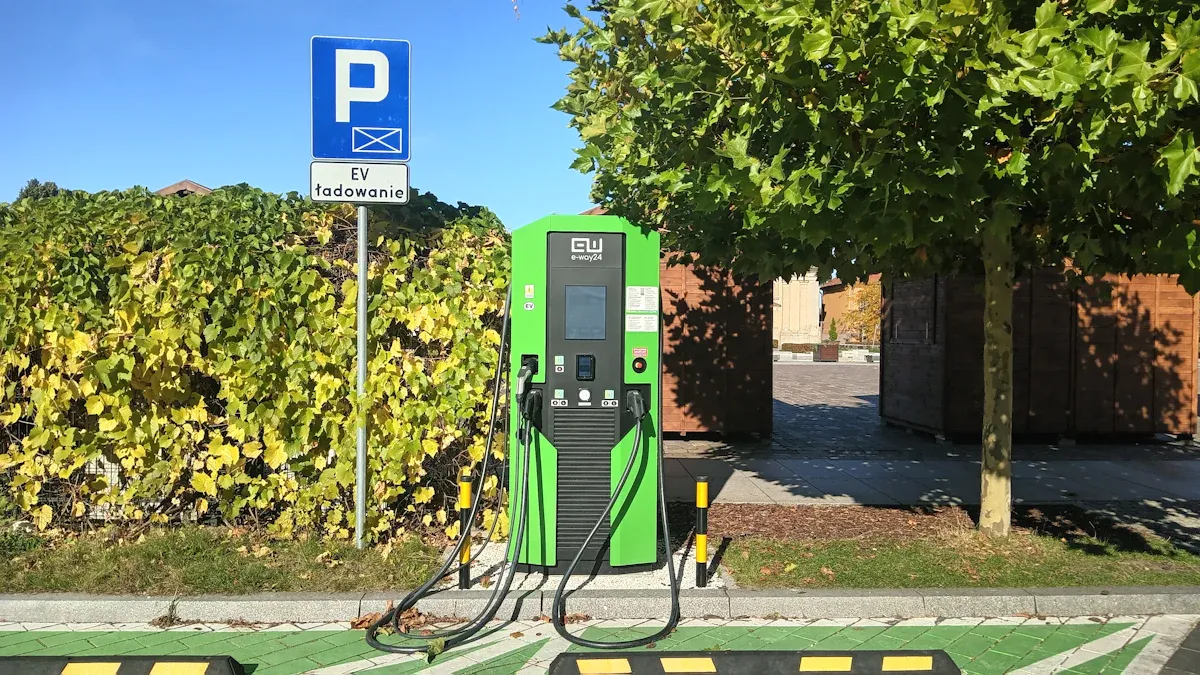
- Physical Protection: Install protective bollards or wheel stops to prevent accidental vehicle impact with the charging stations.
- Ventilation: While most modern AC stations do not require special ventilation, enclosed spaces with multiple stations may need mechanical ventilation to dissipate heat. This is especially critical for high-power DC fast charging stations.
- Emergency Stops: Each station must have a clearly visible emergency stop button.
These measures protect both the equipment and the EV users.
User-Friendly Signage and Bay Marking
Clear signage and bay markings are essential for guiding EV drivers and preventing misuse of the dedicated lots. The bays for the stations should be painted with a distinct color, often green, and marked with an EV charging symbol. Wayfinding signs throughout the car park should direct drivers to the charging stations, reducing confusion and improving traffic flow. This simple step ensures the stations are easy to find and use.
Planning for Cabling and Equipment Space
The physical routing of electric cables and the placement of electrical panels are foundational to the EV infrastructure. This planning must be coordinated with other building systems to avoid conflicts and ensure a clean, professional installation that provides the necessary energy.
Designing Efficient Cable Management Routes
Proper cable management protects the infrastructure and maintains the aesthetic of the property. For underground routes, installers must follow strict guidelines to ensure safety and longevity. The energy cables for each EV need protection.
- Trenches should be at least 500mm deep.
- Warning tape marked
Electric Cable Belowmust be placed 150mm above the cables. - Armoured cables should be bedded in sand to protect them from sharp objects.
- Cables running under driveways should be housed in heavy-duty plastic ducting.
These practices, aligned with standards like the IET Code of Practice, safeguard the electric infrastructure for every EV.
Allocating Space for Switchgear and Panels
The EV charging infrastructure requires dedicated space for its electrical components. Developers must allocate adequate room in the main switchroom or create a dedicated electrical closet for the new switchgear, circuit breakers, and distribution panels that supply energy to the stations. This space must be secure, well-ventilated, and easily accessible for maintenance by a Licensed Electrical Worker. Planning this space from the project’s outset prevents costly and disruptive changes later. The energy for each EV depends on this core infrastructure.
Coordinating with M&E and Architectural Plans
Successful integration of the EV infrastructure depends on close collaboration between different teams. The EV charging plan must be overlaid with the Mechanical & Electrical (M&E) and architectural drawings early in the design process. This coordination ensures that cable routes do not conflict with plumbing, HVAC ducts, or structural elements. It allows architects to incorporate the charging stations and electrical panels into the building’s design seamlessly, ensuring the final installation is both functional and visually cohesive. Every EV benefits from this integrated approach.
Financial Analysis and Cost Estimation for EV Projects
A successful ev charging project requires a detailed financial plan. Developers must look beyond the initial purchase price of chargers. They need to calculate the Total Cost of Ownership (TCO) to understand the long-term financial commitment. This analysis ensures the project is both compliant and commercially viable.
Estimating the Total Cost of Ownership (TCO)
The TCO includes all direct and indirect costs over the lifespan of the EV infrastructure. A comprehensive estimate prevents budget overruns. It provides a clear picture of the investment needed for each EV charging point.
Hardware and Equipment Costs
Hardware represents the most visible upfront expense. This includes the EV charger units themselves. Costs vary based on the charger’s power output and features. An EV will use the energy provided by these units.
Note: The following costs are illustrative estimates. Developers should request formal quotes from suppliers for precise figures.
| Charger Type | Hardware Cost (Approx. S$) |
|---|---|
| 7kW AC Charger | S$850 – S$1,350 |
| 11kW/22kW AC Charger | S$1,000 – S$2,000 |
These figures cover the basic EV charger. The final price depends on the brand and smart capabilities of the selected EV hardware.
Installation, Labor, and LEW Fees
Installation costs can often equal or exceed hardware costs. This category includes labor for trenching, cabling, and mounting the EV chargers. A significant component is the professional fee for the Licensed Electrical Worker (LEW). The LEW designs, endorses, and certifies the entire electric installation, ensuring it safely delivers energy to every EV.
Software, Network, and CMS Subscriptions
Smart charging requires a Charging Management System (CMS). While initial hardware quotes may not detail software fees, these are critical recurring costs. The CMS enables remote monitoring, load balancing, and payment processing. Developers must budget for monthly or annual subscriptions to maintain network connectivity and software features for each EV charging station.
Potential Grid Connection and Upgrade Costs
A project’s existing electric infrastructure may not support the new energy demand. Installing multiple EV chargers, especially DC fast chargers, can require a grid upgrade. This might involve a new substation or higher-capacity transformers. These upgrades represent a substantial potential cost. An early load assessment is vital to determine if the project needs additional energy capacity for EV charging.
Leveraging Government Grants and Incentives
The Singapore government offers incentives to accelerate the adoption of EV infrastructure. Developers should explore these programs to offset initial investment costs. These grants make the financial case for EV charging more attractive.
Overview of the EV Common Charger Grant (ECCG)
The EV Common Charger Grant (ECCG) is a key government initiative. It co-funds the installation of EV chargers. The grant aims to encourage the deployment of charging infrastructure across the island. It helps property owners manage the upfront cost of providing charging for an EV.
Determining Grant Eligibility for New Developments
Developers must carefully review the eligibility criteria for any grant. The ECCG, for example, primarily targets existing non-landed private residences like condominiums and private apartments.
💡 Important: New developments may not be the primary target for certain grants like the ECCG. Developers should always verify the latest guidelines on the official LTA website to confirm eligibility for their specific project type.
Step-by-Step Grant Application Process
Applying for a grant typically involves a structured process.
- Engage a charger supplier to obtain a formal quotation.
- Submit an application through the official government portal.
- Provide all required documentation, including project plans and cost breakdowns.
- Await approval before commencing installation work.
A successful application can significantly reduce the financial burden of installing EV charging infrastructure.
Operational Management and Business Models for Commercial EV Charging
Beyond installation, a successful commercial ev charging project requires a clear operational strategy and a viable business model. Developers must decide how to manage their charging stations and generate revenue. This planning ensures the long-term sustainability and profitability of the EV infrastructure.
Developing a Profitable Business Model
A well-defined business model turns an amenity into a revenue-generating asset. It outlines how the property owner will charge users for the energy and service provided to their EV.
Per-kWh vs. Per-Hour Pricing Strategies
Developers have two primary pricing strategies for their charging stations. A per-kilowatt-hour (kWh) model charges drivers for the exact amount of electric energy their EV consumes. This is often seen as the fairest method. Alternatively, a per-hour model charges for the time the EV is connected to the station. This can encourage drivers to move their vehicles after charging is complete, increasing turnover.
Subscription and Membership Models
Subscription models offer another path to predictable revenue. They provide regular users with convenient access to the charging network.
- Workplace Charging: Businesses can offer employees a monthly subscription for discounted or unlimited EV charging as a green perk. Visitors might pay a standard rate.
- Residential Charging: Apartment complexes can include EV charging access within the monthly rent or offer residents a separate flat-fee subscription for their electric vehicles.
These solutions create a loyal user base and a steady income stream from the charging infrastructure.
Calculating Your Payback Period and ROI
Developers must calculate the payback period and Return on Investment (ROI) for their EV charging infrastructure. The payback period is the time it takes for the revenue from the stations to cover the initial investment. ROI measures the profitability of the charging stations over their lifetime. These calculations are essential for demonstrating the financial viability of the project to stakeholders.
Choosing an Operational Strategy
The operational strategy defines who manages the day-to-day functions of the charging network. This includes handling payments, customer service, and maintenance for each EV.
Self-Management vs. Engaging a CPO
Developers can manage the charging stations themselves. This approach offers full control over pricing and operations but requires dedicated staff and resources. The alternative is to partner with a Charging Point Operator (CPO). A CPO handles all aspects of the charging service, from payment processing to maintenance, in exchange for a fee or a share of the revenue.
Onboarding with a Charging Point Operator (CPO)
Onboarding with a CPO involves connecting the charging stations to their central management software. The CPO integrates the hardware into their existing charging network, making the stations visible to a wider audience of EV drivers through mobile apps. This process simplifies management and enhances user acquisition for the EV charging stations.
Configuring Payment and User Access
Whether self-managed or CPO-operated, developers must configure payment and access. Smart charging solutions allow for flexible options, such as RFID cards for residents, mobile app payments for the public, or QR-code-based systems for guest access. This ensures a seamless experience for every EV driver using the stations.
Long-Term Operation and Maintenance
Reliable operation is key to user satisfaction and protecting the investment in EV charging. A proactive maintenance plan minimizes downtime and ensures the safety of the electric infrastructure.
Establishing a Routine Maintenance Plan
A structured maintenance schedule keeps the charging stations in optimal condition. Regular checks prevent minor issues from becoming costly repairs.
| Task | Frequency | Notes |
|---|---|---|
| Visual Inspection | Weekly | Check for physical damage, loose parts, and vandalism. |
| Cable & Connector Check | Monthly | Inspect for wear and tear on all charging cables. |
| Run Diagnostics | Quarterly | Use smart charging software to check for errors. |
| Professional Inspection | Annually | A LEW should conduct a full electrical safety check. |
Ensuring Uptime and Service Reliability
Consistent uptime is the goal of any maintenance plan. By following a routine, property managers ensure their charging solutions are always ready for use. This reliability builds trust with EV drivers and encourages repeat business, maximizing the utilization of the stations. The consistent energy supply keeps the EV ready to go.
How EV Charging Enhances Property Value
A well-maintained and efficiently managed EV charging infrastructure does more than generate revenue. It enhances the property’s appeal, attracting environmentally conscious tenants and customers. It positions the development as a forward-thinking and sustainable asset, ultimately increasing its long-term market value.
Integrating commercial ev charging is a mandatory, strategic move for new developments. A successful project aligns regulatory compliance with a sound technical and financial strategy from day one. Developers who build robust ev infrastructure unlock significant long-term value. This infrastructure provides the necessary electric energy for every EV.
Beyond compliance, this ev infrastructure offers key advantages for all electric vehicles:
- Future-proofs operations against stricter regulations.
- Reduces long-term fuel and maintenance costs for EV fleets.
- Enhances property value and attracts premium tenants.
The essential first step is engaging a certified LEW. They ensure the project’s ev charging design meets all technical requirements, providing safe energy for every EV. This planning guarantees the right energy for each EV and the success of the charging infrastructure for all vehicles.
FAQ
What is the first step for planning EV charging stations?
Developers must first engage a Licensed Electrical Worker (LEW). The LEW assesses the project’s electrical capacity. This professional ensures the proposed charging infrastructure and stations can handle the required energy load for all charging activities. This step is crucial for compliance and safety of the charging stations.
Can developers install more than the 1% minimum?
Yes. The 1% mandate is a minimum passive provision. Developers can install more active charging stations to enhance property value and meet future demand. Proactive installation of more stations prepares the site for increased ev adoption and provides better charging solutions for tenants.
Do all charging stations need smart charging features?
While not legally mandatory, smart charging solutions are highly recommended. They enable dynamic load balancing, which optimizes energy distribution across all charging stations. This feature prevents grid overload and allows more charging stations to operate simultaneously within the existing power limits of the infrastructure.
Who is responsible for maintaining the charging stations?
The property owner is ultimately responsible. They can manage maintenance in-house or hire a Charging Point Operator (CPO). A CPO handles all operations for the charging stations, including customer service, payment processing, and routine checks of the charging network, ensuring the stations deliver reliable energy.
How do developers choose the right charging solutions?
Developers select charging solutions based on use cases. AC charging stations are ideal for long-duration parking like offices. DC fast charging stations suit high-turnover locations. Vetting suppliers for TR 25 compliance and reliable software is essential for a successful charging network and ev infrastructure.
What are the main costs for charging infrastructure?
The Total Cost of Ownership includes hardware for the stations, installation labor, and LEW fees. Other costs cover software subscriptions for the charging management system and potential grid upgrades. A full financial analysis reveals the true investment required for the energy infrastructure and its stations.