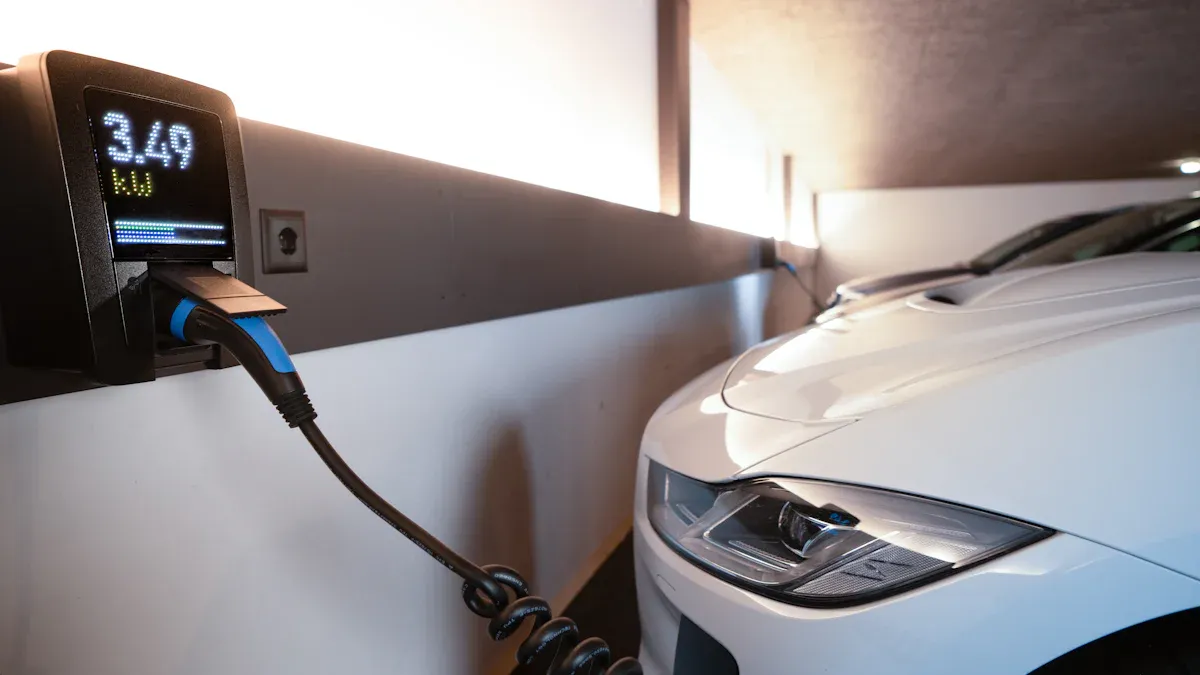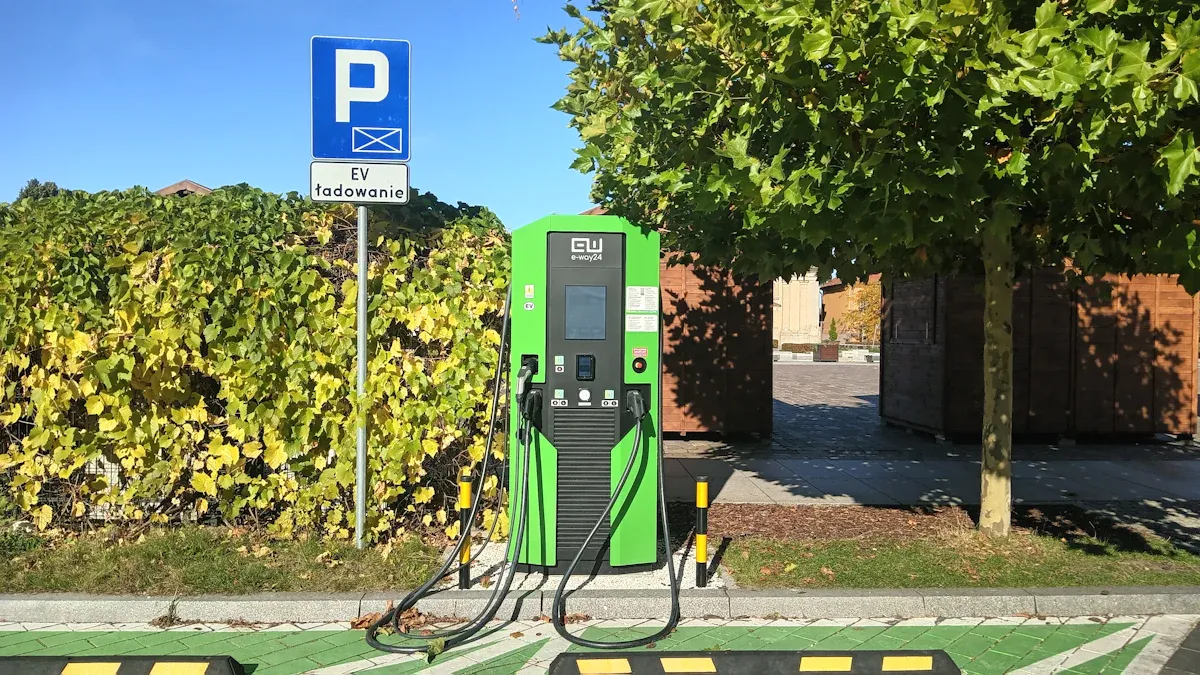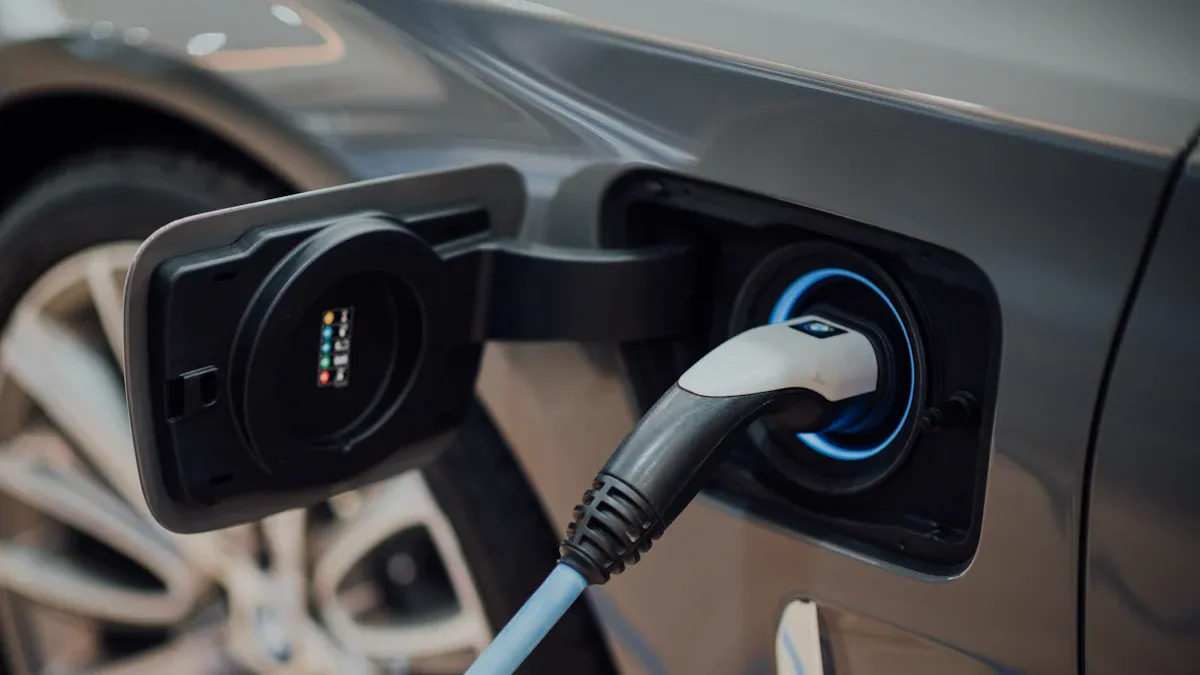
Understanding how-station-amperage-and-kw-affect-ev-charging-times is crucial for optimizing EV charging times for electric vehicles. A higher kilowatt (kW) rating at a charging station generally means a faster charging speed. The actual EV charging speed, however, is always limited by the lower of two values: the Chargeur EV‘s output or the car’s maximum intake rate. This reality of EV charging directly affects the car’s time at the plug.
Remarque : Amperage and voltage are the building blocks of power. Fabricants de chargeurs de VE like the technologically advanced provider TPSON engineer their Solutions de recharge pour véhicules électriques, y compris chargeurs ev portables, based on this fundamental relationship.
Kilowatts (kW): The Direct Measure of EV Charging Speed

The kilowatt (kW) is the most direct metric for understanding the potential EV charging speed of a station. A higher kW number indicates a greater power output. This translates to a faster rate of energy delivery to an electric vehicle’s battery. Understanding this unit is the first step for any driver wondering how fast do electric cars charge.
Qu'est-ce qu'un kilowatt (kW) ?
A kilowatt is a unit of power, not energy. It quantifies the rate at which a station transfers energy to a vehicle.
The “Miles Per Hour” of Charging
An effective analogy is to think of kilowatts as the “miles per hour” of EV charging. A charger with a higher kW rating can “pour” energy into a battery more quickly. This directly influences the overall charging speed. A 150 kW charger, for instance, has a much higher potential to reduce charging times than a 7 kW charger.
The Simple Power Formula: Volts × Amps = Watts
Power is the product of electrical pressure (Volts) and electrical current (Amps). The fundamental formula is:
Volts (V) × Amps (A) = Watts (W)
A kilowatt (kW) is simply 1,000 watts. This unit represents a rate of energy transfer equivalent to 1,000 joules per second. Technologically advanced providers like TPSON engineer their charging solutions based on this core principle to deliver reliable and efficient charging power.
How kW Impacts Your EV Charging Times
The charger’s kW rating is a primary factor in how kilowatts affect charging speed. A higher kW output from the station enables a quicker charging session, provided the vehicle can accept that level of power.
The time required for a charge can be estimated. Use the formula: Charging Time (hours) = Energy Added (kWh) ÷ Charging Power (kW). Most manufacturers recommend charging between 20% and 80% for optimal battery health.
Level 2 AC Charging Time Examples
Level 2 charging is common for homes and workplaces. The difference in kW has a noticeable impact on the charging time for a typical car. Consider a 60 kWh battery charging from 20% to 80%, which requires adding 36 kWh of energy.
| Puissance du chargeur | Energy Added | Estimated Charging Time |
|---|---|---|
| 7 kW | 36 kWh | ~5.1 hours |
| 11 kW | 36 kWh | ~3.3 hours |
Upgrading from a 7 kW to an 11 kW charger significantly shortens the level 2 charging session.
DC Fast Charging Time Examples
DC fast charging offers a much higher charging speed for drivers on long journeys. Using the same 60 kWh car battery example (adding 36 kWh), the impact of a high-power DC fast charger becomes clear.
- At 50 kW: The session takes approximately 43 minutes.
- At 150 kW: The same session takes only about 14 minutes.
This demonstrates how a higher kW rating dramatically reduces EV charging times, making long-distance travel more convenient.
The Role of Amperage (Amps) in Determining Power
While kilowatts provide a direct measure of charging speed, amperage (amps) is a fundamental component that determines that power. Understanding how amperage affects charging speed is especially important for Level 2 AC charging, where electrical circuit limitations play a significant role. A higher amperage directly contributes to a faster charging rate.
Understanding Amps as Electrical Current
Amperage is the unit of measure for electrical current. It represents the flow rate of electrons through a conductor. Technologically advanced electric vehicle charging solution providers like TPSON design their systems around the precise management of this current.
Amps as the “Volume” of Electricity
A helpful analogy is to think of amperage as the “volume” of electricity flowing through a hose. Voltage is the pressure pushing the water, while amperage is the hose’s diameter. A wider hose (higher amperage) allows more water (electricity) to flow per second, even at the same pressure. The modern scientific definition of the Ampere is based on the fixed numerical value of the elementary charge, a fundamental constant of nature. A higher amperage means more electrical charge is delivered to the battery each second.
How Amps and Volts Combine to Create kW
Power (Watts) is the product of voltage and amperage. The formula Volts × Amps = Watts shows that increasing either value increases the power output. For example, a charger operating at 240 volts with a 40-amp current delivers 9,600 watts, or 9.6 kW. A higher amperage at the same voltage results in a higher kW rating and faster charging.
Why Amps Are Key for Level 2 Charging
For level 2 charging, amperage is often the most critical variable an EV owner can control. The choice of charger and the building’s electrical infrastructure directly dictate the maximum available amperage.
240V Residential vs. 208V Commercial Power
Most homes in North America use a 240V split-phase electrical supply. Many commercial buildings, however, use a 208V three-phase supply. This difference matters. A 40-amp charger will deliver 9.6 kW at a 240V residence but only 8.3 kW at a 208V office building. This is why the same car may charge slightly slower at a workplace than at home, even with an identical charger amperage rating. A higher amperage is needed in a 208V setting to match the power of a 240V system.
Matching Your Home Circuit’s Amperage
When you charge an electric car at home, the charger’s amperage must match what your home’s circuit can safely provide. The National Electrical Code (NEC) requires a circuit breaker to be rated for 125% of a charger’s continuous load. This safety rule prevents overheating. Therefore, a higher amperage charger requires a more robust dedicated circuit.
Conseil : To safely charge an electric car at home, always have a qualified electrician install the dedicated circuit for your Level 2 charger.
The relationship between charger amperage and the required breaker is clear:
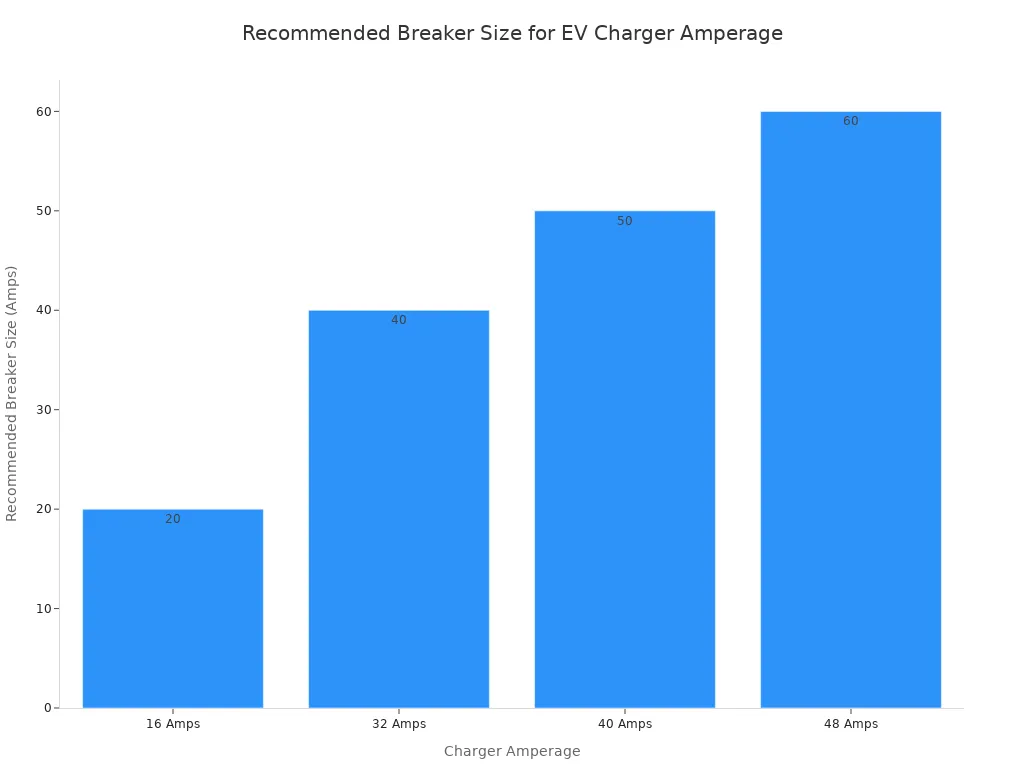
Choosing a charger with a higher amperage, such as 40A or 48A, significantly reduces charging time for a car that can accept it. A higher amperage is the key to unlocking faster level 2 charging speeds, making a powerful impact on the daily convenience for an EV driver.
Your Vehicle’s Limits: The Most Important Factor for Charging Time
While a station’s kW rating indicates its potential power, the electric vehicle itself often determines the actual charging speed. A car’s internal hardware sets a firm ceiling on how much power it can safely accept. This makes the vehicle’s own specifications the most important factor influencing the final charging time. No matter how powerful the station, a car will only charge as fast as its own systems allow.
Your Car’s Onboard Charger for AC Charging
For Level 1 and Level 2 AC charging, every electric vehicle relies on a critical component: the onboard charger (OBC). This piece of hardware is built into the car and is responsible for a crucial conversion process.
The most common method for AC EV charging involves the car’s onboard charger converting AC power from the grid to DC power before it reaches the battery. The OBC takes the alternating current (AC) from a home outlet or public Level 2 station and transforms it into the direct current (DC) that the car’s battery can store. This conversion happens through several stages:
- A power-factor correction (PFC) stage converts the incoming AC voltage to an intermediate DC voltage.
- An isolated DC-DC stage then adjusts this voltage to the specific level required by the battery pack.
Technologically advanced providers like TPSON design their charging solutions to work seamlessly with these onboard systems. The OBC’s power rating, measured in kW, sets the absolute maximum speed for any AC charging session.
Finding Your Car’s Max AC Rate
An EV owner can find their car’s maximum AC charging rate in the vehicle’s manual, on the manufacturer’s official website, or on the specification sheet provided at purchase. This rating is typically listed in kilowatts (kW). Common AC charging rates for modern EVs range from 7.4 kW to 11 kW, with some premium models supporting up to 19.2 kW or even 22 kW.
Exemple : A car with an 11 kW onboard charger will never charge faster than 11 kW on an AC station, even if the station is rated for 19.2 kW. The car’s OBC is the bottleneck.
The “Slowest Link” Rule in Action
The “slowest link” principle is always in effect during EV charging. The final charging speed will be the lower of two values: the station’s maximum output and the car’s maximum intake rate.
Consider a car with a 7.4 kW onboard charger.
- Plugging into a 3,7 kW charger results in a 3,7 kW charging speed.
- Plugging into a 7,4 kW charger results in a 7,4 kW charging speed.
- Plugging into an 11 kW charger still results in only a 7,4 kW charging speed, as the car’s onboard charger cannot accept more power.
This demonstrates why matching the charger to the car’s capability is key for optimizing charging times without paying for unused power capacity.
Your Car’s Battery Management System (BMS) for DC Charging
During DC fast charging, the process is different. The large, external DC fast charger bypasses the car’s smaller onboard charger and delivers DC power directly to the battery. In this scenario, the vehicle’s Battery Management System (BMS) takes control.
The BMS is the sophisticated “brain” of the battery pack. It constantly monitors factors like cell voltage, temperature, and state of charge. During DC fast charging, the BMS communicates directly with the station, providing limits to the charger to enable the fastest possible charging. The accuracy and responsiveness of the BMS directly influence how quickly a vehicle can charge.
Finding Your Car’s Max DC Rate
Similar to the AC rate, a car’s maximum DC fast charging rate is a key specification provided by the manufacturer. This number, also in kW, represents the peak power the battery can handle under ideal conditions. These rates vary widely, from around 50 kW for older models to over 350 kW for the latest high-performance EVs. Knowing this figure helps a driver select the right public charger for a quick top-up on a long journey.
Why a 350 kW Charger Won’t Always Charge at 350 kW
Plugging a car into a 350 kW ultra-fast charger does not guarantee a 350 kW charging speed. Several factors, all managed by the BMS, will limit the power.
- Vehicle’s Max Rate: A car with a maximum DC rate of 150 kW will never exceed 150 kW, regardless of the station’s power.
- État de charge de la batterie (SoC) : Charging is fastest when the battery is nearly empty. The BMS automatically slows the rate as the battery fills up (especially above 80%) to protect its health.
- Température de la batterie : The BMS will limit charging speed if the battery is too cold or too hot to prevent damage.
The BMS constantly calculates the maximum safe charging rate and instructs the charger to adjust its output accordingly. This dynamic control ensures both safety and optimal battery longevity.
How Real-World Factors Reduce Your Charging Speed
The advertised kW rating of a charger represents its maximum potential output under ideal conditions. However, several real-world factors that affect charging speed often reduce the actual power delivered to a vehicle. An EV driver’s experience at a charging station is influenced by more than just the station’s power rating and the car’s specifications. Understanding these variables is essential for setting realistic expectations and planning efficient charging stops.
The 80% Rule: Battery State of Charge (SoC)
One of the most noticeable factors is the battery’s State of Charge (SoC). A battery charges much faster when it is at a lower SoC and slows down considerably as it approaches full capacity. This is a universal characteristic of charging an EV battery.
Why Charging Slows Dramatically
The primary reason for this slowdown is physics. As a battery fills up, its internal resistance increases. Pushing a high electrical current into a battery with high resistance generates significant heat. The car’s Battery Management System (BMS) detects this and deliberately reduces the charging power to prevent the cells from overheating, which could cause permanent damage. This protective measure is why the last 20% of a charge takes much longer than the first 20%.
Protecting Your Battery’s Long-Term Health
This tapering of charging speed is a critical safety feature that protects the long-term health of the battery. Routinely pushing a battery to 100% at maximum speed would accelerate degradation. For this reason, many EV manufacturers and charging experts recommend stopping a DC fast charging session at around 80%. This practice not only saves time but also helps preserve the battery’s capacity and lifespan. It is a key strategy for those looking to fully charge an electric car while being mindful of its longevity.
How Battery Temperature Affects Charging an EV Battery
Battery temperature is another critical variable. Lithium-ion batteries have an optimal temperature range for efficient operation. Extreme temperatures, both hot and cold, will cause the BMS to limit the charging speed to protect the battery pack.
Slower Speeds in Cold Weather
In cold weather, the chemical reactions inside a battery slow down. Attempting to charge a cold battery at high speeds can cause damage. To prevent this, the BMS will severely restrict the charging power until the battery warms up. Some modern EVs have a preconditioning feature that actively heats the battery as the car navigates to a DC fast charger, significantly improving cold-weather charging performance.
Protective Throttling in Hot Weather
Conversely, excessive heat is also detrimental to battery health. During a fast-charging session, especially in hot ambient temperatures, the battery can heat up quickly. If the temperature exceeds a safe threshold, the BMS will again throttle the charging power to allow the battery’s cooling system to catch up. This protective throttling prevents thermal damage and ensures the battery operates safely.
Shared Power at Public Stations
Not all charging stalls at a public charging station are created equal. Many sites use a shared power architecture, where multiple chargers split a finite amount of available power from the grid. This is a common practice that can lead to a slower-than-expected charging session.
What is Power Splitting?
Power splitting, or load balancing, is a system where a charging site’s total electrical capacity is distributed among the active chargers. For example, two 150 kW chargers might share a single 300 kW power cabinet. If only one car is charging, it can potentially receive the full 150 kW. However, if a second car plugs into the adjacent charger, the system may split the power, giving each vehicle only 75 kW.
Advanced networks are evolving this technology. For instance, some systems now feature dynamic power sharing that can distribute power across as many as six stalls, optimizing energy delivery based on real-time demand.
How to Identify a Shared Power Station
Identifying a shared power setup can be tricky. Some stations have labels on the chargers indicating they share power with an adjacent unit (e.g., “Charger 1A” and “Charger 1B”). Another clue is seeing multiple charging stalls connected to a single, large power cabinet. When arriving at a busy site, choosing a stall connected to an unoccupied power cabinet can help ensure the car receives the maximum possible charging power. This knowledge helps drivers avoid unexpectedly slow sessions when trying to fully charge an electric car on a tight schedule.
A Practical Guide to Choosing the Right Charger
Knowing how to select the appropriate charger is a practical skill for every EV driver. The choice depends on the trip’s purpose, the time available, and the car’s capabilities. Making an informed decision ensures an efficient and convenient experience.
How to Read a Charger’s Label
The labels on a charging station provide essential information about its performance. An EV driver can quickly assess a charger’s suitability by understanding these details.
Identifying kW and Amperage Ratings
A charger label prominently displays its maximum power output, shown as a kW rating. This kW rating is the most direct indicator of potential charging speed. For Level 2 AC units, the amperage may also be listed. A higher kW rating generally promises a faster session, assuming the vehicle can accept that power level. The kW rating is a critical piece of data for planning a stop.
Understanding Connector Types: CCS, NACS, and CHAdeMO
A driver must also verify that the charger’s connector is compatible with their car. The three main DC connector standards are:
- CCS (Combined Charging System) : Widely adopted by many manufacturers.
- NACS (North American Charging Standard): Developed by Tesla and being adopted by other brands.
- CHAdeMO : Primarily used by a smaller number of vehicle models.
Most public stations offer CCS, while NACS is rapidly expanding. Ensuring the connector matches the vehicle’s port is the first step before plugging in.
Matching the Charger to Your Trip
Selecting the right charger type is one of the best practices for faster charging. The needs for daily commuting are very different from the needs of a long-distance road trip.
When to Use Level 2 AC Chargers
Level 2 charging is the ‘daily driver of EV infrastructure‘ and covers most routine charging needs. A Level 2 charger is ideal for situations where the vehicle will be parked for several hours. Technologically advanced providers like TPSON engineer these solutions for reliability. Common locations include:
- Homes
- Lieux de travail
- Hotels and destinations
- Commercial parking lots
A typical Level 2 charger with a 7 kW to 11 kW rating can fully charge most EVs overnight or during a standard workday. This makes level 2 charging a convenient and cost-effective option for daily use. The lower kW rating is gentle on the battery.
When to Use DC Fast Chargers
A driver should use a DC fast charger for long journeys where minimizing downtime is the priority. These powerful stations are designed to add significant range in under an hour. When a driver needs to charge an electric car at a charging station quickly, DC fast charging is the solution. The high kW rating of a DC fast charger, often 50 kW to 350 kW, bypasses the car’s onboard charger for direct power delivery. The charger’s kW rating directly impacts the stop time, so choosing a station with a kW rating that aligns with the vehicle’s maximum DC rate is crucial.
How Station Amperage and kW Affect EV Charging Times in Practice
An EV driver can apply theoretical knowledge about how-station-amperage-and-kw-affect-ev-charging-times to make practical decisions. Modern tools and simple calculations help drivers optimize their charging sessions. This practical application turns understanding into shorter charging times and a more convenient ownership experience.
Using Apps to Find the Best Charger
Mobile applications are indispensable tools for locating and evaluating a charging station. Apps like PlugShare and Google Maps provide a wealth of data that helps a driver find the best charger for their needs.
Filtering by Power Level (kW)
Leading apps allow users to filter search results by power level (kW). This is a crucial feature for matching a charger to a car’s capabilities and the trip’s requirements. A driver can filter for high-power Chargeurs rapides à courant continu on a road trip or for Level 2 chargers at a destination. PlugShare, with its global coverage across North America and Europe, offers powerful filter options. Users can specify connector types and charging speed to find a charger perfectly suited for their specific EV model.
Top EV Charging Apps 🗺️
- PlugShare: Features extensive global coverage and relies on a large community for real-time updates. Its intelligent trip planner and powerful filters make it a top choice.
- Google Maps: Integrates charging station search directly into its navigation, showing live availability and smart route planning that can factor in a car’s battery level.
Checking Real-Time Station Status
Knowing a charger’s status before arrival prevents wasted time. Many apps provide données en temps réel on charger availability. This information is often crowdsourced from a community of fellow EV drivers. Apps like PlugShare are community-based tools where driver participation is key. Users contribute reviews, photos, and comments on charging speed and usability. This shared experience makes the app a reliable source, indicating if a charging station is currently in use, out of order, or available. This feature is vital for planning a successful stop to charge an electric car at a charging station.
Calculating Your Estimated Charging Time
A driver can perform a quick calculation to estimate the charging time. This helps set realistic expectations for a charging session.
A Simple Formula for Quick Estimates
A simple formula provides a baseline estimate for how long a session will take. The calculation divides the amount of energy needed by the charging power.
Charging Time (hours) = Energy Needed (kWh) ÷ Charger Power (kW)
For example, adding 40 kWh to a battery with a 50 kW charger would theoretically take 0.8 hours, or about 48 minutes. This formula is a useful starting point for understanding how-station-amperage-and-kw-affect-ev-charging-times.
Factoring in the Charging Curve
The simple formula assumes a constant charging speed, which is not accurate in reality. The EV charging process is non-linear due to the charging curve. A car accepts maximum power at a low state of charge, but the rate gradually drops, especially after the battery reaches 80%. This slowdown is a protective measure for battery health. Simple formulas will be inaccurate because they do not account for this tapering. The time needed to charge from 80% to 100% can be similar to the time needed to go from 20% to 80%. This reality of how-station-amperage-and-kw-affect-ev-charging-times means that for the fastest trip, a driver should plan to unplug around 80% and continue their journey.
Kilowatts (kW) are the most direct measure of charging speed, but they do not tell the whole story of how-station-amperage-and-kw-affect-ev-charging-times. The actual charging speed is always determined by the slowest link: the station’s output, the car’s maximum intake rate, or real-time conditions. To optimize EV charging, a driver must know their car’s limits and choose a station that matches their trip’s needs. This knowledge transforms the EV charging experience, leading to shorter charging times and a better overall charging time.
FAQ
What is the fastest way to charge an electric car?
The fastest method to charge an electric car is by using a DC fast charger. These high-power stations bypass the vehicle’s onboard charger, delivering significant range in under an hour. A driver should select a station with a kW rating that matches their vehicle’s maximum DC intake.
Can a driver use any charger to charge an electric car?
No, a driver must use a charger with a compatible connector. While many brands adopt CCS or NACS standards, it is essential to verify compatibility. Using the wrong connector type will prevent a driver from being able to charge an electric car.
Why does it take so long to charge an electric car from 80% to 100%?
Charging slows significantly after 80% to protect the battery. The car’s Battery Management System reduces the power intake to prevent overheating and cell degradation. This tapering effect is a normal and necessary function when you charge an electric car.
How does cold weather affect the ability to charge an electric car?
Cold temperatures slow the chemical reactions inside a battery. The vehicle’s management system will limit charging speed to prevent damage until the battery warms up. This safety measure means it will take longer to charge an electric car in colder climates.
Is it better to charge an electric car at home or a public station?
For daily needs, it is best to charge an electric car at home overnight using a Level 2 charger. For long-distance travel, public DC fast chargers are necessary for quick top-ups. Each method serves a different purpose for the EV owner.
What is the most important factor when you charge an electric car?
The most important factor is the “slowest link” rule. The actual charging speed is determined by the lowest value among the station’s output, the vehicle’s maximum intake rate, and real-time conditions like battery temperature.
How can a driver charge an electric car more efficiently?
A driver can charge an electric car more efficiently by following these tips:
- Precondition the battery before fast charging.
- Charge when the battery is at a low state of charge.
- Stop DC fast charging sessions around 80%.
- Choose a reliable charger from a provider like TPSON for the car.