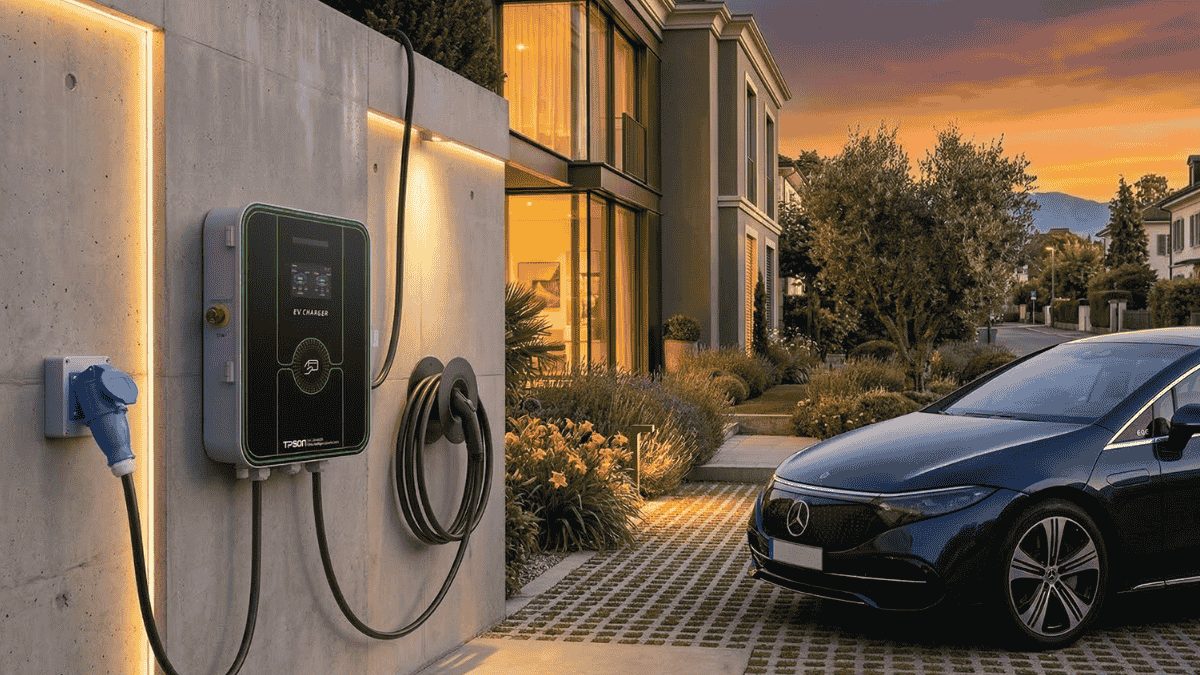
An 80 amp EV charger sounds like the ultimate home charging upgrade, but for most households, the right question is not whether it is the fastest option. The real question is whether your vehicle can use that power, whether your electrical service can support it, and whether the higher installation cost creates meaningful day-to-day value. In many homes, a 40A or 48A charger already provides excellent overnight charging. In others, especially premium homes, high-mileage households, or mixed-use properties, an 80A charger may be worth serious consideration.
This guide explains what an 80 amp EV charger actually means, how it compares with more common home charging options, what installation requirements it creates, and when it makes sense to invest in one. It draws on the provided source material from TPSON, ChargePoint, Emporia, Smart Charge America, Love’s, and Car and Driver to keep the analysis practical and grounded in real market examples.
- What Is an 80A EV Charger?
- How Fast Is an 80A Charger, Really?
- Why Many Households Don’t Actually Need 80A
- The Real Differences Between 80A vs. 40A, 48A, and 50A
- What You Need to Install an 80A Home Charger
- Limits of the Vehicle’s Onboard Charger
- When Upgrading to 80A Is Worth It
- When It’s Not Worth Upgrading
- Why Smart Load Management Matters More Than Simply Increasing Amperage
- How TPSON and the Market View High-Current Home Charging
- Conclusion
An 80 amp EV charger typically refers to a high-output Level 2 AC charging device. In the common North American 240V home environment, 80A continuous output corresponds to a theoretical power of about:
Car and Driver clearly notes in its home EV charger testing guidance that a hardwired Level 2 circuit can, under specific conditions, use a 100A circuit and deliver 80A continuous output—about 19.2 kW. This is commonly considered one of the high-end limits for residential AC charging.
However, 80A is only the capability of the EVSE (the supply equipment). It does not mean your vehicle will actually charge at 80A. Real charging speed is also limited by the car’s onboard AC charger. That’s why, when evaluating Chargeurs de VE, you shouldn’t look only at “maximum current.”
Under the same 240V conditions, different current levels roughly translate to the following power:
| Actuel | Approx. Power | Typical Home Positioning |
|---|---|---|
| 32A | 7.7 kW | Entry-level efficient home charging |
| 40A | 9,6 kW | Mainstream, best value for home use |
| 48A | 11,5 kW | Premium residential Level 2 |
| 50A | 12.0 kW | Higher-output home / light commercial setup |
| 80A | 19,2 kW | High-power residential or commercial AC charging |
Purely by the numbers, 80A is much higher than 48A’s 11.5 kW and can theoretically reduce AC charging time. But whether it feels “much faster” depends on whether your vehicle can accept such high AC input.
For example, many mainstream home products highlighted by Car and Driver—such as the Emporia Classic, Emporia Pro, and Tesla Universal Wall Connector—are mostly in the 48A range. Meanwhile, the few 80A AC products listed by Smart Charge America, such as the Ford Pro AC Charging Station 80A Series 2, are positioned more for commercial or fleet scenarios. This itself shows that 80A is not a mainstream standard for typical households.
An 80A charger isn’t necessarily a better “value” than 40A or 48A. There are three main reasons:
- Many EVs’ onboard AC chargers can’t fully utilize 80A
- Most households have long overnight parking windows, and 40A–48A is enough to replenish daily commuting energy
- 80A installation costs are significantly higher, often requiring a larger circuit, heavier-gauge wiring, and possibly a panel/service upgrade
Car and Driver explicitly states in its buying guidance that a 40A or 50A circuit is often an ideal compromise for home EV charging: it meets overnight needs for most vehicles while keeping installation costs reasonable.
That means: if your car is parked for 8 to 12 hours nightly and your daily mileage is normal, the extra speed advantage of 80A will often be hard to notice in real life.
What’s more useful than focusing on the max-current number is understanding what each option actually means for a household.
| Option | Puissance typique | Installation Difficulty | Meilleur pour |
|---|---|---|---|
| 40A | 9,6 kW | Faible | Most typical households |
| 48A | 11,5 kW | Moyen | Users who want faster home charging and accept hardwiring |
| 50A | 12.0 kW | Medium to high | High-demand households or light commercial use |
| 80A | 19,2 kW | Very high | Very high mileage, short charging windows, certain premium homes, or specific commercial needs |
You can also see this segmentation in the market:
- Emporia Classic: 40A with a plug; 48A when hardwired
- Tesla Wall Connector Gen 3: up to 48A
- Tesla Universal Wall Connector: up to 48A
- ChargePoint Home Flex: adjustable up to ~50A
- Ford Pro AC Charging Station 80A: clearly more commercial/fleet-oriented
So if you’re comparing mainstream home chargers, in practice you’ll most often be choosing among 40A, 48A, and 50A—not 80A.
This is the core factor in deciding whether 80A is worth it. Because 80A doesn’t just mean “buy a bigger charger”—it often means a more substantial electrical project.
Emporia’s official materials emphasize that NEMA plug-in versions are typically limited to 40A, while hardwired versions can reach 48A. At the 80A level, it’s usually not a standard outlet-based home charger—it generally requires hardwired installation.
Car and Driver points out that continuous home Level 2 loads are typically designed at 80% of circuit capacity. That means:
- 50A circuit ≈ 40A continuous output
- 100A circuit ≈ 80A continuous output
In other words, an 80A EV charger typically requires a dedicated circuit close to 100A, which is no longer a “small upgrade” for many homes.
Higher current means thicker conductors, a higher-rated breaker, more labor time, and stricter requirements for ampacity and temperature rise.
Car and Driver also specifically warns that if the home doesn’t have enough remaining electrical capacity, a home charging project can shift from “adding one circuit” to “upgrading the entire service,” with costs potentially rising from a few hundred dollars to several thousand. That risk is higher in 80A scenarios.
Even if your home can support 80A, your vehicle may not be able to use it.
Car and Driver notes that true AC charging speed is determined by the lowest limit among three factors:
- Your home circuit’s output capability
- The EVSE’s output capability
- Your vehicle’s onboard AC charger capability
That means if a vehicle can only accept around 11 kW of AC input, installing a 19.2 kW (80A) charger won’t make it charge at 19.2 kW. Many owners discover after upgrading that they spent more budget without getting a proportional improvement in charging experience.
Therefore, before choosing a higher-current Chargeurs de VE en courant alternatif option, verifying your vehicle’s onboard AC charging limit is the most important first step.
Although it’s not for everyone, 80A isn’t without value. In the following situations, it may genuinely be worth considering:
- Your vehicle supports very high AC charging power
- You drive very high daily mileage and have a limited overnight charging window
- Your home already has higher service capacity and can easily support a large new circuit
- You want to build your home charging system to a higher spec in one step
- Your residential setup has semi-commercial characteristics (e.g., premium multi-car garages, shared parking, serviced residences, etc.)
Additionally, in some light commercial and fleet environments, 80A AC can improve vehicle turnaround. The Ford Pro 80A AC Station listed by Smart Charge America fits that positioning—focused more on output and operational efficiency than on being a typical household standard.
For most typical households, the following conditions suggest that 80A is unlikely to be cost-effective:
- Your vehicle has a lower AC acceptance rate
- The vehicle is usually parked long enough overnight
- Your current 40A or 48A setup already meets your needs
- Your electrical panel has limited spare capacity
- Installing 80A would trigger significant electrical system upgrade costs
This is also why most widely recommended home products cluster in the 40A–48A range. Popular household choices from Emporia, Tesla, and ChargePoint do not treat 80A as the mainstream default. The market’s real product lineup tells us: higher current does not automatically equal a better home charging experience.
For many households, what’s truly needed isn’t “more current,” but “smarter current.”
TPSON states in its Chargeurs de VE overview that its AC products support Dynamic Load Balancing to protect the home electrical system. TPSON’s homepage also highlights capabilities such as its Current Fingerprint Algorithm, Advanced Safety Protection, Dynamic Load Balancing, Dynamic Temperature Control, and Real-Time Diagnostics & Alerts.
That means, for a household with limited spare electrical capacity, a more practical approach may be:
- Choose a smart 40A or 48A home charger
- Pair it with dynamic load management
- Schedule charging during off-peak electricity rates
- Avoid expensive panel/service upgrades
Car and Driver’s review of the Emporia Pro is very similar: it adjusts charging output in real time by monitoring the home’s total load, helping users avoid costly electrical upgrades.
So in many cases, the value delivered by smart load management is greater than jumping blindly from 48A to 80A.
As an EV charger manufacturer that has been building smart power systems and charging products around its Current Fingerprint Algorithm since 2015, TPSON’s overall approach is not simply about pursuing higher amperage. Instead, it emphasizes:
- High compatibility
- Sécurité
- Real-time diagnostics
- Dynamic load adjustment
- Coverage from home use to commercial use and emergency DC scenarios
TPSON’s product overview shows that its charging solutions include not only residential and commercial AC, but also portable Chargeurs DC EV—for example 20 kW, 30 kW, and 40 kW portable DC products for roadside assistance, fleets, temporary event sites, and dealership scenarios.
This reflects a more mature industry view: if users truly need higher turnaround efficiency, sometimes the more reasonable direction is not to keep increasing AC current, but to switch to a more suitable DC solution depending on the scenario.
Looking at other market players, the trend is consistent:
- ChargePoint focuses on an open platform, software, fleets, commercial scenarios, and driver experience
- Love’s deploys both Level 2 and Level 3 across its highway charging network to match different dwell times
- In Smart Charge America’s lineup, 80A AC is clearly commercial-leaning, while best-selling residential options still concentrate on 40A–48A
Therefore, from an industry-structure perspective, an 80A home charger is an optional high-spec configuration—not a standard answer that every household should upgrade to.
An 80 amp EV charger is indeed powerful. At 240V it can deliver about 19.2 kW, making it a high-power option for residential AC charging. But whether it’s worth it depends on three key questions:
- Can your vehicle actually take advantage of that much AC power?
- Can your home electrical system support it at a reasonable cost?
- Do your real-world charging needs truly require it?
For most households, a smart 40A to 48A charger is already more than good enough—especially when it includes Wi-Fi connectivity, scheduling, energy monitoring, and dynamic load management. In practice, that balanced experience is often more reasonable than simply chasing 80A.
For a small number of high-mileage drivers, premium homes, short charging windows, or semi-commercial residential scenarios, 80A can still be a worthwhile upgrade. But it should be a choice verified by driving habits, vehicle capability, and electrical capacity—not an impulse decision based on “a bigger number.”
If you’re evaluating different power levels for home and commercial use, you can start with TPSON’s Chargeurs de VE product matrix and combine residential AC options with DC options for specific scenarios to choose charging infrastructure that truly fits your needs.