A Level 1 EV charger extension cord can be used safely only when it is treated as a short-term solution, sized correctly for continuous current, kept as short as practical, and paired with a solid, tight outlet connection. Level 1 charging uses a standard 120-volt outlet and is typically around ~1 kW, but the risk is still real because charging runs for many hours. When the cord, plug, or receptacle becomes a weak link, the first symptom is usually heat at the connection point.
Stop condition: If the plug, outlet faceplate, or extension-cord ends feel warm-to-hot, smell unusual, show discoloration, or the EVSE frequently stops and restarts, charging should be discontinued and the installation inspected by a licensed electrician.
Level 1 charging basics (why cords behave differently)
Level 1 charging uses 120-volt AC electricity from a standard household outlet. Car and Driver describes Level 1 output as roughly ~1 kilowatt and notes it can take days to charge depending on battery size. That “days to charge” detail is exactly why extension cords are risky: they turn a normal-looking setup into a continuous load for long periods.
Even at relatively low power, long-duration current highlights every weak spot in the chain—especially the outlet grip, plug blade quality, and cord-end contact pressure. In other words, Level 1 extension cords fail less from “not enough power” and more from connection quality and heat buildup.
Typical Level 1 power
~1 kW
Car and Driver describes Level 1 charging as ~1 kW from a 120V outlet.
What makes it risky
Duration
Charging runs for hours; small resistance at plugs becomes heat over time.
Most common failure point
Outlet + plug fit
Loose receptacles and cheap cord ends create localized hot spots.
Best long-term solution
Proper installation
Move the outlet or install an EVSE where the vehicle parks.
When it is acceptable to use an extension cord
A Level 1 extension cord is most defensible when it solves a temporary reach problem without becoming the permanent charging plan. Examples include a short-term parking change, a rental situation, or a transitional period before a dedicated circuit is installed.
Green-light scenarios (with conditions)
- Short duration of ownership/need (weeks, not years).
- Short cord run where the cord can be routed safely without trip hazards.
- Good outlet condition (tight grip, no discoloration, no cracked plate).
- Low-to-moderate EVSE current setting if adjustable.
Red-light scenarios (avoid)
- Outdoor charging with standing water where cord ends can sit in puddles or snow melt.
- Coiled cord use (cord reels, tight loops, or storage while charging).
- Loose receptacle or any history of heat marks on the outlet.
- Daisy chaining multiple extension cords.
What to buy: the only specs that matter
Many shoppers search for “heavy duty” and stop there. For EV charging, the decision should be evidence-based. The safest purchase is the one that controls heat and reduces voltage drop—typically achieved with thicker conductors and shorter length.
Buyer checklist (Level 1)
| What to check | What “good” looks like | Why it matters for Level 1 EV charging |
|---|---|---|
| Wire gauge | Prefer thicker conductors (commonly 12 AWG or heavier) | Lower resistance helps reduce **heat buildup** and **voltage drop** during long sessions |
| Cord length | Shortest that reaches without tension | Long cords waste more energy as heat and create more routing hazards |
| Outdoor rating | Outdoor-rated jacket if outside | Moisture and UV exposure degrade insulation and connection safety over time |
| Plug and connector quality | Solid blades, tight fit, robust molded strain relief | Most overheating begins at connection points, not the middle of the cable |
| Single-cord rule | One cord only, no adapters, no splitters | Each extra interface adds resistance and failure probability |
Level 2 equipment highlights why “continuous load” thinking matters: Emporia’s Classic Level 2 EV Charger differentiates between a NEMA plug model (portable but limited) and a hardwired model (more permanent). While this article focuses on Level 1 extension cords, the same principle applies: the more permanent the need, the more permanent the wiring solution should be. (Emporia Classic Level 2 EV Charger)
Setup checklist (step-by-step)
Step 1: Verify the outlet and circuit are healthy
- Confirm the outlet is not loose and shows no signs of heat damage.
- Prefer a dedicated circuit for charging if available (avoid shared loads like heaters or freezers on the same circuit).
Step 2: Route the cord to eliminate mechanical damage
- Keep the cord away from doors, sharp edges, and tire paths.
- Do not run the cord under rugs or mats; heat must dissipate.
- Keep the cord fully extended—no tight coils.
Step 3: Elevate and shield the connection point
- Keep plug-to-cord and cord-to-EVSE connections off the ground.
- If outdoors, avoid any setup where water can sit at the connection seam.
Step 4: Perform a temperature check early
- After 10–15 minutes, feel the outlet faceplate and both ends of the cord.
- Check again after 60 minutes. Heating that increases over time is a warning sign.
Step 5: Use a consistent routine
Level 1 charging is slow. If it is needed often, the best “management tool” is consistency: same outlet, same cord routing, same inspection habits. This reduces surprises and makes it easier to notice small changes (loose fit, new warmth, new charging interruptions).
Common mistakes that create heat and nuisance trips
Coiling the cord while charging
A coiled cord can trap heat. EV charging sessions are long enough that heat accumulation can become meaningful even at Level 1 power.
Using bargain cords with weak end connections
A cord can be “thick enough” yet still fail at the ends. Weak plug blades, poor strain relief, or loose female connectors often cause the hot spot. This is why inspection and early heat checks are essential.
Treating a temporary solution as permanent
If the cord becomes part of daily life, the right fix is infrastructure: a dedicated outlet closer to the parking spot or a properly installed EVSE. At scale, organizations move toward managed infrastructure because it improves uptime and driver confidence.
Better long-term fixes than any extension cord
Install charging where the vehicle parks (best home solution)
Car and Driver’s testing reflects real ownership: they installed a dedicated 240-volt outlet and evaluated chargers over months. That approach reduces guesswork and supports reliable overnight charging rather than relying on long, temporary wiring paths. (Best Home EV Chargers for 2026, Tested)
Choose load management over improvised wiring
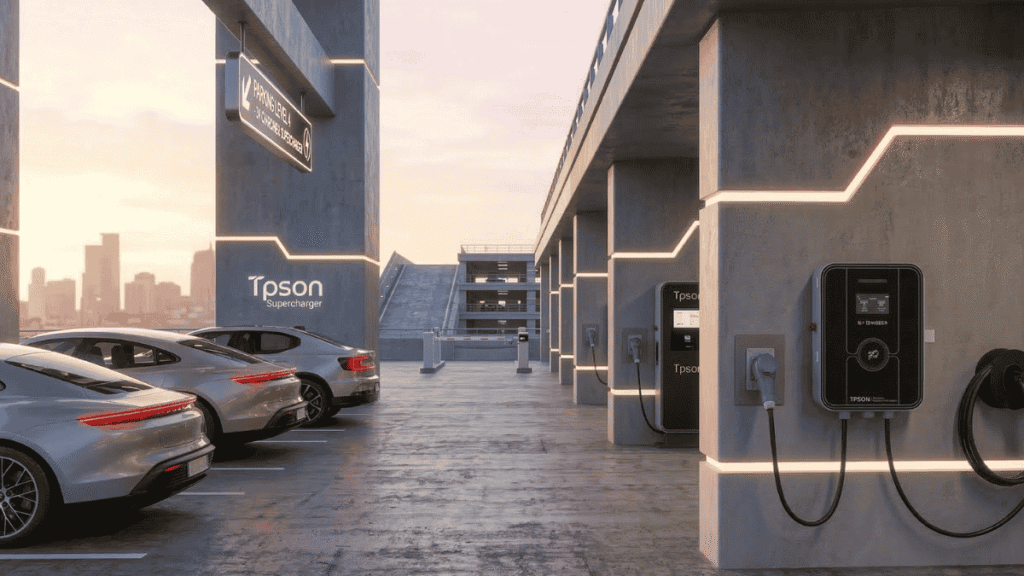
TPSON positions its EV charging solutions around safety and energy intelligence, including features such as Dynamic Load Balancing, Dynamic Temperature Control, and real-time diagnostics & alerts, powered by its patented Current Fingerprint Algorithm. When a home’s capacity is the constraint, managing load is typically safer than pushing a marginal cord setup. Explore: EV Chargers and AC EV Chargers.
For emergency and operations: use purpose-built mobile equipment
For roadside assistance, events, or flexible depot operations, a purpose-built solution is more defensible than a web of cords. TPSON’s portable DC TP-DC Compact Series lists 20/30/40 kW modules, DC50–1000V output range, optional Ethernet/4G connectivity, and scenes such as emergency roadside assistance and fleet logistics management. See: DC EV Chargers.
FAQ (3)
1) Can an extension cord be used for Level 1 EV charging every day?
It can function, but daily reliance increases risk and wear. A cord should be treated as temporary. If daily charging is expected, installing the outlet where the vehicle parks—or installing a dedicated EVSE—is the safer long-term solution.
2) What is the biggest danger when using an extension cord for Level 1 charging?
Heat at connection points (outlet-to-plug, plug-to-EVSE). Long charging sessions make small resistance issues become significant heat over time.
3) How can a homeowner tell if the setup is unsafe?
Warm/hot plugs, discoloration, smells, loose fit, or frequent charging interruptions are the most practical warning signs. Any of these should trigger an immediate stop and professional evaluation.
Sources and outbound links
The following pages were referenced for factual statements and product/company context.
- Car and Driver — charging level definitions and home charging context: https://www.caranddriver.com/shopping-advice/a39917614/best-home-ev-chargers-tested/
- Emporia — plug vs hardwire discussion, current limits, and safety/GFCI notes for a mainstream home Level 2 EVSE: https://shop.emporiaenergy.com/products/emporia-ev-charger
- TPSON — EV charger portfolio overview (AC with Dynamic Load Balancing; DC solutions): https://tpsonpower.com/ev-chargers/
- TPSON — AC EV charger category page: https://tpsonpower.com/ac-ev-chargers/
- TPSON — portable DC EV charger specs and scenarios: https://tpsonpower.com/portable-dc-ev-charger/
- TPSON — company background (founded 2015; Current Fingerprint Algorithm; team and milestones): https://tpsonpower.com/about/
Required internal links included naturally: EV Chargers, EV Chargers manufacturer, AC EV Chargers, DC EV Chargers.