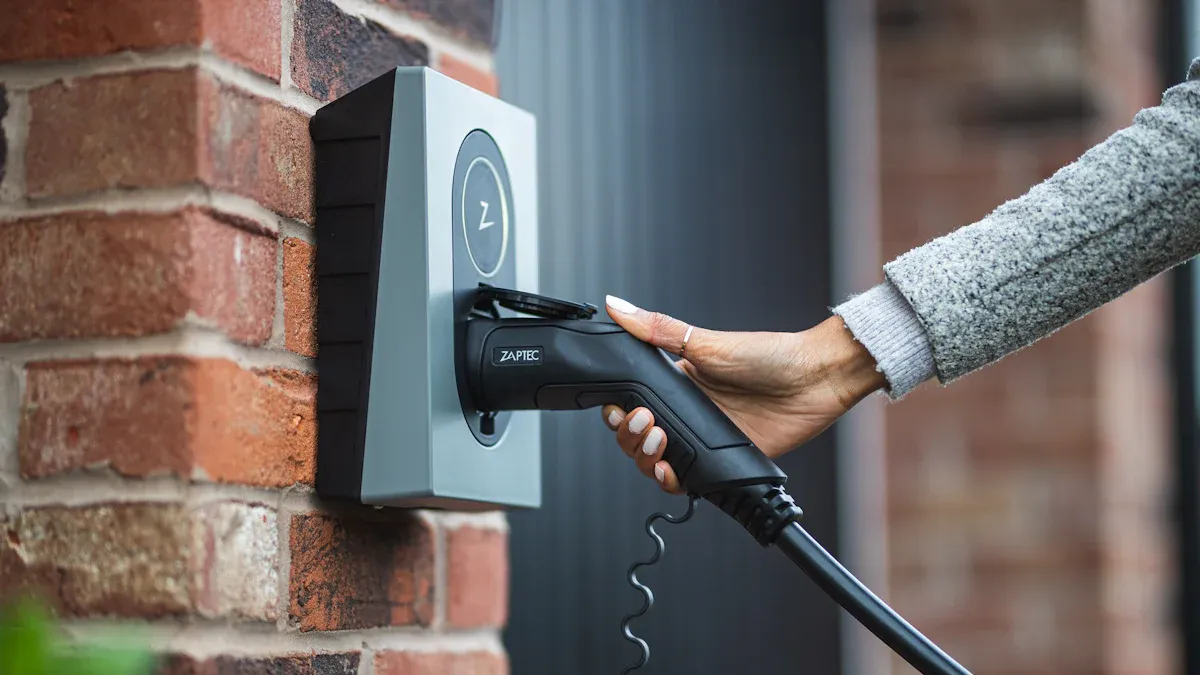
A 7kW charger is the most practical choice for the vast majority of homes in the UK. This home EV charger provides an ideal balance of charging speed and cost-effectiveness for a home charging setup. It aligns perfectly with the standard single-phase power supply. While faster 11kW and 22kW ac wall chargers offer quicker charging, their installation requires a three-phase supply. This makes the powerful EV Charger impractical for most EV home charging. EV charger manufacturers like TPSON provide advanced EV charging solutions, from a dedicated EV charger to portable ev chargers, yet the 7kW unit remains the standard for any EV owner’s home.
Understanding the Basics of EV Charging Power
Choosing the right charger requires understanding some fundamental concepts. The power rating and charging type are the most important factors. These elements determine how quickly an electric vehicle’s battery can be replenished.
What Does “kW” Mean for Your Home EV Charger?
The term “kW” or kilowatt is central to any discussion about EV charging. It is the unit of measurement for electrical power.
Kilowatts as a Measure of Power Flow
A kilowatt (kW) represents the rate of electricity flow. Think of it like water flowing through a hose. A higher kW rating is like a wider hose, allowing a greater volume of electricity to pass through to the vehicle’s battery in the same amount of time. This flow of power is the foundation of charging performance.
How Power Translates to Charging Speed
The power rating of a charger directly correlates to its charging speed. A charger with a higher kW output delivers more energy per hour. For instance, a 7.4 kW charging point can supply 7.4 kilowatt-hours (kWh) of energy in one hour. This higher power flow significantly reduces the time needed to recharge an EV battery compared to a lower-power alternative.
The Difference Between AC and DC Charging
Electric vehicles use two types of electrical current for charging: Alternating Current (AC) and Direct Current (DC). The key difference lies in where the power conversion happens.
AC Charging: The Standard for Home Use
AC charging is the universal standard for home and workplace installations. The electrical grid supplies AC power, which is sent to the vehicle. The car’s own onboard charger then converts this AC power into DC power to store it in the battery.
Why is AC the home standard?
- Cost-Effective: AC chargers are less complex, making them more affordable to install and operate.
- Simple Installation: They connect to the standard residential power supply, simplifying the setup process for a home.
- Ideal for Overnight Charging: The charging duration is perfect for vehicles parked for extended periods, such as overnight.
Technologically advanced providers like TPSON focus on these practical AC solutions for the domestic market.
DC Charging: Rapid Power on the Go
DC charging, often called “rapid charging,” is much faster. In this system, a large converter inside the charging station transforms AC power from the grid into DC power before it ever reaches the car. The DC power flows directly to the EV battery, bypassing the car’s slower onboard charger. This external conversion allows for extremely high power levels, but the equipment is large, complex, and expensive, making it suitable for public stations, not residential properties.
| Feature | AC Charging | DC Charging |
|---|---|---|
| Conversion Location | Inside the car (onboard charger) | Outside the car (in the station) |
| Typical Use | Home, workplace, overnight | Public stations, quick top-ups |
| Charging Speed | Slower (e.g., 7kW) | Rapid (50kW to 350kW) |
| Installation Cost | Lower | Significantly Higher |
The Case for 7kW: The UK Home Charging Standard
A 7kW charger represents the default choice for EV home charging in the United Kingdom. It hits the sweet spot between performance, cost, and compatibility with the nation’s residential infrastructure. This power level is not just a popular option; it is the most logical one for the average EV owner.
Why 7kW is the Perfect Fit for UK Homes
The suitability of a 7kW charger is directly tied to the electrical system found in nearly every home in the UK. It operates perfectly within the limits of this standard setup.
Single-Phase Power Explained
Most residences in the UK run on a single-phase power supply. This system delivers electricity through two wires: one live and one neutral. A standard single-phase residential supply in the UK typically provides 230 volts and up to 80 amperes, creating a stable and sufficient power flow for all typical household appliances.
How 7kW Maximizes Your Home’s Supply
A 7kW charger is engineered to draw power safely without overloading a home’s single-phase supply. It maximizes the available power for EV charging, offering the fastest charging speeds possible on this type of connection.
This balance is crucial. It allows a 7kW charger to fully charge an EV battery in approximately 8 hours, making it ideal for overnight charging. Homeowners can replenish their vehicle’s battery without needing expensive and complex electrical upgrades to their home.
Real-World Charging Speeds with a 7kW Unit
The theoretical power of a charger only matters when translated into practical performance. A 7kW unit delivers consistent and predictable charging speeds.
Miles of Range Added Per Hour
A 7kW charger typically adds around 25 to 30 miles of range for every hour of charging. This rate can vary slightly based on the EV model’s size and efficiency. For example:
- Smaller, efficient cars might gain 30 miles per hour.
- Larger, heavier vehicles may see closer to 20-25 miles per hour.
Typical Overnight Charging Scenarios
This charging rate means any EV can be fully charged overnight. A Nissan Leaf might take around 10 hours to go from empty to full, while a Dacia Spring can charge from 20% to 100% in about 4 hours. Even a larger Tesla Model Y can achieve a full charge in around 12 hours, well within a typical overnight window.
Is 7kW Fast Enough for Your Daily EV Use?
For the vast majority of drivers, 7kW charging is more than sufficient. With most daily commutes being under 30 miles, a 7kW charger can replenish that usage in about an hour. This ensures your EV is ready to go every morning with a full battery.
Installation Simplicity and Cost of 7kW Chargers
The practicality of a 7kW home EV charger extends to its installation and overall cost, making it an accessible choice for many.
The Standard Installation Process
The installation of a 7kW charger is a straightforward job for a qualified electrician. The process involves mounting the unit and connecting it to the home’s consumer unit (fuse box) with a dedicated circuit. Companies like TPSON provide these advanced yet easy-to-install charging solutions.
Typical Costs for a 7kW Home EV Charger
The total cost for a 7kW charger, including both the unit and a standard installation, generally ranges from £800 to £1,200. This investment provides a reliable and efficient charging station at your home, eliminating the reliance on public networks for daily needs.
The Role of Your Car’s Onboard Charger in AC Charging
An EV owner might assume that a more powerful wall charger automatically means faster charging. However, the vehicle itself plays the most critical role in determining AC charging speed. The wall charger offers the power, but the car dictates how much of that power it can actually accept.
Your Car Sets the Ultimate Speed Limit
The key component governing this process is the onboard charger (OBC). It acts as the gatekeeper for all AC power entering the vehicle’s battery.
What is an Onboard Charger (OBC)?
The onboard charger is a component inside the electric vehicle. Its primary function is to convert the Alternating Current (AC) from a home wallbox or public AC station into the Direct Current (DC) that the EV battery requires for storage. The efficiency and reliability of this internal charger significantly influence the overall charging experience.
How the OBC Limits AC Charging Speed
Every OBC has a maximum power rating, measured in kilowatts (kW). This rating creates a ceiling for the charging speed, regardless of how powerful the external charger is.
For example, if an EV has an OBC with a 7.4kW capacity, it will only draw 7.4kW of power. Connecting it to a 22kW charger will not make it charge any faster. The vehicle will still only accept 7.4kW, making the extra power from the wallbox unusable.
Common Onboard Charger Ratings in the UK
Vehicle manufacturers choose OBC ratings based on a balance of cost, weight, and intended use. This leads to a few common standards in the UK market.
Why Most EVs Cap at 7kW or 11kW AC
Most fully electric vehicles sold in the UK feature an OBC with a capacity between 7kW and 7.4kW. This aligns perfectly with the standard single-phase home power supply. Some premium models support 11kW AC charging, but this is less common. Plug-in hybrid electric vehicles (PHEVs) often have even slower onboard chargers, typically rated around 3.6kW.
The Mismatch: Why a 22kW Home Charger is Often Wasted
Installing a 22kW charger for a vehicle with a 7.4kW or 11kW OBC results in a significant mismatch. The extra cost and complex installation of the 22kW unit provide no benefit, as the car cannot use the additional power. This highlights the importance of ensuring compatibility between the charger and the vehicle for an efficient charging setup.
How to Check Your EV’s Maximum AC Charging Rate
Before investing in a charger, an EV owner must know their vehicle’s maximum AC charging rate. This information is readily available from several sources.
Finding Information in Your Vehicle Manual
The most reliable source is the vehicle’s user manual. The manufacturer’s official website also lists detailed technical specifications, including the maximum power for AC charging. This ensures you have accurate information directly from the source.
Using Online Databases and Resources
For quick reference, several online resources provide comprehensive guides on EV compatibility and charging specifications. Checking these databases can help you easily find your car’s limits. Key places to look include:
- The car’s official specification sheet
- The car manufacturer or authorized dealer
- Reputable EV charging guides online
Understanding your EV’s capabilities is the first step toward choosing the right charger from a provider like TPSON, ensuring perfect compatibility and performance.
Exploring 11kW and 22kW AC Wall Chargers: The High-Power Options
While a 7kW charger is the standard, some EV owners consider higher-power 11kW and 22kW AC wall chargers. These units promise faster charging speeds. However, their practicality for standard EV home charging is limited by a significant electrical requirement: a three-phase power supply.
The Critical Three-Phase Power Requirement
The main barrier to installing a high-power charger at home is the need for a three-phase electrical connection. This type of supply is fundamentally different from the one found in most UK homes.
What is a Three-Phase Supply?
A three-phase supply delivers power through three separate wires. This setup provides a more stable and consistent flow of electricity compared to a single-phase connection. It is designed to handle much heavier electrical loads.
| Feature | Single-Phase Power Supply | Three-Phase Power Supply |
|---|---|---|
| Conductors | One power conductor | Three power conductors |
| Voltage (Approx.) | Up to 230V | Up to 415V |
| Power Delivery | Rises and falls, not constant | Constant and stable power delivery |
| Typical Use | Homes, standard appliances | Industrial setups, commercial properties |
Why It’s Rare in UK Residences
The residential electrical grid in the UK was built around single-phase power. It provides ample electricity for typical household needs. Upgrading an entire neighborhood’s infrastructure to three-phase is not practical or necessary for domestic use. Therefore, it is very uncommon in existing residential properties.
Standard Use in Commercial Properties
Commercial and industrial sites often require a three-phase supply. This power is necessary to run heavy machinery, large HVAC systems, and data centers. This is why you often see 22kW chargers in business car parks and depots, where the necessary electrical infrastructure already exists.
The Process and Cost of a Three-Phase Upgrade
An EV owner wanting an 11kW or 22kW charger must first upgrade their home’s electrical supply. This process is both complex and expensive.
Assessing Feasibility with Your DNO
The first step is to contact your local Distribution Network Operator (DNO).
- An electrician must first assess your home’s needs.
- You then request a three-phase connection from the DNO. The DNO will check the local grid capacity and provide a quote.
- If approved, you must arrange for your energy supplier to install a new three-phase meter.
- The DNO performs external work to connect new cables to your property.
- Finally, an electrician completes the internal installation.
The High Financial Cost of Upgrading
The cost of this upgrade is substantial. Homeowners can expect to pay between £3,000 and £8,000 for the installation. This high price covers the complex engineering work and equipment needed to bring a three-phase supply to a home.
Is the Investment Worth It for Home Use?
For most people, the high cost of a three-phase upgrade does not justify the faster charging speeds. The investment provides diminishing returns, especially when a 7kW charger already meets overnight charging needs for any EV.
Who Actually Needs an 11kW Charger or 22kW Charger at Home?
A small number of users can benefit from these powerful chargers. Their specific circumstances make the investment worthwhile.
Homeowners with Existing Three-Phase Power
Some new-build luxury homes or properties with large workshops may already have a three-phase supply. In these rare cases, installing an 11kW charger or 22kW charger is a logical choice, provided their vehicle can accept the faster charging rate.
Drivers with Exceptionally High Daily Mileage
An individual who drives over 150-200 miles daily and needs a rapid top-up between trips might consider an upgrade. This scenario is very uncommon for a typical residential driver.
Users with Specific Commercial Vehicle Needs
Commercial fleet operators are the primary beneficiaries of 22kW charging. A business with a fleet of electric vans needs to maximize vehicle availability. Fast charging at a depot between shifts is essential for operational efficiency. For these users, a powerful charger from a provider like TPSON is a critical business tool.
Head-to-Head Comparison: 7kW vs. 11kW vs. 22kW
Choosing the right power level requires a direct comparison of the key factors. A 7kW charger, an 11kW charger, and a 22kW charger offer different performance levels, but their suitability for a home setting varies dramatically. The decision hinges on power supply, installation complexity, and overall cost.
Quick Comparison Table
This table provides a clear overview of the fundamental differences between these AC wall chargers. It highlights why 7kW is the standard for most residential properties.
Required Power Supply: Single-Phase vs. Three-Phase
Typical Charging Speed: Miles of Range Per Hour
Home Installation Feasibility: Simple vs. Complex
Best Use Case: Standard Homes vs. Commercial Sites
| Feature | 7kW Charger | 11kW & 22kW Chargers |
|---|---|---|
| Required Power Supply | Standard single-phase (230V) | Three-phase (400V) |
| Typical Charging Speed | ~30 miles of range per hour | ~40 to ~80 miles of range per hour |
| Home Installation Feasibility | Simple and straightforward | Complex and very expensive |
| Best Use Case | Nearly all UK homes | Commercial sites, depots, rare homes with existing three-phase power |
A Detailed Cost-Benefit Analysis
A financial analysis reveals the practical choice for most EV owners. The faster charging speeds of high-power units come at a disproportionately high cost for a residential setting.
Comparing Initial Hardware and Installation Costs
The initial outlay for a home EV charger system involves both the unit and the installation.
- A standard 7kW charger installation package typically costs between £800 and £1,200. This covers the unit, cabling, and professional fitting.
- The hardware for 11kW and 22kW units is more expensive. The installation is also more complex, requiring larger cabling and more labor. This can add £700 to £900 to the total cost compared to a 7kW charger, even before considering the power supply.
An electrician must first inspect the property’s fuse box to determine the feasibility of any installation. For most homes, this inspection confirms that only a single-phase connection is available.
The Long-Term Value Proposition
The long-term value of a charger is measured by its ability to meet daily needs efficiently and affordably.
- A 7kW charger provides exceptional value. It fully recharges any EV overnight using the existing home electrical supply. This makes it a cost-effective, “fit-and-forget” solution for daily charging.
- The value of 11kW or 22kW chargers at home is limited. The faster charging is often unnecessary for overnight schedules. The primary benefit is only realized in commercial settings where vehicle turnaround time is critical. For a home, the extra expense rarely translates into a meaningful real-world advantage.
Identifying the Point of Diminishing Returns
The point of diminishing returns is where the extra cost of a feature far outweighs its benefit. For home charging, this point is the three-phase upgrade.
- A 7kW charger offers the best balance of cost and performance.
- Upgrading a home to a three-phase supply can cost anywhere from £3,000 to over £15,000.
This enormous financial leap delivers faster charging that most drivers do not need and many vehicles cannot even accept. The lack of vehicle compatibility and the high cost of the supply upgrade make 11kW and 22kW chargers an impractical investment for the average home. The smart money stays with a 7kW unit from a trusted provider like TPSON, which ensures perfect compatibility with your home and vehicle.
Future-Proofing and Other Key Considerations
An EV owner must consider more than just raw power. Future viability, smart features, and available grants are all crucial factors in selecting the right home charge point. These elements ensure a long-term, cost-effective, and safe charging experience.
Will 7kW Chargers Become Obsolete?
Some buyers worry that a 7kW charger might not be sufficient for future electric vehicles. However, this concern is largely unfounded due to the UK’s infrastructure and established user behaviors.
The Longevity of Single-Phase Supply in the UK
The residential electrical grid in the UK is built on a single-phase supply. A nationwide upgrade to three-phase is not financially or logistically feasible. Therefore, single-phase power will remain the standard for homes for the foreseeable future, making the 7kW charge point the most compatible high-power option.
Evolving Battery Sizes vs. Established Charging Habits
While EV battery sizes are increasing, charging habits remain consistent. Most drivers charge their vehicles overnight. A 7kW unit can fully replenish even the largest EV battery within a typical 8-12 hour overnight window. This makes faster charging speeds unnecessary for daily use.
Smart Charging and Load Balancing
Modern chargers from providers like TPSON offer intelligent features that enhance safety and reduce costs. Smart charging is now a mandatory feature for any new charge point installation.
How to Optimize Your 7kW Charger
A smart charge point gives an owner significant control over their energy usage. Key features allow users to:
- Schedule Charging: Set the charge point to operate during off-peak hours when electricity tariffs are lower.
- Use Renewable Energy: Integrate with home solar panel systems to use self-generated, free electricity for vehicle charging.
- Monitor Usage: Track energy consumption and costs through a mobile app for better financial management.
Protecting Your Home’s Main Fuse
Dynamic load balancing is a critical safety feature. It prevents the home electrical system from overloading when the EV is charging and other high-draw appliances are in use.
The system works by using a sensor to monitor the total electricity demand of the property in real-time. If demand gets too high, the charge point automatically reduces the charging speed. When household demand drops, the charging rate increases again. This intelligent management protects the main fuse from tripping.
UK Government Grants and Incentives
The UK government offers financial support to encourage EV adoption, though eligibility is now more targeted.
The EV Chargepoint Grant for Flats and Renters
The EV Chargepoint Grant provides funding toward the cost of a new charge point. It is specifically for people who live in rental properties or own a flat. Key eligibility criteria include:
- You must rent any residential property or own a flat.
- The property must have a designated, private off-street parking space.
- You must own or have primary use of an eligible EV.
Homeowners living in houses are generally not eligible for this grant.
How Power Level Affects Grant Eligibility
The grant is available for OZEV-approved smart chargers, which includes 7kW models. The power level of the charge point does not typically affect eligibility, as long as the unit is on the government’s approved list and installed by a certified professional.
A 7kW wall charger is the most sensible choice for nearly every home in the UK. It provides ideal EV home charging for any electric vehicle overnight. The significant cost and complex installation of a three-phase supply are not justified for a typical home. Unless a property has a three-phase connection and a compatible vehicle, a 7kW charger remains the superior option. This ensures an efficient and cost-effective solution for daily charging needs.
FAQ
Which charger is best for a typical UK home?
A 7kW charger is the optimal choice for most homes in the UK. It provides the best balance of charging speed, installation cost, and compatibility with a standard single-phase power supply. It efficiently charges any EV overnight.
Is a three-phase supply necessary for a home charger?
A three-phase supply is only required for 11kW and 22kW chargers. A standard 7kW charger operates perfectly on the single-phase supply common in UK homes. Upgrading is expensive and usually unnecessary for residential use.
Will a 22kW charger always charge an EV faster?
No. The vehicle’s onboard charger (OBC) determines the maximum AC charging speed. If a car’s OBC is rated at 7.4kW, it will not charge any faster on a 22kW charger. The car itself limits the power intake.
How quickly does a 7kW charger add range?
A 7kW charger typically adds about 25-30 miles of range for every hour of charging. This rate allows any electric vehicle to achieve a full charge easily overnight, making it ideal for daily driving needs.
Will a 7kW charger become obsolete soon?
It is highly unlikely. The residential grid in the UK will remain predominantly single-phase for the foreseeable future. A 7kW charger fully meets overnight charging needs, even for EVs with larger batteries, making it a sound long-term investment.
What are the benefits of a smart charger?
Smart chargers allow owners to schedule charging for off-peak hours to save money. Technologically advanced providers like TPSON also include features like load balancing. This protects the home’s fuse by automatically adjusting charging speed during periods of high household electricity use.