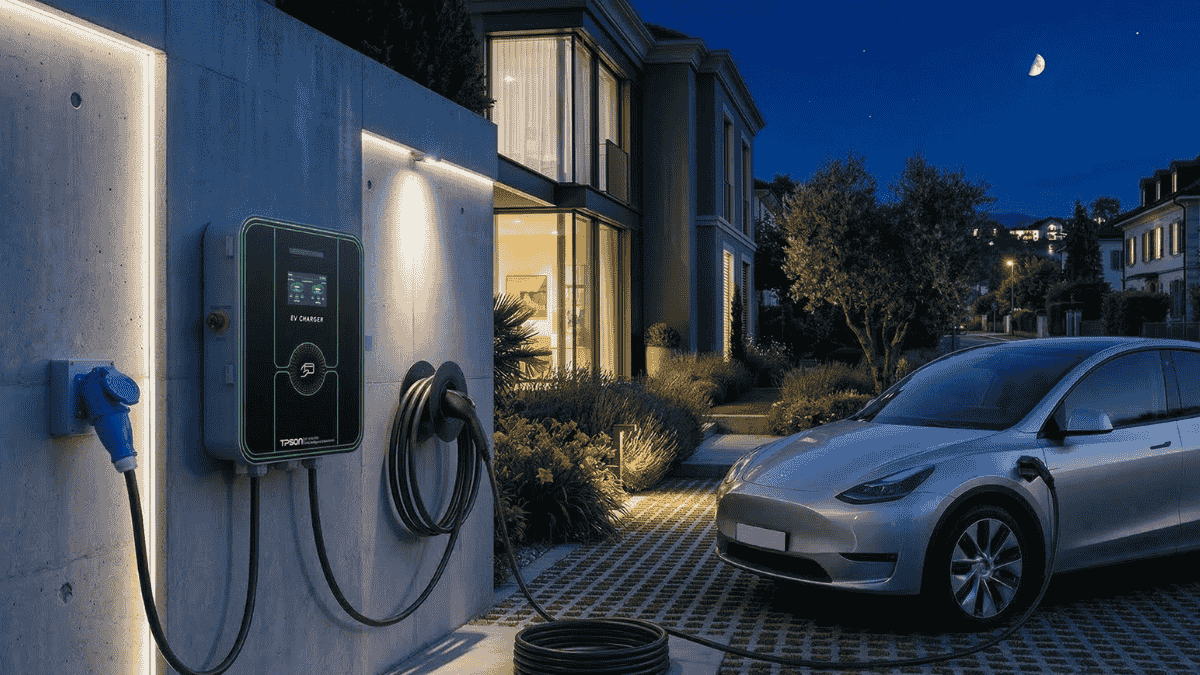
A 22 kW EV charger is often described as a major upgrade from standard home charging, delivering much faster AC replenishment than lower-power Level 2 options. But while 22 kW AC charging is common and practical in some global markets—especially where three-phase power is available—it is not automatically the best fit for every residential property. Whether it makes sense depends on your local electrical system, the vehicle’s onboard AC charging capability, installation cost, and how much charging speed you actually need.
This guide explains what a 22 kW EV charger is, how it compares with lower-power home chargers, what kinds of residential scenarios can realistically support it, and why AC charging intelligence can matter as much as raw output. The discussion is based on the supplied source material from TPSON, ChargePoint, Smart Charge America, Emporia, Love’s, and Car and Driver.
- What Is a 22 kW EV Charger?
- Why 22 kW Chargers Matter in the Global Market
- 22 kW vs. Common Home-Charging Power Levels
- Core Requirements for Using 22 kW at Home
- Why the Vehicle’s Onboard AC Charging Capability Determines Everything
- Is 22 kW Right for a Typical Home?
- What to Consider When Installing a 22 kW AC Charger
- Why Smart Load Management Is Even More Critical at 22 kW
- How TPSON Positions 22 kW AC Charging
- 22 kW AC vs. Home DC Fast Charging
- Who It’s For and Buying Recommendations
- Conclusion
A 22 kW EV charger typically refers to a high-power AC charging device, commonly found in markets that use three-phase electrical systems. Compared with the more common home Level 2 charging power levels—such as 7.7 kW, 9.6 kW, or 11.5 kW in many North American contexts—22 kW AC charging can significantly reduce charging time, especially for vehicles that support higher AC input power.
In a three-phase environment, 22 kW AC charging typically corresponds to a higher—yet still manageable—current configuration. TPSON’s AC product system clearly includes 22 kW-class products, showing that globally, 22 kW is not a niche concept, but a real-world solution for many homes, commercial destinations, and semi-public parking locations.
From TPSON’s overall product structure, EV Chargers cover both residential AC and commercial/emergency DC. That positioning itself suggests that 22 kW AC can be reasonable in certain residential scenarios—but only when the electrical infrastructure and the vehicle capabilities match.
In North America, many home-charging discussions revolve around 32A, 40A, 48A, and 50A because single-phase 240V is common. In Europe and other regions where three-phase power is more widely available, 11 kW and 22 kW AC charging is more common. 22 kW matters for three key reasons:
- It’s faster than standard residential AC charging and can meaningfully shorten replenishment time
- It is usually far less expensive than DC fast charging, making it better suited for long-term residential and destination deployments
- It can provide strong flexibility across homes, villas, shared parking, premium apartments, and light-commercial sites
ChargePoint includes both Level 2 AC and Level 3 DC within a unified platform and emphasizes open software, flexible hardware, and OCPP compatibility. This platform approach signals that high-power AC is not a “lower-end version” of DC fast charging—it’s a distinct layer of EV infrastructure.
Love’s network deployment also shows that the real world uses a mix of Level 2 and Level 3. While highway corridors clearly lean toward DC fast charging, AC charging is still retained to match different dwell times and energy needs. That further reinforces the value of higher-power AC charging in many non-high-turnover scenarios.
Placing 22 kW within the broader AC charging spectrum helps clarify where it fits:
| Charging Type | Typical Power | Common Scenarios |
|---|---|---|
| Level 1 AC | ~1 kW | Emergency use or very low-intensity home charging |
| Basic Level 2 AC | 7.2–7.7 kW | Typical overnight home charging |
| Enhanced Level 2 AC | 9.6–11.5 kW | Faster premium home AC charging |
| Three-phase AC | 11 kW | European and other three-phase residential/commercial sites |
| High-power three-phase AC | 22 kW | Premium homes, shared parking, destination sites, light commercial |
| DC fast charging | 20 kW–350 kW+ | High-turnover sites, highway corridors, fleets, public fast charging |
Car and Driver notes in a North American home-charging context that Level 2 typically falls roughly in the 6 kW to 19 kW range. At 22 kW, you’re slightly above that common North American residential band, further suggesting that 22 kW at home is more of a “high-spec option” for certain markets and specific electrical conditions—not a universal default.
In Smart Charge America’s commercial lineup, the ChargePoint CP6000 can also deliver up to 22 kW of AC output. This again shows that 22 kW AC is a mature, real product class—its residential suitability simply depends heavily on local electrical conditions.
Whether a 22 kW EV charger can realistically be used at home isn’t about availability—it comes down to whether the following conditions are true:
22 kW AC charging typically requires a higher-spec electrical supply and, in many countries, three-phase power. If the home only has standard single-phase residential supply, 22 kW is often impractical—or too expensive to implement.
If the vehicle’s onboard AC charger can only accept around 7 kW or 11 kW, then even with a 22 kW charger installed, the vehicle will not charge at 22 kW.
If the vehicle is parked overnight for long hours, 11 kW—or even 7 kW—may already meet your needs, and the extra speed from 22 kW may not justify the additional investment.
22 kW is better suited for short-stop, frequent top-ups, premium multi-vehicle households, shared residential parking, semi-commercial apartments, or villas—not every “typical commuting household.”
Car and Driver repeatedly emphasizes in its home-charging explanations that the true determinant of AC charging speed is the onboard charger inside the vehicle. No matter how high the EVSE’s output rating is, if the vehicle’s acceptance is lower, charging power will plateau at the vehicle’s limit.
That means the value of 22 kW AC charging at home depends first on whether your vehicle can actually use—fully or close to fully—that level of input. If it can’t, 22 kW remains more of an “equipment capability” than “real-world speed.”
So when considering higher-power AC EV Chargers, confirming your vehicle’s AC charging capability is always more important than looking at wallbox power first.
For a “typical home,” the answer is usually: not necessarily—and often, it isn’t needed.
Most popular products recommended in Car and Driver’s North American home-charger testing include:
- Emporia Pro / Classic
- ChargePoint Home Flex
- Tesla Universal Wall Connector
These products mostly sit in the 40A to 50A range (roughly 9.6 kW to 12.0 kW), or at 48A (about 11.5 kW). The reason is straightforward: for many households, that tier is enough to fully—or nearly fully—recharge overnight, with more manageable installation difficulty and cost.
Meanwhile, Emporia clearly distinguishes between:
- NEMA plug-in: easy to install and movable, but limited to 40A
- Hardwired: can increase to 48A
This mainstream product structure shows that the broad home market is not centered on 22 kW, but on more balanced 40A–48A options. In residential settings, 22 kW is better viewed as an upgrade for homes with the right infrastructure and clearly defined higher-power needs.
Even if your local residential electrical conditions allow it, installing 22 kW at home should involve a careful review of the following:
Residential 22 kW AC deployment typically requires three-phase supply. If three-phase power is uncommon in local homes, implementation costs can increase significantly.
Higher-power AC charging consumes more of the available electrical capacity. A qualified electrician should perform a load calculation based on continuous load rules, other high-demand household appliances, and future expansion plans.
GFCI coordination issues (as referenced in Emporia materials) should be evaluated in advance, especially at higher power. High-power residential chargers are more likely to be hardwired rather than deployed as simple plug-in installations.
More power means more heat. Temperature control, diagnostics, and fault protection become more important for reliability and safety.
If you only need to add 15–25 kWh per day, 22 kW can complete the job in a few hours—and 11 kW can still easily cover it overnight. Whether the extra cost is justified depends on your actual usage intensity.
As AC charging power increases, the importance of dynamic load management rises quickly. The reason is simple: 22 kW affects total household load far more than a typical home charger. If air conditioning, ovens, water heaters, dryers, and other major appliances are running at the same time, high-power EV charging is more likely to become a stress point for the home electrical system.
TPSON’s positioning is representative here. Its website highlights:
- Dynamic Load Balancing
- Advanced Safety Protection
- Dynamic Temperature Control
- Real-Time Diagnostics & Alerts
TPSON’s EV Chargers overview also notes that its AC products protect home electrical systems through innovative Dynamic Load Balancing. This is especially important for 22 kW residential scenarios because high-power AC should not only be “faster,” but also “more stable and safer.”
Car and Driver’s view of the Emporia Pro follows the same logic: monitoring total home load and adjusting output in real time can help avoid expensive electrical upgrades. While Emporia’s mainstream products aren’t 22 kW, the underlying approach applies directly to higher-power residential AC charging.
As an EV charger manufacturer that has been building an intelligent energy and charging ecosystem around its Current Fingerprint Algorithm since 2015, TPSON’s AC lineup is clearly designed for multi-scenario global markets—not only for single-country residential needs.
Based on the provided TPSON content, its overall strategy includes:
- An AC wallbox product line
- Dynamic load management
- Global-standard connector compatibility
- Expansion into commercial and emergency DC fast charging
In this system, 22 kW AC is best viewed as one of TPSON’s key power tiers for international residential and light-commercial scenarios. It fits users who have the electrical conditions, want faster charging while staying within the AC ecosystem, and don’t want to jump straight into higher-cost DC fast charging.
From an architecture standpoint, TPSON’s advantage is not merely pushing power higher, but making higher-power AC safer, more manageable, and better suited for long-term system integration.
Some users ask: if 22 kW AC is already fast, how does it relate to DC fast charging? The answer is that they serve different tiers of needs.
Car and Driver clearly notes that Level 3 / DC fast charging is usually not suitable for typical homes because it is too expensive. TPSON’s DC EV Chargers page also positions its 20 kW, 30 kW, and 40 kW portable DC products for:
- Roadside assistance
- Fleets and logistics
- Events and temporary sites
- Dealers and service centers
This highlights the residential role of 22 kW AC: it offers a faster—but still relatively manageable—middle-ground option between “standard home AC charging” and “more expensive DC fast charging.”
In other words, if your home use case clearly exceeds what ~11 kW can comfortably cover, but you don’t want to enter the cost bracket of DC fast charging, 22 kW AC can be a very attractive intermediate choice.
A 22 kW EV charger is best suited for users who:
- Have three-phase power available at home
- Own a vehicle that supports higher AC charging input
- Have a premium home setup, multiple EVs, or shared parking needs
- Want shorter charging windows while staying with AC charging
- Need a solution that can serve both residential and light-commercial use
On the other hand, 22 kW may not be the best option if:
- Local residential supply doesn’t support three-phase, or upgrades are too expensive
- Your vehicle’s onboard AC charging limit is relatively low
- You park overnight for long hours and 7–11 kW is already enough
- You care more about installation cost than maximum AC speed
- If you only need typical overnight charging, prioritize more standard residential AC power levels.
- If you have three-phase residential power, your vehicle supports higher AC input, and you want faster replenishment, 22 kW is well worth considering.
- If your core need is higher vehicle turnaround or mobile emergency fast charging, you should further evaluate DC solutions.
A 22 kW EV charger is a highly compelling high-power AC charging solution—especially for homes with three-phase power, shared parking spaces, premium apartments, villas, and certain light-commercial environments. It is much faster than standard home AC charging, yet is often easier to deploy and more economical than DC fast charging.
But it is not a default answer for every household. The factors that truly determine its value are the home’s electrical supply conditions, the vehicle’s onboard AC charging capability, the installation budget, and your real charging-time needs. For many households, around 11 kW is already sufficient; for users with higher demands who want to remain in the AC ecosystem, 22 kW can be an ideal upgrade.
If you are evaluating high-power AC charging solutions for residential and light-commercial use, you can start with TPSON’s EV Chargers ecosystem, then combine its AC EV Chargers pathway with expandable DC EV Chargers options to choose charging infrastructure that truly matches your property.