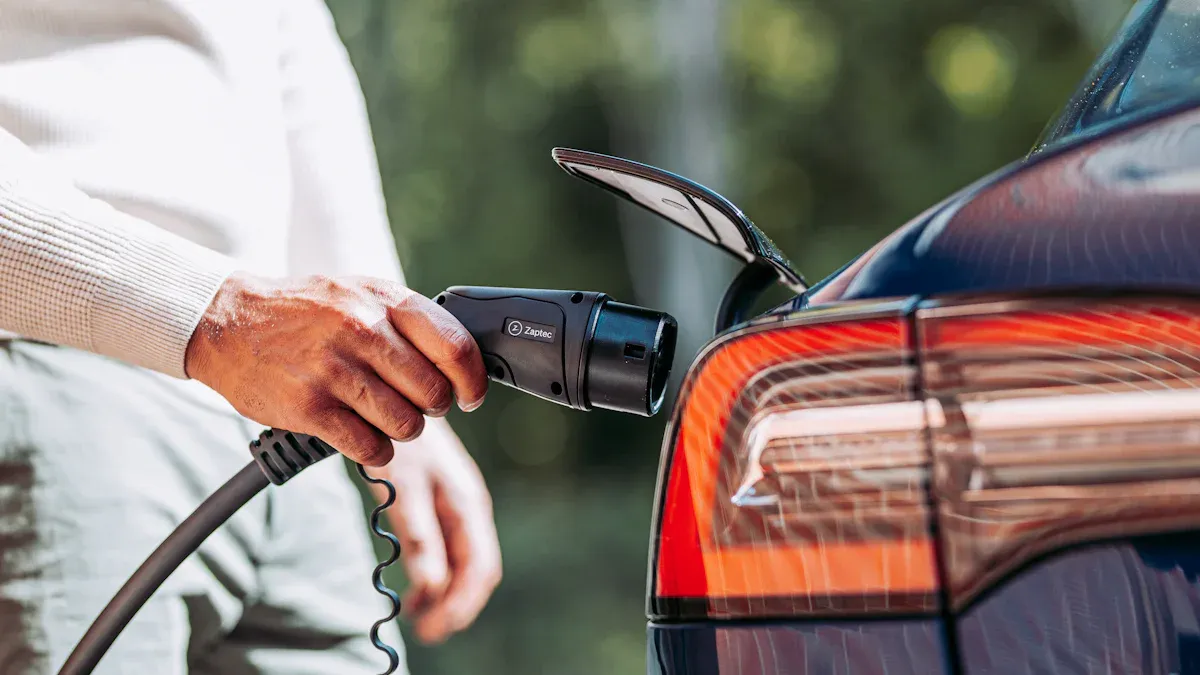
As you drive your EV across Europe, you now experience a rapid transformation in mobility. EV charging station regulations have fueled a 27% increase in public charging infrastructure deployment, making public charging availability more accessible. This shift supports a smarter, greener transport network. You see more charging stations, with Производители зарядных устройств для электромобилей and charging network operators collaborating to ensure seamless charging for electric vehicles. The table below highlights the impact of these changes on the electric vehicle ecosystem:
| Основные сведения | Описание |
|---|---|
| Stakeholder Collaboration | Reliable charging network requires strong partnerships |
| Barriers to EV Adoption | Addressing challenges increases confidence in electric vehicles |
| Actionable Recommendations | Practical steps enhance the Зарядное устройство для электромобилей experience |
Regulatory Trends Shaping EV Charging Station Mobility
Harmonization and Diversity in EV Charging Station Policy
National vs. EU-Level EV Charging Station Regulations
You see a dynamic landscape when driving your EV across Europe. National governments and the European Union set distinct requirements for EV charging station deployment. EU policy, such as the Alternative Fuels Infrastructure Regulation (AFIR) and the Energy Performance Building Directive (EPBD), establishes minimum standards for infrastructure coverage and technical specifications. These regulations ensure that you find a charging station every 60 kilometers on major transport corridors and that new buildings include charging points.
| Положение | Key Requirements |
|---|---|
| Регулирование инфраструктуры альтернативных видов топлива (AFIR) | – Binding targets for charging infrastructure – Charger every 60 km on TEN-T core networks – Minimum power output of 400 kW by 2025, increasing to 600 kW by 2027 – Payment options must be user-friendly and accessible without membership |
| Energy Performance Building Directive (EPBD) | – Mandates installation of charging points in new and renovated buildings – At least one charging point for every five parking spaces in non-residential buildings – Pre-cabling for 50% of parking spaces in residential buildings |
National policies often go further, adapting requirements to local needs and energy strategies. Some EU countries prioritize renewable energy integration, while others focus on rapid infrastructure expansion. This diversity shapes the economic outcomes and effectiveness of EV charging coverage.
| Доказательства | Описание |
|---|---|
| Standardization of Charging Systems | The adoption of CCS in Europe is crucial for interoperability and reducing fragmentation in the charging ecosystem. |
| Influence of National Energy Policies | Diverse policies can either facilitate or hinder the development of charging infrastructure, impacting economic outcomes. |
| Need for Coordinated Policymaking | Effective deployment of EV charging stations requires strategic planning and investment at the EU level. |
Urban and Rural EV Charging Infrastructure Differences
You notice significant differences in infrastructure between urban and rural areas. Cities often lead in public charging infrastructure density, offering fast charging options and integrated payment systems. Rural regions face unique challenges, such as lower population density and longer travel distances. Policymakers address these gaps by setting higher targets for underserved markets and encouraging private investment.
Tip: When planning a trip with your electric vehicle, check charging station availability in rural areas. Infrastructure expansion in these regions continues to accelerate, but coverage may vary.
| Доказательства | Описание |
|---|---|
| National Diversity in Energy Policy | Variations in energy policies across countries influence economic outcomes and infrastructure development. |
| Importance of User Awareness | Tailored education programs are essential for effective EV charging deployment, adapting to local contexts while aligning with global best practices. |
| Interdependencies of Energy Policies | Necessary infrastructure for EV charging must be supported by user education tailored to local contexts. |
| Economic Implications of Policy Diversity | Diverse national policies impact the effectiveness of EV charging deployment across Europe. |
Key Drivers Behind EV Charging Infrastructure Regulatory Changes
Climate Goals and Emissions Targets for EVs
You play a vital role in Europe’s climate strategy when driving your EV. The European Commission aims to cut greenhouse gas emissions by at least 55% by 2030, focusing on transportation. Mass-market adoption of electric vehicles is necessary to meet these ambitious targets. Policymakers recognize a significant gap in public charging infrastructure and accelerate installation to support these goals.
- Mass-market adoption of electric cars is necessary to meet CO2-reduction targets.
- There is a significant gap in public charging infrastructure needed to achieve these targets.
- The installation of charging stations must accelerate to meet EU climate goals.
Government incentives drive infrastructure growth, especially in countries with low charging point density and high population density. An increase of 10% in charging infrastructure incentives can raise the average EV adoption rate to 46%. Infrastructure plans attract private investment and support organic growth in underserved markets.
| Основные выводы | Описание |
|---|---|
| Государственные стимулы | Effective incentive policies can significantly increase EV adoption rates. |
| Инфраструктура зарядки | An increase of 10% in charging infrastructure incentives can raise the average EV adoption rate to 46%. |
| Population Density Impact | Countries with low charging point density and high population density benefit more from infrastructure incentives. |
| Climate Goals | The European Commission aims to cut greenhouse gas emissions by at least 55% by 2030, focusing on the transportation sector. |
Consumer Demand and EV Market Growth
You drive demand for better infrastructure as EV adoption rises. Regulatory changes respond to your needs by requiring fair, open, and accessible charging stations. You benefit from smart charging capabilities, transparent pricing, and simplified payment options. Fast charging stations appear every 60 kilometers on the Trans-European Transport Network, supporting long-distance travel.
- Fast charging stations must be placed every 60 km on the Trans-European Transport Network (TEN-T).
- Chargers must provide at least 150 kW of power, with higher requirements for main network chargers.
- Ad-hoc payment options must be available, simplifying the payment process for users.
Charging infrastructure must support smart energy management and clear communication of costs. You experience a seamless network that adapts to your travel patterns and supports the growth of electric vehicles across Europe.
| Требование | Описание |
|---|---|
| Fair | Charging stations must not give preferential treatment and should be usable by everyone. |
| Open | Charging infrastructure should be accessible to the general public without restrictions. |
| Accessible | A sufficient number of chargers must be installed, especially in key transport locations. |
| Smart Charging | All public charging stations must support smart charging capabilities for better energy management. |
| Прозрачность ценообразования | Clear communication of costs and energy-based pricing must be established at charging points. |
The State of EV Charging Infrastructure in Europe

Growth and Distribution of Public Charging Points
You see rapid growth in EV charging infrastructure across Europe. As of 2025, over 1.1 million publicly accessible EV charging points support your journey. The Netherlands, Germany, and France lead in the number of charging points, making these countries key destinations for driving your EV. The infrastructure includes both AC and DC chargers, with a strong focus on fast charging capabilities. By 2030, you will need access to an estimated 3 million new charging points, bringing the total to nearly 3.9 million. The EU has already surpassed one million public EV charging points, with 941,953 AC chargers and 206,109 DC chargers. Growth remains uneven, with some countries investing heavily while others lag behind.
- Over 1.1 million public charging points are available in Europe.
- The Netherlands, Germany, and France host the majority of charging points.
- Infrastructure includes AC and DC chargers, with fast charging expansion.
- By 2030, Europe will require 3.9 million charging points to meet demand.
- Distribution varies, with some countries investing more in infrastructure.
Public vs. Private EV Charging Networks
You rely on both public and private networks to keep your EV charged. Public charging infrastructure provides accessible charging options in cities, along highways, and at key destinations. Private networks, often found in homes and workplaces, offer convenience for daily charging. The balance between public and private networks shapes your experience, especially when traveling long distances. Public charging points remain essential for cross-country trips and urban mobility, while private infrastructure supports routine charging needs.
Fast Charging and Ultra-Fast Public Charging Infrastructure Expansion
You benefit from the expansion of fast charging and ultra-fast public charging infrastructure. Fast charging stations reduce waiting times and make long journeys possible. The infrastructure now includes more DC chargers, which deliver higher power and faster charging speeds. You find these stations along major transport corridors and in urban centers. The focus on fast charging supports the growing number of EVs and helps you travel efficiently across Europe.
Accessibility and Interoperability of EV Charging Station Networks
You expect seamless access to charging stations, regardless of location. The AFIR regulation aims to standardize and enhance accessibility and interoperability across the EU. All users, including those with disabilities, can access charging facilities. By the end of 2024, the EU will have over 882,012 public charging points, with 16% DC chargers and 84% AC chargers. Countries with high charging point density, such as the Netherlands, Germany, and France, offer more AC chargers. These three countries host 61% of all EU charging points, even though they occupy only 22% of its land area. You notice significant differences in infrastructure investment, with Germany committing €6.3 billion to expansion. In contrast, countries like Croatia, Estonia, and Latvia have fewer than 1,100 chargers.
Standardized Payment Systems for Public Charging Points
You encounter challenges when paying for charging services. Fragmented payment systems create barriers, especially when traveling across borders. The lack of uniform standards for data exchange and authentication complicates your experience. Ensuring compliance with cybersecurity regulations remains crucial for the safety and reliability of charging stations.
| Вызов | Описание |
|---|---|
| Fragmented payment systems | Different payment systems across regions create barriers for users trying to charge their EVs. |
| Lack of uniform standards for data exchange | Without standard protocols, data sharing between stakeholders is inconsistent and inefficient. |
| Compliance with cybersecurity regulations | Ensuring security against threats is crucial for the safety and reliability of charging stations. |
| Absence of a unified authentication system | Multiple proprietary solutions complicate the user experience and hinder seamless access to services. |
Cross-Border Public Charging Infrastructure Challenges
You face additional challenges when driving your EV across borders. Disparities in infrastructure and payment systems make cross-border travel more complex. Some countries invest heavily in public charging infrastructure, while others lag behind. You must plan your route carefully to ensure access to reliable charging points. The EU continues to work toward harmonizing standards and improving interoperability, but differences remain.
Tip: Before embarking on a cross-border trip, check the availability of public charging points and payment options in each country. This preparation helps you avoid unexpected delays and ensures a smooth journey.
EU-Level EV Charging Station Regulatory Frameworks
Alternative Fuels Infrastructure Regulation (AFIR) for Public Charging Infrastructure
Minimum Coverage Requirements for EV Charging Stations
You benefit from the Alternative Fuels Infrastructure Regulation (AFIR), which sets clear minimum coverage requirements for public charging points across Europe. This policy ensures that you find a charging station at regular intervals, making long-distance travel with electric vehicles more practical. AFIR mandates that you encounter fast charging stations at least every 60 kilometers on main roads. For heavy vehicles, the regulation requires even higher power capacities and coverage on both core and comprehensive networks.
| Год | Тип требования | Технические характеристики |
|---|---|---|
| 2025 | Charging Station Distance | At least every 60 km on main transport corridors |
| 2025 | Power Capacity for Cars | Fast charging stations of at least 150 kW |
| 2025 | Power Capacity for Heavy Vehicles | Charging stations of at least 350 kW every 60 km on core network and every 100 km on comprehensive network |
This approach improves ev charging coverage and supports the growing demand for public charging infrastructure in both urban and rural areas. You experience a more reliable network, especially when driving your ev across borders in eu countries.
Technical Standards and Interoperability of EV Charging Infrastructure
AFIR sets strict technical standards to ensure that you enjoy a seamless charging experience. The regulation requires all new or renovated public chargers to support ISO 15118-1 to -5 from October 2025. By January 1, 2027, every charger must support EN ISO 15118-20:2022, enabling Plug & Charge and bidirectional charging. Smart charging capabilities become mandatory for all new installations after 2027.
| Требование | Описание |
|---|---|
| Ценообразование | Prices must be energy-based (per kWh) for chargers of 50 kW or more, and must be reasonable, transparent, and non-discriminatory. |
| Communication Protocols | Compliance with OCPP, OCPI, and ISO 15118 standards is required for interoperability and smart charging capabilities. |
| Smart Charging | Chargers must support smart communication and system integration, enabling real-time data exchange for optimized charging experiences. |
| Internet Connectivity | Chargers must have an internet connection to facilitate data exchange and support roaming capabilities. |
| Identification Registration | Member States must appoint an IDRO to manage identification codes for CPOs and EMSPs to enhance interoperability. |
- All new or renovated public chargers must support ISO 15118-1 to -5 from October 2025.
- By January 1, 2027, all chargers must support EN ISO 15118-20:2022 for Plug & Charge and bidirectional charging.
- Smart charging capabilities are mandatory for all new installations post-2027.
You see that AFIR aims to standardize payment and pricing transparency, enable smart charging, and create a seamless network for ev drivers. This regulation supports interoperability, so you can use any public charging station without worrying about compatibility.
| Компонент | Описание |
|---|---|
| Transparent and non-discriminatory pricing | Pricing must be displayed per kWh, session, and minute for charge points <50kW; for >50kW, pricing must include occupancy fees. |
| Ad-hoc payment via payment terminals | Charging stations <50 kW must offer QR-code payments; all must support contactless payments without prior authorization. |
| Smart charging functionality | All charge points must be digitally connected within a network. |
| Data provisioning | Stations must provide static and dynamic data on availability, location, and pricing, accessible through National Access Points at no charge. |
Renewable Energy Directive III (Red III) and EV Charging Infrastructure
Integration of Renewable Energy in EV Charging Stations
You notice that the Renewable Energy Directive III (RED III) encourages the integration of renewable energy into ev charging infrastructure. This directive incentivizes the use of renewable energy in ev charging stations through renewable energy credits. These credits provide financial benefits to charge point operators, helping them manage operating expenses as subsidies decrease. RED III also promotes investments in grid modernization and smart grids, supporting the increased demand for renewable energy in ev charging.
- RED III incentivizes renewable energy use in ev charging through renewable energy credits.
- These credits help charge point operators manage costs as subsidies decrease.
- The directive promotes investments in grid modernization and smart grids.
Impact on Grid and Energy Mix for Public Charging Points
When you use public charging points, you contribute to a cleaner energy mix. However, unmanaged ev charging can increase peak load on the grid by up to 20%. Optimized charging strategies, such as Time-of-Use pricing and Vehicle-to-Grid systems, can reduce the peak-valley gap by 15%. These strategies also enhance renewable energy consumption by 12%, decreasing reliance on fossil fuels. You help shape a more sustainable future for electric vehicles and the broader energy system.
- Unmanaged ev charging can increase peak load on the grid by up to 20%.
- Optimized charging strategies can reduce the peak-valley gap by 15%.
- These strategies can enhance renewable energy consumption by 12%.
Alternative Fuels Infrastructure Facility (AFIF) Supporting EV Charging Station Deployment
Funding and Incentives for Public Charging Infrastructure
You benefit from the Alternative Fuels Infrastructure Facility (AFIF), which provides financial support for public ev charging station deployment. AFIF aims to expand ev charging infrastructure across the EU’s primary transport corridors and hubs. Eligible projects include megawatt recharging stations for heavy-duty vehicles and support for electricity supply at airports.
- Сайт AFIF program provides financial support for public ev charging stations.
- It aims to expand ev charging infrastructure across the EU’s primary transport corridors and hubs.
- Eligible projects include megawatt recharging stations for heavy-duty vehicles and support for electricity supply at airports.
Государственно-частные партнерства в области инфраструктуры зарядки электромобилей
You see that public-private partnerships play a crucial role in expanding ev charging infrastructure across Europe. These collaborations combine government funding with private sector expertise, accelerating the rollout of public charging infrastructure. Different eu countries have adopted unique partnership models to address local needs.
| Страна | Key Partnerships | Achievements |
|---|---|---|
| Норвегия | Fortum, Circle K | – Extensive charging network covering urban and rural areas. – Financial incentives for consumers. – EV market share over 50%. |
| Германия | Ionity, Siemens | – High-power charger network along the Autobahn. – Integration of renewable energy sources. – Initiatives for EV-centric transportation. |
| Испания | Endesa, Iberdrola | – Nationwide charging station deployment. – Focus on solar energy integration. – Equitable access in urban and rural areas. |
You benefit from these partnerships through improved access, faster deployment, and innovative solutions for ev charging infrastructure. These models help ensure that infrastructure keeps pace with the rapid growth of electric vehicles and supports your needs when driving your ev.
EPBD Article 12 and Private EV Charging Infrastructure
Requirements for EV Charging Stations in Buildings
You see EPBD Article 12 shaping the future of private EV charging station infrastructure in Europe. This policy sets clear requirements for new residential and commercial buildings, as well as those undergoing major renovations. When you move into a new apartment or office, you benefit from improved access to charging for your EV. EPBD Article 12 mandates that developers must install pre-cabling for at least half of all parking spaces. For the remaining spaces, ducting must be available to support future installations. You find that every new building with more than three parking spaces must include at least one recharging point.
- EPBD Article 12 applies to new residential buildings and those undergoing major renovations with more than three parking spaces.
- Developers must install pre-cabling for at least 50% of parking spots and ducting for the rest.
- Every new building must have at least one recharging point for electric vehicles.
- Charging stations must support simultaneous use and enable smart and bidirectional charging.
- The ‘Right to plug’ provision allows tenants to request charger installations, making it easier for you to access charging at home or work.
Note: EPBD Article 12 ensures that all recharging points are interoperable and capable of smart charging, so you can connect your EV to any network without compatibility issues.
You experience fewer regulatory barriers when requesting a charger installation. This legislation supports your transition to electric vehicles by making charging infrastructure a standard feature in modern buildings across Europe.
Impact on Residential and Commercial EV Charging Infrastructure
You notice significant changes in both residential and commercial infrastructure as EPBD Article 12 takes effect. When you drive your EV, you find more charging options at home, in apartment complexes, and at your workplace. Building owners and property managers now prioritize charging station installation to comply with EU law. You see that charging infrastructure supports simultaneous use, so multiple residents or employees can charge their EVs at the same time.
- Residential buildings with more than three parking spaces must offer pre-cabling for at least half of the spots.
- Commercial properties, such as offices and shopping centers, must provide charging infrastructure for employees and visitors.
- Smart charging capabilities allow you to optimize energy use and reduce costs.
- Bidirectional charging supports vehicle-to-grid integration, helping balance energy demand and supply.
You benefit from the interoperability of charging stations, which enables you to use any public or private network without technical limitations. EPBD Article 12 encourages property owners to invest in future-proof infrastructure, making it easier for you to adopt electric vehicles. As you drive your EV, you see Europe moving toward a more sustainable and accessible charging ecosystem.
Tip: If you live in a multi-unit dwelling or work in a commercial building, ask your property manager about the availability of EV charging stations. EPBD Article 12 gives you the right to request installation, supporting your transition to electric vehicles.
Country-Specific EV Charging Station Approaches and Examples

United Kingdom EV Charging Station Policies
Mandates for EV Charging Stations in New Buildings
You see the United Kingdom leading with forward-thinking policies for EV charging station deployment. The government requires all new homes and buildings to include charging stations. This mandate ensures that you have access to charging at home or work, supporting the growth of electric vehicles across the country. Developers must install charging infrastructure in both residential and commercial properties, making it easier for you to charge your EV daily. This approach helps you avoid range anxiety and supports the expansion of public charging infrastructure.
Open Access and Pricing Transparency for Public Charging Points
When you use public charging points in the UK, you benefit from open access and clear pricing. Regulations require operators to display prices in a transparent way, so you always know what you pay before you start charging. You do not need a subscription to use most public charging stations, which makes the network more accessible. This policy supports fair competition and encourages more drivers to switch to electric vehicles.
Norway EV Charging Infrastructure Expansion
Incentives and High EV Market Penetration
Norway stands out in Europe for its high rate of EV adoption and robust infrastructure. You enjoy practical incentives such as access to bus lanes, reduced toll fees, and preferential parking. These benefits make driving your EV more convenient and cost-effective. The government maintains consistent EV-friendly policies, which builds your confidence in long-term support. Norway’s extensive charging infrastructure, with 447 chargers per 100,000 people, ensures you rarely worry about finding a charging station.
- You receive exemptions from registration taxes and road tolls.
- You benefit from reduced VAT and discounted parking.
- The government aligns these incentives with carbon neutrality targets, driving demand for electric vehicles.
Rural Public Charging Infrastructure Development
You notice that Norway invests in both urban and rural charging infrastructure. The country has nearly 27,000 charging stations, so you can travel long distances without concern. Government funding supports new charging points, including a 7 million euro program that delivered 1,900 chargers by 2011. Housing associations also receive financial support to install chargers, making it easier for you to charge your EV at home, even in less populated areas.
- Norway’s approach includes installing charging stations based on demand, similar to cities like Oslo, Amsterdam, and Rotterdam.
- This strategy addresses the unique needs of rural communities and supports widespread EV adoption.
Germany EV Charging Station Legal Requirements
Legal Mandates for Public Charging Points
Germany enforces strict legal requirements for public charging points. You see clear mandates for the installation and operation of зарядная инфраструктура in both urban and rural areas. The government supports the expansion of the network by providing incentives for providers who install public charging stations. This approach ensures that you have reliable access to charging, whether you drive in a city or the countryside.
Integration with Renewable Energy in EV Charging Infrastructure
Germany encourages you to use renewable energy when charging your EV. The government offers premiums to providers based on the amount of electricity consumed at public charging points. If you use local renewable energy, the premium increases, supporting the country’s goal of carbon neutrality by 2045.
| Funding Type | Описание |
|---|---|
| Premiums for kWh | Providers receive 10–20 cents per kWh for electricity consumed at (semi-)public charging points. |
| Increased Premiums for Renewable Energy | Providers receive 20–40 cents per kWh if the electricity comes from local renewable sources. |
You also see incentives for solar-powered and battery-backed chargers. These policies help you reduce your carbon footprint and support the transition to sustainable energy across Europe.
France Public Charging Infrastructure Initiatives
Urban EV Charging Station Expansion
You see France making significant progress in expanding urban EV charging stations. The government prioritizes accessible charging infrastructure in cities, aiming to support the rapid growth of electric vehicles. The Advenir program stands out as a major initiative. You benefit from its goal to finance the installation of 175,000 new charging points by 2025. The program offers a budget of 320 million euros and welcomes individuals, companies, and communities to participate. This approach ensures that you find more charging stations in urban areas, reducing wait times and supporting daily commutes.
- The Advenir program targets 175,000 new charging points by 2025.
- The budget reaches 320 million euros.
- You can access funding as an individual, company, or community.
Support for Multi-Unit Dwellings and Public Charging Points
You notice that France addresses the unique needs of multi-unit dwellings. The Paris Multi-Unit Dwellings initiative provides funding for installing EV charging stations in apartment complexes. You receive coverage for 60% of installation costs, up to 4,000 euros excluding VAT. This support makes it easier for you to charge your EV at home, even if you live in a shared building. The table below highlights the main initiative:
| Инициатива | Описание | Подробности финансирования |
|---|---|---|
| Paris Multi-Unit Dwellings | Funding for EV charging stations in apartments | Covers 60% of costs (up to €4,000) |
You benefit from these programs as they remove financial barriers and encourage property owners to invest in charging infrastructure. France’s strategy helps you adopt electric vehicles and supports the country’s climate goals.
Netherlands Public Charging Infrastructure Innovations
Public-Private Collaboration Models for EV Charging Stations
You experience a seamless EV charging network in the Netherlands due to strong public-private collaboration. The National Charging Infrastructure Agenda (NAL) coordinates efforts among government, municipalities, and private partners. Companies like Allego and Fastned play a key role in building a dense and user-friendly charging network. You find charging stations in convenient locations, making driving your EV across Europe easier.
- The Netherlands excels through coordinated efforts under NAL.
- Allego and Fastned contribute to a robust charging network.
Smart Charging Innovations in Public Charging Infrastructure
You benefit from smart charging technologies that provide real-time data and flexible energy management. These innovations help balance the load on the grid, which is crucial as demand for EV charging grows. You see that smart charging supports efficient energy use and reduces costs. The Netherlands leads in adopting these solutions, making your EV charging experience reliable and future-proof.
- Smart charging technologies deliver real-time data and flexible energy management.
- Load balancing ensures the network meets the needs of all EV drivers.
Other Notable Countries and Unique EV Charging Station Features
Sweden: National Strategy for Public Charging Infrastructure
You observe Sweden’s commitment to innovative EV charging solutions. The EVolution Road Project in Lund features an operational electrified road with a conductive rail system for charging. This project receives close to nine million euros in funding. You see Sweden’s strategy focusing on integrating advanced technology into public infrastructure, supporting the growth of electric vehicles.
| Страна | Название проекта | Характеристики | Funding |
|---|---|---|---|
| Швеция | EVolution Road Project Lund | Electrified road, conductive rail system charging | Close to €9 million |
Italy: Incentives for Public Charging Points and Urban EV Charging Station Growth
You find Italy testing wireless charging systems through the Arena del Futuro project. This initiative aims to achieve efficiency comparable to fast charging. Italy’s strategy focuses on urban EV charging station growth and incentives for public charging points. You benefit from these advancements as they make driving your EV more convenient and sustainable across different countries in Europe.
| Страна | Название проекта | Характеристики | Funding |
|---|---|---|---|
| Италия | Italy Arena del Futuro | Wireless charging, efficiency like fast charging | Н/Д |
Tip: When driving your EV in Europe, explore the unique charging solutions available in different countries. These innovations support your journey and contribute to a cleaner future.
Impact on Innovation and EV Charging Station Business Models
New Business Opportunities in Public Charging Infrastructure
Вы видите new business models emerging as public charging infrastructure expands across Europe. The rapid growth of public charging points—over 35% in 2024—signals a booming market. To meet the EU’s ambitious target of 3.5 million public chargers by 2030, operators must install nearly 520,000 new chargers each year. This surge creates opportunities for technology-driven companies and startups.
- Startups use AI analytics to optimize charger placement and profitability.
- SurplusMap helps municipalities and operators forecast demand and select strategic locations.
- Voltaage focuses on maximizing returns by choosing high-traffic sites.
You notice the sector evolving into an integrated energy ecosystem. Companies now offer services beyond basic charging, such as battery storage and home energy integration. The competitive landscape features over 1,000 players, each seeking new revenue streams and innovative solutions.
Charging-as-a-Service Providers for EVs
You benefit from charging-as-a-service providers who simplify access to EV charging infrastructure. These companies manage installation, maintenance, and payment systems, allowing you to focus on driving your EV. You pay for charging as you use it, without worrying about ownership or technical issues. This model supports flexible, scalable infrastructure deployment and encourages more drivers to adopt electric vehicles.
Mobility Hubs and Integrated Public Charging Solutions
You experience the convenience of mobility hubs that combine общественная зарядная инфраструктура with other transport services. These hubs offer fast charging, parking, and connections to public transit. You can charge your EV while shopping or commuting, making your journey more efficient. Integrated solutions support urban mobility and help cities manage energy demand.
Addressing Grid and Energy Challenges in EV Charging Infrastructure
You face new challenges as the demand for EV charging infrastructure grows. Grid stability and energy management become critical issues. European countries respond with smart charging and vehicle-to-grid (V2G) initiatives.
| Инициатива | Описание |
|---|---|
| Fit for 55 | Regulatory framework for V2G interoperability and grid integration. |
| AFIR | Focuses on alternative fuels and EV infrastructure needs. |
| Pilot Projects | Netherlands, Denmark, France, and the UK test V2G’s technical and economic viability. |
- Netherlands tests V2G viability.
- Denmark implements smart charging solutions.
- France explores economic impacts of V2G.
- UK conducts pilot projects for grid integration.
The Flexibility report 2025 shows that bidirectional charging increases renewable energy consumption. You help support the energy transition by using smart charging and V2G technologies.
Smart Charging and Load Management for Public Charging Points
You rely on smart charging systems that balance energy use and reduce grid strain. These systems adjust charging times based on demand, helping you save money and support grid stability. Operators use real-time data to optimize infrastructure performance and ensure reliable service.
Vehicle-to-Grid (V2G) Initiatives in EV Charging Infrastructure
You participate in V2G programs that allow your EV to supply energy back to the grid. This bidirectional flow supports renewable energy integration and helps balance supply and demand. European pilot projects demonstrate the technical and economic benefits of V2G, paving the way for broader adoption.
Encouraging Private Investment in EV Charging Stations
You see governments and businesses working together to attract private investment in public charging infrastructure. Effective strategies improve profitability and reduce costs for operators and landowners.
To make investment in charging infrastructure more attractive, additional measures need to be in place to improve profitability. This can be done through improving revenue and reducing costs. Improving revenue: Further develop current collaboration with restaurants, shops or shopping centers to create business models that provide added value for the parties involved; Offer services within smart charging for user flexibility and thus enter an ‘Aggregator role’ that serves both the user and the distribution system operator (DSO); Adapt the business model for opportunities within advertising; Open the charging network for customers across memberships and agreements (‘network roaming’). Reducing costs: Collaborate with local government agencies who can play a part in sharing the investment cost in exchange for necessary infrastructure upgrades; Collaborate with private investors or, for example, landowners who can share the investment cost in exchange for a share of future revenue streams.
- Germany’s KfW 441 program offers up to €900 per charging point for businesses.
- The U.S. Infrastructure Investment and Jobs Act allocates $7.5 billion for EV charging networks.
- The Inflation Reduction Act provides tax credits for consumers and refueling facilities.
Incentives for Public Charging Infrastructure Operators and Landowners
You benefit from incentives that encourage operators and landowners to invest in public charging infrastructure. These incentives include direct subsidies, tax credits, and revenue-sharing models. Collaboration with local governments and private investors helps share costs and accelerate infrastructure deployment.
Role of Utilities and Energy Companies in EV Charging Infrastructure
You see utilities and energy companies playing a key role in expanding EV charging infrastructure. These organizations invest in grid upgrades, smart charging systems, and renewable energy integration. Their expertise ensures reliable service and supports the transition to electric vehicles across Europe.
The Future of EV Charging Station Regulation in Europe
Upcoming Policy Changes for Public Charging Infrastructure
Stricter Emissions Standards for EVs
You will see stricter emissions standards shaping the future of electric vehicles across Europe. Policymakers continue to raise the bar for vehicle efficiency and carbon reduction. These standards push manufacturers to innovate and improve battery technology. You benefit from cleaner air and reduced greenhouse gas emissions. As regulations evolve, you notice that зарядная инфраструктура must keep pace with the growing number of EVs on the road. Stronger standards encourage you to choose electric vehicles, knowing that the network supports your mobility needs.
Expansion of Public Charging Infrastructure Mandates
Governments in several countries are introducing new mandates to accelerate the expansion of charging infrastructure. You experience easier access to charging stations as regulations remove barriers and streamline installation processes. The table below highlights upcoming policy changes in key European countries:
| Страна | Policy Change Description | Expected Impact |
|---|---|---|
| ВЕЛИКОБРИТАНИЯ | Removal of planning application requirements for charging installations | Increase in publicly available charging ports across the country. |
| Франция | Mandate for non-residential buildings with 20+ parking spaces to install charging stations | Significant expansion of EV infrastructure as part of a €13.4 billion investment plan. |
| Германия | Requirement for non-residential buildings with 20+ parking spaces to install charging points | Creation of significant opportunities for Charge Point Operators, targeting 12,000 parking spaces by 2025. |
You see the UK government making it easier to install charging stations by removing planning application requirements. France and Germany require non-residential buildings with more than 20 parking spaces to install charging points. These changes create new opportunities for infrastructure providers and ensure you find charging options wherever you travel.
- The UK government is removing planning application requirements for EV charging installations, facilitating easier access to charging ports.
- France’s Mobility Orientation Law mandates charging stations in non-residential buildings with 20 or more parking spaces by January 2025.
- Germany’s Building Electromobility Infrastructure Act requires similar installations, targeting 12,000 parking spaces by 2025.
Long-Term Implications for EV Mobility and Public Charging Points
Urban Planning and Sustainable Transport Integration
You notice that urban planning now prioritizes sustainable transport and charging infrastructure. Cities across Europe redesign streets and parking areas to support electric vehicles. Planners integrate charging stations into public spaces, shopping centers, and transit hubs. You benefit from improved access and shorter charging times. As infrastructure expands, you see fewer gas stations and more charging points, reflecting a shift toward cleaner mobility.
Tip: When you plan your route, look for new mobility hubs that combine charging, parking, and public transit. These hubs make your journey smoother and support sustainable travel.
Consumer Adoption and EV Market Growth
You drive the growth of the EV market as charging infrastructure becomes more robust. Europe aims to reach 2 million public charging points by 2029, transforming how you interact with businesses and services. The shift toward electric vehicles requires a strong public network, especially as fewer owners have access to home charging. In Germany, home charging access is expected to drop from 80% in 2018 to 72% by 2030. Reliable infrastructure boosts your confidence in choosing electric vehicles. Businesses respond by investing in charging solutions that meet your needs.
- The shift towards EVs necessitates a robust public charging network to replace gas stations.
- A significant portion of EV owners will not have home charging access, dropping from 80% in 2018 to 72% by 2030 in Germany.
- The presence of strong charging infrastructure is crucial for consumer confidence in purchasing EVs.
You see government incentives and corporate investments fueling infrastructure growth. As charging becomes more accessible, you help shape a sustainable future for mobility in Europe.
You see evolving regulations for ev charging station deployment accelerating sustainable mobility across Europe. These changes impact how you use ev charging infrastructure, making charging stations more accessible and reliable. Cities and businesses benefit from expanded общественные пункты зарядки, supporting your daily travel. You experience a future where public charging supports widespread ev adoption and cleaner transportation.
Tip: Stay informed about new public charging policies to maximize your benefits as an ev driver.
ЧАСТО ЗАДАВАЕМЫЕ ВОПРОСЫ
What regulations require public EV charging stations in Europe?
You see the Alternative Fuels Infrastructure Regulation (AFIR) setting binding targets for public EV charging stations. AFIR mandates minimum coverage, technical standards, and payment options. You benefit from consistent infrastructure across major transport corridors and urban areas.
How do you pay at public EV charging stations?
You use contactless payment methods, including credit cards and mobile apps. Many stations support ad-hoc payments without membership. You see prices displayed per kWh, session, or minute, ensuring transparency and ease of use.
Are EV charging stations accessible for people with disabilities?
You find that European regulations require accessible design for public charging stations. Operators must provide clear signage, barrier-free access, and user-friendly interfaces. You experience improved accessibility at new installations.
Can you use your EV charger in different European countries?
You charge your EV across borders due to interoperability standards like CCS and ISO 15118. You benefit from roaming agreements and unified payment systems. You see seamless charging experiences in most EU countries.
What incentives support private investment in EV charging infrastructure?
You receive direct subsidies, tax credits, and revenue-sharing opportunities. Governments collaborate with private investors and landowners. You see programs like Germany’s KfW 441 offering up to €900 per charging point for businesses.
How does smart charging help manage energy demand?
You use smart charging systems that optimize charging times based on grid demand. These systems balance energy loads, reduce costs, and support renewable energy integration. You help stabilize the grid and lower your carbon footprint.
What should you check before a cross-border EV trip in Europe?
You review charging station locations, payment options, and network compatibility. You plan your route using apps or maps that show real-time availability. You avoid delays by preparing for differences in infrastructure between countries.
Do new buildings in Europe require EV charging stations?
You see regulations like EPBD Article 12 mandating charging stations in new residential and commercial buildings. Developers must install pre-cabling and at least one charging point. You benefit from easier access to charging at home or work.