
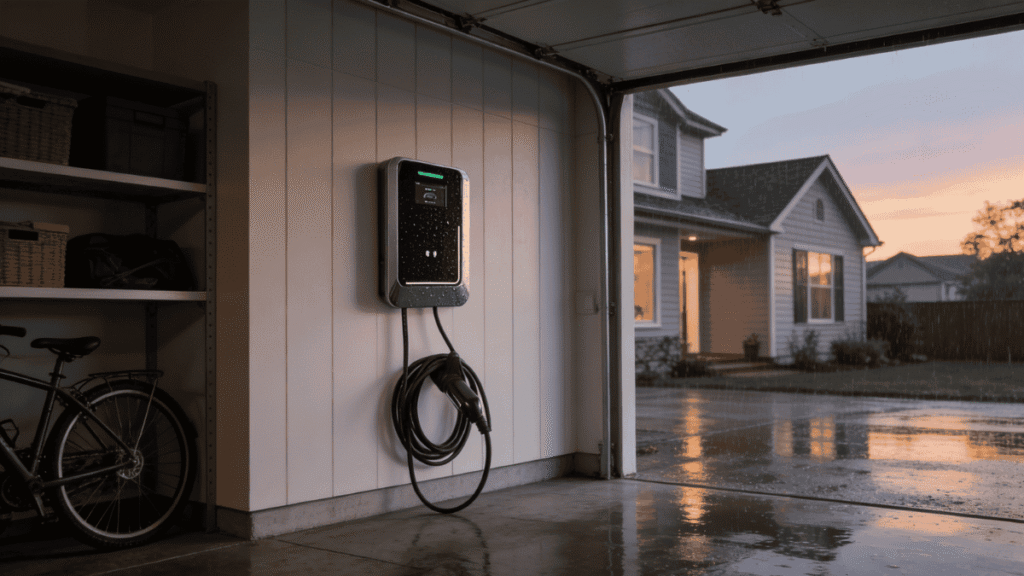
Installing an EV charger outdoors can be just as safe and reliable as an indoor setup—if you plan for water, dust, temperature swings, UV exposure, and physical abuse (wind-driven rain, snow/ice, lawn equipment, and daily cable wear). The goal of weatherproofing isn’t only to “keep water out,” but to ensure the entire charging system (EVSE + wiring + junctions + mounting + cable handling) remains compliant, stable, and easy to use for years.
This guide focuses on best practices for outdoor home and light-commercial installations globally. It references EVSE enclosure ratings and real-world product examples (e.g., NEMA 3R/NEMA 4/NEMA Type 4), and also explains when an outdoor site should choose AC Level 2 versus DC fast charging options.
- Start with the right outdoor rating (NEMA/IP)
- Site selection: rain lines, sun, and physical protection
- Outdoor wiring: conduit, penetrations, and water management
- Plug-in vs hardwired outdoors (and why it matters)
- Cable management: the most overlooked outdoor failure point
- Cold/heat best practices and derating expectations
- Maintenance checklist and periodic inspections
- Outdoor home charging: AC vs DC (when DC is justified)
1) Start with the right outdoor rating (NEMA/IP)
“Outdoor rated” is not one universal spec—manufacturers may use NEMA ratings (common in North America) or IP ratings (common globally). Car and Driver notes that each charging unit they tested had an outdoor-grade rating according to NEMA or IP standards, and that outdoor mounting is generally feasible when the entire installation is properly rated.
| Rating example | What it implies (practical takeaway) | Seen in sources |
|---|---|---|
| NEMA 3R | Outdoor-capable, but not necessarily watertight; some moisture ingress is possible under certain conditions | Car and Driver lists ChargePoint Home Flex and Tesla Universal Wall Connector as NEMA 3R |
| NEMA 4 / Type 4 | Higher water/dust protection than 3R; better for exposed mounting | Car and Driver lists Emporia units as NEMA 4; Smart Charge America describes Emporia enclosures as Type 4 |
| IP ratings (e.g., IP65/67) | Two digits reflect solid and water protection; higher second digit means stronger water resistance | Car and Driver discusses IP66/IP67 context and provides examples like IP65 for Lectron control unit |
Outdoor rating must apply to the EVSE AND the electrical feed. Car and Driver emphasizes that for outdoor mounting, the feed line and (for plug-in installs) the outlet enclosure must also be outdoor-rated—not just the charger itself.
2) Site selection: rain lines, sun, and physical protection
A weatherproof EVSE can still fail early if it is mounted where water can sit, drip constantly, or freeze/thaw around fittings. Think like water: it follows gravity, capillary paths, and cable jackets.
Outdoor placement best practices
- Avoid “drip lines”: don’t mount directly under roof edges/gutters where concentrated runoff hits the enclosure or connector holster.
- Sun/UV management: if possible, mount on a shaded wall or add a small canopy rated for outdoor electrical use.
- Impact and clearance: keep the unit out of door-swing paths, snowplow/shovel zones, and where it can be hit by vehicles.
- Height and splash: mount high enough to avoid puddle splash and snow accumulation around the plug/connector dock.
If you operate public-facing sites (travel stops, retail), the “experience layer” matters too: Love’s highlights amenities, clean facilities, 24/7 staffing, and tech-friendly environments around EV charging—outdoor placement should support safe pedestrian flow and minimize tripping hazards from cables.
3) Outdoor wiring: conduit, penetrations, and water management
Outdoor reliability is often determined by how the electrician handles penetrations, bends, junction points, and the inevitable moisture in conduit. Even “sealed” systems can accumulate condensation.
Key concepts to require in the scope of work
- Proper outdoor-rated conduit and fittings for the full path (panel to EVSE).
- Sealed wall penetrations with appropriate bushings/grommets and exterior-grade sealant where code allows.
- Drip loops on any cable runs that could carry water toward the enclosure (so water drops off before entering).
- Drain/weep strategy where permitted—conduit can trap water; installers may need code-compliant methods to manage it.
- Corrosion awareness in coastal or de-icing salt environments (hardware choice and isolation matter).
4) Plug-in vs hardwired outdoors (and why it matters)
Plug-in (receptacle) outdoors
Plug-in can be convenient, but outdoors it increases the number of weather-exposed interfaces (receptacle, plug blades, box gasket, in-use cover). Car and Driver points out that if you’re using a plug-type unit outside, the outlet enclosure must also be outdoor-rated.
Hardwired outdoors
Hardwired installations eliminate one exposed plug connection and can enable higher output on some models. Emporia’s documentation explains that a plug model is easy to install and portable but can limit charge rate (e.g., 40A), while hardwire can charge at up to 48A.
GFCI and nuisance-tripping considerations
Emporia notes that EV chargers include built-in GFCI protection, and that combining it with a GFCI-protected circuit (often required for certain outlets) can lead to nuisance tripping. For outdoor installations where GFCI requirements apply, confirm the protection approach early with a licensed electrician.
5) Cable management: the most overlooked outdoor failure point
Outdoor cables are exposed to UV, abrasion, twisting, and being run over. Also, the connector end is handled daily—often with wet hands in bad weather. Good cable management is both a safety measure (trip prevention) and an equipment longevity measure.
- Use the EVSE’s integrated holster or mount a dedicated handle holder at a natural height.
- Держите разъем над землей, чтобы предотвратить попадание влаги и истирание от песка.
- Избегайте малых радиусов изгиба, создающих нагрузку на проводники в холодную погоду (из-за жесткости оболочки кабеля).
- Прокладывайте кабель так, чтобы он не пересекал пешеходные дорожки и не зажимался дверями гаража или воротами.
В описаниях продуктов на Smart Charge America часто указываются длина кабеля и система его укладки как ключевые элементы удобства использования (например, 25-футовый кабель Emporia со встроенной системой укладки; 23-футовый кабель ChargePoint Home Flex).
6) Рекомендации для условий холода/жары и ожидаемое снижение мощности
Системы зарядки для улицы должны выдерживать экстремальные условия. Smart Charge America указывает рабочие температурные диапазоны для некоторых моделей (например, Emporia: от -30°C до +50°C; станция Ford Pro AC — до -40°C).
Рекомендации в зависимости от климата
- Холод/снег: Устанавливайте выше ожидаемого уровня снега; предотвращайте превращение держателя разъема в “ледяную полку”.”
- Жара/солнце: По возможности уменьшайте прямую солнечную нагрузку с помощью тени; обеспечивайте зазоры для циркуляции воздуха вокруг корпуса.
- Влажность/прибрежная зона: Отдавайте приоритет более высоким степеням защиты (IP) и крепежному оборудованию, устойчивому к коррозии.
7) Контрольный список обслуживания и периодические проверки
К уличным установкам следует относиться так же, как и к другому наружному электрооборудованию: быстрая ежеквартальная проверка может предотвратить развитие большинства проблем в отказы.
| Проверяемый элемент | На что обращать внимание | Действие |
|---|---|---|
| Корпус и линии уплотнителей | Трещины, деформированные крышки, отсутствующие винты | Прекратить использование и обслуживать при подозрении на проникновение воды |
| Оболочка кабеля | Порезы, сплющивание, точки истирания | Заменить кабель/EVSE при риске обнажения проводников |
| Разъем/рукоятка и держатель | Загрязнения, коррозия, люфт | Очистить/высушить; обеспечить хранение разъема над землей |
| Крепежные элементы | Ржавчина, шаткость, повреждение стены | Подтянуть/заменить крепеж; устранить проблемы с основанием |
8) Уличная домашняя зарядка: AC vs DC (когда оправдано DC)
Уличная установка не означает автоматически “быстрая зарядка DC”. Для большинства домов AC Level 2 остается практическим стандартом для ночной зарядки, в то время как быстрая зарядка DC.
Линейка зарядных устройств для электромобилей TPSON позиционируется Зарядные устройства для электромобилей как полный набор решений, включающий Зарядные устройства переменного тока для электромобилей и компактные быстрые зарядные устройства DC для коммерческого и аварийного применения.
Когда DC может быть оправдан на улице
Если реальная потребность — мобильность или быстрая смена (например, автопарк, помощь на дороге, мероприятия), может подойти портативное решение DC. Компактная серия TP?DC от TPSON Зарядные устройства постоянного тока для электромобилей.
“Лучшая” уличная установка зарядного устройства для электромобиля — это та, где рейтинг EVSE соответствует условиям эксплуатации, проводная система рассчитана на уличное использование от начала до конца, а обращение с кабелем не вызывает затруднений.
- Car and Driver: обсуждение и примеры уличных рейтингов (NEMA/IP) — https://www.caranddriver.com/shopping-advice/a39917614/best-home-ev-chargers-tested/
- Emporia Classic: сравнение plug vs hardwire и ложные срабатывания GFCI — https://shop.emporiaenergy.com/products/emporia-ev-charger
- Список Smart Charge America: рейтинги корпусов, температурные диапазоны, длины кабелей — https://smartchargeamerica.com/electric-car-chargers/
- Love's EV Charging: контекст сети Level 2 + Level 3 — https://www.loves.com/ev-charging
- Зарядные устройства для электромобилей TPSON / AC EV Chargers / Portable DC EV Charger — https://tpsonpower.com/ev-chargers/ | https://tpsonpower.com/ac-ev-chargers/ | https://tpsonpower.com/portable-dc-ev-charger/
- Информация о производителе TPSON — https://tpsonpower.com/about/
Отказ от ответственности: Электромонтажные работы должны выполняться и проверяться квалифицированным электриком в соответствии с местными нормами.




