No official level 4 EV charger currently exists in the market. Most EV charger manufacturers and industry groups recognize three levels of electric vehicle charging, each defined by power output and charging speed. If a level 4 ev charger emerged, it would transform EV charging solutions by drastically reducing charge times for electric vehicles. Today, drivers rely on portable ev chargers and public stations, but the next leap could meet the needs of heavy-duty vehicles. The industry continues to innovate beyond current standards.
EV Charging Levels Overview
Level 1 Charging
Home Charging Basics
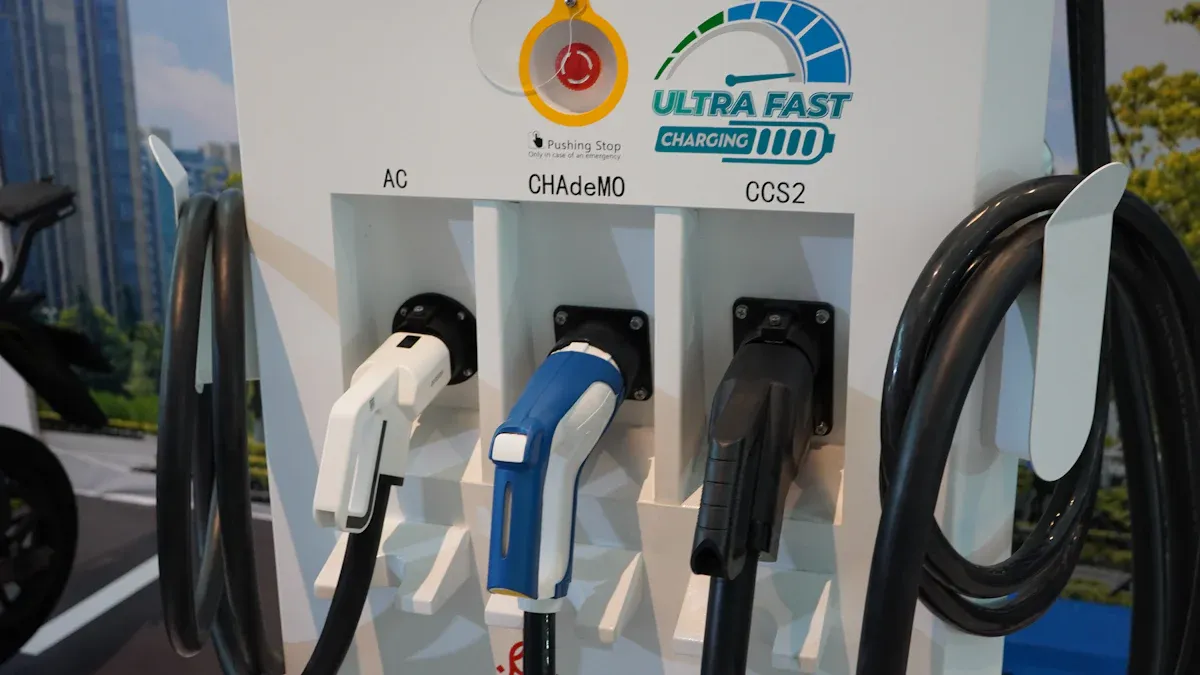
Level 1 charging represents the most accessible method for electric vehicle owners. Most drivers use a standard 120-volt household outlet to charge their vehicles. This approach requires no specialized equipment, making it ideal for home use. The charger connects directly to the vehicle, allowing overnight charging in garages or driveways. Many new EV owners start with Level 1 charging because it offers simplicity and convenience.
Tip: Level 1 chargers are often included with the purchase of an electric vehicle, making them a cost-effective entry point for new owners.
Charging Speed and Use Cases
Level 1 chargers deliver between 1.3 kW and 2.4 kW of power, adding 4-6 miles of range per hour. Charging a typical EV battery can take 8 to 18 hours, depending on battery size and vehicle model. This slow charging speed suits drivers with predictable daily routines and short commutes. Overnight charging provides 30-40 miles of range, which covers most urban travel needs.
- Charging with a standard plug is the slowest method.
- Full charging may require up to 18 hours for medium-sized batteries.
Level 2 Charging
Residential and Public Charging
Level 2 charging offers a significant upgrade in speed and flexibility. These chargers operate on a 240-volt supply and require installation of dedicated charging equipment. Homeowners often install Level 2 chargers in garages, while public stations appear in parking lots, shopping centers, and workplaces. Urban areas feature a well-developed network of Level 2 charging stations, supporting a growing population of electric vehicle users.
| Area Type | Percentage of Charging Devices | Increase in Devices (Jan 2024 – Jan 2025) |
|---|---|---|
| Urban Setting | 84.6% | 14,021 |
| Rural Village and Dispersed | 7.7% | 2,974 |
Speed and Accessibility
Level 2 chargers deliver 3.4 to 22 kW of power, adding 15-25 miles of range per hour. Some models reach up to 43 kW. Drivers can expect a full charge in 4 to 8 hours, making Level 2 ideal for overnight charging and daily use. Public infrastructure supports accessibility, but rural areas lag behind urban centers, creating challenges for EV owners outside major cities.
- Level 2 charging adds 20 to 60 kilometers of range per hour.
- Most urban locations provide reliable access to Level 2 chargers.
Level 3 Charging
DC Fast Charging
Level 3 charging, also known as DC fast charging, delivers the fastest charging speeds available today. These chargers use a 480-volt supply and provide 50 to 400 kW of power. Drivers can add 60-80 miles of range in just 20 minutes, making Level 3 ideal for quick top-ups during long trips. Leading models, such as Tesla Supercharger V3 and Porsche Taycan, offer power outputs from 250 kW to 480 kW.
| Charger Model | Maximum Power Output | Charging Speed |
|---|---|---|
| Tesla Supercharger V3 | 250 kW | Upgradable to 500 kW |
| Porsche Taycan | 270 kW | 10% to 80% in 19 minutes |
| GAC AION EVs | 480 kW | 30% to 80% in 5 minutes |
Applications and Limitations
DC fast charging supports long-distance travel and commercial fleet operations. However, installation costs remain high, and availability is limited compared to Level 2 chargers. Infrastructure challenges and battery compatibility issues restrict widespread adoption. Most drivers rely on Level 3 charging for highway travel and rapid charging needs.
| Limitation |
|---|
| Expensive infrastructure and installation costs |
| Limited availability compared to Level 2 chargers |
Defining Level 4 EV Charger
Technical Specifications
Power Output and Charging Speed
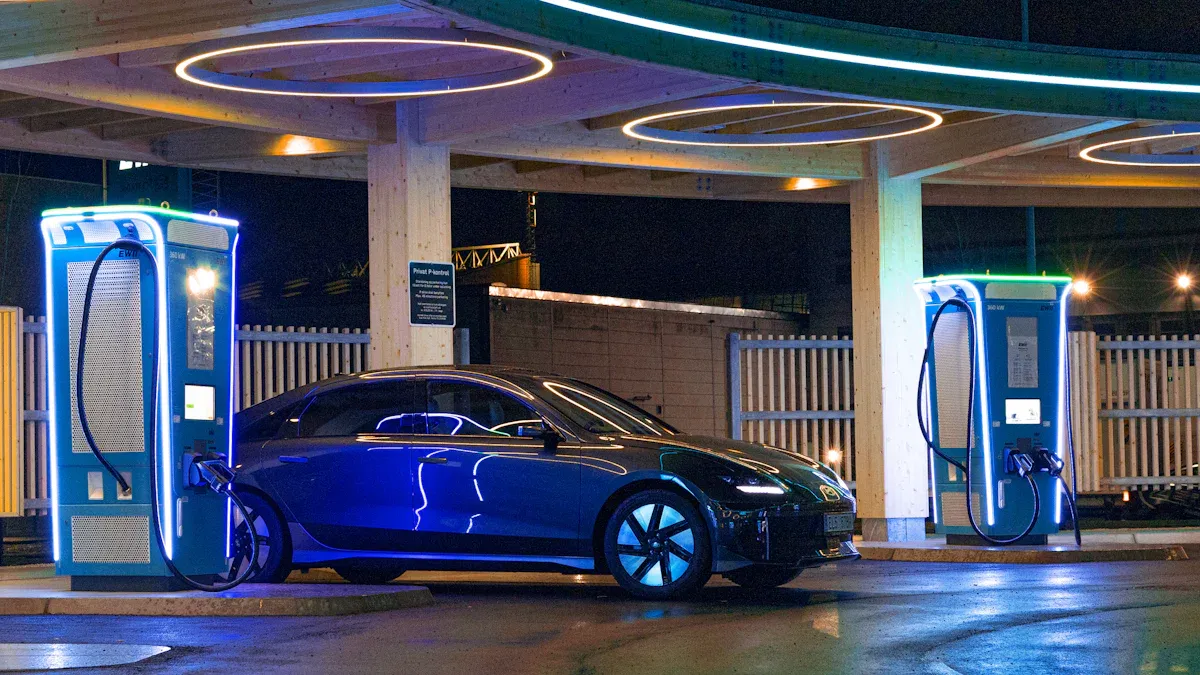
A level 4 ev charger represents a significant leap in electric vehicle charging technology. These chargers deliver power outputs exceeding 1 megawatt, far surpassing the capabilities of current DC fast chargers. For example, the Tesla Megacharger demonstrates the potential of level 4 charging by adding 400 miles of range in just 30 minutes to a 500 kWh battery. This rapid charging speed addresses the needs of commercial fleets and heavy-duty vehicles, enabling efficient operations and minimizing downtime.
| Specification | Details |
|---|---|
| Power Output | Up to 1 MW |
| Charging Speed | As fast as 15 minutes |
| Voltage | Typically operates at 480 volts |
| Charging Type | Direct Current (DC) |
| Usage Context | Commercial fleets, public stations |
| Example | Tesla Megacharger (1.5 MW) |
Level 4 chargers can charge large battery packs rapidly. They are expected to become more common as demand for ev charging grows. These systems provide benefits such as reduced range anxiety and environmental advantages, supporting the transition to sustainable transportation.
Battery Impact
The introduction of level 4 charging brings new challenges for battery technology. High power delivery requires advanced battery chemistries and robust thermal management systems. Lithium iron phosphate (LFP) batteries and solid-state batteries offer improved charging rates and durability. Advanced thermal management maintains optimal battery temperatures, allowing sustained high charging speeds without compromising battery health. Manufacturers like TPSON invest in research and development to ensure compatibility between ultra-fast chargers and evolving battery technologies.
Note: Rapid charging can accelerate battery wear if not managed properly. Battery manufacturers continue to innovate to balance speed and longevity.
Industry Terminology
Official Standards
Industry groups and standards organizations currently recognize three levels of ev charging. No official standard defines a level 4 ev charger. Existing rapid DC chargers draw between 50 kW and 150 kW, with projections for chargers reaching 350 kW and above. The lack of formal classification for level 4 charging reflects ongoing technological advancements and the need for consensus among stakeholders.
- Level 1: 1.3–2.4 kW (AC)
- Level 2: 3.4–22 kW (AC)
- Level 3: 50–400 kW (DC)
- Level 4: Proposed >1 MW (DC)
Industry standards evolve as new technologies emerge. TPSON participates in industry forums to help shape future standards for ultra-fast charging.
Emerging Trends
Emerging trends in ev charging technology drive the development of level 4 chargers. Ultra-fast charging systems operate at 350 kW and beyond, enabling 10–80% battery capacity restoration in under 10 minutes. Battery chemistry improvements, such as LFP and solid-state batteries, support higher charging rates. Advanced thermal management systems maintain battery health during rapid charging.
| Advancement Type | Description |
|---|---|
| Ultra-fast charging systems | Chargers operating at 350kW and beyond, enabling 10–80% battery capacity in under 10 minutes. |
| Battery chemistry improvements | LFP batteries charge at higher rates; solid-state batteries promise rapid capacity restoration. |
| Thermal management systems | Advanced systems maintain optimal battery temperatures, allowing sustained high charging speeds. |
Manufacturers and solution providers, including TPSON, invest in these advancements to meet the growing needs of electric vehicles and commercial fleets. The industry anticipates that level 4 ev charger technology will become more prevalent as infrastructure and battery compatibility improve.
Current Status of Level 4 EV Charger
Technology Today
Ultra-Fast Chargers
Ultra-fast chargers represent the cutting edge of electric vehicle charging technology. These systems deliver power far beyond traditional DC fast chargers. In 2025, the United Kingdom operates 16,698 rapid and ultra-rapid chargers. Among these, 8,619 units provide ultra-rapid charging at 150kW or above. Ultra-rapid chargers can deliver up to 350kW, enabling compatible EVs to gain 120 miles of range in just 10 minutes. Manufacturers design these stations for high throughput and minimal downtime. Most ultra-fast chargers serve highway corridors and urban centers, supporting both passenger vehicles and commercial fleets.
- Ultra-fast chargers deliver up to 350kW.
- Compatible EVs gain 120 miles of range in 10 minutes.
- The UK operates 8,619 ultra-rapid chargers rated at 150kW or above.
Note: Ultra-fast charging stations require advanced battery technology and robust cooling systems to maintain safety and performance.
Experimental Systems
Engineers and researchers continue to develop experimental charging systems that push the boundaries of power delivery. Some prototypes approach or exceed 1 megawatt, targeting heavy-duty vehicles and commercial applications. Tesla’s Megacharger, for example, aims to support electric trucks with rapid charging capabilities. These experimental systems often operate in controlled environments or pilot programs. Manufacturers test new battery chemistries and cooling solutions to ensure compatibility with high-power charging. The industry expects these innovations to pave the way for future level 4 charging solutions.
| System Name | Power Output | Target Vehicle Type | Status |
|---|---|---|---|
| Tesla Megacharger | 1.5 MW | Electric trucks | Pilot deployment |
| ABB Terra HP | 350 kW | Passenger EVs | Commercial use |
| Siemens Prototype | 1 MW | Heavy-duty vehicles | Experimental |
Availability
Public Infrastructure
Public infrastructure for ultra-fast charging continues to expand, especially in developed markets. Urban centers and major highways feature dense networks of rapid and ultra-rapid chargers. The United Kingdom leads Europe with thousands of operational stations. Most public chargers support passenger EVs, but only a few locations offer high-power charging for heavy-duty vehicles. Infrastructure upgrades require significant investment in electrical capacity and grid management. Governments and private companies collaborate to accelerate deployment and improve accessibility.
Tip: Drivers should check compatibility between their EV and available charging stations before planning long-distance travel.
Commercial Applications
Commercial fleets and logistics companies increasingly rely on high-power charging solutions. Level 4 ev charger prototypes target electric trucks, buses, and delivery vans. These systems minimize downtime and maximize operational efficiency. Fleet operators install dedicated charging hubs at depots and distribution centers. Commercial applications demand reliable performance, rapid turnaround, and scalable infrastructure. Manufacturers continue to refine charging technology to meet the needs of heavy-duty vehicles and large battery packs.
- Fleet operators use high-power chargers for electric trucks and buses.
- Dedicated hubs support rapid charging and efficient operations.
- Commercial applications drive innovation in battery and cooling systems.
Alert: Level 4 charging remains limited to pilot projects and specialized commercial sites. Widespread adoption depends on advances in battery technology and infrastructure investment.
Level 4 EV Charger vs Levels 1-3
Speed and Efficiency
Charging Time Comparison
Charging speed remains a critical factor for drivers who rely on electric vehicles. Level 1 chargers require up to 18 hours to fully charge a standard EV battery. Level 2 chargers reduce this time to 4–8 hours. Level 3 chargers, known for DC fast charging, can replenish 80% of a battery in 20–40 minutes. The level 4 ev charger sets a new benchmark. It delivers up to 1 megawatt of power, enabling heavy-duty vehicles to gain hundreds of miles of range in less than 30 minutes. This advancement supports commercial fleets and long-distance travel.
| Charger Level | Typical Charging Time | Range Added per Hour |
|---|---|---|
| Level 1 | 8–18 hours | 4–6 miles |
| Level 2 | 4–8 hours | 15–25 miles |
| Level 3 | 20–40 minutes | 60–80 miles |
| Level 4 | 15–30 minutes | 200–400 miles |
Note: Level 4 charging technology shortens downtime for drivers and fleet operators.
Daily Use Impact
The impact of charging speed extends beyond travel. Level 1 and Level 2 chargers suit daily routines and overnight charging. Level 3 chargers offer flexibility for urban commuters and highway travelers. Level 4 chargers transform daily operations for commercial users. Fleet managers can schedule rapid charging sessions, reducing idle time. Drivers experience less waiting and more productivity. The shift to faster charging supports broader adoption of EV technology.
- Level 4 chargers enable quick turnarounds for delivery vehicles.
- Commercial fleets benefit from reduced operational delays.
- Faster charging encourages more frequent use of electric vehicles.
Cost and Practicality
Installation Costs
Installation costs vary across charger levels. Level 1 chargers require minimal investment, using standard outlets. Level 2 chargers need dedicated circuits and professional installation. Level 3 chargers demand significant infrastructure upgrades, including high-voltage connections and cooling systems. Level 4 chargers present the highest costs. They require advanced electrical systems, robust grid support, and specialized cooling. Commercial sites must invest in large-scale upgrades to accommodate these chargers.
| Charger Level | Installation Complexity | Estimated Cost Range |
|---|---|---|
| Level 1 | Low | $0–$500 |
| Level 2 | Moderate | $500–$2,000 |
| Level 3 | High | $10,000–$50,000 |
| Level 4 | Very High | $50,000+ |
Alert: Level 4 charger installations often require coordination with utility providers and local authorities.
User Experience
User experience changes with each charger level. Level 1 and Level 2 chargers offer convenience for home use. Level 3 chargers provide rapid charging at public stations, but may involve waiting during peak hours. Level 4 chargers deliver unmatched speed, especially for commercial users. Drivers spend less time at charging stations. Fleet operators gain flexibility in scheduling and route planning. However, access to level 4 chargers remains limited. Most users rely on lower-level chargers for daily needs.
- Level 4 chargers improve efficiency for heavy-duty vehicles.
- Public access to ultra-fast charging remains restricted.
- Homeowners rarely install level 4 chargers due to cost and complexity.
Tip: Drivers should evaluate their charging needs and vehicle compatibility before investing in higher-level charging solutions.
Benefits of Level 4 EV Charger
Faster Charging
Long-Distance Travel
Level 4 charging introduces a new era for electric vehicle travel. Drivers can cover greater distances without extended stops. High-powered chargers reduce the time spent at charging stations, making cross-country trips more practical for both individuals and commercial operators. This advancement supports the growing demand for efficient transportation solutions. Travelers no longer need to plan routes around slow charging points. Instead, they can rely on rapid energy replenishment, which encourages broader adoption of electric vehicles.
Tip: For those who drive long distances, access to ultra-fast charging can transform the travel experience and reduce range anxiety.
Reduced Wait Times
Shorter charging sessions benefit everyone from daily commuters to logistics professionals. Level 4 chargers can deliver hundreds of miles of range in less than half an hour. This speed minimizes downtime and increases productivity. Drivers spend less time waiting and more time on the road. Businesses that depend on vehicle availability see improved operational efficiency. Reduced wait times also help alleviate congestion at busy charging stations, enhancing the overall user experience.
- Less time spent at charging stations
- Increased vehicle utilization for commercial fleets
- Improved satisfaction for private EV owners
New Applications
Heavy-Duty Vehicles
The transportation industry requires robust solutions for heavy-duty vehicles. Level 4 charging meets the energy demands of electric trucks, buses, and construction equipment. These vehicles often operate on tight schedules and carry large battery packs. Ultra-fast charging enables them to return to service quickly, supporting continuous operations. Manufacturers design these systems to handle high power loads safely and efficiently. As a result, electric heavy-duty vehicles become more viable for long-haul routes and industrial use.
| Vehicle Type | Charging Time (Level 4) | Typical Range Added |
|---|---|---|
| Electric Truck | 20–30 minutes | 200–400 miles |
| Electric Bus | 15–25 minutes | 150–300 miles |
| Construction Vehicle | 20–35 minutes | 100–250 miles |
Fleet Operations
Fleet operators benefit significantly from the adoption of advanced charging technology. Level 4 charging supports rapid turnaround for delivery vans, taxis, and service vehicles. Companies can schedule multiple charging sessions throughout the day without disrupting operations. This flexibility leads to higher fleet availability and lower operational costs. Fleet managers gain more control over energy use and maintenance planning. The ability to charge quickly also supports the transition to electric vehicles in sectors that require high uptime.
Note: Fleet operations that integrate ultra-fast charging can achieve greater reliability and meet sustainability goals more effectively.
Drawbacks of Level 4 EV Charger
Technical Challenges
Battery Compatibility
Level 4 EV chargers introduce several technical hurdles for battery compatibility. Current electric vehicle batteries require significant engineering modifications to handle the extreme charging profiles and thermal demands of ultra-fast charging. Manufacturers must redesign battery management systems to accommodate these new requirements. Solid-state batteries, which represent the next step in battery technology, can accept charging rates between 6C and 10C. This capability demands upgrades to public charging networks, allowing them to deliver power outputs from 350 kW up to 800 kW.
The table below outlines the main challenges facing battery compatibility:
| Challenge | Description |
|---|---|
| Engineering Modifications | Significant redesign of battery management systems is required to accommodate new charging profiles and thermal characteristics. |
| Charging Infrastructure | Solid state batteries can accept charging rates of 6C-10C, necessitating upgrades to public charging networks to deliver 350-800kW power outputs. |
| Quality Assurance | Standards for solid state batteries exceed traditional lithium-ion requirements by 300-400%, requiring new quality control systems. |
| Defect Rates | Interface imperfections in ceramic processing lead to 20-30% of production units failing performance specifications. |
| Safety Testing | New safety testing protocols and certification standards are needed, with delays of 18-24 months expected for regulatory adaptation. |
Note: Battery manufacturers face higher defect rates and stricter quality assurance standards. Safety testing protocols must evolve, which can delay widespread adoption.
Infrastructure Needs
The deployment of Level 4 chargers requires extensive infrastructure upgrades. Local authorities and charge point operators must coordinate closely with distribution network operators (DNOs). They need to provide DNOs with a forward look at planned investments for at least the next 24 months. Charge point operators should share a list of sites in the pipeline every six months, including potential locations and types of chargers. Governments must remind local authorities to communicate planned investments for Local Electric Vehicle Infrastructure (LEVI) projects.
- Local authorities and charge point operators should provide DNOs with a forward look for planned investments for at least the next 24 months.
- Charge point operators need to share a list of sites in the pipeline every six months, including potential locations and types of chargers.
- Governments should remind local authorities to provide DNOs with planned investments for LEVI projects.
Alert: Infrastructure upgrades require careful planning and significant investment. Coordination between stakeholders ensures reliable power delivery and minimizes disruptions.
Cost and Accessibility
High Costs
Level 4 EV chargers demand substantial financial investment. Installation costs far exceed those of lower-level chargers. Site preparation, electrical upgrades, and cooling systems contribute to the high price tag. Commercial operators must budget for ongoing maintenance and operational expenses. Many businesses hesitate to invest without clear returns or government incentives.
| Charger Level | Estimated Installation Cost |
|---|---|
| Level 1 | $0–$500 |
| Level 2 | $500–$2,000 |
| Level 3 | $10,000–$50,000 |
| Level 4 | $50,000+ |
Tip: High costs limit adoption to large commercial fleets and specialized applications.
Limited Availability
Access to Level 4 chargers remains restricted. Most public charging stations do not support ultra-fast charging. Only a few pilot projects and commercial hubs offer Level 4 capabilities. Drivers must plan routes carefully, especially for long-distance travel or heavy-duty vehicle operations. Expansion depends on infrastructure upgrades, regulatory approval, and market demand.
- Limited public access to Level 4 chargers
- Most installations serve commercial fleets or pilot programs
- Expansion requires investment and regulatory support
Note: Widespread availability will take time as stakeholders address technical, financial, and regulatory barriers.
Practicality of Level 4 EV Charger
Everyday Use
Home Charging Feasibility
Level 4 EV chargers deliver immense power, but their practicality for home use remains limited. Most residential properties lack the electrical infrastructure to support megawatt-level charging. Homeowners would need to invest in substantial upgrades, including high-capacity wiring, advanced cooling systems, and dedicated transformers. These requirements exceed the capabilities of standard household circuits. Safety concerns also arise due to the risk of overheating and electrical faults.
A typical homeowner faces several barriers:
- High installation costs
- Complex permitting processes
- Limited compatibility with current EV models
Tip: Homeowners should consult with certified electricians before considering any high-power charging installation.
Public Network Expansion
Public charging networks continue to expand, but integrating Level 4 chargers presents unique challenges. Operators must coordinate with utility companies to ensure adequate power supply. Urban centers and major highways offer the best locations for these ultra-fast chargers. Expansion requires careful planning to avoid grid overload and maintain reliability. Governments and private companies invest in infrastructure upgrades to support commercial fleets and heavy-duty vehicles.
The table below highlights key factors for public network expansion:
| Factor | Impact on Expansion |
|---|---|
| Grid Capacity | Requires upgrades |
| Site Selection | Focuses on high-traffic areas |
| Investment | Demands significant funding |
| Regulatory Approval | Involves lengthy processes |
Note: Public networks prioritize locations that serve commercial users and long-distance travelers.
Impact on EV Ownership
Expectations for Drivers
Drivers expect faster charging and greater convenience as technology advances. Level 4 chargers promise rapid energy replenishment, but most vehicles cannot utilize their full potential. Owners of passenger cars may not benefit unless manufacturers upgrade battery systems. Commercial drivers and fleet operators gain the most from ultra-fast charging. They experience reduced downtime and improved operational efficiency.
- Commercial drivers benefit from quick turnarounds.
- Passenger car owners may need to upgrade vehicles to access Level 4 speeds.
- Fleet managers can optimize routes and schedules.
Alert: Not all EVs are compatible with Level 4 charging. Drivers should verify vehicle specifications before using these stations.
Future Outlook
Industry experts predict continued growth in high-power charging technology. Manufacturers invest in advanced battery chemistries and thermal management systems. Governments support infrastructure development through grants and incentives. The transition to Level 4 charging will take time, but the benefits for commercial fleets and heavy-duty vehicles drive innovation.
Future trends include:
- Wider adoption of solid-state batteries
- Increased collaboration between stakeholders
- Expansion of public charging networks
Level 4 chargers will shape the future of electric transportation. They enable new applications and support the evolving needs of the industry.
Level 4 EV chargers do not exist as an official industry standard. They represent a leap in charging speed and infrastructure requirements. These systems differ from current solutions by targeting heavy-duty vehicles and commercial fleets. Most drivers will not encounter them in daily life.
EV owners should monitor industry trends and consult manufacturers before investing in new charging technology.
FAQ
What is a Level 4 EV charger?
A Level 4 EV charger refers to ultra-fast charging technology that delivers over 1 megawatt of power. The industry has not officially recognized this level, but it targets heavy-duty vehicles and commercial fleets needing rapid charging.
Can any electric vehicle use a Level 4 charger?
Most passenger EVs cannot use Level 4 chargers. Only vehicles with advanced battery systems and thermal management can handle such high power. Manufacturers design these chargers mainly for trucks and buses.
How fast can a Level 4 charger replenish a battery?
A Level 4 charger can add 200 to 400 miles of range in 15 to 30 minutes. This speed depends on the vehicle’s battery capacity and compatibility with ultra-fast charging.
Where can drivers find Level 4 chargers?
Level 4 chargers remain rare. Most installations serve commercial depots, pilot projects, or specialized fleet hubs. Public access is limited, and expansion depends on infrastructure investment.
Are Level 4 chargers safe for batteries?
Level 4 chargers require advanced battery chemistries and cooling systems. Improper use can accelerate battery wear. Manufacturers continue to improve safety features and compatibility for ultra-fast charging.
How much does it cost to install a Level 4 charger?
Installation costs for Level 4 chargers start at $50,000 and can rise much higher. Expenses include electrical upgrades, cooling systems, and site preparation. Only large commercial operators usually invest in these systems.
Will Level 4 chargers become common for home use?
Level 4 chargers are not practical for homes. Residential electrical systems cannot support megawatt-level charging. Homeowners should use Level 1 or Level 2 chargers for daily needs.
What is the main benefit of Level 4 charging?
Level 4 charging minimizes downtime for heavy-duty vehicles and commercial fleets. It enables rapid energy replenishment, supporting efficient operations and long-distance travel.