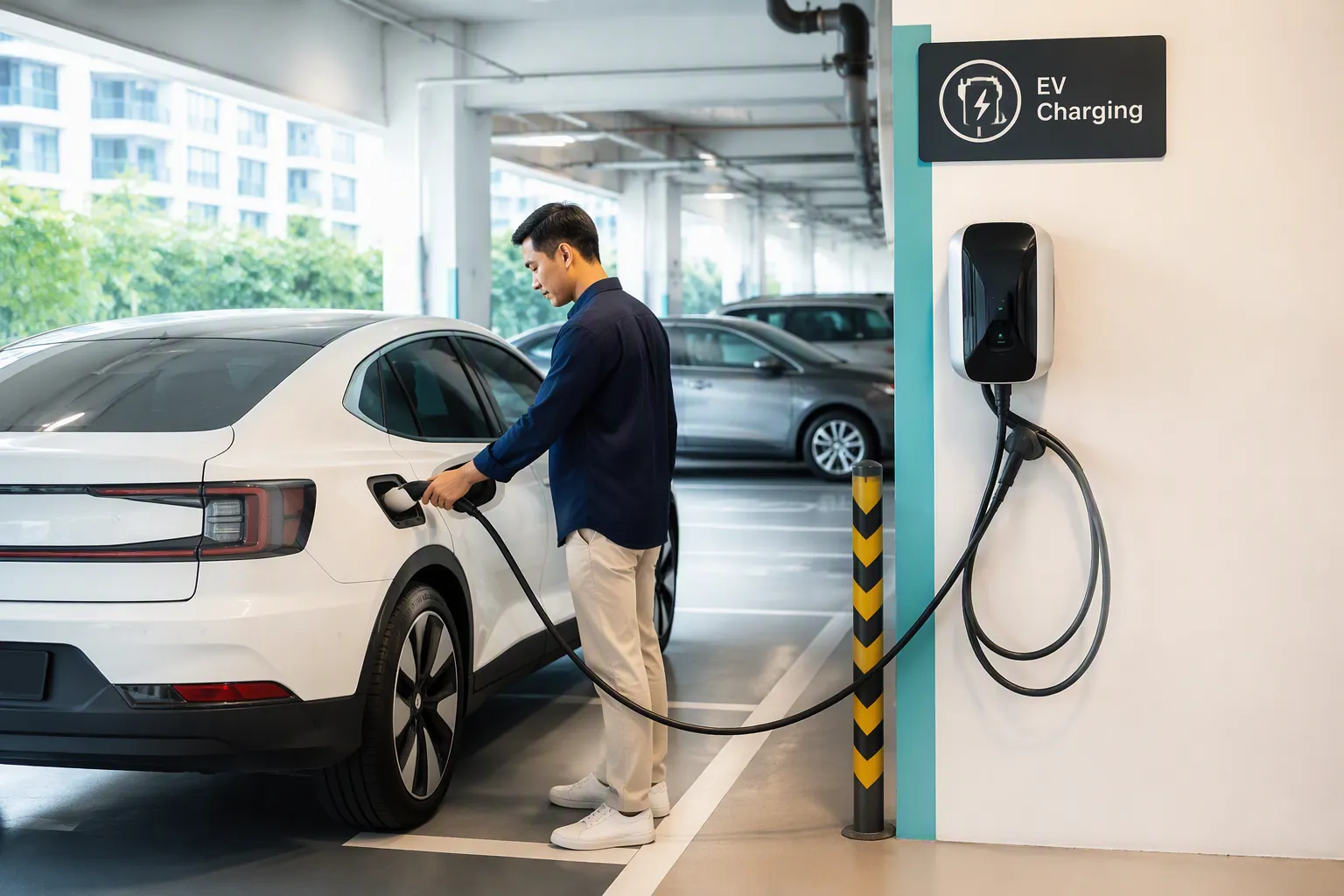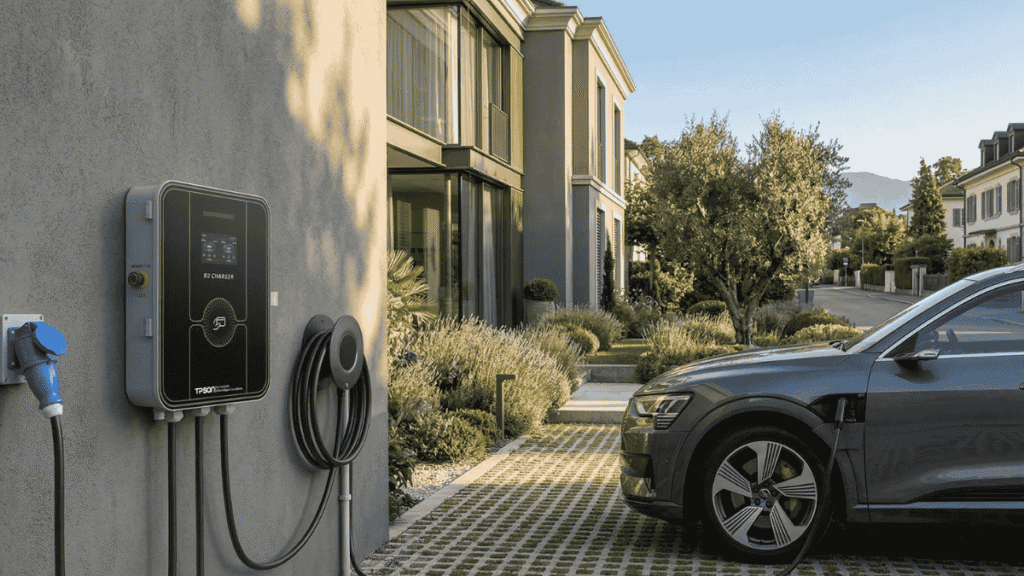
A 32 amp EV charger is one of the most practical charging options in the current market. It sits in the sweet spot between slow entry-level charging and higher-output installations that may require more electrical upgrades, more expensive wiring, and more complex planning. For many homes, apartments, workplaces, and light commercial applications, 32A charging is not a compromise. It is often the most efficient and sensible choice.
This guide explains how 32 amp EV chargers work, what charging speed they deliver, where they fit in the wider EV charging landscape, and when they make more sense than 40A, 48A, or even DC charging. It also uses the supplied source material from TPSON, ChargePoint, Smart Charge America, Emporia, Love’s, and Car and Driver to anchor the discussion in actual products and market practices.
- What a 32 amp EV charger means
- How fast a 32A charger really is
- Why 32A is such a common charging choice
- 32A vs 40A vs 48A charging
- When a 32A charger is the best option for home use
- When 32A makes sense for apartments and workplaces
- Electrical requirements and installation basics
- Plug types, compatibility, and connector considerations
- Smart charging, load balancing, and long-term value
- When 32A is not enough
- Pertanyaan yang sering diajukan
- Kesimpulan
A 32 amp EV charger is a Level 2 AC charger configured to deliver up to 32 amps of current during charging. In a typical 240V North American residential environment, that equals about 7,7 kW of charging power.
The basic formula is:
So at 240V:
- 32A = 7.68 kW, usually rounded to 7,7 kW
- 40A = 9,6 kW
- 48A = 11.5 kW
That makes 32A clearly faster than Level 1 home charging and strong enough for most overnight charging needs. It also fits neatly into the broader world of Pengisi Daya Mobil Listrik, where practical performance often matters more than chasing the highest possible current rating.
In real life, a 32A charger is usually considered a strong Level 2 solution. Car and Driver explains that Level 2 charging at 240V typically ranges between about 6 and 19 kW, and that most EVs can be charged overnight at home using this level. A 32A charger sits comfortably in the middle of that range.
For example, if an EV needs about 30 to 40 kWh added after a day of driving, a 7.7 kW charger can often replenish that energy within a typical overnight parking window. Even after accounting for charging losses and tapering near higher states of charge, that is more than adequate for a large percentage of drivers.
Smart Charge America lists several home chargers around the 7.7 kW class, including older ChargePoint Home products and ClipperCreek HCS-40 at 7.7 kW, showing that this power level has long been a mainstream benchmark for dependable home charging.
| Saat ini | Tegangan | Perkiraan Daya | Penggunaan Khas |
|---|---|---|---|
| 16A | 240V | 3.8 kW | Entry-level or limited-capacity charging |
| 32A | 240V | 7,7 kW | Strong overnight home and shared charging |
| 40A | 240V | 9,6 kW | Higher-output residential charging |
| 48A | 240V | 11,5 kW | Premium hardwired residential charging |
There are three big reasons 32A chargers remain widely relevant.
Most private EV owners do not need maximum-power home charging. They need consistent overnight replenishment. A 32A charger usually delivers that without difficulty, especially for commuters or households where the vehicle remains parked for many hours overnight.
Higher charging currents can increase installation cost and make panel capacity planning more difficult. A 32A charger is often easier to accommodate than a 40A, 48A, or 50A setup, especially in older homes or shared facilities.
For apartments, workplaces, and commercial sites, moderate-output charging can sometimes be more efficient than a smaller number of higher-output stations. ChargePoint’s site-wide platform approach and Smart Charge America’s large catalog of commercial chargers show that infrastructure design is often about balancing user dwell time, total port count, and electrical availability rather than maximizing current per port.
A 32A charger is not the fastest common Level 2 option, but it is often the most balanced. Here is how it compares.
| Charger Class | Approx. Output | Typical Installation Impact | Terbaik untuk |
|---|---|---|---|
| 32A | 7,7 kW | Sedang | Most homes, apartments, workplace charging |
| 40A | 9,6 kW | Lebih tinggi | Faster overnight home charging |
| 48A | 11,5 kW | Hardwire-oriented, more demanding | Premium home charging and shorter dwell windows |
Car and Driver’s testing reinforces this range. The publication highlights chargers with 40A and 48A capability as strong home options, but it also repeatedly emphasizes that most households do not necessarily need the maximum possible Level 2 rate. In fact, its guidance recommends a modest 40- or 50-amp circuit as a practical middle ground for home charging.
That perspective indirectly supports the role of 32A charging: if a site or user does not need the extra performance, staying at 32A can reduce cost and complexity without sacrificing usability.
A 32A charger is often ideal at home when the vehicle is parked for long periods, the homeowner wants to avoid expensive electrical upgrades, or the daily energy need is moderate.
- You commute daily and charge overnight
- Your electrical panel has limited headroom
- You want to keep installation cost reasonable
- Your EV’s onboard charger does not make strong use of higher-output home charging
- You are adding a second charger and prefer better circuit efficiency
This is particularly relevant because the car itself may be the limiting factor. Car and Driver notes that the charging rate is always limited by the lowest of the circuit, the charger, and the vehicle’s onboard charger. So if the vehicle does not benefit materially from more than 32A AC charging in your actual daily use, the higher-rated charger may produce very little real-world advantage.
In shared settings, 32A can be even more compelling than it is at home. Apartments, condos, and workplaces are often constrained not by one user’s charging speed, but by the total number of ports the site can support economically.
Smart Charge America’s commercial catalog shows how common adjustable or moderate-output AC charging remains in these environments. Examples include:
- LiteOn 32A commercial charger
- ChargePoint CPF50 with configurable amperage from 16A to 50A
- Wallbox Pulsar Plus with adjustable capacity and power sharing
The logic is straightforward: if vehicles stay parked for hours, moderate amperage can still fully satisfy users while allowing the site to deploy more ports, reduce installation burden, and improve total charging access.
ChargePoint’s own platform messaging strongly supports this broader infrastructure view. Its website emphasizes software, open OCPP operation, fleet and workplace flexibility, and a unified charging platform rather than presenting charging as a pure race toward the highest current.
A 32A charger is generally easier to integrate than a 40A or 48A unit. Because EV charging is a continuous load, the circuit must be sized accordingly. In common North American practice, 32A charging is typically paired with a 40A circuit.
Car and Driver explains the continuous-load rule clearly: a 40A circuit supports 32A continuous charging, while a 50A circuit supports 40A continuous charging. This is one reason 32A remains such an accessible target for home and light-commercial charging projects.
Compared with higher current configurations, 32A often means:
- Less stress on panel capacity
- Lower chance of requiring a panel upgrade
- Lower material and labor cost
- A practical fit in older homes or buildings
That said, installation still depends on local code, breaker selection, wiring method, and whether the pengisi daya bersifat plug-in atau hardwired. Buyers should always confirm actual site conditions with a qualified electrician.
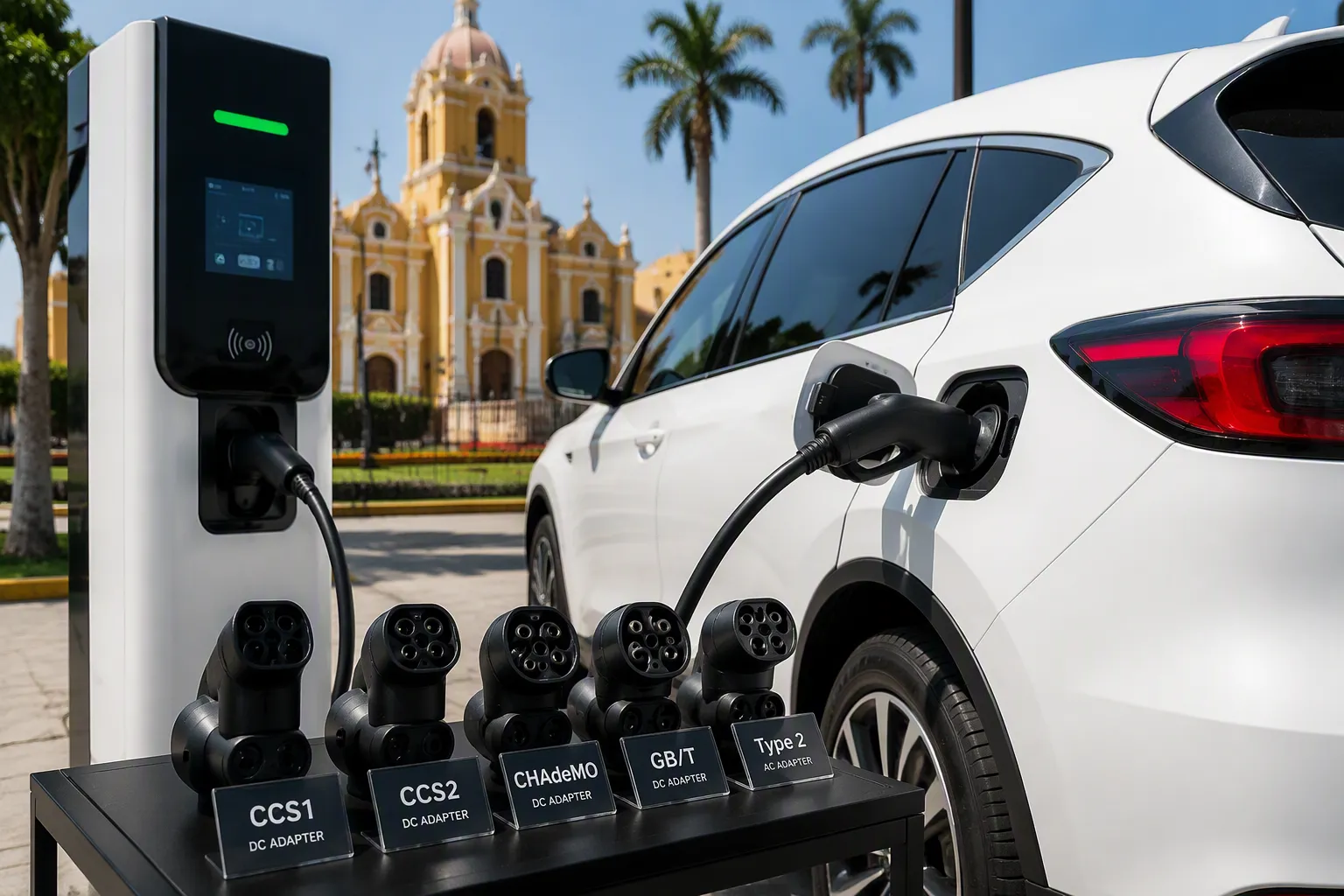
Connector and outlet decisions matter just as much as amperage. Car and Driver notes that for home charging, the two most relevant connector types are J1772 dan NACS/J3400, and adapters between them are increasingly common.
Emporia’s product materials show how modern home chargers often come in both:
- J1772 / CCS style variants
- NACS / Tesla style variants
Its product page also clearly distinguishes between:
- NEMA plug models, which are easier to install and portable but limited to lower output classes
- Hardwire models, which support higher charging rates but involve more permanent installation
For many 32A charging installations, a plug-in style may be entirely sufficient, especially when flexibility and ease of replacement are valued.
A lower-current charger can become much more valuable when paired with smart features. This is where TPSON’s positioning is highly relevant. TPSON describes its EV charging product line as combining intelligent charging with features such as Penyeimbangan Beban Dinamis, compatibility across multiple connector standards, and robust safety monitoring.
This matters because a 32A charger with smart controls may outperform a “dumber” higher-output charger in overall value. For example, smart features can help with:
- Scheduling charging during lower-cost utility periods
- Avoiding household overload
- Managing multiple chargers on one site
- Improving visibility into charging sessions and costs
Car and Driver praised the Emporia Pro specifically because it can adjust charging output in real time to avoid exceeding the home’s electrical limits. That same principle supports the value of a well-managed 32A setup: if the site is capacity-constrained, intelligence often matters more than raw output.
TPSON’s overall EV charging strategy also reflects this approach. Across its Pengisi Daya Mobil Listrik AC offering and broader platform messaging, the company emphasizes safety, energy efficiency, diagnostics, and flexible charging infrastructure instead of treating maximum amperage as the only goal.
The broader source set shows that 32A is not a niche spec. It is an embedded part of how the market actually works.
- ChargePoint Home Flex includes 32A as one of its selectable output settings.
- Lectron’s budget-oriented home charger includes 32A as one of several user-selectable current levels.
- LiteOn has a dedicated 32A commercial unit listed by Smart Charge America.
- Electrify America HomeStation can be configured down to 32A during installation.
- Commercial shared-charging products frequently rely on adjustable or managed output rather than fixed high amperage.
That widespread presence tells us something important: 32A remains one of the most useful currents in EV charging because it fits both technical and economic realities.
A 32A charger is not the right answer for every use case. You may need more if:
- You have a very large battery EV and a very short overnight charging window
- You regularly arrive home nearly empty and need maximum replenishment by morning
- You are serving fleet vehicles with rapid turnaround requirements
- The site is public or commercial and user dwell time is short
In those cases, 40A, 48A, or even DC charging may be more appropriate. For example, TPSON’s Pengisi Daya Mobil Listrik DC page describes 20 kW, 30 kW, and 40 kW portable DC solutions designed for roadside assistance, logistics, temporary events, and service centers. Those scenarios are very different from standard overnight residential charging and justify higher-speed charging infrastructure.
Likewise, Love’s public charging network demonstrates how commercial operators pair Level 2 AC with Level 3 DC fast charging depending on travel patterns and dwell time. Its network description notes that Love’s is adding more DC fast chargers to complement its Level 2 charging footprint, which reflects the reality that not all charging scenarios have the same power requirement.
TPSON menampilkan diri sebagai Bagi seorang focused on AI-driven smart energy solutions built around its Current Fingerprint Algorithm. According to its published materials, the company has been operating since 2015 and emphasizes:
- Advanced safety protection
- Kompatibilitas tinggi
- Efisiensi energi
- Penyeimbangan beban dinamis
- Dynamic temperature control
- Diagnostik dan peringatan real-time
Those capabilities are especially relevant in the 32A range, where value is often driven not by maximum charging speed, but by safety, compatibility, smart energy management, and long-term operating efficiency. In other words, 32A charging is often at its best when backed by intelligent controls rather than treated as a bare electrical commodity.
Yes, for many drivers it is. At about 7.7 kW on a 240V circuit, a 32A charger can usually add enough energy overnight to support daily commuting and typical household use. It is significantly faster than Level 1 charging and remains one of the most practical Level 2 options.
Often, yes. Because it generally requires less electrical capacity and may be easier to fit into existing service conditions, a 32A charger can reduce the likelihood of needing a costly panel upgrade. Exact costs still depend on wiring distance, local code, labor, and the installation method.
Choose 32A if it fits your daily energy need, charging window, and panel capacity. Choose higher current only if you have a clear reason, such as shorter dwell time, a vehicle that benefits from faster AC charging, or a future-proofing strategy that justifies the extra installation cost. In many homes, 32A is not an undersized choice at all. It is the most rational one.
32 amp Pengisi daya listrik tetap menjadi salah satu opsi pengisian daya paling berguna dan kurang dihargai di pasar. Ia memberikan performa Level 2 yang signifikan, biasanya sekitar 7,7 kW, sambil menjaga kebutuhan instalasi dan infrastruktur lebih mudah dikelola dibandingkan alternatif berdaya lebih tinggi. Untuk rumah, apartemen, tempat kerja, dan banyak lingkungan pengisian daya bersama, ia menyediakan tepat jenis pengisian yang sebenarnya dibutuhkan orang: daya yang andal, efisien, dan siap semalaman.
Pelajaran yang lebih besar adalah bahwa pengisi daya EV terbaik tidak selalu yang memiliki amperase tertinggi. Ia adalah yang sesuai dengan lokasi, kendaraan, anggaran, dan pola penggunaan. Dalam hal itu, pengisian daya 32A sering kali menjadi pilihan paling seimbang dari semuanya.
Bagi pembeli yang mengeksplorasi strategi pengisian daya pintar yang lebih luas, ekosistem TPSON dari Pengisi Daya Mobil Listrik, manajemen energi cerdas, dan opsi pengisian daya yang dapat diskalakan memberikan titik referensi yang berguna untuk bagaimana infrastruktur EV praktis dapat dibangun dengan mengutamakan keamanan, fleksibilitas, dan efisiensi jangka panjang.