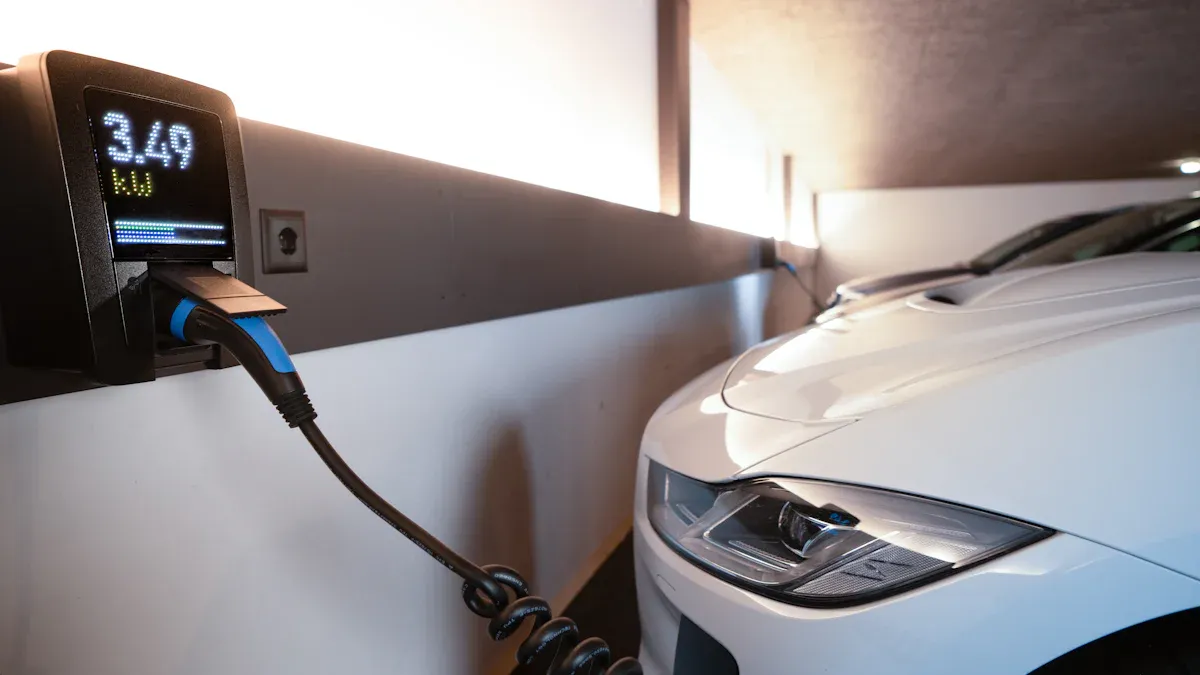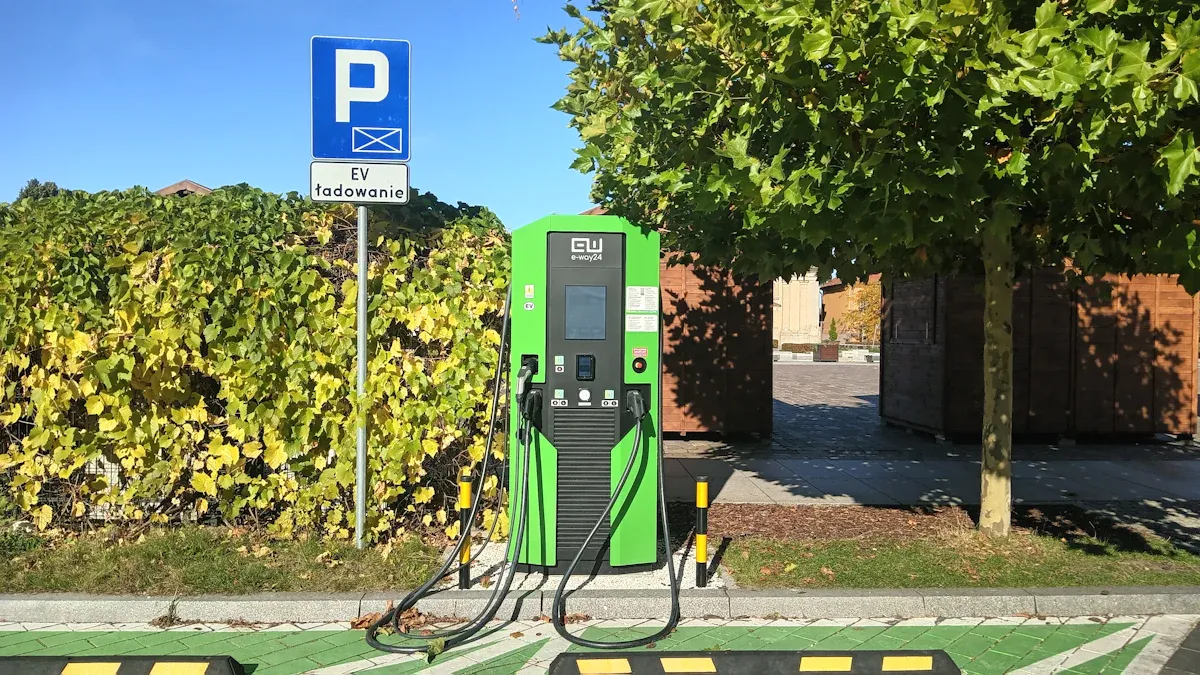
Charging an electric car at home will make your electric bill go up, typically by $30 to $100 per month. This cost varies based on your mileage, the specific electric vehicle you own, and your electricity tariff. A key factor in your total energy consumption is the EV charger you use. TPSON, a provider of technologically advanced EV charging solutions, notes that many EV charger manufacturers focus on efficient energy transfer to manage costs. Drivers can estimate their monthly electric cost increase.
Quick Estimate Formula:
(Monthly Mileage ÷ Car’s Efficiency in miles/kWh) × Electricity Price per kWh = Estimated Monthly Cost Increase.
This guide breaks down how to calculate the precise cost for any situation and explores ways to minimize charging expenses, from using a standard home charger to considering portable EV chargers for more flexibility.
How to Calculate the Exact Cost to Charge Your EV at Home
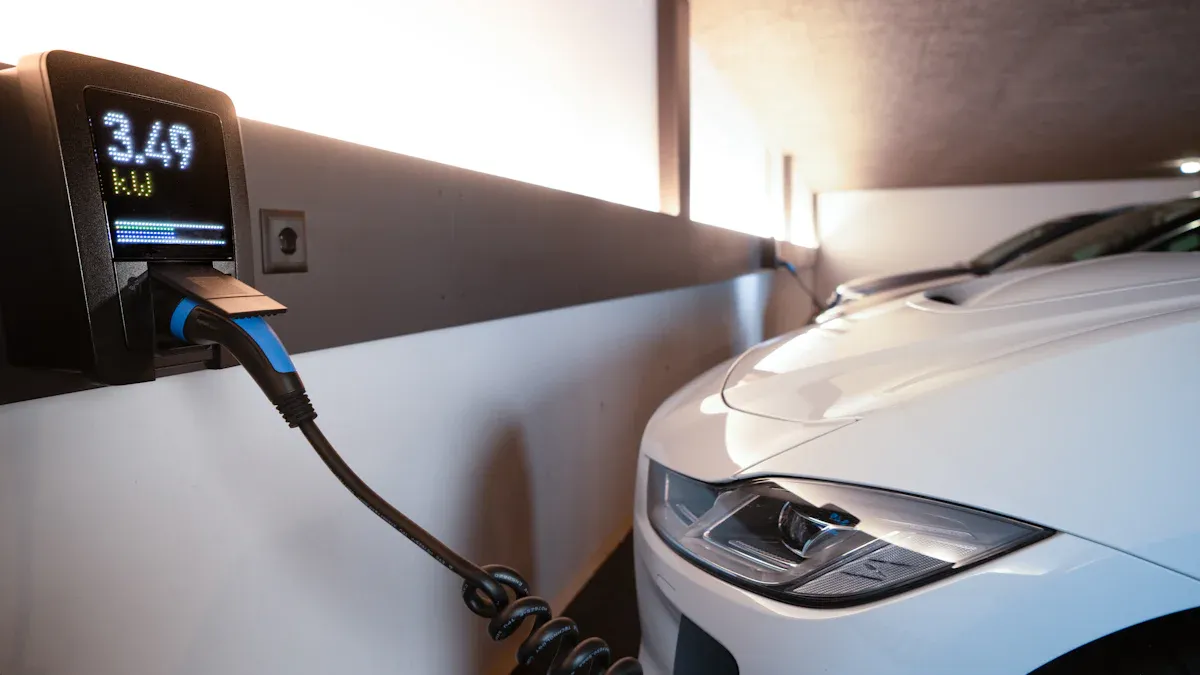
Understanding the financial impact of owning an electric vehicle begins with a few simple calculations. By breaking down the cost into smaller, manageable parts, a driver can accurately predict the increase in their monthly electric bill. This section provides a three-step guide to determine the precise cost of home charging.
Step 1: Find Your Cost Per Mile
The most granular way to understand EV running costs is to calculate the price per mile. This figure is the foundation for all other cost estimates. It reveals how much energy the vehicle consumes for every mile it travels.
The Pence Per Mile Formula Explained
To find the cost per mile, a driver needs two key pieces of information: their electricity price and their car’s efficiency. The price of electricity is listed on a utility bill in cents per kilowatt-hour (kWh). A car’s efficiency is measured in miles per kWh, which is found in the vehicle’s specifications or on its dashboard display.
Formula:
(Electricity Price in cents per kWh ÷ Vehicle Efficiency in miles/kWh) = Cost in Pence Per Mile
This calculation shows the direct cost of the energy required to move the car one mile.
Example Costs Per Mile at Different Rates
The cost per mile fluctuates significantly based on the electricity tariff. Charging during off-peak hours is substantially cheaper than using a standard rate. The table below illustrates this difference for an average EV with an efficiency of 4 miles per kWh.
| Tariff Type | Example Rate (p/kWh) | Cost Per Mile (cents) |
|---|---|---|
| EV Off-Peak | 7.5p | 1.88p |
| Standard Rate | 24.5p | 6.13p |
| Public Rapid | 69p | 17.25p |
Step 2: Find Your Monthly Cost Based on Mileage
Once the cost per mile is known, calculating the total monthly charging cost is straightforward. This step connects the vehicle’s efficiency with a driver’s real-world usage patterns.
The Monthly Cost Formula Explained
A driver can estimate their monthly charging expense by multiplying their cost per mile by the number of miles they typically drive each month. This provides a clear picture of how much their electric bill will increase.
Formula:
(Cost in Pence Per Mile × Monthly Mileage) = Estimated Monthly Charging Cost
This final figure represents the added cost to a household’s monthly electricity budget.
Estimated Monthly Costs by Driving Habits
Annual mileage varies greatly among UK drivers. The average annual mileage for private cars is around 7,400 miles, or approximately 617 miles per month. The table below shows estimated monthly costs for different driving habits, using an average cost of 6.13p per mile (based on a standard 24.5p/kWh tariff).
| Driving Habit | Average Annual Mileage | Estimated Monthly Cost |
|---|---|---|
| Low User | 5,000 miles | $25.54 |
| Average User | 7,500 miles | $38.31 |
| High User | 12,000 miles | $61.30 |
These figures demonstrate how driving habits directly influence the total cost of charging for electric cars.
Step 3: Find the Cost of a Full Charge
Another useful metric is the cost to charge an EV from empty to full. This is similar to knowing the cost of filling a tank of gasoline and helps in understanding the expense of a single, complete charging session at home.
The Full Charge Formula Explained
The cost to charge an EV’s battery from 0% to 100% depends on the battery’s size (measured in kWh) and the price of electricity. It is important to note that some energy is always lost during the charging process. Advanced EV charging solutions from providers like TPSON are engineered to maximize energy transfer efficiency, but a 10-15% energy loss is typical. For a simple estimate, the following formula is used.
Formula:
(Battery Size in kWh × Electricity Price in cents per kWh) = Cost for a Full Charge
This calculation provides a baseline cost for a full charging cycle. The actual energy drawn from the wall will be slightly higher.
Example Costs for Popular UK EV Models
The battery size of electric cars varies by model, which directly affects the cost of charging. Larger batteries offer more range but have a higher cost for a full charge. The table below shows the estimated cost to charge some popular electric cars in the UK, based on a standard electric rate of 24.5p/kWh.
| EV Model | Usable Battery Size (kWh) | Estimated Cost for a Full Charge |
|---|---|---|
| Tesla Model Y RWD | 57.5 kWh | $14.09 |
| Nissan LEAF | 39 kWh | $9.56 |
| Kia Niro EV | 64.8 kWh | $15.88 |
This comparison highlights how the choice of an ev model impacts the overall cost to charge.
How Much Will Your Electric Bill Go Up with Different Tariffs?
The single most influential factor determining how much your electric bill go up is your electricity tariff. The price a driver pays per kilowatt-hour (kWh) can vary by over 300% between a standard tariff and a specialized electric vehicle tariff. Understanding this difference is the key to managing the cost of charging an electric car at home.
The Cost of Charging an Electric Car at Home on a Standard Tariff
Most households in the UK are on a Standard Variable Tariff (SVT) by default. While simple, this is rarely the most economical option for owners of electric cars.
What is a Standard Variable Tariff (SVT)?
A Standard Variable Tariff is a supplier’s default energy plan. The price per unit of electric energy is not fixed and can change, though it is protected by a price cap set by the energy regulator, Ofgem. For the period of January 1 to March 31, 2026, Ofgem set the average cost for electricity on an SVT at 27.69 cents per kWh for customers paying by Direct Debit. This rate applies at all times of the day, making peak and off-peak charging identical in price.
Monthly Cost Example on a Standard Rate (~24.5p/kWh)
Let’s calculate the monthly cost of charging for an average UK driver. We will use the previous example of a driver covering 7,500 miles per year (625 miles per month) in an EV with an efficiency of 4 miles/kWh.
Calculation on a Standard Rate:
- Energy Needed: 625 miles ÷ 4 miles/kWh = 156.25 kWh per month
- Monthly Cost: 156.25 kWh × $0.245/kWh = $38.28
This figure represents a typical baseline cost for a driver who has not optimized their energy tariff for their new electric vehicle.
Reducing Your Bill with an EV Tariff
Energy suppliers offer specialized tariffs for owners of electric cars to dramatically lower the cost to charge. These tariffs provide a powerful incentive to shift energy consumption to off-peak hours.
What is an Off-Peak EV Tariff?
An off-peak EV tariff offers a window of several hours, usually overnight, where the price of electricity is significantly reduced. For example, some suppliers offer rates as low as 7.5p/kWh. These tariffs almost always require a smart meter and a compatible smart EV charger. Technologically advanced chargers, such as those from providers like TPSON, can communicate with the grid and the supplier to automatically schedule charging during these cheap windows.
Popular UK suppliers provide competitive options for drivers of electric cars:
| Supplier | Tariff Name | Off-Peak Rate | Off-Peak Hours |
|---|---|---|---|
| Octopus Energy | Intelligent Octopus | ~7.5p/kWh | 23:30 – 05:30 |
| British Gas | Electric Driver Tariff | ~9p/kWh | 12am – 5am |
| OVO | Charge Anytime | Dynamic | Varies |
Monthly Cost Example on an Off-Peak Rate (~7.5p/kWh)
Now, let’s recalculate the monthly cost for the same average driver, assuming they do all their home charging on an off-peak EV tariff.
Calculation on an Off-Peak Rate:
- Energy Needed: 625 miles ÷ 4 miles/kWh = 156.25 kWh per month
- Monthly Cost: 156.25 kWh × $0.075/kWh = $11.72
The difference is substantial. Simply switching tariffs and charging at the right time reduces the monthly expense by nearly 70%.
Standard vs. EV Tariff: A Direct Cost Comparison
Placing the two scenarios side-by-side reveals the true financial impact of choosing the right tariff. The potential for savings is a primary benefit of owning an electric vehicle.
Side-by-Side Monthly Cost Breakdown
For an average driver covering 625 miles per month, the difference in charging costs is stark. This comparison assumes 100% of charging is done at home.
| Tariff Type | Rate (p/kWh) | Monthly Cost (625 miles) |
|---|---|---|
| Standard Variable Tariff | 24.5p | $38.28 |
| Off-Peak EV Tariff | 7.5p | $11.72 |
| Monthly Savings | $26.56 |
How Much You Can Save Annually
Extrapolating these monthly figures over a full year demonstrates the significant long-term savings. For many drivers of electric cars, these savings can offset a large portion of the initial cost of a home charger installation.
- Annual Cost on SVT: $38.28 × 12 = $459.36
- Annual Cost on EV Tariff: $11.72 × 12 = $140.64
- Total Annual Savings: $318.72
By actively managing their electric tariff, a driver can save hundreds of pounds each year, making the switch to electric cars even more financially compelling.
How Your Choice of EV Affects the Cost of Running an Electric Car
The specific electric vehicle a person chooses has a direct and significant impact on the cost of running an electric car. Just as gasoline cars have different fuel economies, electric cars vary in their efficiency and battery capacity. These two factors—efficiency and battery size—are primary drivers of the overall running costs.
The Impact of Vehicle Efficiency (Miles/kWh)
Vehicle efficiency is arguably the most important factor in determining the day-to-day cost of charging. It dictates how much electric energy a car uses to travel a certain distance.
What is EV Efficiency and Why It Matters
EV efficiency is measured in miles per kilowatt-hour (miles/kWh). This metric is the electric equivalent of miles per gallon (MPG). A higher miles/kWh figure means the electric vehicle uses less energy to cover each mile, resulting in a lower cost.
Official efficiency ratings, known as WLTP (Worldwide Harmonised Light Vehicle Test Procedure), are determined in laboratory conditions. However, real-world efficiency is often lower. Motoring publications find that electric cars typically achieve about 15% less than their official figures due to several variables.
Key factors that reduce real-world efficiency include:
- Weather: Cold temperatures reduce battery performance.
- Driving Habits: Aggressive acceleration and high speeds consume more energy.
- Auxiliary Use: Heating and air conditioning draw significant power from the battery.
Understanding this gap is crucial for accurately predicting the real cost of running an electric vehicle.
Cost Difference: Efficient vs. Inefficient EV Models
The difference in efficiency between various electric cars can be substantial. A more efficient EV will have noticeably lower running costs than a less efficient one, even when driving the same distance.
Consider the cost to drive 100 miles on a standard 24.5p/kWh tariff:
| Car Model | Efficiency (miles/kWh) | Energy Needed (100 miles) | Cost for 100 Miles |
|---|---|---|---|
| Vauxhall Corsa Electric | 5.1 | 19.6 kWh | $4.80 |
| Audi Q8 E-tron | 2.9 | 34.5 kWh | $8.45 |
The more efficient EV costs nearly 43% less for the same amount of travel, highlighting how a car’s design directly affects a driver’s electric bill.
The Impact of Battery Size (kWh)
While efficiency affects the cost per mile, battery size determines the cost of a full charge. A larger battery offers more range but requires more energy to fill.
How Battery Size Influences Full Charge Cost
An EV’s battery capacity is measured in kilowatt-hours (kWh). The cost to charge it from empty to full is a simple calculation: the battery’s size multiplied by the price of electric energy. For example, charging a 60 kWh battery on a 24.5p/kWh tariff would cost $14.70. Technologically advanced chargers from providers like TPSON help ensure this energy transfer is as efficient as possible, minimizing waste.
Cost Difference: Small vs. Large Battery EVs
Different electric cars come with a wide range of battery sizes. A smaller battery is cheaper to charge fully, but a larger one provides greater range between charges. The table below compares the full charge cost for several popular EV models on both standard and off-peak electric rates.
| EV Model | Battery Size (kWh) | Full Charge Cost (Standard Rate) | Full Charge Cost (Off-Peak Rate) |
|---|---|---|---|
| Nissan Leaf | 40 | $9.80 | $3.00 |
| Tesla Model 3 | 57.5 | $14.09 | $4.31 |
| MG4 EV | 64 | $15.68 | $4.80 |
| Kia EV6 | 77.4 | $18.96 | $5.81 |
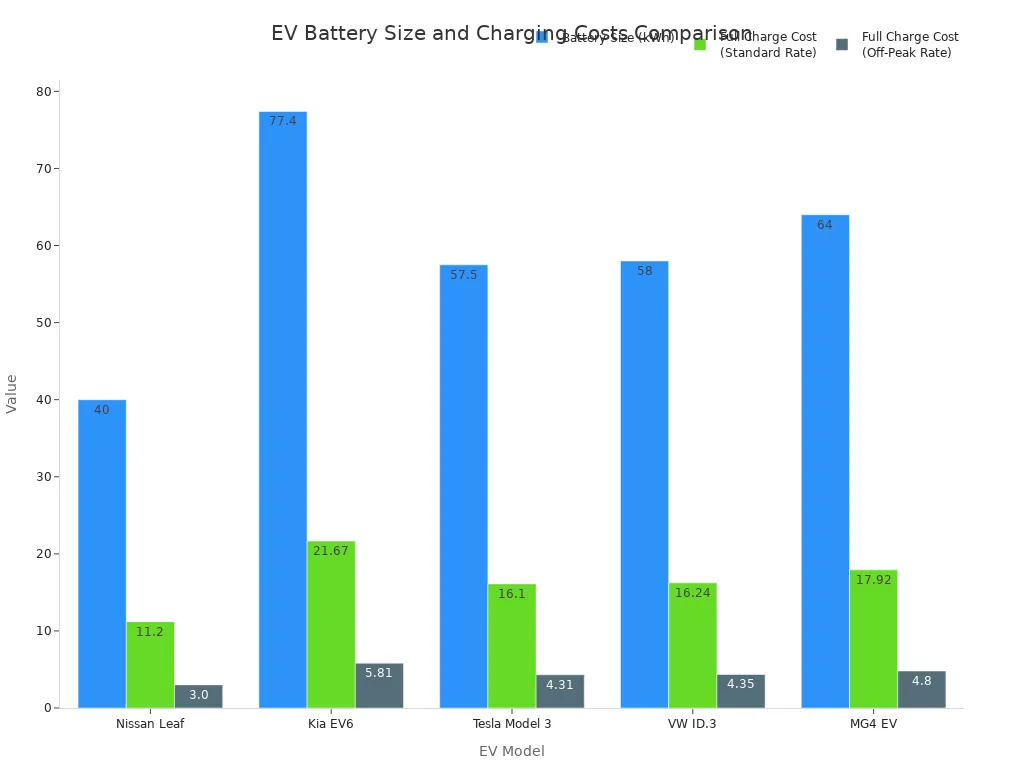
This shows that while a larger battery has a higher cost for a full charge, using an off-peak tariff keeps the expense manageable for all models of electric cars.
Factoring in the Upfront Cost of Home Charger Installation

While the daily running costs of electric cars are low, the initial setup for home charging represents a one-time investment. This upfront expense is a crucial part of the total cost of ownership. Understanding the price of charging points and available financial support helps drivers budget effectively.
The Initial Cost of a Home Charger
Installing a dedicated charger at home is the most convenient and cost-effective way to charge an EV. The price for this installation varies based on the charger model and the complexity of the installation.
Typical Charger and Installation Prices
The typical cost for installing a 7kW home charger in the UK ranges from $800 to $1,500. This price often includes both the charger unit and standard installation. Many companies offer bundled packages. For example, a charger and installation might be available for around $1,250 for a straightforward setup. The final price depends on the home’s existing electrical system and the distance from the fuse box to the charger location.
Available Government Grants (EV Chargepoint Grant)
The UK government offers financial assistance to make home charging more accessible. The EV Chargepoint Grant helps reduce the initial installation cost for specific residents.
Who is eligible?
The grant is for individuals who own and live in a apartment or rent any residential property.
Key details of the grant include:
- It provides up to 75% off the cost of buying and installing a chargepoint, capped at $350.
- Applicants must own or lease an eligible electric vehicle for at least six months.
- The property must have a designated, private off-street parking space.
This grant significantly lowers the barrier to entry for many drivers of electric cars.
Smart Chargers vs. Non-Smart Chargers
The type of charger a person chooses impacts long-term expenses. Smart charging points offer advanced features that non-smart chargers lack, directly affecting a household’s electric bill.
How Smart Chargers Reduce Your Long-Term Bill
Smart charging points are essential for minimizing the running costs of electric cars. These devices connect to the internet, allowing them to perform several money-saving functions. Technologically advanced electric vehicle charging solution providers like TPSON engineer their charging points with these features.
| Feature | How It Reduces Your Bill |
|---|---|
| Scheduled Charging | Automatically starts charging during off-peak hours when electric rates are lowest. |
| Solar Integration | Uses free energy from home solar panels to charge the car, reducing grid reliance. |
| Remote App Control | Allows users to monitor energy use and manage charging sessions from a smartphone. |
These capabilities ensure drivers can easily take advantage of cheaper EV tariffs, leading to substantial savings.
Is a Smart Charger Worth The Initial Cost?
A smart charger may have a higher initial price, but it is a worthwhile investment for most owners of electric cars. The ability to schedule charging to coincide with off-peak electric tariffs (like 7.5p/kWh overnight) unlocks the biggest financial benefit of home charging. Without a smart charger, a driver cannot easily access these low rates. The long-term savings on the electric bill quickly outweigh the higher upfront cost, making smart charging points a financially sound choice.
When Public Charging Increases Your Total Running Cost
While home charging offers the lowest running costs for electric cars, drivers will inevitably use public charging points. Relying heavily on public networks significantly increases the overall cost of charging an electric vehicle. Understanding these external charging fees is essential for managing a realistic budget.
Understanding the Cost of Public Charging Networks
The cost of charging electric cars at public stations varies widely depending on the speed of the charger and the network provider. Prices are typically advertised in cents per kilowatt-hour (kWh).
Slow and Fast Charger Pricing (AC)
Slow and fast AC charging points (up to 22kW) are common at destinations like supermarkets, hotels, and workplaces. These are ideal for topping up the battery over several hours.
- Slow Chargers (3-7kW): Prices often range from 25p to 55p per kWh.
- Fast Chargers (7-22kW): These generally cost between 40p and 60p per kWh.
Some locations offer free charging as an incentive for customers, but this is becoming less common.
Rapid and Ultra-Rapid Charger Pricing (DC)
Rapid and ultra-rapid DC charging points are designed for quick top-ups on long journeys, delivering power from 50kW to over 200kW. This speed and convenience come at a premium cost. The cost to charge at these stations is much higher than the typical electric rate at home.
| Charger Type | Approx. Cost per kWh |
|---|---|
| Destination (slow/fast, 7–22 kW) | 35–45 p/kWh |
| Rapid (50–150 kW) | 55–75 p/kWh |
| Ultra-rapid (200 kW +) | 75–85 p/kWh |
How Public Charging Affects Your Overall Bill
Frequent use of public charging points, especially rapid chargers, will noticeably inapartmente an EV driver’s monthly expenses compared to exclusive home charging.
When to Use Public Chargers vs. Home Charging
The most cost-effective strategy is to use home charging for daily needs and reserve public charging points for long-distance travel or emergencies. The price difference is substantial.
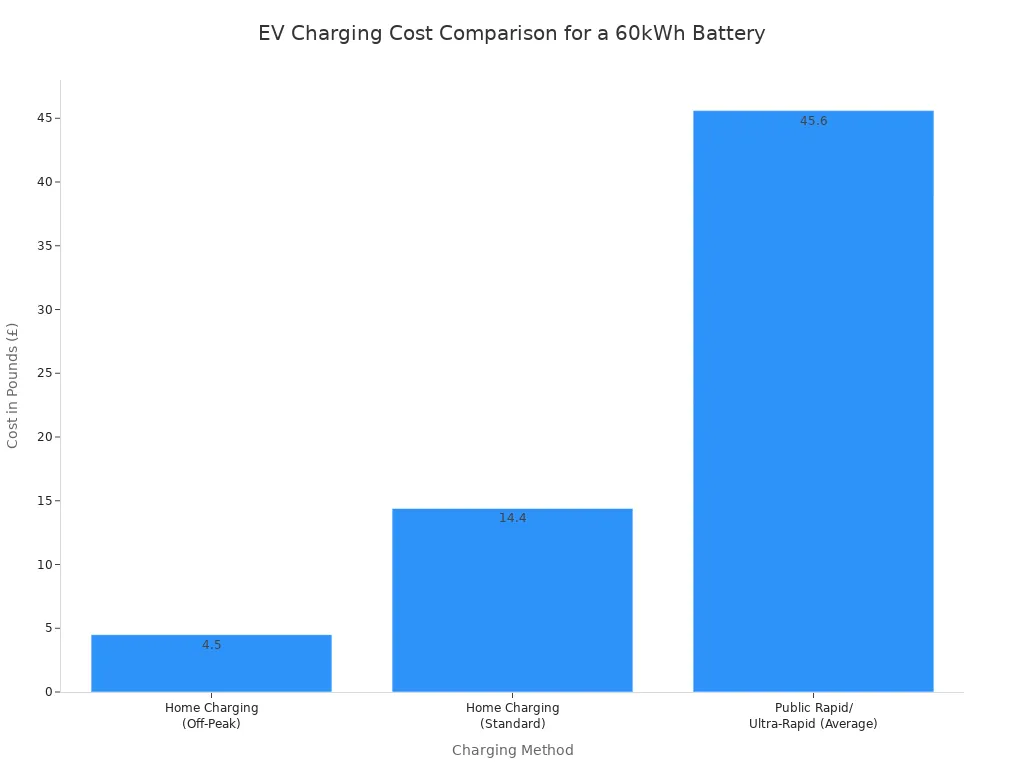
A full charge for a 60kWh battery on an off-peak home tariff might cost around $4.50. The same charge at a public rapid charger could cost between $27 and $51. This convenience comes at a premium, making off-peak home charging the economical choice for regular use.
Calculating a Blended Home and Public Charging Cost
Most drivers of electric cars will use a mix of charging methods. To estimate a blended monthly cost, a driver can calculate the cost for each type of charging based on their habits.
For example, if a driver uses 150 kWh per month:
- 80% at Home (Off-Peak): 120 kWh × $0.075/kWh = $9.00
- 20% at Public Rapid Chargers: 30 kWh × $0.75/kWh = $22.50
- Estimated Blended Monthly Cost: $9.00 + $22.50 = $31.50
This calculation provides a more accurate financial picture for drivers of electric cars who rely on both home and public electric charging points.
Other Factors That Influence Your Electric Bill
The tariff and the car model are major components of your electric bill, but they are not the only ones. A driver’s habits and the environment also play a significant role in the final cost. Understanding these external factors helps owners of electric cars manage their energy consumption and charging expenses more effectively.
How Seasonal Changes Affect Charging Cost
Weather directly influences an electric vehicle’s performance. Both cold winters and hot summers can alter battery efficiency, leading to changes in the overall cost of charging.
Winter’s Impact on Battery Efficiency and Cost
Cold temperatures are a known challenge for electric car batteries. The chemical reactions inside the battery slow down, reducing its ability to hold and deliver energy.
Research from What Car? shows that drivers can expect a 15-20% reduction in range during winter months. This means the car requires more frequent charging to cover the same distance, increasing the monthly electric expense. The battery also uses extra energy to heat itself and the cabin.
Summer’s Impact from Air Conditioning Use
Hot weather presents its own challenges, primarily from the use of air conditioning. Cooling the cabin requires a significant amount of electric energy, which is drawn directly from the main battery. Renault estimates that using climate control systems can reduce an EV’s range by as much as 30%. However, it is important to note that aggressive driving habits often consume more energy than running the air conditioner.
How Your Driving Style Affects Efficiency
How a person drives has a direct and immediate impact on energy consumption. A smooth driving style conserves energy, while an aggressive one wastes it, leading to a higher cost to charge.
Aggressive vs. Smooth Driving Cost Comparison
Driving style is one of the most controllable factors affecting an electric car’s efficiency.
- Aggressive Driving: Rapid acceleration and hard braking consume large amounts of energy. High-speed highway driving also significantly increases electric consumption.
- Smooth Driving: Gentle acceleration, maintaining a steady speed, and anticipating stops allow the car to use energy more efficiently.
Adopting a smoother driving style can extend the vehicle’s range and reduce the frequency of charging sessions.
Maximizing Range with Regenerative Braking
Modern electric cars use a feature called regenerative braking to recover energy. When the driver lifts their foot off the accelerator or applies the brakes, the electric motor works in reverse. It acts as a generator, converting the car’s kinetic energy back into electric energy to top up the battery.
Studies show this system can recover 15% to 20% of energy in general driving conditions. In urban stop-and-go traffic, the savings can be even higher. Some manufacturers, like Porsche, claim that up to a third of an electric vehicle’s range can be gained from this recuperation process alone. Mastering one-pedal driving, where available, maximizes this effect and is a key skill for efficient EV ownership.
A driver’s electric bill will go up with an electric car, but this increase is highly controllable. The final figure depends on a driver’s choices. The most critical factor for managing charging costs is the electricity tariff. Switching to an off-peak EV tariff for home charging can reduce the electric energy expense by over 70%. This switch can lead to annual savings of over $1,200.
Smart charging is essential. Technologically advanced charging solutions, like those from TPSON, enable drivers to automatically use the cheapest electricity. This makes a significant difference in how much the electric bill will go up.
To find a precise estimate, a driver should use the formulas in this guide with their specific mileage, car efficiency, and electric energy rate. This calculation will show exactly how much their electric bill will go up after transitioning to electric charging.
FAQ
How much will my bill really go up?
A typical driver can expect their monthly electric bill to increase by $30 to $100. The exact amount depends on their mileage, vehicle efficiency, and electricity tariff. Using the formulas in this guide provides a precise estimate for any individual situation.
What is the easiest way to lower charging costs?
The single most effective method to reduce costs is switching to an off-peak EV tariff. These plans offer significantly cheaper electricity rates overnight. A driver can cut their charging expenses by over 70% by charging during these hours.
Is a smart charger necessary?
A smart charger is essential for maximizing savings. It automatically schedules charging sessions to coincide with cheap off-peak electricity rates. Technologically advanced providers like TPSON offer smart charging solutions that make this process seamless for the EV owner.
Does the type of EV change the cost?
Yes, the specific electric car matters. A vehicle’s efficiency (miles/kWh) determines the cost per mile. Its battery size (kWh) dictates the cost of a full charge. More efficient models with smaller batteries generally have lower running costs.
How much more expensive is public charging?
Public rapid charging is significantly more expensive than home charging. A full charge at a public station can cost 5 to 10 times more than charging at home on an off-peak tariff. It is best reserved for long journeys.
Does winter weather increase charging costs?
Yes, cold weather reduces a battery’s efficiency. An EV will have a shorter range in the winter, requiring more frequent charging to cover the same distance. This increased energy consumption leads to a higher monthly electric bill.