Finding EV chargers across Europe has never been easier. You can rely on advanced tools that quickly locate charging stations from leading Fabricants de chargeurs de VE. As of the end of 2024, you benefit from a vast network supporting your travel:
- Over 882,012 public EV charging points span the European Union.
- DC chargers make up 16% of these stations, while 84% are AC chargers.
- The number of available points has grown rapidly since 2020.
Reliable apps help you find EV chargers instantly, saving you time and reducing stress during your journey.
Principales applications et sites web pour trouver des chargeurs de VE

Finding electric car chargers across Europe requires reliable tools. You can choose from a range of apps and websites designed to help you locate public charging stations quickly and efficiently. Each platform offers unique features, coverage, and user experiences. Below, you will discover the most recommended options for both all-in-one solutions and national or regional platforms.
Best All-in-One Apps for Electric Car Charging
All-in-one apps simplify your search for points de charge. You can access real-time data, filter by charger type, and plan your route with ease. These platforms receive frequent recommendations from European EV drivers.
PlugShare
PlugShare stands out for its extensive database and user-friendly interface. You can view thousands of charging locations, read user reviews, and check station availability. The app allows you to filter by connector type and charging speed, making it easier to find EV chargers that match your vehicle’s needs. PlugShare’s high app store rating reflects its reliability and popularity among drivers.
ChargeMap
ChargeMap provides comprehensive coverage across Europe. You can access key details for each station, including connector types and power ratings. The app offers real-time information on station functionality and availability, helping you avoid unnecessary detours. ChargeMap’s intuitive design and strong user ratings make it a top choice for finding public charging points.
| Nom de l'application | App Store Rating | Coût |
|---|---|---|
| Carte de charge | 4.4 | Gratuit |
| Pouls BP | 4.4 | Free (subscription available) |
| PlugShare | 4.7 | Gratuit |
Un meilleur planificateur d'itinéraires (ABRP)
A Better Routeplanner (ABRP) helps you plan long journeys by mapping out charging stops along your route. You can enter your vehicle details and destination, then receive optimized charging recommendations. ABRP supports a wide range of European charging networks and provides live updates on station status.
ChargeFinder
ChargeFinder offers a detailed map of charging stations throughout Europe. You can filter results by charger type, speed, and network. The app’s real-time data ensures you always know which stations are available, reducing wait times and improving your travel experience.
Électroverse
Électroverse delivers a comprehensive solution for public EV charging across the UK and Europe. You can filter stations by criteria such as connector type, charging speed, and network. Electroverse’s coverage and filtering options make it easy to find electric car chargers that suit your requirements.
Tip: You can also explore other frequently recommended apps such as EV Navigation for range prediction, Intelligent Octopus Go for home charging scheduling, Co Charger for sharing home chargers, and EV Hotels for locating hotels with charging facilities.
| Nom de l'application | Coverage Description | Real-Time Data Features |
|---|---|---|
| IONITÉ | Extensive network with over 450 stations across 24 European countries | Not specified |
| Carte de charge | Provides key details for each station, including connector types and power ratings | Offers real-time information on station functionality and availability |
| Général | Varies significantly among apps, with some focusing on specific areas | Common feature allowing users to check availability instantly |
National and Regional Apps for Public Charging Stations
You may prefer apps tailored to specific countries or regions. These platforms often provide localized information and support.
Zapmap (UK)
Zapmap specializes in the UK market. You can view a detailed map of public charging stations, filter by charger type, and check live availability. Zapmap’s interface is designed for quick searches and easy navigation.
Electromaps (Spain, France, Germany, and more)
Electromaps covers Spain, France, Germany, and other European countries. You can access a wide range of charging locations, view station details, and check real-time status. Electromaps supports multiple languages, making it accessible for travelers.
easyCharging (UK, Spain, France, Germany)
easyCharging provides access to charging points in the UK, Spain, France, and Germany. You can search for stations by location, charger type, and speed. The app’s straightforward design helps you find EV chargers without hassle.
FordPass (Europe-wide)
FordPass offers Europe-wide coverage for Ford EV owners. You can locate charging stations, check availability, and receive route planning assistance. FordPass integrates with your vehicle’s navigation system for seamless travel.
| Type de défi | Description |
|---|---|
| Multiple App Installations | You must install numerous apps, which leads to confusion and inconvenience. |
| Unique Interfaces | Each app has its own interface, complicating the user experience. |
| Storage and Data Consumption | Managing multiple apps consumes storage space and data, further complicating usage. |
Note: Using several national apps may require you to manage multiple accounts and interfaces. You should consider storage and data usage when installing several platforms.
Using Google Maps and Apple Maps to Find EV Charging Points
General map apps like Google Maps and Apple Maps offer basic charging station search features. You can use these tools for quick searches, but you may encounter limitations compared to dedicated EV apps.
How to Search for EV Chargers
You can search for charging stations by entering keywords such as “EV charging” or “electric car chargers” in the app’s search bar. Both Google Maps and Apple Maps display nearby public charging points, including directions and estimated arrival times.
- Apple Maps sometimes provides inaccurate state-of-charge projections. Estimates may be higher or lower than actual levels upon arrival.
- Apple Maps initially assumes the state-of-charge matches the last time the car was turned off, which can lead to errors until the data updates.
- After syncing, Apple Maps’ projections can be accurate, with arrival state-of-charge estimates within 1% of actual levels.
Pros and Cons of Map Apps
General map apps offer convenience but lack advanced features found in dedicated EV platforms.
- Technical difficulties such as login failures and slow performance can occur.
- Inaccurate information may lead you to chargers that are out of service or have different pricing than displayed.
- Limited filtering options make it difficult to sort stations by price or charger type.
Tip: For the most reliable experience, you should use dedicated EV charging apps alongside general map apps. This approach helps you find EV chargers with greater accuracy and flexibility.
Step-by-Step Guide to Using EV Charging Apps
Setting Up Your Account for Electric Car Charging
Creating a Profile
You start your journey by creating a profile in your chosen EV charging app. This process unlocks essential features and ensures a smooth experience at public charging stations. Most apps guide you through these steps:
- Join the app by registering with your email or phone number.
- Provide payment information, such as a debit or credit card. Some apps may hold a deposit and refund it later.
- Request a charging card or key if you want to access partner networks across Europe. Providers like Electroverse offer monthly billing through these cards.
- Complete your profile to enable seamless payments and access to all app features.
Tip: Setting up your account in advance helps you avoid delays when you need to find ev chargers on the road.
Adding Your Vehicle Details
Adding your vehicle details improves the accuracy of charger recommendations. The app uses this information to tailor suggestions based on your car’s battery and charging needs.
| Point d'information | Description |
|---|---|
| Battery Data | Accessing live battery data helps tailor recommendations based on remaining battery levels. |
| Charging Preferences | User preferences can be integrated to provide personalized charging solutions. |
| Charging Patterns | Analyzing charging patterns allows for alerts and tailored recommendations based on utility rates and driver behavior. |
When you enter your vehicle’s make, model, and battery size, the app can suggest the most suitable ev charging points for your trip.
Searching for Nearby EV Charging Points
Using Location Services
Location services in EV charging apps help you quickly identify nearby charging stations. Apps like E.ON Drive Comfort give you access to over 500,000 charge points across Europe. You can search for chargers by location, check their availability, pay, and start charging—all within the app. Mises à jour en temps réel ensure you always know where to go.
- The app displays available chargers in your area.
- You receive live updates on station status.
- You can pay and activate charging sessions directly from your phone.
Filtering by Charger Type and Speed
Filtering options help you narrow down your search for the best charging station. Leading apps offer filters for power, availability, connector type, and more.
| Application | Filters Available |
|---|---|
| Zapmap | Power, Availability |
| Carte de charge | Free charging stations, Highest scoring stations, Nearby services, Favorite networks, Specific connector types, Power ratings, Compatible with Chargemap Pass |
You can select the right charger for your EV based on speed, connector type, and network compatibility.
Checking Real-Time Availability at Public Charging Stations
Live Status Updates
EV charging apps provide real-time updates on the status of public charging stations. You see whether a charger is available, in use, or offline. Apps like Chargemap, Electroverse, and Zapmap connect directly to partner networks to display live availability for most chargers.
- Chargemap shows live status: available, in use, or out of service.
- Electroverse displays a live map with disponibilité des chargeurs en temps réel.
- Zapmap indicates current status for about 75% of chargers.
Avoiding Busy Stations
You avoid busy stations by checking live updates before you arrive. The app helps you plan your route to less crowded locations, saving you time and reducing stress. Always check the app for real-time status to ensure a smooth charging experience.
Understanding Pricing and Payment Options at EV Charging Points
Understanding how pricing works at public EV charging points across Europe helps you plan your electric car charging experience and avoid surprises. You find that pricing transparency has improved, with regulations requiring clear displays at most public charging stations.
How to View Pricing Before You Charge
You can check the price before starting a charging session. Most operators display prices per kWh, similar to how petrol stations show fuel costs. This makes it easier for you to compare costs between locations.
- Prices appear clearly at the charging station.
- You see the cost per kWh of electricity delivered.
- Operators must charge reasonable, non-discriminatory prices.
- Payment options include bank card or QR code.
In some countries, such as the Netherlands, you notice price differences of up to 30% between nearby public charging points. The AFIR regulation now requires operators to standardize pricing information, helping you make informed decisions.
Price Per kWh vs. Per Minute
You encounter two main pricing models:
- Per kWh: You pay for the amount of electricity delivered to your EV. This model is the most common and easiest to compare.
- Par minute: Some stations charge based on the time your vehicle spends plugged in. This model can be less predictable, especially if your car charges slowly.
| Pays | Average Cost per kWh (€) | Type de station de recharge |
|---|---|---|
| Norvège | 0.20 – 0.30 | Conventional, Fast |
| Suède | 0.25 – 0.35 | Conventional, Fast |
| Allemagne | 0.25 – 0.40 | Conventional, Fast |
| France | 0.30 – 0.50 | Conventional, Fast |
| Espagne | 0.20 – 0.40 | Conventional, Fast |
| DC rapide | 0.25 – 0.50 | Fast Charging Stations |
| Superfast | 0.30 – 0.80 | Superfast Charging Stations |
Extra Fees to Watch For
You should watch for additional fees that may apply at public EV charging stations:
- Connection fees for starting a session
- Idle fees if you leave your car plugged in after charging completes
- Network access fees for using certain charging networks
Payment Methods for Electric Car Charging
You have several ways to pay for electric car charging at public stations. The most widely accepted methods include:
| Mode de paiement | Description |
|---|---|
| Credit and Debit Cards | Widely accepted, but not all stations have card readers. |
| Multi-Network Charging Cards | Simplifies access to various charging stations without multiple accounts. |
| Subscriptions | Offers discounted rates for regular users, providing predictable costs. |
| Network Apps | Allows payment through specific apps, often requiring account setup. |
| Cartes RFID | Enables contactless payment by tapping the card at the reader. |
| QR Codes | Some networks allow payment by scanning a QR code with a smartphone. |
Approximately 65% of consumers prefer to pay for public EV charging with debit or credit cards. Regulators in Germany are pushing for mandatory card payment acceptance at public charging stations. You benefit from regulatory changes that make payment more seamless and secure.
App Payments
You can pay for charging sessions directly through network apps. These apps use secure protocols, such as the ISO 15118 standard, to protect your transactions. EU regulations require interoperability and secure payment methods, so you enjoy peace of mind when using app-based payments.
| Preuves | Description |
|---|---|
| ISO 15118 Standard | Ensures secure communications between car and charger, forming a foundation for secure transactions. |
| DEFA’s Dynamic QR Code | Prevents man-in-the-middle fraud by allowing secure ad-hoc payments through scanning a dynamic QR code. |
| EU Regulations | Mandates interoperability and secure payment methods across Europe, enhancing overall security for app-based payments. |
RFID Cards and Key Fobs
You can use RFID cards or key fobs for contactless payment at many public charging stations. These tools simplify access and reduce the need for multiple accounts.
Contactless and Credit Card Payments
Most public EV charging stations accept contactless payments and credit cards. You tap your card or phone to start a session. Some networks also support QR code payments for added convenience.
Using Subscriptions and Memberships for Public Charging Stations
Subscriptions and memberships offer benefits for frequent electric car charging. You gain access to preferential rates, simplified access, and exclusive services.
| Avantages | Inconvénients |
|---|---|
| Cost control with preferential rates | Variability in pricing |
| Simplified access to charging points | Coverage limitations |
| Time savings through exclusive services | Potential extra fees at some stations |
When Subscriptions Make Sense
Subscriptions make sense if you charge your EV regularly or travel long distances. You save money with discounted rates and enjoy predictable costs. Occasional users may prefer pay-as-you-go options.
Popular European Charging Networks
Several European charging networks offer popular subscription plans. Eldrive provides flexible options in Lithuania, Bulgaria, and Romania. Chargemap Pass and Freshmile suit urban drivers with no monthly fees and competitive rates. Electra+ offers the best rates for ultra-fast charging, while Shell Recharge provides flexible options without mandatory subscriptions. Chargemap Pass stands out for European travelers with coverage across 800 networks.
| Réseau de recharge | Subscription Cost | kWh Rate | Stations Available | Compatible Networks |
|---|---|---|---|---|
| Pass Chargemap | Gratuit | €0.45–0.90/kWh | 650,000 stations | 800 networks in Europe |
| Electra+ | €4.99–19.99/month | €0.29–0.39/kWh | 500+ stations | Electra network |
| Recharge de la coquille | No subscription | €0.36/kWh | Multiple stations | Ionity, Total, others |
| Freshmile | Gratuit | €0.39–0.65/kWh | Local stations | Public networks |
| Plugsurfing | Gratuit | €0.40–0.79/kWh | 200,000 stations | Europe, Tesla |
| Izivia Pass | Optional €2/month | €0.30–0.60/kWh | 250,000 stations | EDF networks |

Planning EV Trips Across Europe Using Public Charging Stations
Mapping Your Route with EV Charging Points
Using Route Planners
Vous pouvez plan your journey across Europe efficiently by using advanced route planners designed for EV drivers. These apps help you map out charging stops, optimize your route, and avoid unnecessary detours. Many route planners offer real-time charger availability, live navigation, and customizable planning features. You can select your preferred charging networks, filter by charging speed, and compare prices at different stations. This approach gives you access to over 600,000 charge points from various networks, so you do not need to install multiple apps.
| Fonctionnalité | Description |
|---|---|
| Real-Time Charger Availability | See which chargers are available as you plan your trip. |
| European Coverage | Plan routes across 11 countries, including the UK, Germany, and France. |
| Real-Time Navigation | Follow your plan live and re-route as needed. |
| Charging Assistance | Add charging stops and include charging time in your trip duration. |
| Customisable Planning | Choose networks and charging speeds that fit your needs. |
| Plan Ahead | Compare charging prices across networks for cost-effective travel. |
Tip: Use the EV filter on Google Maps or a dedicated app to ensure your route includes all necessary charging stops.
Estimating Charging Times
You need to estimate charging times accurately for a smooth trip. Several factors influence how long your EV will take to charge at a public charging station. Battery architecture, battery capacity, and the maximum charge acceptance rate of your vehicle all play a role. Charging is usually faster when your battery is low and slows down as it fills up. The power output of the charging station and environmental conditions, such as temperature, also affect charging speed.
| Facteur | Description |
|---|---|
| Battery architecture | Higher voltage systems support faster charging rates. |
| Capacité de la batterie | Larger batteries take longer to charge. |
| Maximum charge acceptance rate | Your vehicle’s limit may be lower than the charger’s output. |
| State of charge (SOC) | Charging slows as the battery nears full capacity. |
| Power output of station | Higher output means faster charging, if your EV supports it. |
| Environmental factors | Cold or hot weather can slow down charging. |
Cross-Border Charging Tips for Electric Car Charging
Dealing with Different Networks
When you travel between countries, you may encounter different charging networks and standards. The lack of a universal charging standard can make it difficult to use your usual charging card or app at every public charging station. Some networks require their own app or RFID card, which can complicate your journey. You should check network compatibility before your trip and consider using apps that support roaming across multiple networks.
- Charging infrastructure varies by country.
- Some regions have not expanded public charging as quickly as EV adoption rates.
- Grid capacity and local regulations may affect charger availability.
Language and Currency Considerations
You may face language barriers and currency differences when charging around Europe. Many charging apps offer multi-language support, but not all charging stations provide instructions in English. Payment systems may also use local currencies, so you should prepare for possible conversion fees or unfamiliar payment methods. Carrying a backup payment option, such as a credit card, can help you avoid issues.
Note: Downloading apps with multi-language support and checking payment compatibility before you travel can save you time and stress.
Backup Plans for Remote Areas to Find EV Chargers
Finding Chargers Off the Beaten Path
Remote areas in Europe may have fewer charging options. You should always research backup charging points before your trip. Download offline maps and keep a backup navigation system in your vehicle, as mobile signals can be unreliable in rural regions. Identify at least two charging options at each stop to ensure you can find EV chargers even if one station is offline.
| Strategy Type | Description |
|---|---|
| Technology Backup | Download offline maps and have backup navigation systems. |
| Préparation aux situations d'urgence | Pack emergency supplies for the climate you will encounter. |
| The 60% Rule | Keep your battery above 40% to reach the next charging point safely. |
| Backup Charging Research | Identify at least two charging options at every stop. |
| Emergency Supplies | Carry a phone battery pack, whistle, physical maps, and a first aid kit. |
| Accommodation Strategy | Book hotels or lodgings with guaranteed charging facilities. |
What to Do If a Charger Is Out of Service
If you arrive at a public charging station and find it out of service, do not panic. Use your backup plan to locate the next nearest charger. Your offline maps and pre-researched charging points will help you reroute quickly. Always keep your battery above 40% in remote areas to give yourself enough range for unexpected detours. If you cannot find a working charger, contact your EV’s roadside assistance service for help.
Pro Tip: Booking accommodations with guaranteed charging can prevent last-minute surprises and ensure a smooth journey.
Tips for a Smooth Electric Car Charging Experience
Etiquette at Public Charging Stations
Partage des chargeurs
You play a key role in creating a positive environment at every public charging station. Good etiquette ensures everyone can access chargers efficiently.
- Park your EV so you do not block access to another charging point.
- Move your vehicle promptly after charging finishes.
- Avoid unplugging other vehicles without permission.
- Use apps to monitor your charging progress and leave a note with your expected return time if needed.
- Offer help to other drivers if they seem confused or need assistance.
- Report any malfunctions to the operator as soon as you notice them.
- Keep the area clean and dispose of any trash properly.
- Do not park a non-EV in a charging spot or occupy a charger longer than necessary, especially during peak hours.
- Stay flexible and compassionate, especially if someone faces an emergency and needs to charge fast.
Avoiding Idle Fees
Many networks charge idle fees if you leave your EV plugged in after charging completes. You can avoid these extra costs by:
- Setting reminders on your phone or app to move your vehicle when charging ends.
- Monitoring your charging session through the app for real-time updates.
- Planning your activities so you can return before your session finishes.
Tip: Quick action after charging not only saves you money but also helps others access the charger sooner.
Staying Safe While Using EV Charging Points
Well-Lit Locations
You should always choose a well-lit public charging station, especially at night. Good lighting increases your safety and deters theft or vandalism.
- Park close to the charger and stay aware of your surroundings.
- If possible, select stations with security cameras or those located near busy areas.
Emergency Contacts
Prepare for unexpected situations by saving emergency contacts in your phone.
- Know the customer support number for your charging network.
- Keep local emergency numbers handy in case you need assistance.
- Share your location with a trusted contact when charging in unfamiliar areas.
Dépannage des problèmes courants aux stations de recharge publiques
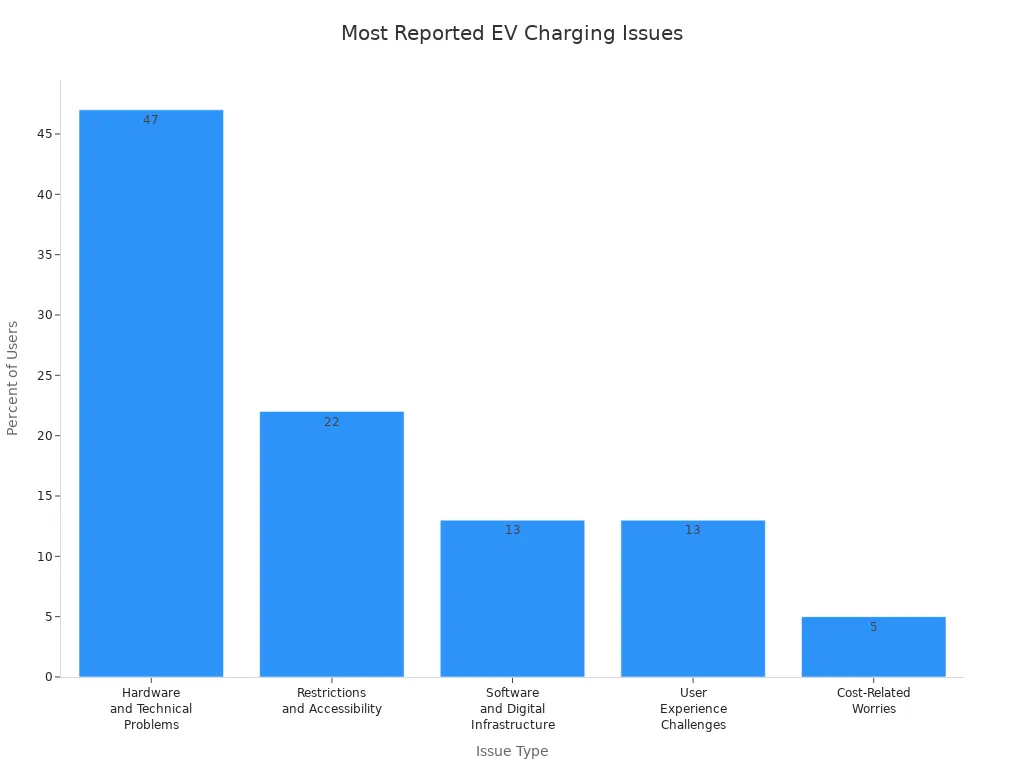
You may encounter technical or user experience challenges at a public charging station. The most common issues include hardware malfunctions, software glitches, and payment problems.
| Issue Type | Percentage of Users Reporting | Description |
|---|---|---|
| Hardware and Technical Problems | 47% | Malfunctions with chargers, screens, card readers, plugs, and adapter compatibility issues. |
| Software and Digital Infrastructure | 13% | App crashes, incorrect charging availability info, and connectivity problems at stations. |
| User Experience Challenges | 13% | Slow charging speeds, long wait times, and inadequate customer support. |
| Restrictions and Accessibility | 22% | Parking limitations, blocked spots, and need for clear signage. |
| Cost-Related Worries | 5% | Perceived high costs and confusion over pricing transparency. |
App Not Working
If your charging app fails to load or crashes, try these steps:
- Restart the app or your phone.
- Check your internet connection.
- Use an alternative app or the charger’s built-in payment terminal if available.
- Contact customer support for your charging network.
Payment Problems
Payment issues can occur due to card reader errors or app malfunctions.
- Try a different payment method, such as a contactless card or RFID key fob.
- Ensure your payment details are up to date in the app.
- If the problem persists, call the network’s support line for immediate help.
Note: Most issues resolve quickly with patience and preparation. Keeping backup payment options and knowing support contacts will help you stay on track.
Understanding Charging Networks in Europe for Electric Car Charging
Europe offers a robust infrastructure for electric vehicle drivers. You benefit from a wide range of charging networks that make long-distance travel and daily commutes more convenient. Understanding how these networks operate helps you plan your trips and avoid unexpected issues at public charging stations.
Major European EV Charging Networks
You encounter several major charging networks as you travel across Europe. Each network provides unique features, coverage, and charging speeds.
Ionité
Ionity operates one of the largest high-power charging networks in Europe. You find their stations along major highways and key transit routes. Ionity focuses on ultra-fast charging, which means you can recharge your EV quickly during long journeys. The network uses standardized connectors, so most modern EVs can access their chargers without adapters. You often see Ionity stations at rest stops, making them ideal for cross-country travel.
Allego
Allego delivers a comprehensive charging network that covers urban centers and rural areas. You can access both AC and DC charging at Allego stations. The network supports a wide range of EV models, so you rarely face compatibility issues. Allego emphasizes accessibility, so you find their chargers in city centers, shopping areas, and business districts. The network also integrates with many roaming platforms, which simplifies payment and access.
Fastned
Fastned specializes in fast and reliable charging along highways and major roads. You recognize Fastned stations by their distinctive canopies and solar panels. The network focuses on sustainability and user experience. You benefit from real-time availability updates and transparent pricing. Fastned supports contactless payments, so you can start charging without hassle. The network continues to expand, so you see new stations appearing in more countries each year.
| Réseau de recharge | Coverage Area | Vitesse de chargement | Options de paiement |
|---|---|---|---|
| Ionité | Pan-European | Ultra-fast (up to 350 kW) | App, RFID, Card |
| Allego | Urban & Rural Europe | AC & DC (up to 350 kW) | App, Card, Roaming |
| Fastned | Highways & Major Roads | Fast (up to 300 kW) | App, Card, Contactless |
Tip: Always check your EV’s compatibility with each charging network before your trip.
Roaming Agreements and Interoperability at Public Charging Stations
You gain flexibility when charging networks support roaming agreements. These agreements allow you to use one app or card across multiple networks, which simplifies your charging experience.
Using One App Across Multiple Networks
Many charging networks participate in roaming partnerships. You can use a single app or RFID card to access chargers from different providers. For example, if you subscribe to a major charging network, you often unlock access to partner stations across Europe. This interoperability reduces the need to manage multiple accounts or payment methods.
- You save time by using one app for route planning and payment.
- You avoid confusion at unfamiliar charging stations.
- You benefit from unified billing and customer support.
Limitations to Be Aware Of
Despite the advantages, you should remain aware of certain limitations. Not all charging networks participate in every roaming agreement. Some stations may not support your preferred payment method. Pricing can vary between networks, so you might pay different rates at partner stations. You may also encounter occasional technical issues with authentication or app compatibility.
Note: Always review the terms of your charging network’s roaming agreements before relying on them for cross-border travel.
Joining EV Communities for Local Advice on Finding EV Chargers
Connecting with other EV drivers gives you a valuable edge when searching for charging points across Europe. You gain access to real-time information, local insights, and support that no app or charging network can fully provide. By joining online forums, social media groups, and local clubs, you build a network of resources that helps you navigate the evolving world of electric mobility.
Online Forums and Social Media Groups for Electric Car Charging
Getting Real-Time Tips
You can join online forums and social media groups dedicated to EV charging. These communities often share updates about new charging stations, temporary outages, or changes in pricing. When you post a question, members respond quickly with advice tailored to your location or route. You stay informed about the latest developments in charging technology and network expansion.
- Reddit’s r/electricvehicles and r/evcharging offer active discussions.
- Facebook groups like “European EV Drivers” or “EV Charging Europe” connect you with thousands of drivers.
- Telegram and WhatsApp groups provide instant alerts about charging station status.
Pro Tip: Enable notifications for your favorite groups to receive urgent updates about public charging points or network issues.
Sharing Experiences
You benefit from reading about other drivers’ experiences with different charging networks. Members often post detailed accounts of their journeys, including which charging stations worked well and which ones had problems. You learn from their successes and mistakes, which helps you plan your own trips more effectively. Sharing your own experiences also contributes to the community and builds trust among members.
Local EV Clubs and Meetups Near Public Charging Stations
Finding Support on the Road
Local EV clubs organize meetups at public charging stations or popular travel routes. You meet other drivers face-to-face, exchange tips, and sometimes even share charging cables or adapters. These gatherings create a sense of camaraderie and provide practical help if you encounter issues with a charging network while traveling.
- Many clubs maintain a list of recommended charging points in their area.
- Some clubs partner with charging providers to offer exclusive access or discounts.
Note: Check club websites or local event calendars for upcoming meetups near your route.
Learning from Other Drivers
You gain valuable knowledge by talking directly with experienced EV owners. They explain how to maximize charging efficiency, avoid common pitfalls, and choose the best network for your needs. You also discover local shortcuts, such as hidden charging points or the best times to visit busy stations. This peer-to-peer learning helps you become a more confident and resourceful EV driver.
| Bénéfice | How It Helps You |
|---|---|
| Local insights | Find lesser-known charging locations |
| Troubleshooting support | Solve network or charging issues faster |
| Community connections | Build relationships with fellow drivers |
Building relationships within the EV community ensures you always have support, whether you need advice about a charging network or help at a public station.
You now have the tools to find ev chargers quickly across Europe. Download recommended apps, set up your account, and explore charging options before you travel. Stay organized by planning your route and checking real-time station status. For ongoing support, join a charging network or local EV community. These steps help you enjoy a smooth and reliable EV experience.
FAQ
How do you find the nearest EV charging station in Europe?
You open a recommended charging app, enable location services, and search for nearby stations. Most apps display real-time availability and directions. You can also use Google Maps or Apple Maps for quick searches.
Can you use one charging card or app across different European countries?
Many major networks support roaming agreements. You often use one app or RFID card across multiple countries. Always check your provider’s coverage and roaming partners before traveling.
Que faire si une borne de recharge est hors service ?
You check your app for alternative stations nearby. Always plan backup options before your trip. If you cannot find a working charger, contact your EV’s roadside assistance for help.
How do you pay for public EV charging in Europe?
You pay using a network app, RFID card, contactless credit or debit card, or sometimes a QR code. Most stations display accepted payment methods clearly.
Are there extra fees when using public EV chargers?
Some stations charge connection or idle fees. You may also see network access fees. Always review pricing details in your app before starting a session.
Do you need to register for every charging network?
You do not need to register for every network. Many apps and cards offer access to multiple networks through roaming. Register with a major provider for the widest coverage.
How can you ensure safety at public charging stations?
You choose well-lit locations, stay aware of your surroundings, and keep emergency contacts handy. Use stations near busy areas or with security cameras when possible.
What is the best way to plan a long EV trip across Europe?
You use a route planner app designed for EVs. Enter your vehicle details and destination. The app suggests optimal charging stops, estimates charging times, and helps you avoid busy or out-of-service stations.