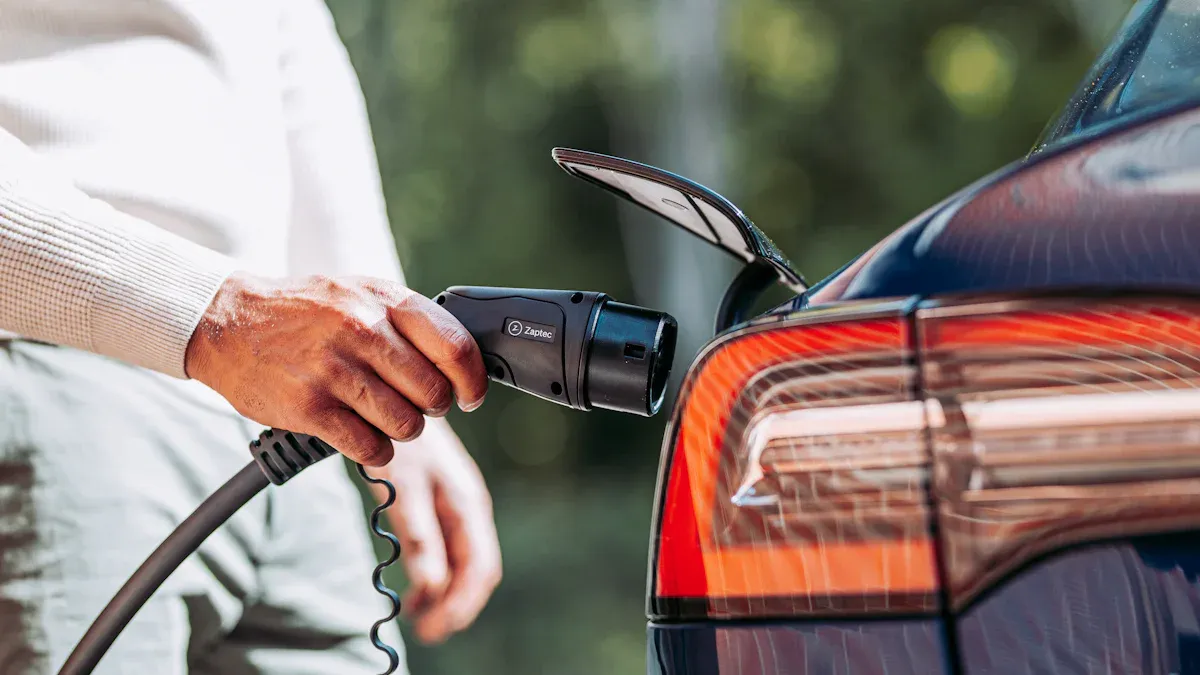
A full fast charge for a typical electric vehicle in Singapore during 2024 has a specific price range.
A typical session generally costs between S$35 and S$55.
The final Fast Charge Cost depends on two primary factors: the vehicle’s battery capacity (kWh) and the rate set by the operator (S$/kWh). Leading Fabricants de chargeurs de VE provide diverse Solutions de recharge pour véhicules électriques across the island. These powerful, stationary Chargeur de VE units differ significantly from low-power chargeurs ev portables designed for basic top-ups.
Cost Breakdown by Major Fast Charging Providers

An EV driver’s final bill depends heavily on the chosen charging provider. Singapore features several major players in the fast-charging market, each with its own pricing structure. This section breaks down the rates and provides cost estimates for the island’s three most prominent DC fast-charging networks.
SP Group: Cost Analysis
SP Group operates one of Singapore’s largest public charging networks. Its extensive presence across heartland locations and commercial buildings makes it a convenient and popular choice for many EV drivers. The company is known for its competitive and transparent pricing.
Current DC Fast Charging Rate
SP Group maintains a consistent pricing model for its high-speed DC chargers.
As of mid-2024, the rate for DC fast charging (50kW and above) is S$0.6037 per kWh.
This single rate applies across their entire network of fast chargers, simplifying the Fast Charge Cost calculation for users regardless of location.
Full Charge Cost for Popular EVs
The following table illustrates the estimated cost to charge several popular EV models from 0% to 100% using the SP Group network. These figures provide a clear baseline for budget planning.
| Modèle EV | Approx. Battery Size | Estimated Full Charge Cost |
|---|---|---|
| BYD Atto 3 | 60.5 kWh | S$36.52 |
| Tesla Model 3 (RWD) | 60 kWh | S$36.22 |
| Hyundai Ioniq 5 (LR) | 77 kWh | S$46.49 |
| Porsche Taycan (PBP) | 93 kWh | S$56.14 |
Charge+: Cost Analysis
Charge+ is another significant provider, rapidly expanding its network with a focus on both AC and high-powered DC chargers. It often installs chargers in condominiums, commercial properties, and public hubs, offering a mix of charging speeds to suit different needs.
Current DC Fast Charging Rate
Charge+ uses a tiered pricing strategy based on the charger’s power output. For fast charging, drivers will primarily use their “Turbo” chargers.
The standard pay-per-use rate for Charge+ Turbo DC chargers (up to 120kW) is S$0.6105 per kWh.
Remarque : 📝 Always verify the rate in the Charge+ app before starting a session, as prices can vary slightly between locations.
Full Charge Cost for Popular EVs
Using the standard Turbo rate, the cost to fully charge popular EVs is slightly higher than with SP Group. The table below outlines these costs.
| Modèle EV | Approx. Battery Size | Estimated Full Charge Cost |
|---|---|---|
| BYD Atto 3 | 60.5 kWh | S$36.94 |
| Tesla Model 3 (RWD) | 60 kWh | S$36.63 |
| Hyundai Ioniq 5 (LR) | 77 kWh | S$47.01 |
| Porsche Taycan (PBP) | 93 kWh | S$56.78 |
Shell Recharge: Cost Analysis
Shell Recharge leverages its extensive network of petrol stations to offer high-speed charging convenience. Its chargers are strategically located along major roads, making them ideal for drivers needing a quick top-up during a journey. This premium convenience often comes with a higher price point.
Current DC Fast Charging Rate
Shell Recharge chargers are among the fastest available to the public, with many stations offering speeds of 180kW. This performance is reflected in their pricing.
The typical rate for Shell Recharge DC fast chargers is S$0.65 per kWh.
This premium rate positions Shell as a go-to option for speed and location convenience rather than for the lowest cost.
Full Charge Cost for Popular EVs
The higher per-kWh rate results in the most expensive full charge among the three major providers. Drivers pay a premium for the speed and accessibility that the Shell Recharge network provides.
| Modèle EV | Approx. Battery Size | Estimated Full Charge Cost |
|---|---|---|
| BYD Atto 3 | 60.5 kWh | S$39.33 |
| Tesla Model 3 (RWD) | 60 kWh | S$39.00 |
| Hyundai Ioniq 5 (LR) | 77 kWh | S$50.05 |
| Porsche Taycan (PBP) | 93 kWh | S$60.45 |
Other Providers Cost Comparison
The Singaporean EV charging market extends beyond the three largest networks. Several other key operators provide services that influence the overall Fast Charge Cost landscape. These providers often present competitive rates or cater to specific locations, giving drivers more options to choose from.
Volt Charging Rates
Volt is an emerging player in the local EV charging scene. It focuses on building a network in accessible public and private locations. The company often positions itself as a highly cost-competitive option for drivers.
Volt’s standard pay-per-use rate for Chargement rapide en courant continu is S$0.58 per kWh.
This pricing makes Volt one of the most affordable choices for DC fast charging on the island, appealing to budget-conscious EV owners.
CDG Engie Charging Rates
A joint venture between ComfortDelGro and Engie, CDG Engie leverages its parent companies’ extensive reach. Its chargers are found in public housing estates, commercial buildings, and fleet hubs, serving both the public and commercial vehicle drivers.
The typical DC fast charging rate on the CDG Engie network is S$0.60 per kWh.
This rate places CDG Engie in direct competition with SP Group, offering a similar price point across its growing network.
TotalEnergies Charging Rates
Global energy company TotalEnergies is actively expanding its EV charging infrastructure in Singapore. It operates high-speed chargers at its service stations, providing another convenient option for drivers on the move.
TotalEnergies generally prices its DC fast charging at S$0.62 per kWh.
This positions the provider in the mid-to-premium range, slightly below Shell Recharge but above the most economical options.
The Most Cost-Effective Provider Today
A direct comparison of standard pay-per-use rates reveals a clear hierarchy in pricing among Singapore’s charging providers. The rate per kWh is the single most important factor determining the final bill for a charging session.
The table below summarizes the current DC fast charging rates across all major providers discussed.
| Fournisseur | Standard DC Rate (S$/kWh) |
|---|---|
| Volt | S$0.58 |
| Groupe SP | S$0.6037 |
| CDG Engie | S$0.60 |
| Charge + | S$0.6105 |
| TotalEnergies | S$0.62 |
| Recharge de la coquille | S$0.65 |
Based on these figures, Volt currently offers the lowest pay-per-use rate for DC fast charging. Groupe SP et CDG Engie follow closely, representing the most cost-effective choices among the larger, more established networks. This rate directly impacts the final Fast Charge Cost for drivers.
Conseil de pro : 💡 Pricing is dynamic. Always launch the provider’s app to confirm the exact rate at a specific charger before you begin your session. Promotions or location-specific pricing can offer unexpected savings.
Understanding Your Total Fast Charge Cost
While provider rates offer a baseline, the final amount on your bill depends directly on your vehicle. Understanding the simple mechanics behind the calculation empowers drivers to accurately predict expenses. This knowledge removes guesswork and allows for precise budgeting for every charging session.
Calculating Your Specific Cost
Le total cost is not a fixed number but a result of a straightforward calculation. Every driver can determine their expected expense before they even plug in.
The Simple Formula
Calculating the cost of a charging session requires two key pieces of information. The first is the amount of energy added to the battery, measured in kilowatt-hours (kWh). The second is the provider’s price per kWh.
The fundamental formula for calculating your charge is:
Total Cost = Energy Added (kWh) × Price per kWh (S$/kWh)
This principle applies to every charging session, whether you are topping up a few percent or charging from empty to full.
A Worked Example
Let’s apply this formula to a real-world scenario. Imagine a driver needs to add a significant amount of energy for a long trip.
- Énergie nécessaire : 50 kWh
- Provider Rate (using SP Group as an example): S$0.6037 per kWh
The calculation would be:
50 kWh × S$0.6037/kWh = S$30.19
In this case, the driver’s session would cost approximately S$30.19. This simple multiplication gives a precise estimate of the final bill.
Cost Examples for Different EV Segments
An electric vehicle’s battery size is the single largest factor determining the maximum Fast Charge Cost for a full charge (e.g., from 10% to 90% or 0% to 100%). Vehicles in different segments, from compact city cars to large premium SUVs, have vastly different battery capacities.
The following table provides estimated costs for a full 0-100% charge for popular EV models in Singapore. It compares the final cost across three major providers with different price points, illustrating how provider choice impacts your wallet.
| EV Segment | Model & Battery Size | SP Group (S$0.6037/kWh) | Charge+ (S$0.6105/kWh) | Shell Recharge (S$0.65/kWh) |
|---|---|---|---|---|
| Petit EV | BYD Dolphin (45 kWh) | S$27.17 | S$27.47 | S$29.25 |
| Mid-Size Sedan | Tesla Model 3 (60 kWh) | S$36.22 | S$36.63 | S$39.00 |
| Mid-Size SUV | BYD Atto 3 (60.5 kWh) | S$36.52 | S$36.94 | S$39.33 |
| Large SUV | Hyundai Ioniq 5 (77 kWh) | S$46.49 | S$47.01 | S$50.05 |
| Premium EV | Porsche Taycan (93 kWh) | S$56.14 | S$56.78 | S$60.45 |
Remarque : 📝 These figures represent a full 0-100% charge. Most drivers fast charge from 10-20% up to 80%, which would result in a lower total cost.
Small EV (BYD Dolphin, 45 kWh)
Compact EVs like the BYD Dolphin feature smaller batteries, making them the most affordable to fully charge. Their lower capacity results in a significantly lower total cost per session.
Mid-Size Sedan (Tesla Model 3, 60 kWh)
The Tesla Model 3 represents a common battery size for sedans. Its 60 kWh battery places it squarely in the average cost bracket for a full charge among today’s EVs.
Mid-Size SUV (BYD Atto 3, 60.5 kWh)
Slightly larger than the Model 3’s battery, the BYD Atto 3’s pack is typical for the popular mid-size SUV segment. The cost is nearly identical to that of a mid-size sedan.
Large SUV (Hyundai Ioniq 5, 77 kWh)
Larger SUVs and vehicles designed for long-range travel, such as the Hyundai Ioniq 5, carry bigger batteries. A full charge for these vehicles crosses the S$45 mark with most providers.
Premium EV (Porsche Taycan, 93 kWh)
High-performance and luxury models like the Porsche Taycan are often equipped with very large battery packs to deliver extended range and power. The Taycan’s 93 kWh battery leads to the highest charging costs, exceeding S$60 at premium-priced chargers.
Are There Other Costs Involved in a Fast Charge?
The price per kWh is the primary component of your bill, but other factors can influence the final amount. EV drivers should be aware of different payment models and potential penalty fees. These elements can significantly alter the total Fast Charge Cost if not managed properly.
Subscription Plans vs. Pay-Per-Use
Charging providers offer different payment structures to cater to various user needs. The two dominant models are subscription plans and pay-per-use.
How Subscriptions Work
Subscription plans require drivers to pay a recurring monthly or annual fee. In exchange, they receive preferential charging rates. These discounted rates can offer substantial savings on each kWh of energy consumed.
For example, a provider might offer a subscription for S$15 per month that reduces the DC charging rate from S$0.60/kWh to S$0.50/kWh.
Who Benefits from a Subscription?
Subscriptions primarily benefit high-mileage drivers. Individuals who rely heavily on public fast chargers, such as private-hire drivers or those who travel long distances for work, often find these plans cost-effective. The savings from the discounted kWh rate can quickly outweigh the monthly subscription fee.
Pay-Per-Use: The Standard Model
Pay-per-use is the default payment method for most public chargers. Drivers pay only for the electricity they consume during a session, with no recurring fees. This model offers maximum flexibility and is ideal for drivers who:
- Charge at home most of the time.
- Use public fast chargers infrequently.
- Prefer not to commit to a single provider.
Understanding Idling Fees
Idling fees are a crucial, and often overlooked, cost associated with public charging. Providers implement these fees to ensure high charger availability.
What Are Idling Fees?
An idling fee is a penalty charged to a driver whose vehicle remains plugged into the charger after the charging session is complete. The fee encourages drivers to move their fully charged cars promptly, freeing up the station for the next user.
Typical Idling Fee Rates
Most providers grant a short grace period (usually 5 to 15 minutes) after charging finishes. Once this period expires, idling fees begin to accrue.
Typical idling fees range from S$0.50 to S$1.00 per minute. These rates are intentionally high to act as a strong deterrent.
How Idling Fees Impact Your Bill
Idling fees can dramatically inflate a charging bill. Forgetting to move a car for just 30 minutes could add S$15 to S$30 in penalties. Most charging provider apps send a notification when a session is complete. Drivers should monitor these alerts closely to avoid unnecessary charges and practice good charging etiquette.
Comparing Fast Charging vs. Slow Charging Costs
Electric vehicle drivers in Singapore have two primary methods for charging: Alternating Current (AC) slow charging and Direct Current (DC) fast charging. Each serves a different purpose and comes with a distinct cost structure. Understanding this difference is key to managing overall vehicle running costs effectively.
The Price of Convenience
The fundamental trade-off between AC and DC charging is speed versus cost. Drivers pay a premium for the convenience of a rapid top-up, while slower, longer sessions offer significant savings.
AC (Slow) Charging Rates
AC chargers are the most common type, found in homes, workplaces, and public parking lots. They deliver power at a slower rate, making them suitable for overnight charging or for topping up while a car is parked for several hours. Their lower installation and operational costs translate to more affordable rates for the end-user.
In Singapore, AC charging rates typically range from S$0.50 to S$0.55 per kWh.
This lower price makes AC charging the most economical choice for daily needs.
DC (Fast) Charging Rates
DC fast chargers provide a rapid injection of power, significantly reducing charging time. This speed requires more complex and expensive hardware. As a result, the price per kWh is higher. As established earlier, DC rates generally fall between S$0.58 and S$0.65 per kWh, reflecting the cost of this advanced technology.
When to Use Fast Charging
Choosing the right charging method depends entirely on the situation. While fast charging is essential in some scenarios, AC charging is often the more practical and economical option.
Ideal Scenarios for DC Charging
DC fast charging is the optimal solution when time is a critical factor. Its primary purpose is to make long-distance travel feasible and to provide quick power boosts during a busy day. Ideal situations include:
- During long road trips where a quick recharge is necessary to continue the journey.
- At stations along major motorways and in urban centers for on-the-go convenience.
- Pour commercial fleets, such as delivery vans or taxis, that operate on tight schedules and cannot afford long downtimes.
When AC Charging is More Economical
For routine charging, the slower and cheaper AC method is almost always the better choice. It integrates seamlessly into a driver’s daily life and is gentler on the vehicle’s battery over the long term. AC charging is most economical for:
- Chargement de nuit à domicile, allowing the car to recharge fully while the owner sleeps.
- Workplace charging, where the vehicle is parked for the entire workday.
- Destination charging at locations like shopping centers or restaurants, where the car will be stationary for an extended period.
By matching the charging method to the need, EV drivers can effectively balance convenience with cost.
Factors That Can Influence Your Final Bill
The advertised rate per kWh is a primary driver of cost, but it is not the only variable. Several other factors related to vehicle efficiency and provider pricing strategies can influence the final amount a driver pays for a session. Understanding these elements helps drivers manage their charging expenses plus efficacement.
Charging Efficiency and Battery Health
A vehicle’s ability to accept a charge efficiently is determined by the physical condition of its battery. Two key factors, temperature and current charge level, play a significant role in how quickly and effectively a battery can absorb energy.
How Battery Temperature Affects Charging
Lithium-ion batteries in EVs operate best within a specific temperature window. Extreme heat or cold can reduce charging speed and efficiency, impacting the overall session cost.
- Ideal Temperature: The optimal operating temperature for most EV batteries is between 15°C et 35°C.
- Cold Conditions: In cold weather, the battery’s internal chemical processes slow down. The vehicle’s management system will divert energy to warm the battery pack before it can accept a charge at full speed. This extends charging time.
- Hot Conditions: High temperatures increase the battery’s internal resistance. This reduces charging efficiency and can cause the system to slow the charging rate to prevent overheating and protect long-term battery health.
The Impact of State of Charge (SoC)
An EV does not charge at a constant speed. The charging rate is dynamic and depends heavily on the battery’s current State of Charge (SoC), which is its current percentage of fullness. The vehicle’s Battery Management System (BMS) controls this process to protect the battery cells.
An EV charges fastest when the battery level is low, typically between 10% and 80%. As the battery fills, the charging speed tapers off significantly. This is like pouring water into a glass; you can pour quickly at first but must slow down near the top to avoid spilling.
Charging from 80% to 100% can often take as long as charging from 20% to 80%. This makes topping up the last 20% on a fast charger inefficient and less cost-effective.
Time-of-Use Tariffs and Promotions
Charging providers sometimes adjust their pricing based on demand or as part of marketing campaigns. Alert drivers can take advantage of these opportunities to lower their Fast Charge Cost.
Off-Peak Charging Discounts
Some operators may introduce time-of-use tariffs to encourage charging during periods of low demand, such as late at night. While not yet widespread in Singapore’s public DC charging market, this is a common strategy in other regions. Drivers should monitor provider apps for any announcements regarding off-peak rates, which can offer significant savings.
Provider-Specific Promotions
Competition among charging providers benefits consumers through promotions. These can take several forms:
- Limited-time discounts on kWh rates.
- Partnerships with credit card companies offering rebates.
- Introductory offers for new charging locations.
Conseil de pro : 💡 Always check the provider’s app for the specific charger’s rate and any active promotions before starting a session. A few seconds of verification can lead to unexpected savings.
Tips for Reducing Your EV Fast Charging Costs

Proactive planning and smart habits can significantly lower an EV driver’s expenses. By adopting a few key strategies, owners can take control of their charging expenditures and maximize savings over the long term.
Plan Your Charging Sessions
A little foresight before plugging in goes a long way. Strategic planning helps drivers avoid paying premium rates and ensures they find the most economical options available.
Using Apps to Find the Cheapest Charger
Nearly every charging provider, including those offering technologically advanced solutions from manufacturers like TPSON, has a dedicated mobile app. Drivers should use these apps to compare real-time S$/kWh rates before heading to a station. A charger just a few streets away might offer a lower price, leading to immediate savings.
Leveraging Off-Peak Rates
Some providers may offer lower rates during off-peak hours to balance grid demand. Drivers should monitor their provider apps for any announcements about time-of-use discounts. Charging late at night or during other low-demand periods can reduce the overall Fast Charge Cost.
Optimize Your Charging Habits
How a driver charges is just as important as where. Simple adjustments to charging routines protect the vehicle’s battery and reduce time spent at the station.
Charging to 80% vs. 100%
An EV’s Battery Management System (BMS) intentionally slows down charging speed as the battery approaches full capacity. This “tapering” phase protects the battery from stress and heat. Charging from 80% to 100% can take nearly as long as charging from 10% to 80%.
For daily driving, stopping a fast charge session at 80% is more efficient and beneficial.
The advantages of charging to 80% include:
- Increased Battery Longevity: It reduces wear on battery cells, extending the battery’s operational life.
- Faster Charging Times: The session is completed much quicker, improving convenience.
- Better Thermal Management: The battery stays cooler, reducing the risk of heat-related degradation.
- Optimal Performance: It allows the regenerative braking system to function effectively, as a 100% full battery cannot accept recovered energy.
Avoiding Unnecessary Idling
Drivers must remain mindful of when their charging session ends. Most provider apps send a notification when the car is ready. Moving the vehicle promptly after the grace period expires is essential to avoid expensive per-minute idling fees that can quickly inflate a bill.
Consider Subscription Plans
For certain drivers, a monthly subscription can be a powerful cost-saving tool. It involves paying a flat fee in exchange for a discounted rate per kWh.
Evaluating Your Monthly Mileage
High-mileage users, such as private-hire drivers or sales professionals, benefit most from subscriptions. They should calculate their average monthly energy consumption in kWh. If the savings from the discounted rate exceed the monthly subscription fee, the plan is a financially sound choice.
Comparing Provider Subscription Benefits
Not all subscription plans are equal. Drivers should compare the offerings from different providers. Key factors to evaluate include the monthly fee, the discounted kWh rate, and the number of accessible chargers included in the network.
In 2024, EV drivers in Singapore can expect a full fast charge to cost between S$35 and S$55. This final Fast Charge Cost depends on the vehicle’s battery and the chosen provider. Current pay-per-use rates often position SP Group as a highly economical choice for DC charging.
To secure the best price, drivers should always verify rates and promotions in the provider’s app before plugging in. This simple check guarantees they receive the most current and advantageous pricing for every session.
FAQ
Which provider offers the cheapest fast charge?
Based on current pay-per-use rates, Volt often provides the most affordable DC fast charging. SP Group and CDG Engie also offer very competitive pricing. Drivers should always check provider apps for the latest rates, as prices can change.
Why is DC fast charging more expensive than AC slow charging?
DC chargers require more complex and costly hardware to deliver high power directly to the battery. This higher equipment and operational cost results in a premium price per kWh. Chargement en courant alternatif uses simpler technology, making it a more economical option.
How can a driver avoid idling fees?
Drivers can avoid idling fees by moving their vehicle promptly after a charging session ends. Most provider apps send a notification when the battery is full. Setting a personal timer is another effective strategy to prevent these expensive penalty charges.
Is it better to fast charge only to 80%?
Yes, charging to 80% is more efficient. The charging speed slows significantly after 80% to protect the battery. Stopping at 80% saves time, reduces battery wear, and is more cost-effective for the energy gained.
Should every EV driver get a subscription plan?
Subscription plans primarily benefit high-mileage drivers who use public fast chargers frequently.
Drivers who charge mostly at home or use public chargers infrequently will find the standard pay-per-use model more economical. Evaluate your monthly usage to see if a plan offers savings.
What is the best way to find the lowest charging rate?
💡 The best method is to use the providers’ mobile apps. These apps show real-time pricing for each specific charger location. Comparing rates on apps like SP Group, Charge+, and Volt before driving to a station ensures the lowest possible cost.