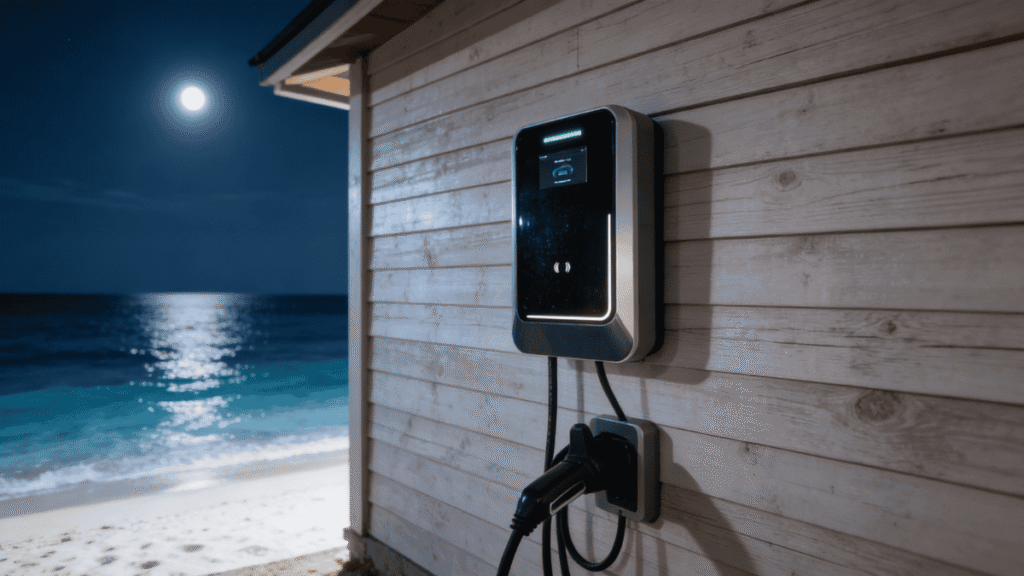
L'emplacement idéal pour une borne de recharge de véhicule électrique dans un garage est celui qui minimise la longueur de câble nécessaire et les risques de trébuchement, protège le connecteur des chocs et de l'humidité, et maintient le trajet du câblage suffisamment court pour maîtriser le coût d'installation — tout en permettant à la borne de fonctionner sous une charge continue sûre. Dans la plupart des habitations, cela signifie fixer l'unité sur le mur latéral le plus proche de la prise de recharge du véhicule, à une hauteur pratique pour un usage quotidien, avec un chemin dégagé pour la gestion du câble et un dégagement suffisant par rapport aux portes, aux outils mobiles et au rangement.
Ce guide de planification se concentre sur les décisions d'implantation qui influencent la sécurité, la facilité d'utilisation et la fiabilité à long terme. Il intègre des considérations éprouvées sur le terrain décrites par Car and Driver (indices de protection pour extérieur, dimensionnement du circuit, limites de charge continue, et rôle de la gestion de charge), ainsi que des exemples du marché de Smart Charge America (configurations courantes de bornes domestiques) et de l'écosystème produit de TPSON, incluant la surveillance de sécurité intelligente et l'Équilibrage Dynamique de Charge présent sur sa gamme de recharge pour VE.
- Réponse rapide : l“” emplacement idéal » pour la plupart des garages
- Commencer par l'implantation, pas par le matériel : ce qu'il faut cartographier
- Choisir en fonction du côté de la prise de recharge et du comportement de stationnement
- Hauteur de fixation, dégagements et gestion du câble
- Planification du trajet du câblage (pourquoi les trajets courts sont généralement préférables)
- Bordures intérieur vs. extérieur (recharge sur allée et intempéries)
- Planification électrique dans le garage : charge continue et ampérage réaliste
- Où l'Équilibrage Dynamique de Charge influence l'emplacement
- Garages pour deux VE : options d'implantation évitant les retouches
- Erreurs courantes de placement (et comment les éviter)
- Modèle de planification imprimable (mesures + liste de contrôle)
- FAQ
- Références & sources externes
Réponse rapide : l“” emplacement idéal » pour la plupart des garages
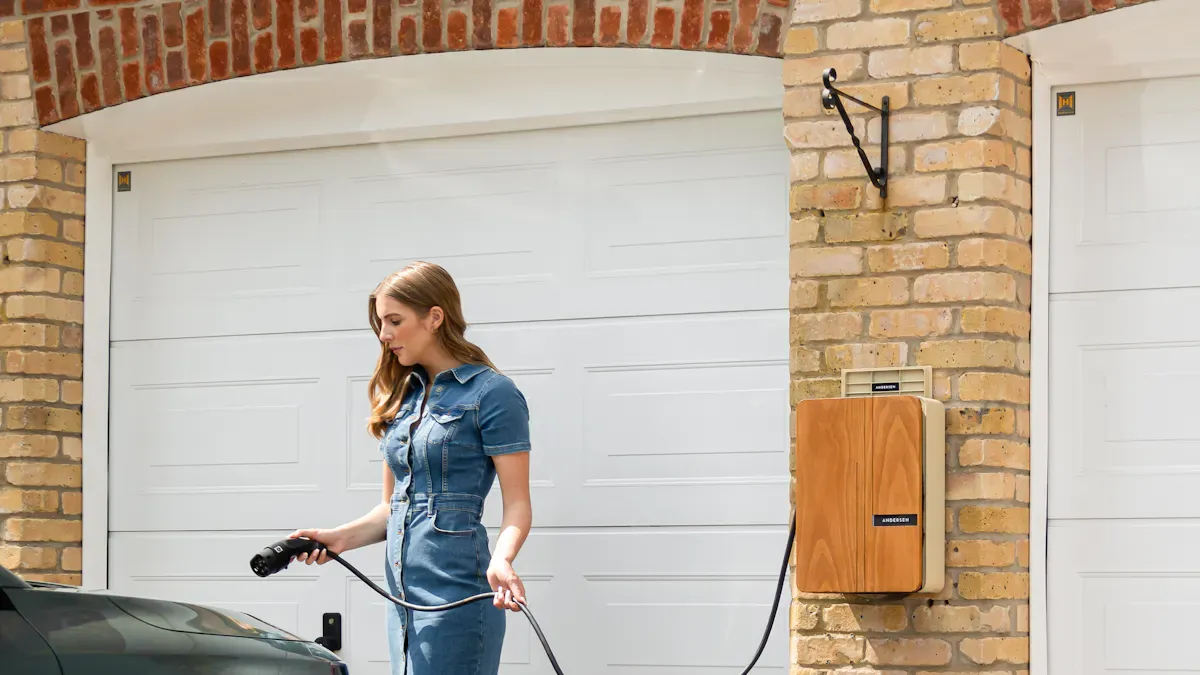
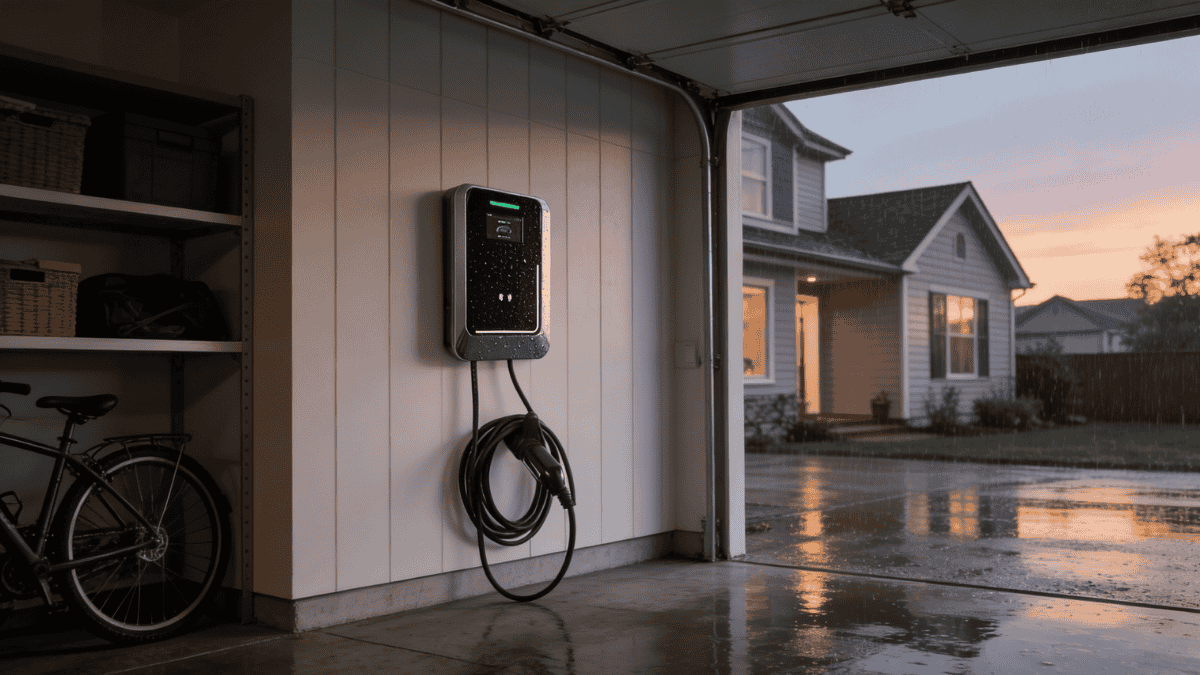
Pour un garage typique à un véhicule, l'emplacement le plus souvent réussi est : le mur latéral le plus proche de la prise de recharge du véhicule, fixé à un endroit où le câble peut atteindre la prise sans traverser le passage piéton principal.
| Type de garage | Emplacement par défaut idéal pour la borne | Pourquoi cela fonctionne | Points à vérifier |
|---|---|---|---|
| Garage un véhicule, stationnement en marche avant | Premier tiers du mur latéral du côté de la prise | Portée la plus courte ; évite que le câble ne traverse la baie | Encombrement de la porte, étagères et dégagement du passage |
| Garage un véhicule, véhicule parfois stationné à l'extérieur | Mur latéral près du montant de la porte de garage (côté prise) | Fonctionne pour la recharge à l'intérieur et sur l'allée | Risque de coincement du câble sous la porte ; exposition aux intempéries |
| Garage deux véhicules (un VE aujourd'hui, deux plus tard) | Mur mitoyen entre les baies ou pilier central | Meilleure flexibilité de portée pour chaque place | Gestion du câble ; futur second circuit ou partage |
Pour la sélection de catégorie de produit (wallbox AC vs. DC à usage spécial), TPSON organise les options sous Chargeurs de VE, les familles de wallbox typiques pour garage étant listées sous Chargeurs de VE en courant alternatif.
Commencer par l'implantation, pas par le matériel : ce qu'il faut cartographier
Les installations de garage performantes commencent par un simple exercice de cartographie. Les données les plus importantes sont physiques, pas électriques : position de stationnement, emplacement de la prise de recharge, et chemins de circulation.
Mesures minimales à prendre (10 minutes)
- Distance entre le mur prévu et la prise de recharge du véhicule (véhicule bien droit et légèrement décalé).
- Emplacement des montants/béton et du trajet de conduit le plus proche et réalisable vers le tableau électrique.
- Zones de mouvement des portes : rails de porte de garage, portes latérales et espace d'ouverture des portières du véhicule.
- Zones de rangement (vélos, bacs, échelles) pouvant bloquer l'accès à la poignée de la borne.
Un placement est “ correct ” lorsque le conducteur peut brancher d'une seule main, sans enjamber le câble, facilité d'utilisation quotidienne.
Choisir en fonction du côté de la prise de recharge et du comportement de stationnement
L'emplacement de la prise de recharge varie selon le modèle, et le “ meilleur ” mur du garage change en conséquence. Une borne placée du mauvais côté reste utilisable — mais elle a tendance à créer.
Trois configurations courantes
| Position de la prise | Meilleur choix de mur | Objectif de trajet du câble | À éviter |
|---|---|---|---|
| Avant-gauche / avant-droite | Premier tiers du mur du côté de la prise | Portée courte et directe vers la zone de l'aile | Câble traversant l'axe central de la baie |
| Arrière-gauche / arrière-droite | Dernier tiers du mur du côté de la prise | Câble maintenu près de la zone du pare-chocs arrière | Câble sous les portières et les pieds |
| Avant-centre (certaines plateformes) | Mur avant près de l'axe central ou d'un pilier | Portée droite, mou minimal | Mounting where car bumper can strike the unit |
Hauteur de fixation, dégagements et gestion du câble
A charger that is “technically installed” can still be a daily frustration if the handle is too low (dragging), too high (awkward reach), or blocked by storage. The goal is consistent access and a predictable loop for cord storage.
Placement rules that reduce damage and tripping
- Keep the holster off the floor; floor contact increases dirt ingress and connector wear.
- Keep the cable out of the main walking lane; prefer routing along the wall then to the port.
- Reserve space for a dedicated hook or integrated cable management; Smart Charge America product listings show that many mainstream home chargers include cable management, but layout still determines whether it is used properly.
- Protect against impact: avoid mounting in a spot where the bumper, doors, or rolling tool chests can strike the unit.
Why this matters for long-term reliability
Car and Driver’s testing notes that cord length and thickness differences did not produce measurable charging-performance differences, but daily usability (cable handling and storage) strongly influences owner satisfaction. In practice, a well-managed cable also reduces accidental strain at the connector and mounting bracket.
Planification du trajet du câblage (pourquoi les trajets courts sont généralement préférables)
Garage charger placement affects the electrical scope. A location that requires a long conduit run, a complex attic drop, or trenching typically increases labor and may increase conductor size. Car and Driver notes that installation cost depends heavily on available electrical capacity and the complexity of running a dedicated line; it can range from a few hundred dollars to several thousand when upgrades are required.
A practical planning hierarchy
- First priority: safe daily use (short reach, low trip risk).
- Second priority: an efficient wiring path (shorter run, simpler routing).
- Third priority: future flexibility (second EV, driveway charging, or a different connector standard).
Typical quotes and plans reference conduit routing, breaker panel capacity, charge continue, wire gauge, voltage drop, et GFCI/RCD coordination. The optimal location is the one that reduces scope without compromising safety.
Bordures intérieur vs. extérieur (recharge sur allée et intempéries)
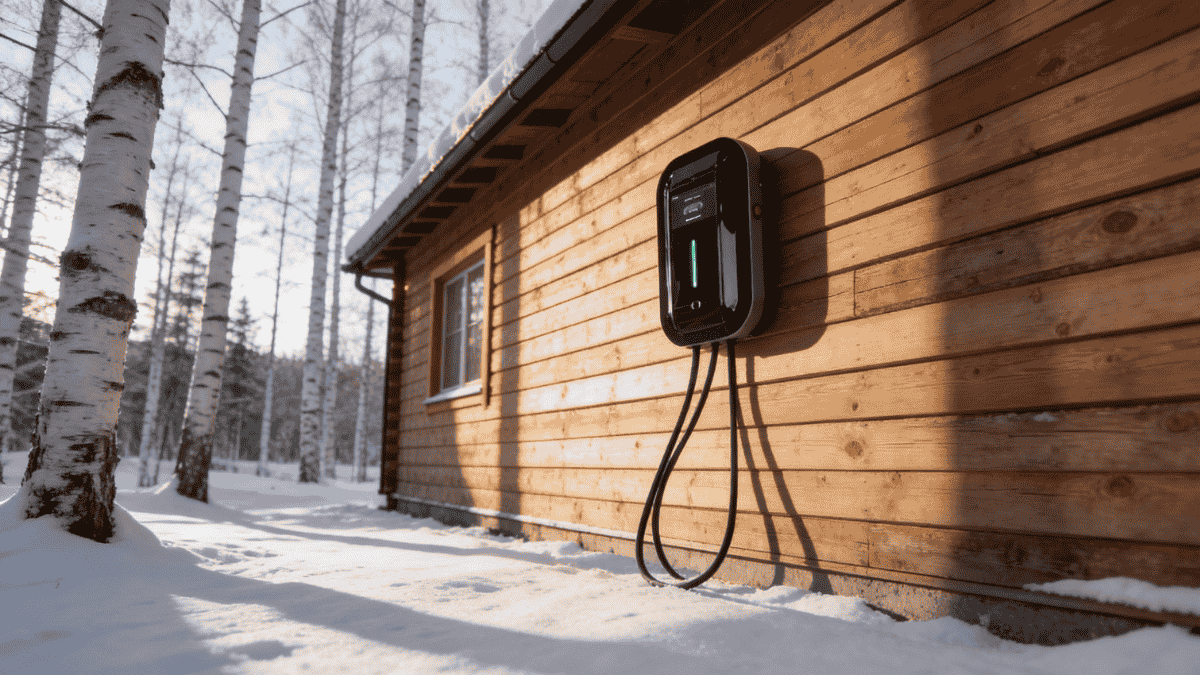
Some households frequently charge in the driveway due to garage storage or parking patterns. Car and Driver notes that outdoor mounting is generally feasible if the charger and the electrical feed are appropriately rated (NEMA or IP) and the outlet enclosure is outdoor-rated when using plug-in equipment.
Two robust strategies
| Stratégie | When it fits | Key advantage | Key trade-off |
|---|---|---|---|
| Indoor mount near garage door jamb | Occasional driveway charging | Protected unit; short route outside | Cable can interact with door seal path |
| Outdoor-rated mount on exterior wall | Frequent driveway charging | Most convenient for outside parking | Exposure planning; outdoor-rated wiring/enclosure required |
Planification électrique dans le garage : charge continue et ampérage réaliste
Location decisions should align with the power plan. Car and Driver recommends a modest 40- or 50-amp circuit as a strong middle ground for overnight charging, and explains that EV charging hardware typically runs at 80% of circuit capability for continuous load (for example, 50A circuit → 40A continuous). This affects both circuit design and the practical benefit of placing the charger farther away.
Charging tiers commonly seen in home products
Retail listings confirm that most home units cluster around 40–48A output. Smart Charge America lists Emporia as 40A plug-in or 48A hardwired. Car and Driver’s 2026 testing also highlights mainstream options in the 6–48A capability range, reinforcing that the garage layout should be designed around realistic overnight charging rather than extreme amperage.
| Common continuous output | Typical circuit pairing (illustrative) | Practical garage implication |
|---|---|---|
| 32A (~7.7 kW @ 240V) | 40A breaker | Easier routing; often sufficient for overnight replenishment |
| 40A (~9.6 kW @ 240V) | 50A breaker | Most common “balanced” home configuration |
| 48A (~11.5 kW @ 240V) | 60A breaker | Hardwire favored; placement should reduce cable strain and heat exposure |
Où l'Équilibrage Dynamique de Charge influence l'emplacement
Équilibrage dynamique de la charge changes garage planning when a home has limited electrical headroom or multiple high-demand appliances. Car and Driver describes load management as a way to prevent panel upgrades by automatically reducing charging draw when necessary. Smart Charge America similarly describes Emporia Pro’s dynamic adjustment based on home energy monitoring.
TPSON positions Dynamic Load Balancing as an integrated protection approach across its EV charging ecosystem, designed to protect the home’s electrical system while maintaining stable charging. TPSON’s home page also highlights Protection avancée de la sécurité, Contrôle dynamique de la température, et Diagnostics et alertes en temps réel, which are directly relevant to high-usage garage installations.
Placement implications when DLB is part of the plan
- If an energy meter/monitor or network gateway is required, confirm the communication path (Wi?Fi/Ethernet/4G) in the garage location.
- Prefer a mounting point with stable signal and easy access for service checks.
- If the panel is remote, choose a charger location that avoids overly complex cable routing; DLB helps reduce upgrade needs, but it does not eliminate installation complexity.
Garages pour deux VE : options d'implantation évitant les retouches
Two-EV households frequently outgrow a “single-car” placement plan. The goal is to choose a location that allows flexibility for both stalls without forcing a second full rewire later. Car and Driver highlights solutions such as power sharing for multi-EV households, and market offerings commonly support scheduling and load-oriented controls.
Three scalable layouts
| Layout | Idéal pour | Strength | Points de vigilance |
|---|---|---|---|
| Central mount (between bays) | Two cars, mixed port locations | Maximum reach flexibility | Cable routing must avoid both walking lanes |
| Two dedicated mounts (each bay) | High daily mileage, frequent simultaneous charging | Simplest daily use | Higher electrical scope; needs capacity planning |
| One mount + managed scheduling/load balancing | Moderate needs, long overnight window | Reduces upgrade pressure | Requires good user discipline and configuration |
For broader infrastructure planning, TPSON positions solutions for homeowners and fleets under its Chargeurs de VE ecosystem. For specific garage wallbox options, see Chargeurs de VE en courant alternatif.
Erreurs courantes de placement (et comment les éviter)
The following mistakes repeatedly appear in homeowner installations and are strongly associated with cable damage, nuisance trips, and daily frustration:
Mistake 1: placing the charger where the cable must cross the main walkway
This increases trip risk and leads to repeated stepping on the cable. A better approach is to place the charger on the port side and route along the wall.
Mistake 2: mounting too low so the connector rests on the floor
Floor contact increases contamination and wear. The connector should be holstered clear of the ground with a stable storage point.
Mistake 3: choosing a “convenient wall” that forces an expensive wiring run
Car and Driver notes that installation cost can rise from a few hundred dollars to a few thousand when electrical capacity or routing complexity demands upgrades. A slightly different wall location can materially reduce total project cost.
Mistake 4: assuming more amps fixes everything
Car and Driver explains charging speed is limited by the lowest of the household circuit, the EVSE, and the vehicle’s onboard charger. Many households benefit more from smart scheduling ou la gestion de charge than from chasing maximum amperage.
Modèle de planification imprimable (mesures + liste de contrôle)
- Wall-to-charge-port distance (straight park): ________
- Wall-to-charge-port distance (offset park): ________
- Nearest safe conduit path back to panel: ________
- Clearance from doors/track/storage: ________
- Wi?Fi/cellular signal quality at location: ________
- Chosen wall aligns with charge-port side and minimizes cable crossing.
- Charger and holster are protected from impacts and water exposure.
- Cable storage is planned (hook/holder) to keep the floor clear.
- Circuit plan follows continuous-load limits (as described by Car and Driver).
- If capacity is limited, DLB/load management is evaluated before upgrading service.
FAQ
1) Where should an EV charger be mounted in a one-car garage?
The most practical location is usually the side wall closest to the vehicle’s charge port, positioned so the cable does not cross the main walking path. This reduces daily friction and minimizes connector wear.
2) Is it better to install an EV charger near the garage door for driveway charging?
If driveway charging is frequent, mounting near the door jamb can provide flexible reach. Car and Driver notes outdoor charging is feasible with proper outdoor ratings (NEMA/IP) and appropriate enclosure for the electrical feed. The cable path under the door must be planned to avoid pinch and abrasion.
3) How does charger placement affect installation cost?
Placement changes wiring distance and complexity. Car and Driver explains that if a home has sufficient spare electrical capacity, installation may be relatively modest; if not, upgrades can raise cost substantially. A location that allows a simpler conduit route typically reduces labor and materials.
4) What amperage should be planned for a garage charger?
Many homes target 32–40A continuous Level 2 charging as a practical overnight tier. Car and Driver recommends modest 40–50A circuits as a balanced approach, and explains the 80% continuous-load rule. Smart Charge America listings also show mainstream home products commonly configured around 40–48A output, with hardwired setups typically enabling higher output.
5) Do two-EV households need two chargers?
Not always. With sufficient overnight dwell time, a single well-placed charger and a managed schedule can be enough. However, the garage layout should anticipate future charging needs; a central mount or a plan for a second circuit can prevent rework.
6) What is Dynamic Load Balancing and how does it affect placement?
Load management can automatically adjust EV charging current to keep total household draw below a safe threshold. Car and Driver highlights load management as a way to avoid panel upgrades, and Smart Charge America describes dynamic adjustment in products that use home energy monitoring. If DLB is planned, placement should ensure reliable connectivity and service access.
7) Is DC fast charging a garage solution?
For most homes, Level 2 AC is the rational choice. Car and Driver notes Level 3/DC fast charging is generally illogical for home use due to cost. DC becomes relevant for special scenarios such as emergency roadside assistance, depots, or temporary locations—use cases aligned with TPSON’s portable DC positioning.
8) How does public charging network design inform garage planning?
Love’s describes adding more DC fast chargers (Level 3) to complement its Level 2 network, reflecting a practical rule: AC serves longer dwell times while DC targets turnaround. In a garage, dwell time is usually long, so the layout should optimize safe, convenient nightly charging rather than highway-style speed.
Résumé
The optimal garage charger location is the one that makes nightly charging effortless: short reach to the charge port, minimal cable on the floor, and a wiring path that keeps the electrical scope reasonable. Evidence from testing and market listings shows that most households succeed with mainstream Level 2 outputs and benefit disproportionately from cable management, continuous-load circuit design, et la gestion de charge where capacity is limited.
For a structured path from product category to implementation, TPSON’s portfolio overview is organized under Chargeurs de VE, with garage-typical wallbox families listed under Chargeurs de VE en courant alternatif. Chargeurs DC EV.
Références & sources externes
Les sources suivantes ont été consultées pour les déclarations factuelles, les spécifications et les exemples. Des liens externes sont fournis à des fins de vérification :