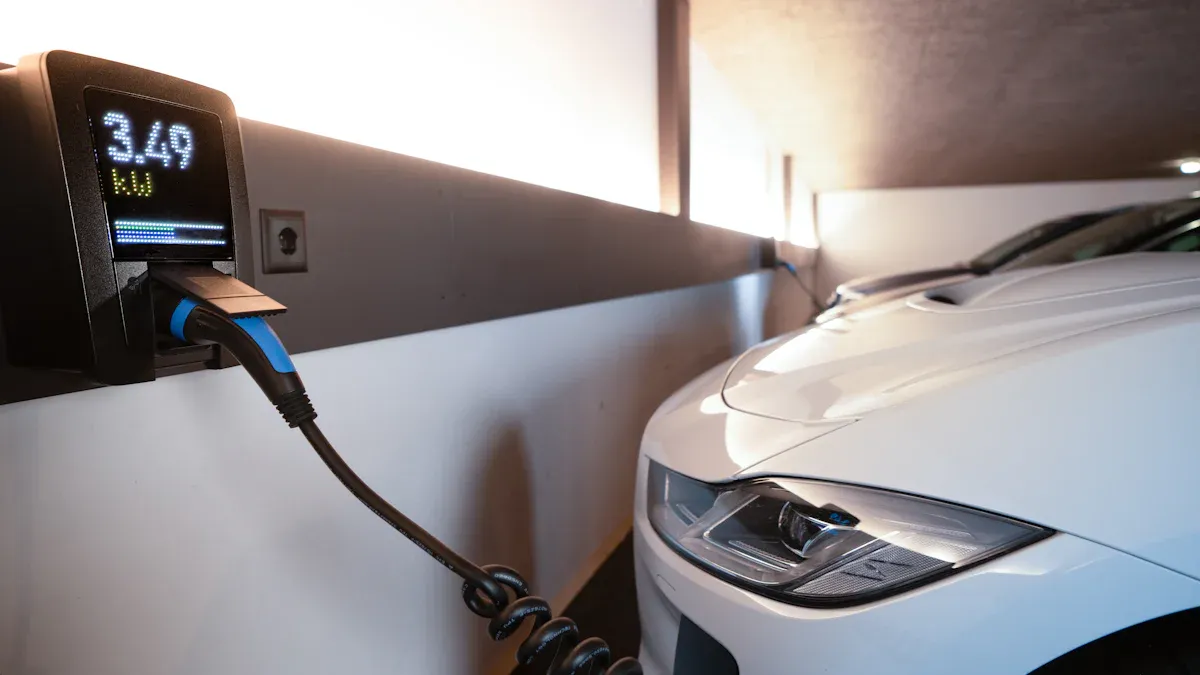
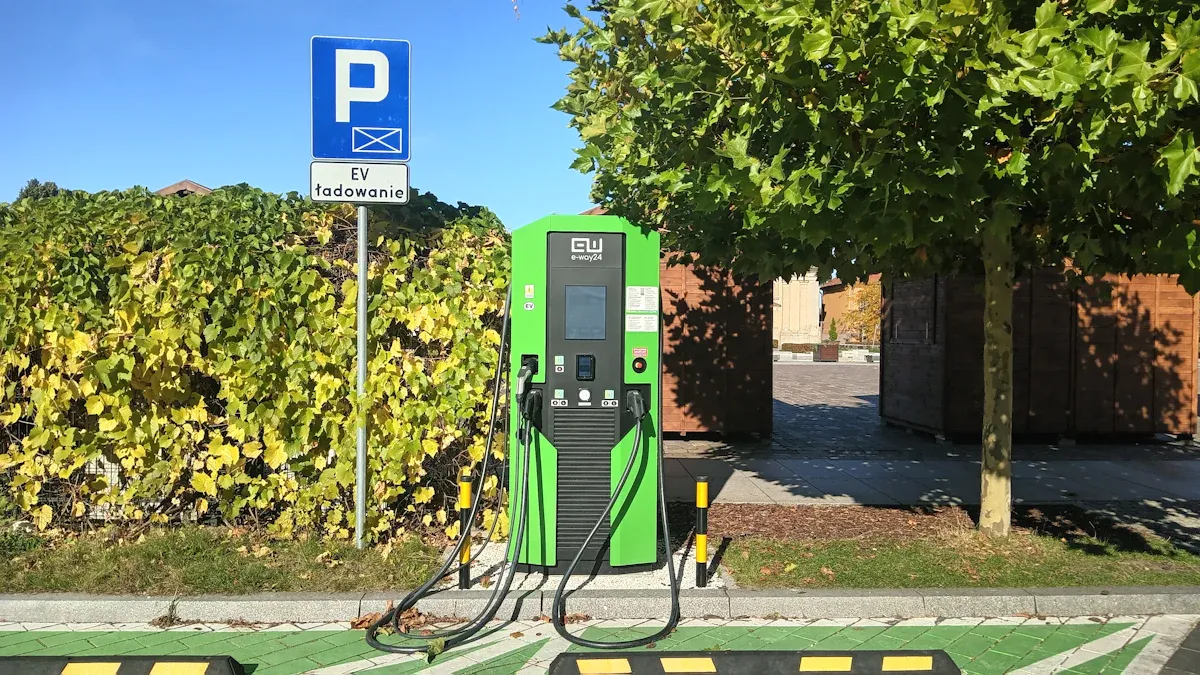
EV charger upgrades continue to redefine charging speed and convenience across global markets. Charging infrastructure, including ultra-fast solutions, expanded by 35% in Europe and 20% in the United States, making charging more accessible. EV charger manufacturers have accelerated deployment, raising the global fast charger stock to 2 million. Charging ratios improved, with Europe now at 13 EVs per public charger. These advances set new benchmarks for e-mobility trends, supporting rapid growth in e-mobility and efficient EV charging for drivers and fleets.
- Nearly 200,000 public charge points now operate in the United States.
- Ultra-fast charging networks grew by over 50%, reaching 71,000 stations worldwide.
- The IEA projects a ninefold increase in public charging infrastructure by 2030.
Fast-Charging and Ultra-Rapid EV Charger Solutions

Next-Generation DC Fast Chargers
350kW+ Charging Capabilities
Next-generation DC fast charging stations deliver impressive power outputs, reaching up to 350kW. These advanced systems use cutting-edge components such as Vienna rectifiers, Schottky diodes, and SiC MOSFETs to maximize efficiency and safety. The following table highlights the technical benchmarks of modern DC fast charging solutions:
| Specification | Details |
|---|---|
| Power Rating | Up to 350 kW |
| Charging Time | 80% capacity in under 15 minutes |
| Current Output | Up to 500 A |
| Efficiency Recommendations | Vienna rectifier, Schottky diodes, SiC MOSFETs, efficient gate driver chips |
| Safety Standards | Multiple certifications required |
Reduced Charging Times
DC fast charging stations dramatically reduce the time required to replenish an EV battery. Ultra-rapid chargers can achieve an 80% charge in as little as 10-15 minutes. Rapid chargers, with outputs between 49kW and 75kW, typically reach 80% in about 35 minutes. These solutions enable drivers to add 100 miles of range in less than 35 minutes, making EV charging more practical for daily use.
- Rapid and ultra-rapid DC fast charging stations are commonly installed at motorway services and large shopping centers.
- Ultra-rapid chargers represent the fastest way to charge an EV, supporting high vehicle turnover and minimizing wait times.
Ultra-Rapid Charging Networks
Expansion of High-Speed Corridors
Fast-charging networks continue to expand across major regions, creating high-speed corridors that support long-distance travel. The growth rate of ultra-rapid charging infrastructure has accelerated in recent years. The following chart illustrates the increase in ultra-rapid chargers from 2021 to August 2025:

| Year | Number of Ultra-Rapid Chargers | Growth Rate (%) |
|---|---|---|
| 2021 | 5,087 | – |
| 2023 | 10,118 | – |
| 2024 | 14,471 | – |
| August 2025 | 17,132 | 30% (from 2024) |
| August 2024 | – | 52% (from 2023) |
North America leads the global EV charging infrastructure market, holding nearly 49% of the share. The region expects a compound annual growth rate of 36.6% through 2030. Europe and Asia-Pacific also show strong expansion, with projected growth rates of 29% and 33%, respectively.
Impact on Long-Distance Travel
Ultra-rapid charging networks make long-distance travel more feasible for EV drivers. High-speed corridors allow vehicles to recharge quickly, reducing travel interruptions and supporting cross-country journeys. These networks provide reliable access to DC fast charging stations, ensuring that drivers can plan trips with confidence.
Benefits for Drivers and Fleets
Convenience and Time Savings
DC fast charging hubs offer strategic locations for fleet vehicles to recharge during breaks. This minimizes downtime and ensures that vehicles maintain sufficient range for their next journey. Fast-charging solutions enable commercial EVs to gain a substantial distance in a short period, such as a 100km charge in just 33 minutes. Drivers benefit from quick turnaround times, allowing them to resume travel with minimal delay.
Tip: Fast-charging networks optimize operational efficiency for businesses by reducing charging time and improving vehicle availability.
Increased EV Adoption
The widespread availability of DC fast charging stations encourages more drivers and fleets to transition to electric vehicles. Modern EV charging stations feature intelligent systems that interact with the grid, drawing power when rates are lowest. This cost optimization supports businesses in managing expenses and increases the appeal of EV adoption. As charging infrastructure grows, more individuals and companies choose electric mobility for its convenience and reliability.
Smart and AI-Driven EV Charging Management

Intelligent Load Balancing
Grid Optimization
Smart EV charging management systems use artificial intelligence to optimize grid performance. These systems monitor real-time conditions and adjust charging schedules to prevent grid overloads. By balancing demand across multiple stations, they help utilities maintain stability and avoid costly disruptions. AI-driven load balancing also enables automated demand response, adjusting charging rates during grid stress events. This approach supports reliable energy distribution and reduces the risk of blackouts.
- Smart EV chargers monitor grid conditions and adapt charging in real time.
- They pause or slow charging during peak demand, resuming when demand drops or renewable energy becomes available.
- Integration with energy management systems provides insights for forecasting demand and implementing efficient power distribution.
Cost-Efficient Charging
Intelligent load balancing delivers significant cost savings for both users and operators. AI systems analyze energy market trends and recommend optimal charging times, often during off-peak hours when rates are lower. This dynamic pricing strategy encourages EV charging when electricity costs are reduced, benefiting drivers and businesses. By optimizing charging schedules, these systems minimize energy expenses and maximize operational efficiency.
Tip: Charging during off-peak hours not only saves money but also supports grid health.
Predictive Maintenance and Monitoring
AI-Powered Diagnostics
Predictive maintenance leverages IoT sensors and AI algorithms to monitor the health of EV charging equipment. These systems analyze data such as temperature and voltage fluctuations to identify potential failures before they occur. By anticipating faults, operators can schedule maintenance proactively, reducing the likelihood of unexpected breakdowns.
| Feature | Description |
|---|---|
| Predictive Maintenance | AI anticipates faults by analyzing usage data and wear patterns, prompting maintenance before breakdowns. |
| Dynamic Load Balancing | AI allocates power based on current grid load and vehicle statuses, ensuring efficient charging. |
| User Behavior Analysis | The system learns user patterns to optimize power distribution and suggest better charging schedules. |
| Energy Source Optimization | The software selects the most eco-friendly energy sources available for charging. |
| Peak Demand Prediction | AI predicts high-demand periods, allowing for better resource preparation and user adjustments. |
| Optimal Pricing Selection | The system analyzes energy market trends to recommend cost-effective charging times. |
Minimizing Downtime
AI-powered diagnostics minimize downtime by predicting when a charging point might fail or require servicing. Real-time monitoring allows for timely interventions, preventing critical failures and ensuring continuous operation. Charge point operators report significant operational cost savings due to reduced maintenance emergencies. This proactive approach enhances reliability and user trust in EV charging infrastructure.
- Predictive maintenance uses sensors to monitor equipment health.
- AI analyzes usage patterns to forecast failures, enabling timely repairs.
- Reduced downtime leads to increased reliability and lower operational costs.
Personalized Charging Experiences
User Profiles and Preferences
Personalized charging experiences increase user satisfaction and engagement. AI algorithms analyze driving habits, charging patterns, and energy consumption to understand individual preferences. The system tailors recommendations, such as suggesting stations based on frequently visited locations or regular commutes. Users receive advice on the best times to charge, maximizing cost savings and convenience.
- Personalization tailors charging recommendations to individual needs.
- Efficiency improves station utilization and reduces wait times.
- Cost savings result from optimal charging times based on lower energy rates.
Mobile App Integration
Mobile app integration enhances the user experience by providing real-time updates and personalized notifications. Apps offer special deals at preferred charging points and advise users on optimal charging schedules. Predictive analytics within the app help maintain station reliability by forecasting potential failures. This seamless integration empowers users to manage their EV charging with greater control and confidence.
- Apps suggest charging stations based on user location and habits.
- Special rates and deals appear at preferred stations.
- Users receive alerts for the best charging times, optimizing cost and convenience.
Wireless and Plug & Charge EV Charger Innovations
Wireless Charging Technology
Inductive Charging Pads
Wireless charging technology has advanced rapidly, offering new levels of convenience for electric vehicle owners. Inductive charging pads now support high-speed wireless charging, with some systems delivering up to 300 kW. The SAE International Standard J2954 ensures compatibility across different vehicle brands, allowing drivers to align their vehicles over charging pads for maximum efficiency. Oak Ridge National Laboratory recently set a new record by achieving 100 kW wireless charging with 96% efficiency. These improvements simplify the charging process by removing the need for physical connectors and enable integration into home garages and public parking lots.
- New standards guarantee cross-brand compatibility.
- High-speed wireless charging pads reduce charging times.
- Wireless charging can be installed in various environments, including residential and commercial spaces.
Automated Charging for Fleets
Automated wireless charging solutions are transforming fleet operations. Fleet vehicles can recharge automatically by parking over inductive pads, eliminating manual intervention. This approach streamlines charging for delivery vans, taxis, and public transport vehicles. Wireless charging tracks embedded in roads further enhance efficiency, reducing battery size requirements and shortening charging duration. Improvements in wireless power transfer systems, such as advanced compensation topologies and power converter designs, continue to extend the driving range of electric vehicles.
Plug & Charge Protocols
Seamless Authentication
Plug & Charge protocols have revolutionized the authentication process for EV charging. Drivers simply connect their vehicles to a charging point, and the system automatically authenticates and initiates charging. After the initial setup, the vehicle stores driver information, enabling immediate charging without the need for cards or apps. This seamless process enhances user convenience and reduces wait times at charging stations.
- Plug & Charge enables automatic authentication.
- Driver information is stored for future charging sessions.
- Charging begins instantly after connection.
Enhanced Security Features
Security remains a top priority for modern charging solutions. Plug & Charge protocols use standardized frameworks like ISO 15118, which employ Transport Layer Security (TLS) and digital certificates for encrypted communication. Public Key Infrastructure (PKI) manages these certificates, ensuring only authorized devices can interact. The authentication process involves exchanging digital certificates between the vehicle and charger, verifying identities and protecting user data. Cryptographic tools, including digital signatures, secure all communications and provide multiple layers of authentication and encryption.
User Experience Improvements
Hassle-Free Charging
Recent innovations in charging solutions have significantly improved the user experience. Mobile apps now provide real-time information on available charging stations and estimated charging times. Approximately 75% of EV owners prefer managing charging and navigation through their smartphones. Contactless payment methods have gained popularity, with nearly 60% of drivers favoring this option for its convenience. AI algorithms optimize charging schedules and energy management, making the process smoother for users.
- Mobile apps offer real-time updates and station availability.
- Contactless payments simplify the charging process.
- AI-driven recommendations help users find optimal charging times.
Accessibility for All
Modern charging solutions focus on accessibility, ensuring that all users can benefit from advancements. IoT technology enables real-time communication between vehicles and charging stations, improving reliability and ease of use. Wireless charging and Plug & Charge protocols remove barriers for individuals with limited mobility, as they eliminate the need for handling heavy cables or complex authentication steps. These innovations support a more inclusive charging ecosystem, making EV adoption practical for a wider audience.
V2G and Energy Sharing EV Charging Technologies
Vehicle-to-Grid (V2G) Integration
Bidirectional Charging
V2G technology enables bidirectional charging, allowing electric vehicles to both draw power from and supply energy back to the grid. This dynamic interaction transforms each vehicle into a mobile energy storage unit. As grid modernization efforts accelerate, V2G integration supports time shifting, frequency response, and emergency backup services. Commercial and residential applications benefit from these capabilities, with individuals able to sell excess energy and commercial operators gaining new revenue streams.
| Segment | Description | Growth Factors |
|---|---|---|
| Service | Time shifting, frequency response, reserve, backup, arbitrage | Aging infrastructure and rising grid demand |
| Application | Commercial, individual, both | Financial benefits for individuals and revenue for businesses |
| Charger | DC, AC, both | DC charging advancements attract consumers and operators |
Automakers such as Nissan and Renault have introduced models with bidirectional chargers, enabling users to participate in energy markets. These advancements make V2G a practical solution for both individual and fleet operators.
Supporting Renewable Energy
V2G technology plays a vital role in supporting renewable energy integration. Electric vehicles store excess solar and wind power, then supply it back to the grid during peak demand. This process helps absorb fluctuations in renewable generation and provides stability to the electrical grid. As the number of electric vehicles grows, their collective battery capacity enhances the utilization of clean energy sources and reduces reliance on fossil fuels.
V2G integration can enhance renewable energy utilization by up to 25% and reduce peak demand by as much as 15% when 20–30% of vehicles participate.
Peer-to-Peer Energy Sharing
Community Charging Models
Peer-to-peer energy sharing models empower communities to share energy between electric vehicles and local infrastructure. These models increase accessibility to charging points and promote sustainable energy use. Community members can participate in local energy markets, optimizing the distribution of renewable power and reducing the need for centralized infrastructure.
| Benefits | Challenges |
|---|---|
| Increased accessibility to charging points | Need for improved infrastructure |
| Potential revenue for EV owners | Requirement for community engagement |
| Sustainable and efficient energy use |
Monetizing Excess Energy
Electric vehicle owners can monetize surplus energy by selling it to neighbors or back to the grid. This approach creates new financial incentives for rapid and ultra-rapid chargers, especially in residential settings. Commercial entities also benefit by offering charging services to fleets or the public, generating additional revenue streams. These peer-to-peer models encourage broader adoption of electric vehicles and foster local energy independence.
Grid Resilience and Sustainability
Stabilizing Local Grids
V2G and energy sharing technologies strengthen grid resilience by balancing supply and demand. Aggregated fleets of vehicles provide ancillary services such as frequency regulation and peak shaving. Managed charging allows utilities to control when vehicles charge, optimizing grid load and enhancing reliability.
Intelligent energy management systems and power quality metering optimize electricity use, ensure power reliability, and provide insight into the electrical capacity to add charger units.
Reducing Carbon Footprint
By integrating renewable energy and enabling efficient energy management, V2G and peer-to-peer charging solutions help reduce the carbon footprint of transportation. Electric vehicles act as distributed energy resources, supporting the transition to a cleaner energy system. Initiatives like California’s managed charging programs demonstrate how large-scale integration of EVs with the grid can drive sustainability and resilience.
Infrastructure Expansion and Standardization in E-Mobility Trends
Global EV Charging Network Growth
Urban and Rural Deployment
Cities and rural areas both experience rapid growth in charging infrastructure. Urban centers see dense installations of charging stations to meet the rising number of electric vehicles. Rural regions, once underserved, now benefit from targeted investments that close the accessibility gap. The global number of public charging points is projected to exceed 15 million by 2030, a dramatic increase from nearly 4 million in 2023. This expansion supports the growing demand for electric mobility and ensures that drivers in all locations have reliable access to charging.
- The global EV charging network expands due to increased infrastructure development in urban areas.
- The number of electric vehicles rises, requiring more dedicated charging points.
- Government initiatives and private sector investments drive this expansion.
Public and Private Partnerships
Public and private partnerships play a crucial role in scaling charging infrastructure. Governments collaborate with companies to deploy charging stations efficiently. These partnerships leverage public funding and private expertise, accelerating the rollout of charging networks. The energy infrastructure for EV charging stations is projected to reach $20.0 billion by 2029, with a compound annual growth rate of 36% from 2022 to 2029. Demand for fast-charging infrastructure and supportive policies further fuel this growth.
Note: Collaboration between sectors ensures that both urban and rural communities benefit from robust charging infrastructure.
Standardization of Connectors and Protocols
Universal Compatibility
Standardization addresses the challenge of fragmented charging infrastructure. Governments actively push for standards to enhance charger compatibility. In Europe, CCS is mandated for all new fast chargers. India aligns with global norms by requiring CCS2 for DC and Type 2 for AC. The US adapts federal funding to support both CCS and NACS, reducing fragmentation in the charging ecosystem. Compatibility standards from organizations like SAE and IEC ensure interoperability and safety across different vehicles and charging stations.
- Recent innovations include liquid-cooled connectors for ultra-fast charging.
- Modular and smart connectors improve durability and integration with smart grid technologies.
Simplifying User Experience
Universal standards simplify the charging experience for drivers. Standardized connectors and protocols allow users to access any charging station without confusion. This reduces barriers to EV adoption and increases confidence in the charging network. Despite progress, challenges remain as technology evolves rapidly. Ongoing efforts to update standards help maintain a seamless user experience.
| Region | Standard(s) Adopted | Impact |
|---|---|---|
| Europe | CCS (all new fast chargers) | Widespread adoption, high compatibility |
| US | CCS1, NACS | Reduced fragmentation, automaker support |
| India | Type 6, Type 7, CCS2, Type 2 | Promotes interoperability |
Government Policies and Incentives
Funding and Grants
Government policies and incentives remain essential for deploying charging infrastructure. Many countries implement construction subsidies, operation subsidies, tax rebates, and exemptions from electricity charges. China leads with national-level policies that guide regional governments to create tailored support for charging infrastructure deployment. These incentives attract investment and encourage rapid expansion of charging networks.
Regulatory Support
Regulatory frameworks shape the growth and accessibility of charging infrastructure. The US and China demonstrate how different policy approaches influence network development. Governments worldwide set standards, provide funding, and remove barriers to entry. These actions ensure that charging infrastructure keeps pace with the increasing adoption of electric vehicles and supports the transition to sustainable transport.
The transition to sustainable transport relies on updated infrastructure and common standards. Integrating electric vehicles into the power grid reduces emissions and enhances grid efficiency.
Real-World Impact of EV Charger Upgrades: Case Studies and Statistics
Leading Markets and Regions
North America
The United States leads the transformation of the EV charging landscape. Federal and state policies drive this shift, with California, New York, and Texas expanding their networks to meet rising demand. The market benefits from significant investments and a strong push for green energy. Major EV manufacturers and charging network operators contribute to a robust infrastructure. The Biden administration’s commitment to clean energy accelerates the deployment of advanced charging solutions.
Europe
Western Europe stands out for its high adoption rates and sophisticated charging infrastructure. Countries such as Norway, Germany, and the Netherlands have built dense networks of fast chargers. Germany and the Netherlands, in particular, serve as benchmarks for other regions. The market in Europe thrives due to supportive government policies and a focus on universal compatibility. Businesses and cities across the continent continue to invest in future-proof charging solutions.
Asia-Pacific
Asia-Pacific is projected to dominate the EV charging infrastructure market by 2025, accounting for about 60% of revenue share. China leads with the highest number of fast chargers, while Japan and South Korea make significant investments to enhance their networks. Strong government support and rapid urbanization fuel the market’s momentum. The region’s focus on innovation and large-scale deployment positions it as a global leader in charging technology.
Success Stories from Businesses and Cities
Fleet Electrification Initiatives
| Business/City | Description |
|---|---|
| UTU Oy | Powers Finland’s electric mobility transition |
| Scania Dagab | Enables green food deliveries in Stockholm |
| Valenzuela City | Deploys the largest electric police fleet in the Philippines |
Fleet electrification drives sustainability and operational efficiency. Companies like Scania Dagab support green logistics, while cities such as Valenzuela deploy electric fleets for public safety. These initiatives demonstrate how targeted investments in charging infrastructure can transform transportation.
Urban Charging Solutions
| Business/City | Description |
|---|---|
| Ragde Eiendom | Offers future-proof fast charging solutions |
| CATEC Mobility | Expands EV charging in the Middle East |
| Soregies | Develops Vienne’s charging infrastructure |
| CGR Cinema | Provides DC fast charging for movie-goers |
Urban centers benefit from innovative charging solutions. Ragde Eiendom and Soregies invest in scalable networks, while CATEC Mobility brings advanced charging to new markets. CGR Cinema enhances customer experience by offering fast charging at entertainment venues.
Adoption Rates and User Feedback
Growth in EV Ownership
The global market for electric vehicles continues to expand as charging infrastructure improves. Recent studies show that by 2045, 67% of California’s power distribution feeders will need upgrades to support increased charging demand. These upgrades could require up to 25 GW in additional capacity, with costs ranging from $6 to $20 billion. However, higher electricity consumption may lower rates by $0.01 to $0.06 per kWh. Residential areas face twice the upgrade requirements compared to commercial zones, highlighting the importance of managing home-charging demand to reduce grid stress.
Note: Managing residential charging demand can help utilities avoid costly upgrades and maintain grid stability.
Satisfaction with Charging Upgrades
User feedback does not always directly influence the usage rates of EV charging stations. Studies emphasize that transparency and detailed service operations matter more than user ratings or pricing. The activity level of the surrounding environment plays a crucial role in site selection. Broader contextual factors, such as accessibility and convenience, shape both adoption rates and user satisfaction with charging upgrades.
EV charger upgrades drive the shift to e-mobility by improving speed, intelligence, and accessibility. Research highlights a hybrid model that blends traditional and dynamic charging, with a focus on efficiency and safety. Innovation and collaboration remain essential as the industry evolves. Key trends include energy management, renewable integration, and AI-driven optimization.
- Charging stations support cleaner transportation and economic growth.
- Stakeholders benefit by staying informed and choosing reliable, compatible solutions.
FAQ
What are charging points and how do they work?
Charging points supply electricity to electric vehicles. They connect to the grid and deliver power through cables or wireless pads. Drivers use public charge points or private points at home. Each point follows safety standards and supports different charging speeds.
How do public charge points differ from private points?
Public charge points operate in shared spaces like parking lots or shopping centers. Private points serve homes or businesses. Public charge points often support multiple vehicles and offer higher power levels. Private points provide convenience for daily charging.
Why is the expansion of charging points important for e-mobility?
Expansion of charging points increases access for drivers. More points reduce wait times and support long-distance travel. A dense network of charging points encourages EV adoption. Public investments in charging points help cities and rural areas meet growing demand.
What role do high-powered chargers play in charging networks?
High-powered chargers deliver fast charging at public charge points. They reduce charging time and support busy locations. Networks with high-powered chargers allow fleets and drivers to recharge quickly. These chargers improve the efficiency of charging points.
How do public investments impact the growth of charging points?
Public investments fund the installation of charging points. Governments and agencies support network expansion through grants and subsidies. Investments in public charge points increase coverage and reliability. These efforts ensure that charging points reach underserved areas.
How do charging points support grid stability?
Charging points with smart technology balance energy demand. Networks use intelligent load management to prevent overloads. Charging points can pause or adjust power during peak hours. This helps utilities maintain stable service and supports renewable energy integration.
What factors influence the location of public charge points?
Operators consider traffic, accessibility, and proximity to amenities. Points near highways or busy areas serve more drivers. Public charge points in strategic locations improve network coverage. Investments in site selection optimize the use of charging points.
How can users find available charging points in a network?
Mobile apps and online maps display charging points in real time. Drivers search for public charge points by location or availability. Networks update point status and provide directions. These tools help users plan routes and avoid busy points.