You now see EV charger policies fueling a new wave of electric vehicle adoption across ASEAN. As battery technology costs drop to around USD 120 per kWh, you benefit from more affordable and longer-range EVs. Government investment, totaling nearly USD 1.5 billion, accelerates charging infrastructure and supports growth for EV charger manufacturers. Urban demand rises as 70% of residents prioritize air quality, pushing for cleaner transportation. The table below shows how these policy changes shape adoption rates:
| Country | Adoption Rate | Notes |
|---|---|---|
| Indonesia | 9.1% | Significant sales increase of 267% in 1H 2025, but sticker premium affects buyers. |
| Thailand | N/A | Demand softened after incentives were reduced. |
| Vietnam | N/A | Electric-motorcycle volumes increased by 99.2% in H1 2025. |
| Malaysia | N/A | Sales rose from 850 units in 2021 to 14,800 in 2024 due to incentives. |
| Singapore | 19% | Highest adoption rate in 2023, supported by charging infrastructure and carbon taxes. |
The Evolving Landscape of EV Charger Policies in ASEAN

Government Targets for Electric Vehicle Adoption
National EV goals and milestones
You see ASEAN governments setting ambitious targets to accelerate electric vehicle adoption. These targets shape the direction of ev charger policies and drive investment in ev charging infrastructure. The table below summarizes each country’s goals and timelines:
| Country | EV Adoption Target | Timeline |
|---|---|---|
| The Philippines | 10% of vehicle sales | By 2040 |
| Brunei Darussalam | 65% of vehicle sales | By 2035 |
| Indonesia | 20% of total vehicle production | By 2025 |
| Malaysia | 9% of passenger vehicle sales | By 2025 |
| 15% of passenger vehicle sales | By 2030 | |
| Singapore | Phase out ICE vehicles | By 2040 |
| Thailand | 30% of total annual automotive production | By 2030 |
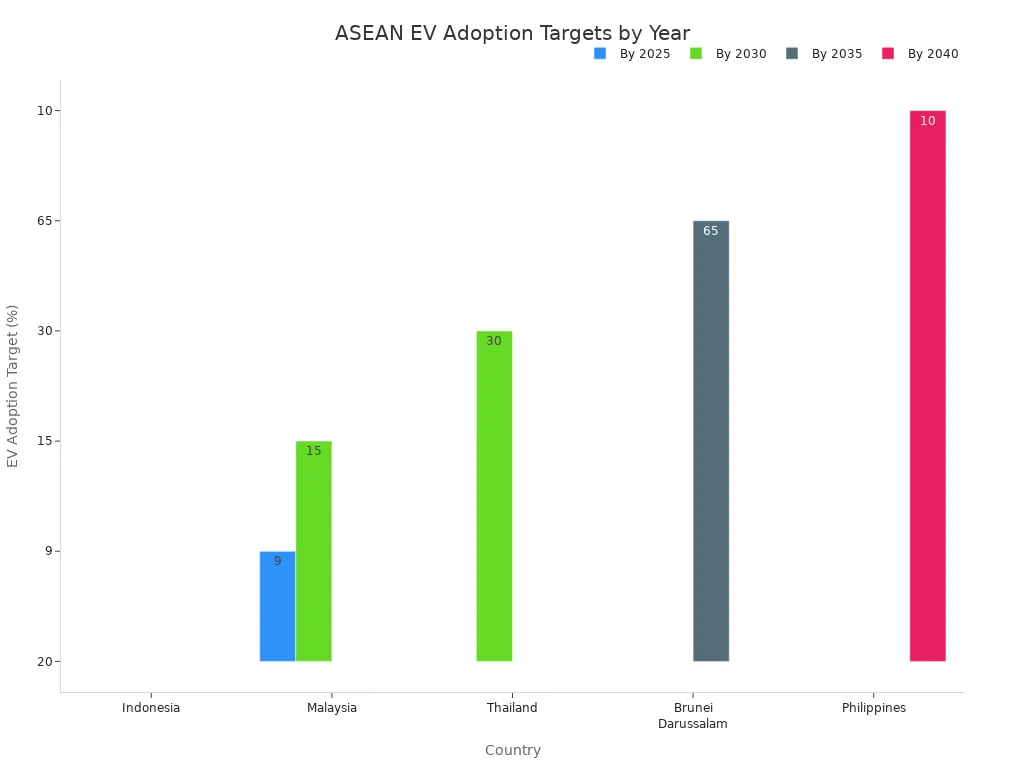
You notice that countries like Singapore and Thailand have set ambitious targets, aiming to phase out internal combustion engine vehicles or convert a significant portion of automotive production to electric vehicles. These milestones create a clear roadmap for industry stakeholders and signal strong government commitment.
A comparison with global benchmarks shows that Thailand, Singapore, and Indonesia have established ambitious and supportive policy frameworks. In contrast, countries such as Myanmar still lack clear policies, which slows progress.
| Country | EV Adoption Target | Policy Clarity |
|---|---|---|
| Thailand | Ambitious | Established |
| Singapore | Ambitious | Established |
| Indonesia | Ambitious | Supportive |
| Myanmar | N/A | Lacking |
Expansion plans for EV charging infrastructure
You benefit from these national targets as they drive expansion plans for charging stations and ev charging networks. Governments prioritize urban centers but also recognize the need to extend infrastructure to rural areas. For example, Indonesia and Thailand have announced plans to increase the number of public and private charging stations, ensuring that you can access reliable charging wherever you travel. Malaysia and Singapore focus on integrating charging infrastructure into new developments, making it easier for you to charge your ev at home or work.
Regulatory Frameworks for EV Charging Infrastructure
Licensing and standards for EV chargers
You encounter a complex regulatory environment as each country develops its own standards for ev charging infrastructure. Indonesia, for instance, enforces the Regulation of the Minister of Energy and Mineral Resources No. 13 of 2020. This policy outlines requirements for licensing, safety, and technology standards for charging stations. You must ensure that your charging equipment meets these standards, whether you operate a private facility or a public charging station.
| Aspect | Details |
|---|---|
| Regulation Name | Regulation of the Minister of Energy and Mineral Resources No. 13 of 2020 |
| Enactment Date | August 7, 2020 |
| Objectives | Development of charging infrastructure, responsibilities of PLN, policy framework, charging fees, safety installation requirements |
| Charging Locations | Private electric facilities or public charging stations |
| Battery Replacement | Public electric vehicle battery replacement stations |
| Licensing | Entities must possess a General Electric Supply License or a Sales Electric Supply License |
| Types of Charging Technologies | Normal charging, fast charging, ultra-fast charging |
| PLN Responsibilities | Craft a roadmap for infrastructure development, including charging locations and capacities, business schemes for charging stations, and submission to the Minister of Energy and Mineral Resources within six months of regulation promulgation. |
| Electricity Pricing | According to electricity rate plans provided by PLN |
You see similar frameworks emerging in Malaysia, Singapore, and Thailand, where authorities set clear guidelines for charger installation, safety, and interoperability. These standards help you trust the reliability and safety of the charging infrastructure.
Public-private partnerships in EV policies
You benefit from public-private partnerships that accelerate the rollout of ev charging networks. Governments often provide incentives, such as tax breaks or grants, to encourage private investment in charging infrastructure. You see energy companies, automotive manufacturers, and technology firms collaborating to build and operate charging stations. These partnerships help you access more charging options and support the rapid growth of the ev market.
Regional Cooperation on EV Charging Infrastructure
ASEAN-wide initiatives for electric vehicle adoption
You witness growing regional cooperation as ASEAN countries work together to harmonize ev charger policies and promote electric vehicle adoption. Organizations like CharIN serve as knowledge hubs, providing technical expertise and regulatory roadmaps. You see Thailand advancing technologies such as Plug & Charge and Vehicle-to-Grid (V2G), which require regional collaboration to ensure compatibility across borders.
Note: Regional initiatives aim to create a seamless user experience for you, making it easier to travel between countries with your ev.
Cross-border interoperability of EV charging
You face challenges when traveling across ASEAN due to fragmented charging apps and payment systems. Malaysia considers a universal ev charging app to address these issues. CharIN supports the region by advising on interoperable charging standards and regulatory alignment. You benefit from these efforts as they pave the way for cross-border travel and logistics, making it easier to drive your ev throughout Southeast Asia.
- Lack of regional alignment in charging infrastructure and user experience remains a challenge.
- Fragmented apps and payment systems complicate cross-border EV travel.
- CharIN provides technical expertise on interoperable charging and regulatory roadmaps to address these challenges.
You can expect that as regional cooperation deepens, you will see more consistent policies and a smoother charging experience across ASEAN.
Thailand’s EV Charger Policies and Implementation
National EV Policy Updates
Recent changes in EV policies
You see Thailand making significant updates to its national EV policies. The government amended the EV 3.0 and EV 3.5 incentive schemes to boost electric vehicle exports and strengthen Thailand’s position as a regional production hub. These changes allow battery electric vehicles produced for export to count as 1.5 units toward local production requirements. This adjustment helps automakers meet obligations more easily. The government also extended vehicle registration deadlines and improved subsidy disbursement criteria. These updates give you and industry players more flexibility and oversight, making the market more attractive for investment.
Mandates for EV charging infrastructure
You benefit from clear mandates that integrate charging targets into national frameworks. Thailand’s EV 3.5 Policy, effective from 2024, adjusts subsidies and production requirements, which increases demand for domestic charging networks. The National EV Policy 2021 includes regulations that promote cost-competitive operations for public chargers. By March 2025, Thailand expects to exceed its charging station targets, showing a strong response to policy incentives. However, you may still face challenges with coverage as the EV fleet grows.
- Thailand’s EV policies integrate charging targets into national frameworks.
- The EV 3.5 Policy increases demand for domestic charging networks.
- National regulations support cost-competitive public chargers.
- Thailand is projected to surpass charging station targets by March 2025.
- Coverage gaps remain as the EV fleet expands.
Incentives for Electric Vehicle and Charging Infrastructure
Tax breaks and subsidies for EVs and chargers
You can take advantage of a new subsidy package, effective through 2027, offering up to 100,000 baht per electric vehicle. The government reduced import duty and excise taxes to make the market more attractive. Charging service providers receive a three to five-year tax holiday, encouraging infrastructure development. These incentives lower your costs and support the growth of the EV ecosystem.
| Incentive Type | Details |
|---|---|
| Purchase Subsidy | Ranges from 5,000 to 100,000 baht depending on vehicle type and battery capacity. |
| Excise Duty Reduction | Reduced from 8% to 2% for models under 7 million baht. |
| Import Duty Reduction | Up to 40% reduction planned for 2024-2025. |
| Tax Holiday for Charging | Three to five-year tax holiday for charging service providers to encourage infrastructure. |
Support for private sector investment in EV charging
You see strong support for private sector investment in charging infrastructure. The government offers business operator subsidies for local assembly of battery electric vehicles. Reduced duty and excise-tax treatment on imports during 2024 and 2025 further stimulate investment. These policies help you access more charging options and encourage companies to expand their networks.
Progress in EV Charging Infrastructure
Growth in public and private charging stations
You witness rapid growth in the number of public and private charging stations across Thailand. In 2022, the country had 900 fast chargers. By 2025, the target rises to 4,400 fast chargers, reflecting ambitious infrastructure goals.
| Year | Number of Fast Chargers | Target for 2025 |
|---|---|---|
| 2022 | 900 | 4,400 |
This expansion supports your ability to travel longer distances and reduces range anxiety.
Collaboration for EV adoption
You benefit from collaboration between government agencies, private companies, and international partners. These partnerships drive the rollout of charging infrastructure and support the adoption of EVs throughout ASEAN. You see energy firms, automakers, and technology providers working together to create a robust charging network. This teamwork ensures that you have reliable access to charging stations and helps Thailand maintain its leadership in the regional EV market.
Indonesia’s EV Charging Infrastructure Expansion
Regulatory Developments in EV Policies
Presidential decrees and ministerial regulations
You see Indonesia taking decisive steps to strengthen its ev charger policies. Since 2020, the government has issued several key regulations to accelerate electric vehicle adoption and charging infrastructure development. The table below highlights major regulatory milestones:
| Regulation | Status |
|---|---|
| Law No. 59/2024 on long term development plan 2025–2045 | Issued |
| Presidential Regulations No.55/2019 amended by 79/2023 on battery electric vehicles for road transport | Issued |
| Presidential Instruction No. 7/2022 on battery electric vehicles for government fleets | Issued |
| Presidential Regulation No.12/2025 on medium term development plan 2025–2029 | Issued |
| Ministry of Energy and Mineral Resources Regulation No.1/2023 on battery electric vehicle charging infrastructure development | Issued |
| Ministry of Energy and Mineral Resources Regulation No.7/2024 on electricity tariff provided by PLN | Issued |
| Ministry of Finance Regulation No.12/2025 on value added tax and luxury tax for passenger cars and buses | Issued |
| Ministry of Investment and Downstreaming No.6/2023 on import incentives | Issued |
You notice that these policies focus on technological innovation and environmental compliance. The government aims to produce 2.5 million battery electric passenger cars per year by 2030. New regulations support the growth of the battery electric vehicle industry and encourage manufacturers to use more domestic components.
Local content requirements for EV chargers
You must pay attention to local content requirements when investing in Indonesia’s ev charging infrastructure. The Minister of Investment and Downstreaming announced incentives for manufacturers who use more domestic components in their ev chargers. You benefit from these incentives if you meet the 40% local content threshold, which helps you qualify for reduced taxes and import duties. This approach supports local industry and aligns with ASEAN’s broader push for regional supply chain resilience.
Financial Incentives for Electric Vehicle Adoption
Tax holidays and import duty exemptions for EVs
You can take advantage of generous financial incentives designed to make electric vehicle ownership more affordable. The government offers a value-added tax discount, reducing VAT from 11% to 1% for EVs that meet the local content requirement. You also benefit from a 0% import duty on completely built up and completely knocked down EVs if you commit to establishing a domestic factory by 2026. These incentives lower your upfront costs and encourage you to choose EVs over traditional vehicles.
Grants for EV charging infrastructure
You see opportunities for grants that support the expansion of charging stations. The government provides funding to help you install new chargers, especially if you use local components. These grants make it easier for you to invest in charging infrastructure and contribute to Indonesia’s goal of increasing the number of public charging stations. You help drive the transition to cleaner transportation by participating in these programs.
Infrastructure Rollout for EV Charging
State-owned enterprise involvement in EV policies
You observe state-owned enterprises playing a central role in Indonesia’s ev charger policies. PLN, the national electricity company, leads the development and operation of charging stations. You rely on PLN’s expertise to ensure reliable electricity supply and competitive tariffs for charging your EV. Collaboration between PLN and private companies accelerates infrastructure growth and supports the government’s policy objectives.
Urban and rural deployment strategies
You notice that most charging stations are located in urban areas like Jakarta and Surabaya. This concentration makes it easy for you to charge your EV in the city, but rural regions remain underserved. The government plans to install more charging stations at strategic locations such as shopping malls and highways. Public-private partnerships play a key role in this expansion. By 2028, you will see more chargers in rural areas, making long-distance travel easier and promoting broader EV adoption across Indonesia. This strategy helps bridge the gap between urban and rural infrastructure, supporting ASEAN’s vision for inclusive electric mobility.
Tip: If you live outside major cities, watch for new charging stations in your area as Indonesia expands its network to support nationwide EV adoption.
Singapore’s Smart EV Charging Infrastructure
Policy Frameworks for Electric Vehicle Adoption
Green Plan 2030 and EV Roadmap
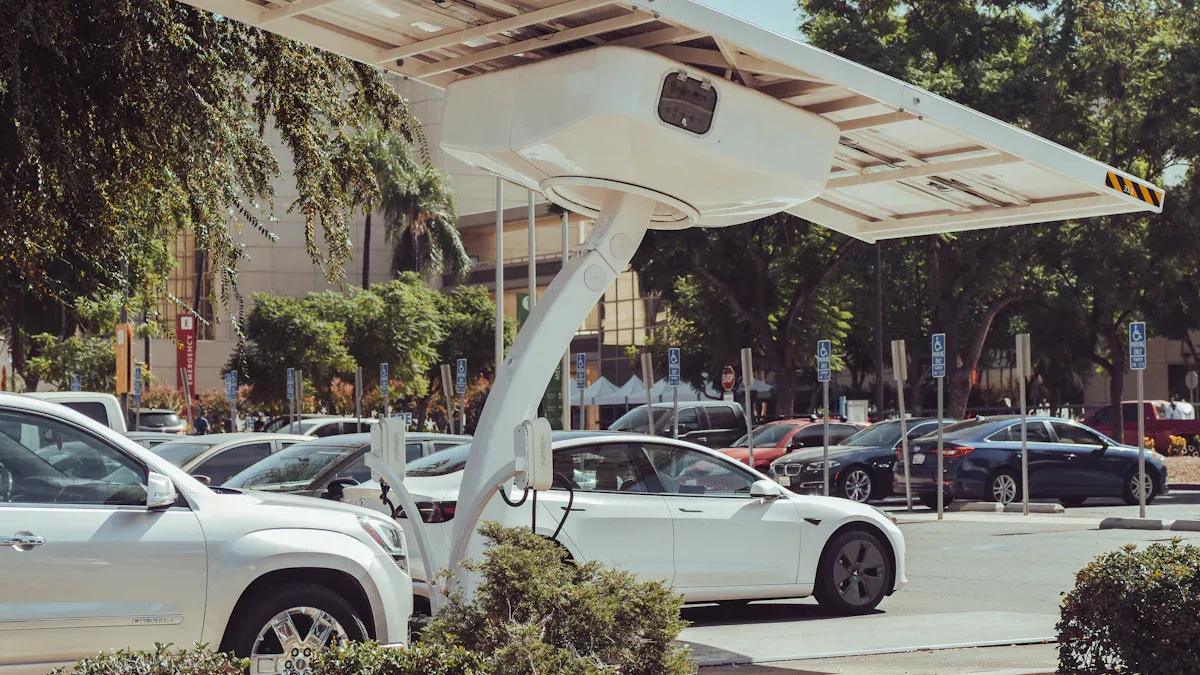
You see Singapore leading the region with clear policy frameworks that guide electric vehicle adoption and charging infrastructure development. The Green Plan 2030 sets ambitious targets for the deployment of charging stations, aiming for up to 60,000 points by 2030. You benefit from a structured approach, with 40,000 chargers planned for public car parks and 20,000 for private premises. The Electric Vehicles Charging Act (EVCA) introduces requirements for charger registration and mandates EV-ready infrastructure in new developments. Technical Reference 25 (TR25:2022) ensures safety standards for charging, including ultra-fast charging options. The EV Common Charger Grant (ECCG) co-funds up to 50% of charging infrastructure in non-landed private residences, making installation more accessible.
| Policy Initiative | Description |
|---|---|
| Green Plan 2030 | Targets up to 60,000 EV charging points by 2030, with 40,000 in public car parks and 20,000 in private premises. |
| Electric Vehicles Charging Act (EVCA) | Introduces requirements for charger registration and mandates EV-ready infrastructure in new developments. |
| Technical Reference 25 (TR25:2022) | Sets technical safety standards for charging, including ultra-fast charging provisions. |
| EV Common Charger Grant (ECCG) | Co-funds up to 50% of charging infrastructure in non-landed private residences, facilitating installation of chargers. |
Mandates for EV chargers in new buildings
You notice that Singapore’s policies require new buildings to include EV-ready infrastructure. Developers must install the necessary cabling and electrical capacity to support future charging stations. This mandate ensures that you can access charging facilities in residential and commercial developments, supporting the growth of the EV market across ASEAN.
Incentives and Funding for EV Charging
Rebates for EV charger installation
You benefit from incentives that make EV charger installation more affordable. The Electric Vehicle Common Charger Grant (ECCG) covers up to 50% of installation costs for chargers in non-landed private residences. You can receive funding for licensed electrical worker fees, cabling, and installation, with a cap of $4,000 per charger. Only chargers with smart charging functions qualify for co-funding, encouraging you to choose advanced technology that optimizes energy use.
Support for fleet electrification
You see Singapore supporting fleet electrification through targeted incentives. Businesses receive funding to convert their fleets to electric vehicles and install charging infrastructure. These policies help you reduce operating costs and meet sustainability goals. Fleet operators gain access to rebates and grants, making the transition to EVs more attractive and practical.
Tip: If you manage a fleet, explore available grants to accelerate your shift to electric vehicles and charging infrastructure.
Implementation and Technology in EV Charging
Smart charging networks for electric vehicles
You experience the benefits of smart charging networks as Singapore integrates digital innovation into its EV infrastructure. The Smart Nation initiative drives the development of battery chargers, swap stations, and control mechanisms for the electrical grid. Charging stations operate independently using renewable energy sources, which enhances grid stability and optimizes electricity prices. You enjoy reliable and efficient charging, supported by advanced technology.
- Singapore’s Smart Nation initiative launched in 2014 focuses on digital innovation across sectors.
- Development of EV infrastructure includes battery chargers, swap stations, and control mechanisms for the electrical grid.
- Charging stations are designed to operate independently using renewable energy sources, enhancing grid stability and optimizing electricity prices.
Integration with public transport systems
You see Singapore integrating EV charging infrastructure with public transport systems. Charging stations support electric buses and taxis, making urban mobility cleaner and more efficient. You benefit from a seamless travel experience, as public transport and EV infrastructure work together to reduce emissions and improve air quality. Singapore’s approach sets a benchmark for ASEAN, demonstrating how smart technology and policy can transform urban transportation.
Malaysia’s EV Policies and Charging Infrastructure Growth
National Policy Initiatives for Electric Vehicles
Low Carbon Mobility Blueprint
You see Malaysia taking a strategic approach to electric vehicle adoption through the Low Carbon Mobility Blueprint 2021–2030. This policy aims to improve vehicle fuel economy and promote the use of EVs and low-emission vehicles. You benefit from efforts to reduce greenhouse gas emissions by supporting alternative fuels and cleaner transportation. The blueprint sets a clear direction for the country’s transition to sustainable mobility, aligning with broader ASEAN goals for environmental responsibility.
Updates to National Automotive Policy
You notice that Malaysia’s National Automotive Policy 2020 (NAP 2020) focuses on developing Next Generation Vehicles (NxGV). This policy covers charging, energy management, and safety standards. You can see how these initiatives encourage innovation and investment in the EV sector. The table below summarizes the main national policy initiatives:
| Initiative | Description |
|---|---|
| National Automotive Policy 2020 (NAP 2020) | Focuses on the development of Next Generation Vehicles (NxGV) including charging, energy management, and safety. |
| Low Carbon Mobility Blueprint 2021–2030 | Aims to improve vehicle fuel economy, promote EV and low emission vehicle adoption, and reduce GHG emissions through alternative fuel adoption. |
Incentives and Grants for EV Charger Policies
Tax exemptions for EVs and charging stations
You benefit from Malaysia’s commitment to closing the infrastructure gap. The government has set a target of 10,000 charging stations by 2025, addressing the current shortfall of about 600 stations. You see tax exemptions offered to companies building EV infrastructure. These incentives attract more manufacturers and service providers, making it easier for you to access reliable charging options. The supportive environment encourages rapid growth in the EV ecosystem.
Support for local manufacturing of EV chargers
You notice that Malaysia’s policies also support local manufacturing of EV chargers. The government provides grants and incentives to companies that produce chargers domestically. This approach strengthens the local supply chain and creates new opportunities for innovation. You benefit from increased availability of charging solutions and improved service reliability.
Note: Malaysia’s incentives and grants have created a favorable environment for expanding charging networks and introducing new technologies.
Infrastructure Development for EV Charging
Expansion of public charging networks
You witness significant progress in Malaysia’s public EV charging market. Strategic market penetration combines policy support with private sector innovation. The National Automotive Policy sets aggressive targets for EV adoption, which encourages investment in public charging infrastructure. Over 1,000 public charging points now operate across Malaysia, mainly in urban centers and along highways. However, you still see the need for further expansion to match regional leaders in ASEAN.
- Malaysia’s public EV charging market is growing due to strategic policy support and private sector innovation.
- The National Automotive Policy encourages investment in public charging infrastructure.
- Over 1,000 public charging points are available, but further expansion is needed.
- ChargeSini surpassed 900 EV charging points nationwide in Q4 of 2024.
- More than 200 new charging points were installed during the year.
- The distribution of these points is strategically planned for maximum accessibility.
Collaboration with private operators
You benefit from strong collaboration between the government and private operators. Public-private partnerships play a crucial role in accelerating network expansion, especially in urban areas. Leading energy providers use data analytics to optimize charger placement and improve reliability. This teamwork ensures that you have access to convenient and efficient charging, supporting Malaysia’s ambition to become a regional leader in EV infrastructure within ASEAN.
The Philippines’ EV Charging Policy Foundations
Legislative and Regulatory Actions for EV Policies
Electric Vehicle Industry Development Act (EVIDA)
You see the Electric Vehicle Industry Development Act (EVIDA) as a turning point for the Philippines. Signed into law on April 15, 2022, EVIDA defines the national policy framework for the electric vehicle industry. This law covers manufacturing, assembly, importation, maintenance, and research for EVs and related infrastructure. EVIDA also mandates the Comprehensive Roadmap for the Electric Vehicle Industry (CREVI), which guides the sector’s growth and aligns with ASEAN goals.
Here is a summary of key legislative actions shaping EV policy in the Philippines:
| Year | Legislative Action | Description |
|---|---|---|
| 2006 | Executive Order 488 | Imposed zero tariffs on components for hybrid and electric vehicles. |
| 2018 | Republic Act 10963 (TRAIN Law) | Exempted purely electric vehicles from excise tax; hybrid vehicles subject to reduced tax. |
| 2022 | Republic Act 11697 (EVIDA) | Established a national policy framework for the EV industry and mandated the CREVI development plan. |
Guidelines for EV charging infrastructure
You benefit from clear guidelines for EV charging infrastructure. The government sets technical standards for charging stations, ensuring safety and reliability. These guidelines support the deployment of both AC and DC charging points. You see a focus on interoperability and accessibility, which helps you charge your EV with ease across different networks. The policy framework encourages private sector participation, which accelerates the rollout of charging infrastructure nationwide.
Incentives and Support for Electric Vehicle Adoption
Tax incentives for EVs and charging stations
You gain from a range of incentives that lower the cost of owning an EV. The government offers tax exemptions on electric vehicles and reduced duties on charging equipment. These incentives help you overcome the initial price barrier and make EV ownership more attractive. Public policy support remains crucial for expanding the market and encouraging more people to switch to electric mobility.
Partnerships for EV charging infrastructure
You notice strong partnerships between the public and private sectors. Large operators invest in charging stations, especially in major urban areas. These collaborations help you access reliable charging options and support the growth of the EV ecosystem. The availability of charging infrastructure becomes a key factor in your decision to acquire an EV.
Tip: Look for new charging stations in shopping malls, office complexes, and public parking areas as partnerships continue to expand the network.
Implementation Status of EV Charging Infrastructure
Early-stage deployment of EV chargers
You observe that the Philippines is in the early stages of deploying EV chargers. By mid-2025, the country expects to have 962 public charging stations, including 421 AC and 59 DC units. This marks a 5% increase from early 2025. The EV charging infrastructure market is valued at USD 168.30 million, reflecting growing demand. Over 16,000 registered EVs in 2023 signal a rising adoption rate, with projections reaching 20,000 units by 2025.
Urban vs. rural challenges in EV adoption
You find that most charging stations are concentrated in urban centers, particularly Metro Manila, which accounts for 70% of the infrastructure. This urban focus supports rapid EV adoption in cities but leaves rural areas underserved. You may face challenges accessing charging stations outside major cities. The government and private sector continue to address these gaps, aiming to create a more balanced network across the country. As the market grows, you can expect more investments targeting rural deployment, aligning with broader ASEAN efforts for inclusive mobility.
Brunei’s EV Charger Policies and Regional Ambitions
Policy Direction for Electric Vehicle Adoption
National EV roadmap and pilot projects
You see Brunei taking early steps to shape its electric vehicle future. The government evaluates fuel economy regulations and promotes hybrid and electric vehicles as part of its energy efficiency strategy. These actions form the backbone of Brunei’s national EV roadmap. You notice that Brunei’s approach focuses on pilot projects and policy exploration rather than binding targets. This allows you to observe how new technologies perform in local conditions before large-scale adoption.
| Initiative | Description |
|---|---|
| Fuel Economy Regulations | Evaluate the possibility of implementing fuel economy regulations. |
| Promotion of Hybrid and Electric Vehicles | Promoting the utilisation of hybrid and electric vehicles as part of energy efficiency strategies. |
Government initiatives for EV charging
You benefit from government-led initiatives that support the installation of charging stations. The authorities encourage public agencies and private companies to participate in pilot projects. These projects help you understand the practical challenges of deploying EV infrastructure in Brunei’s unique market. The government also works to align its policy direction with broader ASEAN goals, ensuring that you can access regional best practices and technical support.
Incentives and Support for EV Charging Infrastructure
Subsidies for EV chargers
You can take advantage of subsidies designed to lower the cost of installing EV chargers. The government provides financial incentives to encourage both individuals and businesses to invest in charging infrastructure. These subsidies help you overcome the high upfront costs often associated with new technology. By making EV chargers more affordable, Brunei aims to accelerate the adoption of electric vehicles and support the growth of a reliable charging network.
Public awareness campaigns for electric vehicles
You see public awareness campaigns playing a crucial role in Brunei’s EV journey. The government organizes events and educational programs to inform you about the benefits of electric vehicles. These campaigns address common misconceptions and highlight the advantages of switching to EVs, such as lower emissions and reduced fuel costs. You gain the knowledge needed to make informed decisions about adopting new mobility solutions.
Note: Public awareness remains a key factor in driving demand for EVs and supporting the success of government incentives.
Progress and Challenges in EV Policies
Limited market size for EVs
You face unique challenges in Brunei’s EV market. The country’s small population and limited vehicle demand slow the pace of adoption. High EV prices and a lack of widespread charging stations create additional barriers. You may find it difficult to justify the investment in an electric vehicle without a robust support network. The table below summarizes Brunei’s progress and ongoing challenges:
| Aspect | Details |
|---|---|
| Progress | Brunei, along with other ASEAN countries, has announced non-legally binding EV targets for various vehicle segments. |
| Challenges | Key challenges include high EV prices, insufficient charging infrastructure, and lack of public awareness about ZEV benefits. |
Opportunities for regional collaboration
You see opportunities for Brunei to collaborate with other ASEAN countries. Regional cooperation allows you to benefit from shared expertise, harmonized ev charger policies, and cross-border infrastructure development. By working together, ASEAN members can address common challenges and accelerate the adoption of electric vehicles. You stand to gain from a more connected and efficient regional EV ecosystem, making it easier to travel and do business across borders.
Comparative Analysis of EV Charging Infrastructure Challenges and Opportunities
Infrastructure Gaps in EV Charger Policies
Urban-rural disparities in EV charging
You encounter significant differences in access to charging stations between urban and rural areas across ASEAN. Cities like Jakarta, Bangkok, and Kuala Lumpur offer a growing network of public chargers, making it easier for you to own and operate an electric vehicle. Rural regions, however, often lack sufficient infrastructure. This urban-rural divide limits your ability to travel long distances and slows the adoption of EVs outside major metropolitan areas.
- Insufficient public charging infrastructure, especially in rural locations
- Urban centers receive priority for new charging stations
- Service availability remains inconsistent outside cities
You see that governments and private companies focus on urban deployment first. As a result, rural communities face challenges in accessing reliable charging options. Bridging this gap requires targeted policy interventions and investment in rural infrastructure.
Grid capacity and reliability for electric vehicles
You depend on a stable and robust electricity grid to support widespread EV adoption. As more drivers switch to electric vehicles, the demand for electricity increases. Some ASEAN countries experience grid limitations that affect the reliability of charging services. You may encounter slow charging speeds or outages if the grid cannot handle peak loads.
- Grid capacity challenges arise as EV adoption accelerates
- Reliability issues impact charging station performance
- Upgrades to grid infrastructure are necessary for long-term growth
You benefit when governments invest in grid modernization and smart energy management. These improvements ensure that charging stations remain reliable and efficient, supporting the expansion of the EV market.
Financial Incentives and Market Response to EV Policies
Effectiveness of subsidies for EV adoption
You notice that financial incentives play a crucial role in shaping the EV market. Subsidies, tax breaks, and rebates make electric vehicles more affordable for you and encourage manufacturers to increase production. These incentives drive both supply and demand, helping you overcome the initial cost barrier.
| Country | Financial Incentives | Target Production Goals |
|---|---|---|
| Indonesia | Corporate tax reduction, import duty reduction, lower vehicle testing costs | 3.1 million E2Ws by 2035 |
| Thailand | Tax holiday for manufacturers, import duty reduction, excise tax waiver | 650,000 e-motorcycles by 2030 |
You see Indonesia offering corporate tax reductions, import duty relief, and lower certification costs for EV manufacturers. Thailand provides tax holidays and excise tax waivers to boost local production. These measures stimulate investment and make EVs more accessible to you.
- Indonesia implements corporate tax reduction, import duty reduction, and lower vehicle testing costs
- Thailand offers tax holidays for component manufacturers, import duty reductions, and excise tax waivers
You benefit from these policies as they lower the price of electric vehicles and support the growth of charging infrastructure. Financial incentives remain essential for accelerating market response and achieving national production goals.
Private sector engagement in EV charging infrastructure
You observe strong engagement from private companies in building and operating charging stations. Governments encourage this participation through grants, loans, and favorable policy frameworks. You see energy firms, automotive manufacturers, and technology providers investing in new infrastructure and innovative charging solutions.
- Private sector investment accelerates charging station deployment
- Collaboration between public and private entities improves service quality
- Market-driven approaches foster competition and innovation
You gain access to more charging options and benefit from improved reliability and convenience. Private sector involvement ensures that infrastructure keeps pace with rising demand for EVs across ASEAN.
Cross-Border Interoperability of EV Charging Infrastructure
Harmonizing standards for EV chargers
You face challenges when traveling between ASEAN countries due to differences in charging standards and payment systems. Lack of harmonization creates confusion and limits your ability to use charging stations outside your home country. You may need multiple apps or payment methods, which complicates cross-border travel.
Note: Standardization among service providers helps you enjoy a seamless charging experience across ASEAN.
You see regional organizations working to align technical standards and regulatory frameworks. Harmonizing these standards makes it easier for you to charge your EV anywhere in the region.
Regional travel and logistics for electric vehicles
You benefit from improved regional cooperation that supports cross-border EV travel. As ASEAN countries collaborate on policy and infrastructure, you gain access to a more connected network of charging stations. This integration enhances logistics for electric vehicles and supports regional mobility.
- Regional travel becomes easier with interoperable charging infrastructure
- Logistics for EVs improve as countries align policies and standards
- You experience fewer barriers when driving across borders
You can expect continued progress as ASEAN deepens cooperation on EV charger policies. These efforts create new opportunities for travel, commerce, and sustainable transportation throughout the region.
Consumer Adoption Barriers in EV Policies
Awareness and education for electric vehicle adoption
You face several challenges when considering the switch to an EV in ASEAN. Many consumers lack clear information about the benefits and limitations of electric vehicles. You may not know how EVs compare to traditional cars in terms of maintenance, performance, and long-term savings. Public education campaigns remain limited, and you often rely on word-of-mouth or online sources for guidance.
Governments and industry leaders recognize the need for better education. You see some policy initiatives that aim to increase awareness, but these efforts do not always reach rural communities or older drivers. You might encounter misconceptions about battery life, charging times, and the environmental impact of EVs. These misunderstandings can discourage you from exploring electric mobility.
Tip: If you want to learn more about EVs, look for local workshops or online resources provided by government agencies and automotive associations. These sources often offer reliable information about new technologies and policy updates.
You benefit when policymakers invest in targeted education programs. These initiatives help you understand how EV charger policies affect your daily life and transportation choices. As awareness grows, you gain confidence in adopting new technology and navigating the evolving landscape of electric vehicles.
Affordability and access to EV charging
You encounter significant financial barriers when purchasing an EV. In Indonesia, for example, basic electric vehicle models cost up to 30% more than internal combustion engine vehicles. This price gap makes it difficult for you to justify the investment, especially if you have limited income or live outside major cities. High costs remain one of the most common obstacles to widespread adoption.
You also face challenges with charging infrastructure. Many urban centers offer public charging stations, but rural areas often lack reliable options. Range anxiety becomes a real concern when you cannot find a charger during long trips or daily commutes. You may hesitate to buy an EV if you worry about running out of power far from home.
Here are the main barriers you might experience:
- High costs of electric vehicles compared to traditional models.
- Insufficient availability of charging infrastructure, especially in rural regions.
- Limited readiness of the EV supply chain, which affects access to vehicles and chargers.
- Range anxiety due to gaps in charging networks.
Governments address these issues through targeted policy measures. You see subsidies, tax breaks, and grants designed to lower the cost of EV ownership. Some policies encourage private investment in charging infrastructure, making it easier for you to find a station when you need one. As these efforts expand, you gain more affordable options and better access to charging, which supports your transition to electric mobility.
Note: If you live in a rural area, monitor local news for updates on new charging stations and policy changes. These developments can improve your access to EV technology and reduce barriers over time.
The Road Ahead for EV Policies and Charging Infrastructure in ASEAN
Policy Recommendations for Electric Vehicle Adoption
Strengthening regional cooperation on EV charger policies
You play a vital role in shaping the future of electric mobility in ASEAN. To create a seamless experience for EV users, you need to support stronger regional cooperation on ev charger policies. When countries align technical standards and regulatory frameworks, you benefit from easier cross-border travel and consistent charging experiences. Regional working groups can help you share best practices and accelerate the adoption of new technologies. You see that harmonized approaches reduce confusion and make it easier for you to plan long-distance trips with your EV.
Note: Regional cooperation also helps you address supply chain challenges and ensures that charging infrastructure grows at the same pace across borders.
Enhancing public-private partnerships for EV charging
You notice that public-private partnerships drive innovation and investment in charging infrastructure. When governments and businesses work together, you gain access to more charging stations and advanced services. You can encourage local companies to invest in new charging networks by supporting clear policy incentives. These partnerships help you bridge infrastructure gaps, especially in underserved areas. You see that collaboration leads to faster deployment and better maintenance of charging stations.
Next Steps for Stakeholders in EV Charging Infrastructure
Opportunities for investors and businesses in EV policies
You find many opportunities if you invest in the EV sector. The rapid growth of electric vehicles creates demand for new charging solutions, battery technologies, and support services. You can enter the market by developing smart charging systems or by building networks in emerging cities. Policy incentives, such as tax breaks and grants, make it easier for you to start new projects. You also benefit from regional initiatives that promote interoperability and shared infrastructure.
| Opportunity Area | Description |
|---|---|
| Smart Charging Systems | Develop software and hardware for efficient charging management. |
| Infrastructure Networks | Build and operate charging stations in key locations. |
| Battery Services | Offer battery swapping, recycling, or maintenance. |
Tip: Stay updated on policy changes and regional agreements to identify new business opportunities in the EV ecosystem.
Roles for governments and consumers in electric vehicle adoption
You see that governments must set clear policy goals and provide incentives for both manufacturers and consumers. By investing in education campaigns, you help raise awareness about the benefits of EVs. Governments can also support you by funding research and pilot projects that test new charging technologies. As a consumer, you drive demand by choosing electric vehicles and using public charging stations. Your feedback helps shape future policies and ensures that infrastructure meets your needs.
- Governments: Set targets, offer incentives, invest in research, and support rural deployment.
- Consumers: Choose EVs, use charging networks, and participate in awareness programs.
You help build a sustainable future by staying informed and engaged with the latest developments in EV policy and infrastructure.
You see ev charger policies shaping the future of transportation in ASEAN. These policies help you access more reliable ev charging, encourage investment, and support cleaner mobility. Ongoing innovation and regional collaboration remain essential for expanding ev infrastructure. You can accelerate ev adoption by staying informed, supporting new technologies, and participating in public-private partnerships.
Take action now—your choices drive the growth of the ev ecosystem and create a sustainable future.
FAQ
What is the main goal of EV charging policies in ASEAN?
You see these policies aim to accelerate electric vehicle adoption. Governments want to create reliable charging networks, reduce emissions, and support economic growth through new technology and investment.
How do financial incentives help you adopt electric vehicles?
You benefit from lower purchase prices, tax breaks, and rebates. These incentives reduce your upfront costs and make EVs more affordable compared to traditional vehicles.
Can you use your EV charger in different ASEAN countries?
You may face challenges with cross-border charging due to different standards and payment systems. Regional cooperation continues to improve interoperability, making travel between countries easier for you.
What role does the private sector play in EV charging infrastructure?
You see private companies build and operate many charging stations. Their investment increases your access to charging points and drives innovation in charging technology.
Are there enough charging stations in rural areas?
You find most charging stations in urban centers. Rural areas often lack coverage. Governments and companies plan to expand networks so you can charge your EV wherever you live.
How do public-private partnerships benefit you as an EV user?
You gain more charging options and better service quality. Partnerships between governments and businesses speed up infrastructure rollout and improve reliability for your daily use.
What should you consider before buying an electric vehicle in ASEAN?
You need to check charging station availability, vehicle price, and government incentives. Understanding local policies helps you make informed decisions about EV ownership.
How do EV charging policies support environmental goals?
You help reduce air pollution and greenhouse gas emissions by switching to electric vehicles. Charging policies encourage cleaner transportation and support national sustainability targets.