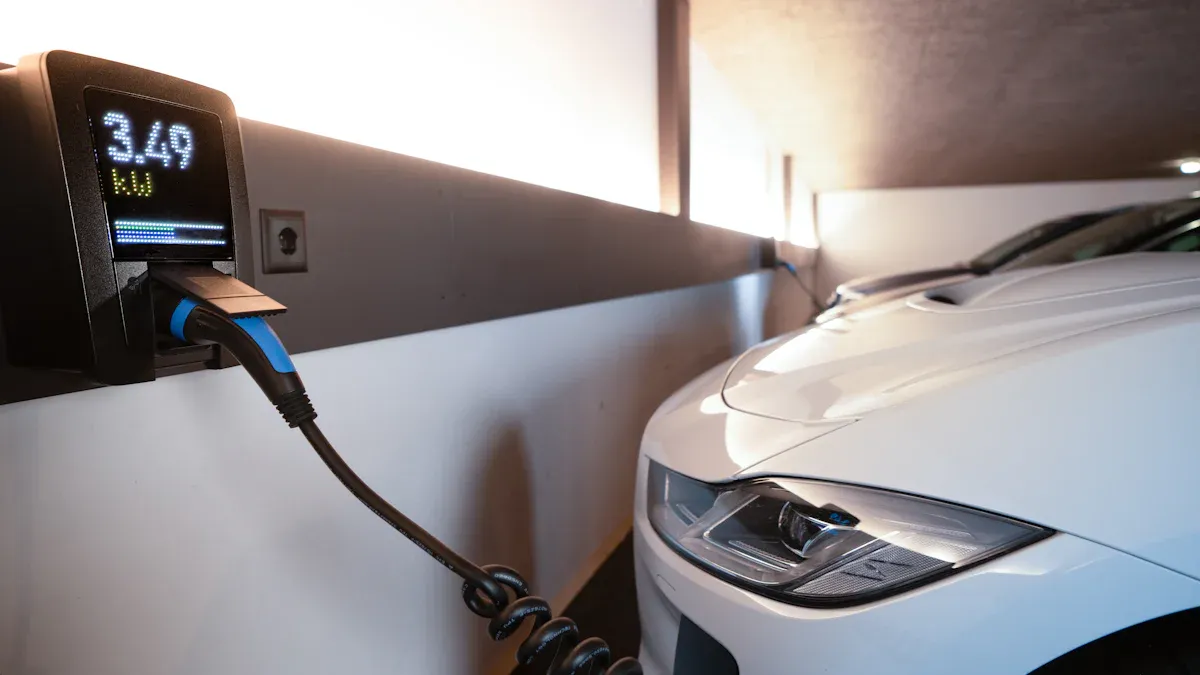
Die Frage nach how long does it take to charge an ev depends heavily on the charging method. A typical 7kW home EV-Ladegerät can fully charge an electric car with a 60kWh battery in about 8 hours. In contrast, public rapid chargers offer a partial charge in as little as 20-30 minutes, while basic tragbare ev-ladegeräte can take over 24 hours. As global EV adoption grows, Hersteller von EV-Ladegeräten are developing advanced EV-Ladelösungen to meet demand.

Anmerkung: Most drivers find it simple to charge an ev overnight, making long waits a rare occurrence for daily driving needs.
How Long Does It Take to Charge an EV by Charger Type?

Die Antwort auf Wie lange dauert es, ein Elektroauto aufzuladen? is directly tied to the type of charger used. Charging speeds vary dramatically across three main levels, each designed for different scenarios. Understanding these levels helps drivers manage their vehicle’s energy needs efficiently.
Level 1 Charging (120-Volt Standard Outlet)
What Is Level 1 Charging?
Level 1 charging uses a standard 120-volt residential wall outlet. Every electric vehicle comes with a Level 1 cordset, making it the most accessible charging method available. A driver simply plugs the cord into the wall and connects it to the car. No special installation is required, offering universal convenience.
Charging Time: 24+ Hours
This method is the slowest available. The low power output means the total charging time can easily exceed 24 hours for a full battery electric vehicle (BEV). It adds range very gradually, making it impractical for drivers who need a significant charge quickly.
| Metrisch | Wert |
|---|---|
| Leistung | 1-1.8 kW |
| Aufladegeschwindigkeit | 3-7 miles/hour |
| Volle Ladezeit | 22-40 hours (BEV) |
Best Use Cases for Level 1
Level 1 charging is best suited for plug-in hybrid electric vehicles (PHEVs) with smaller batteries, which can often recharge fully overnight. For BEV owners, it serves as a useful backup or a supplementary option when visiting friends or family who do not have a dedicated EV charger.
Level 2 Charging (240-Volt Home & Public Charger)
What Is Level 2 Charging?
Level 2 charging operates on a 240-volt circuit, similar to what large home appliances like electric dryers use. These chargers are common in both residential settings and public locations such as workplaces, shopping centers, and parking garages. Technologically advanced providers like TPSON offer a range of these EV-Ladelösungen. Key technical specifications umfassen:
- Spannung: A dedicated 240-volt circuit is necessary.
- Aufladegeschwindigkeit: These chargers deliver power up to 22 kW for faster charging times.
- Socket Types: Common socket types include Type 2 and CCS, so compatibility with the vehicle is essential.
- Smart vs. Non-Smart: Smart chargers connect to Wi-Fi, allowing for remote scheduling and energy monitoring.
Charging Time: 4-10 Hours
A Level 2 unit can fully charge an electric car in approximately 4 to 10 hours, depending on the battery size and the charger’s power output. This speed makes it possible to start the day with a full battery after charging overnight. It is the most practical way to charge an electric car.
The Standard for Home Charging
For most EV owners, a Level 2 charger is the gold standard. The ability to reliably charge an electric car at home overnight covers nearly all daily driving needs. Professional installation is crucial for safety and performance.
Anmerkung: Key installation requirements for a home charger include:
- Elektrische Anforderungen: A dedicated 40-amp, 230-volt circuit is standard. An electrician must assess the home’s electrical panel.
- Property Permission: Homeowners can proceed with installation, while tenants must get landlord approval.
- Designated Parking: A private driveway or garage is needed to ensure the cable can reach the vehicle safely.
- Konnektivität: Smart chargers require a stable Wi-Fi or 4G connection for features like remote management.
Level 3 Charging (DC Fast Charging)
What Is DC Fast Charging?
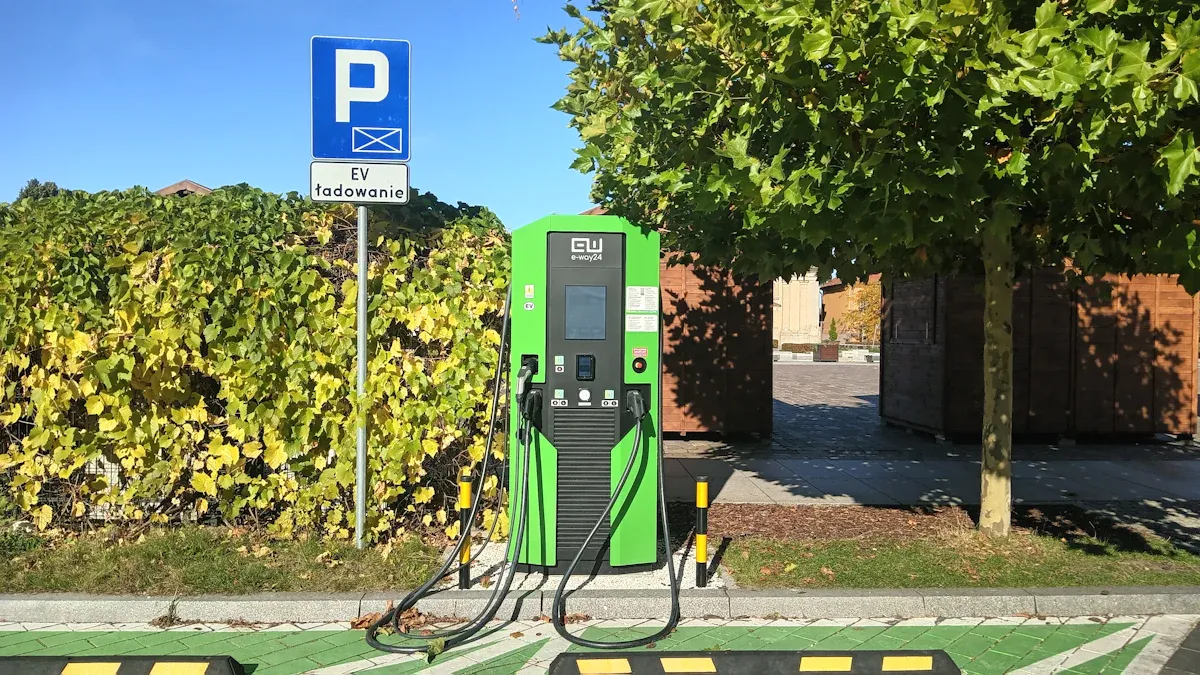
Level 3 charging, also known as DC Fast Charging, provides the fastest charging speeds possible. Unlike Level 1 and 2 chargers that use alternating current (AC), these stations supply direct current (DC) straight to the battery. This bypasses the car’s onboard converter, enabling rapid power delivery. Power levels for these chargers start at 50 kW and extend to ultra-rapid chargers that deliver 100 kW, 150 kW, or even a massive 350 kW.
Charging Time: 15-60 Minutes
With a DC fast charger, a driver can charge an electric car at a charging station and add significant range in a short period. The goal is not usually a full charge but to get enough range to continue a journey. Most EVs can gain an 80% charge in just 15 to 60 minutes.
| Merkmal | Level 3 (DC Rapid/Ultra-rapid) |
|---|---|
| Leistung | 50-350 kW |
| Aufladegeschwindigkeit | 20–40 minutes for 100–200 miles |
Essential for Road Trips
DC fast chargers are indispensable for long-distance travel. They are strategically located along major highways and travel corridors, allowing drivers to charge an ev quickly during a brief stop for coffee or a meal. This network transforms the EV from a daily commuter into a capable road trip vehicle.
How Fast Do Electric Cars Charge? Range Per Hour Explained
Understanding charging speed in terms of range gained per hour provides a more practical perspective than total charging time. The question of how much range do you get per hour of charging helps drivers plan their daily trips and long-distance journeys effectively. This metric shifts the focus from “empty to full” to “how much do I need?”
Range Gained with a Level 1 Charger
3-5 Miles of Range Per Hour
Level 1 charging is the slowest method available. Using a standard 120-volt household outlet, an EV driver can expect to add approximately 3 to 5 miles of range for every hour the vehicle is plugged in. This slow rate, often called “trickle charging,” makes it difficult to replenish a large portion of the battery in a short amount of time.
Real-World Scenario: Overnight Top-Up
A commuter drives 25 miles to and from work each day. They plug their EV into a standard wall outlet upon returning home at 6 p.m. and leave it charging for 10 hours overnight. By the next morning, the car has regained 30-50 miles of range, easily covering the daily commute with extra range to spare for errands. This scenario works well for drivers with low daily mileage.
Range Gained with a Level 2 Charger
20-30 Miles of Range Per Hour
A Level 2 charger significantly improves charging speeds. A typical 7kW home charger adds around 25 to 30 miles of range per hour. This rate transforms EV ownership, making it easy to fully charge an electric car overnight regardless of the day’s driving. More powerful 11kW units can boost this even further.
| Ladegerät Leistung | Ungefähre zusätzliche Reichweite pro Stunde | Anmerkungen |
|---|---|---|
| 7 kW | 25-30 Meilen | The most common home charging setup. |
| 11 kW | 40-45 miles | Offers faster charging times for compatible vehicles. |
| 22 kW | 75-80 miles | Typically found at public destinations; requires three-phase power. |
Real-World Scenario: Full Charge Overnight
An EV owner arrives home with 30% battery remaining after a long day of driving that covered 150 miles. They plug into their 7kW Level 2 home charger. Over an 8-hour period, the charger adds approximately 200 miles of range (25 miles/hour x 8 hours), bringing the battery to a full 100% charge by morning. The car is ready for any driving demands the next day.
Range Gained with a DC Fast Charger
100-200+ Miles of Range in 30 Minutes
DC-Schnellladegeräte answer the question of how fast do electric cars charge on the road. These powerful stations are designed for speed, not for a full charge. Depending on the station’s power output and the vehicle’s capabilities, a driver can add 100 to over 200 miles of range in just 20 to 30 minutes. This rapid replenishment makes long-distance EV travel practical and efficient.
Real-World Scenario: A Quick Highway Stop
A family is on a 400-mile road trip. After driving for about 2.5 hours (180 miles), they stop at a highway service area with a 150kW DC fast charging station.
- They plug in the car and head inside for a 25-minute break to use the restroom and grab snacks.
- During that time, the car gains approximately 150 miles of additional range.
- They return to a vehicle with more than enough charge to comfortably reach their next planned stop or final destination.
Key Factors That Determine How Long It Takes to Charge an Electric Car
Several key variables influence the answer to Wie lange dauert es, ein Elektroauto aufzuladen?. The total time depends on a combination of the vehicle’s battery, the charger’s power, and even the car’s own internal hardware. Understanding these factors helps drivers set realistic expectations for every charging session.
Batteriegröße (kWh)
Why a Bigger Battery Takes Longer
The size of an EV’s battery, measured in kilowatt-hours (kWh), is a primary determinant of its charging duration. A larger battery holds more energy and therefore requires more time to fill. For instance, a compact vehicle with a 40kWh battery will charge much faster than a large SUV equipped with a 100kWh battery, even when using the same charger. The 100kWh battery would typically require a full overnight session to reach a complete charge.
Comparing Compact EVs vs. Long-Range SUVs
This difference is clear when comparing vehicle classes. A smaller city EV, designed for efficiency and shorter trips, might have a 30-50kWh battery. In contrast, a long-range SUV or truck built for extended travel may feature a battery of 100kWh or more. The SUV offers greater range but demands longer charging sessions to replenish its massive battery.
Charger’s Power Output (kW)
The Difference Between 7kW, 50kW, and 350kW
A charger’s power output, measured in kilowatts (kW), directly impacts charging speed. The kilowatt figure represents the rate of energy delivery. A higher kW output translates to faster charging. This relationship clarifies how different chargers affect overall charging times.
| Art der Aufladung | kW Range | Approximate Charging Time |
|---|---|---|
| Langsames Aufladen | Up to 2.3 kW | 8 to 12 hours |
| Schnelles Aufladen | 7 kW bis 22 kW | 3 to 8 hours |
| Rapid/Ultra-Rapid | 50 kW bis 350 kW | Under an hour (for 80% charge) |
Matching the Charger to Your Needs
Drivers should select a charger that aligns with their requirements. A 7kW home unit is perfect for overnight charging. A 50kW rapid charger is ideal for a quick top-up during errands. An ultra-rapid 350kW station is best reserved for long-distance road trips where minimizing downtime is essential.
Your Vehicle’s Maximum Charging Rate
Your Car’s Built-In Speed Limit
Every EV has a maximum charging rate it can accept for both AC (Level 1 & 2) and DC (Level 3) charging. This rate is a built-in speed limit determined by the vehicle’s battery management system and hardware. You cannot charge an electric car faster than this specified limit, regardless of the charger’s power.
Why a 350kW Charger Won’t Always Charge Faster
Plugging a car with a low maximum charging rate into a high-powered charger will not speed up the process. For example, a MINI Electric has a maximum DC rate of 50kW. If connected to a 350kW ultra-rapid station, it will still only draw power at a maximum of 50kW. The charger and car communicate to ensure a safe speed, so the vehicle is the bottleneck. In contrast, a vehicle like the Tesla Model 3 can take advantage of much higher speeds.

Battery’s State of Charge (SoC)
The battery’s current level, or State of Charge (SoC), significantly affects how long a charging session takes. An EV does not charge at a constant rate from empty to full. The process is fastest when the battery is less full and slows down considerably as it approaches 100%.
The 20-80% Sweet Spot
Most electric vehicles charge fastest within the 20% to 80% battery range. This window is often called the “sweet spot” for rapid charging. Sticking to this range minimizes time spent at public charging stations, making road trips more efficient.
Imagine an EV battery as an empty movie theater. The first people arriving can find seats quickly because the space is open. As the theater fills up, it takes much longer for new arrivals to navigate the aisles and find the remaining empty seats. Electrons filling a battery behave similarly, moving freely at lower charge levels but facing more resistance as the battery nears capacity.
Verstehen der Ladekurve
The slowdown in charging speed as a battery fills is known as the “charging curve.” As a battery approaches full capacity, its internal resistance increases, which generates more heat. To prevent cell damage, the vehicle’s Battery Management System (BMS) deliberately reduces the charging speed. This tapering effect means the last 20% of a charge (from 80% to 100%) can take as long as the first 60-70%. For example, reaching 80% at a DC fast charger might take 25 minutes, while the final push to 100% could take another 25 minutes or more.
How Temperature Affects Charging Speed
Ambient temperature is another critical factor that influences charging performance, especially in extreme climates. Batteries have an ideal temperature range for optimal operation.
Why Cold Weather Slows Charging
Cold weather significantly lengthens charging times. The electrochemical processes inside a lithium-ion battery slow down in frigid conditions, making it harder for the battery to accept a charge. An ideal temperature for charging is between 20-40°C (68-104°F). When temperatures drop, the vehicle must first divert energy to warm the battery pack. This initial heating phase means it takes longer before the battery can begin accepting power at its maximum rate, making it harder to charge an electric car quickly.
Die Rolle der Vorkonditionierung von Batterien
Many modern EVs offer a feature called battery preconditioning to solve this problem. This system automatically warms the battery to its optimal temperature before a planned DC fast-charging session. A driver can often activate this by navigating to a charging station using the car’s built-in navigation.
- Funktion: Preconditioning heats the battery to around 15-35°C (59-95°F).
- Nutzen Sie: A warm battery can accept a high charging speed immediately upon being plugged in.
- Result: This feature minimizes delays and ensures efficient charging, even on the coldest days.
Während preconditioning itself consumes a small amount of energy, the time saved at the charger makes it an invaluable feature for drivers in cold climates.
How to Quickly Estimate Your EV Charging Time
Drivers can quickly estimate Wie lange dauert es, ein Elektroauto aufzuladen? using a straightforward calculation. This simple math provides a useful baseline for planning, even though real-world charging times can vary. It helps set expectations for both daily top-ups and longer road trip stops.
The Simple Charging Formula
Battery Size (kWh) / Charger Speed (kW) = Time (Hours)
The most basic way to estimate charging duration involves a simple division. A driver needs just two key pieces of information: the vehicle’s battery size in kilowatt-hours (kWh) and the charger’s power output in kilowatts (kW). Dividing the battery size by the charger’s power gives a rough estimate of the total charging time in hours.
Calculating Your Charging Time
Applying this formula to specific scenarios makes it easy to understand. The results show how different chargers dramatically affect how long it takes to charge an electric car.
Example 1: Charging a Chevy Bolt at Home
A Chevrolet Bolt has a 65kWh battery. If the owner uses a common 7.4kW Level 2 Heimladegerät, the calculation is as follows:
65 kWh (Battery Size) / 7.4 kW (Charger Power) = 8.8 hoursThis result shows that a full charge from empty is easily achievable overnight.
Example 2: Fast-Charging a Ford Mustang Mach-E
A Ford Mustang Mach-E with a 91kWh battery pulls into a 150kW DC-Schnellladegerät. The driver wants to charge from 10% to 80%, which adds 70% of the battery’s capacity (about 64kWh).
64 kWh (Energy Needed) / 150 kW (Charger Power) = 0.42 hours
To convert this to minutes, multiply by 60:
0.42 x 60 ≈ 25 minutes. This quick stop adds significant range for a road trip.
Why This Formula Is an Estimate
The simple formula provides a valuable ballpark figure, but it is only an approximation. Real-world charging is not a perfectly linear process. Several factors can extend the actual charging duration.
Factoring in the Charging Curve
The formula assumes a constant rate of power delivery, which is not accurate. An EV’s software actively reduces charging power once the battery reaches approximately 80% capacity. This tapering, known as the charging curve, protects the battery from overheating and damage. As a result, the final 20% of a charge takes significantly longer than the initial 80%.
External Factors Like Temperature
Real-world conditions also introduce inefficiencies. Factors like heat loss from internal resistance and power conversions mean that not all energy from the charger makes it into the battery. These inefficiencies can add 10% to 20% to the calculated charging duration. Extreme temperatures, especially cold, also slow the process as the vehicle must use energy to warm the battery pack to an optimal temperature before it can accept a full charge.
Real-World Scenarios: How Long to Charge an EV for Your Trip
Understanding charging theory is one thing; applying it to real-world driving is another. The ideal charging strategy depends entirely on the type of trip a driver is taking. From daily errands to cross-country adventures, the approach to how you charge an ev changes significantly.
Daily Commuting
The Convenience of Overnight Home Charging
For the average daily driver, charging is a simple, background task. A Level 2 Heimladegerät allows an owner to plug in their vehicle at night and wake up to a full battery every morning. This “set it and forget it” routine eliminates any need to visit a public station for daily use, making the process more convenient than fueling a gasoline car.
How Much Charge Do You Really Need Daily?
Most commuters drive far less than their vehicle’s total range each day. An EV owner with a 40-mile round-trip commute only needs to replenish that amount of energy, plus a small buffer. This often requires just a couple of hours of charging, not a full overnight session. This flexibility reduces stress on the battery and the electrical grid.
A Weekend Getaway
Planning Your Charging Stops
A weekend trip requires a bit more planning. Drivers can use their electric car’s built-in route planner, which often integrates charge point data and automatically calculates stops. For vehicles without this feature, third-party apps are excellent tools.
- Ein besserer Routenplaner (ABRP): This app offers detailed planning, considering factors like weather and elevation to optimize stops.
- ChargeMap: A community-powered app that provides user reviews on charger reliability and pricing.
These tools help drivers plan routes based on their car’s range and real-time charger availability, ensuring a smooth journey.
Using Public Level 2 Chargers at Destinations
Upon arriving at a destination like a hotel or a public park, drivers can often find Level 2 chargers. These units are perfect for topping up the battery over several hours or overnight while the car is parked. This ensures the vehicle is ready for local exploration or the return trip home.
The Cross-Country Road Trip
Relying on the DC Fast Charging Network
Long-distance travel is where the DC fast charging network becomes essential. The goal is to minimize charging time and maximize driving. Effective planning is key. Drivers should use apps to identify reliable networks and aim to stop for a charge when the battery has around 25% capacity remaining.
To optimize efficiency, it is best to charge an electric car to about 80%. Charging beyond this point slows down dramatically, making it an inefficient use of time on a road trip.
How Much Time Is Spent Charging vs. Driving?
Modern EVs and rapid chargers have made long trips remarkably efficient. The time spent charging is often just a small fraction of the total travel time. For example, a long journey might look like this:
| Metrisch | Dauer |
|---|---|
| Driving Time | 13 hours 46 minutes |
| Aufladezeit | 1 hour 22 minutes |
This data shows that charging stops align well with natural breaks for meals or rest, adding very little overall time to a trip.
Charging at Home vs. Public Stations: A Time Comparison

An EV driver’s charging strategy depends heavily on their daily schedule and travel habits. The choice between charging at home and using public stations involves a trade-off between convenience, cost, and speed. Understanding these differences helps drivers optimize their time and budget.
The Reliability of Home Charging
Set It and Forget It Overnight
Home charging offers unmatched reliability and convenience. A driver can simply plug in their vehicle upon arriving home and wake up to a fully charged battery. This “set it and forget it” approach eliminates the need for trips to a charging station for daily driving, making it a seamless part of a routine.
Cost and Time Benefits
The primary advantage of home charging is its low cost. Electricity rates are typically much cheaper at home than at public stations. Drivers can further reduce costs by using Time of Use (ToU) tariffs, which offer discounted electricity rates during off-peak hours, usually late at night. Scheduling a charge during these periods makes it significantly cheaper to charge an electric car at home.
| Art der Aufladung | Cost per kWh (UK Average) | Kosten für 60kWh Batterie |
|---|---|---|
| Home (Level 1) | £0.28 | £16.80 |
| Public (Level 2) | £0.30 – £0.40 | £18 – £24 |
| DC-Schnellaufladung | £0.45 – £0.85 | £27 – £51 |

The Speed of Public Charging
When to Use a Public Charger
Public chargers, especially DC fast chargers, are essential for specific situations. Their main advantage is speed.
- Long Trips: They are ideal for adding hundreds of miles of range in under an hour during a long journey.
- Quick Top-ups: Drivers can use them for “opportunity charging” while running errands or dining.
- No Home Access: They provide a necessary alternative for drivers who live in apartments or lack a private driveway.
Understanding Network Speeds and Costs
The public charging landscape is diverse. Networks like Electrify America and EVgo offer various charging speeds and pricing structures. Rates are generally higher than home electricity, especially for the fastest charging speeds. Drivers can use network apps to find a charging station, check availability, and compare prices. Many networks also offer membership plans that can reduce the cost to charge an electric car at a charging station.
Which Is Better for Your Schedule?
For the Daily Driver
For a daily commuter, a Level 2 Heimladegerät is the most practical and cost-effective solution. This approach aligns perfectly with overnight parking, supports long-term battery health, and covers all typical driving needs without requiring any mid-day stops.
For the Long-Distance Traveler
A long-distance traveler must rely on the speed of the public DC fast charging network. The strategy is to charge an ev quickly during brief stops to minimize downtime. For these drivers, the higher cost of rapid charging is a worthwhile trade-off for the ability to travel hundreds of miles in a single day. The best approach is to charge an electric car to about 80% and then continue the journey.
The total charging time for an EV varies significantly, from under 30 minutes to over 24 hours. For most daily driving, owners can easily charge an electric car overnight with a Level 2 home charger. Key factors like battery size, the vehicle’s maximum rate, and charger power ultimately determine the duration. On long road trips, DC fast chargers are the essential solution, allowing a driver to quickly charge an ev and continue their journey with minimal delay.
FAQ
Kann ich jedes öffentliche Ladegerät für mein E-Fahrzeug benutzen?
Most EVs can use a wide range of public chargers. Drivers must ensure the station’s plug (like CCS or CHAdeMO) matches their vehicle’s charging port. Adapters can sometimes provide compatibility for different plug types, expanding a driver’s options.
Is it bad to always fast charge an EV?
Relying exclusively on DC fast charging can degrade the battery faster over time due to high heat and stress. Experts recommend using Level 2 AC charging for daily needs and reserving DC fast charging for long trips to preserve long-term battery health.
Should I charge my EV to 100% every night?
For daily use, it is best to charge the battery to about 80%. This practice reduces stress on the battery cells and can extend its overall lifespan. A driver should only charge to 100% when they need the vehicle’s maximum range for a long trip.
Can I charge an electric car in the rain? 🌧️
Yes, charging an EV in the rain is perfectly safe. EV chargers and vehicle charging ports are designed with extensive weatherproofing and safety mechanisms. These systems prevent electrical shorts and ensure a secure connection, even during heavy downpours.
Was ist der Unterschied zwischen kW und kWh?
Kilowatts (kW) measure the speed or power of a charger, similar to the flow rate of water. Kilowatt-hours (kWh) measure the amount of energy stored in a battery, like the total volume of a water tank. A higher kW charger fills a kWh battery faster.
Warum lädt mein Elektroauto im Winter langsamer?
Cold temperatures slow the chemical reactions inside an EV’s battery. The vehicle’s management system must first use energy to warm the battery to an optimal temperature. This heating process delays the start of fast charging, extending the total session time.