
Charging an electric car at home will make your electric bill go up, typically by $30 to $100 per month. This cost varies based on your mileage, the specific electric vehicle you own, and your electricity tariff. A key factor in your total energy consumption is the EV-Ladegerät you use. TPSON, a provider of technologically advanced EV-Ladelösungen, notes that many Hersteller von EV-Ladegeräten focus on efficient energy transfer to manage costs. Drivers can estimate their monthly electric cost increase.
Quick Estimate Formula:
(Monthly Mileage ÷ Car’s Efficiency in miles/kWh) × Electricity Price per kWh = Estimated Monthly Cost Increase.
This guide breaks down how to calculate the precise cost for any situation and explores ways to minimize charging expenses, from using a standard home charger to considering tragbare EV-Ladegeräte for more flexibility.
How to Calculate the Exact Cost to Charge Your EV at Home
Understanding the financial impact of owning an electric vehicle begins with a few simple calculations. By breaking down the cost into smaller, manageable parts, a driver can accurately predict the increase in their monthly electric bill. This section provides a three-step guide to determine the precise cost of home charging.
Step 1: Find Your Cost Per Mile
The most granular way to understand EV running costs is to calculate the price per mile. This figure is the foundation for all other cost estimates. It reveals how much energy the vehicle consumes for every mile it travels.
The Pence Per Mile Formula Explained
To find the cost per mile, a driver needs two key pieces of information: their electricity price and their car’s efficiency. The price of electricity is listed on a utility bill in cents per kilowatt-hour (kWh). A car’s efficiency is measured in miles per kWh, which is found in the vehicle’s specifications or on its dashboard display.
Formel:
(Electricity Price in cents per kWh ÷ Vehicle Efficiency in miles/kWh) = Cost in Pence Per Mile
This calculation shows the direct cost of the energy required to move the car one mile.
Example Costs Per Mile at Different Rates
The cost per mile fluctuates significantly based on the electricity tariff. Charging during off-peak hours is substantially cheaper than using a standard rate. The table below illustrates this difference for an average EV with an efficiency of 4 miles per kWh.
| Tarif Typ | Example Rate (p/kWh) | Cost Per Mile (cents) |
|---|---|---|
| EV Off-Peak | 7.5p | 1.88p |
| Standard Rate | 24.5p | 6.13p |
| Public Rapid | 69p | 17.25p |
Step 2: Find Your Monthly Cost Based on Mileage
Once the cost per mile is known, calculating the total monthly charging cost is straightforward. This step connects the vehicle’s efficiency with a driver’s real-world usage patterns.
The Monthly Cost Formula Explained
A driver can estimate their monthly charging expense by multiplying their cost per mile by the number of miles they typically drive each month. This provides a clear picture of how much their electric bill will increase.
Formel:
(Cost in Pence Per Mile × Monthly Mileage) = Estimated Monthly Charging Cost
This final figure represents the added cost to a household’s monthly electricity budget.
Estimated Monthly Costs by Driving Habits
Annual mileage varies greatly among UK drivers. The average annual mileage for private cars is around 7,400 miles, or approximately 617 miles per month. The table below shows estimated monthly costs for different driving habits, using an average cost of 6.13p per mile (based on a standard 24.5p/kWh tariff).
| Fahrgewohnheit | Average Annual Mileage | Geschätzte monatliche Kosten |
|---|---|---|
| Low User | 5,000 miles | $25.54 |
| Average User | 7,500 miles | $38.31 |
| High User | 12,000 miles | $61.30 |
These figures demonstrate how driving habits directly influence the total cost of charging for electric cars.
Step 3: Find the Cost of a Full Charge
Another useful metric is the cost to charge an EV from empty to full. This is similar to knowing the cost of filling a tank of gasoline and helps in understanding the expense of a single, complete charging session at home.
The Full Charge Formula Explained
The cost to charge an EV’s battery from 0% to 100% depends on the battery’s size (measured in kWh) and the price of electricity. It is important to note that some energy is always lost during the charging process. Advanced EV charging solutions from providers like TPSON are engineered to maximize energy transfer efficiency, but a 10-15% energy loss is typical. For a simple estimate, the following formula is used.
Formel:
(Battery Size in kWh × Electricity Price in cents per kWh) = Cost for a Full Charge
This calculation provides a baseline cost for a full charging cycle. The actual energy drawn from the wall will be slightly higher.
Example Costs for Popular UK EV Models
The battery size of electric cars varies by model, which directly affects the cost of charging. Larger batteries offer more range but have a higher cost for a full charge. The table below shows the estimated cost to charge some popular electric cars in the UK, based on a standard electric rate of 24.5p/kWh.
| EV-Modell | Usable Battery Size (kWh) | Estimated Cost for a Full Charge |
|---|---|---|
| Tesla Model Y RWD | ~6 Stunden | $14.09 |
| Nissan LEAF | 39 kWh | $9.56 |
| Kia Niro EV | 64,8 kWh | $15.88 |
Dieser Vergleich verdeutlicht, wie die Wahl eines E-Auto-Modells die Gesamtkosten für das Laden beeinflusst.
Wie stark steigt Ihre Stromrechnung bei verschiedenen Tarifen?
Der einflussreichste Faktor, der bestimmt, wie hoch Ihre electric bill go up Stromrechnung ausfällt, ist Ihr Stromtarif. Der Preis, den ein Fahrer pro Kilowattstunde (kWh) zahlt, kann zwischen einem Standardtarif und einem speziellen Elektrofahrzeug-Tarif um über 300 % variieren. Dieser Unterschied zu verstehen, ist der Schlüssel zur Kontrolle der Kosten für das Laden eines Elektroautos zu Hause..
Die Kosten für das Laden eines Elektroautos zu Hause mit einem Standardtarif
Die meisten Haushalte in Großbritannien sind standardmäßig auf einem Standardvariablen Tarif (SVT). Obwohl einfach, ist dies selten die wirtschaftlichste Option für Besitzer von Elektroautos..
Was ist ein Standardvariabler Tarif (SVT)?
Ein Standardvariabler Tarif ist der Standard- Energie- tarif eines Anbieters. Der Preis pro Einheit elektrischer Energie ist nicht festgelegt und kann sich ändern, obwohl er durch eine Preisobergrenze des Energieregulators Ofgem geschützt ist. Für den Zeitraum vom 1. Januar bis 31. März 2026 legte Ofgem die durchschnittlichen Kosten für Strom auf einem SVT auf 27,69 Cent pro kWh für Kunden mit Lastschriftzahlung fest. Dieser Satz gilt zu jeder Tageszeit, wodurch das Laden zu Spitzen- und Schwachlastzeiten preislich identisch ist.
Beispiel für monatliche Kosten mit einem Standardtarif (~24,5 ct/kWh)
Berechnen wir die monatlichen Ladekosten für einen durchschnittlichen britischen Fahrer. Wir verwenden das vorherige Beispiel eines Fahrers, der 7.500 Meilen pro Jahr (625 Meilen pro Monat) mit einem EV Elektroauto mit einem Verbrauch von 4 Meilen/kWh zurücklegt.
Berechnung mit einem Standardtarif:
- Benötigte Energie: 625 Meilen ÷ 4 Meilen/kWh = 156,25 kWh pro Monat
- Monatliche Kosten: 156,25 kWh × 0,245 €/kWh = 38,28 € $38.28
Diese Zahl stellt eine typische Basislinie Kosten für einen Fahrer dar, der seinen Energie- Tarif nicht für sein neues Elektrofahrzeug optimiert hat..
Senken Sie Ihre Rechnung mit einem E-Auto-Tarif
Energieanbieter bieten spezielle Tarife für Besitzer von Elektroautos. Elektrofahrzeugen an, um die Kosten zu berechnen. Ladekosten erheblich zu senken. Diese Tarife bieten einen starken Anreiz, den Energie- Verbrauch in Schwachlastzeiten zu verlagern.
Was ist ein Schwachlast-E-Auto-Tarif?
Ein Schwachlast- EV Tarif bietet ein Fenster von mehreren Stunden, normalerweise über Nacht, in dem der Preis für Strom Strom deutlich reduziert ist. Beispielsweise bieten einige Anbieter Sätze von nur 7,5 ct/kWh an. Diese Tarife erfordern fast immer einen Smart Meter und eine kompatible intelligente EV Ladestation. Technologisch fortschrittliche Ladestationen, wie z.B. von Anbietern wie TPSON, können mit dem Netz und dem Anbieter kommunizieren, um das das Laden Laden automatisch in diesen günstigen Zeitfenstern zu planen.
Beliebte britische Anbieter bieten wettbewerbsfähige Optionen für Fahrer von Elektroautos.:
| Anbieter | Elektrofahrzeugen. | Tarifname | Außerhalb der Hauptgeschäftszeiten |
|---|---|---|---|
| Oktopus Energie | Schwachlast-Tarif | Intelligent Octopus | 23:30 – 05:30 |
| Britisches Gas | ~7,5 ct/kWh | Electric Driver Tariff | ~9 ct/kWh |
| OVO | 0–5 Uhr | Charge Anytime | Variiert |
Dynamisch
Beispiel für monatliche Kosten mit einem Schwachlasttarif (~7,5 ct/kWh) Kosten Nun berechnen wir die monatlichen Ladekosten das Laden für denselben durchschnittlichen Fahrer neu, unter der Annahme, dass sie ihr gesamtes EV Laden zu Hause zu Schwachlastzeiten durchführen.
Berechnung zu einem Niedertarif:
- Benötigte Energie: 625 Meilen ÷ 4 Meilen/kWh = 156,25 kWh pro Monat
- Monatliche Kosten: 156,25 kWh × 0,075 £/kWh = $11.72
Der Unterschied ist erheblich. Ein einfacher Tarifwechsel und das Laden das Laden zur richtigen Zeit reduzieren die monatlichen Kosten um fast 70 %.
Standardtarif vs. E-Auto-Tarif: Ein direkter Kostenvergleich
Ein direkter Vergleich der beiden Szenarien zeigt die tatsächlichen finanziellen Auswirkungen der richtigen Tarifwahl. Das Potenzial für Einsparungen ist ein Hauptvorteil des Besitzes eines Elektrofahrzeug optimiert hat..
Gegenüberstellung der monatlichen Kostenaufschlüsselung
Für eine durchschnittliche Fahrleistung von 625 Meilen pro Monat ist der Unterschied Verrechnungskosten eklatant. Dieser Vergleich geht davon aus, dass 100 % das Laden der Ladevorgänge zum Ladekosten.
| Tarif Typ | Tarif (p/kWh) | Monatliche Kosten (625 Meilen) |
|---|---|---|
| Standardvariabler Tarif | 24.5p | $38.28 |
| Niedertarif-E-Auto-Tarif | 7.5p | $11.72 |
| Monatliche Einsparungen | $26.56 |
Wie viel Sie jährlich sparen können
Die Hochrechnung dieser monatlichen Zahlen auf ein ganzes Jahr zeigt die erheblichen langfristigen Einsparungen. Einsparungen. Für viele Fahrer von Elektroautos., Elektrofahrzeugen können diese Einsparungen einen großen Teil der anfänglichen Kosten Kosten für die Installation einer Heimladestation ausgleichen.
- Jährliche Kosten mit Standardvariablem Tarif (SVT): 38,28 £ × 12 = $459.36
- Jährliche Kosten mit E-Auto-Tarif: 11,72 £ × 12 = $140.64
- Jährliche Gesamtersparnis: $318.72
Durch aktive Steuerung ihres elektrischer Stromtarifs kann ein Fahrer jedes Jahr Hunderte von Pfund sparen, was den Umstieg auf Elektroautos. ein Elektroauto finanziell noch attraktiver macht.
Wie Ihre Wahl des E-Autos die Betriebskosten beeinflusst
Das spezifische gewählte Elektrofahrzeug hat einen direkten und erheblichen Einfluss auf die Betriebskosten eines Elektroautos.. Genau wie Benzinautos unterschiedliche Kraftstoffverbräuche haben, variieren Elektroautos in ihrer Effizienz und Batteriekapazität. Diese beiden Faktoren – Effizienz und Batteriegröße – sind die Haupttreiber der gesamten Betriebskosten.
Die Auswirkung der Fahrzeugeffizienz (Meilen/kWh)
Die Fahrzeugeffizienz ist wohl der wichtigste Faktor für die Bestimmung der täglichen Ladekosten. Sie bestimmt, wie viel elektrische Energie ein Auto für eine bestimmte Strecke verbraucht.
Was ist E-Auto-Effizienz und warum ist sie wichtig?
Die Effizienz eines E-Autos wird in Meilen pro Kilowattstunde (Meilen/kWh) gemessen. Diese Kennzahl ist das elektrische Äquivalent zu Meilen pro Gallone (MPG). Ein höherer Meilen/kWh-Wert bedeutet, dass das Elektrofahrzeug weniger Energie pro Meile verbraucht, was zu geringeren Kosten führt.
Offizielle Effizienzwerte, bekannt als WLTP (Worldwide Harmonised Light Vehicle Test Procedure), werden unter Laborbedingungen ermittelt. Die reale Effizienz ist jedoch oft niedriger. Automobilpublikationen stellen fest, dass Elektroautos aufgrund verschiedener Variablen typischerweise etwa 15 % weniger erreichen als ihre offiziellen Werte.
Wichtige Faktoren, die die reale Effizienz verringern umfassen:
- Wetter: Kalte Temperaturen reduzieren die Batterieleistung.
- Fahrgewohnheiten: Aggressives Beschleunigen und hohe Geschwindigkeiten verbrauchen mehr Energie.
- Zusatzverbrauch: Heizung und Klimaanlage entnehmen der Batterie erhebliche Leistung.
Diese Lücke zu verstehen, ist entscheidend, um die realen Betriebskosten eines Elektrofahrzeugs genau vorherzusagen.
Kostenunterschied: Effiziente vs. ineffiziente E-Auto-Modelle
Der Effizienzunterschied zwischen verschiedenen Elektroautos kann erheblich sein. Ein effizienteres E-Auto hat bei gleicher Fahrstrecke deutlich niedrigere Betriebskosten als ein weniger effizientes.
Betrachten Sie die Kosten für das Fahren von 100 Meilen zu einem Standardtarif von 24,5 p/kWh:
| Auto-Modell | Effizienz (Meilen/kWh) | Benötigte Energie (100 Meilen) | Kosten für 100 Meilen |
|---|---|---|---|
| Vauxhall Corsa Electric | 5.1 | 19,6 kWh | $4.80 |
| Audi Q8 E-tron | 2.9 | 34,5 kWh | $8.45 |
Das effizientere E-Auto kostet für die gleiche Fahrstrecke fast 43 % weniger, was zeigt, wie sich die Konstruktion eines Autos direkt auf die Stromrechnung des Fahrers auswirkt.
Die Auswirkung der Batteriegröße (kWh)
Während die Effizienz die Kosten pro Meile beeinflusst, bestimmt die Batteriegröße die Kosten für eine Vollladung. Eine größere Batterie bietet mehr Reichweite, erfordert aber auch mehr Energie zum Füllen.
Wie die Batteriegröße die Vollladekosten beeinflusst
Die Batteriekapazität eines E-Autos wird in Kilowattstunden (kWh) gemessen. Die Kosten für eine Vollladung from empty to full is a simple calculation: the battery’s size multiplied by the price of electric energy. For example, charging a 60 kWh battery on a 24.5p/kWh tariff would cost $14.70. Technologically advanced chargers from providers like TPSON help ensure this energy transfer is as efficient as possible, minimizing waste.
Cost Difference: Small vs. Large Battery EVs
Different electric cars come with a wide range of battery sizes. A smaller battery is cheaper to charge fully, but a larger one provides greater range between charges. The table below compares the full charge cost for several popular EV models on both standard and off-peak electric rates.
| EV-Modell | Batteriegröße (kWh) | Full Charge Cost (Standard Rate) | Full Charge Cost (Off-Peak Rate) |
|---|---|---|---|
| Nissan Leaf | 40 | $9.80 | $3.00 |
| Tesla Model 3 | 57.5 | $14.09 | $4.31 |
| MG4 EV | 64 | $15.68 | $4.80 |
| Kia EV6 | 77.4 | $18.96 | $5.81 |
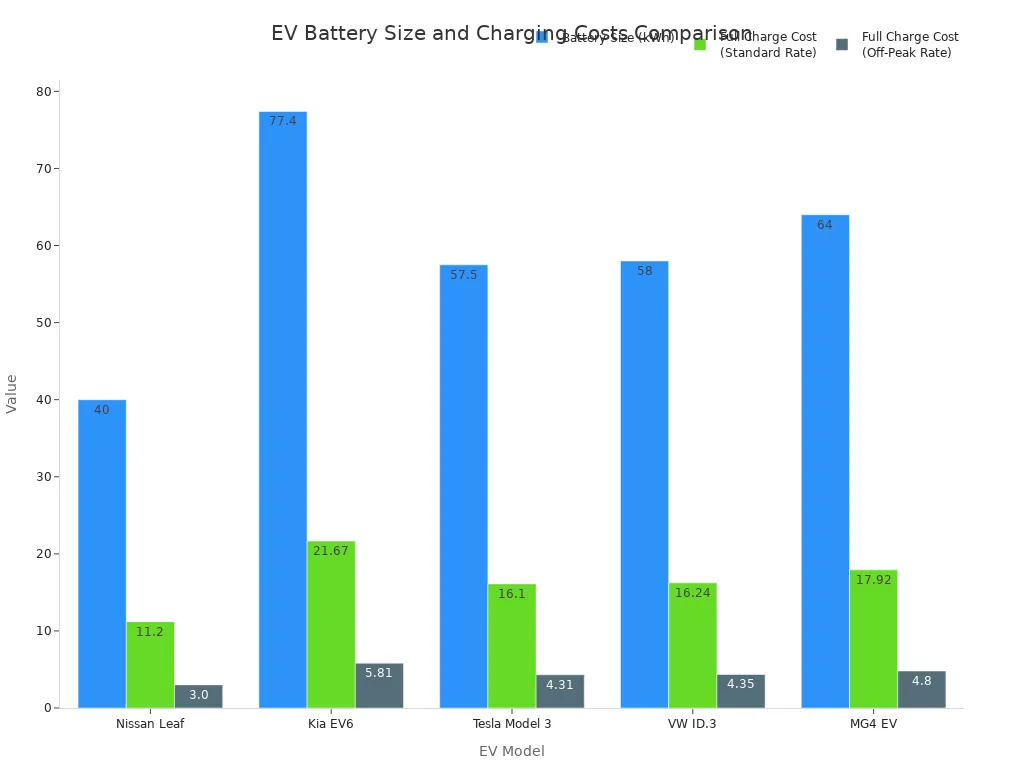
This shows that while a larger battery has a higher cost for a full charge, using an off-peak tariff keeps the expense manageable for all models of electric cars.
Factoring in the Upfront Cost of Home Charger Installation

While the daily running costs of electric cars are low, the initial setup for home charging represents a one-time investment. This upfront expense is a crucial part of the total cost of ownership. Understanding the price of charging points and available financial support helps drivers budget effectively.
The Initial Cost of a Home Charger
Installing a dedicated charger at home is the most convenient and cost-effective way to charge an EV. The price for this installation varies based on the charger model and the complexity of the installation.
Typical Charger and Installation Prices
The typical cost for installing a 7kW home charger in the UK ranges from $800 und $1.500. This price often includes both the charger unit and standard installation. Many companies offer bundled packages. For example, a charger and installation might be available for around $1,250 for a straightforward setup. The final price depends on the home’s existing electrical system and the distance from the fuse box to the charger location.
Available Government Grants (EV Chargepoint Grant)
The UK government offers financial assistance to make home charging more accessible. The EV Chargepoint Grant helps reduce the initial installation cost for specific residents.
Who is eligible?
The grant is for individuals who own and live in a apartment or rent any residential property.
Key details of the grant include:
- It provides up to 75% off the cost of buying and installing a chargepoint, capped at $350.
- Applicants must own or lease an eligible electric vehicle for at least six months.
- The property must have a designated, private off-street parking space.
This grant significantly lowers the barrier to entry for many drivers of electric cars.
Smart Chargers vs. Non-Smart Chargers
The type of charger a person chooses impacts long-term expenses. Smart charging points offer advanced features that non-smart chargers lack, directly affecting a household’s electric bill.
How Smart Chargers Reduce Your Long-Term Bill
Smart charging points are essential for minimizing the running costs of electric cars. These devices connect to the internet, allowing them to perform several money-saving functions. Technologically advanced electric vehicle charging solution providers like TPSON engineer their charging points with these features.
| Merkmal | How It Reduces Your Bill |
|---|---|
| Planmäßige Aufladung | Automatically starts charging during off-peak hours when electric rates are lowest. |
| Solare Integration | Uses free energy from home solar panels to charge the car, reducing grid reliance. |
| Remote App Control | Allows users to monitor energy use and manage charging sessions from a smartphone. |
These capabilities ensure drivers can easily take advantage of cheaper EV tariffs, leading to substantial savings.
Is a Smart Charger Worth The Initial Cost?
A smart charger may have a higher initial price, but it is a worthwhile investment for most owners of electric cars. The ability to schedule charging to coincide with off-peak electric tariffs (like 7.5p/kWh overnight) unlocks the biggest financial benefit of home charging. Without a smart charger, a driver cannot easily access these low rates. The long-term savings on the electric bill quickly outweigh the higher upfront cost, making smart charging points a financially sound choice.
When Public Charging Increases Your Total Running Cost
While home charging offers the lowest running costs for electric cars, drivers will inevitably use public charging points. Relying heavily on public networks significantly increases the overall cost of charging an electric vehicle. Understanding these external charging fees is essential for managing a realistic budget.
Understanding the Cost of Public Charging Networks
Die cost of charging electric cars at public stations varies widely depending on the speed of the charger and the network provider. Prices are typically advertised in cents per kilowatt-hour (kWh).
Slow and Fast Charger Pricing (AC)
Slow and fast AC charging points (up to 22kW) are common at destinations like supermarkets, hotels, and workplaces. These are ideal for topping up the battery over several hours.
- Slow Chargers (3-7kW): Die Geschwindigkeit von Schnellladegeräten korrespondiert mit einem höheren Preis. 25p to 55p per kWh.
- Fast Chargers (7-22kW): These generally cost between 40p and 60p per kWh.
Some locations offer free charging as an incentive for customers, but this is becoming less common.
Rapid and Ultra-Rapid Charger Pricing (DC)
Rapid and ultra-rapid DC charging points are designed for quick top-ups on long journeys, delivering power from 50kW to over 200kW. This speed and convenience come at a premium cost. The cost to charge at these stations is much higher than the typical electric rate at home.
| Ladegerät Typ | Approx. Cost per kWh |
|---|---|
| Destination (slow/fast, 7–22 kW) | 35–45 p/kWh |
| Rapid (50–150 kW) | 55–75 p/kWh |
| Ultra-rapid (200 kW +) | 75–85 p/kWh |
How Public Charging Affects Your Overall Bill
Frequent use of public charging points, especially rapid chargers, will noticeably inapartmente an EV driver’s monthly expenses compared to exclusive home charging.
When to Use Public Chargers vs. Home Charging
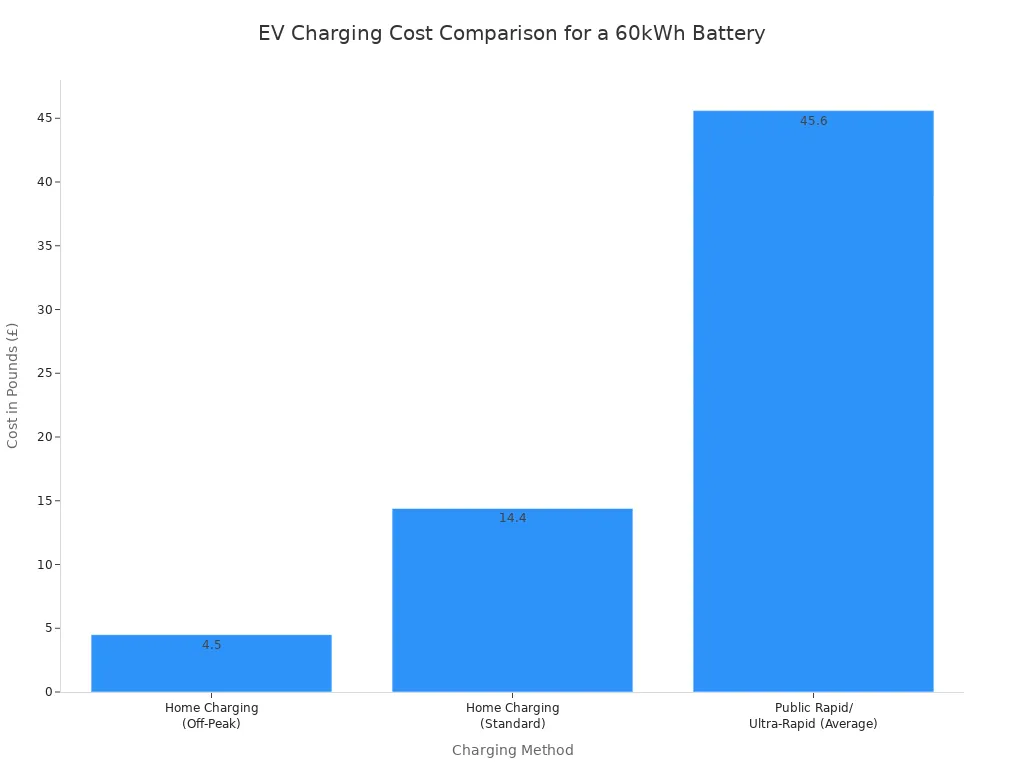
The most cost-effective strategy is to use home charging for daily needs and reserve public charging points for long-distance travel or emergencies. The price difference is substantial.
A full charge for a 60kWh battery on an off-peak home tariff might cost around $4.50. The same charge at a public rapid charger could cost between $27 and $51. This convenience comes at a premium, making off-peak home charging the economical choice for regular use.
Calculating a Blended Home and Public Charging Cost
Most drivers of electric cars will use a mix of charging methods. To estimate a blended monthly cost, a driver can calculate the cost for each type of charging based on their habits.
For example, if a driver uses 150 kWh per month:
- 80% at Home (Off-Peak): 120 kWh × $0.075/kWh = $9.00
- 20% at Public Rapid Chargers: 30 kWh × $0.75/kWh = $22.50
- Estimated Blended Monthly Cost: $9.00 + $22.50 = $31.50
This calculation provides a more accurate financial picture for drivers of electric cars who rely on both home and public electric charging points.
Other Factors That Influence Your Electric Bill
The tariff and the car model are major components of your electric bill, but they are not the only ones. A driver’s habits and the environment also play a significant role in the final cost. Understanding these external factors helps owners of electric cars manage their energy consumption and charging expenses more effectively.
How Seasonal Changes Affect Charging Cost
Weather directly influences an electric vehicle’s performance. Both cold winters and hot summers can alter battery efficiency, leading to changes in the overall cost of charging.
Winter’s Impact on Battery Efficiency and Cost
Cold temperatures are a known challenge for electric car batteries. The chemical reactions inside the battery slow down, reducing its ability to hold and deliver energy.
Research from What Car? shows that drivers can expect a 15-20% reduction in range during winter months. This means the car requires more frequent charging to cover the same distance, increasing the monthly electric expense. The battery also uses extra energy to heat itself and the cabin.
Summer’s Impact from Air Conditioning Use
Hot weather presents its own challenges, primarily from the use of air conditioning. Cooling the cabin requires a significant amount of electric energy, which is drawn directly from the main battery. Renault estimates that using climate control systems can reduce an EV’s range by as much as 30%. However, it is important to note that aggressive driving habits often consume more energy than running the air conditioner.
How Your Driving Style Affects Efficiency
How a person drives has a direct and immediate impact on energy consumption. A smooth driving style conserves energy, while an aggressive one wastes it, leading to a higher Kosten zu berechnen.
Aggressive vs. Smooth Driving Cost Comparison
Driving style is one of the most controllable factors affecting an electric car’s efficiency.
- Aggressive Driving: Rapid acceleration and hard braking consume large amounts of energy. High-speed highway driving also significantly increases electric consumption.
- Smooth Driving: Gentle acceleration, maintaining a steady speed, and anticipating stops allow the car to use energy more efficiently.
Adopting a smoother driving style can extend the vehicle’s range and reduce the frequency of charging sessions.
Maximizing Range with Regenerative Braking
Modern electric cars use a feature called regenerative braking to recover energy. When the driver lifts their foot off the accelerator or applies the brakes, the electric motor works in reverse. It acts as a generator, converting the car’s kinetic energy back into electric energy to top up the battery.
Studies show this system can recover 15% to 20% of energy in general driving conditions. In urban stop-and-go traffic, the savings can be even higher. Some manufacturers, like Porsche, claim that up to a third of an electric vehicle’s range can be gained from this recuperation process alone. Mastering one-pedal driving, where available, maximizes this effect and is a key skill for efficient EV ownership.
A driver’s electric bill will go up with an electric car, but this increase is highly controllable. The final figure depends on a driver’s choices. The most critical factor for managing charging costs is the electricity tariff. Switching to an off-peak EV tariff for home charging can reduce the electric energy expense by over 70%. This switch can lead to annual savings of over $1,200.
Intelligentes Laden is essential. Technologically advanced charging solutions, like those from TPSON, enable drivers to automatically use the cheapest electricity. This makes a significant difference in how much the electric bill will go up.
To find a precise estimate, a driver should use the formulas in this guide with their specific mileage, car efficiency, and electric energy rate. This calculation will show exactly how much their electric bill will go up after transitioning to electric charging.
FAQ
How much will my bill really go up?
A typical driver can expect their monthly electric bill to increase by $30 to $100. The exact amount depends on their mileage, vehicle efficiency, and electricity tariff. Using the formulas in this guide provides a precise estimate for any individual situation.
What is the easiest way to lower charging costs?
Die mit Abstand effektivste Methode zur Kostensenkung ist der Wechsel zu einem EV-Nachttarif. Diese Tarife bieten deutlich günstigere Strompreise über Nacht. Ein Fahrer kann seine Ladekosten um über 70 % senken, indem er in diesen Stunden lädt.
Ist ein intelligentes Ladegerät erforderlich?
Ein intelligenter Ladepunkt ist entscheidend, um Einsparungen zu maximieren. Er plant Ladevorgänge automatisch so, dass sie mit den günstigen Nachttarifen zusammenfallen. Technologisch fortschrittliche Anbieter wie TPSON bieten Smart-Charging-Lösungen an, die diesen Prozess für den EV-Besitzer nahtlos gestalten.
Beeinflusst die Art des Elektroautos die Kosten?
Ja, das spezifische Elektroauto spielt eine Rolle. Der Wirkungsgrad eines Fahrzeugs (Meilen/kWh) bestimmt die Kosten pro Meile. Die Batteriegröße (kWh) bestimmt die Kosten für eine Vollladung. Effizientere Modelle mit kleineren Batterien haben in der Regel geringere Betriebskosten.
Wie viel teurer ist öffentliches Laden?
Öffentliches Schnellladen ist deutlich teurer als das Laden zu Hause. Eine Vollladung an einer öffentlichen Station kann 5- bis 10-mal mehr kosten als das Laden zu Hause zu einem Nachttarif. Es sollte am besten für lange Fahrten reserviert bleiben.
Erhöhen winterliche Bedingungen die Ladekosten?
Ja, kaltes Wetter verringert die Effizienz der Batterie. Ein Elektroauto hat im Winter eine geringere Reichweite und muss für die gleiche Strecke häufiger geladen werden. Dieser erhöhte Energieverbrauch führt zu einer höheren monatlichen Stromrechnung.