An electric vehicle offers a dynamic driving experience. Finding fast charge points for it has become simpler. This is due to the rapid expansion of charging infrastructure. In Q2 2025, the US public charging network grew by 5%, with DC fast charging showing particular strength. الشركات المصنعة لشاحن السيارة الكهربائية like TPSON are key players in this expansion. Drivers can use dedicated apps and their car’s navigation to locate an شاحن السيارة الكهربائية easily. These tools make long-distance travel convenient and efficient for everyone.
Understanding Your Electric Vehicle Charger Options

Navigating the world of electric vehicle chargers is simpler than it appears. Each charging level serves a distinct purpose, from slow overnight top-ups to powerful boosts on the open road. Understanding these options helps drivers make the most of the public charging infrastructure.
The Tiers of EV Charging
المستوى 1: الشحن الليلي البطيء
Level 1 charging uses a standard household outlet. It is the slowest method, adding only a few miles of range per hour. This option works best for plug-in hybrids or for electric vehicle owners who drive short distances daily and can charge for extended periods overnight.
Level 2: The Everyday Standard
Level 2 chargers are the most common type for home and public use. They require a 240-volt outlet, similar to an electric dryer. A Level 2 unit can fully charge most EVs overnight. For example, charging a battery from 20% to 80% on a typical 7.68 kW Level 2 charger can take around 6.25 hours. These are ideal for workplaces, shopping centers, and home installations.
المستوى 3: الشحن السريع بالتيار المستمر
Level 3, or الشحن السريع بالتيار المستمر, represents the pinnacle of speed. These powerful stations bypass the car’s onboard converter and deliver direct current (DC) straight to the battery. This method is the core of long-distance EV travel. The key difference between AC (Level 1 & 2) and DC charging is where the power conversion happens.
| الميزة | الشحن بالتيار المتردد | الشحن بالتيار المستمر |
|---|---|---|
| موقع التحويل | Inside the vehicle (onboard charger) | Inside the charging station |
| سرعة الشحن | Slower, limited by onboard charger | Faster, sends power directly to the battery |
| الحد الأقصى لإخراج الطاقة | حتى 22 كيلوواط | Up to 350 kW or more |
| منحنى الشحن | Flat line (consistent power) | Degrading curve (starts high, then slows) |
What Qualifies as a “Fast” Charger?
The term “fast” can be subjective. The industry uses more specific labels like “rapid” and “ultra-rapid” to define power output.
Defining Fast vs. Rapid/Ultra-Rapid
Terminology varies between network providers, but a general consensus exists. Technologically advanced providers like TPSON contribute to a growing network of these powerful electric vehicle chargers.
- Fast Charging: Often refers to 7-22kW AC chargers.
- Rapid Charging: Typically includes 50kW DC chargers.
- Ultra-Rapid Charging: Describes chargers delivering 100kW, 150kW, or even 350kW of power.
The Power of 50kW+ Chargers
A charger’s kilowatt (kW) rating directly impacts charging speed. A 50kW charger is the baseline for effective rapid charging on a journey. For instance, a Nissan LEAF with a 40kWh battery can charge from 20-80% in about 40 minutes on a 50kW unit. Higher-powered, ultra-rapid stations reduce this time even further, making them highly desirable.
Key Benefits of Using DC Fast Chargers
DC fast chargers are a game-changer for EV owners, making long-distance travel practical and convenient. They currently account for over 72% of the revenue share for public electric vehicle chargers.
Add Significant Range in Minutes
The primary advantage of DC fast charging is speed. A session can add a significant amount of range in as little as 20-40 minutes. This efficiency minimizes downtime during road trips.
The Essential Tool for Road Trips
Long-distance travel in an EV relies on a network of rapid chargers. Drivers can plan stops around these stations to quickly replenish their battery and continue their journey with minimal delay.
Convenient for Quick Top-Ups
Even for local driving, a rapid charger offers great convenience. An owner who forgot to charge at home can visit a station for a quick 15-minute boost, adding enough range to handle their daily errands without worry.
نصيحة محترف: To maximize efficiency and battery health, most EV manufacturers recommend charging to 80% at DC fast chargers. The charging speed slows considerably after this point.
How to Find Fast Charge Points Near You
Locating convenient fast charge points is a critical skill for any electric vehicle owner. Modern digital tools transform this task from a challenge into a simple part of the journey. Drivers can use a combination of universal apps, specialized route planners, and network-specific software to find charging points near you with confidence.
Mastering EV Charging Locator Apps
A smartphone is an EV driver’s most powerful accessory. Dedicated applications provide a comprehensive overview of the charging landscape, each offering unique strengths for different situations.
Using PlugShare for Universal Search
PlugShare operates as a universal, crowd-sourced map of chargers. It aggregates data from nearly every charging network into a single interface. Drivers use it to find their nearest ev charging stations regardless of the operator. Its key strength lies in its community features. Users can leave reviews, post photos, and report if a station is out of order, providing valuable real-world insight that official maps may lack.
Planning Trips with A Better Routeplanner (ABRP)
A Better Routeplanner (ABRP) is an essential tool for long-distance travel. It is recognized for its advanced algorithms that calculate an optimal route based on the vehicle’s specific model, battery level, and even external factors.
- It supports a wide range of EV models for precise planning.
- Key functions include estimating the state of charge upon arrival and planning necessary charging halts.
- The app accounts for variables like weather and traffic to improve accuracy.
- A premium membership unlocks features like Apple CarPlay and Android Auto integration, allowing drivers to connect the app directly to the vehicle for live data.
Leveraging Network-Specific Apps
Major charging networks like Electrify America, EVgo, and ChargePoint offer their own mobile apps. These applications provide the most reliable information for their own stations. Drivers benefit from accurate real-time availability, seamless payment processing, and the ability to start and monitor a charging session directly from their phone. Using a network’s native app often results in the smoothest on-site experience.
Filtering for the Right EV Charging Points
Finding a charger is only the first step. Drivers must ensure the station meets their specific needs for power, compatibility, and availability. Effective filtering saves time and prevents unnecessary stops.
Search by Power Level (kW)
The most important filter for efficient travel is power level, measured in kilowatts (kW). To find a rapid charger, drivers should filter for DC stations with outputs of 50kW or higher. This setting removes slower Level 2 AC chargers from the map, ensuring that every result is a station capable of adding significant range quickly.
Filter by Connector Type (CCS vs. CHAdeMO)
EVs use different connectors for DC fast charging. The two primary standards are CCS (Combined Charging System) and CHAdeMO. Most new electric vehicles use the CCS standard. Drivers must filter for ev charging points that match their vehicle’s port to avoid arriving at an incompatible station. Some apps also allow filtering for the NACS (North American Charging Standard) connector as its adoption grows.
Check Real-Time Availability
Arriving at a station to find all chargers occupied or broken is a major frustration. Real-time availability data is a crucial feature in modern charging apps. According to the HERE-SBD EV Index Consumer Survey 2025, this information is very important for the general user experience. It enables drivers to see if a charger is currently in use, available, or out of service before they even start driving toward it. This data significantly boosts driver confidence. A survey showed prospective buyers had a 65% confidence in a successful charge with real-time data, compared to just 52% without it. This feature is essential for reliable public ev charging.
Common Locations for Public EV Charging
Fast chargers are strategically placed where drivers need them most. Understanding these common locations helps in planning both long-distance journeys and daily errands.
Highway and Interstate Service Plazas
The backbone of EV road trips is the network of chargers at highway service plazas. These locations are ideal for a rapid top-up during a long drive. Effective charging at motorway services allows drivers to replenish their battery while taking a short break, making long-distance travel seamless and efficient.
Dedicated Charging Hubs (Electrify America, EVgo)
In urban and suburban areas, dedicated charging hubs are becoming more common. These sites feature multiple high-power electric vehicle chargers, reducing the chance of having to wait. Technologically advanced providers like TPSON contribute to the development of these powerful stations, ensuring reliable and fast charge points are available to a growing number of EV drivers.
Supermarkets and Retail Centers
A growing trend is the installation of public charging stations at destinations like supermarkets and retail parks. This strategy allows drivers to charge their vehicle while they shop.
Real-World Examples: Partnerships are making charging at supermarkets more accessible. Electra is deploying 300 rapid charging stations at EDEKA Group supermarkets in Germany. In the UK, Vauxhall partnered with Tesco to offer free charging credits across its 2,700-bay network. Other retailers like Lidl offer free electric car charging points to attract customers, while companies like Mer install ultra-rapid stations at shopping parks to increase visitor dwell time.
Using Your Car’s Navigation System
Beyond third-party apps, an electric vehicle’s built-in navigation system is a powerful tool for managing a journey. The level of integration and reliability, however, varies significantly between manufacturers. A seamless in-car experience can automate route planning and reduce driver stress.
The Tesla Supercharger Network Advantage
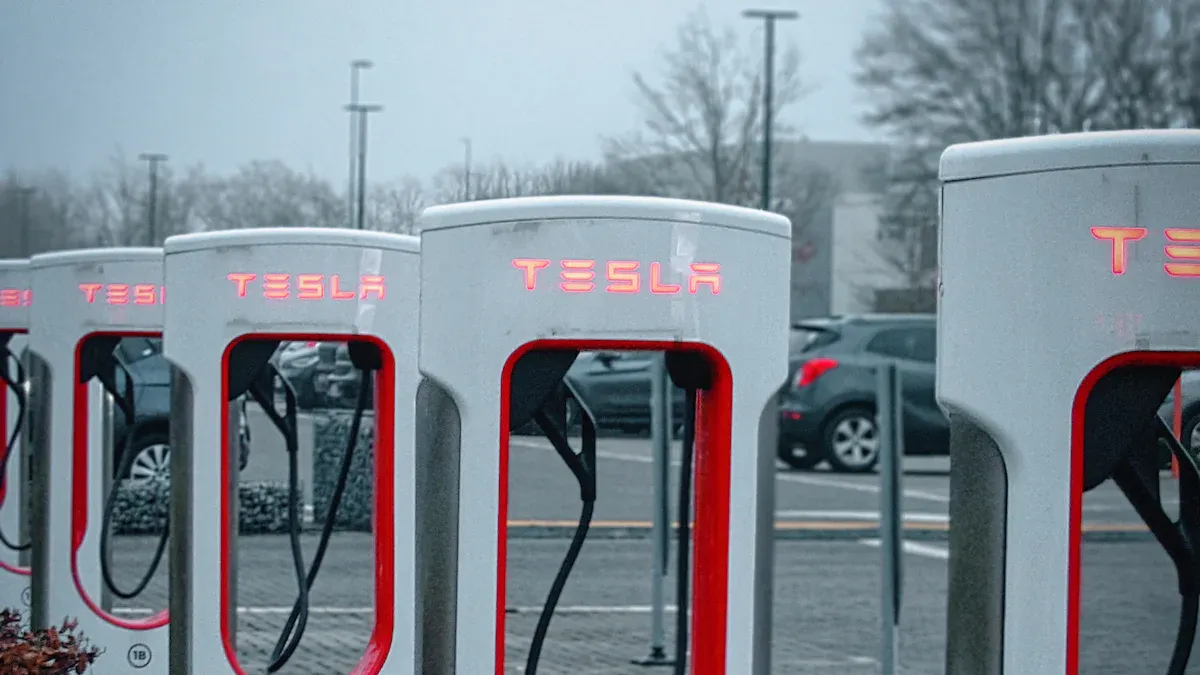
Tesla’s navigation system demonstrates a high degree of integration with its proprietary Supercharger network. This seamless connection provides drivers with convenient and reliable access to fast-charging stations. The system offers a comprehensive decision-making tool by incorporating real-time data on traffic, weather, and elevation into its route calculations. This contrasts with many other GPS systems that often lack such deep integration, compelling drivers to use external resources.
However, the system has a notable limitation. The route planner can sometimes over-rely on specific Supercharger locations. This tendency may lead to deviations from the most direct route as the system prioritizes its preferred stations. While this is less of an issue in regions with a dense charging network, it can be a drawback in areas with fewer options.
ملاحظة السائق In areas with sparse charging infrastructure, drivers may find it beneficial to cross-reference the vehicle’s suggested route with a third-party app like PlugShare. This helps ensure they are taking the most efficient path available.
Integrated Route Planning in Other EVs
Non-Tesla EVs are improving their navigation capabilities, but inconsistencies can still arise. For example, some vehicles demonstrate a disconnect between the manufacturer’s mobile app and the car’s native navigation. An app might correctly plan a route using a preferred charger, but the in-car system often recalculates the trip and favors other options, ignoring the driver’s initial choice.
This lack of reliable integration leads many non-Tesla owners to depend on third-party tools. Applications like مخطط مسارات أفضل (ABRP) often provide more dependable route planning. They are particularly valued for their accuracy in managing battery pre-conditioning and predicting the State of Charge (SoC) upon arrival, which are critical functions for efficient fast charging. As more automakers refine their software, the gap in user experience is expected to narrow.
The On-Site Experience at Electric Car Charging Points
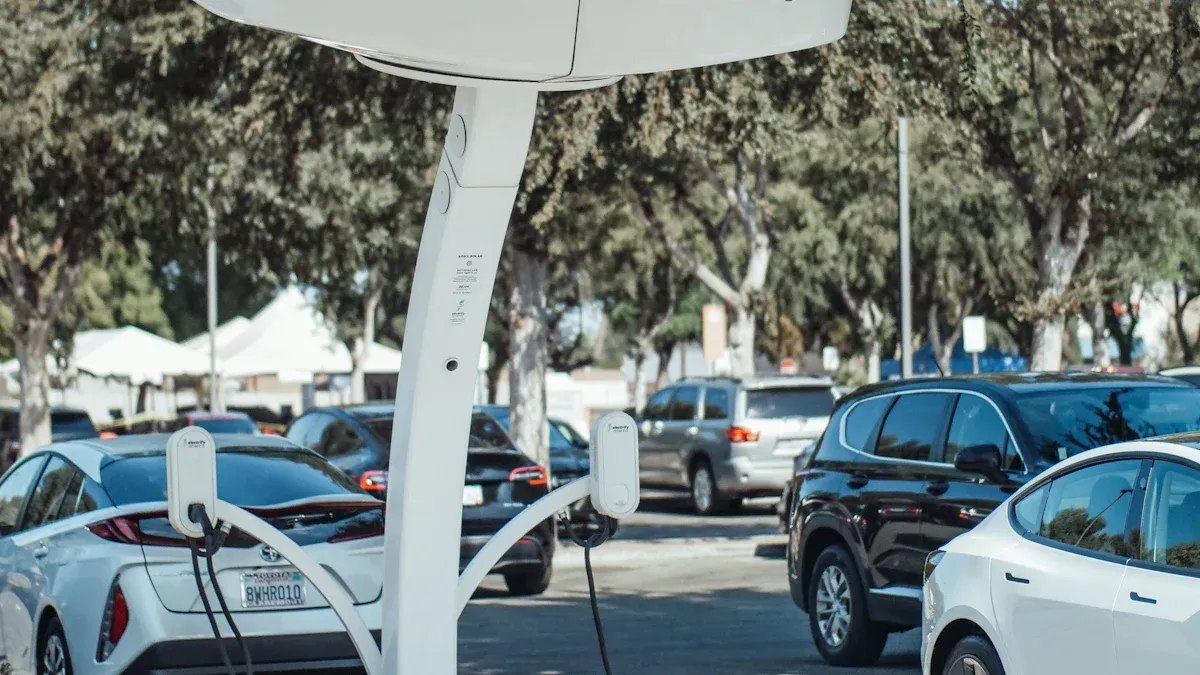
Navigating public electric car charging points is a straightforward process once a driver understands the on-site steps. From parking correctly to monitoring progress, a smooth experience depends on knowing what to expect.
Arriving at the Station
Identifying the Correct Charger
Upon arrival, the first step is to identify the right charger for the vehicle. Most stations have multiple chargers with different power outputs and أنواع الموصلات. Drivers should look for labels on the unit indicating its power in kilowatts (kW) and the connector type (e.g., CCS or CHAdeMO). The charger’s screen will also display its current status, such as “Available,” “In Use,” or “Out of Service.”
Parking and Accessing the Stall
Proper parking ensures the charging cable can reach the vehicle’s port. Accessibility standards guide the design of these stalls to ensure ease of use for all drivers.
- Cables must be long enough to accommodate vehicles with different charge port locations.
- Heavier DC fast charging cables are installed to allow charging for vehicles positioned up to 1.5 meters away.
- Cable management systems help manage slack and weight but must be well-maintained.
- Operable parts, like the screen and card reader, must not require tight grasping or more than 2.2 kg of force to use.
How to Start a Charging Session
The Simple “Plug, Pay, Charge” Process
The fundamental process of how to charge your electric car is simple: plug the connector into the vehicle, authorize payment, and begin charging. However, session failures can occur. Hardware and payment system malfunctions are frequent culprits behind non-operational stations. Technologically advanced providers like TPSON focus on robust hardware to improve reliability and minimize these issues.
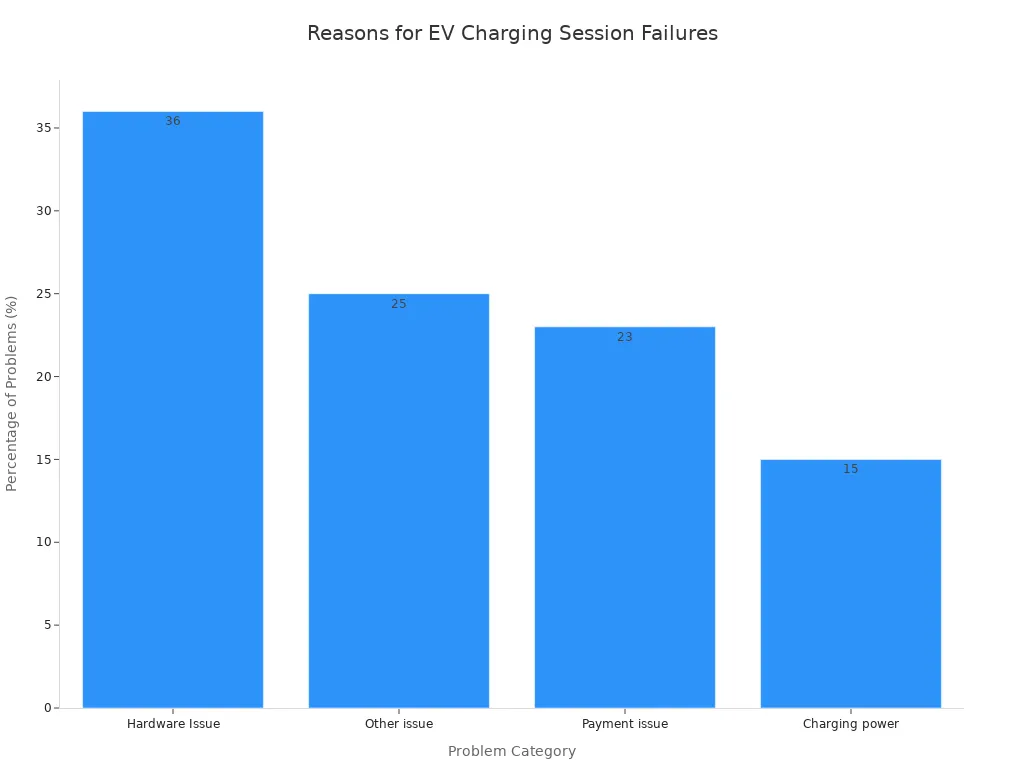
A breakdown of common hardware and payment problems reveals specific pain points for drivers.
| Problem Category | مشكلة محددة | Percentage of Problems |
|---|---|---|
| الأجهزة | Screen broken or unresponsive | 76% |
| Charging cable or plug broken | 10% | |
| Payment | Able to pay, but encountered a problem | 56% |
| Payment failed, had to go elsewhere | 25% |
Using Tethered vs. Non-Tethered Cables
DC fast chargers almost always use tethered cables, meaning the cable is permanently attached to the charging unit. The driver simply selects the correct connector (if multiple are offered) and plugs it into their car. This is different from some Level 2 AC chargers that may require the driver to use their own cable.
Activating via App vs. Card Reader
Drivers can initiate a session in two primary ways. They can use the network’s mobile app to select the specific charger and start the session from their phone. Alternatively, most modern electric car charging points are equipped with contactless credit/debit card readers for simple tap-to-pay activation.
Monitoring Your Charging Progress
Reading the Charger’s Display Screen
The charger’s display provides essential real-time information. It shows the current charging speed (kW), the total energy delivered (kWh), the duration of the session, and an estimated time until the battery reaches its target (often 80%).
Tracking via Your Vehicle’s Mobile App
Most EV manufacturers offer a mobile app that allows drivers to monitor their charging session remotely. The app displays the current State of Charge (SoC), charging rate, and an estimated completion time.
ملاحظة السائق The “time to full” estimate on chargers and in apps can be inaccurate. Studies show the error for a Tesla Model X can be as high as 60 minutes. This is because commercial chargers often struggle to deliver a consistent current, and the charging profile is difficult to predict as the battery fills. Drivers should treat these estimates as a guide, not a guarantee.
Ending Your Session Correctly
Properly concluding a charging session is just as important as starting one. This final step ensures the station is ready for the next driver and helps avoid unnecessary fees. The process is simple and promotes good etiquette within the EV community.
How to Stop the Flow of Power
A driver has several options to stop the flow of electricity to their vehicle. The most common method is to use the charging station’s touchscreen. A button labeled “Stop” or “End Session” is usually prominent on the display. Tapping this button will safely terminate the power delivery. Alternatively, drivers can use the corresponding network’s mobile app to end the session remotely. Many vehicles also allow the driver to stop charging directly from the car’s infotainment screen or its own mobile app.
In many cases, the session concludes automatically. Drivers often set a target State of Charge (SoC), typically 80%, before the session begins. The charger will automatically stop once the battery reaches this level. At this point, it is crucial for the driver to return to their vehicle promptly. Networks like Electrify America enforce idle fee policies to encourage charger turnover. Their policy applies a $0.40 per minute fee if a vehicle remains connected for more than ten minutes after charging is complete. This fee structure, rolled out to discourage drivers from occupying electric car charging points after their session ends, ensures better availability for everyone.
Unplugging and Stowing the Connector
Once the power flow has stopped, the driver can unplug the connector. The vehicle’s charging port typically locks the connector in place during a session for security. To release it, the driver usually just needs to unlock the car with their key fob. This action sends a signal to disengage the lock, allowing the connector to be removed.
After unplugging, the final and most critical step is to return the cable and connector to the station’s holster. This simple action has several benefits:
- It protects the connector from weather damage.
- It prevents the heavy cable from becoming a tripping hazard.
- It keeps the connector off the ground where it could be run over.
Charging Etiquette 101: Always re-holster the charging connector. Leaving a cable on the ground can damage expensive equipment and make the station unusable for the next person. Proper care of public electric car charging points benefits the entire EV community.
Planning and Paying for Your Charge
Effective planning is the key to a seamless public charging experience. Drivers who understand how to map journeys, navigate payment options, and interpret costs can travel long distances with confidence. This knowledge transforms potential challenges into simple, predictable steps.
Mapping a Long-Distance Journey
Using Apps to Plan Stops
Modern route planners are essential for mitigating “range anxiety,” the fear of running out of power. Research shows this is a significant concern for drivers. Advanced apps use AI to predict charger availability and optimize routes by considering road topography and traffic. They provide access to a vast charging infrastructure database, giving drivers confidence for any trip.
The 20-80% State of Charge Strategy
For optimal efficiency and battery health, drivers should adopt the 20-80% charging strategy. This approach leverages the physics of lithium-ion batteries for faster and healthier charging cycles.
- Keeping the battery between 20% and 80% is gentler on the cells, promoting long-term longevity.
- Charging from 80% to 100% can take nearly as long as charging from 20% to 80% because the charging speed slows dramatically to protect the battery.
- Maintaining a buffer above 20% provides a reserve for unexpected detours.
- A charge level below 80% allows the vehicle to capture energy from regenerative braking.
Choosing Stations with Amenities and Backups
A good route plan includes more than just charger locations. Drivers should choose stations with useful amenities like restrooms and food options, which are common at locations offering charging at motorway services. It is also wise to identify backup stations nearby in case the primary choice is occupied or out of service.
Navigating Payment Methods
Payment for public EV charging has become increasingly flexible. Drivers can choose from several methods, each with distinct advantages.
| طريقة الدفع | الإيجابيات | السلبيات |
|---|---|---|
| Contactless Card | Simple tap-to-pay; works across networks; no account needed. | Can be more expensive per session; no access to rewards. |
| Network App | Access to rewards and session history; can start/stop remotely. | Requires account setup and a smartphone with a data connection. |
| بطاقة RFID | Quick tap-to-start activation; not reliant on a phone. | Usually tied to a single network; can be lost or misplaced. |
The Rise of Contactless Credit/Debit Card Payments
The most straightforward payment method is a contactless credit or debit card. Most new chargers support this feature, allowing drivers to simply tap their card to start and end a session without needing a specific app or account.
Paying Through the Network’s App
Using a network’s dedicated app offers a more integrated experience. Drivers can locate stations, monitor charging progress, and handle payments from their phone. Aggregator apps even allow access to multiple networks through a single interface.
Understanding RFID Cards and Subscriptions
Some networks still offer RFID cards, which link directly to a driver’s account for quick activation. These are often tied to subscription plans that provide lower charging rates for a monthly fee.
Breaking Down the Costs of Public EV Charging
The cost of public EV charging varies by location, network, and time. Understanding the pricing structure helps drivers manage their expenses.
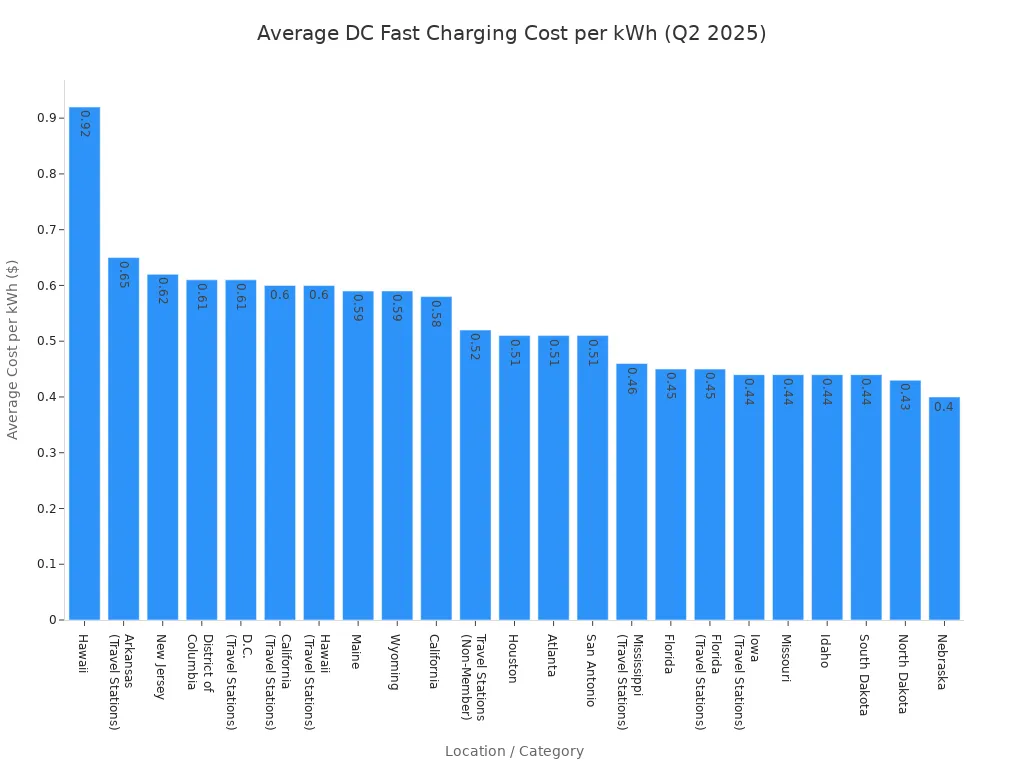
Pricing per Kilowatt-Hour (kWh)
إن most common pricing model is per kilowatt-hour (kWh), which is the amount of energy delivered to the electric vehicle. Rates can fluctuate significantly based on regional electricity costs.
Understanding Session and Idle Fees
In addition to per-kWh rates, some networks charge other fees. These can include a flat connection fee to start a session or per-minute fees. Drivers must also be aware of idle fees, which are charged if a vehicle remains plugged in after its charging session is complete. Some retailers, however, may offer free charging to attract customers.
Subscription Plans vs. Pay-As-You-Go Rates
For frequent users, a subscription plan can offer significant savings. These plans typically involve a monthly fee in exchange for a 15-30% discount on per-kWh rates compared to pay-as-you-go pricing. A subscription becomes cost-effective for an electric vehicle owner who relies on public charging more than two or three times per month.
Efficiently charging an electric vehicle on the road is straightforward. Drivers can ensure a smooth journey by prioritizing high-power (50kW+) fast charge points and using app filters to find available stations. The expansion of rapid charging is notable; in 2024, Europe’s ultra-fast charger count grew by 50%. This rapid growth ensures more reliable fast charge points are available, supported by technologically advanced electric vehicle chargers from providers like TPSON. With these strategies, long-distance travel in an electric vehicle is not just possible, but simple and convenient.
الأسئلة الشائعة
ما الفرق الرئيسي بين الشحن بالتيار المتردد والشحن بالتيار المستمر؟
AC charging converts electricity inside the vehicle, making it slower. DC charging converts power at the station and delivers it directly to the battery. This process allows for much faster charging speeds, ideal for long journeys.
Why does fast charging slow down near 80%?
A vehicle’s battery management system reduces charging speed to protect the battery cells from heat and stress. This safety measure preserves the battery’s long-term health and performance. It is a normal and expected function of DC fast charging.
Can any electric vehicle use any fast charger?
No. A driver must match their vehicle’s connector type (e.g., CCS or CHAdeMO) to the charger. Most modern EVs use the CCS standard. Using app filters to search by connector type prevents arrival at an incompatible station.
How do I find reliable fast chargers?
Drivers use dedicated apps to locate stations and check real-time availability. Technologically advanced providers like TPSON supply robust hardware, improving the reliability of public networks and ensuring drivers find operational fast charge points for a smooth journey.
Is frequent fast charging bad for my EV’s battery?
Occasional fast charging is safe and designed for road trips. However, relying on it daily can accelerate battery degradation compared to slower AC charging. A balanced charging routine is optimal for preserving battery longevity.
Quick Tip: 💡 Think of kilowatts (kW) as the speed of the fuel pump and kilowatt-hours (kWh) as the size of the fuel tank. A higher kW rating means a faster charge.