Installing an EV charger outdoors can be just as safe and reliable as an indoor setup—if you plan for water, dust, temperature swings, UV exposure, and physical abuse (wind-driven rain, snow/ice, lawn equipment, and daily cable wear). The goal of weatherproofing isn’t only to “keep water out,” but to ensure the entire charging system (EVSE + wiring + junctions + mounting + cable handling) remains compliant, stable, and easy to use for years.
This guide focuses on best practices for outdoor home and light-commercial installations globally. It references EVSE enclosure ratings and real-world product examples (e.g., NEMA 3R/NEMA 4/NEMA Type 4), and also explains when an outdoor site should choose AC Level 2 versus DC fast charging options.
- Start with the right outdoor rating (NEMA/IP)
- Site selection: rain lines, sun, and physical protection
- Outdoor wiring: conduit, penetrations, and water management
- Plug-in vs hardwired outdoors (and why it matters)
- Cable management: the most overlooked outdoor failure point
- Cold/heat best practices and derating expectations
- Maintenance checklist and periodic inspections
- Outdoor home charging: AC vs DC (when DC is justified)
1) Start with the right outdoor rating (NEMA/IP)
“Outdoor rated” is not one universal spec—manufacturers may use NEMA ratings (common in North America) or IP ratings (common globally). Car and Driver notes that each charging unit they tested had an outdoor-grade rating according to NEMA or IP standards, and that outdoor mounting is generally feasible when the entire installation is properly rated.
| Rating example | What it implies (practical takeaway) | Seen in sources |
|---|---|---|
| NEMA 3R | Outdoor-capable, but not necessarily watertight; some moisture ingress is possible under certain conditions | Car and Driver lists ChargePoint Home Flex and Tesla Universal Wall Connector as NEMA 3R |
| NEMA 4 / Type 4 | Higher water/dust protection than 3R; better for exposed mounting | Car and Driver lists Emporia units as NEMA 4; Smart Charge America describes Emporia enclosures as Type 4 |
| IP ratings (e.g., IP65/67) | Two digits reflect solid and water protection; higher second digit means stronger water resistance | Car and Driver discusses IP66/IP67 context and provides examples like IP65 for Lectron control unit |
Outdoor rating must apply to the EVSE AND the electrical feed. Car and Driver emphasizes that for outdoor mounting, the feed line and (for plug-in installs) the outlet enclosure must also be outdoor-rated—not just the charger itself.
2) Site selection: rain lines, sun, and physical protection
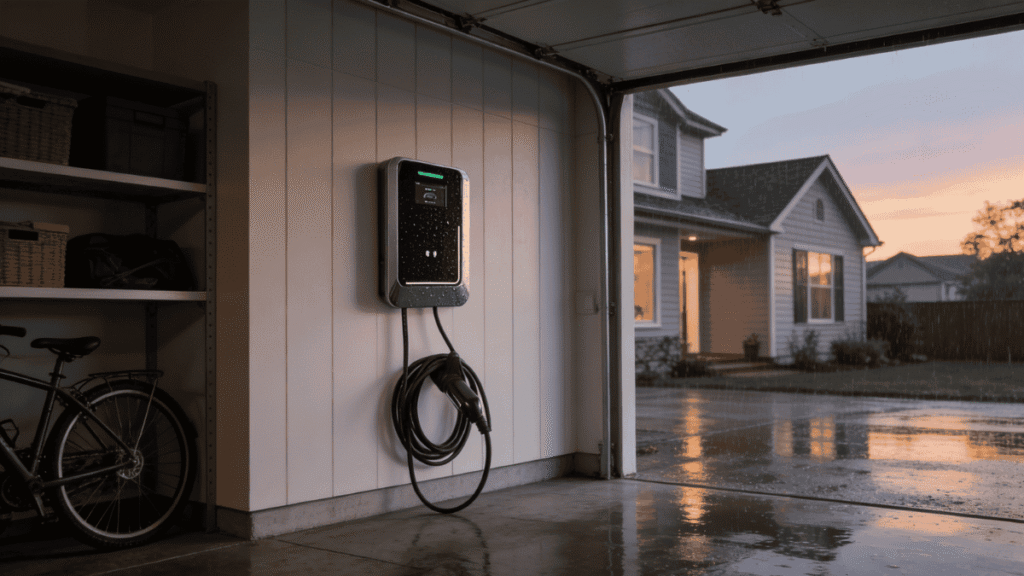
A weatherproof EVSE can still fail early if it is mounted where water can sit, drip constantly, or freeze/thaw around fittings. Think like water: it follows gravity, capillary paths, and cable jackets.
Outdoor placement best practices
- Avoid “drip lines”: don’t mount directly under roof edges/gutters where concentrated runoff hits the enclosure or connector holster.
- Sun/UV management: if possible, mount on a shaded wall or add a small canopy rated for outdoor electrical use.
- Impact and clearance: keep the unit out of door-swing paths, snowplow/shovel zones, and where it can be hit by vehicles.
- Height and splash: mount high enough to avoid puddle splash and snow accumulation around the plug/connector dock.
If you operate public-facing sites (travel stops, retail), the “experience layer” matters too: Love’s highlights amenities, clean facilities, 24/7 staffing, and tech-friendly environments around EV charging—outdoor placement should support safe pedestrian flow and minimize tripping hazards from cables.
3) Outdoor wiring: conduit, penetrations, and water management
Outdoor reliability is often determined by how the electrician handles penetrations, bends, junction points, and the inevitable moisture in conduit. Even “sealed” systems can accumulate condensation.
Key concepts to require in the scope of work
- Proper outdoor-rated conduit and fittings for the full path (panel to EVSE).
- Sealed wall penetrations with appropriate bushings/grommets and exterior-grade sealant where code allows.
- Drip loops on any cable runs that could carry water toward the enclosure (so water drops off before entering).
- Drain/weep strategy where permitted—conduit can trap water; installers may need code-compliant methods to manage it.
- Corrosion awareness in coastal or de-icing salt environments (hardware choice and isolation matter).
4) Plug-in vs hardwired outdoors (and why it matters)
Plug-in (receptacle) outdoors
Plug-in can be convenient, but outdoors it increases the number of weather-exposed interfaces (receptacle, plug blades, box gasket, in-use cover). Car and Driver points out that if you’re using a plug-type unit outside, the outlet enclosure must also be outdoor-rated.
Hardwired outdoors
Hardwired installations eliminate one exposed plug connection and can enable higher output on some models. Emporia’s documentation explains that a plug model is easy to install and portable but can limit charge rate (e.g., 40A), while hardwire can charge at up to 48A.
GFCI and nuisance-tripping considerations
Emporia notes that EV chargers include built-in GFCI protection, and that combining it with a GFCI-protected circuit (often required for certain outlets) can lead to nuisance tripping. For outdoor installations where GFCI requirements apply, confirm the protection approach early with a licensed electrician.
5) Cable management: the most overlooked outdoor failure point
Outdoor cables are exposed to UV, abrasion, twisting, and being run over. Also, the connector end is handled daily—often with wet hands in bad weather. Good cable management is both a safety measure (trip prevention) and an equipment longevity measure.
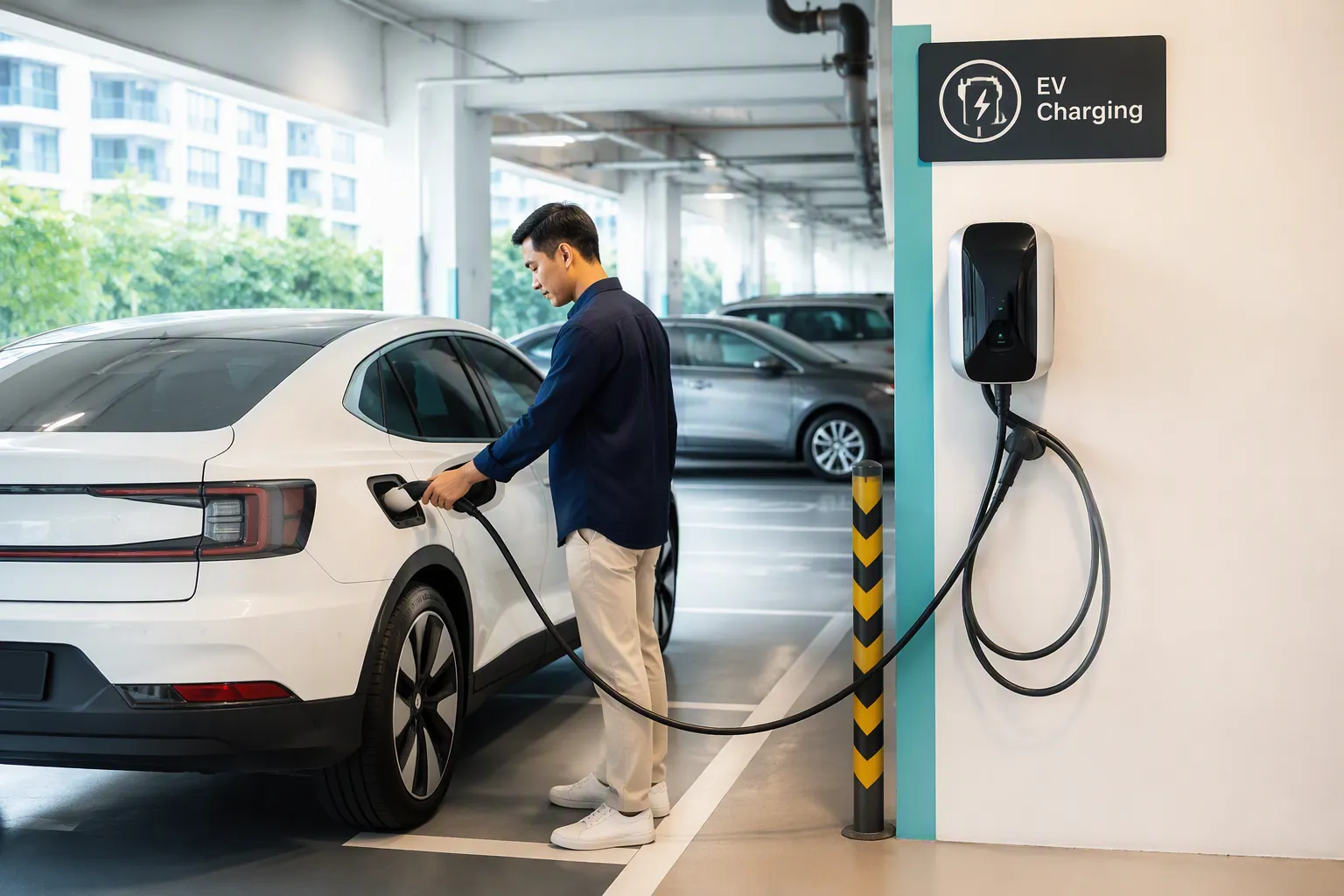
- Use the EVSE’s integrated holster or mount a dedicated handle holder at a natural height.
- Keep the connector off the ground to prevent water ingress and grit abrasion.
- Avoid tight wrap radii that stress the conductors in cold weather (stiff cable jackets).
- Route so the cable doesn’t cross walkways or get pinched by garage doors or gates.
Product listings on Smart Charge America frequently call out cable length and management as key usability elements (e.g., Emporia’s 25-foot cable with integrated management; ChargePoint Home Flex 23-foot cable). Treat these as installation design parameters, not mere accessories.
6) Cold/heat best practices and derating expectations
Outdoor charging systems must survive extremes. Smart Charge America lists operating temperature ranges on certain units (e.g., Emporia -22°F to 122°F / -30°C to 50°C; Ford Pro AC station down to -40°F). The practical planning point: some EVSEs may reduce output or stop charging in extreme heat (to protect components), and cable handling becomes harder in deep cold.
Best practices by climate
- Cold/snow: mount above expected snow line; prevent connector holster from becoming an “ice shelf.”
- Hot/sun: reduce direct solar load with shade when possible; ensure airflow clearances around the enclosure.
- Humid/coastal: prioritize higher sealing ratings and corrosion-resistant mounting hardware.
7) Maintenance checklist and periodic inspections
Outdoor installs should be treated like other exterior electrical equipment: a quick quarterly check can prevent most issues from becoming failures.
| Inspection item | What to look for | Action |
|---|---|---|
| Enclosure and gasket lines | Cracks, warped covers, missing screws | Stop use and service if water intrusion is suspected |
| Cable jacket | Cuts, flattening, abrasion points | Replace cable/EVSE if conductor exposure risk exists |
| Connector/handle and holster | Debris, corrosion, looseness | Clean/dry; ensure connector stores off-ground |
| Mounting fasteners | Rust, wobble, wall damage | Re-torque/replace hardware; address substrate issues |
8) Outdoor home charging: AC vs DC (when DC is justified)
Outdoors does not automatically mean “fast DC.” For most homes, AC Level 2 remains the practical standard for overnight charging, while DC fast charging is typically deployed for public or operational use-cases. Love’s describes adding more DC fast chargers (Level 3) to complement its existing AC charging (Level 2) network—reflecting how DC is used to reduce dwell time on the road.
TPSON’s EV charger lineup positions EV Chargers as a full solution set including AC EV Chargers and compact DC fast chargers for commercial and emergency applications.
When DC can make sense outdoors
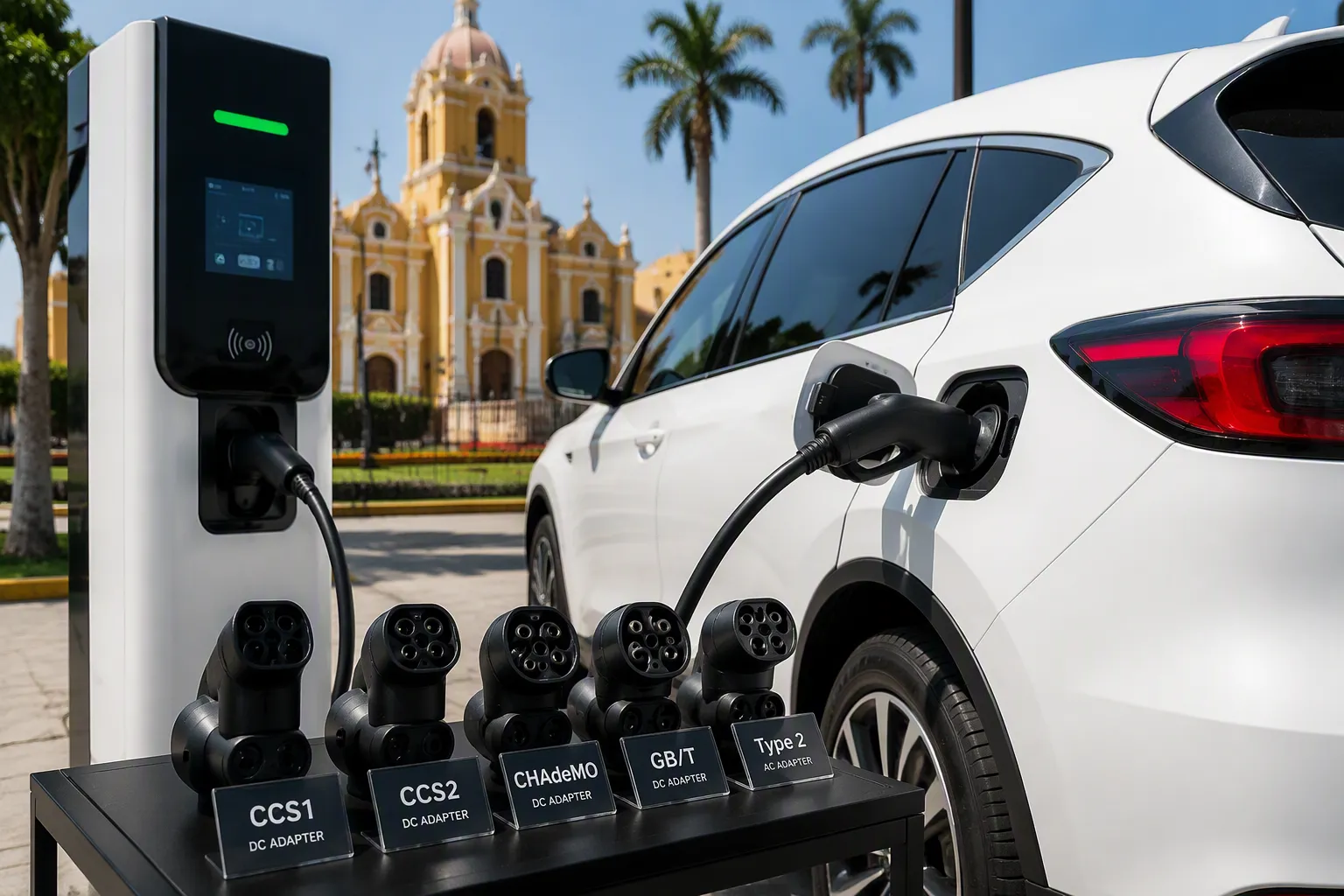
If the real need is mobility or rapid turnaround (e.g., fleet yard, roadside assistance, events), a portable DC solution may be appropriate. TPSON’s TP?DC Compact Series specifies 20kW/30kW/40kW rated power, wheel mobility, Ethernet with optional 4G, a 7-inch touchscreen, and operating environment of -20°C to +50°C, humidity 5%–95% non-condensing, altitude <2000m. It supports multiple interfaces including CCS2, CCS1, CHAdeMO, and GB/T. See details under DC EV Chargers.
The “best” outdoor EV charger setup is the one where the EVSE rating matches exposure, the wiring system is outdoor-rated end-to-end, and cable handling is easy. Start with placement and weatherproofing design—then choose features like apps, load management, and access control based on your site’s needs.
- Car and Driver: outdoor rating discussion and examples (NEMA/IP) — https://www.caranddriver.com/shopping-advice/a39917614/best-home-ev-chargers-tested/
- Emporia Classic: plug vs hardwire and GFCI nuisance tripping — https://shop.emporiaenergy.com/products/emporia-ev-charger
- Smart Charge America listings: enclosure ratings, temperature ranges, cable lengths — https://smartchargeamerica.com/electric-car-chargers/
- Love’s EV Charging: Level 2 + Level 3 network context — https://www.loves.com/ev-charging
- TPSON EV Chargers / AC EV Chargers / Portable DC EV Charger — https://tpsonpower.com/ev-chargers/ | https://tpsonpower.com/ac-ev-chargers/ | https://tpsonpower.com/portable-dc-ev-charger/
- TPSON manufacturer background — https://tpsonpower.com/about/
Disclaimer: Electrical work should be performed and inspected according to local code by a qualified electrician.