How long does it take to charge an electric car? The answer can range from just 20 minutes to over 8 hours. With the global electric vehicle market share in new car sales exceeding 20% in 2024, understanding this is essential for every EV driver. The exact time to charge an electric car at a public charging station depends on three key variables: the charger’s power output (kW), the car’s battery size (kWh), and the vehicle’s maximum charging rate.
A DC fast charger can provide a substantial boost in 20-60 minutes, while a standard Level 2 EV Charger typically requires several hours for a full charge. Technologically advanced EV charger manufacturers like TPSON provide a variety of EV charging solutions to meet different needs. Their offerings range from powerful station units to convenient portable EV chargers, each influencing the final charging speed.
How Long Does It Take to Charge an Electric Car by Charger Type?
The type of public charging station an EV driver uses is the single biggest factor influencing charging speed. Public chargers are broadly categorized into two main types: Level 3 DC Fast Chargers and Level 2 AC Public Chargers. Each serves a distinct purpose and offers vastly different charging times.
Level 3: DC Fast Chargers (Rapid & Ultra-Rapid)
DC (Direct Current) fast chargers provide the quickest way to charge an electric car. They bypass the vehicle’s onboard AC-to-DC converter and deliver high-power DC electricity directly to the battery. This process significantly reduces the time needed for a substantial charge.
Time to Charge (80%): 20-60 Minutes
These powerful units can typically charge an EV battery from 20% to 80% in under an hour. The final 20% of the battery takes much longer to fill for battery health reasons, so most drivers unplug after reaching 80%.
Power Output: 50kW to 350kW
DC chargers are classified by their power output.
- Rapid Chargers: These offer power from 50kW.
- Ultra-Rapid Chargers: These deliver 100kW, 150kW, or even up to 350kW.
Networks are continuously expanding their high-power capabilities. Leading providers offer some of the most powerful chargers available.
| Network | Maximum Power |
|---|---|
| IONITY | 350kW |
| Gridserve Electric Highway | 350kW |
Best For: Highway travel and quick top-ups
The incredible speed of DC fast chargers makes them ideal for long-distance journeys. Drivers can add hundreds of miles of range during a short break. This answers the question of how fast do electric cars charge on the motorway. However, this convenience comes at a premium.
Cost Consideration: The speed of rapid chargers corresponds with a higher price.
- DC Fast Chargers: Prices often range from £0.45 to £0.85 per kWh.
- Level 2 Public Chargers: Costs are lower, typically between £0.30 and £0.40 per kWh.
Level 2: AC Public Chargers
Level 2 chargers are the most common type of public charging point. They supply AC (Alternating Current) power, which the electric vehicle’s onboard charger then converts to DC to fill the battery. This conversion process limits the charging speed compared to DC chargers.
Time to Charge (Full): 3-8 Hours
A Level 2 charger is not designed for a quick top-up. Instead, it is meant to fully charge an electric car over several hours. The exact empty to full charging time depends heavily on the car’s battery size and the charger’s specific output. A 7kW charger, for example, adds about 25-30 miles of range per hour.
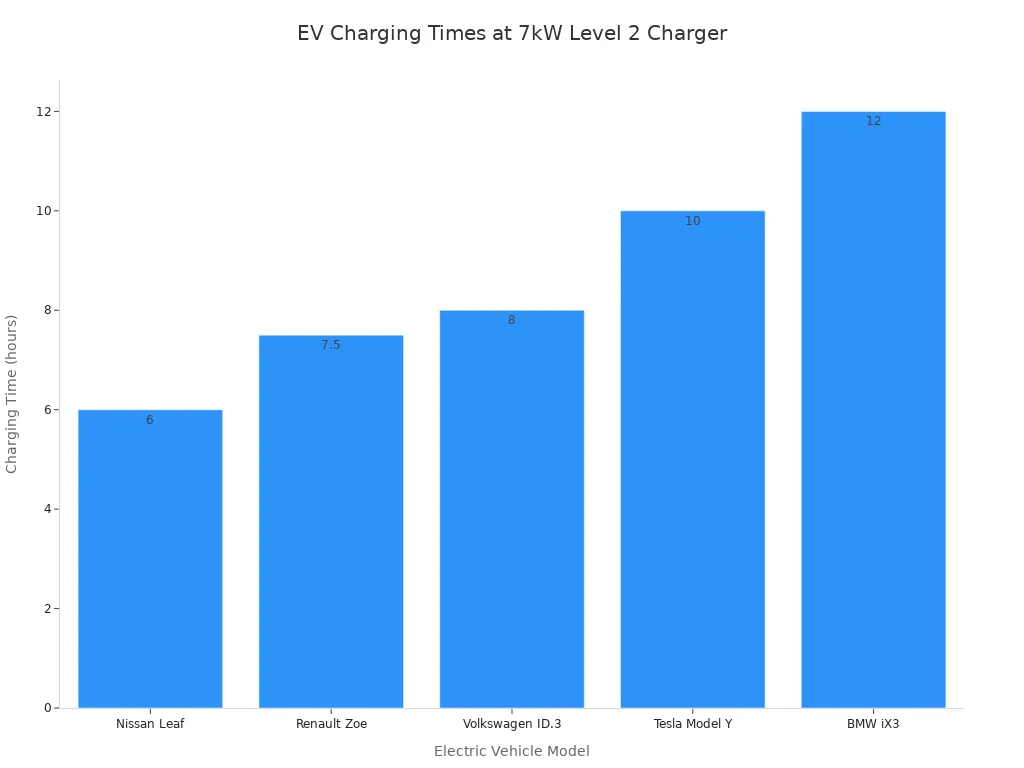
The chart above illustrates how long does it take to charge different models. Here are a few more specific examples for a standard 7kW charging point:
| Electric Car Model | Battery Size (approx.) | 0-100% Charging Time |
|---|---|---|
| Nissan Leaf | 40 kWh | ~6 hours |
| Tesla Model 3 | 57.5 kWh | ~8 hours |
Power Output: 7kW to 22kW
Most Level 2 public chargers offer either 7kW or 22kW of power. While a 22kW charger can significantly reduce charging time, the car must have an onboard charger capable of accepting that speed. Many EVs are limited to 7kW or 11kW AC charging. Technologically advanced providers like TPSON offer a variety of EV charging solutions to suit these different power needs.
Best For: Destination charging (workplaces, malls, hotels)
These chargers are perfect for “destination charging,” where the car can be left for an extended period. Drivers will commonly find them installed at:
- Workplaces
- Shopping centres and retail car parks
- Hotels and restaurants
- Public car parks
This allows a driver to charge an electric car while they work, shop, or stay overnight, returning to a full battery.
The 4 Key Factors That Determine Your Public Charging Times
While charger type provides a general estimate, the actual time it takes to charge an electric car depends on a dynamic interplay of factors. Understanding these four key variables helps drivers predict and optimize their public charging times.
Factor 1: Your Car’s Battery Size (kWh)
How Capacity Affects Charging Duration
The size of an electric vehicle’s battery, measured in kilowatt-hours (kWh), is the most straightforward factor influencing charging duration. A larger battery holds more energy and therefore takes more time to fill. This is directly comparable to filling a larger fuel tank in a conventional car. An EV with a 100kWh battery will take roughly twice as long to charge as one with a 50kWh battery at the same charging station.
Example: Small vs. Large Battery Charging Times
The market offers a wide range of battery capacities. Compact city cars often have smaller batteries for efficiency, while larger SUVs designed for long-range travel feature much bigger packs. This difference significantly impacts how long does it take to charge.
| Electric Car Model | Battery Capacity (approx.) |
|---|---|
| Hyundai Kona Electric | 64kWh |
| Skoda Enyaq iV | 82kWh |
| Ford Mustang Mach-E | 99kWh |
| Tesla Model X | 100kWh |
Factor 2: Your Car’s Maximum Charging Rate (kW)
Why Your Car Can Limit Charging Speed
Not all EVs can accept power at the same rate. Every electric car has a maximum charging rate, measured in kilowatts (kW), which acts as a speed limit. A powerful 350kW charger cannot force a car to charge faster than its own system allows. For example, the Kia EV6 can accept up to 350kW, while a Porsche Taycan has a maximum rate of 268kW. This internal limit is a crucial factor.
The “Handshake” Between the Car and Charger
When an EV is plugged in, its Battery Management System (BMS) communicates with the charger. This “handshake” determines the safe and optimal charging speed. The car’s Vehicle Control Unit (VCU) monitors battery temperature and voltage, adjusting the power flow to protect the battery’s health and longevity. This intelligent management ensures the system never exceeds its safety limits.
Factor 3: The Charger’s Power Output (kW)
How Charger Speed Dictates the Session
The charger’s power output is the other half of the speed equation. Public DC fast chargers on major routes typically offer power from 50kW to 350kW. A higher kilowatt rating means the charger can deliver energy faster, reducing the overall time needed to charge an electric car. A session at a 150kW ultra-rapid charger will be significantly shorter than one at a 50kW rapid charger.
Matching the Charger to Your Car’s Capability
The final charging speed is always determined by the lower of the two values: the car’s maximum rate or the charger’s maximum output.
Important Tip: If you charge an electric car with a 50kW maximum rate at a 350kW station, the car will only draw 50kW. The vehicle is in control. You will not damage the car, but you may pay a premium for speed you cannot use.
Factor 4: Your Battery’s State of Charge (SoC)
A battery’s current charge level, or State of Charge (SoC), significantly impacts public charging times. A nearly empty battery accepts power much faster than one that is almost full. This behavior is illustrated by a “charging curve,” a graph showing how charging power changes as the battery fills. Understanding this curve is key to optimizing any charging session.
The 20-80% Fast Charging Window
Most electric vehicles experience their fastest charging speeds when the battery is between 20% and 80% full. This range is often called the “fast charging window.” During this phase, the battery can accept high power levels with maximum efficiency.
A typical charging session follows a predictable pattern:
- Peak Power (Below 60%): The EV accepts its maximum possible power at the beginning of the session when the SoC is low.
- Gradual Tapering (60-80%): The charging power begins to decrease steadily as the battery fills.
- Significant Slowdown (Above 80%): The power delivered drops sharply once the battery reaches the 80% mark.
Pro Tip: The time it takes to charge from 80% to 100% can be similar to the time it takes to charge from 20% to 80%. For drivers on a long journey, it is often more efficient to unplug at 80% and continue to the next station.
Why Charging Slows Dramatically After 80%
The slowdown after 80% is not a fault of the charger but a deliberate safety feature of the vehicle’s Battery Management System (BMS). As a battery approaches full capacity, its internal resistance increases. Pushing high power into a battery with high resistance generates significant heat, which can damage the cells and reduce the battery’s long-term health.
To prevent this, the BMS intervenes. It actively reduces the charging rate to manage temperature and protect the battery. This intelligent tapering of power is a crucial balance between achieving fast charging speeds and ensuring the battery’s operational life. Every EV must manage this trade-off. Technologically advanced EV charging solution providers like TPSON engineer their products to work seamlessly with these vehicle systems, ensuring a safe and effective charge every time. This protective measure is why the final 20% of a charge takes a disproportionately long amount of time.
Practical Scenarios: How Much Range Can You Add in 30 Minutes?
Understanding charging speeds in theory is helpful. Applying that knowledge to real-world scenarios provides a practical perspective. The amount of range an electric vehicle driver can add in a 30-minute stop depends entirely on the type of charger they use. This fixed amount of time yields vastly different outcomes across the public charging network.
At a 150kW+ Ultra-Rapid Charger
Range Added: Up to 200 miles
Ultra-rapid chargers, with power outputs from 150kW to 350kW, are the fastest way to charge an EV. In just 30 minutes, a compatible car can gain a significant amount of range, often enough for several hours of driving. These chargers are designed for situations where time is critical.
Real-World Speed: Under ideal conditions, these powerful chargers can deliver hundreds of miles of range in 15 to 30 minutes. A 30-minute session can achieve the following:
- Add approximately 100 miles of range in just 10-15 minutes.
- Charge a 60kWh battery from 10% to 80% in 20-30 minutes.
Ideal for Long-Distance Journeys
The incredible speed of ultra-rapid chargers makes them essential for long-distance travel. Drivers can stop at a motorway service station, plug in, and add substantial range during a short coffee or lunch break. This efficiency minimizes downtime and makes cross-country trips in an electric vehicle seamless and convenient.
At a 50kW Rapid Charger
Range Added: Up to 90 miles
The 50kW rapid chargers represent a common and reliable option on the public network. While not as fast as ultra-rapid units, they provide a meaningful charge in a short period. A 30-minute session at a 50kW charger can typically add up to 90 miles of range, depending on the vehicle’s efficiency. For example, a Nissan Leaf 40kWh model can add approximately 50 miles of range in 30 minutes.
Common for Quick Stops and Errands
These chargers are perfectly suited for top-ups while running errands. A driver can plug in at a supermarket or retail park and return to a car with significantly more range. It is important to note that some vehicles have a maximum charging speed of 50kW.
| Vehicle | Rapid Charge (50kW) |
|---|---|
| Mini Electric | 25 mins (50kW max) |
The BMW i3 120Ah is another model that accepts a maximum charging speed of 50kW. Using a more powerful charger with these cars will not reduce the charging time.
At a 22kW AC Fast Charger
Range Added: Up to 45 miles
A 22kW AC charger offers a slower but still very useful charging speed. In 30 minutes, a driver can expect to add around 30-45 miles of range. This assumes the car has an onboard charger capable of accepting 22kW AC power. Many cars are limited to 11kW or 7.4kW, which would reduce the range added in the same period. Technologically advanced EV charging solution providers like TPSON offer products that work seamlessly with these varied vehicle systems.
Useful for Extended Stays at a Destination
This type of charger is not designed for a quick “splash and dash.” Instead, it excels at destination charging. It is ideal for locations where a driver will be parked for an hour or more, such as:
- Shopping centers
- Cinemas
- Restaurants
- Gyms
Plugging into a 22kW charger during these activities allows the driver to return to a vehicle with a healthy amount of added range, making it a practical and convenient option for daily use.
How to Calculate How Long It Takes to Charge Your Electric Car
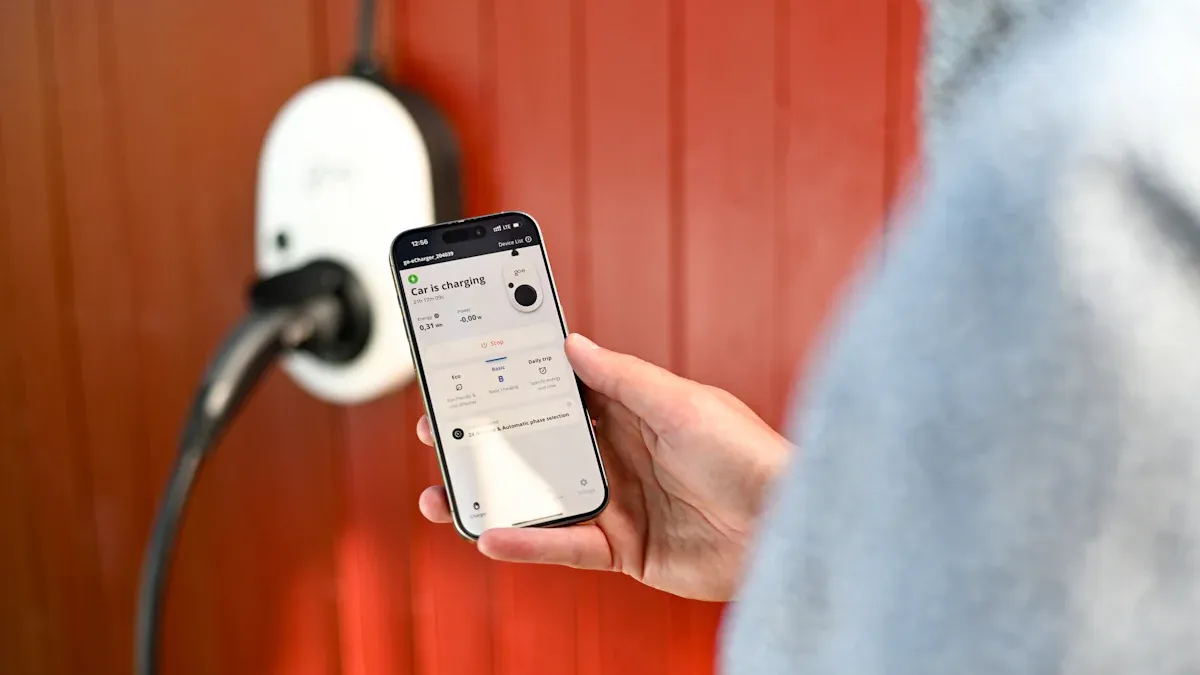
Drivers can estimate their public charging sessions with a simple calculation. While several factors influence the exact duration, a basic formula provides a solid starting point. Understanding how to calculate charging times helps drivers plan their stops more effectively. This knowledge answers the common question: how long does it take to charge an electric car?
The Basic Formula for Estimating Charging Time
At its core, the calculation for charging time is straightforward. It involves dividing the amount of energy needed by the speed at which it is delivered.
Battery Size (kWh) ÷ Charger Power (kW) = Time (Hours)
This formula gives a theoretical estimate for how long it takes to charge. For example, a 70kWh battery charging on a 7kW charger would theoretically take 10 hours to charge from empty to full.
Battery Capacity to Add (kWh) / Charger Power (kW) = Charging Time (Hours)
Factoring in Charging Efficiency
The basic formula assumes 100% efficiency, which is not achievable in the real world. During any session to charge an electric car, some energy is lost as heat. The vehicle’s battery management system also consumes power. This results in an efficiency loss of about 10-15%.
A More Realistic Calculation: To get a better estimate, drivers should account for this inefficiency. A simple way is to increase the estimated time by about 10%.
- Ideal Time: 5 hours
- Realistic Time: 5 hours * 1.10 = 5.5 hours
Real-World Calculation Example
Let’s apply this knowledge to a practical scenario. This example shows how to estimate the time needed to charge an electric car at a common public station.
Calculating Time for a 60kWh Battery on a 50kW Charger
Imagine a driver with an EV that has a 60kWh battery. They arrive at a 50kW DC rapid charger and want to charge from 0% to 100%.
- Ideal Calculation: 60 kWh ÷ 50 kW = 1.2 hours
- Factoring in Efficiency: 1.2 hours * 1.10 = 1.32 hours, or about 1 hour and 20 minutes.
This calculation provides a good baseline for the total session time.
Adjusting for the 20-80% Charging Curve
As discussed, charging speeds slow significantly after the battery reaches 80% capacity. Most drivers using DC fast chargers only charge within this optimal window. Let’s recalculate for a 20-80% charge, which is 60% of the total battery capacity.
- Energy Needed: 60 kWh * 0.60 = 36 kWh
- Estimated Time: 36 kWh ÷ 50 kW = 0.72 hours, or approximately 43 minutes.
This demonstrates why charging to 80% is much more time-efficient. Technologically advanced EV charging solutions from providers like TPSON are engineered to communicate seamlessly with a vehicle’s BMS, optimizing power delivery throughout this curve for a safe and effective session. This real-world adjustment is key to understanding how long does it take to charge.
Other Factors That Influence How Long It Takes to Charge
Beyond the primary factors of battery size and charger power, several environmental and situational variables can significantly alter how long it takes to charge an electric car. A driver’s awareness of temperature, battery readiness, and station configuration can make a noticeable difference in charging session duration.
Ambient Temperature
A battery’s chemical reactions are sensitive to its surrounding temperature. Both extreme cold and heat can negatively impact charging speeds as the vehicle’s Battery Management System (BMS) works to protect the cells.
How Cold Weather Slows Charging Speeds
In cold weather, a battery’s internal resistance increases. This makes it harder for the cells to accept a charge. To prevent damage, the BMS will deliberately limit the charging power until the battery warms up to an optimal temperature. This protective measure can add considerable time to a charging session, especially at the beginning.
Battery Management in Hot Weather
High temperatures also pose a risk to battery health. An EV’s BMS prevents overheating by adjusting the charging rate based on the battery’s internal temperature. In hot climates, it will reduce charging power or even stop the session if temperatures become too extreme. To manage this, vehicles use sophisticated cooling systems.
- Liquid Cooling: The most efficient method, circulating a coolant like glycol around the battery to absorb and transfer heat away.
- Air Cooling: A simpler method that uses fans to blow air across the battery pack.
☀️ Hot Weather Tip: Drivers can help their vehicle by parking in the shade and scheduling charging for cooler parts of the day, like early morning or evening.
Battery Preconditioning
Battery preconditioning is a feature designed to overcome the challenges of ambient temperature by actively managing the battery’s temperature before a charging session begins.
What It Is and Why It Matters
Preconditioning automatically warms or cools the battery to its ideal temperature range while the driver is en route to a charging station. This ensures the battery is ready to accept the maximum possible charging speed upon arrival, minimizing wait times and maximizing efficiency, particularly for DC fast charging.
Activating Preconditioning for Faster Charging
Many modern electric vehicles offer this feature. For instance, the Hyundai KONA Electric and certain Kia models can automatically activate battery preconditioning. This process begins when a driver sets a public charging point as the destination in the vehicle’s navigation system, allowing the car to prepare its battery during the journey.
Shared Power at Charging Stations
Not all charging stations deliver their advertised power to every vehicle at all times. Some are designed to split their total output between multiple cars.
How Some Stations Split Power Between Cars
Certain charging stations, often labeled as ‘dual chargers’, contain hardware that serves two parking stalls but has a single power cabinet. When two vehicles plug in simultaneously, the station divides its maximum power output between them. This means each ev receives a significantly lower charging speed than it would if it were charging alone.
Identifying and Avoiding Power-Sharing Stalls
A driver can identify a power-splitting station by observing a sudden drop in charging speed when another car plugs into the adjacent stall. Some units are explicitly labeled. If possible, it is best to choose a stall that is not paired or wait for one to become free. The impact can be substantial, as shown below.
| Number of Vehicles Connected | Power Output per Vehicle |
|---|---|
| One | 7.4 kW |
| Two | 3.7 kW |
Technologically advanced EV charging solutions from providers like TPSON are engineered to clearly communicate their status, helping drivers make informed decisions.
Essential EV Terminology to Understand Charging Times
Navigating the world of electric vehicles involves learning a new vocabulary. Understanding a few essential terms is crucial for predicting public charging times and making informed decisions at the station. These concepts explain how power is measured and delivered to an EV.
Kilowatt (kW) vs. Kilowatt-hour (kWh)
These two units are the most fundamental measurements in the EV world, but they represent very different things.
kW: The Speed of Energy Flow
A kilowatt (kW) measures power, or the rate at which energy is transferred. It represents the speed of the charger. A higher kW rating means a faster flow of energy.
An easy way to visualize this is to think of a swimming pool. The kilowatt (kW) is like the rate at which water flows from the hose into the pool. A wider hose (higher kW) fills the pool faster.
kWh: The Amount of Energy Stored
A kilowatt-hour (kWh) measures energy capacity. It represents the amount of energy a battery can hold. This is similar to the size of a fuel tank in a conventional car. A larger kWh number means a bigger battery and, typically, a longer driving range. In the swimming pool analogy, the kWh is the total amount of water the pool can hold.
AC vs. DC Charging
The type of electrical current a charger delivers directly impacts its speed and application.
AC (Alternating Current): For Slower, Onboard Charging
AC power is the standard electricity supplied by the grid to homes and businesses. When an EV uses an AC charger, the vehicle’s onboard charger must convert this power to DC to store it in the battery. This conversion process limits the charging speed, making AC charging ideal for longer stays, like overnight at home or during a workday. Technologically advanced electric vehicle charging solution providers like TPSON engineer products that manage this conversion efficiently.
DC (Direct Current): For Rapid, Direct-to-Battery Charging
DC fast chargers perform the AC-to-DC conversion inside the charging station itself. This allows them to bypass the car’s slower onboard charger and deliver high-power DC electricity directly to the battery. This method enables significantly faster charging, making it perfect for quick top-ups during long journeys.
Common Public Charging Connectors
The physical plug that connects the charger to the car is called a connector. Different regions and manufacturers have adopted various standards.
CCS (Combined Charging System): The Standard for Most EVs
CCS is the most widespread standard for DC fast charging across Europe and North America. It combines a standard AC connector with two large DC pins below it, allowing for both AC and DC charging with a single port.
NACS (North American Charging Standard): Used by Tesla
Developed by Tesla, the NACS connector is a compact, single-plug design that handles both AC and DC charging. While historically exclusive to Tesla, many other manufacturers have announced plans to adopt this standard.
CHAdeMO: Used by Nissan and Mitsubishi Models
CHAdeMO was an early standard for DC fast charging, primarily used by some Asian automakers. While still available at many stations, it is becoming less common on new vehicle models.
| Charging Connector | Primary Manufacturers |
|---|---|
| CCS | BMW, Volkswagen Group, Mercedes-Benz, Audi |
| NACS | Tesla, Ford (planned), General Motors (planned) |
| CHAdeMO | Nissan (transitioning), Toyota, Subaru, Mazda |
So, how long does it take to charge an electric car? The answer depends on your needs. A driver can charge an electric car at a public charging station in 20 minutes or over eight hours. The final charging time for any electric vehicle hinges on several key factors.
Key Takeaways:
- The charger’s power and the EV’s capabilities determine how long does it take to charge.
- Rapid chargers are best for road trips, adding significant range in under an hour.
- Level 2 chargers are ideal to fully charge an electric car over several hours at a destination.
- Drivers can minimize wait times by understanding the 80% charging rule and using advanced EV charging solutions from providers like TPSON.
FAQ
Can I use any public charger for my EV?
A driver must use a charger with a compatible connector for their vehicle. Most modern EVs use the CCS standard. Some models use CHAdeMO or NACS. Drivers should check their car’s specifications and the charger’s labeling before plugging in.
Is it bad to always fast charge my EV?
Relying exclusively on DC fast charging can degrade battery health over time due to increased heat. Most manufacturers recommend a mix of slower AC charging and occasional DC fast charging. This practice helps preserve the battery’s long-term capacity and lifespan.
Why did my car charge slower than advertised?
Several factors can reduce charging speed. A cold battery, a hot day, or a station sharing power between two cars will slow the session. The car also intentionally slows charging after reaching 80% battery to protect the cells.
Can I leave my car plugged in after it’s fully charged?
Drivers should move their vehicle once it finishes charging. Many charging networks impose idle fees for cars that remain plugged in after their session ends. This policy ensures the charger becomes available for the next EV owner.
How can I find public charging stations?
EV drivers can use dedicated mobile apps like PlugShare or Zap-Map. A vehicle’s built-in navigation system often shows nearby chargers. Technologically advanced electric vehicle charging solution providers like TPSON design products that integrate seamlessly with these network platforms.
What is the difference between a 50kW and a 150kW charger?
The kilowatt (kW) number indicates charging speed. A 150kW charger can deliver energy three times faster than a 50kW charger. A higher kW rating results in a significantly shorter charging time, assuming the vehicle can accept that speed.