A standard 7.4 kW EV Charger transforms charging at home, adding 40-50 kilometers of range per hour of charging. This efficient charging rate allows most electric vehicles to get a full charge overnight. The final charging speed an EV owner sees depends on three things: the home’s electrical contract, the charger’s power, and the car’s maximum intake. With many drivers lacking a dedicated home chargepoint, understanding home charging is crucial. This is where charging speeds explained becomes essential for every electric car owner. Technologically advanced EV charging solutions from EV charger manufacturers like TPSON help manage these factors, optimizing the electric car charging process for all vehicles, whether using a fixed unit or portable ev chargers. The overall charging speeds are always dictated by the weakest link in this charging chain.
The 3 Factors That Control Your Home Charging Speed
An EV owner’s final charging speed is a result of three interconnected components. The slowest element in this chain always dictates the overall charging power. Understanding these factors is the first step in optimizing the home charging experience for any electric car.
1. Your Home’s Electrical Contract (Contracted Power)
What is ‘Contracted Power’?
‘Contracted Power’ is the maximum amount of electrical power a home can draw from the grid at any given time. It is measured in kilowatts (kW) and is a fixed part of a Spanish electricity contract. This limit determines how many high-power appliances can run simultaneously without tripping the main circuit breaker.
How to Check Your ‘Potencia’ on Your Bill
An owner can find their ‘Contracted Power’ listed on their monthly electricity bill. It is usually located in the contract details section, often labeled “Contracted Power” or “Power Term.”
Why 5.75 kW or More is Often Recommended
A higher ‘potencia’ is essential for fast charging. A typical Spanish home might have 3.45 kW or 4.6 kW. This is often insufficient for a 7.4 kW charger plus other household appliances. Installers recommend at least 5.75 kW to support dedicated electric car charging without causing power outages.
2. The Charging Box’s Power Output (kW)
Common Charger Power Levels in Spain
Home charging stations in Spain primarily come in two power levels for single-phase installations:
- 3.7 kW: A basic option suitable for overnight charging.
- 7.4 kW: The most popular choice, offering a great balance of speed and cost.
Technologically advanced EV charging solutions from manufacturers like TPSON provide reliable charging at these power levels.
Kilometers of Range Added Per Hour
The charger’s output directly impacts how quickly a car’s battery replenishes. The charging power determines the range added.
| Charger Power | Approx. Range Added Per Hour |
|---|---|
| 3.7 kW | 20-25 km |
| 7.4 kW | 40-50 km |
Matching the Charger to Your Home’s Power
A charger should be selected based on the available ‘potencia’. Installing a 7.4 kW charger in a home with only 4.6 kW of ‘potencia’ will not achieve full charging speeds and risks overloading the circuit.
3. Your Car’s On-Board Charger (OBC)
Your Car’s Maximum AC Charging Speed
Every electric car has an On-Board Charger (OBC) that converts AC power from the wallbox into DC power to store in the battery. This component has a maximum rate at which it can accept AC charging. Common OBC limits for modern vehicles are 7.4 kW or 11 kW.
The “Weakest Link” Rule Explained
The actual charging speed will be the lowest value among your home’s ‘potencia’, the charger’s output, and the car’s OBC limit.
Example: If a home has a 7.4 kW charger and sufficient ‘potencia’, but the EV has a 3.7 kW OBC, the car will only charge at 3.7 kW. The car is the weakest link. This is a core concept for charging speeds explained.
The charging process also follows EV charging curves, meaning the rate slows as the battery nears full capacity.
Where to Find Your Car’s AC Charging Rate
An owner can find their car’s maximum AC charging rate in the vehicle’s user manual, on the manufacturer’s official website, or on the specification sheet provided at the time of purchase. This detail is crucial for selecting the right equipment for all electric vehicles. The charging speeds are influenced by these EV charging curves.
Spanish Electrical Terms for EV Owners Explained
Navigating the world of home EV charging in Spain involves understanding some key local electrical terms. This knowledge helps an owner make informed decisions about their charging setup and communicate effectively with installers. A clear grasp of these concepts ensures a smooth installation process for any electric car.
Single-Phase vs. Three-Phase (Single-Phase vs. Three-Phase)
The type of electrical supply to a property is a fundamental factor in determining potential charging speeds. Most Spanish homes use a single-phase system, while some larger or newer properties might have a three-phase supply.
Understanding Single-Phase (‘Single-Phase’)
A single-phase installation is the standard for most residential properties in Spain. It delivers power through a single alternating current. This system comfortably supports charging speeds up to 7.4 kW, which is ideal for the overnight charging needs of most electric car drivers.
Understanding Three-Phase (‘Three-Phase’)
A three-phase installation provides power through three separate alternating currents. This setup can handle much higher power loads. It is a requirement for high-speed home charging at 11 kW or 22 kW. This type of connection is more common in commercial buildings or large, modern houses.
How to Know Which System You Have
An owner can check their electrical panel (electrical panel).
- A single-phase system typically has a double-pole main switch (
main automatic switchor IGA). - A three-phase system will have a larger, triple-pole or tetra-pole main switch. Your electricity bill may also indicate the type of supply.
The ICP (Power Control Switch)
The ICP is a critical component of a Spanish electrical system that directly impacts EV charging.
What the ICP Does and Why It Matters
The Power Control Switch (Power Control Switch) is a circuit breaker that enforces the potencia contratada. If a home consumes more power than the contracted limit, the ICP trips and cuts off the electricity. This prevents system overloads. An EV charger is a high-power device, so it can easily cause a trip if other appliances are running. This makes managing power essential for reliable car charging.
How Smart Chargers Manage Power to Avoid Trips
Modern EV charging solutions address this challenge. Technologically advanced chargers from manufacturers like TPSON offer Dynamic Power Control. This feature monitors the home’s total energy use in real-time. It automatically reduces the car’s charging speed when other appliances are on and increases it when power is available, preventing ICP trips.
The CUPS Number (Universal Supply Point Code)
The CUPS number is a unique identifier every EV owner will need for their charger installation.
What Your CUPS Number Is
The Universal Supply Point Code is a 20 or 22-character alphanumeric code that uniquely identifies an electricity supply point. Think of it as the DNI for your home’s electrical connection. An owner can find it prominently displayed on any electric bill.
Why Installers Need Your CUPS Number
Installers require the CUPS number for several administrative tasks. They use it to process the necessary paperwork for the installation, register the new charging point with the authorities, and manage applications for government subsidies like the Plan MOVES III. Providing this code is a mandatory step for a legal and compliant EV charging installation.
Home Charging Speeds Explained: A Practical Breakdown

Choosing the right charger involves understanding the practical differences between power levels. The ideal charging speed for one EV owner may be insufficient for another. This breakdown of charging speeds explained provides clarity on what to expect from each option, helping drivers match a charger to their car and lifestyle.
Slow Charging (Up to 3.7 kW)
A 3.7 kW charger represents the entry-level for dedicated home charging stations. While slower, it is a significant upgrade over a standard domestic socket and serves specific needs effectively.
Who It’s Best For
This charging power is an excellent choice for:
- Plug-in Hybrid (PHEV) Owners: PHEVs have small batteries (typically 10-25 kWh) that can be fully charged in just 3-6 hours at 3.7 kW.
- Low-Mileage Drivers: An owner who drives less than 100 km per day can easily replenish the used range overnight.
- Homes with Limited ‘Potencia’: It places minimal strain on a home’s electrical system, making it suitable for properties with a lower contracted power (e.g., 3.45 kW or 4.6 kW).
Real-World Charging Times
The charging time depends on the car’s battery size. A 3.7 kW charger adds approximately 20-25 km of range per hour.
| Battery Size | Approx. Time to Full Charge (0-100%) |
|---|---|
| 20 kWh (PHEV) | 5-6 hours |
| 50 kWh (Compact EV) | 13-14 hours |
| 75 kWh (Long-Range EV) | 20-21 hours |
Note: The final 20% of charging is slower due to EV charging curves, which protect battery health. The times above are estimates for a full cycle.
Pros and Cons of 3.7 kW
- Pros:
- Lower installation cost.
- Minimal electrical system requirements.
- Gentler on the car battery over the long term.
- Cons:
- Very slow for large-battery electric vehicles.
- May not provide a full charge overnight for a long-range EV.
- Offers little flexibility for quick top-ups.
Standard Fast Charging (7.4 kW)
A 7.4 kW charger is the most popular and recommended solution for home electric car charging in Spain. It offers a perfect blend of speed, cost, and practicality for the majority of EV drivers.
The Most Common Choice in Spain
Most installers and EV experts recommend a 7.4 kW wallbox. This power level provides efficient fast charging on a standard single-phase (monofásica) supply. It ensures that nearly any electric car can get a full charge overnight. Technologically advanced solutions from manufacturers like TPSON deliver reliable 7.4 kW charging power, often with smart features to manage energy use.
Real-World Charging Times
A 7.4 kW charger doubles the charging speed, adding around 40-50 km of range per hour. This significantly reduces the overall charging time.
| Battery Size | Approx. Time to Full Charge (0-100%) |
|---|---|
| 20 kWh (PHEV) | 2.5-3 hours |
| 50 kWh (Compact EV) | 6-7 hours |
| 75 kWh (Long-Range EV) | 10-11 hours |
Pros and Cons of 7.4 kW
- Pros:
- Ideal balance of speed and cost for home use.
- Fully charges most EVs overnight with ease.
- Future-proofs the installation for future vehicles.
- Cons:
- Often requires a
potencia contratadaupgrade to 5.75 kW or more. - Higher installation cost compared to a 3.7 kW unit.
- Often requires a
High-Speed Home Charging (11 kW – 22 kW)
For drivers seeking the fastest possible charging at home, 11 kW and 22 kW options are available. However, these speeds come with a significant prerequisite.
The Three-Phase Requirement
These higher charging speeds are only possible with a three-phase (trifásica) electrical installation. Most Spanish homes have a single-phase supply, making this option unavailable without a costly and complex grid connection upgrade. It is more common in new builds, rural properties, or commercial sites.
Real-World Charging Times
These charging speeds are exceptionally fast for a home setting. An 11 kW charger can add about 60-70 km of range per hour.
- 11 kW: This is a common maximum AC charging rate for many modern electric vehicles. A car with a 75 kWh battery can charge in about 7 hours.
- 22 kW: Very few cars can accept 22 kW AC charging. While the charger can supply this power, the car’s on-board charger will likely be the limiting factor. This level of fast charging is often considered overkill for overnight needs.
The Weakest Link: An owner with a 22 kW charger whose car has an 11 kW on-board charger will only charge at 11 kW. The car dictates the final speed. This is a key principle of EV charging curves and power delivery.
Pros and Cons of 11 kW and 22 kW
- Pros:
- Extremely fast charging, suitable for high-mileage drivers.
- Provides maximum flexibility for quick turnarounds.
- Cons:
- Requires a three-phase electrical supply, which is rare in homes.
- Significantly higher installation and potential grid upgrade costs.
- Many electric vehicles cannot take advantage of speeds above 11 kW.
Real-World Scenarios: Matching Charging Speeds to Your Life
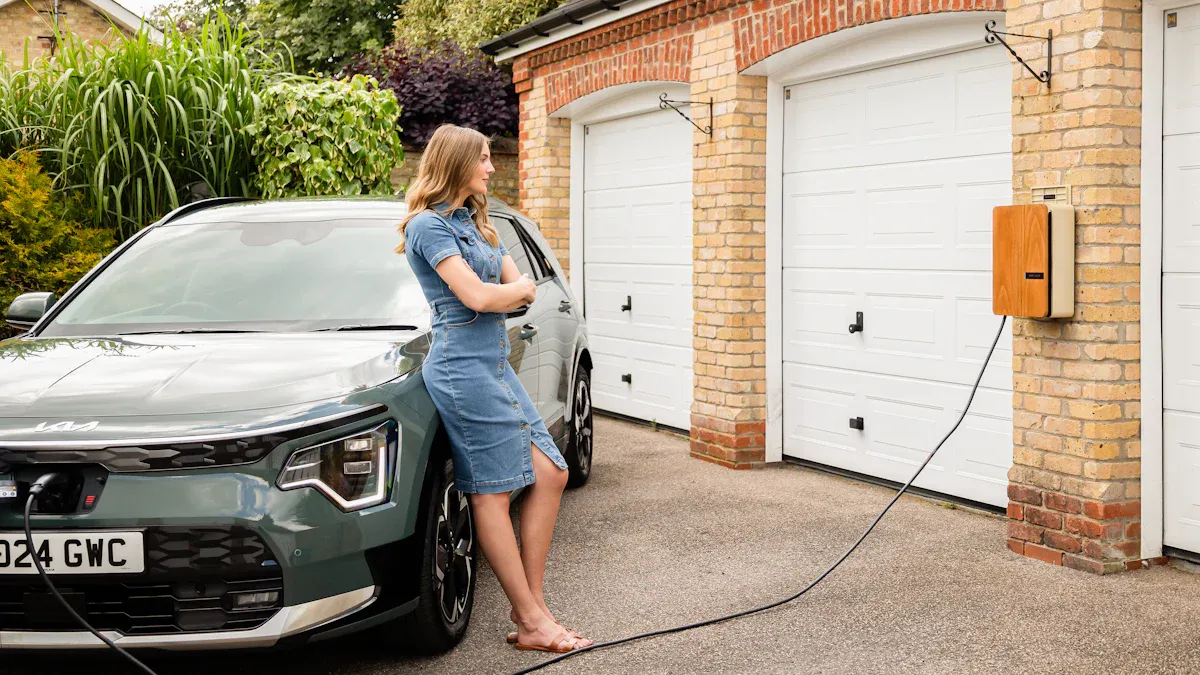
Theoretical numbers are helpful, but understanding charging speeds explained through real-world scenarios makes the choice clearer. An EV owner’s daily routine is the best guide for selecting the right power level for charging at home.
Scenario 1: The Daily Commuter (50 kWh Battery)
A typical commuter drives a predictable distance to and from work each day. Their electric car, with a 50 kWh battery, rarely needs a full charge from empty.
Charging with a 7.4 kW Box
A 7.4 kW charger is the perfect match for this lifestyle. If the daily commute is 80 kilometers, the car only needs about two hours of charging to replenish the battery. This can easily be done in the evening, leaving the car fully charged for the next morning. The 7.4 kW power level provides ample speed without putting excessive strain on the home electrical system.
Is an 11 kW Box Overkill?
For a daily commuter, an 11 kW charger is usually unnecessary. The 7.4 kW option already completes the required charging in a short overnight window. The extra cost and complex three-phase installation for an 11 kW unit offer little practical benefit for this use case. The car will be full by morning either way.
Scenario 2: The Plug-in Hybrid (PHEV) Owner
PHEVs combine a small electric battery with a gasoline engine. Their charging needs are very different from those of a fully electric EV.
Why 3.7 kW or 7.4 kW is Ideal
PHEVs have much smaller batteries, so they require less power for a full charge. A 3.7 kW charger is often sufficient for charging an electric car of this type. Many popular models are designed for these slower charging speeds.
| Model | EV Battery Capacity | Max AC Charging Rate |
|---|---|---|
| Cupra Leon Plug-In Hybrid | 12.8 kWh | 3.6 kW |
| Kia Niro PHEV | 11.1 kWh | 3.3 kW |
| Kia Sportage PHEV | 13.8 kWh | 7.2 kW |
Typical Charging Times for a PHEV
The charging time for these vehicles is very short. A Cupra Leon PHEV can go from empty to full in under 4 hours with a 3.7 kW charger. Even a Kia Sportage PHEV, which can accept faster charging, will be full in less than two hours on a 7.4 kW unit. This makes overnight charging extremely easy.
Scenario 3: The High-Mileage Driver (80 kWh+ Battery)
Some professions require extensive daily driving, far exceeding a typical commute. These drivers need their EV to be ready for another long day with minimal downtime.
Making the Case for an 11 kW Charger
Consider a professional whose job involves significant travel.
- Profession: A multi-drop delivery driver for a company like ATA Logistics.
- Work Schedule: They may work up to six days a week, covering large territories.
- Nature of Work: The job involves constant driving between locations, accumulating high daily mileage.
For these drivers, fast charging is not a luxury; it is a necessity. An 11 kW charger (with a three-phase supply) ensures their high-capacity EV battery can be fully replenished overnight. The EV charging curves still apply, but the higher power significantly shortens the overall charging duration.
Calculating Overnight Charging Needs
If a driver returns home with a nearly depleted 80 kWh battery, the charging math is critical. A 7.4 kW charger would take over 10 hours for a full charge. An 11 kW charger reduces this to around 7.5 hours. This faster turnaround provides peace of mind and guarantees the car is ready for the next demanding shift. The EV charging curves will slow the final phase, making the initial high-power charging even more important. Technologically advanced electric car charging solutions from providers like TPSON can reliably deliver these higher power levels for commercial-grade use at home.
How to Determine Your Ideal Home Charging Speed
Selecting the ideal home charging speed requires a methodical approach. An EV owner must evaluate their electrical system, their vehicle’s capabilities, and their daily driving patterns. This systematic process ensures the chosen charging solution perfectly aligns with their specific needs.
Step 1: Check Your Electricity Bill
The first step begins with a document every homeowner is familiar with: the monthly electricity bill. This paper contains critical data about the property’s electrical service.
Find Your ‘Contracted Power’
An owner must locate the ‘Contracted Power’ on their bill. This value defines the maximum power the home can draw. While many homes have 4.6 kW or 5.75 kW, properties with higher capacity will list values such as:
- 9.2 kW
- 9.21 kW
- 13 kW
- 13.8 kW
- 13.856 kW
A higher ‘potencia’ directly supports faster EV charging speeds.
Identify ‘Single-Phase’ or ‘Three-Phase’ Supply
The bill or the main electrical panel reveals if the supply is single-phase (‘monofásica’) or three-phase (‘trifásica’). This distinction is crucial. A single-phase supply limits charging to 7.4 kW, while a three-phase supply is necessary for 11 kW or 22 kW charging.
Step 2: Know Your Car’s Specifications
The electric car itself is the next piece of the puzzle. Its technical specifications set firm limits on charging performance.
Find Your Battery Size (kWh)
An owner should know their car’s battery capacity, measured in kilowatt-hours (kWh). A larger battery stores more energy but requires more time for a full charging session. This figure is essential for calculating total charging duration.
Find Your Max AC On-Board Charger Rate (kW)
Every electric car has a maximum AC charging rate determined by its on-board charger (OBC). This rate might be 3.7 kW, 7.4 kW, or 11 kW. The car will never charge faster than this limit, regardless of the wallbox’s power. The charging process also follows EV charging curves, slowing down as the battery approaches 100%.
Step 3: Analyze Your Driving Habits
The final step personalizes the decision. An owner’s daily routine dictates the real-world charging requirements for their EV.
Calculate Your Average Daily Kilometers
An owner should track their driving for a typical week to find their average daily distance. This calculation reveals how much range they need to replenish each night. A driver covering 50 km daily has very different needs than one covering 200 km.
Determine Your Required Overnight Charging Time
With the daily kilometers known, an owner can determine the necessary charging speed. The goal is to comfortably replenish the used energy overnight, typically within an 8-10 hour window.
Pro Tip: Always factor in a buffer. The EV charging curves mean the final part of the charging cycle is slower. Choosing a charger that completes the task in 6 hours provides flexibility for unexpected trips. Technologically advanced solutions from providers like TPSON help manage this process efficiently, ensuring the car is always ready.
Step 4: Make an Informed Decision
After analyzing the home’s electrical supply, the car’s specifications, and personal driving habits, an EV owner can confidently select the right charger. This final step synthesizes all the data into a practical choice that balances cost, speed, and convenience for daily charging needs.
Choosing Between 3.7 kW, 7.4 kW, and 11 kW
The decision ultimately comes down to matching the charger’s power to a specific lifestyle and vehicle. Each power level serves a distinct purpose.
Choose 3.7 kW for Basic Needs: A 3.7 kW charger is the most economical option. It is ideal for plug-in hybrid (PHEV) owners, as it can fully charge their smaller batteries in a few hours. It also works well for full EV drivers with low daily mileage (under 80 km) who have a long overnight charging window. This power level is the safest bet for homes with a lower
potencia contratada(e.g., 4.6 kW or less), as it minimizes the risk of electrical overloads.Choose 7.4 kW for the Best Balance: For the vast majority of EV owners in Spain, a 7.4 kW charger is the optimal solution. This power level provides fast and efficient overnight charging for almost any electric car on the market. It ensures a full battery every morning, even after a long day of driving. While it may require a
potenciaupgrade to 5.75 kW or higher, the investment provides future-proofing and flexibility. Technologically advanced 7.4 kW chargers from providers like TPSON offer smart features that make the charging experience seamless.Choose 11 kW for High-Performance Demands: An 11 kW charger is a specialized choice for a small subset of users. It is only an option for homes with a three-phase electrical supply. This faster charging is beneficial for high-mileage drivers who consistently need to replenish a large battery (80 kWh+) in a shorter overnight period. For most residential users, the benefits of 11 kW charging do not justify the significant installation complexity and cost.
The Professional Recommendation: For most drivers, a 7.4 kW wallbox offers the perfect combination of speed and practicality. It transforms home charging from a slow trickle to a powerful and reliable overnight routine, ensuring the car is always ready to go.
The Cost of Speed: Upgrades and Installation
Faster charging often involves more than just the price of the wallbox. An EV owner must consider potential electrical upgrades, installation complexity, and available government aid to understand the total investment for their electric car.
Costs of Increasing ‘Contracted Power’
A home may need more available power to support faster EV charging. This upgrade comes with specific utility costs.
Utility Company Fees Per kW Increased
Utility companies in Spain charge a one-time fee for every kilowatt (kW) of potencia an owner adds to their contract. This cost varies by region but is a direct expense for enabling faster charging. The fee covers the grid access rights for the increased power demand.
The ‘Electrical Bulletin’: When It’s Required
A Electrical Bulletin (CIE) is an official electrical installation certificate. An owner needs a new one if they increase their potencia significantly or if the existing home installation is over 20 years old. A certified electrician must issue this document, adding another professional cost to the upgrade process.
Installation Costs for Different Charger Speeds
The cost of the physical installation depends heavily on the charger’s power and the property’s layout.
Standard 7.4 kW Installation Costs
A standard 7.4 kW installation is the most common scenario. It typically includes a reasonable length of cable from the fuse box to the charging location, the necessary circuit protection, and the labor. Technologically advanced solutions from providers like TPSON are designed for this straightforward installation, making it a cost-effective choice for the average electric car owner.
Complex or Three-Phase Installation Costs
Costs rise with complexity. A complex installation might involve drilling through thick concrete walls, trenching across a garden, or running very long cables. A three-phase installation for an 11 kW charger is even more expensive, as it requires specialized wiring and a compatible electrical panel. These factors can substantially increase the final price for the car charging setup.
Government Subsidies: The Plan MOVES III
The Spanish government offers significant financial support to encourage EV adoption. The Plan MOVES III makes home charging much more affordable.
How Subsidies Reduce Charger and Installation Costs
The Plan MOVES III provides substantial aid that lowers the financial barrier for a new EV charger.
For individuals and homeowner associations, the subsidy covers 70% of the eligible costs for the equipment and installation. This aid increases to 80% for residents in municipalities with fewer than 5,000 inhabitants, making electric car charging accessible everywhere.
Eligibility Requirements for the Subsidy
A wide range of applicants can benefit from the program. The regulations set a limit of €5,000 per dossier for individuals. Eligible parties include:
- Individuals
- Self-employed individuals
- Homeowner associations
- Legal entities and other organizations
The application process varies by region. In communities like Andalusia and Madrid, the installation company manages the subsidy application. In other autonomous communities, the car owner is responsible for submitting the paperwork. This program is a key factor in reducing the overall cost of EV ownership.
Dynamic Power Control: The Smartest Way to Charge
An EV owner can maximize their charging efficiency without risking electrical overloads by using Dynamic Power Control. This smart technology acts as an energy manager for the home, intelligently balancing the power demands of an EV with the rest of the household. It ensures a safe and optimized charging process.
What is Dynamic Power Control?
Dynamic Power Control is an advanced feature in modern EV chargers that monitors a home’s real-time electricity consumption. It then adjusts the power flowing to the electric vehicle accordingly. This prevents the total energy use from exceeding the property’s contracted limit (potencia contratada).
How It Prevents Power Outages
Every Spanish home has an Power Control Switch (ICP) that trips if the power demand surpasses the contracted limit. A high-power EV charger, combined with other appliances, can easily cause such an outage. Dynamic Power Control prevents this by constantly monitoring the total load. If the system detects that the home is approaching its limit, it instantly reduces the charger’s output, averting a power cut.
Automatically Adjusting Charging Speed
This technology works through a sensor or module connected to the main electrical panel. This device measures the home’s total energy use in real-time and communicates it to the charger.
- When an owner turns on a high-power appliance like an oven or washing machine, the system automatically lowers the EV’s charging power.
- Once those appliances are turned off, the system frees up that capacity and increases the charging power back to the maximum available level.
This automatic adjustment optimizes the entire charging session without any manual intervention. Technologically advanced solutions from providers like TPSON integrate this feature seamlessly, offering a truly smart charging experience.
Is Dynamic Power Control Worth It?
For many EV owners, the added intelligence of Dynamic Power Control offers significant practical and financial advantages. It transforms the charging experience from a manual balancing act into an automated, worry-free process.
Benefits for Homes with Lower ‘Potencia’
This feature is especially valuable for properties with a lower potencia contratada (e.g., 4.6 kW or 5.75 kW). An owner can install a powerful 7.4 kW charger without needing to pay for a costly potencia upgrade. The system ensures the charger never draws too much power, allowing for a faster charging speed when capacity is available. This makes efficient EV charging accessible to more households.
Peace of Mind and Convenience
The ultimate benefit is convenience. An owner no longer needs to worry about what time they plug in their EV or which appliances are running. The system handles all the complex power management automatically.
The charger works in harmony with the home. An owner can cook dinner, do laundry, and run the air conditioning while their car is charging. The system guarantees a smooth, uninterrupted flow of power, providing complete peace of mind.
For most EV owners, a 7.4 kW charger is the ideal solution for home charging. This power level provides efficient fast charging for any electric car. The overall charging speeds are a key part of electric car charging.
The final charging speed when charging an electric car is always dictated by the slowest component: the home’s contracted power, the charger’s output, or the car’s intake limit.
This charging speeds explained guide helps every EV owner optimize their charging at home for their specific vehicles, ensuring their electric car is always ready.
FAQ
Can an owner use a standard home socket to charge their EV?
An owner can use a domestic socket, but it provides very slow charging (2-3 kW). For optimal safety and speed, a dedicated wallbox is the professional recommendation for daily use, as it is designed for sustained high-power delivery.
What happens if the charger is faster than the car’s limit?
The car will only charge at its maximum AC rate. For example, a car with a 7.4 kW on-board charger will only draw 7.4 kW of power, even from an 11 kW wallbox. The car’s specification always dictates the final speed.
Is a ‘potencia’ upgrade always needed for a 7.4 kW charger?
An upgrade is not always necessary. A home with sufficient existing potencia or a smart charger featuring Dynamic Power Control can often support a 7.4 kW unit without requiring a costly contract change. The system manages power automatically to prevent overloads.
Is an 11 kW charger a better choice than a 7.4 kW charger?
For most residential users, a 7.4 kW charger is the superior choice. It provides excellent speed on a standard single-phase supply. An 11 kW charger requires a rare and costly three-phase installation, making it unnecessary for typical overnight charging needs.
How does Dynamic Power Control help an owner save money?
This feature allows an owner to install a powerful 7.4 kW charger without paying for a potencia contratada upgrade. Technologically advanced solutions from providers like TPSON use this to manage power, avoiding utility fees and the potential cost of a new Electrical Bulletin.
Will a home charging box work with any electric car?
Yes. Modern home chargers in Spain use the Type 2 connector. This is the universal standard for AC charging across all major EV brands, ensuring one wallbox can charge nearly any electric car or PHEV on the market today.