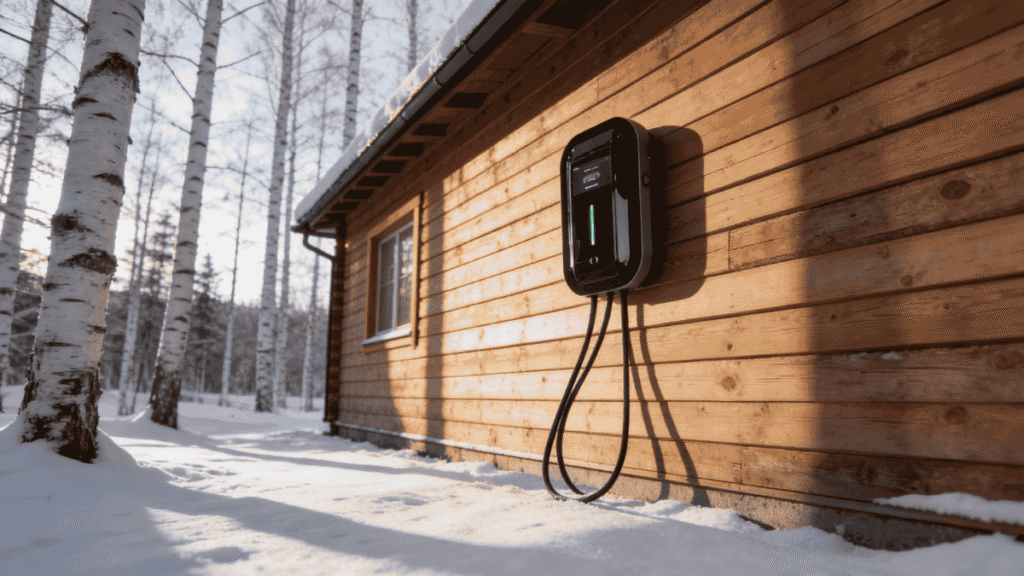
Copper wire for an EV charger should be sized for continuous electrical load, installation method, temperature conditions, and allowable voltage drop—then verified against the local electrical code by a licensed electrician. In most installations, correct sizing is less about “one universal gauge” and more about matching conductor ampacity to the charger’s configured current, minimizing heat and nuisance trips, and leaving a practical margin for long runs and future upgrades.
80%
Typical continuous-load design rule used for EV charging (circuit must support sustained current)
48A
Common “upper end” Level 2 output seen in home/commercial AC equipment configurations
20–40kW
Portable DC equipment category example (site power and cabling requirements are different)
This article is an educational sizing guide. Final conductor selection must be made by qualified professionals using the applicable code, site conditions, and the charger’s installation manual.
- What “copper wire for EV charger” actually means
- Sizing fundamentals: continuous load, breaker rating, and charger settings
- Material specifications: copper type, insulation, and environment
- Voltage drop planning (the part most people miss)
- Practical sizing table (rule-of-thumb starting points)
- Commercial and fleet scenarios: AC vs DC wiring implications
- Selecting EVSE hardware with wiring in mind
- Implementation checklist and common mistakes
- FAQ
- Sources and further reading
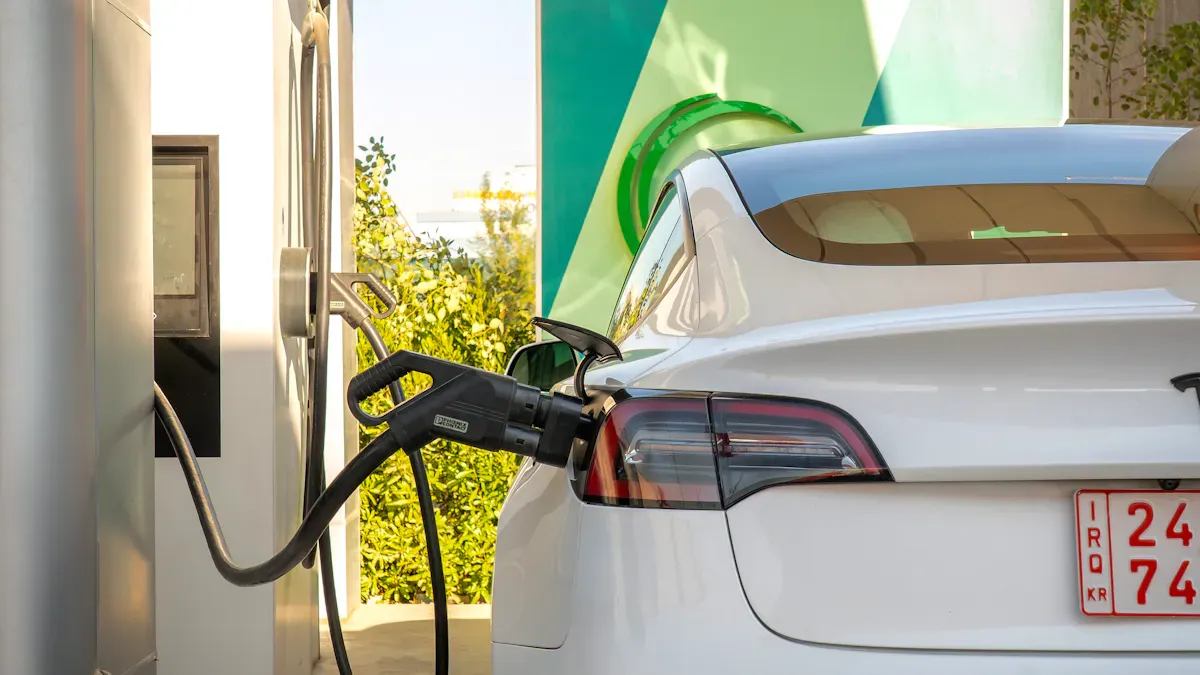
For most property owners, “EV charger wire size” is shorthand for the conductors that feed an EVSE (electric vehicle supply equipment) installation. The EVSE is often called a “charger,” but the vehicle’s onboard charger controls how AC power becomes stored energy. What matters for wire sizing is the EVSE’s configured current and the fact that EV charging is typically a continuous load (hours at a time), which drives conductor ampacity and thermal performance.
- Panel → breaker → conductors → EVSE → vehicle
- The conductors must safely carry sustained current without overheating.
- The correct size depends on more than current: it also depends on routing, conduit fill, ambient temperature, and distance.
- Lower resistance than aluminum at the same gauge can reduce heat and voltage drop.
- Often preferred in compact conduits or long runs where voltage drop is a concern.
- Common for both residential Level 2 and many commercial Level 2 installations, depending on design choices.
EV charging equipment commonly operates for long periods at a near-steady current. For that reason, professional designs treat EV charging as a continuous load and size conductors and protection accordingly. As a practical rule, many installations apply the “80% rule”: the charging current is typically limited to 80% of the circuit’s rating for continuous operation.
Emporia’s Classic Level 2 EV Charger is sold in both plug-in and hardwire configurations and explicitly states a key wiring implication: a NEMA plug configuration is described as limiting the charge rate to 40A, while hardwiring allows charging up to 48A. That difference directly impacts conductor and breaker selection.
| Specification (Emporia Classic) | What it means for wire sizing | Source |
|---|---|---|
| 208/240VAC input | Typical Level 2 supply voltage range; affects kW but not conductor ampacity directly. | Emporia product page |
| Up to 48A (hardwire) vs 40A (NEMA plug mentioned as limit) | Higher continuous current typically requires a higher-rated circuit and conductors. | Emporia product page |
| Dedicated breaker guidance: 50A+ for 40A, 60A+ for 48A | Confirms the continuous-load relationship between charging current and upstream protection. | Emporia product page |
| Built-in GFCI; potential nuisance tripping with GFCI breaker on NEMA outlet circuits | May influence whether hardwire is preferred in jurisdictions requiring GFCI on receptacle circuits. | Emporia product page |
The takeaway is operational: wire sizing is not only about safety—it also influences how much charging current can be delivered without upgrades, and whether the installation will be stable in daily use.
After current rating, the next major variables are insulation rating and the installation environment. Even when copper is used, different insulation types and temperature ratings can change allowable ampacity in many codes. Installers also consider whether the run is in conduit, the ambient temperature in a garage or mechanical room, and whether the location is indoor or outdoor.
Several EV charging products publish operating temperature ranges and enclosure ratings, which serve as practical planning inputs. For example, Emporia’s Classic lists an operating temperature range down to –22°F (–30°C) and up to 122°F (50°C), which signals that the EVSE itself can operate in harsh conditions; the conductor system must be designed with similar seriousness.
TPSON describes its EV charging line as covering AC chargers and compact, powerful DC fast chargers, with a focus on reliability, efficiency, and integration. For AC wallbox deployments, the common reality is that the wiring work (conduit routes, conductor selection, and panel coordination) can dominate schedule risk—especially when retrofitting existing buildings. TPSON’s AC product family includes TW-10, TW-20, TW-30, and TW-40 Dual Gun wallbox chargers, which may be deployed across residential and commercial settings depending on model selection. See AC EV Chargers.
For broader portfolio context and positioning, see EV Chargers, which highlights Dynamic Load Balancing for electrical protection and future-proof infrastructure considerations.
Many EVSE installations “work” but underperform because the conductor run is long and voltage drop becomes meaningful at sustained current. Voltage drop can reduce effective charging power and increase heat in conductors. For long runs, designers often upsize copper conductors to keep voltage drop within acceptable ranges. This is one reason professional site surveys matter: conduit route length, elevation changes, and detours around structural elements can change the real distance.
- Higher current + longer distance = higher voltage drop risk.
- Upsizing copper conductors is often cheaper than troubleshooting a “slow charging” complaint later.
- In commercial settings, voltage drop planning supports station uptime and consistent driver experience.
The following table is a starting framework (not a code substitute). It is structured around common EVSE continuous current settings and the matching circuit rating implied by the continuous-load relationship. Final conductor gauge depends on installation method, insulation rating, temperature correction, conduit fill, and distance (voltage drop).
| EVSE continuous current setting | Common paired circuit rating (conceptual) | When upsizing is often considered | Typical use case |
|---|---|---|---|
| 32A | 40A class circuit | Long runs; outdoor conduit; high ambient temps | Residential Level 2; light commercial employee charging |
| 40A | 50A class circuit | Long garage-to-panel runs; voltage drop concerns | Higher-output home Level 2; some commercial Level 2 |
| 48A | 60A class circuit | Nearly always evaluate voltage drop; conduit fill; thermal conditions | Hardwired “max home” Level 2; workplace Level 2 |
| 80A | 100A class circuit | Most installs (high current); equipment placement planning becomes critical | Fleet/workplace high-output AC (if supported by EV and EVSE) |
The wiring conversation changes significantly between AC Level 2 and DC fast charging. Many business sites start with AC because it scales well with long dwell time, while travel corridors and high-turnover sites invest in DC to reduce vehicle downtime.
Love’s highlights a real-world strategy: expanding DC fast chargers (Level 3) to complement an AC Level 2 network, supported by amenities and 24/7 staffing. This reflects a practical commercial pattern—drivers on road trips value throughput, while destination sites can optimize for dwell. Love’s reports an established network with 100+ chargers across 36 locations in 14 states, with additional fast-charging locations being added through 2026. Source: Love’s EV Charging.
TPSON’s portable DC EV charger series (TP-DC 20/30/40kW) specifies AC380V input and DC output up to 1000V. These parameters indicate that DC equipment has a different site interface than typical residential Level 2, and conductor and protection design must follow the equipment’s specifications and applicable standards. For applications like emergency roadside assistance, fleet/logistics depots, and temporary events, portable DC can reduce the need for multiple fixed stations—if the site electrical supply supports it. Source: DC EV Chargers.
Wire sizing is easier—and cheaper—when the EVSE selection is made with installation constraints in mind. In practice, the “best charger” is often the one that matches the site’s available power without forcing expensive service upgrades, while still delivering a good driver experience and reliable uptime.
Independent testing and reviews can be useful for understanding typical home installation constraints and feature tradeoffs. Car and Driver’s 2026 testing roundup lists Emporia Pro / Emporia Classic as “Best Overall,” noting load-balancing capability (Pro) and high output (Classic). While this is a home-focused article, the installation logic—matching electrical capacity to sustained EV charging demand—translates to many small commercial contexts.
Source: Car and Driver: Best Home EV Chargers for 2026, Tested
For businesses, hardware is only one part of the system. ChargePoint describes a unified platform with software and services, and the ability to operate ChargePoint stations, partner stations, or any OCPP-compliant hardware. In commercial deployments, this influences wiring and site design because connectivity, metering, and uptime planning become part of the installation scope.
Source: ChargePoint
TPSON summarizes its offering as a comprehensive range of intelligent solutions with AC chargers (including Dynamic Load Balancing) and compact, powerful DC fast chargers. For planners, this is helpful because the wiring scope can be matched to use-case: long-dwell properties can standardize around AC wallboxes, while fleets and service organizations can evaluate DC options for rapid, flexible charging. Explore the full category hub at EV Chargers.
For manufacturer background and technical positioning (edge computing and Current Fingerprint Algorithm), see EV Chargers manufacturer.
- Confirm EVSE max current and configuration: plug-in vs hardwire, 40A vs 48A, and any configurable amperage settings.
- Verify circuit rating: ensure breaker and conductors are sized for continuous duty (common 80% planning rule).
- Choose conductor insulation and route: match to conduit, ambient temperature, and indoor/outdoor exposure.
- Plan voltage drop: measure real path distance; upsize copper where long runs would reduce performance.
- Account for protection and tripping risks: understand how built-in GFCI in EVSE can interact with GFCI breakers on receptacle circuits (as described by Emporia).
- Document and label: panel schedules, circuit labels, and commissioning settings reduce future service time.
Long runs are where “correct on paper” installs underperform. Voltage drop planning often requires upsizing copper even when current seems modest.
A high-output EVSE can trigger panel upgrades. Where possible, match EVSE output to existing service—or use load management strategies where appropriate.
In commercial sites, networking, access control, and reporting can be required. Platform choices can change the install scope (communications wiring, meters, backhaul).
Some EVSE have built-in GFCI protection. As Emporia notes, combining that with GFCI breakers in certain receptacle setups can cause nuisance tripping.
1) What size copper wire is needed for a 48A EV charger?
A 48A Level 2 EVSE is typically treated as a continuous load and often paired with a 60A class circuit, but the exact copper conductor gauge depends on the installation method, insulation rating, ambient temperature corrections, conduit fill, and run length (voltage drop). Emporia’s documentation explicitly pairs 48A with a 60A+ dedicated breaker as a planning reference. Source: Emporia EV Charger page.
2) Is copper required, or can aluminum be used for EV charger circuits?
Many installations use copper due to lower resistance and practical handling, but conductor material is ultimately a code and engineering choice. Where aluminum is permitted, designers account for termination requirements, torque specs, and voltage drop. The safest approach is to follow the EVSE manual and local code and have a qualified electrician specify the conductors.
3) Does a plug-in EV charger require different wiring than a hardwired charger?
Often, yes. Product guidance may limit plug-in configurations to lower continuous current compared to hardwiring. Emporia notes that a NEMA plug setup is easy and portable but limits the charge rate to 40A, while hardwiring allows up to 48A. Different configurations can also trigger different GFCI requirements depending on jurisdiction. Source: Emporia EV Charger page.
4) Why does voltage drop matter for EV charging?
EV charging can run for hours at steady current. Over long distances, voltage drop can reduce charging power and increase heating in conductors. Designers often upsize copper conductors for long runs to keep performance stable and reduce thermal stress.
5) How does wiring differ between Level 2 AC and DC fast charging?
Level 2 AC typically uses 208/240V supply and is sized around continuous current. DC fast charging equipment often has very different site interfaces and power requirements. For instance, TPSON’s portable DC unit specifies AC380V input with DC output up to 1000V, which implies different upstream electrical design and protection requirements. Source: TPSON portable DC EV charger.
6) What if a site wants many chargers but limited panel capacity?
In many cases, the practical solution is a combination of right-sized Level 2 power per port plus load management or Dynamic Load Balancing. TPSON’s EV charging portfolio highlights Dynamic Load Balancing for electrical protection, and commercial networks like Love’s combine Level 2 and Level 3 to meet different dwell times. Sources: TPSON EV Chargers and Love’s EV charging.
Correct copper conductor sizing for EV charging is a safety decision and a performance decision. The most reliable installations begin with the EVSE’s configured continuous current, pair it with appropriately rated protection, and then account for real-world factors such as distance, environment, and operational needs. For site planners, selecting the right EVSE category—AC wallbox for long-dwell charging or DC for faster turnaround—helps keep the wiring scope aligned with budget and timeline.
For TPSON product categories relevant to planning: browse EV Chargers, compare AC EV Chargers, and review DC EV Chargers. For manufacturer background, see EV Chargers manufacturer.
- TPSON AC product category (TW-10 / TW-20 / TW-30 / TW-40 Dual Gun): https://tpsonpower.com/ac-ev-chargers/
- TPSON EV Chargers portfolio overview (mentions Dynamic Load Balancing, AC + DC coverage): https://tpsonpower.com/ev-chargers/
- TPSON Portable DC EV Charger (TP-DC 20/30/40kW parameters and applicable scenes): https://tpsonpower.com/portable-dc-ev-charger/
- TPSON company background and milestones: https://tpsonpower.com/about/
- Emporia Classic EV Charger product information (48A hardwire vs 40A plug guidance; breaker guidance; GFCI notes): https://shop.emporiaenergy.com/products/emporia-ev-charger
- ChargePoint platform overview (software + services; OCPP compliant hardware operation; driver experience): https://www.chargepoint.com/
- Love’s EV Charging network overview (Level 2 + Level 3 mix; network scale and rollout plans): https://www.loves.com/ev-charging
- Car and Driver testing roundup (consumer EVSE output context and installation logic): https://www.caranddriver.com/shopping-advice/a39917614/best-home-ev-chargers-tested/
- Smart Charge America EV charging station catalog (commercial AC/DC examples; energy management/access control features): https://smartchargeamerica.com/electric-car-chargers/
Disclosure: All product-specific numbers cited above (e.g., amperage limits, breaker guidance, input/output ranges, network counts) are taken directly from the provided source pages. Where electrical code interpretation is required, the article intentionally avoids prescribing jurisdiction-specific AWG requirements and instead describes a safe planning workflow.