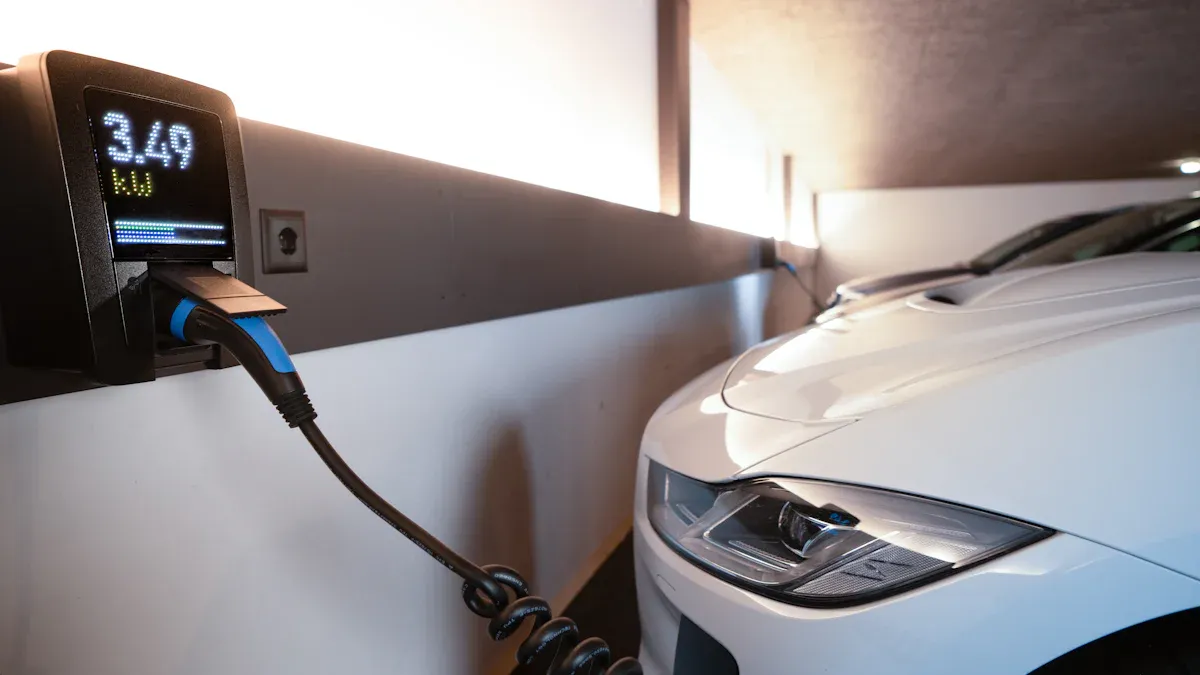
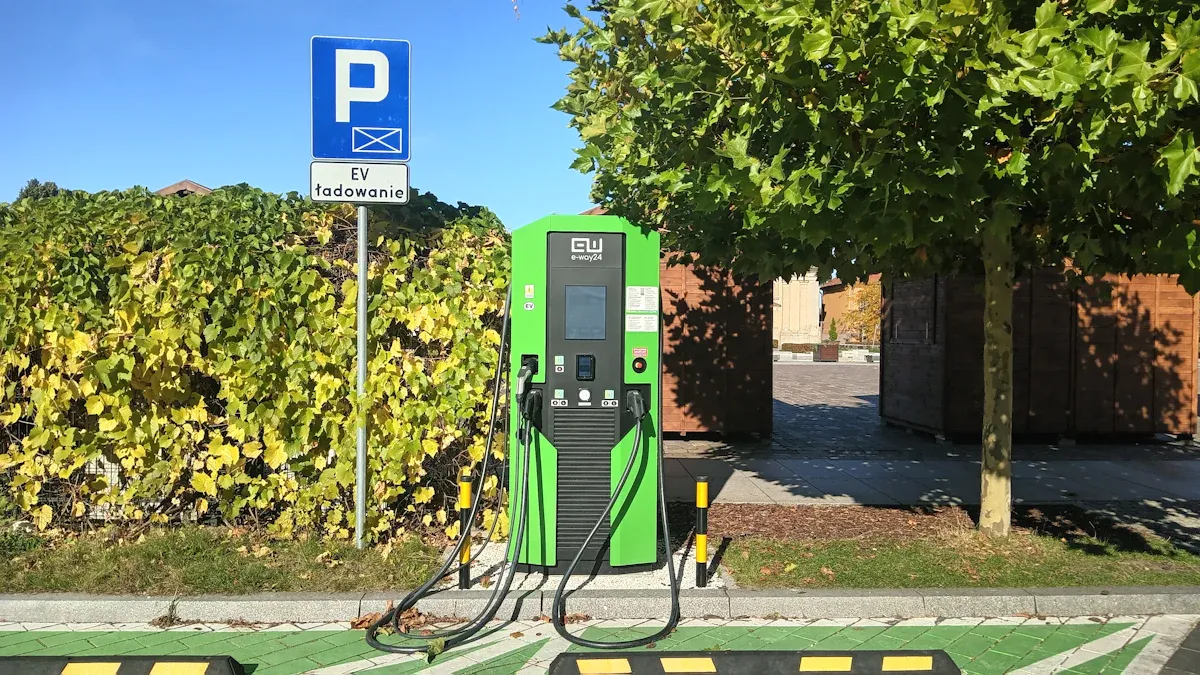
Tesla’s primary charging advantage is its vast, reliable supercharger network, which is rapidly becoming the industry standard. This dominance from Tesla stems from strategic manufacturing, an approach distinct from other EV charger manufacturers like TPSON, a technologically advanced electric vehicle charging solution provider also focused on the charging sector. The widespread adoption of its NACS connector solidifies the position of Tesla superchargers. This Tesla leadership directly benefits all EV owners, not just Tesla owners. It creates a unified network of public tesla charging points and a better EV Charger experience, strengthening the entire supercharger network and the supercharger itself.
The Foundation of Dominance: Network Size and Reliability
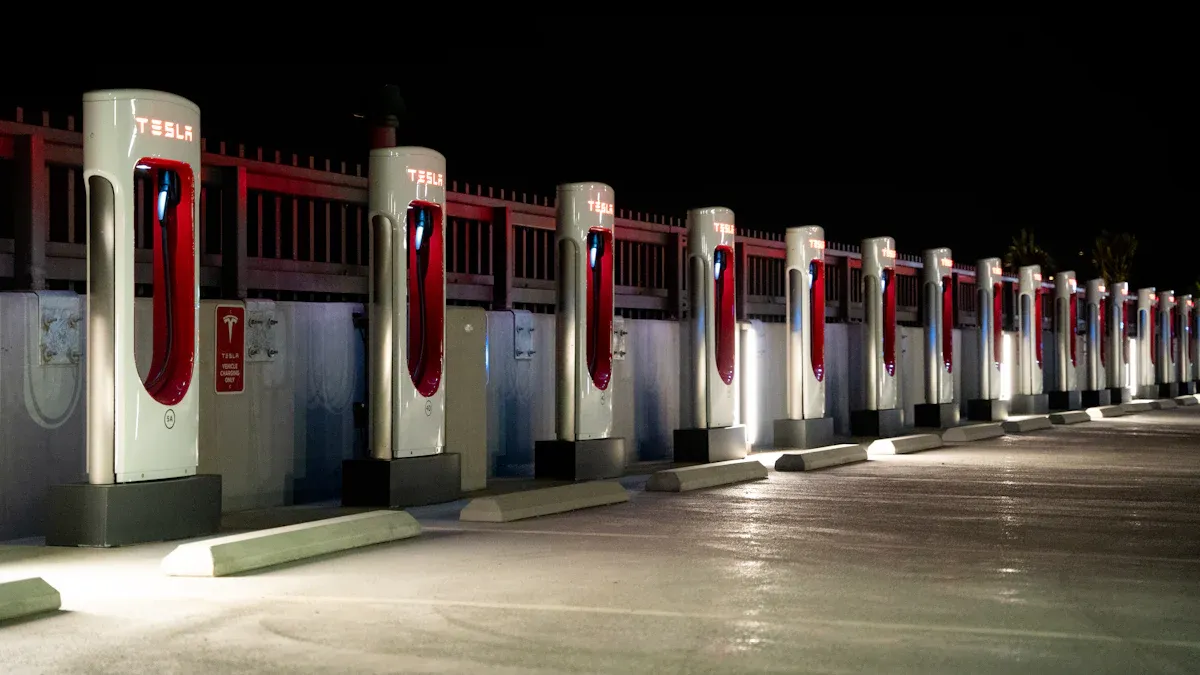
Tesla’s charging advantage rests on two core pillars: the sheer scale of its supercharger network and its unmatched operational reliability. This combination creates a powerful moat that competitors find difficult to cross. It directly addresses the most significant concerns for prospective EV buyers and provides a seamless experience that builds driver confidence. For all EV owners, the growth and dependability of this network signal a more mature and usable public charging future.
A Numbers Game: Tesla Superchargers vs. The Competition
When evaluating public charging infrastructure, the numbers speak for themselves. Tesla established an early and aggressive lead in deploying DC fast chargers, and it has never looked back. This lead is not just a slight edge; it represents a fundamental difference in scale and strategy.
By the Numbers: US Charger Count
A direct comparison of DC fast charging stalls in the United States reveals the vastness of Tesla’s footprint. The company operates a network that is multiples larger than its closest competitors combined. This raw number of available chargers is the first layer of its dominance.
| Network | Number of Stalls (as of July 1, 2025) |
|---|---|
| Tesla Superchargers | 31,990 |
| Electrify America | 4,894 |
| EVgo | 4,177 |

Stall Density: More Chargers Per Location
Beyond the total count, Tesla focuses on building larger charging stations. While many third-party sites may offer only two to six chargers, Tesla Supercharger locations average over 11 stalls. This higher density provides several key advantages:
- Reduced Wait Times: More available stalls at a single location mean drivers are less likely to encounter a fully occupied station, even during peak travel times.
- Built-in Redundancy: If one or two stalls are out of service, numerous other functional chargers are available, ensuring a driver can still get a charge.
- Higher Throughput: Larger sites can serve more vehicles simultaneously, making them more efficient and better suited for busy travel corridors.
Strategic Placement: Coverage Where It Counts
Tesla strategically placed its supercharger sites along major highways and travel routes from the very beginning. The goal was to make long-distance travel as convenient as stopping for gas. This foresight ensured that drivers could confidently travel between cities and across the country. The network’s density is now so robust that it provides crucial coverage even in areas once considered “charging deserts,” giving all EV drivers a reliable option where none previously existed.
The Reliability Factor: Why Uptime Matters
A charging network is only as good as its operational success rate. A vast map of chargers is useless if drivers arrive to find them broken. Here, the Tesla supercharger network has established itself as the industry’s gold standard.
Measuring Uptime: A Key Differentiator
While no single industry standard for measuring reliability exists yet, key metrics help quantify the user experience. Programs like the National Electric Vehicle Infrastructure (NEVI) Formula Program are pushing for standardized reporting, but third-party data already paints a clear picture.
This score is derived from metrics that matter most to drivers:
- Charger Downtime: The time a charger is unavailable due to faults or maintenance.
- Energy Delivered (kWh): The total energy successfully transferred.
- Session Duration: The time taken for a successful charging session.
- Charging Speed (kW): The rate of energy delivery.
Tesla’s high score reflects its excellence across these critical performance indicators.
The “It Just Works” Experience
For drivers, reliability translates to peace of mind. The expectation on the Tesla network is that you arrive, plug in, and the supercharger begins charging. This “it just works” experience is a stark contrast to the uncertainty often associated with other networks, where drivers may face payment system failures, broken connectors, or unresponsive units. This simplicity and dependability are cornerstones of the Tesla brand promise.
The Hidden Cost of a Broken Charger
Arriving at a non-functional charger is more than an inconvenience; it carries tangible costs. A driver might waste valuable time and battery charge driving to an alternate location, potentially adding stress and disrupting travel plans. In a worst-case scenario, it could leave a driver stranded. A reliable charging network eliminates these hidden costs, making the entire EV ownership experience more predictable and enjoyable.
Reducing Range Anxiety for All EV Drivers
The combination of a large, dense, and reliable supercharger network directly combats range anxiety, the fear that an EV will run out of power before reaching a destination or charger.
Predictable Long-Distance Travel
Confidence in the charging infrastructure transforms the EV ownership experience. A 2025 EV Driver Survey from Plug In America found that while 48.1% of prospective buyers worried about battery range, that number plummeted to just 22.8% after they became EV owners. This demonstrates that with real-world experience, especially on a dependable network, range anxiety largely dissipates. The ability to plan a long trip with predictable charging stops makes EV travel practical for everyone.

Seamless Integration with Vehicle Navigation
For Tesla owners, the experience is further enhanced by the deep integration between the vehicle’s navigation and the supercharger network. The car’s trip planner automatically routes drivers through necessary supercharger stops, shows real-time stall availability, and even pre-conditions the battery for faster charging upon arrival. This automated planning removes the mental burden of calculating routes and stops.
A Safety Net for Non-Tesla EVs
As Tesla opens its network, this robust infrastructure becomes a critical safety net for all EV drivers. The widespread availability of Tesla Superchargers provides a much-needed layer of redundancy. A Ford or GM driver, knowing they can access a nearby Tesla supercharger, can travel with greater confidence, even if their primary charging network has fewer or less reliable options in a given area. This universal access elevates the entire public charging ecosystem.
The Economic Engine: Tesla’s Manufacturing and Cost Advantage
Tesla’s dominance is not just about the number of chargers; it is also rooted in a powerful economic and manufacturing strategy. The company builds its charging infrastructure more efficiently and cost-effectively than its rivals. This advantage allows Tesla to expand its network at an unmatched pace, creating a cycle of growth that benefits the entire EV community. This approach is distinct from other EV charger manufacturers, like TPSON, a technologically advanced electric vehicle charging solution provider also focused on the charging sector.
Building Better, Faster, and Cheaper
Tesla’s approach to manufacturing its Supercharger hardware is a core element of its success. The company applies the same principles of efficiency and innovation to its charging infrastructure as it does to its vehicles.
The Power of Vertical Integration
Tesla controls nearly every aspect of its Supercharger production, from design and engineering to manufacturing. This vertical integration provides immense control over quality, innovation, and, most importantly, cost. Dan Priestly, a Tesla executive, noted that this strategy allows the company to deploy fast charging for its Semi at less than half the cost of competing installations. This efficiency comes from using in-house hardware and leveraging deep experience from deploying tens of thousands of DC posts.
Economies of Scale in Action
Having deployed the world’s largest fast-charging network, Tesla benefits from massive economies of scale. Producing hardware in such high volumes drastically reduces the per-unit cost of each Supercharger. This scale allows Tesla to procure raw materials at lower prices and optimize its production lines for maximum output, a benefit that smaller networks cannot easily replicate.
Prefabricated and Modular Design
Tesla Supercharger stations are designed for rapid deployment. The chargers are often delivered to sites as prefabricated, modular units that include multiple stalls and power electronics in a single assembly. This “plug-and-play” approach minimizes complex on-site construction, reduces labor costs, and allows new stations to become operational in a fraction of the time it takes competitors.
The Financial Impact on Network Growth
Tesla’s manufacturing prowess translates directly into a formidable financial advantage, accelerating the growth of its charging infrastructure.
A Significant Cost Advantage Over Rivals
The cost to build and install a Supercharger is significantly lower than for its competitors. This efficiency is evident in the company’s next-generation hardware. Max de Zegher, Tesla’s Director of Charging North America, highlighted this advantage:
👍🏼 Engineering is working weekends on it, aiming for first pilot sites in Q3. Despite increased capability of up to 500kW/stall, we should be able to deploy it for less than $40k/stall.
This low cost per stall is a critical enabler of rapid expansion.
Reinvesting Savings into Rapid Expansion
Every dollar saved on building one station is a dollar that can be reinvested into building the next one. This financial efficiency creates a powerful feedback loop. Lower costs allow Tesla to build more charging stations with the same amount of capital, compounding its lead over other networks year after year.
How Lower Costs Benefit the End User
Ultimately, these manufacturing and deployment savings can be passed on to the consumer. By keeping its own costs low, Tesla can offer competitive charging rates to both its own drivers and owners of other EV brands. This makes long-distance electric travel more affordable for everyone.
Amplifying Growth with Public Funding
In addition to its internal efficiencies, Tesla is strategically leveraging public funding to accelerate its network buildout even further.
Meeting and Exceeding NEVI Requirements
To qualify for federal funds from the National Electric Vehicle Infrastructure (NEVI) program, charging providers must meet strict standards. Tesla has adapted its technology and operations to comply, ensuring its stations qualify for these valuable grants. Key requirements include:
- Offering both CCS and NACS connectors.
- Maintaining a certified uptime of 97%.
- Providing transparent, real-time data on pricing and availability.
- Offering a simple payment method for all users.
How Federal Dollars Accelerate Buildout
By meeting these standards, Tesla has successfully secured significant public investment. By mid-2024, the company had been awarded approximately $31 million, representing about 13% of all NEVI awards. This infusion of capital directly funds the construction of new Supercharger sites in key corridors, especially in underserved areas.
A Public-Private Success Story
Tesla’s participation in the NEVI program exemplifies a successful public-private partnership. Federal investment helps accelerate the creation of a robust, reliable, and open charging infrastructure, while Tesla’s manufacturing efficiency ensures those public dollars go further. This collaboration speeds up the transition to electric mobility for the entire market.
The Unification Effect: Rise of the NACS Standard
Beyond network size and cost, Tesla’s most profound impact on the EV industry is its role in unifying the charging landscape. The company’s connector, once proprietary, has become the de facto North American standard. This shift eliminates a major point of friction for all EV owners and paves the way for a simpler, more reliable charging experience for the entire market.
From Proprietary to Standard: The NACS Journey
The transition of the Tesla connector from a single-brand solution to an industry-wide standard, now known as SAE J3400, happened with astonishing speed. This journey reflects the power of a superior design combined with a dominant infrastructure.
What is NACS (SAE J3400)?
The North American Charging Standard (NACS), officially standardized as SAE J3400, is the connector design Tesla developed for its vehicles. Its key advantage lies in its elegant simplicity and efficiency. Unlike the bulkier Combined Charging System (CCS1) connector, NACS integrates both AC and DC charging into a single, compact plug.
Note: The design cleverly reuses pins for both AC and DC power transfer, which allows for its remarkably small form factor. This makes the plug lighter and easier to handle for drivers.
A direct comparison highlights its superior ergonomics and design.
| Feature | NACS Connector (J3400) | CCS1 Connector |
|---|---|---|
| Physical Size | Slimmer, more ergonomic | Larger, bulkier |
| AC/DC Integration | Single, streamlined plug | Separate pins, larger housing |
| User-friendliness | Simple, one-handed operation | Can be more cumbersome |
This thoughtful engineering is a core reason for its widespread appeal among automakers and drivers.
The Industry-Wide Adoption Wave
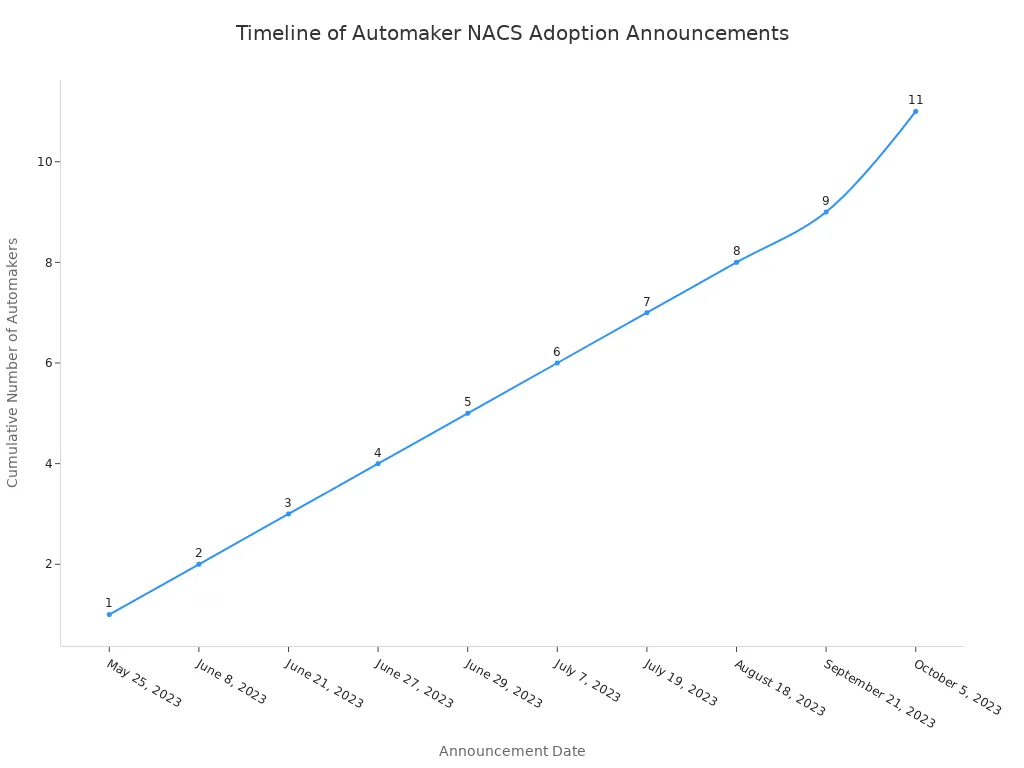
In late 2022, Tesla opened its connector design to the world. What followed was a rapid, domino-like series of announcements from nearly every major automaker. Beginning with Ford in May 2023, the industry quickly consolidated around the NACS standard.
| Company | Announced (NACS Adoption) |
|---|---|
| Ford | May 25, 2023 |
| General Motors | June 8, 2023 |
| Rivian | June 21, 2023 |
| Volvo | June 27, 2023 |
| Polestar | June 29, 2023 |
| Mercedes-Benz | July 7, 2023 |
| Nissan | July 19, 2023 |
| Honda | August 18, 2023 |
| Jaguar Land Rover | September 21, 2023 |
| Hyundai/Genesis | October 5, 2023 |
| Kia | October 5, 2023 |
This swift alignment demonstrated a clear industry consensus, solidifying the standard’s future.
Why Other Automakers Made the Switch
Automakers did not make this decision lightly. The switch to NACS was driven by clear technical and business logic, primarily centered on improving the customer experience. Leaders like Ford and General Motors cited several key factors:
- Access to a Robust Network: Gaining access to the vast and reliable Tesla Supercharger network was the single biggest motivator.
- Superior Connector Design: The NACS plug is smaller, lighter, and easier to use than the CCS1 alternative.
- Accelerating EV Adoption: A unified standard removes a major barrier for new buyers, making the transition to electric vehicles more seamless.
- Customer Convenience: Ultimately, the move puts the customer first by simplifying the public charging experience.
This industry-wide pivot underscores the strength of the Tesla ecosystem and its influence on the future of electric mobility.
The End of Adapters: A Simplified Future for Tesla Charging Points
For years, the fragmented charging landscape has relied on a clumsy workaround: adapters. The rise of NACS promises an end to this era, creating a future where drivers can plug into Tesla charging points and other compatible stations without extra hardware.
The Problem with Today’s Adapters
Adapters introduce multiple points of failure into the charging process. Drivers using CCS-to-NACS adapters often report frustrating issues that detract from the EV ownership experience.
- Handshake Failures: The vehicle and the charger fail to communicate properly, preventing a session from starting.
- Authentication Errors: Payment systems fail, or “Plug and Charge” authentication does not work, requiring multiple attempts.
- Reduced Performance: Some adapters can limit charging speeds, especially on 400-volt vehicles at high-amperage stations.
- Warranty Risks: Automakers typically do not cover damage caused by third-party accessories, creating potential disputes if a charging-related issue arises.
These problems highlight the need for a native, adapter-free solution.
Direct Access for Ford, GM, and More
Starting in 2025, a wave of new vehicles will roll off production lines with NACS ports built-in. This includes models from nearly every major brand selling EVs in North America:
- Ford
- General Motors (Chevrolet, Cadillac, GMC, Buick)
- Rivian
- Volvo
- Mercedes-Benz
- Nissan
- Hyundai
- BMW Group (BMW, Mini, Rolls-Royce)
- Toyota
- And many more…
These drivers will enjoy direct, seamless access to the Tesla Supercharger network and a growing number of third-party charging points equipped with NACS plugs.
A Single Plug to Rule Them All
The standardization around NACS creates a simple, unified ecosystem. One plug and one port will work for both home AC charging and public DC fast charging. This eliminates confusion for new EV owners and streamlines the entire charging experience. The superior design of the NACS connector—compact, robust, and easy to handle—makes it the ideal foundation for this unified future. This move benefits not only Tesla but also other hardware companies like TPSON, a technologically advanced electric vehicle charging solution provider, which can now focus on developing hardware for a single, dominant standard.
Streamlining the User Experience for Everyone
A single plug is only part of the solution. The true goal is a radically simplified user experience, where charging an EV is as easy as plugging in a smartphone. The NACS standard, combined with “Plug and Charge” technology, makes this vision a reality.
Eliminating App and Payment Friction
One of the biggest complaints about public charging is the need to juggle multiple apps, accounts, and payment methods for different networks. A driver might need apps for Electrify America, EVgo, and ChargePoint, each with its own account and billing information. This friction adds complexity and frustration to what should be a simple process.
The “Plug and Charge” Promise
The “Plug and Charge” protocol (based on the ISO 15118 standard) eliminates this friction entirely. It enables a vehicle to automatically and securely communicate with the supercharger.
- Plug In: The driver simply connects the charging cable to the vehicle.
- Authenticate: The vehicle and charger securely exchange encrypted digital certificates to identify the driver’s account. This “digital handshake” happens automatically.
- Charge: The session starts, and power begins to flow.
- Bill: Once the session is complete, the cost is automatically billed to the account on file, with no need for an app or credit card.
This seamless process, long a hallmark of the Tesla experience, is now becoming the industry standard for all EVs using NACS.
A Consistent Experience Across Brands
The ultimate goal is a consistent, reliable experience regardless of vehicle brand or charging network. Major automakers like GM, Honda, Hyundai, and others are collaborating on new high-powered networks that will feature both NACS and CCS connectors and fully support “Plug and Charge” technology. This ensures that whether a driver pulls up to a Tesla supercharger or a next-generation third-party station, the experience is the same: just plug in and charge. This consistency is critical for building consumer confidence and accelerating EV adoption for everyone.
The User Experience: Charging on the Tesla Network

The true measure of a charging network lies in its day-to-day usability. The Tesla Supercharger network delivers a distinct user experience that varies between native Tesla drivers and owners of other EV brands. This difference highlights both the current advantages of a closed ecosystem and the future promise of an open, unified standard.
For Tesla Owners: The Native Advantage
For Tesla owners, the charging experience is deeply integrated into the vehicle’s software, creating a seamless and intuitive process that remains the industry benchmark.
Seamless Trip Planning and Preconditioning
The vehicle’s navigation system does more than just provide directions. It acts as an intelligent travel assistant that fully integrates with the Supercharger network.
- Automatic Supercharger Integration: The trip planner automatically adds necessary Supercharger stops to any long-distance route.
- Battery Preconditioning: The vehicle automatically warms its battery as it approaches a designated Supercharger, optimizing it for the fastest possible charging speeds upon arrival.
Automatic Billing and Authentication
Tesla owners enjoy a true “Plug and Charge” experience. There is no need for apps or credit cards at the charger. The driver simply plugs the connector into the vehicle, and the session begins automatically. The Supercharger authenticates the vehicle, and the cost of the charging session is billed directly to the owner’s linked Tesla account.
Real-Time Stall Availability Data
To eliminate the frustration of arriving at a full station, the vehicle’s map displays live data for all Tesla charging points. Drivers can see how many stalls are currently available or in use at any location, allowing them to make informed decisions and reroute if necessary.
For Non-Tesla Owners: Accessing the Network
As Tesla opens its network, it provides a crucial service to all EV drivers. The process for non-Tesla owners is straightforward, though it involves a few extra steps compared to the native experience.
How “Magic Dock” Superchargers Work
Select Tesla Supercharger stations feature a “Magic Dock.” This clever device houses an integrated CCS adapter. When a non-Tesla driver initiates a session via the Tesla app, the dock unlocks and presents the CCS adapter attached to the NACS plug, allowing them to connect to their vehicle.
Using the Tesla App for Charging
Accessing the network requires the Tesla mobile app. A non-Tesla driver must first download the app and create an account with a payment method. At the station, the driver selects their specific stall number in the app to begin and end the charging session.
Understanding Pricing for Non-Tesla EVs
Tesla offers tiered pricing for non-Tesla drivers. A pay-as-you-go rate is the default, but drivers can opt for a monthly membership to access lower per-kWh costs, which are comparable to what Tesla owners pay. For example, pricing in the UK illustrates this model clearly.
| Vehicle Type | Membership Status | Typical Cost per kWh (pence) | Monthly Membership Fee (UK) |
|---|---|---|---|
| Non-Tesla EV | Pay-as-you-go | 60-67 | N/A |
| Non-Tesla EV | With Membership | 47-58 | £10.99 |
| Tesla Vehicle | N/A | 47-58 (some instances 40) | N/A |
The Future of Open Access
The industry’s consolidation around the NACS standard signals a future where the charging experience becomes consistent for everyone.
The Rollout Plan for NACS-Equipped EVs
Starting in 2025, most new EVs will ship with a native NACS port. These drivers will gain direct access to Tesla charging points without needing an adapter, streamlining the process significantly.
Retrofitting Older Stations for Universal Use
Tesla continues to retrofit existing stations with Magic Docks to broaden access. This ongoing effort ensures that more of the network becomes available to all EV drivers, regardless of their vehicle’s original connector type.
What to Expect in the Next 2-3 Years
The next few years will see a rapid convergence toward a unified charging experience. This benefits not only drivers but also hardware companies like TPSON, a technologically advanced electric vehicle charging solution provider, which can now focus on a single, dominant standard. The goal is a future where any driver can pull up to any station and simply plug in.
The Competitive Landscape and Future Outlook
Tesla’s dominance in the charging space has forced competitors to re-evaluate their strategies and has fundamentally shaped the future of public EV infrastructure. The industry is now adapting to a landscape heavily influenced by the standards Tesla established.
How Competitors Are Responding to Tesla
Rival networks cannot ignore the success of the Tesla Supercharger network. Their responses involve strategic shifts in technology, partnerships, and focus to remain relevant.
Electrify America’s Strategy Shift
Electrify America is pivoting to directly address its biggest weaknesses compared to Tesla: reliability and user experience. The company is redesigning its stations with a greater emphasis on uptime and is adding NACS connectors to its chargers. This move acknowledges that competing with Tesla requires matching the “it just works” experience that drivers expect.
EVgo’s Focus on Partnerships and Reliability
EVgo has adopted a partnership-centric strategy to expand its footprint in high-value locations. Rather than trying to match the scale of the Tesla Supercharger network, EVgo collaborates with major corporations to integrate charging into existing consumer habits. Key partnerships illustrate this approach:
- A 2021 partnership with General Motors focused on improving fast charging availability in urban areas.
- A 2022 expansion with General Motors planned for up to 500 high-power DC fast chargers at Pilot and Flying J travel centers.
The Challenge of Matching Tesla’s Scale
Competitors face a significant uphill battle in matching the sheer scale of the Tesla network. Tesla’s early start, vertical integration, and cost-efficient deployment create a formidable barrier. Building a comparable number of reliable charging stalls would require immense capital investment and time, a challenge for any single provider.
The Future of Public EV Charging in the US
The public charging infrastructure of the future will be a direct reflection of Tesla’s influence, from the plug itself to the user experience.
A Tesla-Influenced Infrastructure
The widespread adoption of the NACS standard means the future charging infrastructure will be built around a Tesla design. This unification simplifies the experience for all drivers. The high reliability of the Supercharger network has also set a new benchmark, pushing all providers to improve their uptime and service quality.
The Evolving Role of Third-Party Networks
Third-party networks will play a crucial, specialized role. While the Tesla Supercharger network excels at highway travel, other charging needs remain. PwC analysis forecasts that by 2030, public and commercial charging will represent about 20% of all charge points. Within this segment, workplace charging is expected to grow significantly. This creates opportunities for other networks and hardware suppliers, like the technologically advanced provider TPSON, to focus on these destination charging markets.
What This Means for EV Adoption Rates
Ultimately, this competitive evolution benefits all consumers. A more unified and reliable public charging ecosystem, led by the standards set by Tesla, directly reduces range anxiety. This increased driver confidence is a critical catalyst that will accelerate the broader market’s transition to electric vehicles.
Tesla’s charging advantage is built on three pillars. These are its unmatched network scale, superior cost-efficiency, and the NACS connector’s standardization. This leadership from Tesla is not just a win for Tesla owners. It creates a more reliable public infrastructure for all EV drivers. The result is a unified ecosystem that simplifies the EV experience. This unified standard, driven by Tesla, benefits the entire industry, including technologically advanced providers like TPSON. Ultimately, Tesla’s influence will accelerate the market’s transition to electric vehicles.
FAQ
How fast is a Tesla Supercharger?
A Tesla supercharger can add significant range in a short period. The charging time varies by vehicle model and battery level. Most drivers can gain enough range for several hours of driving in about 15 to 30 minutes. Tesla continues to improve this technology.
What is the cost to use the Tesla network?
Pricing varies by location and time. Tesla owners typically pay a lower per-kWh rate. Non-Tesla drivers can pay a standard rate or subscribe to a monthly membership for reduced pricing. The Tesla app provides specific cost details for each station.
Can non-Tesla EVs use Tesla Superchargers?
Yes, many non-Tesla EVs can access the supercharger network. This is possible at stations with “Magic Docks” or for vehicles with a native NACS port. Drivers use the Tesla app to initiate and pay for their charging session.
Why is the NACS connector becoming a standard?
Automakers are adopting the NACS (SAE J3400) connector for its superior design. It is smaller, lighter, and combines AC and DC charging in one plug. This move by Tesla simplifies the experience for all EV drivers and unifies the industry.
How do drivers find Tesla charging points?
Tesla owners can use their vehicle’s built-in navigation system. It shows all nearby charging points and plans routes with necessary stops. All EV drivers can also use the Tesla mobile app to locate available stations on the network.
What makes the Tesla network reliable?
The Tesla supercharger network is known for its high uptime. Tesla designs, builds, and operates its own hardware. This vertical integration allows for rapid maintenance and ensures a consistent, dependable experience for drivers seeking a charge.
How does public charging compare to home charging?
Public charging, like at Tesla charging points, offers much faster speeds for long-distance travel. Home charging is more convenient for daily needs. Technologically advanced providers like TPSON offer excellent home solutions, complementing the public network for a complete EV lifestyle.