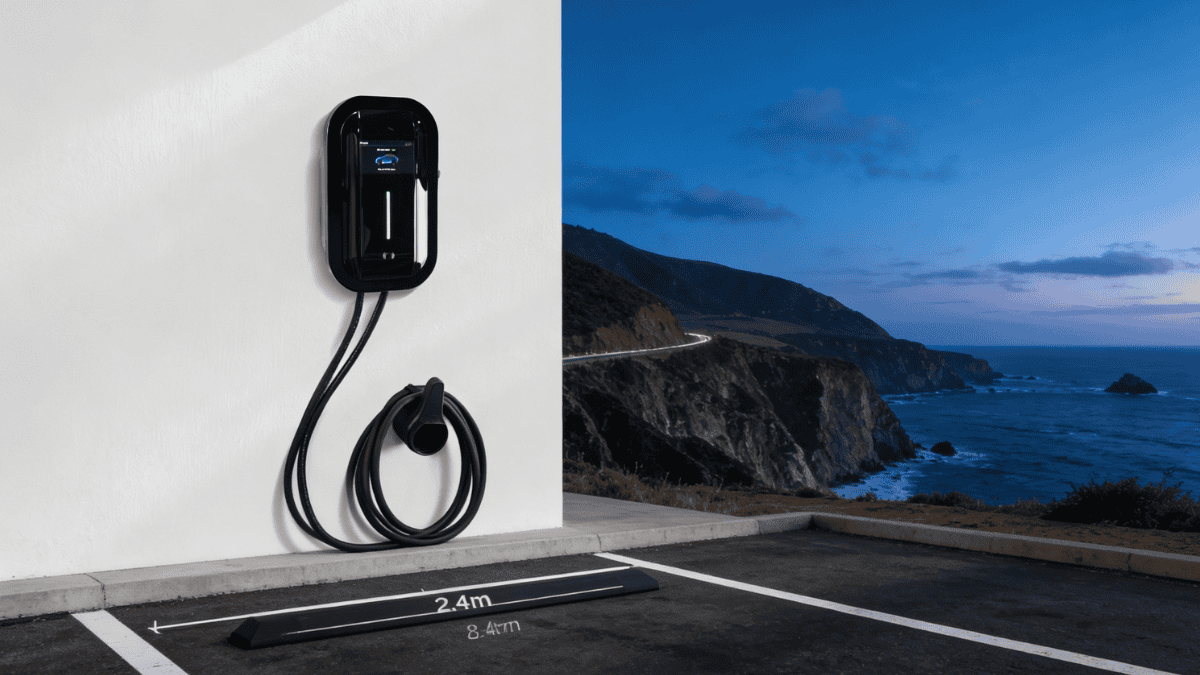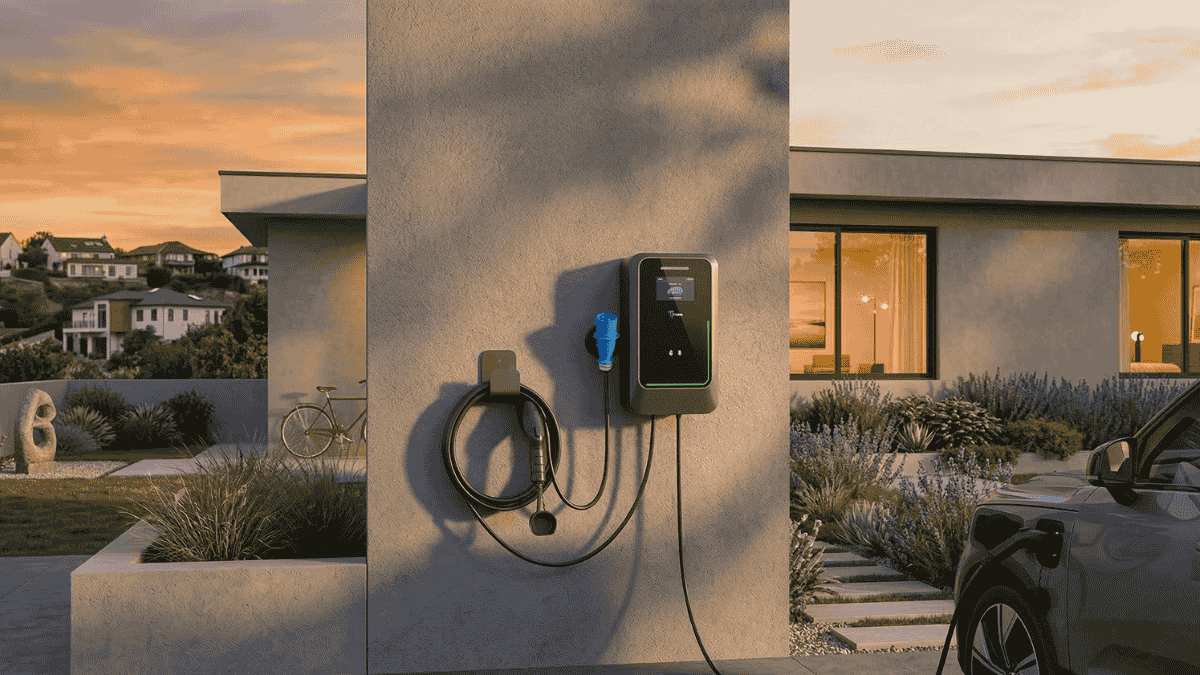
The best scalable EV charging infrastructure for fleets is designed around one reality: fleet charging is a systems problem, not a single hardware purchase. Scalability comes from matching charger types to duty cycles (AC for long dwell, DC for fast turnaround), using إدارة الأحمال to avoid expensive electrical upgrades, and running operations on a platform that can monitor uptime, manage access, and evolve as the fleet grows.
This guide is global. Electrical codes, tariffs, and billing rules differ by region. Use the architecture and planning steps here, then validate with local engineering and utility requirements.
- Start with fleet needs: duty cycle drives everything
- A scalable fleet charging architecture (3 layers)
- AC vs DC for fleets: what scales best, where
- Load management: scaling without stranded capex
- Operations: uptime, access control, and driver experience
- Phased deployment plan (pilot → expand → standardize)
- Where TPSON fits (AC portfolio + compact portable DC)
- FAQ (7 questions)
- Sources & references
“Scalable” means the site still works at 2× or 5× fleet size without constant rebuilds. That starts by translating fleet operations into charging needs: how long vehicles park, how many return at the same time, and how quickly they must be ready again.
Long dwell fleets
AC-first
Overnight depot parking or long layovers: prioritize more Level 2 ports.
High-turn fleets
Add DC strategically
Short shifts / quick turnaround: DC becomes a throughput tool.
Distributed fleets
Standardize + monitor
Multiple depots need consistent hardware + software + service model.
Scalability rule: design for the “worst 60 minutes” (peak arrivals) and the “best 8 hours” (overnight window). If those two periods are covered, the rest is usually manageable with smart scheduling and load controls.
The most resilient fleet charging programs separate concerns into three layers:
| Layer | What it includes | Why it matters for scaling |
|---|---|---|
| 1) Electrical capacity | Utility service, transformer, switchgear, panels, cabling | Capacity is slow/expensive to change—design for growth early |
| 2) Charging hardware | AC ports, DC fast units, cable management, safety protections | Hardware determines how many vehicles you can serve per hour/night |
| 3) Software & operations | Monitoring, diagnostics, access control, pricing (if needed), reporting | Without ops tooling, utilization drops and downtime rises as you expand |
ChargePoint explicitly positions its offer as an EV charging platform that mixes hardware with software, supports ChargePoint stations, partner stations, or any OCPP-compliant hardware, and emphasizes proactive tools to improve uptime and operational efficiency. For fleets, that platform layer is a major scaling lever because it turns “more sites” into “repeatable deployments.” (Source: ChargePoint)
Fleets often overspend by defaulting to DC everywhere. In reality, AC scales by port count and is ideal when vehicles can sit. DC scales by throughput and is justified when time is money.
| Fleet scenario | Recommended base | When to add DC |
|---|---|---|
| Overnight depot (delivery, municipal) | Level 2 AC (many ports) | Add DC only for exceptions (late return / urgent redeploy) |
| Mixed-use yard (service + ops) | Level 2 AC + managed power | Add compact DC for vehicle prep / short dwell blocks |
| Corridor operations / roadside support | DC-heavy | Use AC as a complement, not a primary |
Love’s provides a real-world example of portfolio thinking on a travel-stop network: it says it is adding more DC fast chargers (Level 3) to complement its current AC charging (Level 2) network to meet a variety of vehicles and charging needs. That same “AC + DC mix” logic applies to fleets—just with different dwell time patterns than retail travel stops. (Source: Love’s EV Charging)
Electrical upgrades are a common scaling bottleneck. That’s why a scalable design emphasizes controlled power allocation: spread available capacity across more ports, schedule charging, and prevent site peaks.
TPSON’s EV charger overview highlights “versatile AC chargers with innovative موازنة التحميل الديناميكي” to protect an electrical system, and positions compact, powerful DC fast chargers for commercial and emergency applications with flexible power options and robust connectivity. (Source: TPSON EV Chargers)
- More vehicles per transformer: allocate power dynamically instead of provisioning for every port at max output simultaneously.
- Better capex timing: delay utility upgrades until utilization proves they’re necessary.
- Operational stability: keep the depot from “tripping itself” when vehicles return in waves.
Once a fleet has more than a handful of chargers, the limiting factor becomes operations: uptime, fault response, and whether drivers can actually complete sessions reliably. ChargePoint emphasizes increasing station uptime, proactive management tools, and a consistent driver experience through a top-rated app and integrations (Apple CarPlay, Android Auto, in-dash infotainment). For fleets, “driver experience” includes dispatch confidence: vehicles must be ready when scheduled. (Source: ChargePoint)
The broader market also reflects how commercial charging commonly bundles networking, access control, and management. Smart Charge America’s catalog describes multiple commercial units with features such as OCPP support, RFID access control, web-portal monitoring, and integrated payment terminals (for public/commercial contexts). Even if a fleet doesn’t monetize charging, the same tooling patterns matter for controlling access and getting actionable reporting. (Source: Smart Charge America catalog)
The safest way to scale is to build in phases with measurable gates. This reduces the risk of “wrong power, wrong port count, wrong policy.”
| المرحلة | What you install | What you measure | Scale decision |
|---|---|---|---|
| المرحلة 1 Pilot depot | AC-first (several ports) + basic monitoring | Peak arrivals, kWh/vehicle/day, failure rate, congestion | Add ports if congestion occurs; add DC if turnaround demands it |
| المرحلة 2 Expand capacity | More AC ports + load management tuning | Peak demand (kW), utilization by time block | Upgrade electrical only if managed capacity is consistently saturated |
| المرحلة 3 Standardize multi-site | Repeatable hardware + platform + service model | Uptime SLA, MTTR, operating cost per vehicle | Roll out to additional depots with proven bill of materials |
TPSON positions itself as an EV chargers manufacturer founded in 2015 in Hangzhou, shaping smart energy solutions with a “Current Fingerprint Algorithm,” using edge computing and a patented algorithm to develop AI-driven smart electrical systems and vehicle chargers. (Source: TPSON About)
For fleets, TPSON’s published product structure supports two key building blocks:
- شواحن التيار المتردد الكهربائية (TW?10, TW?20, TW?30, TW?40 Dual Gun): a portfolio suited to depot and workplace-style dwell patterns where scaling means adding more ports.
- شواحن التيار المستمر للمركبات الكهربائية in a compact mobile format: the TP?DC Compact Series uses 20/30/40kW intelligent charging modules with wheel mobility, DC50–1000V output range, a 7-inch touch screen, and Ethernet/optional 4G. It is explicitly positioned for emergency roadside assistance, dynamic fleet/logistics management, temporary events, and dealerships/service centers.
For TPSON’s overall EV charging lineup narrative—including Dynamic Load Balancing and “future-proof” infrastructure claims—see: شواحن السيارات الكهربائية.
Scalability means you can add vehicles and sites without constant redesign: right-sizing AC/DC mix for duty cycle, managing peak load, and using a platform to monitor uptime and operations across locations.
Most depots should start AC-first (more Level 2 ports), then add DC where operational turnaround requires it. DC everywhere is rarely cost-optimal unless dwell time is consistently short.
Use load management and phased expansion. TPSON’s EV charger overview explicitly highlights AC chargers with Dynamic Load Balancing to protect an electrical system while enabling flexible deployment. (Source: TPSON EV Chargers)
When flexibility is valuable: moving the charger around a depot, supporting roadside assistance, temporary locations, or topping up vehicles at service centers. TPSON positions its TP?DC Compact Series for these exact scenarios and lists 20/30/40kW configurations with wheel mobility. (Source: TPSON Portable DC EV Charger)
Once you operate multiple chargers or sites, monitoring and uptime management become essential. ChargePoint emphasizes a unified software platform plus services that help manage and monitor operations and improve uptime, and supports operating ChargePoint stations or OCPP-compliant hardware. (Source: ChargePoint)
Corridor networks illustrate the AC/DC mix principle at scale. Love’s states it’s adding more DC fast chargers to complement its AC Level 2 network to meet varied needs—fleets can apply the same thinking internally (AC baseline + DC for throughput). (Source: Love’s)
Peak arrival clustering (how many vehicles return within the same hour). That single metric often determines whether you need more AC ports, better scheduling, or a DC throughput lane.
- TPSON About (company positioning, founded 2015, Hangzhou, Current Fingerprint Algorithm): https://tpsonpower.com/about/
- TPSON EV Chargers overview (Dynamic Load Balancing mention; AC + compact DC narrative): https://tpsonpower.com/ev-chargers/
- TPSON AC EV Chargers list (TW series): https://tpsonpower.com/ac-ev-chargers/
- TPSON Portable DC EV Charger (TP?DC 20/30/40kW; DC50–1000V; wheel mobility; Ethernet/optional 4G; applicable scenes): https://tpsonpower.com/portable-dc-ev-charger/
- ChargePoint (platform approach; OCPP hardware support; uptime and driver experience framing; fleet focus): https://www.chargepoint.com/
- Love’s EV Charging (AC/DC mix for travel stops; network scale): https://www.loves.com/ev-charging
- Smart Charge America catalog (examples of commercial stations and common features like OCPP, RFID, web portal, payment terminals): https://smartchargeamerica.com/electric-car-chargers/
- Emporia Classic EV Charger (home L2 benchmarking: 48A hardwire vs 40A plug; scheduling app; UL/GFCI notes): https://shop.emporiaenergy.com/products/emporia-ev-charger
- Car and Driver testing roundup (home charging economics; load balancing narrative via Emporia Pro): https://www.caranddriver.com/shopping-advice/a39917614/best-home-ev-chargers-tested/
Internal links used in-body (as required): شواحن السيارات الكهربائية · مصنعة لوحدات شحن المركبات الكهربائية · شواحن التيار المتردد الكهربائية · شواحن التيار المستمر للمركبات الكهربائية